Tuesday, June 27, 2023

CRRC’s 9th Annual Conference: New Frontiers: The South Caucasus Amidst New Challenges

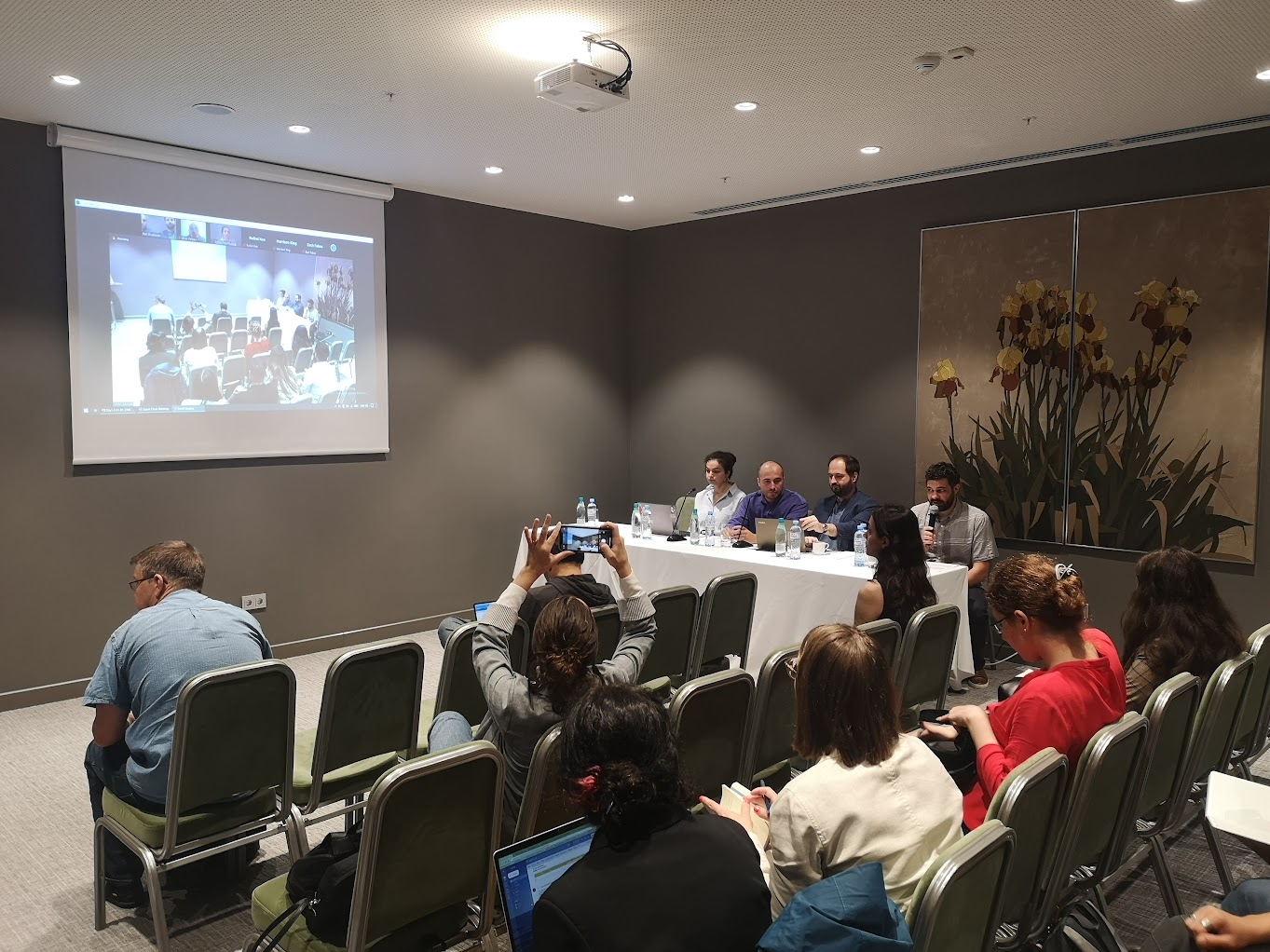
On June 22 and 23, the Caucasus Research Resource Centers in Armenia, Azerbaijan, and Georgia hosted the 9th annual methods conference. This year the conference focused on the  Russian-Ukrainian and how it has altered the geopolitical, economic, and demographic state of the South Caucasus. 

The first day of the conference featured four panels, on issues ranging from values, mobilization, and activism in the South Caucasus to migration to and from the region. 

The first day also featured a round table on  Archival Access and Openness in the Caucasus and Eurasia, with speakers from Berkeley, Cambridge, and Princeton, among other universities. 

The second day of the conference featured two panels, with the first looking at new economic geographies of the region, and the second focused on intercommunal relations in the South Caucasus. 

The conference concluded with a methods workshop, focused on Empowering Research Subjects with Photovoice in the South Caucasus.

The full conference video will be available from CRRC Georgia’s YouTube Channel in the near future, here.

The conference abstract book is available here


Tuesday, June 20, 2023

What Do Non-Partisans Think of Politicians and Parties in Georgia?

Note: Note: This article first appeared on the Caucasus Data Blog, a joint effort of CRRC-Georgia and OC Media. This article was written by Zachary Fabos, an International Fellow at CRRC Georgia. The views presented in the article are the author’s alone and do not necessarily represent the views of CRRC Georgia, Caucasian House, or any related entity.


A CRRC analysis found that, of the plurality of Georgians who do not feel any party aligns with their views, most dislike Georgia’s leading political figures and parties.

Controversy over Georgia’s leading politicians’ actions and statements is commonplace. Prime Minister Irakli Gharibashvili’s recent statements on the war in Ukraine and the subsequent criticism surrounding it is just one recent example.

Typically, an individual’s reaction to such controversy is connected to their political views and party alignment. However, a plurality of Georgians either do not know which party their views align with or feel their views do not align with any party, according to CRRC Georgia’s January 2023 Omnibus survey. This segment of the Georgian public is critical of all political figures and parties they are surveyed on, regardless of a politician’s political affiliation.

Participants of CRRC Georgia’s Omnibus Survey were asked which party best aligned with their views. A plurality (47%) of Georgians either do not know or believe no party aligns with their views. A quarter (24%) indicated their views align with Georgian Dream, while 11% reported the United National Movement (UNM) did. 12% chose other parties, and the remaining 6% refused to answer.

As the plurality of respondents do not know, or feel no party aligns with their views, what do they think of some of the country’s leading political figures?

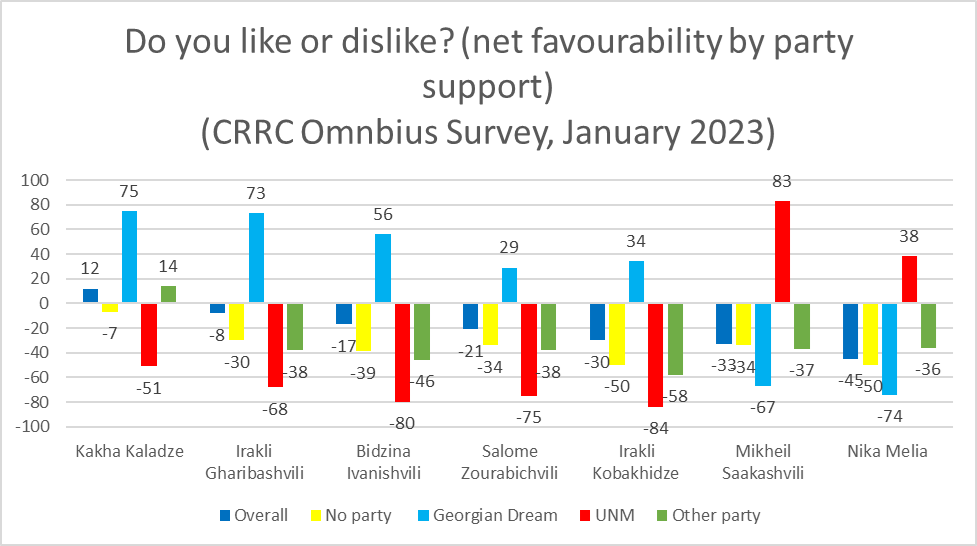
Respondents that indicated don’t know or no party aligns with their views disliked all the political figures they were asked about. However, this group was most critical of Georgian Dream party chairman Irakli Kobakhidze and former UNM chairman Nika Melia with a net favourability of -50% each, with 13% reporting they liked Kobakhidze, and 63% reporting they disliked him. The nonpartisans, and the public more generally, were least critical of Tbilisi Mayor Kakha Kaladze, with a net favourability of -7% amongst those who supported no party. The rest of the political figures in the survey fell somewhere between, all with negative net favourability among this group.


The degree to which these respondents’ criticism is nonpartisan is reinforced by data from those that indicated either the Georgian Dream party or UNM was closest to their views. Among these partisan respondents, likes and dislikes sharply align with partisanship.

Georgian Dream supporters greatly dislike political figures associated with the UNM, with former President Mikheil Saakashvili receiving -67% net favourability, and former party chairman Nika Melia -84% net favourability. Support for political figures associated with Georgian Dream is consistently positive. However, party chair Irakli Kobakhidze and President Salome Zourabichvili, an independent who was strongly supported in her election by Georgian Dream, received the lowest net favourability scores of the group with 34% and 29%, respectively.

Similarly, those indicating the UNM is closest to their views strongly supported opposition-aligned political figures, while being critical of those associated with Georgian Dream. Amongst this group, for example, Prime Minister Irakli Gharibashvili received a net favourability score of -68%. In contrast, UNM supporters have highly positive attitudes towards Saakashvili, who had a net favourability of 83%, the highest net favourability rating of any political figure in all groups regardless of party.

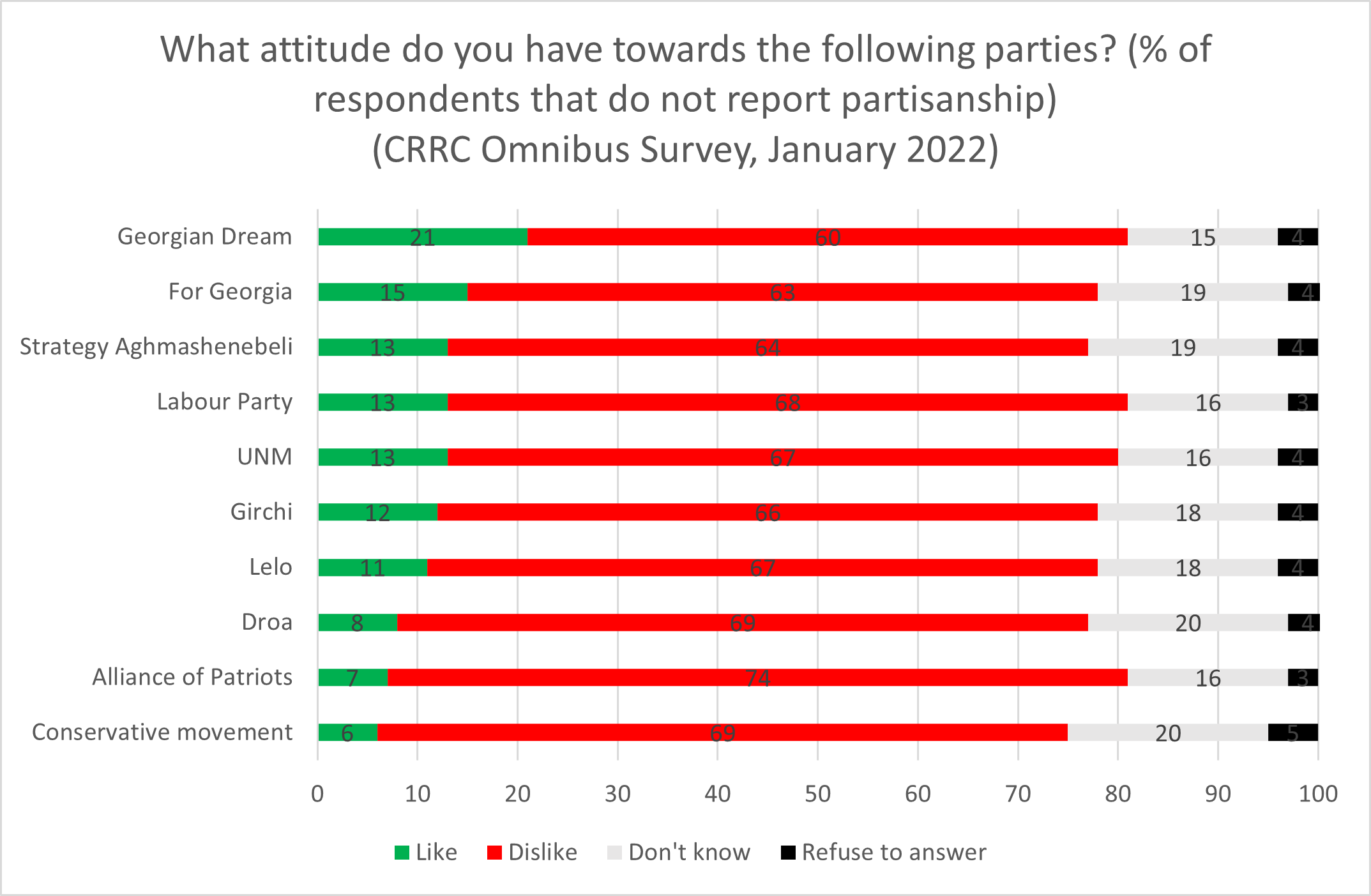
Opinions on the two leading parties among nonpartisans were largely critical, as 60% stated they disliked Georgian Dream while 67% disliked the UNM. Although the group was more likely to like the ruling party (21%) than the opposition (13%), positive perceptions of both parties were relatively uncommon.

This group was similarly critical of all other parties they were surveyed on, with all being disliked by a majority (at least 60%), or more of the group. The most liked of the third parties was former Prime Minister Giorgi Gakharia’s For Georgia, with 15% of those in the group of nonpartisans questioned indicating they liked the party. The least liked was the far-right Conservative Movement, at 6%.


Note: Response options to the question on the above chart included like a lot, like more than dislike, dislike more than like, and do not like at all in addition to don’t know, refuse to answer, and I have not heard of this party. The chart above merges responses of like a lot and like more than dislike as like. It also combines responses of dislike more than like and do not like at all into dislike.

The data shows that party allegiance, or lack thereof, is associated with Georgians’ opinions on political figures. As a plurality of those surveyed do not align themselves with any one party’s beliefs, many Georgians are left not sympathising with any party, and largely dislike most major political figures.

Tuesday, June 13, 2023

Do Georgians Feel Like They are Being Spied on by the Government?

 Note: This article first appeared on the Caucasus Data Blog, a joint effort of CRRC Georgia and OC Media. It was written by Dustin Gilbreath, a Senior Non-Resident Fellow at CRRC Georgia. The views presented in the article are of the author alone, and do not necessarily reflect the views of NDI, CRRC-Georgia, or any related entity.


Nearly half of the Georgian public think that they or their family members are under government surveillance at least some of the time.

Georgia has consistently had controversies around surveillance over the past two political administrations, as both the United National Movement and Georgian Dream governments have had extensive access to communications.

In September 2021, a massive cache of files allegedly belonging to the State Security Services (SSG) was leaked, causing a scandal in Georgia and stirring fears of mass surveillance among the public.

[Read more on OC Media: Datablog | Georgian public opinion on the SSG files]

Though Georgian Dream initially made some reforms in this area upon coming to power, recent legislative changes have largely rolled back on this progress. In light of the consistent scandals, it is perhaps unsurprising that nearly half the public thinks that they are being surveilled in one form or another, according to a recent survey CRRC-Georgia conducted for the Social Justice Center.

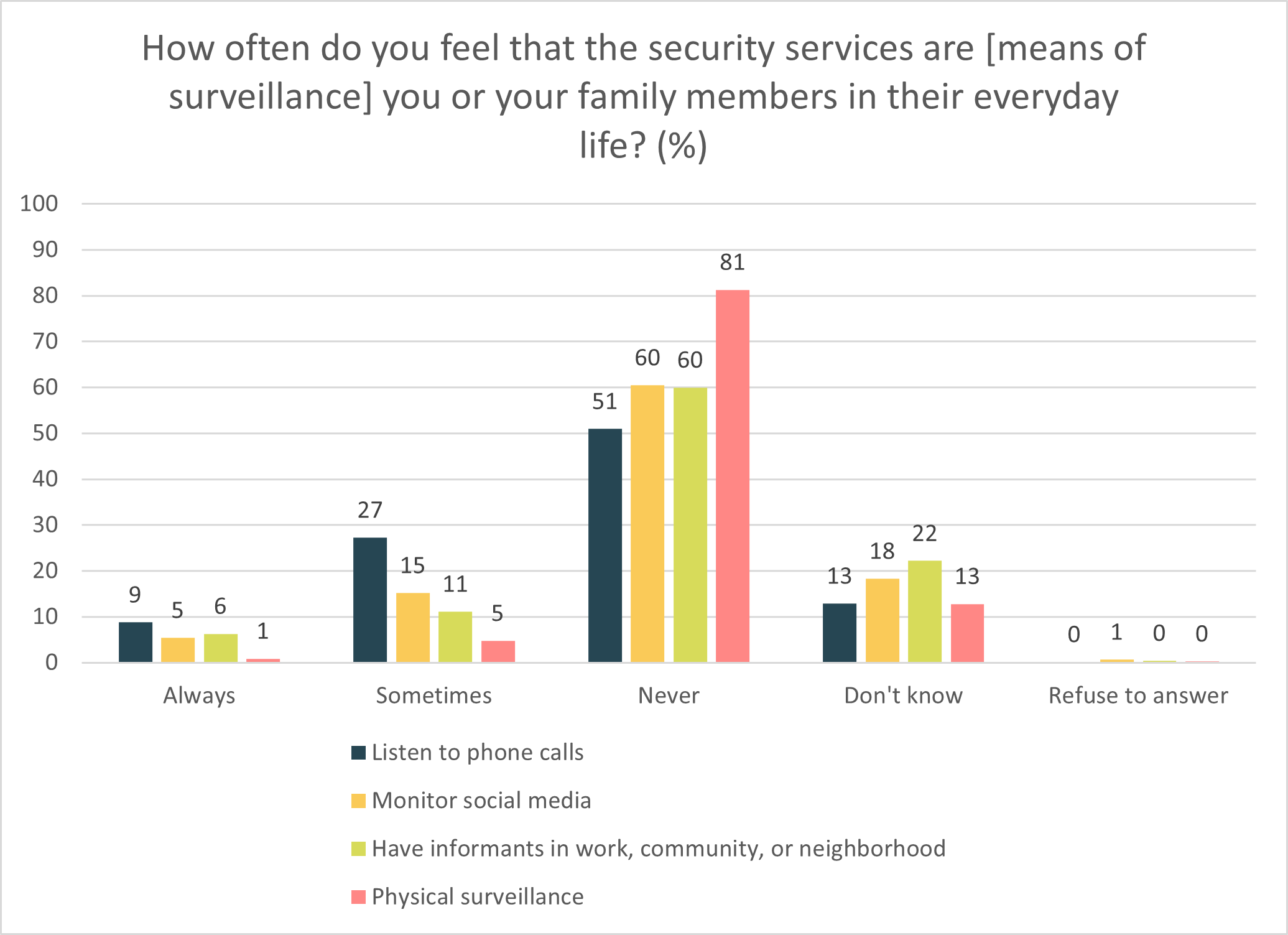
The survey asked respondents how much they felt that the SSG surveilled them or their family members in everyday life through the following means:

    Listening to their phone calls;
    Monitoring their social media activity;
    Informants in their neighbourhood, community, or workplace and;
    Physical surveillance.

The data suggest that the public is most likely to think that security services listen to their phone calls, with 36% reporting they believe this happens sometimes or always.

Social media monitoring was the second-most common form of surveillance people believed to be subject to, with one in five (20%) believing this happens sometimes or always. Approximately one in six (17%) believe that there are government informants at their workplace, in their community, or in their neighbourhood. Direct surveillance is believed to be least common among the public, with only 6% reporting they believe this happens to them sometimes or always.


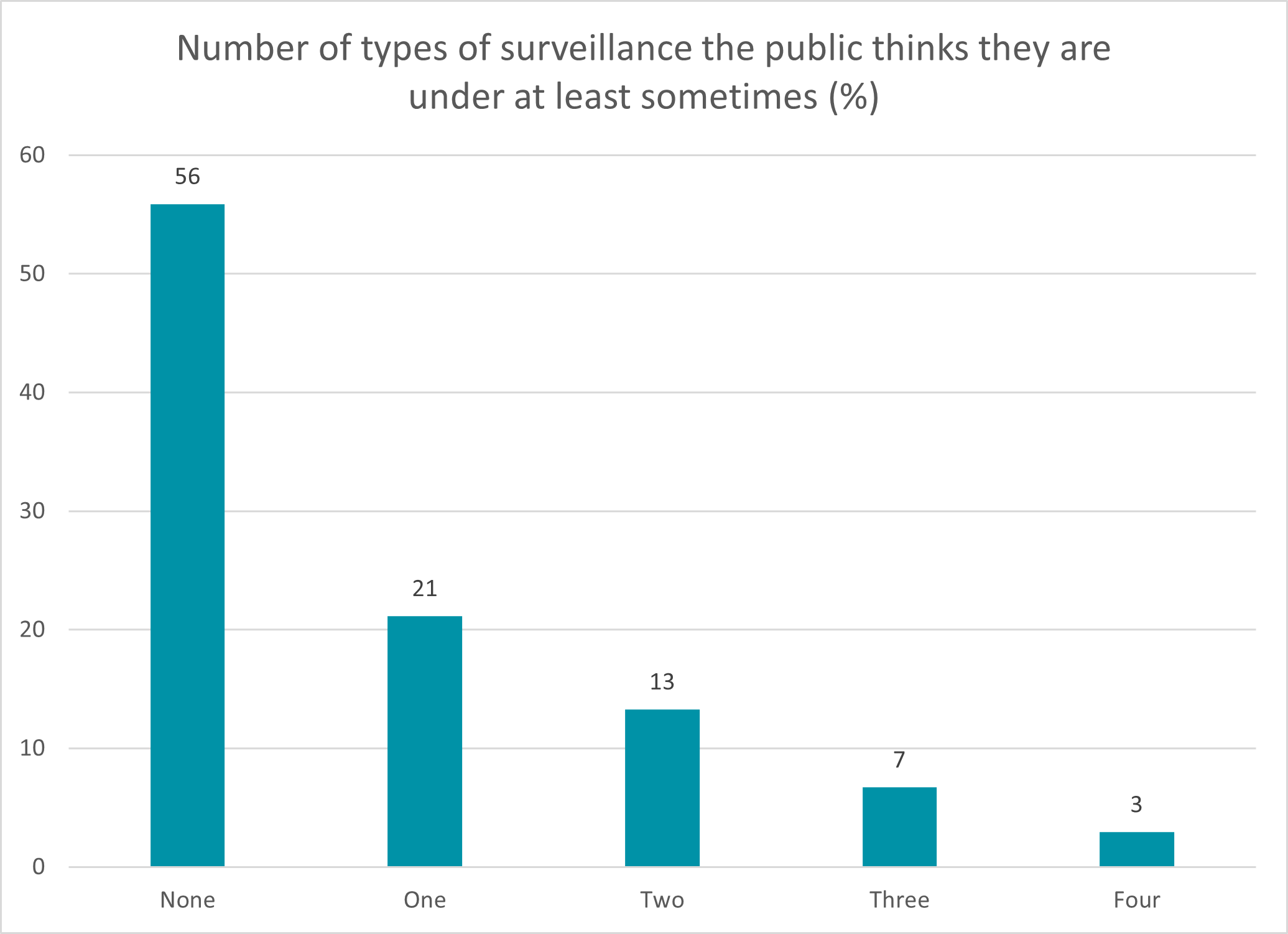
Overall, 44% of the public reported that they believe the government monitors them in one of the above manners. One in five (21%) named one means of surveillance on the survey, one in eight (13%) reported two means of surveillance while one in ten (10%) reported three or four means of surveillance.


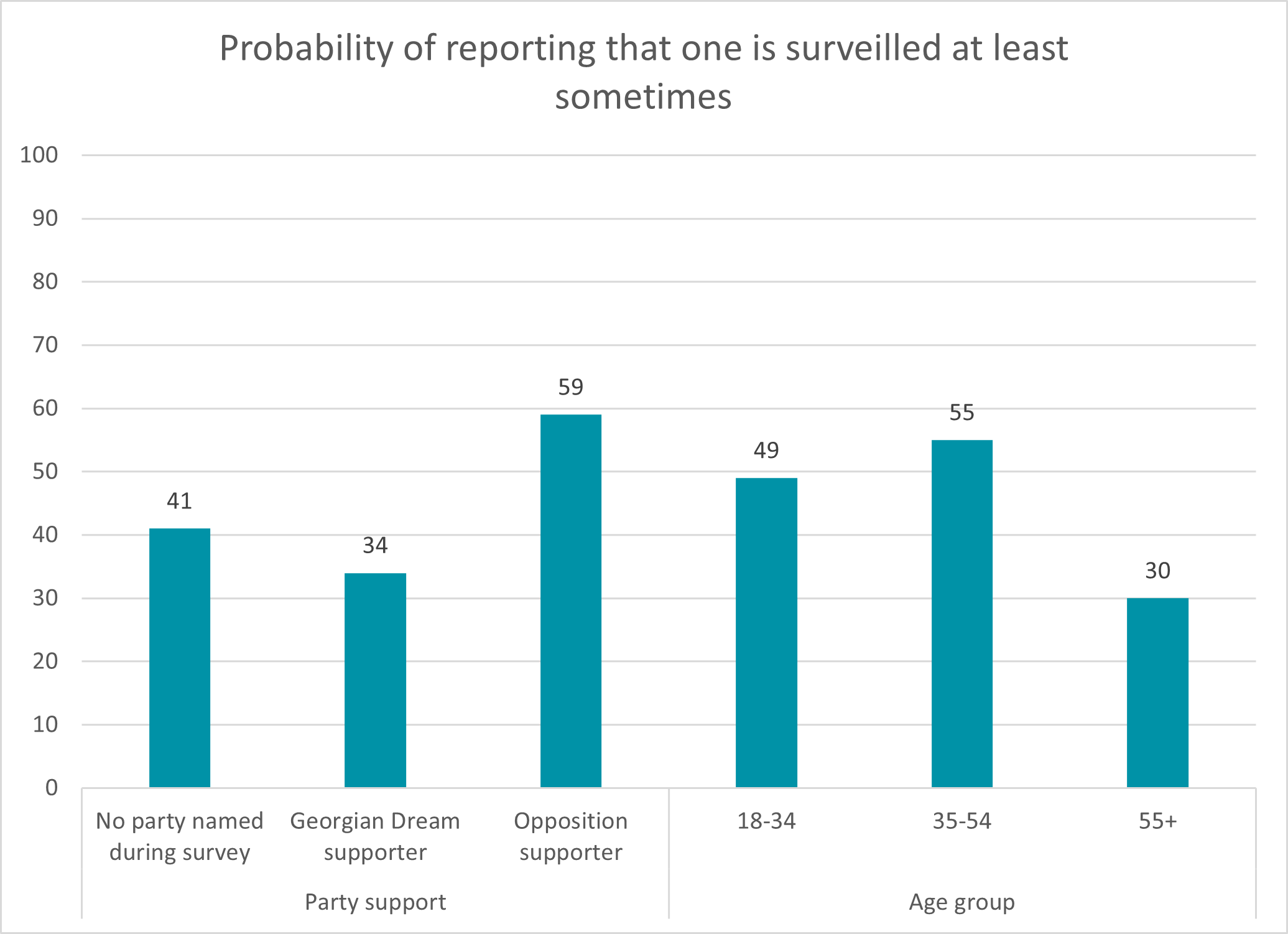
When the data is broken down by social and demographic variables, a number of patterns emerge: first, older people (55+) are significantly less likely to believe they are under surveillance than those between 18–34 or 35–54.

Second, people who support the opposition are 25 points more likely than Georgian Dream supporters to believe they are under surveillance at least sometimes. Similarly, nonpartisans are seven points more likely to believe that they are being surveilled than supporters of the ruling party.

A regression that included the above variables did not show any significant differences between men and women, ethnic minorities and ethnic Georgians, IDPs and non-IDPs, wealthier and poorer households, people in different types of settlement, those with differing levels of education, those working and not, and working the public and private sectors.


The above data suggests that nearly half the public thinks the government is surveilling them, with opposition supporters being particularly likely to believe the government is watching.

The data in this article is available here.

Tuesday, June 06, 2023

Georgians' Attitudes and Beliefs Associated with Polarised Media Preferences

Note: This article first appeared on the Caucasus Data Blog, a joint effort of CRRC-Georgia and OC Media. This article was written by Givi Siligadze, a Researcher at CRRC-Georgia. The views presented in the article are the authors’ alone, and do not necessarily reflect the views of CRRC Georgia, the National Endowment of Democracy, or any related entity.

A recent NDI/CRRC survey suggests that Georgians have markedly different beliefs about the present state and future of their country, regardless of their party sympathies, depending on whether the television channel they trust is pro-government or pro-opposition.

Georgian media is widely considered to be heavily polarised, with its focus ‘almost entirely on the party-political agenda’, according to one respondent in a recent DW Akademie study.

This polarisation may have reached the point of impeding the functionality of the media: a 2021 study found that Georgia’s main media outlets in Georgia had become so partisan that their ability to report in the broader public interest was undermined.

Research using data from a March 2023 NDI/CRRC survey found that people’s attitudes and perceptions of Georgia and its politics differed significantly depending on what TV channels they considered trustworthy, even when controlling for party preferences.

The data suggests that people who trust pro-government TV channels tend to be more optimistic about the country's direction, less concerned with political issues, more convinced that Georgia is a democracy, and more open to Georgia cooperating with Russia on political as well as economic issues than people who trust pro-opposition TV stations.

In Georgia, one in five people (19%) trust pro-government TV channels the most (Imedi or PosTV). Roughly every eighth Georgian (13%) puts their trust in pro-opposition TV channels (Mtavari, TV Pirveli, Formula, Kavkasia), and a similar proportion (12%) of the public trusts other TV stations (Rustavi 2, GPB, Adjara TV, Obiektivi, etc.). The remaining 57% of the electorate trust no TV channel or are uncertain about which station they trust most.

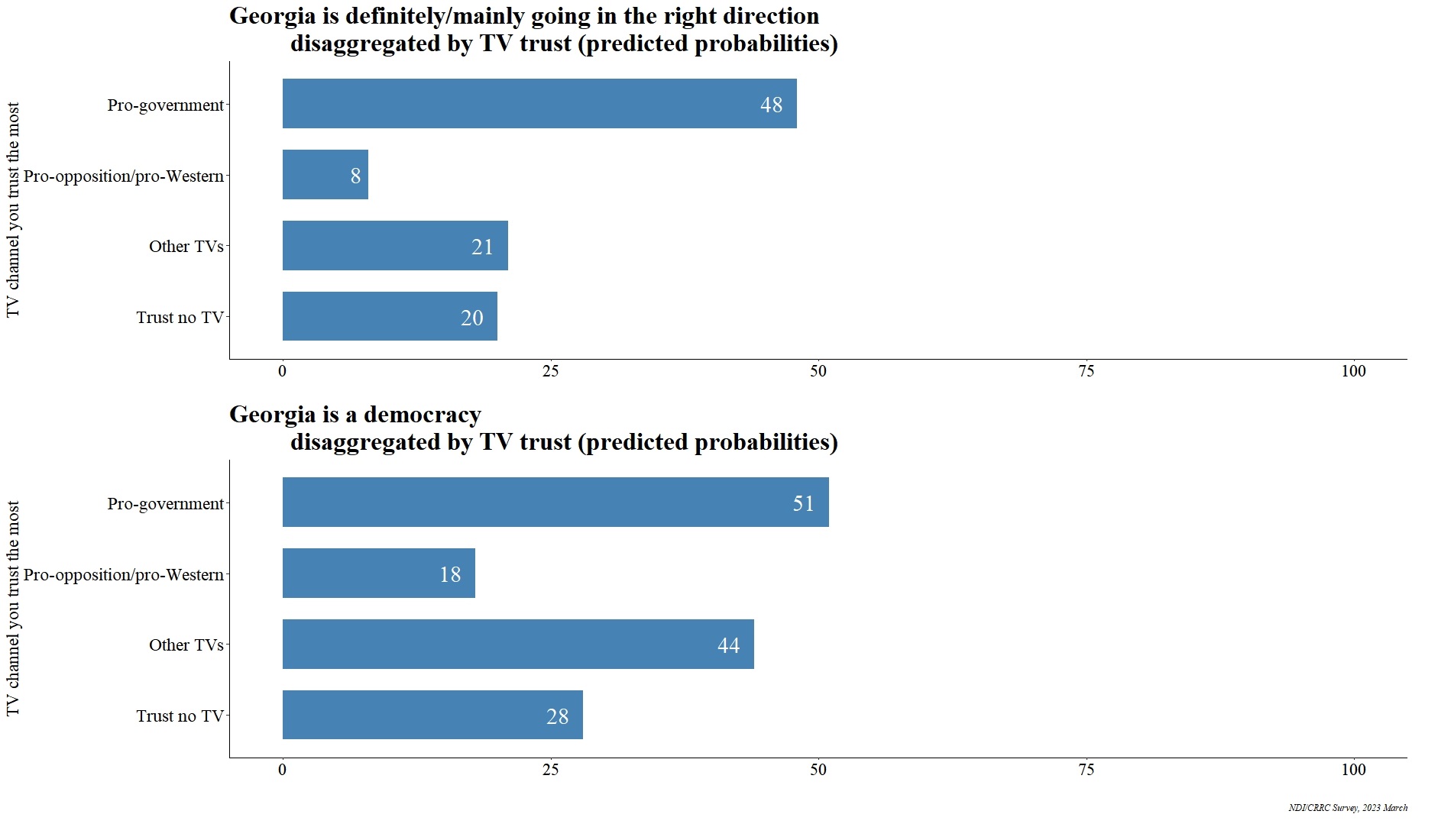
The data suggests that regardless of age, sex, settlement type, ethnicity, wealth, and partisan sympathy, people who trust pro-government TV channels tend to feel more positive about Georgia’s present and future, compared to people who trust other TV channels or do not trust TV at all.

All else being equal, Georgians whose most trusted TV channel is pro-government are 40 percentage points more likely than people who trust pro-opposition TV channels to think that the country is going in the right direction, and 33 percentage points more likely to say that Georgia is a democracy today, than people who trust pro-opposition channels.


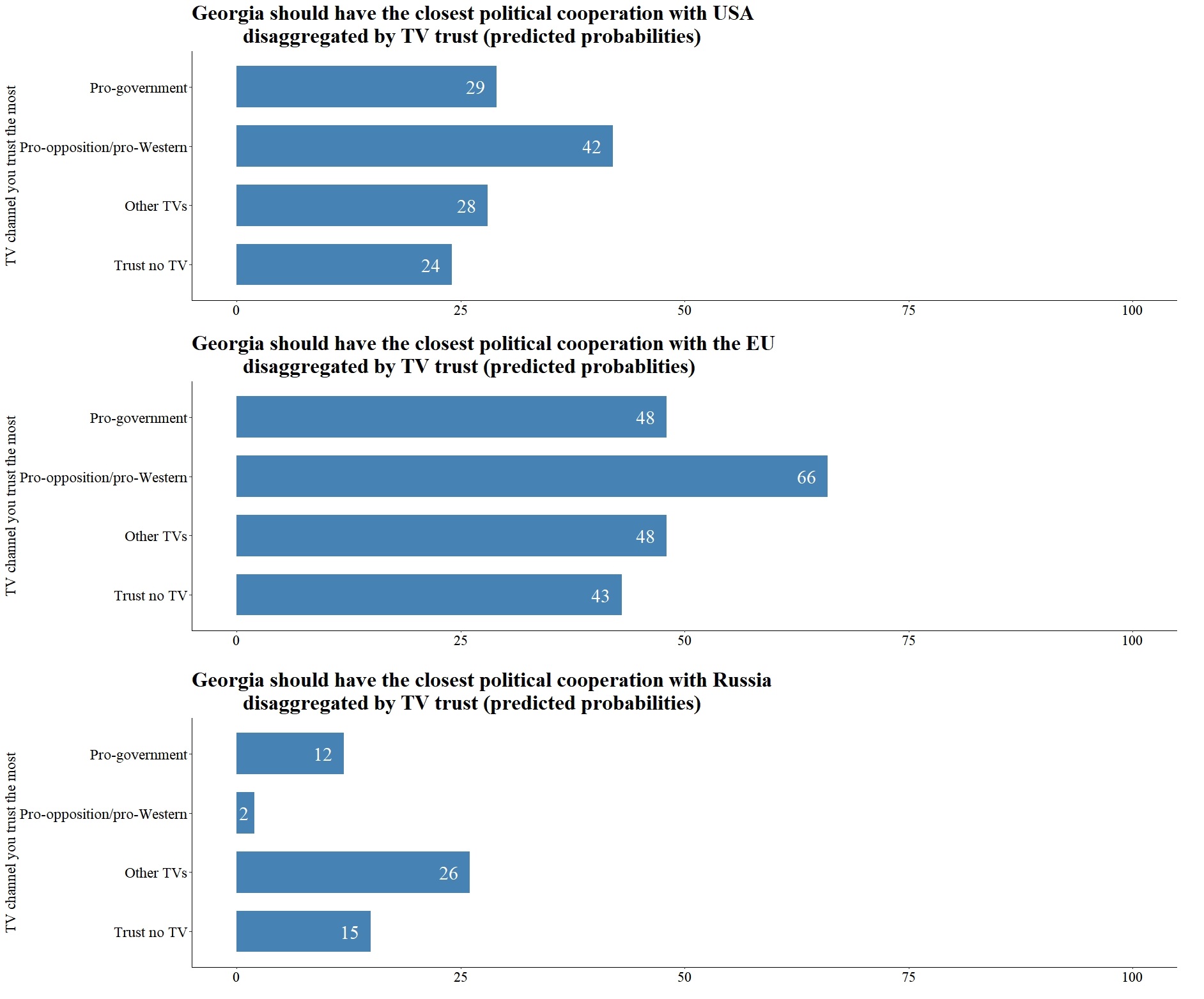
Regarding which countries or international organisations Georgia should have the closest political cooperation with, people who trust pro-opposition TV stations differ from other segments of the electorate.

A regression analysis suggests that people who trust pro-opposition TV channels tend to be more pro-Western and anti-Russian than people who trust pro-government media, other TV channels, or do not trust TV at all.

People who trust pro-opposition TV channels are 13 percentage points more likely to think that Georgia should politically cooperate most closely with the USA, and 18 percentage points more likely to think that the EU should be Georgia’s closest political ally, than Georgians who trust pro-government media.

Moreover, they are 10 percentage points less likely to say that Georgia should have its closest political ties to Russia.


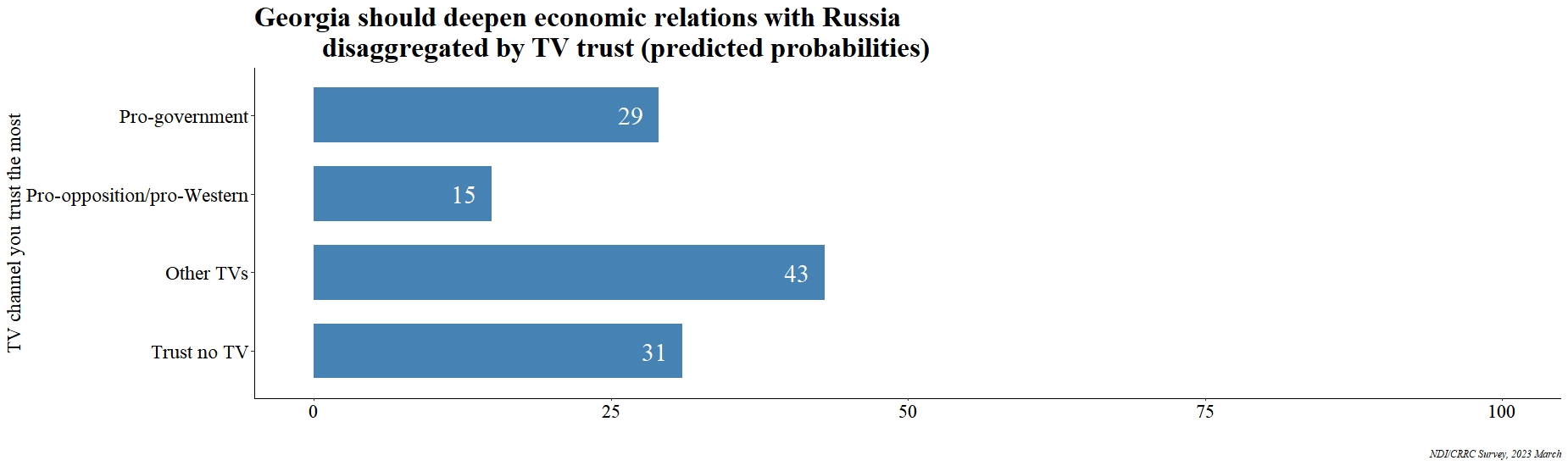
The patterns are similar for opinions on Georgia’s economic partnerships. The data suggests that after controlling for age, sex, settlement type, ethnicity, wealth, and partisan sympathy, people who trust pro-government TV channels are twice as likely to support deepening economic relations with Russia than people who trust pro-opposition TV stations.


Similar patterns emerge regarding what issues people consider to be priorities in Georgia.

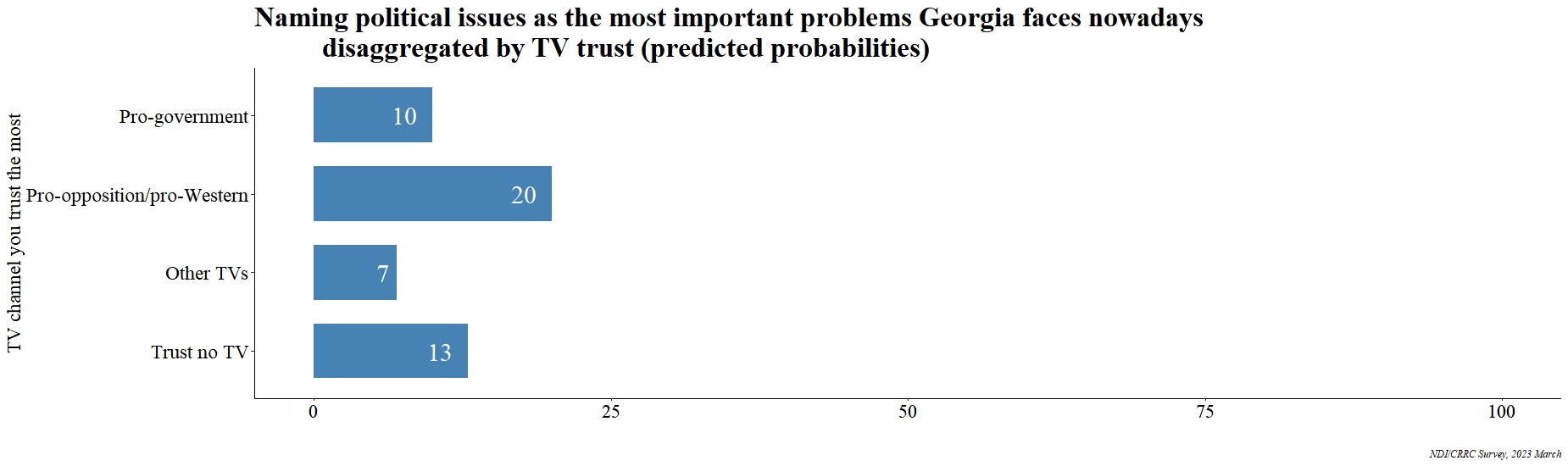
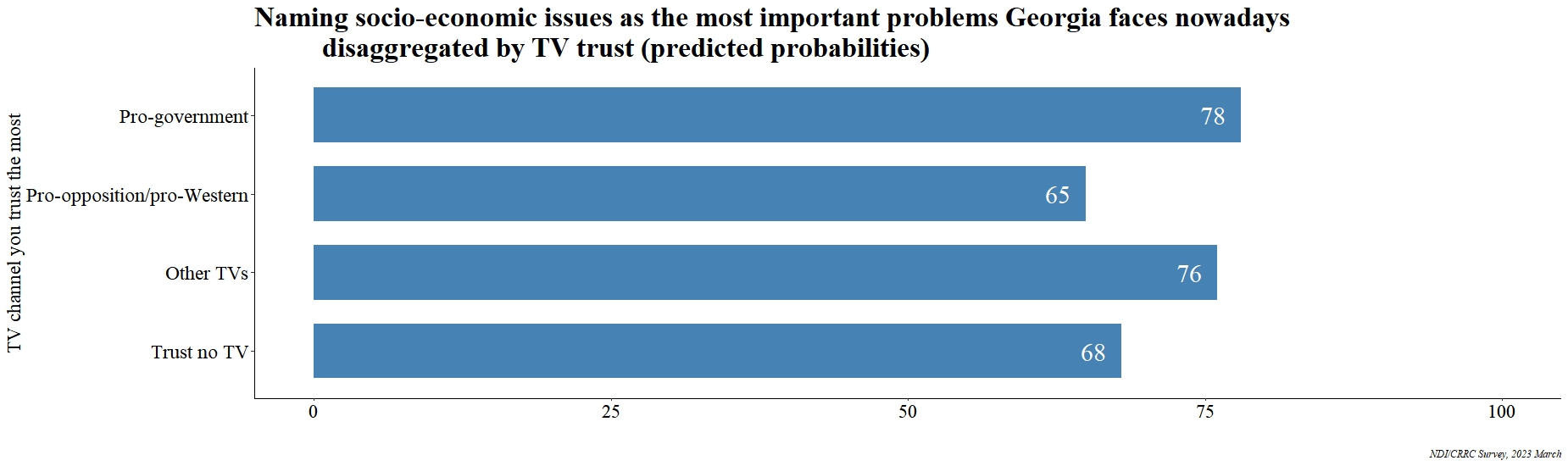
All else being equal, people who trust pro-opposition TV channels are more likely to name political issues (free and fair elections, court systems, freedom of speech, media independence) and less likely to name socio-economic issues (rising prices, wages, pensions, jobs, poverty) as the most important problems that Georgia faces today than people who trust other TV channels (pro-government and non-affiliated media).

Georgians that trust pro-opposition TV channels are 10 percentage points more likely than people who trust pro-government media and 13 percentage points more likely than people who trust other TV channels to name political issues as the most pressing problems that the country is facing.
Georgians
 
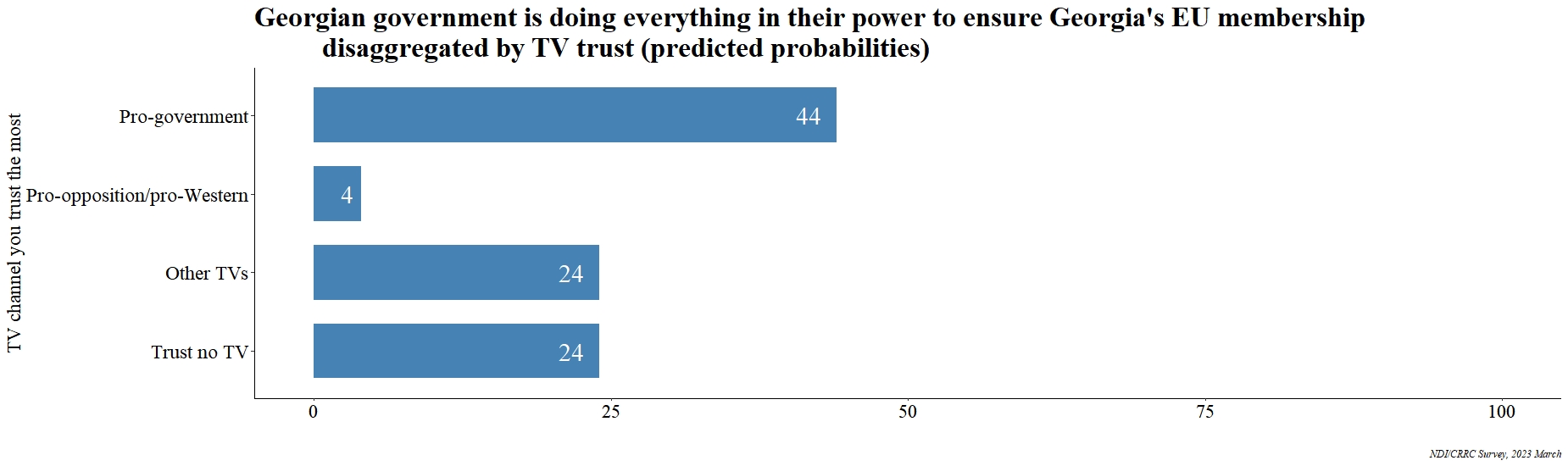
Georgians who trust pro-government media tend to assess the government's performance positively, both broadly, and more specifically in terms of Georgia’s efforts at integrating into the European Union, while people who trust other TV channels or trust no TV at all tend to be more critical.

After controlling for other factors, people who trust pro-government media are 40 percentage points more likely than people who trust pro-opposition media to report that the government is doing everything in its power to ensure Georgia’s EU membership. Similarly, they are 20 percentage points more likely to say the same in comparison to people who trust other media or no media at all.


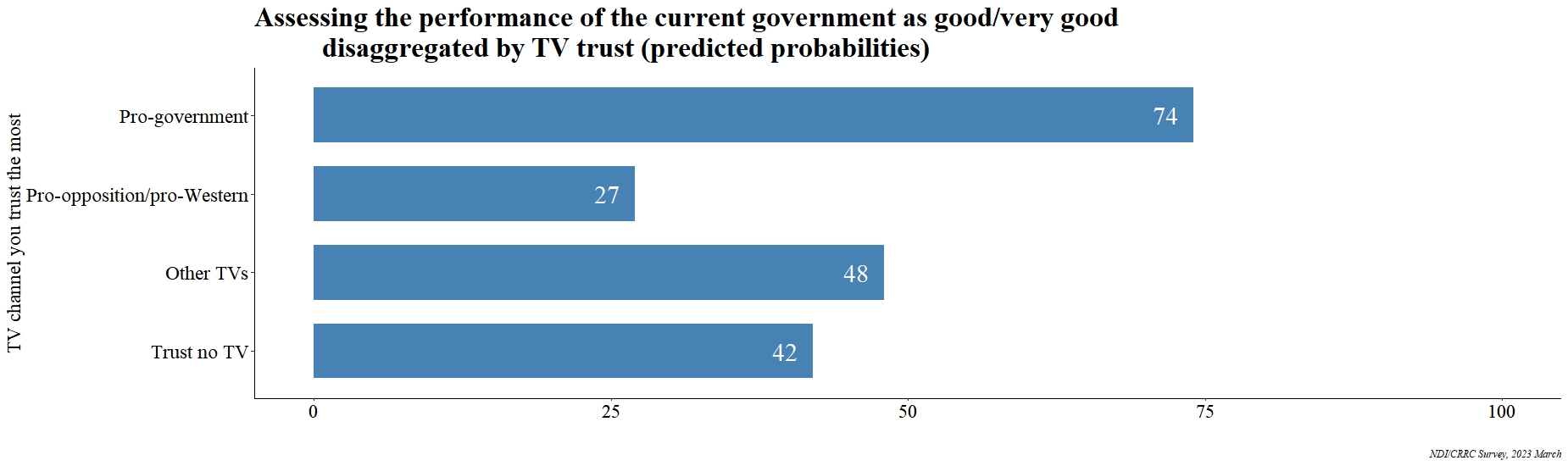
All else being equal, people who trust pro-government TV channels have a 74% chance of assessing the current government’s performance positively, versus 27% for those who trust pro-opposition media. As with other issues, people who trust non-partisan TV channels and people who do not trust any TV channel at all are somewhere in between.


The above analysis is correlational rather than causal, so cannot identify causal effects of trusting or viewing partisan TV channels. However, it is evident that people who trust explicitly pro-government and pro-opposition TV channels view things differently. This association between trust in TV channels and public attitudes holds true even after controlling for partisan identification, suggesting that TV might play an important and independent role in shaping politically polarised segments of Georgian society.

Note: The above data analysis is based on logistic and multinomial regression models which included the following variables: age group (18-35, 35-55, 55+), sex (male or female), education (completed secondary/lower or incomplete higher education/higher), settlement type (capital, urban, rural), wealth (an additive index of ownership of 10 different items, a proxy variable), party identification (Georgian Dream, Opposition, Not affiliated) and ethnicity (ethnic Georgian or ethnic minority).


The data used in this article is available here.
Tuesday, May 30, 2023

Is Georgia's Gen Z More Politically Engaged Than Young Millennials?

Note: This article first appeared on the Caucasus Data Blog, a joint effort of CRRC-Georgia and OC Media. It was written by Zachary Fabos, an International Fellow at CRRC-Georgia. The views presented in the article are the author’s alone and do not necessarily represent the views of CRRC-Georgia, Caucasian House, or any related entity.


Public discourse in Georgia has in recent months raised the idea that Georgia’s young people, and particularly Gen Z, are politically interested and active, particularly following the March foreign agent protests. CRRC data suggests that a majority of 18-29-year-old Georgians are politically engaged, although the older age bracket are somewhat more interested.

In the conversation around Georgia’s foreign agent law protests, which took place in March, Gen Z — people born between the late 1990s and early 2000s — have featured heavily. Many of the protests’ most striking moments were attributed to those recently having reached voting age, as was some of their creativity and momentum.

The legislation in question found itself between contesting visions of Georgia’s political future, with protestors suggesting it would ruin Georgia’s hopes of Western integration, and Georgian Dream arguing that the law was necessary for transparency.

But prior to their engagement in the protests, what were Gen Z’s attitudes towards politics and how did they choose to participate? Data from CRRC-Georgia and Caucasian House’s 2021 Survey on Youth Civic and Political Engagement and Participation in Peacebuilding suggests that both Georgia’s Gen Z and millennials are interested in and engaged with the country’s politics, though Millennials are slightly more interested in politics.

For the purpose of this analysis, 18-25 year-olds are considered part of Gen Z, while the survey’s older participants, those aged 26-29, are referred to as millennials despite only covering the youngest of those born between the late 1980s and mid-late 1990s.

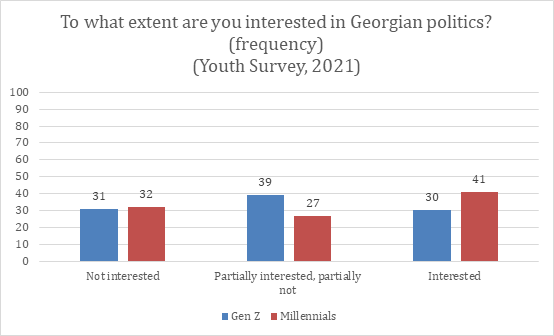
Data from the survey suggests a majority of both age groups are partially interested or interested in the country’s politics. However, more millennials were interested, with 41% reporting interest compared to 30% of Gen Z. By comparison, Gen Z was more likely to indicate partial interest, with 39% claiming to be somewhat interested and somewhat not and 27% of millennials stating the same.


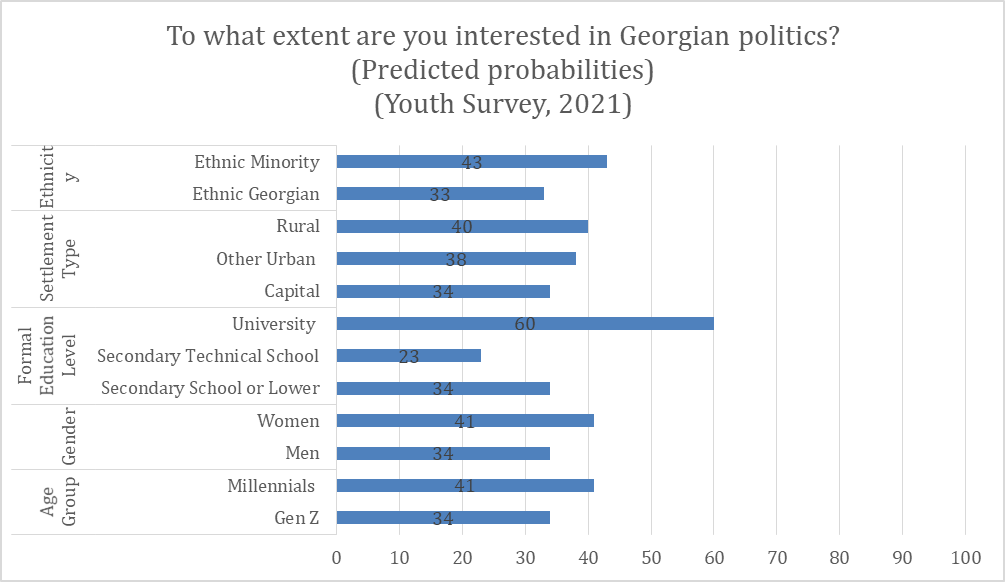
When the data is broken down by social and demographic groups including gender, ethnicity, settlement type, and education level, a number of patterns emerge.

In terms of settlement type, young people in rural areas are six points more likely to be interested in politics than people in Tbilisi. People in urban areas other than Tbilisi are interested at a rate somewhere between the two.

When it comes to gender, women are seven points more likely to be interested in Georgian politics than men.

Finally, people with a higher education are twenty-six and thirty-seven points more likely to report they are interested in politics than people with secondary education or vocational education, respectively.

Note: Interest is coded as expressing at least partial interest.


Aside from general interest, the survey asked young people if they ever engaged in a range of political actions including membership in a political party, donating to a political party, participating in a political campaign, attending a meeting with a party member or candidate, taking part in a protest, or having voted in the 2020 parliamentary elections.

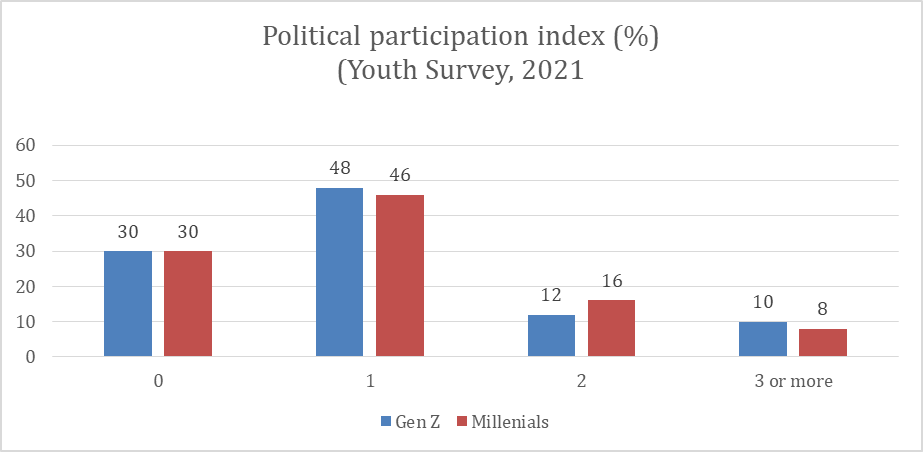
For the purpose of measuring engagement in politics among Gen Z and Millennials, the six activities were grouped together to create a political participation index, with six being all activities and zero being engagement in no activities. Overall, roughly half of respondents reported engaging in one activity, a third no activities, and the remainder two or more.


The survey data suggested that both generations engage in political activities at about the same rate, with a plurality having taken part in at least one action: 48% of Gen Z and 46% of millennials.

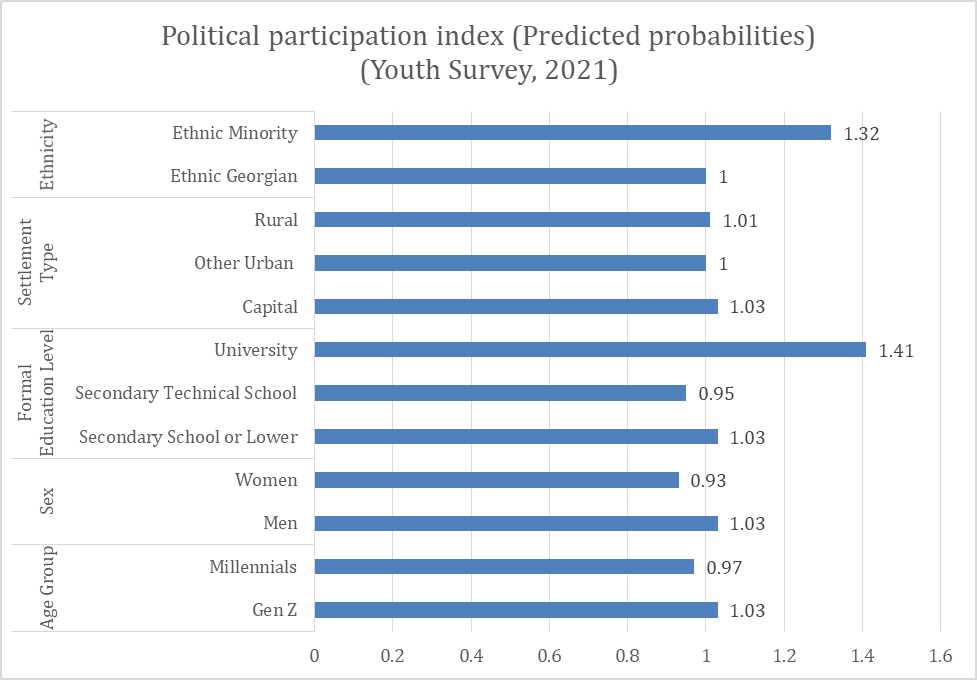
Breaking this down, education and ethnicity were the strongest predictors of how many political activities someone had taken part in.

Young people with a university education on average engaged in approximately one half of one activity more than those with other levels of education, controlling for other factors.

In contrast to perceptions in Georgia that ethnic minorities are politically unengaged, the data showed that ethnic minorities engaged in approximately one third more actions on average, controlling for other factors. While the data does not provide a clear explanation for this pattern, it may stem from the fact that this data focuses on young people, who may be more politically active than older people who are not ethnic Georgians. Alternatively, it could point towards an incorrect perception of ethnic minority political engagement more broadly.

Aside from one’s education level and ethnicity, the model demonstrated that other demographic factors were not associated with the types of civic engagement young people were engaged in.


Note: The chart above was generated from a regression model. The model includes ethnicity (ethnic Georgian, ethnic minority), settlement type (capital, other urban, rural), education (tertiary, secondary technical school, secondary school or lower), gender (female, male) and age group (18-25, 26-29).

The results of the youth survey suggest that among young people, interest in politics is slightly higher among millennials than among Gen Z. Within those groups, participation in political activities is more associated with education and ethnicity than most other factors. However, the data does confirm that Gen Z was interested in politics and as likely as millennials to have engaged in political activity prior to the protests against the foreign agent law in March.

Note: The analysis in this article makes use of logistic regression analysis. The analysis included gender (male, female), age group (18-25, 26-29), settlement type (capital, urban, rural), education (secondary or lower, secondary technical, tertiary), and ethnicity (ethnic Georgian, ethnic minority), as predictor variables. The data used in this article is available here.

Tuesday, May 23, 2023

What Makes People Feel Insecure in Georgia?

 Note: This article first appeared on the Caucasus Data Blog, a joint effort of CRRC Georgia and OC Media. It was written by Dustin Gilbreath, a Senior Non-Resident Fellow at CRRC Georgia. The views presented in the article are of the author alone, and do not necessarily reflect the views of NDI, CRRC-Georgia, or any related entity.


A CRRC analysis found that Georgians who feel insecure in Georgia mostly attribute this to economic insecurity, but also express concern about a wider array of harder security issues.

Georgia has faced numerous crises in recent years; from the pandemic, to the results of the war in Ukraine, via political controversy and uncertainty.

It is consequently perhaps unsurprising that almost half the public is uncertain about how they will fare economically in five years’ time. This is reflected in recent data, which shows that economic insecurity is the main reason why Georgians feel insecure in Georgia. However, a wide array of harder security issues also contribute to people feeling insecure in the country.

In the December 2022 NDI and CRRC Survey, the public was asked whether they felt insecure or secure living in Georgia. A third reported that they felt either very insecure living in Georgia (8%) or more insecure than secure (26%). By comparison, about half of the public reported that they were more secure than insecure (47%). One in five (19%) felt that they were very secure living in Georgia.

Why do people feel insecure?
Amongst those who felt insecure living in Georgia, economic issues were the main reasons given for their sense of insecurity.

The top three issues named were poverty, inflation, and unemployment, with between 34% and 39% of respondents naming one of these options.

Crime was identified as the main reason for feeling insecure by a third of relevant respondents, and political instability by one in five. Healthcare and the high price of drugs were named by 7% and 10% of relevant respondents, respectively. Harder security issues such as the war in Ukraine, and instability in the Caucasus were named by relatively few; 5% and 1%, respectively. 


Note: Because respondents could name up to three responses to this question, the data does not sum to 100%.

The above issues were grouped into economic, hard security, and social policy related issues. Economic issues included poverty, inflation, and unemployment. Crime, violence, political instability, territorial integrity, the war in Ukraine, actions by Russia towards Georgia, and instability in the Caucasus were grouped into hard security issues. All other options were grouped together into social policy issues.

While the most commonly cited issues are mainly economic, people’s concerns were multifaceted. The data found that 66% of those who felt insecure named at least one economic issue, 62% named at least one hard security issue, and 32% named one social policy issue, suggesting that similar shares of people are concerned about at least one economic issue and at least one hard security issue. 

WHO FEELS INSECURE?

Given the dominance of economic issues as a reason for feeling insecure, it is perhaps unsurprising that people living in poorer households are more likely to feel insecure, and cite economic issues more than people living in relatively well-off households.

A number of other patterns are also present.

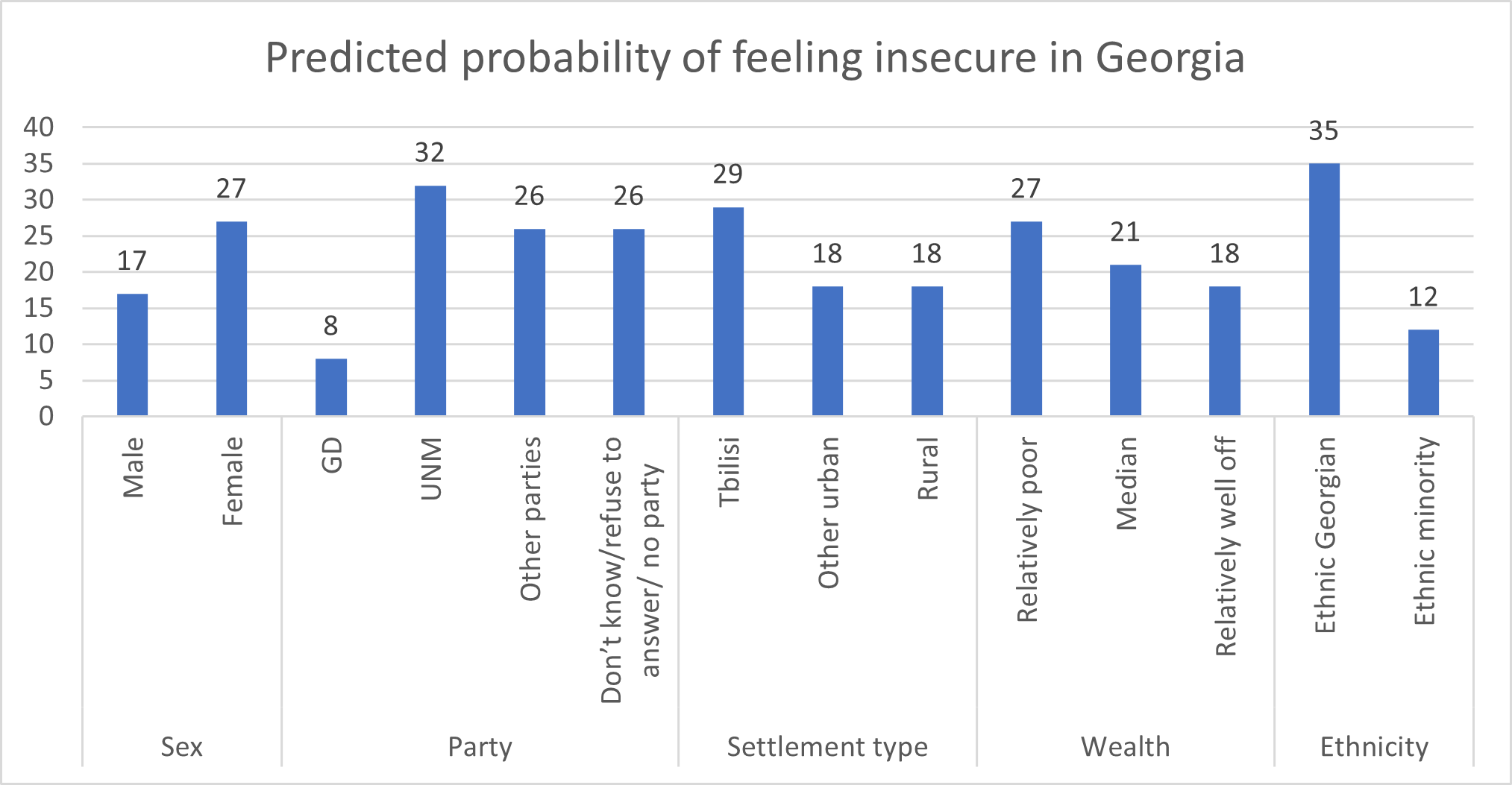
Women are ten points more likely to feel insecure in Georgia, controlling for other factors, than men. 

People in Tbilisi are 11 points more likely to feel insecure than people outside Tbilisi. 

Ethnic Georgians are 23 points more likely to feel insecure in Georgia than ethnic minorities.

Supporters of the United National Movement, Georgia’s main opposition party, are 24 points more likely to feel insecure in Georgia than supporters of the ruling Georgian Dream party. People who support other parties or report not supporting any party are 18 points more likely to feel insecure in Georgia than supporters of Georgian Dream.


The above data shows that a third of Georgians feel insecure in the country. While recent large-scale instability in Georgia has related more to hard security issues, such as the war in Ukraine, the data shows that economic insecurity remains the greatest concern for people who feel insecure in the country.

Note: The social and demographic breakdowns shown in the article above were generated from a regression analysis. The analysis had whether or not someone felt insecure as the dependent variable. The independent variables included age group (18-34, 35-54, 55+), sex (male or female), settlement type (Tbilisi, other urban, or rural), education level (secondary, vocational, tertiary), wealth (an index of durable goods owned by the respondents’ household), ethnicity (ethnic minority or ethnic Georgian), employment (working, unemployed, or outside the labor force), and party support (Georgian Dream, United National Movement, other opposition, refuse to answer/don’t know/no party). This article only reports on statistically significant differences between groups.

The data used in this article is available here.