Showing posts with label Migration. Show all posts

Tuesday, May 02, 2023

Who Wants To Leave Georgia?

Note: This article first appeared on the Caucasus Data Blog, a joint effort of CRRC Georgia and OC Media. This article was written by Elene Ergeshidze, a Researcher at CRRC-Georgia. The views expressed in the article are the author’s alone and do not reflect the views of CRRC Georgia or any related entity.

CRRC data suggests that every fifth person was considering leaving Georgia for work in 2023, with men, younger people, people with poorer economic standings, and supporters of the opposition reporting that emigration is a better option than staying in Georgia.

Emigration has become a hot topic in everyday discourse in Georgia; the media is rife with stories about people who have decided to leave their jobs and families in search of better opportunities in the West, with many migrants taking significant risks through illegal emigration to Mexico in search of the American Dream.

Data published by Mexico indicates that 9,468 Georgians crossed the border between 2021 and 2023. A recent report from Georgia’s National Statistics Office shows that 125,269 people emigrated from Georgia in 2022, the vast majority of whom were Georgians. This is a 25.3% increase compared to statistics from 2021.

Data from CRRC and NDI’s regular surveys suggests that a significant share of the public was considering migrating for work in 2023.

The survey, conducted in December 2022, showed that every fifth person in Georgia reported that it was very likely (3%) or likely (16%) that they will go abroad for work in the next 12 months.

The data show that a number of groups are more likely to be considering migrating for work than others.

Men are ten percentage points more likely to report they are willing to go abroad for work than women, controlling for other factors. 

People under 55 are substantially more likely to be interested in going abroad for work. While 18–34-year-olds are 24 percentage points more likely to report they are interested in going abroad in the next 12 months, 35–54-year-olds are 21 percentage points more likely to say they want to leave than people 55 and older.

After controlling for other factors, a quarter of the people in Tbilisi (27%) are considering emigrating abroad, compared with one in six residents of other urban (21%) and rural areas (16%).

Ethnic minorities were eight points more likely than ethnic Georgians to be interested in emigration.

Opposition supporters are ten percentage points more likely to be interested in migrating abroad for work than Georgian Dream supporters, controlling for other factors.

When it comes to economic factors, those who reported that their household either doesn’t have enough money for food or is only able to buy food but not clothes were more likely to report wanting to emigrate than those who are better off.

There was no statistically significant difference between employed and unemployed people in terms of migration interest.
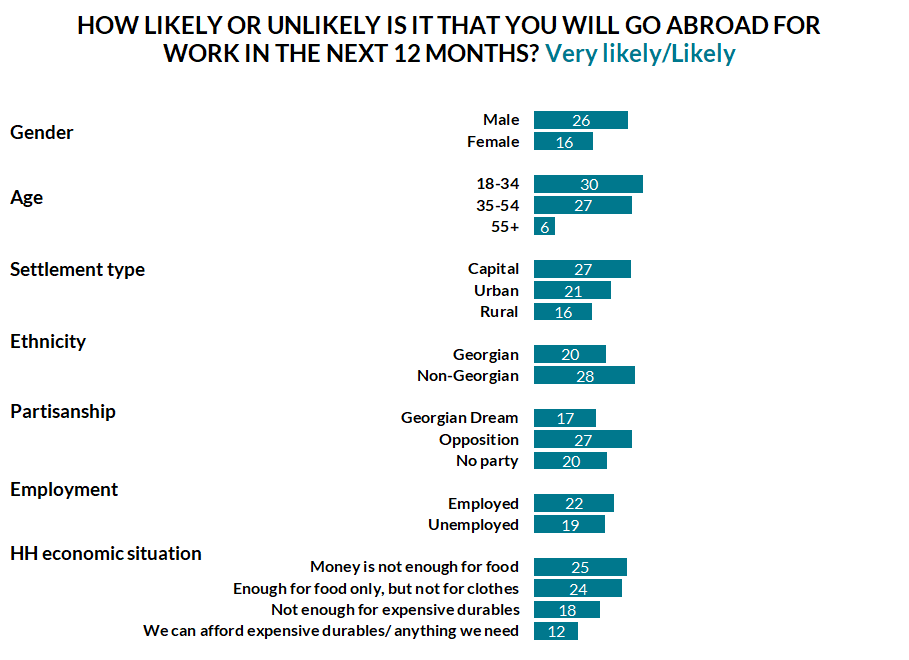
Note: The chart above was generated from a regression model. The model includes gender (male, female), age group (18–34, 35–54, 55+), settlement type (capital, urban, rural), education (secondary or lower, secondary technical, tertiary), ethnicity (Georgian, ethnic minority), party respondent names as closest to his/her views (Georgian Dream, opposition party, did not name a party (Don’t know, Refuse to answer, No party)), employment status (Employed, unemployed), and a household’s economic situation.

Despite the difficulties associated with emigration, many people see going abroad for work in 2023 as a better option than staying in Georgia. This applies especially to men, younger people, residents of Tbilisi, ethnic minorities and those who report having poorer economic standing. Time will tell how this attitude will be reflected in actual migration statistics.


This article was written by Elene Ergeshidze, a researcher at CRRC-Georgia. The views expressed in this article are the author’s alone and do not necessarily reflect the views of CRRC-Georgia, NDI, or any related entity.

The data used in this post are available here.

Tuesday, February 07, 2023

How do Georgians feel about the influx of Russians?

Note: This article first appeared on the Caucasus Data Blog, a joint effort of CRRC Georgia and OC Media. It was written by Givi Silagadze, a Researcher at CRRC-Georgia, The views presented in the article are of the author alone, and do not necessarily reflect the views of NDI, CRRC-Georgia, or any related entity.

Recent CRRC data shows that a large majority of the Georgian public is concerned about the migration of Russians to Georgia.

Since Russia launched its invasion of Ukraine in February 2022, at least 1.2 million Russian citizens have entered Georgia, equivalent to roughly 30% of Georgia’s population. While the number of Russian citizens who have decided to stay in Georgia remains unclear, the impact of this mass migration is strongly felt in rising rents and concerns over the country’s security.

[Read more on OC Media: Suitcases and shattered dreams: fleeing Russians bring crisis to the Caucasus]

This has manifested in political conflict, with the opposition and the ruling Georgian Dream party arguing over the introduction of entry restrictions for Russian citizens.

A recent NDI and CRRC survey from December 2022 shows that this elite-level partisan difference mirrors a policy divide between everyday voters.

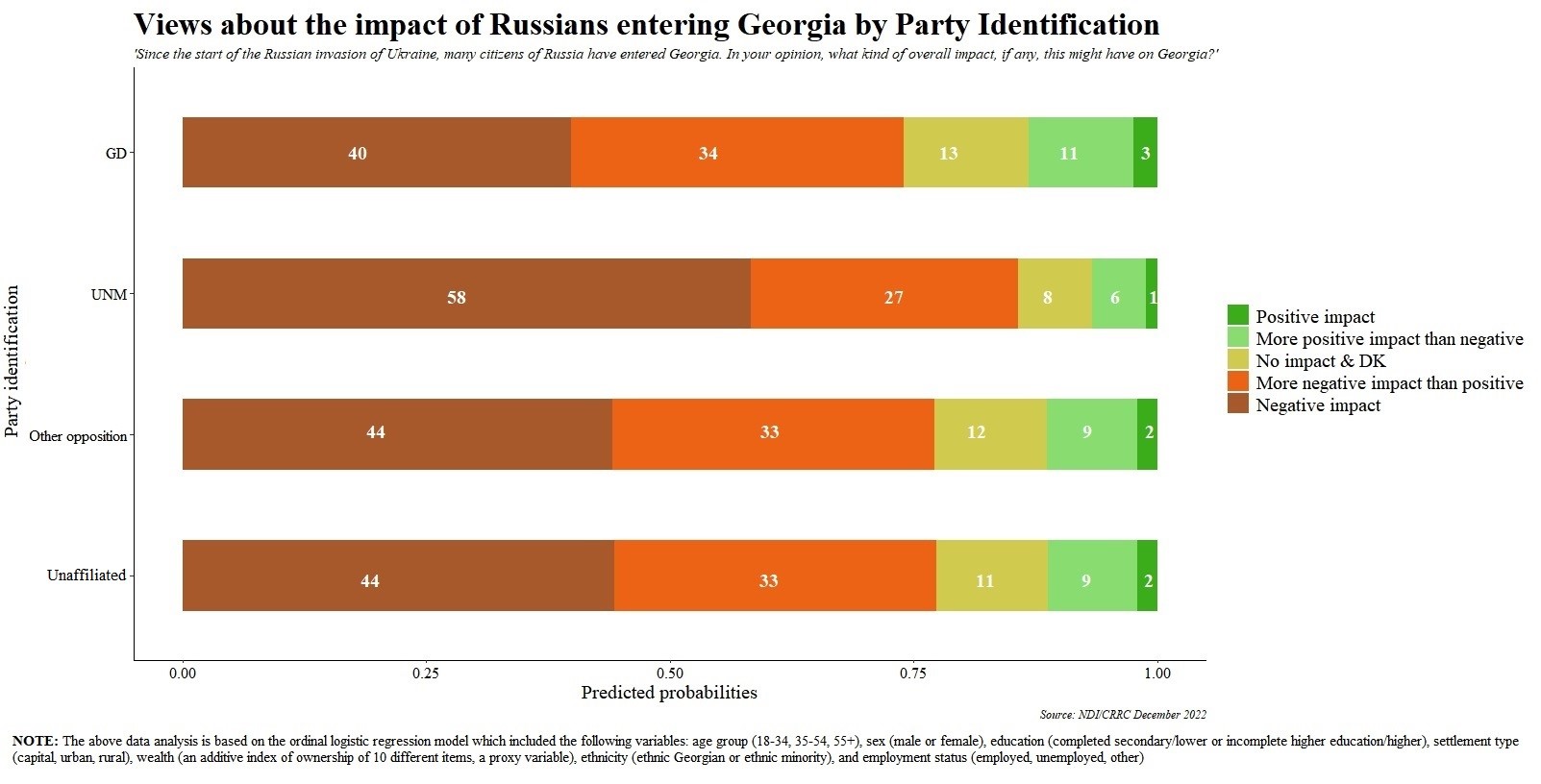
According to the findings, Georgians appear to be concerned about Russians entering their country: two-thirds (69%) think that the large number of Russian citizens entering Georgia since the war will likely have a negative impact on Georgia. 

On the other hand, every sixth Georgian (17%) thinks it will have a positive impact, while 8% say that they do not know, and 6% think the recent influx of Russian citizens will have no impact on the country.

After controlling for other socio-demographic variables, Georgian Dream supporters were slightly more optimistic about Russians coming to Georgia than supporters of the largest opposition group, the United National Movement. However, supporters of the ruling party were not different from supporters of other opposition parties or voters who do not support any party in particular on this issue.

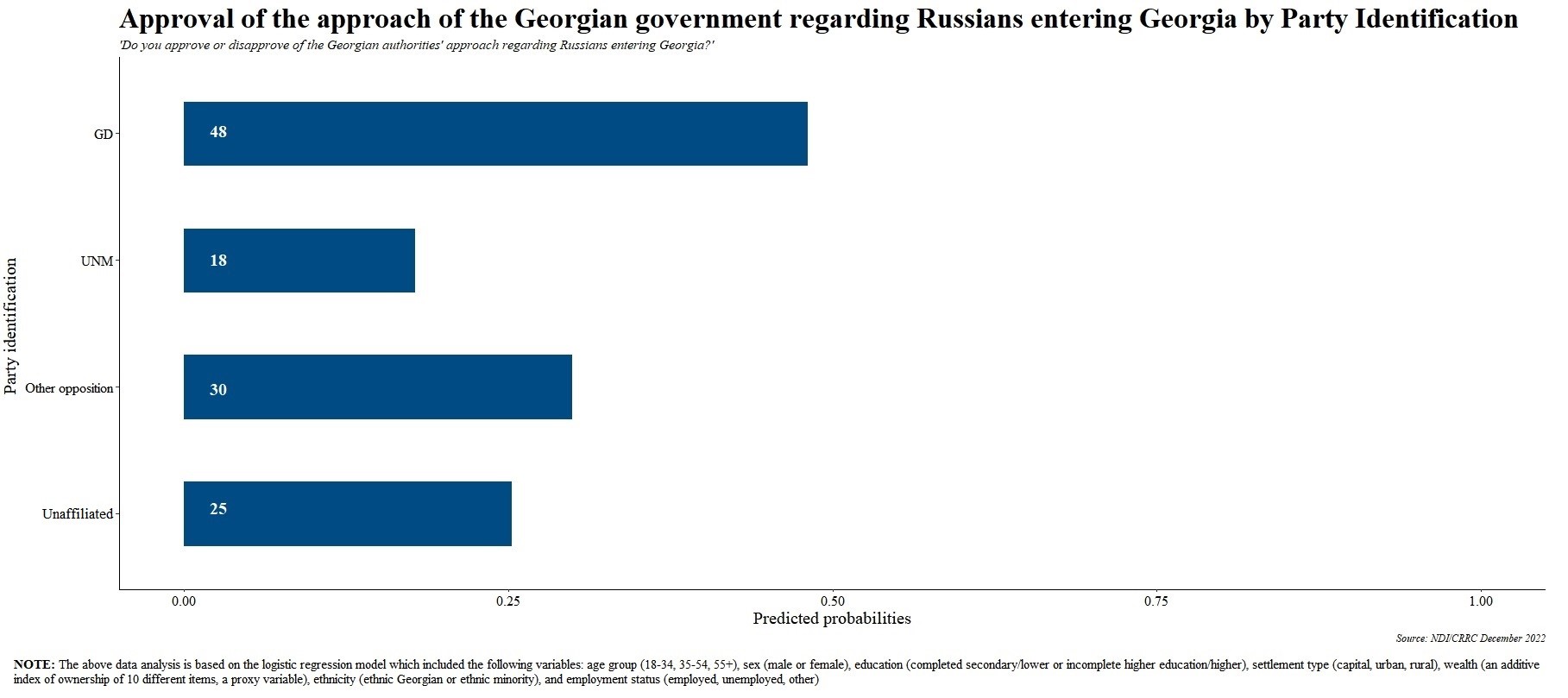
Approximately a third of the public (29%) approve of how the government handled the influx of Russian emigrés, while a majority of the public (57%) disapprove — the remaining 13% do not know what to think about the government’s handling of the emigration.

Regression analysis suggests there is a sharp partisan divide between those who support and do not support the authorities’ approach, with Georgian Dream supporters being much more likely to approve of the government’s Russian migration policy, as shown in the graph below.

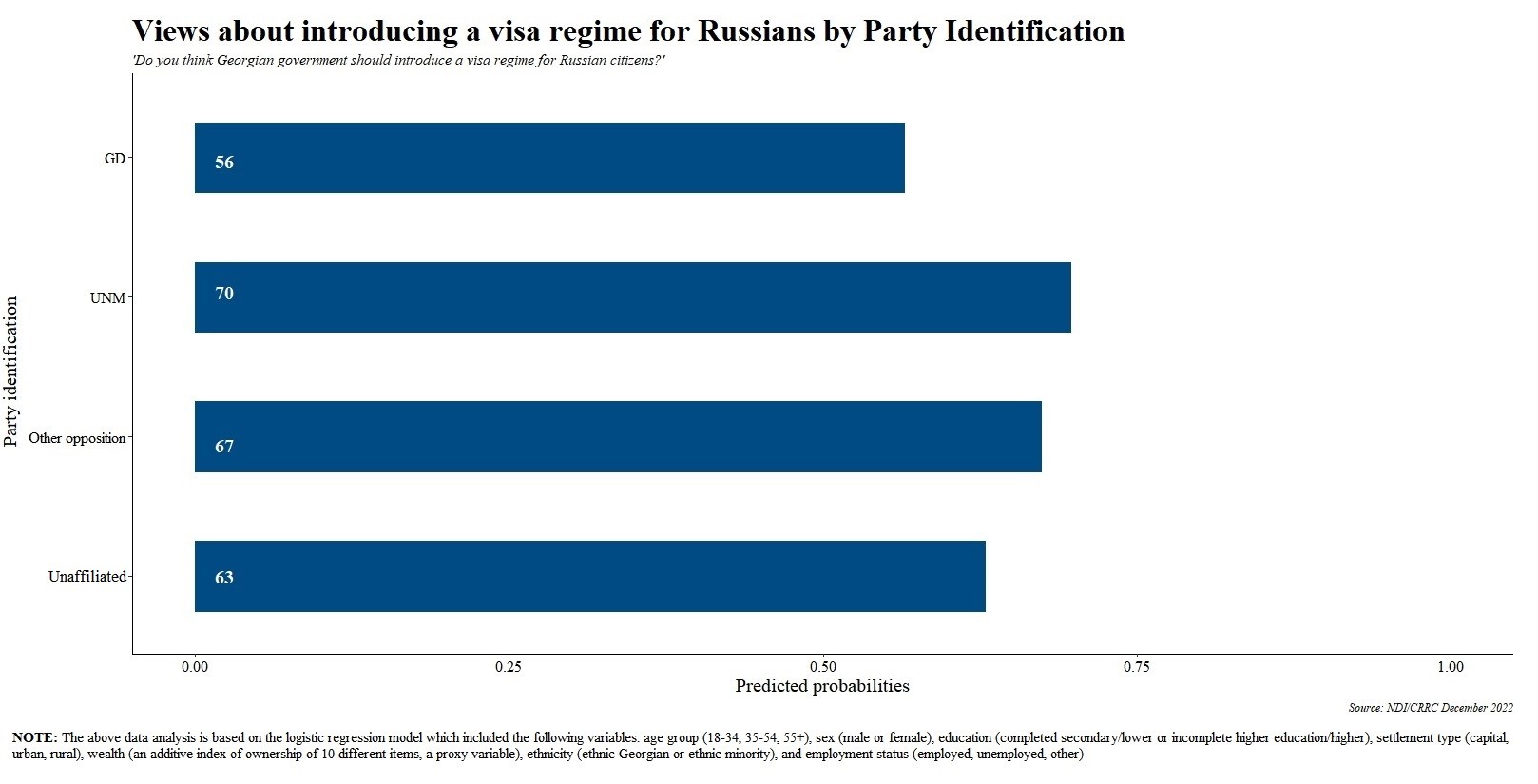
Slightly more than two-thirds of the public (69%) were also in favour of introducing a visa regime for Russian citizens — including the majority of Georgian Dream’s supporters.

The above data shows two things clearly: a large majority of the public is concerned about the migration of Russian citizens to Georgia, but supporters of the ruling party are more likely to be satisfied with the government’s approach to the Russian influx. 

Beyond partisan lines, however, the data also shows that the majority of Georgians are concerned and want the government to do something about Russian migration.

Tuesday, March 22, 2022

Georgians want immigration restrictions for Russians

Note: This article first appeared on the Caucasus Data Blog, a joint effort of CRRC Georgia and OC Media. It was written by Dustin Gilbreath, the Deputy Research Director of CRRC Georgia. The views presented in this article are the author's alone and do not reflect the views of CRRC Georgia or any related entity.

Following Russia’s invasion of Ukraine, there has been an outflow of Russians to the South Caucasus.

Following the Russian invasion of Ukraine and accompanying domestic crackdown in Russia and imposition of sanctions, there has been an outflow of Russians to the South Caucasus — leaving many in Georgia feeling uneasy.

On 7 March, Georgia’s Ministry of Economy estimated that 20,000–25,000 Russians had come to Georgia since the invasion. In Armenia, the government has reported that around 5,000 Russians have been moving to the country daily since the start of the war. 

This mass migration has raised fears in Georgia. It has been argued that Russia could use the presence of a large number of Russian citizens as a pretext for military intervention in the past. As a result, many have begun to propose that Georgia’s lax migration policies be tightened against Russians. In response, further concerns were raised about the implicit Russophobia embedded within this discourse. 

Data from CRRC Georgia’s survey on Ukraine suggests that a majority of the public support the introduction of migration restrictions. Overall, 59% of the public reported that they would support the introduction of migration restrictions. In contrast, 31% were opposed and 9% were uncertain.

When the data is broken down by social and demographic variables, it indicates that support for migration restrictions varies substantially between groups. 

Young people were significantly more supportive of migration restrictions. Controlling for other factors, young people (aged 18–34) had a 60% chance of supporting the introduction of restrictions. By comparison, this drops to 54% among those aged 35–54 and 44% among those who were 55+.

Ethnic minorities were also significantly less supportive of the introduction of migration restrictions. While ethnic Georgians had a 61% chance of supporting restrictions, ethnic minorities had a 44% chance, controlling for other factors. 

Supporters of different parties also held significantly different views. People who supported an opposition party had a 65% chance of supporting restrictions while supporters of the ruling party had a 43% probability of doing so. People who refused to answer which party they supported had a 45% chance of supporting restrictions, while people who were uncertain over which party to support had a 58% chance of supporting restrictions.

The above data reflects the significant concerns of the Georgian public around the war in Ukraine, the uncertainties around what large scale immigration from the Russian Federation would mean for Georgia, and likely anger at Russians for the war which Vladimir Putin has unleashed in Ukraine.

Note: The social and demographic breakdowns shown in this blog post are generated from a regression model. The regression model includes age, sex, IDP status, a simple additive index of durable goods ownership (a common proxy for wealth), ethnicity (minority or not), education level, and party which the respondent supports. The data used in this blog post is available here.


Monday, February 24, 2020

Who’s thinking about temporary and permanent migration?

The population of Georgia has declined after the dissolution of Soviet Union from 5.4 million to 3.7 million according to the latest estimates provided by the Georgian National Statistical Office. The mass emigration of the Georgian population in the 1990s has been attributed to the decline of the economy and military conflicts in the country. Even though the economic situation stabilized starting in the 2000s, the migration flow has not stopped and interest in emigration is quite widespread in Georgia. This blog shows that interest in both temporary and permanent migration is associated with age. In contrast, settlement type, ethnicity and wealth of the household is associated with interest in permanent migration but not temporary and sex, internet usage, and having a relative living abroad with temporary but not permanent migration.

The Caucasus Barometer 2019 survey shows that around 10% of the Georgian population is interested in permanent emigration, while 50% would temporarily leave Georgian to live somewhere else. These figures have been relatively stable over time, and there was no significant change between the 2017 and 2019 Caucasus Barometer surveys.


This leads to the question who is more or less likely to be interested in temporary and permanent migration? A logistic regression suggests that those living in the capital, younger people, and ethnic minorities have higher chances of considering permanent emigration, controlling for other factors. There are no statistically significant differences for other demographic factors.


Household wealth is also associated with intention to migrate. Those with less wealth are more likely to be interested in emigrating from Georgia on a permanent basis.


When it comes to the temporary migration, the same analysis suggests a number of findings. Younger people are more interested in temporary migration than older people. In addition, males are more likely to say they want to leave the country temporarily. Internet use is also associated with thinking about leaving the country temporarily. Having a close relative abroad is associated with a nine percentage point higher likelihood of being interested in temporary migration. There are no statistically significant differences for other demographic factors.


Overall, Georgians are less enthusiastic about leaving the country permanently than temporarily. Being interested in emigration is associated with several factors. When it comes to the permanent emigration settlement type, ethnicity, and economic well-being matter. While for temporary migration internet use and having relatives abroad matter. In both cases age is a significant factor for emigration. In this regard, permanent migration might have more to do with poverty and temporary migration an interest in seeing the world and being in good enough health to do so.

To explore more the Caucasus Barometer 2019 survey findings for Georgia, visit CRRC’s Online Data Analysis portal. Replication code for the data analysis is available at CRRC’s GitHub repository here.


Monday, June 04, 2018

Willingness to temporarily emigrate from Armenia and Georgia: Does education matter?

A previous CRRC blog post showed how people’s willingness to temporarily emigrate from Armenia and Georgia varied according to their belief in whether everything in life is determined by fate or people shape their fate themselves. The blog post concluded that compared to people who are not interested in temporary emigration from these countries, those who are tended to believe slightly more often that people shape their fate themselves.

There are a number of factors that contribute to an individual’s willingness to emigrate including political, economic, and social circumstances. Using data from CRRC’s Caucasus Barometer (CB) survey, this blog post looks at whether or not people who express a willingness to temporarily emigrate from Armenia and Georgia differ from others in terms of their educational attainment. Importantly, though, this question does not measure actual emigration, but rather reported intentions that may or may not result in action.

In both countries, the share of people willing to temporarily emigrate is the highest among those who have tertiary education. Importantly, this finding is consistent over time.


Note: The answer options for the question, “What is the highest level of education you have achieved to date?” were grouped as follows: options “No primary education”, “Primary education (either complete or incomplete)”, “Incomplete secondary education”, and “Completed secondary education” were grouped into the category “Secondary or lower”. Options “Incomplete higher education”, “Completed higher education (BA, MA, or specialist degree)”, and “Post-graduate degree” were grouped into the category “Tertiary”.

People with either a close friend or a close relative living abroad at the time of survey fieldwork also report more often that they would leave Georgia for a certain period of time to live somewhere else. The findings are similar in Armenia. Importantly, when looking at this indicator of migration networks, there are, again, differences by level of education. As the chart below shows, in 2017, people with higher levels of education reported having close friends abroad more often than those with lower levels of education. This finding is also consistent for CB waves through the last decade.


As the findings presented in this blog post show, in both Armenia and Georgia, people having tertiary education report an interest in temporary emigration more often than those with lower levels of education. Importantly, a larger share of people with tertiary education also have relatives and/or friends living abroad. Thus they can rely both on relatively advanced knowledge, including knowledge of foreign language(s), and on the opportunities provided by migration networks.

To learn more about CRRC surveys, visit our Online Data Analysis portal.


Monday, May 07, 2018

Willingness to temporarily emigrate from Armenia and Georgia: Does fatalism matter?

Scholarship points to a number of factors that contribute to an individual’s willingness to emigrate, either on a temporary or permanent basis. Political, economic, and social conditions are all important variables in the emigration equation. This blog post uses data from CRRC’s Caucasus Barometer survey to see whether or not people who express a willingness to temporarily emigrate from Armenia and Georgia differ from others in terms of the reported belief that people shape their fate themselves. Those who believe so may be more inclined to consider actions such as temporary emigration.

In Georgia, beliefs of whether or not individuals shape their fate themselves have changed a bit over the years. In 2011, 31% of the population tended to believe that “People shape their fate themselves.” In 2017, this share increased to 43%. Similarly, a slightly greater share of the population of Armenia expressed the opinion that people shape their fate themselves in 2017 than in 2011.


Note: A 10-point scale was used during the interviews to record answers to the question about fate, with code ‘1’ corresponding to complete agreement with the opinion, “Everything in life is determined by fate” and code ‘10’ corresponding to a complete agreement with the opinion, “People shape their fate themselves.” The original scale was recoded for the charts in this blog post. Codes ‘1’ through ‘4’ were combined into the category, “Everything in life is determined by fate.” Codes ‘5’ and ‘6’ were combined into the category “In the middle.” Codes ‘7’ through ‘10’ were combined into the category “People shape their fate themselves.” 

The share of the population in Georgia who report wanting to temporarily emigrate has slightly increased since 2011, while it does not seem to have changed in Armenia. In Georgia, the share has been consistently lower than in Armenia, at between 42% and 48% of the population. 


In both countries, though, those who are interested in temporary emigration also tend to believe slightly more that people shape their fate themselves rather than everything in life being determined by fate. This finding is consistent over time.


Thus, people who are interested in temporary emigration from Armenia and Georgia tend to believe slightly more that people shape their fate themselves than those who do not report such an interest. The finding points to a more general consideration: people who feel they possess agency over their lives may feel more empowered to pursue actions that directly affect their life’s course, such as temporarily emigrating from their home country.

To explore the data used in this blog post further, visit our Online Data Analysis platform.

Note: The 2017 data for Armenia presented above makes use of preliminary population weights. The final population weights were not possible to complete in time for publication of this blog post. Hence, the figures for 2017 may change slightly, once the 2017 Caucasus Barometer Armenia survey weights are calculated. The weights for Georgia, on the other hand, are final. 


Monday, March 19, 2018

Temporary emigration intentions from Georgia: Do migration networks count?

The UN estimates the number of international migrants worldwide to be on the rise. Academics and policy makers continue to pay considerable attention to drivers of international migration, i.e. the factors that cause people to move from their home country, either temporarily or permanently.  While a significant body of scholarship exists on the structural ‘push’ factors of international migration, such as limited economic opportunities, poverty, poor governance, or war in migrants’ home countries, interpersonal factors are no less important in shaping migration.  This blog post investigates the latter, seeking to examine how individuals in Georgia with and without close friends and family living abroad differ in their willingness to emigrate from the country temporarily. 

Studies have been conducted that demonstrate the impact of personal networks on migration behavior.  One central theory guiding these studies is the ‘migration network theory,’ which posits that the reduced social, economic, and emotional costs of migration stemming from existing contacts who are able and willing to help new migrants ultimately ease migration, and, to a certain degree, promote it. Understanding migration networks permits a more comprehensive view of migration as a dynamic process, rather than a mechanical outcome of economic or political deprivation.  Migration networks include family, friends, neighbors, and former colleagues — essentially anyone an individual can rely on and share information about opportunities abroad, including settlement assistance.

Emigration has been an important coping strategy for the population of Georgia since the dissolution of the Soviet Union. CRRC’s Caucasus Barometer survey data from 2010 through 2017 indicates that the share of people in Georgia willing to temporarily emigrate has increased slightly.  In CB 2017, 55% of the adult population of Georgia responded ‘yes’ to the question: “If you had a chance, would you leave Georgia for a certain period of time to live somewhere else?”  In 2010, this share was 47%.


CB also asked two questions that can help see individuals’ temporary migration intentions in light of the migration networks they might have.  Of those who had a close relative living abroad at the time of the survey, 59% responded that they would leave Georgia temporarily to live somewhere else.  In contrast, only 40% of those without close relatives living abroad responded that they would emigrate temporarily. Similarly, individuals who reportedly had a close friend abroad were more likely to report a willingness to temporarily emigrate than those who did not. It is still important to mention, though, that about 40% of those not having a close friend or relative abroad still report willingness to temporarily emigrate from the country.


The findings presented in this blog post suggest, in accordance with the migration network theory, that social networks may play a role in people’s willingness to temporary emigrate from Georgia. Individuals with a close contact who was living abroad at the time of the survey were more likely to respond that they would leave Georgia for a certain period of time to live somewhere else.  It should be emphasized, however, that CB does not present data on actual emigration, but rather reported intentions that may or may not result in individual actions.

To explore the data used in this blog post further, visit our Online Data Analysis platform.


Saturday, September 09, 2017

Attitudes towards immigrants in Georgia, and how they differ based on a person’s economic situation

A recent protest in Tbilisi was a reminder of the importance of studying attitudes towards immigrants in Georgia. A previous blog post discussed how these attitudes vary based on whether a person has or has not had personal contact with immigrants. This blog post explores how attitudes towards immigrants differ based on whether people believe or not that immigrants will contribute to the economic development of Georgia, and how they describe their households’ economic condition compared to the households around them, using CRRC’s 2015 Caucasus Barometer survey (CB) data. “Immigrants” was operationalized in the questionnaire as “foreigners who come to Georgia and stay here for longer than three months.”

A plurality of the population of Georgia (45%) report that immigrants will sometimes contribute to the country’s economic development and sometimes not. About one in five (22%) think that immigrants will contribute to the economic development of Georgia, and 18% think the opposite. Among those who think that immigrants will contribute to the economic development of Georgia, 50% report positive attitudes towards them. However, when people think that immigrants sometimes will and sometimes will not contribute to the economic development of Georgia or when they think immigrants will not contribute to it, they generally report neutral attitudes towards immigrants. Notably, among those who believe that immigrants will not contribute to the economic development of Georgia, 17% report negative attitudes towards them, which is the highest share of negative attitudes reported.


Note: For the question, “How would you characterize your attitude towards the foreigners who come to Georgia and stay here for longer than 3 months?” the original 5-point scale (1 – ‘Very bad’, 2 – ‘Bad’, 3 – ‘Neutral’, 4 – ‘Good’, 5 – ‘Very good’) was re-coded into a 3-point scale, with codes 1 and 2 labeled “Bad attitude” and codes 4 and 5 labeled “Good attitude” on the charts in this blog post. Answer options “Don’t know” and “Refuse to answer” are not shown and hence the percentages reported in the charts in this blog post may not sum to 100%.

Interestingly, the better a person’s assessment of their household’s relative economic condition, the better attitudes they report towards immigrants.


Note: For the question, “Relative to most of the households around you, would you describe the current economic condition of your household as …?” the original 5-point scale (1 – ‘Very poor’, 2 – ‘Poor’, 3 – ‘Fair’, 4 – ‘Good’, 5 – ‘Very good’) was re-coded into a 3-point scale, with codes 1 and 2 labeled “Poor” and codes 4 and 5 labeled “Good” on the chart above.

Overall, reported attitudes towards immigrants are rather neutral in Georgia. Importantly though, when people think that immigrants will contribute to the economic development of Georgia or consider the current economic condition of their households to be good, their attitudes tend to be more positive.

To have a closer look at the Caucasus Barometer data, visit CRRC’s Online Data Analysis tool.


Wednesday, March 29, 2017

New OECD/CRRC-Georgia report calls for more coherent migration management in Georgia

From 2013 to 2016, the OECD Development Centre coordinated a EU-funded project on Interrelations between Public Policies, Migration and Development (IPPMD) in ten developing countries including Armenia, Burkina Faso, Cambodia, Costa Rica, Côte d’Ivoire, Dominican Republic, Georgia, Haiti, Morocco and the Philippines. The project collected empirical data to assess the development potential of migration in these countries and develop policy recommendations that would help make the most of this potential. Project findings for Georgia were presented during the launch of the report in Tbilisi on March 28, 2017.

(1)Opening remarks by Mr. Kaido Sirel, Deputy Head of Cooperation, EU Delegation to Georgia.
(2)OECD's Jason Gagnon presenting major findings of the project in Georgia
(3) CRRC Researcher Mariam Kobaladze and conference participants during a break out session.


In Georgia, IPPMD project’s key partners were the State Commission on Migration Issues of Georgia and CRRC-Georgia. The focus of the project was the impact of emigration, remittances and return migration, on agriculture, the labour market, education and investment/financial services. Within the project, a total of 2260 households were interviewed nationwide, including 972 households with migrant members (current or return international migrants) and 1288 households without such members. In addition, 71 comminity interviews were conducted with representatives of local authorities and community leaders, and 27 semi-structured interviews with stakeholders representing civil society, international organizations and academic institutions.

While, according to the United Nations Department of Economic and Social Affairs (UN DESA), total migrant stock from Georgia decreased through the 2000s, according to the latest census data, 24% of those born in Georgia currently live abroad. As the IPPMD report claims, “[e]migration … can … benefit the country by relieving a congested labour market, providing opportunities for women to increase their economic independence and generating incentives to upgrade skills. However, realising these positive impacts depends on the right conditions being in place,” i.e. efficient evidence-based policies.

The IPPMD survey collected impressive empirical data that allows us to compare emigrant and non-emigrant households in Georgia. Accodring to the IPPMD data, emigrants from Georgia are younger compared to the average age of household members remaining in Georgia – respectively, 42 and 47 years old. Unsurprisingly, 80% of current emigrants are reported to have left in search of work.

IPPMD data also provides interesting and up to date insights about the role of international remittances for households in Georgia. According to the World Bank, remittances constitute 12% of Georgian GDP. About USD 2 billion was estimated to be remitted to Georgia in 2014, up from about USD 300 million in 2004. The development potential of remittances is, however, not fully used, since the remittances are mostly used on consumption or real estate for the households’ personal use. A very small share of remittances is allocated for productive investments. They do, however, tend to increase expenditures on household members’ education.

The IPPMD report argues that the development potential of remittances can be increased if relevant policies are in place. According to the IPPMD findings, households that report receiving remittances are more likely to also have a bank account in urban settlements, but not in rural settlements. This finding calls for the development of the formal banking sector in rural settlements, and also for offering cheaper and faster formal money transfer channels. The report further argues that “[t]raining those who receive remittances in using money transfer operators and financial services more effectively may help to lower the costs and to use remittances in a more productive way. The IPPMD data show that very few households … (1%) have participated in a financial training programme in the past five years.” The so-called social remittances of migration, i.e. knowledge and experiences that the migrants bring back to the country, are no less important, and their role could also be crucial for the country’s development.

The State Commission on Migration Issues of Georgia has been coordinating migration management since 2010. Continuing to integrate migration-related issues into major policy documents, including the national development strategy, and thus developing a more coherent policy framework, will help to use the development potential of migration more effectively.

The report this blog is based on is available here.

Monday, August 15, 2016

What can CRRC’s Caucasus Barometer survey tell us about internal migration in Georgia?

According to existing estimates, the stock of internal migrants is much larger than the stock of international migrants worldwide. In Georgia, however, internal migration is largely overlooked and there is very little data available on the number and distribution of internal migrants. The National Statistics Office of Georgia (Geostat) regularly collects data on internal migration in the country via an Integrated Household Survey. The Public Service Development Agency, on the other hand, is in charge of population registration by place of residence. Several indicators of internal migration in Georgia can also be found in CRRC’s Caucasus Barometer (CB) survey. This blog post discusses one such indicator: whether, at the time of interview, adults in Georgia lived in the same settlement where they were born. Results of the latest, 2015 wave of CB are presented in this blog post.

About half of the population of Georgia (49%) reported having been born in a settlement where they lived and were interviewed at the time of the survey. An extremely small share (under 3%) reported being born outside the country. The rest are internal migrants – a quarter (25%) were born in another settlement, but in the same region of the country, and almost a quarter (23%) in a settlement in another region of the country. Thus, although we do not know the details of their migration (e.g., at what age, or for what reason they migrated), we can estimate that roughly half of the population of the country (48%) are internal migrants. Importantly, this CB finding is in line with Geostat’s estimates, according to which the share of internal migrants constituted 54% in 2014.

Differences between internal migrants and non-migrants by settlement type, age and, especially, gender are quite striking. Unsurprisingly, the share of internal migrants is highest in the capital, with 65% of Tbilisi’s population born elsewhere in Georgia. Villages, on the other hand, house the highest share of non-migrants. Nonetheless, 41% of the rural population was not born in the villages where they resided at the time of the survey.


When it comes to age differences, the share of internal migrants is highest among the oldest segment of the population (58% of those over 60 years old), and gradually decreases with age. Although differences by age groups are statistically significant, these differences are not particularly large.


While 62% of females report not being born in the settlement where they currently live, roughly half as many men (34%) report the same. This may be related to the tradition of women moving to their husbands’ households after marriage. Thus, in the absolute majority of cases when spouses are from different settlements, it would be a wife moving to another settlement, rather than a husband.


Although it might have been expected that those with higher education would more likely be internal migrants than those with lower levels of education, CB data does not suggest any significant differences between internal migrants and non-migrants in Georgia by level of education.
Preliminary analysis of CB 2015 data lets us estimate that about half of the population of Georgia can be considered internal migrants. Most strikingly, internal migrants and non-migrants differ by gender, with women being internal migrants about twice as often as men. There are relatively small differences between internal migrants and non-migrants by age and settlement type.

CRRC’s Caucasus Barometer data can be explored at our online data analysis platform.

Monday, March 14, 2016

The population of Georgia on immigrants


Unlike emigration, immigration to Georgia is a relatively recent and small in scale phenomenon. The country attracts a diverse group of immigrants from a variety of countries that arrive for educational, work, business or family reunification purposes. Data on immigrant flows and stocks are collected by GeoStat and the Public Service Development Agency of Georgia (PSDA), but since current regulations do not require that citizens of more than 100 countries coming to Georgia even for relatively extended periods of time (e.g., up to 12 months) apply for residence permits or otherwise register, existing residence statistics only provide an estimate of the number of immigrants in the country.

In many societies, including traditional ones with little or no previous experience of immigration, attitudes towards immigrants are rarely welcoming. The findings of a few empirical studies on the subject suggest that Georgia is no exception. CRRC’s 2015 Caucasus Barometer survey tried to find out more about the dominant attitudes in Georgia towards immigrants, defined during the survey as foreigners that have stayed in the country for a period longer than three months. This blog post provides the results of preliminary analysis of CB 2015 findings on the topic.

Only about a third of the population claims to have had any form of contact with immigrants: 9% report they’ve been in contact with them “quite often”, and another 17% have been in contact with them, but not much. The majority of the population (72%) reports never having any contact with immigrants. Unsurprisingly, those living in the capital report interacting with immigrants more often, but even in Tbilisi, 64% reports never having communicated with them.

Irrespective of whether people have or have not had personal contact with immigrants, they are still able to report certain attitudes towards them. Only 9% could not answer the question, “How would you characterize your attitude towards the foreigners who come to Georgia and stay here for longer than three months?” As for the rest, a large majority (61%) describes their attitude as neutral, while 25% describe it as good and 5% as bad. Importantly, as is often the case (among many others, the French and Italian examples are rather convincing), the more people have been in contact with immigrants, the better attitudes they tend to report towards them.


Note: For the question, “Have you had any form of contact with foreigners in Georgia who have stayed here for longer than 3 months?” answer options “Yes, I’ve often been in contact with them” and “Yes, I’ve rarely been in contact with them” have been combined for this blog post, and answer option “Refuse to answer” (less than 1% of all answers) was excluded from the analysis. For the question, “How would you characterize your attitude towards foreigners who come to Georgia and stay here for longer than three months?” answer options “Very good” and “Good” have been combined and labeled as “Good”, while answer options “Very bad” and “Bad” have been combined and labeled as “Bad”. The answer option “Refuse to answer” (less than 1% of all answers) was excluded from the analysis.

Similarly, more of those who have been in contact with immigrants believe that foreigners will contribute to the economic development of Georgia.


As it is the case in many other countries, in Georgia direct interaction with immigrants seems to be one of the most important conditions determining attitudes towards them – however, a very small share of the population of Georgia report having had direct interaction with immigrants. On the one hand, this may indicate that despite the existing myth that lots of foreigners are in the country, their number is actually not that high. On the other hand, this also means that the attitudes of the majority of the population towards immigrants are based on indirect information, which may be inaccurate.

To find out more, visit CRRC’s online data analysis platform.


Monday, January 25, 2016

The Georgian public’s awareness of visa liberalisation with the EU: Facts and expectations


The visa liberalisation agreement between Georgia and the EU is expected to enter in force in Summer 2016, allowing Georgian citizens holding biometric passports to enter and stay in Schengen area countries without a visa for up to 90 days in a 180-day period. EU-Georgia Visa Liberalisation Dialogue was launched in June, 2012. In February 2013, Visa Liberalisation Action Plan (VLAP) was presented to Georgian authorities. The European Commission’s December 2015 progress report stated that “given the outcome of the continuous monitoring and reporting carried out since the launch of the EU-Georgia Visa Liberalisation Dialogue, the Commission considers that Georgia meets all the benchmarks set in respect of the four blocks of the second phase of the VLAP.”  Visa liberalisation, however, in no way gives Georgians the right to work, study or become residents of Schengen area countries – for these purposes, a labor, study or immigration visa will be needed.

Visa liberalisation is considered a significant success of Georgian foreign policy and is an important step towards country’s EU integration through increased mobility. It is crucial to know, however, to what extent the population of Georgia is aware of the specific aspects of visa liberalisation, hence – how informed their opinions about this process are.

Before the European Commission’s December 2015 progress report mentioned above, CRRC’s 2015 Caucasus Barometer survey, conducted in October 2015, asked a series of questions measuring the population’s awareness of the then-expected visa liberalisation process. When asked, will successful completion of the visa liberalisation process benefit or not ordinary people living in Georgia, only 12% responded ‘no,’ while 32% answered they believed it would benefit ordinary Georgians. The remaining 56%, however, answered either “Don’t know” or said they did not know what the visa liberalisation process was (26% and 28%, respectively), with a small share refusing to answer the question. Hence, questions about specific aspects of the visa liberalisation process were only asked to those who answered either “yes” or “no” to this question i.e. just under a half (45%) of the total sample.

Importantly, only slightly over half (53%) of this group knows that only those Georgian citizens who possess biometric passports will be able to benefit from visa liberalisation, with 28% answering “Don’t know.” Even fewer (45%) are aware that the conditions of the visa liberalisation agreement will be effective only if the length of stay in EU countries does not exceed three months; this question resulted in the highest share (37% of the eligible group) answering “Don’t know.” Even more worrying is the finding showing that 42% of this group wrongly thinks that visa liberalisation will allow the Georgian citizens who have already emigrated gain living and work permits in the EU countries, without having to apply for additional residency documents – a major misunderstanding of what visa liberalisation is about.


 Note: These questions were asked only to those who answered either “Yes” or “No” to the previous question, “In your opinion, will successful completion of the visa liberalisation process benefit or not benefit ordinary people living in Georgia?” (i.e. 45% of the total sample). 

Although those living in Tbilisi tend to have slightly better knowledge compared to those living in other cities/towns or villages, the difference is not striking, and it cannot be claimed that the Tbilisi population is very well informed about specific aspects of visa liberalisation.

There are, though, interesting variations in knowledge by age. While Georgians of all age groups respond quite similarly to the question about whether or not visa liberalisation conditions apply if a person does not hold a biometric passport, younger Georgians tend to be better informed that the visa liberalisation agreement will be effective only if the length of stay in EU countries does not exceed three months and that visa liberalisation does not actually mean that Georgian citizens who have already emigrated will gain living and work permits in EU countries.


These findings strongly suggest that an awareness raising campaign about what the visa liberalisation process with the EU actually implies is crucial. A successful campaign will help to ensure that the population of Georgia has adequate expectations of it and makes informed migratory decisions to the EU countries once visa liberalisation enters into force.


Monday, March 16, 2015

Kundera revisited: Are Armenians longing to leave their country because of unhappiness?


Although many literature lovers take their favorite novels’ quotes for granted, a hybrid literature lover and social scientist cannot resist but putting literature’s postulates to data scrutiny. In one of his most famous works, The Unbearable Lightness of Being, Milan Kundera wrote that “A person who longs to leave the place where he lives is an unhappy person.” If Kundera’s statement is taken as a hypothesis and generalized from the individual to the societal level, it could be argued that the unhappier people are, the more they will long to leave their countries, emigrating either temporarily or permanently.

Using data from CRRC’s 2010 and 2013 Caucasus Barometer surveys, this blog post tries to test Kundera’s postulate on Armenia. Armenians demonstrate higher interest in both temporary and permanent emigration compared to Azerbaijanis and Georgians. This is consistent throughout the 2008-2013 period covered by Caucasus Barometer surveys. In both 2010 and 2013, almost 1 in 3 Armenians reported that they would leave the country forever if they had the chance, compared to roughly 1 in 5 Azerbaijanis and only around 1 in 14 Georgians. Moreover, regarding temporary emigration, the same pattern emerges, with roughly 3 in 5 Armenians that would leave the country for a certain period if they had the chance, compared to 1 in 2 Azerbaijanis and almost 1 in 2 Georgians.


Note: Options “Do not know” and “Refuse to answer” are excluded from the analysis throughout this blog post.

While it is clear that, in the South Caucasus, Armenians are the most eager to leave their country either temporarily or permanently, it is difficult to point out a single reason behind this eagerness, given the socio-historic background of Armenian emigration and the well-organized diaspora communities that provide support for Armenian emigrants worldwide. Nevertheless, it is interesting to explore whether Armenians’ reported level of (un)happiness is in any way associated with their distinct willingness to leave their country.

Unhappy people in Armenia are slightly less inclined to emigrate temporarily, while there is no significant difference between happy and unhappy people in relation to permanent emigration. Thus, in 2010, 67% of those Armenians who reported to be happy also reported that they would like to leave the country for a certain period if they had the chance, while 58% of unhappy citizens reported the same. In 2013, 62% of Armenians reporting to be happy also reported that they would like to leave the country for a certain period if they had the chance, compared with 54% of the unhappy citizens that were willing to do so. In both years, though, almost the same share of happy and unhappy people would leave Armenia forever if they had the chance.


Note: Answer options to the question “Overall, how happy would you say you are?” were re-coded from a 10-point scale into a 3-point scale, so that answer options 1 through 4 were re-coded into “unhappy”, 5 and 6 into “neither happy nor unhappy,” and 7 through 10 into “happy”. 

Although literary postulates are admired and quoted for their aesthetic beauty rather than their statistical significance, this does not make them immune from data truthiness testing. Despite the sacrilege of putting Kundera’s famous quote under data scrutiny, this blog post showed that in the case of Armenia, there is no statistical association between the level of (un)happiness and Armenians’ distinct willingness to leave their country either temporarily or permanently. Maybe J.R.R Tolkien was right instead, “Not all those who wander are lost.”

What are your thoughts on Armenians’ distinct willingness to emigrate? Join in the conversation on the CRRC Facebook page or in the comments section below.

Monday, August 25, 2014

Emigration, Language, and Remittances in Georgia

As discussed in a recent blog post, household incomes in Georgia have risen steadily since 2008. The percentage of Georgians who have family or close relatives living abroad has also significantly increased from 37% in 2009 to 53% in 2013. 14% of Georgian households currently receive money from family members, relatives, or friends living in another country as an income source. This blog examines changes in interest in emigrating from Georgia over the last five years, while controlling for certain variables.

Since 2008, though the percentage of Georgians who have family living abroad has increased, interest in emigrating from Georgia, both temporarily and permanently, has barely changed. In 2008, 48% of Georgians expressed interest in emigrating temporarily, while 44% felt the same in 2013. Interest in permanently emigrating from Georgia has remained extremely low, at 8% in 2008 and at 7% in 2013.


In CB 2013, respondents were asked to describe their ability in English and Russian. Today in Georgia, 63% of Georgians say they have no basic knowledge of English, 15% say they have intermediate knowledge, and 6% feel that they have advanced knowledge. As might be expected, knowledge of English among younger Georgians is higher than among older Georgians. 41% of Georgians aged 18-35 years old say they have intermediate or advanced knowledge of English, while only 14% of Georgian aged 36-55 feel the same. Knowledge of Russian is more widespread among Georgians, with 70% of Georgians saying they have intermediate or advanced knowledge of Russian. Among 18-35 year old Georgians, 65% say they have intermediate or advanced knowledge of Russian, while 80% of 36-55 year old Georgians say the same. As a general trend, Georgians with more advanced language skills in English or Russian tend to express a higher level of interest in temporarily emigrating from Georgia. This trend is more pronounced among English speakers.

Similarly, more frequent users of the Internet are also more interested in temporarily emigrating. However, there is no discernible pattern between the desire to permanently emigrate and knowledge of English or Russian, or frequency of internet usage. Both Georgian men and women are equally disinterested in permanently emigrating (only 7% are interested), while slightly more Georgian men are interested in temporary emigration (49% of men and 39% of women).


In conclusion, though there has been no visible increase in interest among Georgians in emigrating over time, it is possible that this interest will eventually grow as more Georgians learn foreign languages and use the internet more frequently.

Wednesday, October 23, 2013

At the crossroads of Europe and Eurasia - exploring public attitudes in the South Caucasus

Armenia's announcement in September that it would enter the Eurasian Customs Union led to some dissatisfaction regarding relations with Russia, especially since the announcement came months before the Armenian delegation’s visit to Vilnius to sign a DCFTA (Deep and Comprehensive Free Trade Agreement) with the EU. At the first public debate on the issue in Armenia, organised by the Konrad Adenauer Stiftung and Regional Studies Center, speakers addressed possible attitudes of Azerbaijan and Georgia to the Customs Union. The director of the Caucasus Institute, Dr. Alexander Iskandaryan, noted that Azerbaijan, with its significant energy resources and ability to export them to the EU, does not need to join the organisation for economic development. However, according to him Azerbaijan would not be able to sign a DCFTA given that the country is not a member of the WTO—a prerequisite for all signatories of the document. Georgian Prime Minister Ivanishvili has remained sceptical about the Customs Union, but has not ruled out some form of Georgian participation. While all three South Caucasian countries attempt to diversify their trade (particularly with the EU and Turkey), Russia remains a very important trading partner. Russian firms own critical assets in the Armenian telecommunications, transport, and energy sectors. Data from the Caucasus Barometer (CB) show largely positive attitudes towards conducting business with Russians – not only in Armenia, but in all three countries. In light of the ongoing debate in Armenia on the significance of joining the Customs Union, the CB's results are worth considering within the wider South Caucasian context.

Armenia has shown the most positive attitudes towards business with Russians from 2009 to 2012, but negative attitudes have slightly increased. The result for 2012 shows an approval rating of 84%, lower than the past four years, yet higher than any result in Azerbaijan during the same time period, and higher than results in Georgia for the prior 3 years.


Azerbaijanis’ approval of doing business with Russians has increased over time, and have shown the biggest change from negative to positive attitudes over the four years shown. The share of those who approve of doing business with Russians has increased from 62% in 2009 to 82% in 2012.


Georgians have continued to have positive attitudes about doing business with Russians over time. Even in 2009, one year after the Russian-Georgian War in 2008, 76% approved doing business with Russians.


There are several possible reasons for these positive attitudes in addition to intensive trade with Russia and strong social networks with Russians. According to an infographic from the World Bank in 2013, 4 of the top 10 countries receiving remittances by share of GDP are in the CIS (Armenia taking sixth place with 21%). Russia is the top destination for migrant workers across the Former Soviet Union, and it is the destination of choice for 61% of Armenia's potential emigrants. Considering that the amount of private remittances from Russia to Armenia in the first half of 2013 increased by 113%, Armenians' positive attitudes may not be surprising. The net amount of remittances sent from Russia to Azerbaijan in 2013 has been 234 million USD thus far, and 263 million USD to Armenia—remittances from abroad were less significant than in Armenia as a share of GDP. During a recent conference in Yerevan on demography, Dr. Alexander Grigorian noted that access to Russia for Armenian migrant labourers could become even easier following Armenia's accession to the Customs Union, and that this possibly lead to  quantitative (higher numbers of migrant labourers) and qualitative (a higher percentage of educated workers) changes in emigration from the country.


What other factors do you think could play a part in attitudes towards doing business with Russians?

If you want to explore these questions in more detail for yourself, we welcome you to download the 2012 and other Caucasus Barometer datasets.


Tuesday, March 05, 2013

Visa Liberalization Prospects in Georgia – the Way Open for Temporary Emigrants?


Last week the EU Commissioner for Home Affairs, Cecilia Malmström, presented the Georgian government with a Visa Liberalization Plan between Georgia and the EU. This is significant progress from the previous Visa Facilitation Agreement from 2010 which eased the visa application process for Georgian citizens wanting to go to the EU. Under this previous agreement, the cost of an EU visa was reduced from €60 to €35 for Georgian citizens, and a maximum wait time of 10 days was established for a decision regarding the visa. However, in general the process of receiving an EU visa has remained rather complicated. Now, further reforms in document security, border control, migration, public order and human rights are required for a final agreement over an eventual visa-free regime. The final visa liberalization rules are expected to be implemented before the upcoming Eastern Partnership Vilnius Summit on November 28-29, 2013.

Yet, there may be economic and social consequences from the EU an eventual visa-free regime. As the International Organization for Migration (IOM) reveals in its country overview for Georgia, development of the country’s migration management system and a lack of economic opportunities at home are two major migration challenges facing Georgia. According to the 2012 Caucasus Barometer (CB), while only 6% of Georgians would want to permanently live elsewhere, 42% of Georgians would like to temporarily live elsewhere. 


Georgians who are unemployed and looking for a job (59%) are more interested in temporarily going abroad than those who are not interested in a job.


Additionally, students are the more interested in temporary migration than other groups.  87% of students said they would leave Georgia for a certain period of time to live somewhere else if they had a chance. Also, just over half of unemployed and less than half of those who currently have a job, are self-employed or are homemakers would like to temporarily emigrate. 


The results of the CB 2012 also show that younger Georgians are more interested in temporary emigration than those in older age groups. 67% of Georgians aged 18-35 said they would like to live outside Georgia if there was an opportunity, whereas less than half of Georgians 36-55 years old and a one-fifth of those 56 years or older said the same.


A final visa-free agreement could trigger immigration flows from Georgia to EU countries, especially as particular subsets of Georgians (e.g., younger, students, unemployed, and job-seekers) desire to leave the country for a certain period of time. Therefore, migration flows due to unemployment and difficulties while searching for a job might be controlled by promoting job counseling and placement centers, increasing employment prospects within Georgia and creating flexibility to adapt to changing labor market needs. 

To explore more about job and employment related questions in Georgia, we welcome you to download the new 2012 CB dataset here.

Friday, March 02, 2012

ETF Migration Survey in Armenia | Update

For the last few months, CRRC Armenia has been doing a survey for the European Training Foundation (ETF).  This is a major undertaking, with 4.000 respondents, and a specialized sampling procedure (basic details here). We are looking forward to getting the results. Now, the effort has been covered by the ETF website, in an article that shows some of the human dimensions of migration, and its various dimensions.


Within that article, there is a short reference to our ongoing work.


In early March 2012, Heghine Manasyan, the Country Director at CRRC Armenia, will be presenting the preliminary results of that survey at a conference in Turin (program). Keep following the blog, we will let you know once the survey results are available. (Of course, much additional CRRC migration research materials is also available, most of it linked through this blog.)

You find the ETF article here.

Saturday, November 12, 2011

Labor Migration Article | Zvezda Dermendzhieva

In a recent article in Post-Communist Economies, Zvezda Dermendzhieva uses Caucasus Barometer data to compare labour migration from the South Caucasus.

We found one of the more remarkable results to be that "while individuals with higher education are not more likely to become migrants in general, having higher education is associated with up to four times higher probability of migration to a high-income OECD country among Armenians and Georgians. The results are in line with theoretical arguments that skill distribution and returns to education in the host country relative to the home country affect the selection of migrants, and that the cost of migration plays an important role in the migration decision."

Zvezda Dermendzhieva also suggests that migration indirectly contributes to economic development by raising local incomes in demand. In the same vein, she finds "a significant correlation between having a migrant and running a family business in Armenia, which suggests that migrants' earnings can provide scarce capital for business investment and support the development of the private sector in the region."

Interested in finding out more? Check the online abstract here.

Friday, October 14, 2011

Fancy Living Abroad? 39% of Young Armenians Say "Preferably Forever"

Last year, Ani Navasardyan asked, “Why do so many Armenians leave Armenia?” Migration is also an issue in Georgia and Azerbaijan. Data from the CB 2010 reveals that around half of the respondents in Georgia (47%) and Azerbaijan (52%) are interested in temporary migration. Still, Armenia stands out since 64% of the adult population is open to the idea of temporarily leaving the country.

With regard to permanent migration, only 7% of Georgians are interested in leaving the country, compared to 17% of Azerbaijanis and 29% of Armenians who say that they would be interested in leaving their country for good.

The analysis by age group shows that younger people in all 3 countries prefer to migrate temporarily. Three out of four young Armenians (77%) between the ages of 18 to 35 are interested in going abroad temporarily. Equally striking, in its own way, is that many people 56 years and older would leave (38%). In Azerbaijan and Georgia too, interest in temporary migration declines with age. Interestingly, young and middle aged Georgians show a similar interest in temporary migration with affirmation rates of 58% and 52%, respectively.


When looking at the interest in permanent migration by age category, there is also a trend where younger people have more of a desire permanently migrate abroad. Georgia has the lowest percentage of young people (9%) who are interested in permanent migration. There are more than twice as many young Azerbaijanis (24%) who would leave permanently, and more than four times as many young Armenians (39%).

If you are interested in slicing CRRC's data on migration by gender, settlement type, income, knowledge of English or other aspects, we welcome you to analyze our data online.