Showing posts with label Court. Show all posts

Tuesday, January 23, 2024

Obstacles to accessing Georgia’s courts

Note: This article first appeared on the Caucasus Data Blog, a joint effort of CRRC-Georgia and OC Media. It was written by Salome Dolidze, a Researcher at CRRC-Georgia. The views presented in the article are the author’s alone and do not necessarily represent the views of CRRC-Georgia, Caucasian House, or any related entity.

A CRRC Georgia survey investigated who considers and who pursues litigation in Georgia, and the obstacles people face in doing so. 

Georgia’s court system faces significant issues, with reports suggesting that long delays, access to the legal system, and overloaded caseloads are among the barriers that prevent citizens from using the courts. 

A 2021 Social Justice Center report noted that geography, the physical accessibility of buildings, a lack of legal awareness and empowerment, and other physical, financial, cultural, and social barriers presented challenges for large segments of Georgian society. A recent CRRC Georgia survey looks specifically at who goes to court and who considers it, but ultimately doesn’t, and the challenges both groups face in their pursuit of justice. 

Overall, 4% of those surveyed reported they went to the courts over the six years prior to the survey, and a further 4% reported that they considered starting litigation but decided not to. Among those who went to court, 71% were there for civil litigation, 17% for criminal cases, and 12% for administrative legal disputes.

The data suggest there are a number of differences between social and demographic groups in terms of who goes to court.

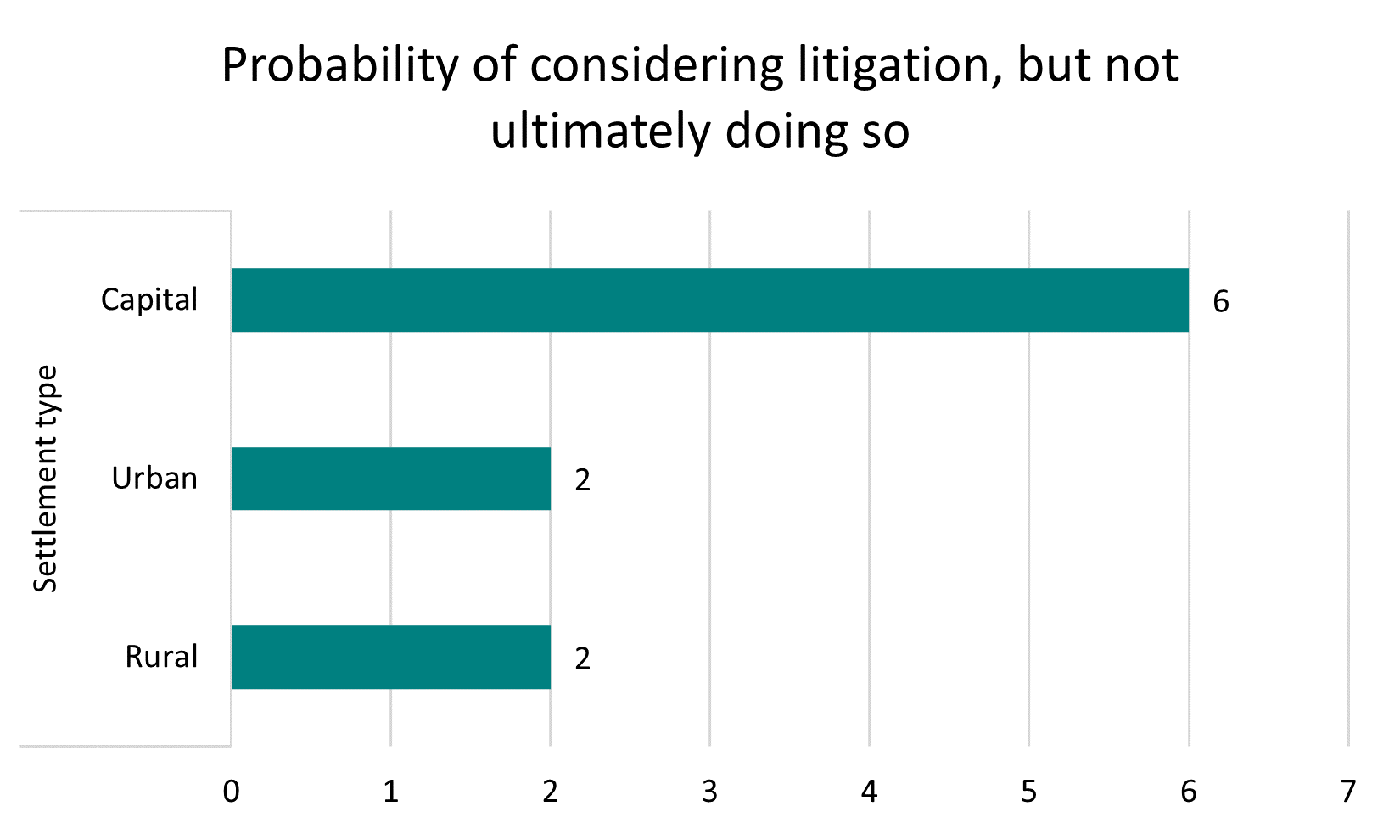
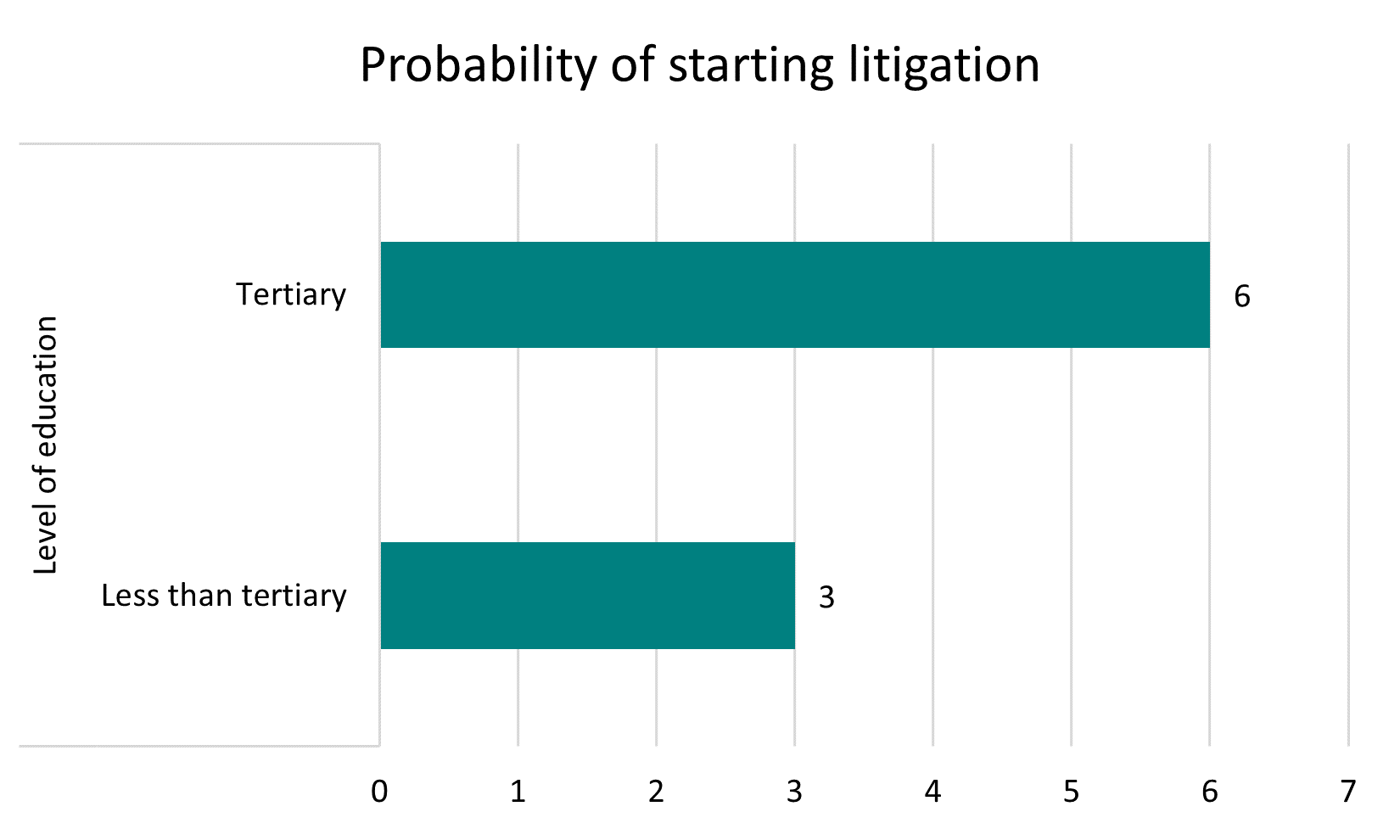
Those who had tertiary education were more likely to have started litigation than those without.  People living in urban areas outside of Tbilisi were more likely to have considered starting litigation, but ultimately refrained from doing so, than those living in the capital. 

Other social and demographic variables such as sex, ethnicity, employment status and wealth were not associated with whether or not someone considered starting litigation or actually did so. 
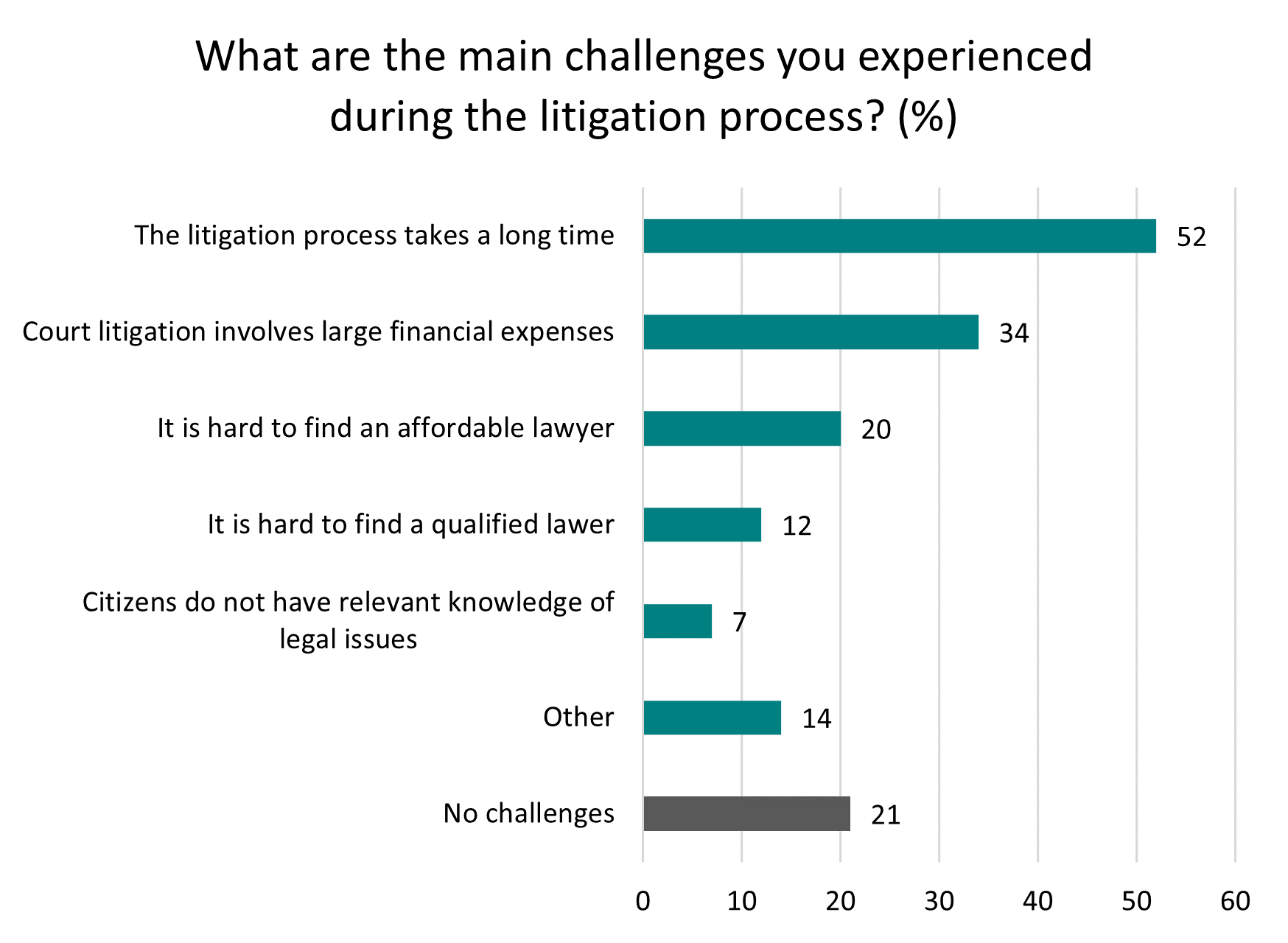
The data also provided insight into the main challenges people faced in Georgia’s court system, as well as the reasons why people ultimately decided not to use the courts.

When people who had actually engaged in litigation were asked about difficulties they had encountered during that process, a majority of respondents (52%) stated that the litigation process takes too long. Another significant concern was the cost associated with litigation, which was cited by 34% of respondents that went to court. In addition, 20% highlighted the difficulty of finding an affordable lawyer, with another 12% stating that finding a qualified lawyer was a challenge. Legal expertise can, of course, be critical to navigate the complexities of the legal system, and ensuring a fair and just outcome. 

The lack of legal expertise amongst ordinary citizens (7%) was highlighted infrequently. Approximately one fifth of respondents (21%) mentioned that they encountered no difficulties in the litigation process.
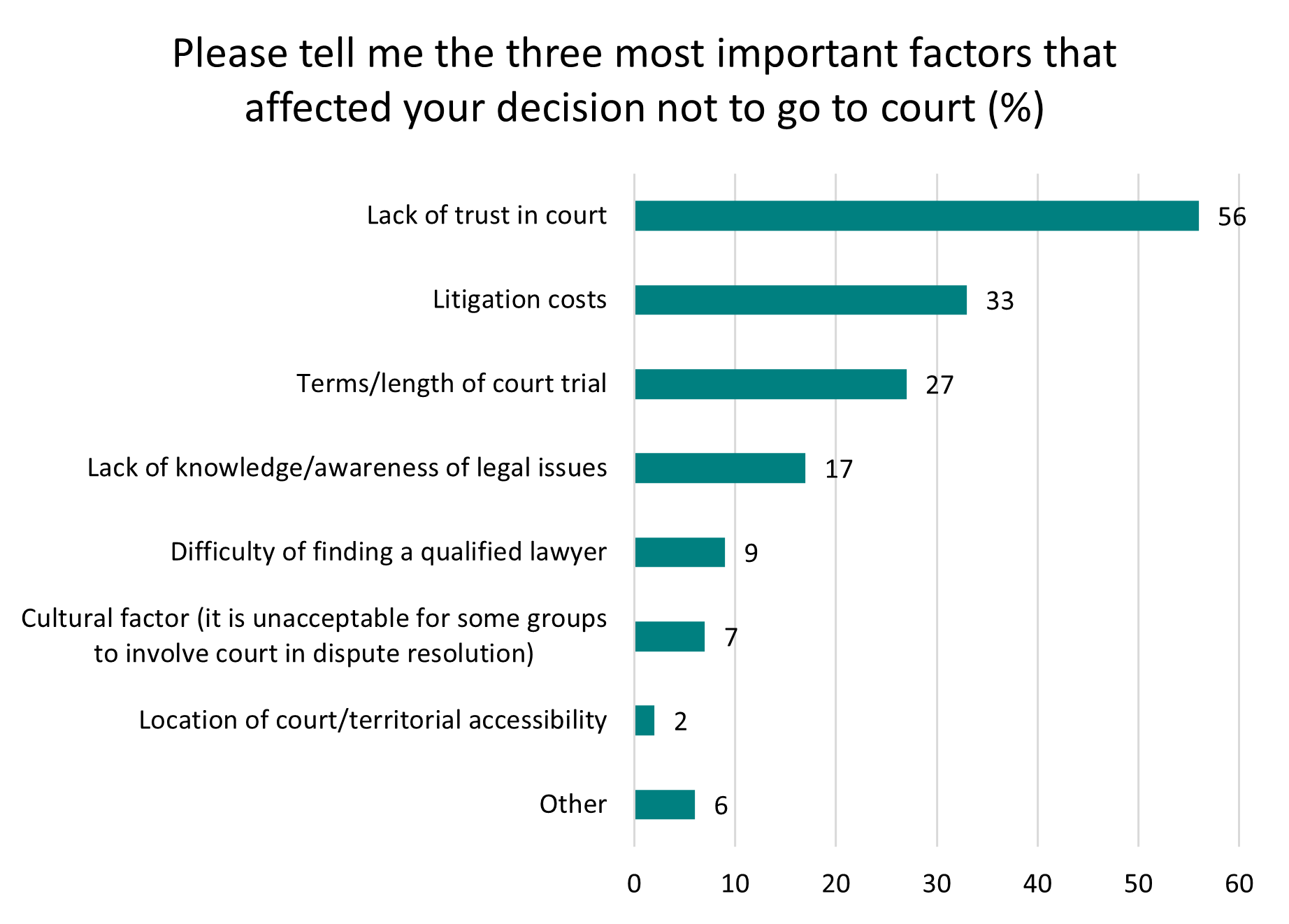
When respondents who had considered starting litigation, but not done so were asked why they had chosen not to go to court, a number of key factors stood out. 

A lack of trust in the judicial system was the most commonly given reason, with 56% of respondents identifying this as a significant deterrent. Another prominent concern for those who refrained from legal action was the cost of litigation, mentioned by 33% of respondents. The length of court trials was also cited by 27% of those who ultimately chose not to pursue litigation. Other significant concerns included lacking knowledge or awareness of legal matters (17%).
One in twenty Georgians have considered going to court in the last six years, and a further one in twenty went to court. Among those who went to court, prolonged court procedures, financial constraints, and a lack of trust in the judicial system were cited as significant barriers to accessing justice in Georgia.

The data used in this article is available hereThe regression analysis used in this article included the following variables:  Age (18-34, 35-54, 55+); Sex (male or female); Settlement type (Tbilisi, other urban, rural); Education level (tertiary or not); Ethnicity (Ethnic Georgian or ethnic minority); Employment status (employed or not working); Wealth index (A simple additive index of ownership of a number of durable goods within a household).

Monday, July 06, 2020

Georgians’ perceptions about equality at court

Attitudes toward the judicial system have been one of the most discussed and researched topics in Georgia. CRRC’s past blogs have shown that Georgians’ perceptions of court system fairness have been at low levels throughout the last decade and that attitudes toward court system (im)partiality are associated with rates of  trust toward the court system and people working in the court system. A recent CRRC study also highlighted division among the public regarding trust in judicial institutions. This blog post contributes to this conversation through describing views on the fairness of courts in Georgia, showing its broader inter-relations with trust in institutions, political views, and general perceptions of the government’s treatment of citizens.

The 2019 Caucasus Barometer survey shows that the majority of Georgians (63%) think that the court system is biased toward some citizens over others. However, the levels of agreeing with that statement vary across different demographic groups. A logistic regression suggests that people living in the capital, those with higher levels of education, and ethnic Georgians are more likely to think the courts favor some citizens, controlling for other factors. People in different age groups, women and men, the employed and those not working, those who use the internet more and less often, and those with more and fewer household assets do not differ in terms of evaluations of court impartiality. 
 

The belief that the courts are (im)partial is also associated with party support, trust in institutions, and people’s perceptions of whether the government treats people fairly. Controlling for the above social and demographic factors, Georgian Dream party supporters are less likely to agree with the statement that the court system in Georgia favors some citizens over others compared to people who support an opposition party. Those who do not report supporting any particular party fall somewhere in between. With institutional trust, controlling for other factors, lower levels of institutional trust are associated with higher levels of thinking that courts favor some citizens over others. People who think that people like them are not treated fairly by the government are also more likely to think that the Georgian court system treats citizens unequally, when all other factors are held constant.  

 
Note: The institutional trust index was created from the following variables: Trust in the Healthcare system; Banks; Educational system; Army; Court system; NGOs; Parliament; Executive government; President; Police; Political parties; Media; Local government; Religious institutions respondent belongs to; and the Ombudsman. A 1 represents the lowest level of trust, while a 5 represents the highest level of institutional trust. 

These correlations matter. People who support the opposition, trust institutions less, and think the government does not treat people fairly are all more likely to also think the courts are stacked against citizens. This suggests that people clearly view what should in theory be an impartial umpire as a political one in practice. 

The data presented in this blog post is available here. Replication code for the above analysis is available here.

Tuesday, October 15, 2019

Selection of Supreme Court judge candidates: What people in Georgia know and think about the process


Following the constitutional amendments and changes to the organic law of Georgia on common courts, the minimum number of judges at the Supreme Court increased to 28. At the same time, 10-year appointments were changed to lifetime tenures, and the High Council of Justice was given the authority to nominate candidates for parliamentary appointment.  Following these changes, the High Council of Justice started the selection of Supreme Court candidates and in the beginning of September 2019 provided a list of 20 candidates to be submitted to the Parliament of Georgia for approval.  Interviews with candidates were live streamed and the process enjoyed wide media coverage.

The selection process was generally critically received, despite positive assessments of the live-streaming of interviews. The OSCE/ODIHR assessed the Supreme Court judge candidate selection process as “lacking transparency and accountability despite some positive measures to build public trust in the judiciary”.  The Coalition for an Independent and Transparency Judiciary was also critical of the process as well as the regulatory framework, which “allowed the formation of a list of candidates suiting the interests of the dominant group of judges and the ruling party”.
What does the public in Georgia know about the process and what is their attitude towards the selection of Supreme Court candidates and judicial institutions? A phone survey conducted on September 5-11, 2019 suggests that people in Georgia are divided in their trust towards judicial institutions, are not knowledgeable about the process, have little trust in it, and largely have not heard of the selected candidates.

Generally, the public is divided in whether they trust the High Council of Justice, Supreme Court, and the court system in general. About half of the public trusts and distrusts each of these institutions.

The public is also divided in terms of awareness of the selection process of Supreme Court candidates. Approximately half of the Georgian-speaking adult population (54%) has heard of the selection process of Supreme Court candidates. However, their attitude to it is not particularly positive, as about half of those who have heard about the selection do not trust the process (53%). Similarly, almost half of those who heard about the selection process, say the selection was not unbiased (48%).

The survey asked respondents to share their first association regarding the selection of the Supreme Court candidates. The majority (64%) did not have any association, responding don’t know. Of those who shared their view, there were both positive and negative associations as well as neutral ones. However, negative attitudes predominated. Overall, 3% of respondents reported a positive word, 20% reported a negative association and 10% of responses were neutral. The top three associations were that “appointment should not be lifetime” (6%), “insecurity” (3%), and “distrust” (2%). Positive associations included “hope” (1%), “the process is going in a good direction” (0.6%), and “fair court”. Some of the negative associations were: “negative attitude” (2%), “unfairness” (1%), and “clan” (1%).

After the long selection process, the High Council of Justice finalized the list of 20 candidates to be submitted to the Parliament. The survey asked about whether each candidate should or should not be appointed as a Supreme Court judge. The majority of people in Georgia (over 60% for most candidates) reported that they have not heard of the candidate. Attitudes were most approving of appointment towards: Shalva Tadumadze, Prosecutor General (14% of the population approve of his appointment), Giorgi Mikautadze, Secretary of the High Council of Justice (13% of the population approve of his appointment), and Shota Getsadze, judge of the Tbilisi Court of Appeals (10% of the population approve of his appointment).

About one fifth of the adult Georgian-speaking population (19%) says appointment of these 20 candidates will improve justice in the country. The same share (19%) says the state of justice will get worse. About a third (29%) believe it will stay the same.

Considering the knowledge of the population about the selection process and their attitude to it, it may not be surprising that only 1% of the Georgian-speaking adult population considered it one of the most important events of the summer.  The top five events named during the survey were:

  • The devaluation of Georgian Lari; 
  • Dissolution of the June 20 rally;
  • Further moving the administrative boundary line between Georgia and South Ossetia/Tskhinvali Region;
  • The protest rallies “It’s a shame” and; 
  • Gavrilov’s visit to Parliament. 

More than a quarter of people responded “Don’t know” to the question or refused to answer altogether. There were non-relevant answers as well, such as “good weather” and “lack of water and electricity”, etc.


Overall, the public is divided in their trust towards judicial institutions. More than half of the population has heard of the Supreme Court judge selection process, though few find it to be among the most important events over the summer. Among those that are aware of the selection process, attitudes are more negative than positive. A majority of people in Georgia have never heard about the candidates.

Note: This blog post has been produced with the assistance of the European Union. Its contents are the sole responsibility of CRRC-Georgia, EMC and IDFI and do not necessarily reflect the views of the European Union.

On September 5-11, 2019, within the EU-funded project “Facilitating Implementation of Reforms in the Judiciary (FAIR)”, CRRC-Georgia conducted a phone survey to find out people’s knowledge and attitude about the Supreme Court selection process. The survey resulted in 867 completed interviews, and is representative of the adult Georgian-speaking population of the country. The average margin of error of the survey is 2.2%.

Monday, August 07, 2017

Rare evidence: Judges on challenges in the court system of Georgia

Georgia has long faced problems with its court system. On CRRC’s 2015 Caucasus Barometer survey, only about one in four people in Georgia reported trusting the country’s court system. Since 2012, there have been three sets of judicial reforms, yet according to a number of NGOs, there are still important issues to be solved.
We often hear what NGO representatives think about the challenges facing the judiciary system in Georgia. It is, however, rare to have the chance to learn what judges think about the system. In partnership with the Coalition for an Independent and Transparent Judiciary, CRRC-Georgia interviewed 12 current and former judges in Tbilisi, Kutaisi and Zugdidi in October-December, 2016. Although 28 judges were sampled originally, others could not be contacted or refused to be interviewed. Importantly, the findings of these interviews cannot be generalized. Still, they provide rather unique insights into what judges think about the problems in the judicial system in Georgia. 
Respondents named several important issues that have a negative impact on the court system. First, judges have large caseloads that might affect the quality of decisions. Thus, more judges are needed to handle cases. Second, judges note a lack of courtrooms. Both problems result in trials being delayed. As one judge noted:
We have a shortage of staff, we need more judges. There are too many cases. We fail to handle them all. We lack judges, <…> so, this may affect the quality of [court] decisions. Trials take too long, because we simply don’t have [enough] courtrooms. (Current judge; male; Tbilisi City Court).
Importantly, both these issues have already been addressed in the draft version of the 2017-2021 Court System Strategy, which calls for an increase in the number of judges as well as courtrooms.
The interviewed judges also noted the lack of trust in the court system as another important issue. The respondents believe that it may be the judges themselves who are sometimes responsible for the lack of trust in the court system. In their opinion, if judges in Georgia consistently issued well-elaborated verdicts, the system would earn more trust, since such verdicts would help avoid any suspicion about the quality of the verdict, particularly from representatives of the party that has lost.  
Respondents also think that the media influences public opinion about the courts. Some of the respondents believe that the media prefers to cover problematic cases, especially when the court competence is to be questioned, rather than the cases when the court came up with a well-reasoned and convincing verdict. Generally, the interviewed judges are not against media coverage of the court proceedings and believe that such coverage increases the transparency of courts. However, some of them believe that journalists should be trained on how to use legal terminology properly.
In spite of the challenges associated with such interviews, it would be valuable to continue to collect these first-hand accounts of the court system from judges. The full report of this study is available here

Thursday, July 02, 2015

Perceptions of court proceeding transparency

[Note:  Social Science in the Caucasus is publishing the work of six young researchers who entered CRRC-Georgia’s Junior Fellowship Program (JFP) in February 2015. This is the sixth blog post in the series. Click here to see the first, secondthird, fourth, and fifth posts in the series.]

By Mari Mekhrishvili

Transparent courts are essential to ensuring the accountability of the judiciary and to sustaining society’s confidence in the judicial system. The current version of the Organic Law of Georgia on Common Courts, after important amendments made in 2013, is designed to ensure the transparency of the courts. The courts are now obliged to record court sessions and provide records to all interested parties upon request. In addition, the Public Broadcaster is authorized to record and broadcast court sessions except in cases when sessions are closed either in part or in whole, and to provide records to other media outlets upon request. The law also guarantees that the prosecution, defense, and any person present at the trial can record court sessions. 

To find out to what extent the legislative changes about photo, video and audio recording during the court sessions works in practice, the Georgian Young Lawyers Association surveyed 26 Georgian media outlets. According to the results of this survey, court proceedings are truly transparent in Georgia, as all media requests to receive court session records were granted from the Public Broadcaster when carried out in compliance with law. 

In this context, this blog post looks at Georgian citizens’ perceptions of court transparency in 2014 using CRRC-Georgia’s 2014 Attitudes towards the Judicial System in Georgia survey, funded by East-West Management Institute and the United States Agency for International Development.

Respondents were asked whether, in their opinion, Georgian court proceedings were transparent (a) before and (b) after the milestone 2012 Parliamentary Elections. Only 13% reported that courts were transparent before 2012. This is the period, when only the courts had the authority to record and stenograph court sessions, which could still be banned by the judge’s “reasoned decision”. 34% reported the same for the period after 2012 elections.


Note: The answers to the question, “To what extent do you agree or disagree with the opinion that court proceeding are transparent in Georgia?” were re-coded from a 10-point scale used in the questionnaire into a 3-point scale, where original options 1 through 4 were combined into “Disagree,” options 5 and 6 were combined into “Neither agree nor disagree,” and options 7 through 10 were combined into “Agree.”

Differences in attitudes are evident in different settlement types. Only 7% of Tbilisi residents reported that the courts were transparent before 2012, compared with 13% of urban settlements besides the capital and 17% of rural residents. Perceptions of court proceeding transparency after the 2012 Parliamentary Elections followed a similar pattern with 20% of capital residents, 33% of residents of urban settlements besides the capital, and 44% of rural residents agreeing with the statement that court proceedings were transparent. Rural residents generally appear to believe most in transparency of courts, though, as it is well known, rural residents always report higher levels of trust in institutions.


Hence, people’s perceptions of court transparency in Georgia differ when assessing the situation before and after 2012 Parliamentary Elections, but in both cases the rural and urban populations have very different assessments. 

Take a look at the 2014 Attitudes towards the Judicial System in Georgia survey, here.


Monday, February 16, 2015

On courts and trust: Perceptions of the judiciary in Georgia


As in many countries in transition, reform of the judiciary has been a major issue in Georgia. The country has gone through a number of reforms since the early 1990s. After the bitter September 2012 prison abuse scandal, the post-2012 election period saw a renewed attempt at reforming the judiciary by the newly elected government. This attempt involved a series of legislative changes in 2012, 2013 and 2014. While these changes might have passed unnoticed on the part of the general public, the high profile trials and indictments of former top officials, including President Mikheil Saakashvili, the Minister of Internal Affairs Vano Merabashvili, Mayor of Tbilisi Gigi Ugulava, Defense Minister Davit Kezerashvili and Chief Prosecutor and Minister of Justice Zurab Adeishvili have certainly attracted the public’s attention.

As the prison scandal, judicial reforms and trials continue to make headlines three years into the new government, it is interesting to look at the dynamics of public trust in the judiciary in Georgia and to explore factors that could be linked to it. Using data from CRRC-Georgia’s 2014 survey Attitudes towards the Judicial System in Georgia, funded by USAID through the East-West Management Institute, this blog post explores Georgian citizens’ trust towards the judiciary by looking at three factors that are commonly used in the literature to explain levels of trust in public institutions: (1) perceived performance (Askvik, Jamil and Dhakal, 2011); (2) fairness  (Rothstein, 2004; Mishler and Rose, 1997); and (3) trust in incumbents (Sztompka, 1999). As Georgian citizens indicate that courts and judges are one of the first things that come to their mind when thinking of the judiciary, we refer to courts in this post to represent the judiciary.

In order to explore how assessments of the courts’ performance are associated with trust in courts in Georgia, we look at trust in courts by perceived court performance. The latter is measured by the answers to the question asking how Georgian courts work after the 2012 Parliamentary Elections. The chart below shows that half of those that reported better performance also reported trusting courts, while roughly the same share (54%) of those who reported worse performance reported distrust in courts. Unsurprisingly, the data proves that the more people perceive that courts are performing well, the more they tend to trust them. This conclusion is also backed by correlation analysis which shows significant, but relatively weak correlation between these variables.


Note: During the analysis, the answers to the question “How much do you trust or distrust courts?” were re-coded from the 10-point scale used in the questionnaire into a 3-point scale where original options 1 through 4 were combined into “Distrust,” options 5 and 6 were combined into “Neither trust nor distrust” and options 7 through 10 were combined into “Trust.” Options “Do not know” and “Refuse to answer” are excluded from the analysis here as well as in the rest of the analysis. Answer options to the question “How did the Georgian courts work after the 2012 Elections?” were re-coded as follows: “much better” and “somewhat better” into “better”, and “somewhat worse” and “much worse” into “worse”. 

Fairness is another factor that helps to explain the level of trust in courts. It can be measured through the level of (dis)agreement with the statement “All people are equal before the law in Georgia.” Similar to the previous chart, the chart below shows that about half of those agreeing that everyone is equal before the law in Georgia trust courts, while half of the people that disagree with the statement distrust courts. Therefore, the more that Georgians agree that all people are equal before the law in Georgia, the more they tend to trust courts. The correlation between these two variables is also significant and relatively weak.


Note: The answers to the statement “All people are equal before the law in Georgia” were re-coded from the 10-point scale used in the questionnaire into a 3-point scale where original options 1 through 4 were combined into “Disagree,” options 5 and 6 were combined into “Neither agree nor disagree” and options 7 through 10 were combined into “Agree”.

Finally, the literature suggests that trust in an institution is an aggregation of trust in an institution’s incumbents i.e. the people that are employed or that represent an institution. Here, the perceived level of judges’ fairness, measured by (dis)agreement with the statement, “Overall, the judges are fair in Georgia,” serves as a window into trust in court incumbents. Unsurprisingly, 69% of those that agree that judges are fair report trusting courts, and 63% of those that disagree report distrusting them. Thus, the more people believe judges are fair, the more they tend to trust courts in Georgia. This conclusion is also backed by correlation analysis that showed significant and strong correlation between Georgian citizens’ trust in courts and their assessment of judges’ fairness.


Note: The answers to the question “To what extent do you agree or disagree with the opinion that Georgian judges are fair?” were re-coded from a 10-point scale used in the questionnaire into a 3-point scale where original options 1 through 4 were combined into “Disagree,” options 5 and 6 were combined into “Neither agree nor disagree” and options 7 through 10 were combined into “Agree”.

This blog post explored associations between levels of trust in courts in Georgia and some factors that are considered important to the level of trust in public institutions. The analysis found that all three factors discussed – perceived performance, perceived fairness and trust in incumbents – can help explain levels of trust in the judiciary in Georgia and that they can potentially serve as explanatory variables for further analysis of trust in courts. Unsurprisingly, the charts presented above display an almost symmetrical compatibility between (dis)agreement with statements and levels of (dis)trust, while correlation analysis also backed the results. Still, it would be interesting to explore the effects of political discourse, especially when emphasis is placed on “change” and “reform,” in order to see whether perceptions are affected by personal experience with institutions or by the general climate which emphasizes change in everyday public discourse.

What other factors are at play when thinking about trust in the judiciary in Georgia? Join in the conversation on the CRRC-Georgia Facebook page or in the comments section below.

Wednesday, November 13, 2013

Perceptions of Court System Fairness in the South Caucasus

Ann Bennett Lockwood, an American attorney, politician and author once said that, “If nations could only depend upon fair and impartial judgments in a world court of law, they would abandon the senseless, savage practice of war”. For many, the credibility of a government is judged by the fairness of its judicial system. For instance, Michel Rosenfeld (2001) argued that a fair justice system creates respect and faith in government by saying that, “If a citizen implicitly or explicitly endorses a law or legal regime, the latter can be considered subjectively fair.” Therefore, trust in judiciary system can be seen as a reflection of government performance, and is interpreted as one of the major conditions for a functioning democracy. Trust also signifies the perceived legitimacy of a particular institution. Data from the 2010 European Social Survey (ESS) shows that the perceived legitimacy of a country’s justice system may improve compliance with the rule of law more than the risk of punishment. Due process and equal protection before the law are stipulated in the Georgian (Article 14), Armenian (Article 14) and Azerbaijani (Article 25) constitutions. Yet, these populations tend to be skeptical about the practice and security of these constitutional rights. This blog discusses opinions and perceptions about the justice system in each of these countries.

According to 2010 ESS data, Eastern and some Southern European countries tend to be less trusting of both police and court systems than Nordic countries, as well as less believing that these institutions are legitimate holders of judicial power. In the case of court systems, the South Caucasus populations are also skeptical. Each year the Caucasus Barometer (CB) asks respondents to assess their level of trust towards their court system. According to the 2010 CB, just under one third of Azerbaijanis (30%), and less than one fifth of Armenians (17%) and Georgians (18%) said they trusted their respective court system (the sum of “fully trust” and “somewhat trust”). In the latter two countries, the trust in the court system fell by 5% and 13%, respectively during the last 2 years (from 2011 to 2012). In contrast, Azerbaijanis have indicated slightly more confidence in their court system – trust increased from 24% in 2011 to 30% in 2012.

For a broader length of time, from 2009 to 2012, the level of trust in the court system has remained relatively similar in Azerbaijan (a change of 3%), and in Armenia (a change of 5%), while it has decreased by 8% in Georgia. In the 2011 CB, these populations were asked if “Bringing a case to the court will make the problem worse.” Comparing the results, 36% of Armenians, 36% of Azerbaijanis and 13% of Georgians agreed with this notion.


From 2009 to 2011 the CB also asked to what extent people agreed or disagreed with one of the following statements--“The court system in their country favors some citizens” or “The court system in their country treats all citizens equally”. The results indicate that most frustration about the court system is felt in Armenia where two thirds (67%) of the population in 2011 thought that the court system was unjust and favored some citizens. However, this percentage has gradually decreased from 81% in 2009. A similar situation is observed in Georgia where from 2009 to 2011 these figures fell from 52% to 37%. In Azerbaijan the percentage change from 2009 to 2011 was low at 3%. Thus, the majority of adult citizens in Armenia and Azerbaijan believe that their court system treats favors some citizens over others. It is thus noticeable that the more the court system is perceived to favor some citizens is, the less there is trust in the court system.


Despite the fact that the independence of courts is guaranteed by the constitutions and laws of Georgia, Armenia and Azerbaijan, many people in the South Caucasus still believe that the court system is unjust. A fair justice system can help to create an environment in which those subjected to a crime can seek justice, and those committing a crime can be held accountable under the law.

If you would like to explore more about trust in various institutions in the region, please visit http://www.crrc.ge/oda/