Showing posts with label Health expenditure. Show all posts

Tuesday, December 06, 2022

How has Georgia changed in the last decade?

Note: This article first appeared on the Caucasus Data Blog, a joint effort of CRRC Georgia and OC Media. It was written by Givi Silagadze, a Researcher at CRRC-Georgia, The views presented in the article are of the author alone, and do not necessarily reflect the views of CRRC-Georgia, or any related entity.

A recent survey suggests that Georgians tend to believe that poverty, crime, and corruption have increased in the last decade, while affordable healthcare has become more accessible. However, available public data does not always match these assessments. 

Recent public opinion surveys suggest that Georgians feel increasingly worried about where the country is headed. As of August 2022, less than a quarter of the electorate believed that Georgia was going in ‘the right direction’. 

While the overarching assessment is quite negative, the public’s views on specific issues is more variable, adding nuance to the picture. 

The August 2022 CRRC/NDI survey asked respondents how they thought things had changed over the last decade in Georgia, in nine key policy areas. According to the data, at least half of the public think poverty, crime, and territorial integrity have worsened over the last decade.  In contrast, the public was most positive about progress in terms of affordable health care and freedom of speech, with roughly a third of the public believing the situation had improved for both issues.
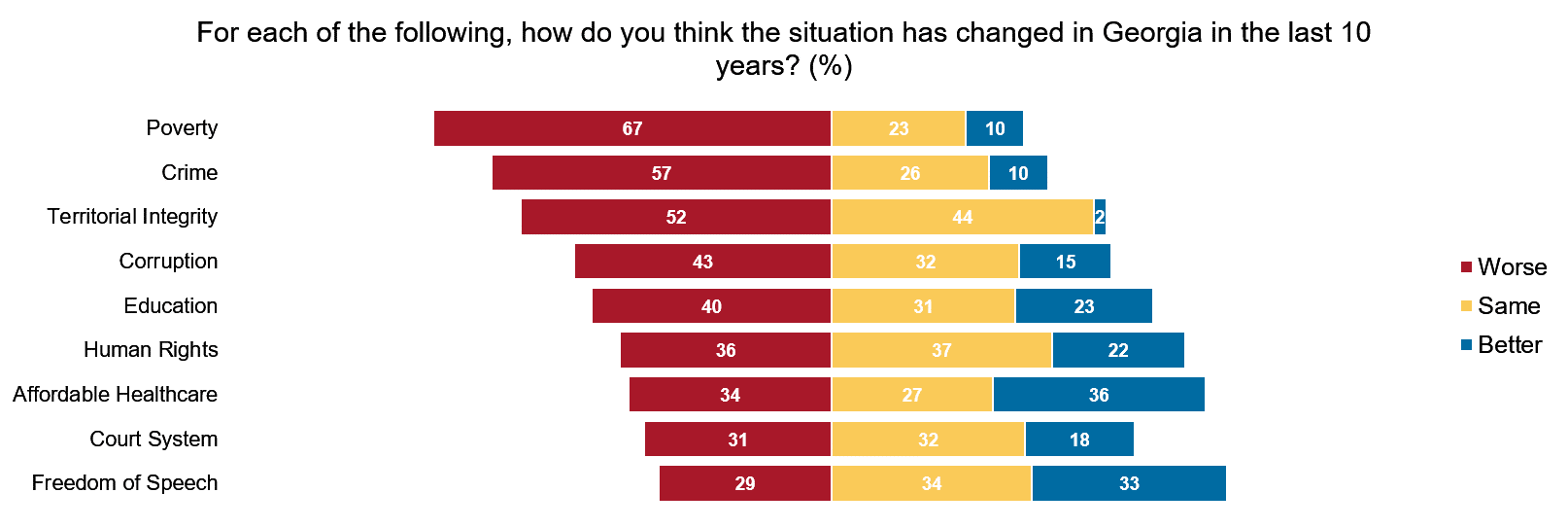
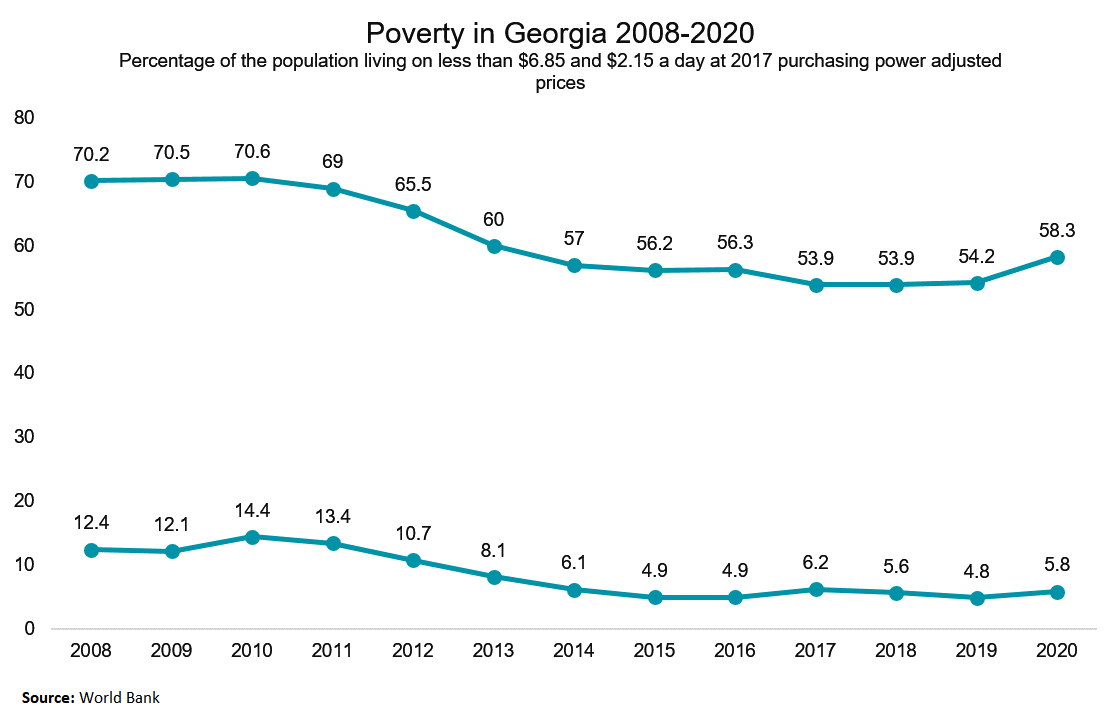
While two thirds of the public think that poverty has worsened, World Bank data suggests that poverty in Georgia has declined over the past decades. Although there are ups and downs in the data over the years, there has been a decline in the share of Georgians living on under $6.85 (converted into purchasing power parity) a day, from 66% in 2012 to 58% in 2020. The percentage of Georgians living in poverty did, however, increase in 2020, likely in response to the pandemic. A similar trend is present for the $2.15 poverty line (converted into purchasing power parity), with declines from 11% to 6%.
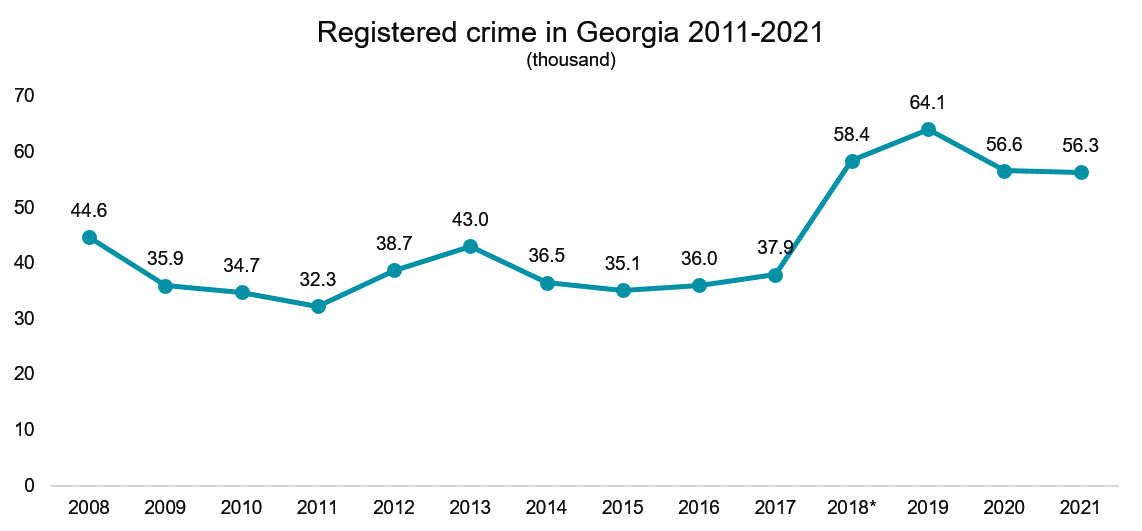
Roughly three in five Georgians (57%) believe that crime has worsened over the last decade. Official statistics seem to confirm people’s negative views, with Georgia registering 56,300 crimes in 2021, compared to less than 40,000 ten years prior. However, in 2018 the Ministry of Internal Affairs changed its crime recording methodology in a way that meant that a greater range of crimes were recorded. As a result, it is not possible to unequivocally claim that crime has substantially increased over the last 10 years.
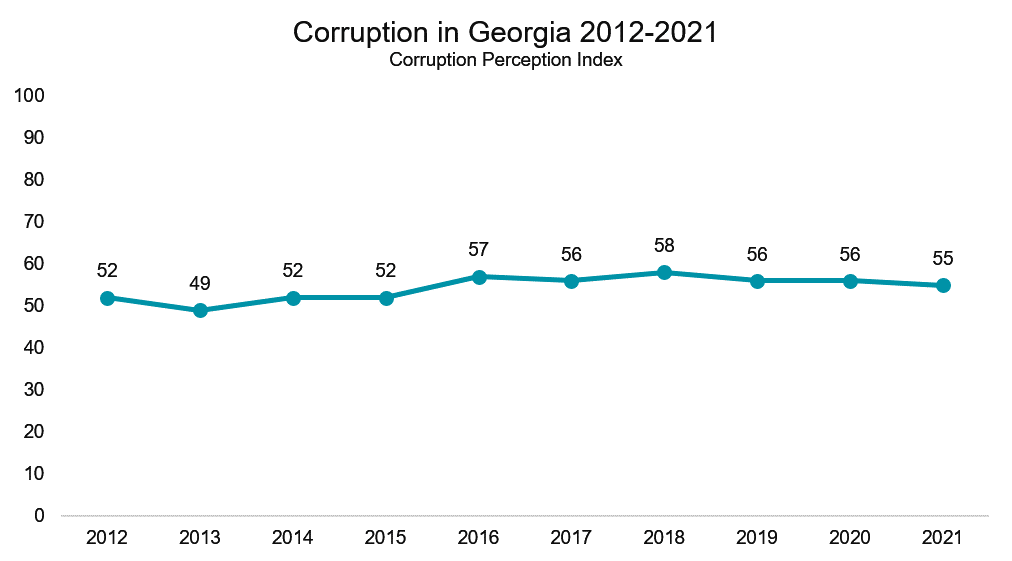
Two in five Georgians think that corruption (43%) has worsened in the last decade. However, the Corruption Perception Index (CPI) suggests that corruption has not varied much over the last decade, with a slight improvement from 2013-2018 and slight decline since.
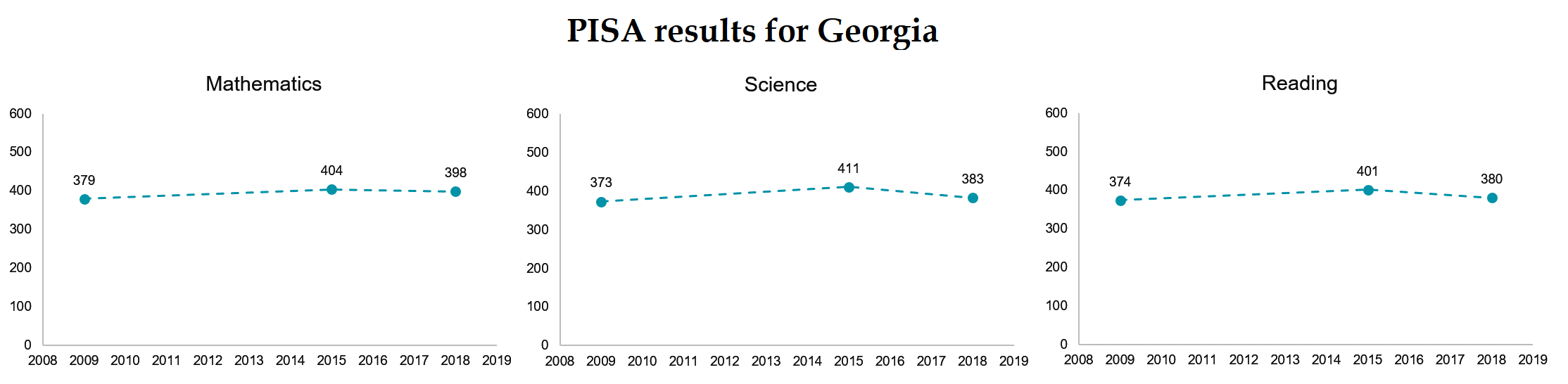
With regards to education, 40% of the public feel it has worsened. But data from the Programme for International Student Assessment (PISA), a study intended to evaluate national education systems, suggests that Georgia has slightly improved its scores in the last decade, albeit with a slight decline since 2015. 
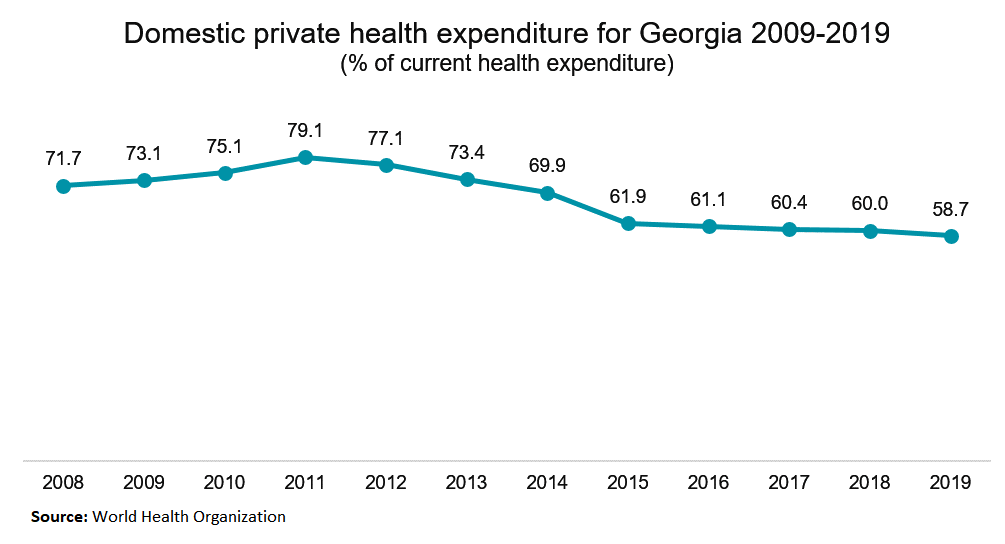
Some of the most positive public assessments were for affordable healthcare. About a third of the public (36%) believe that the situation around affordable healthcare has improved in the last decade. Data from the World Health Organisation appears to corroborate this, as it suggests that domestic private health expenditure in Georgia has declined as a share of total health expenditure from 77% to 59% of spending. However, it must also be noted that lesser private and greater public expenditure is no guarantee of better quality health care services. 
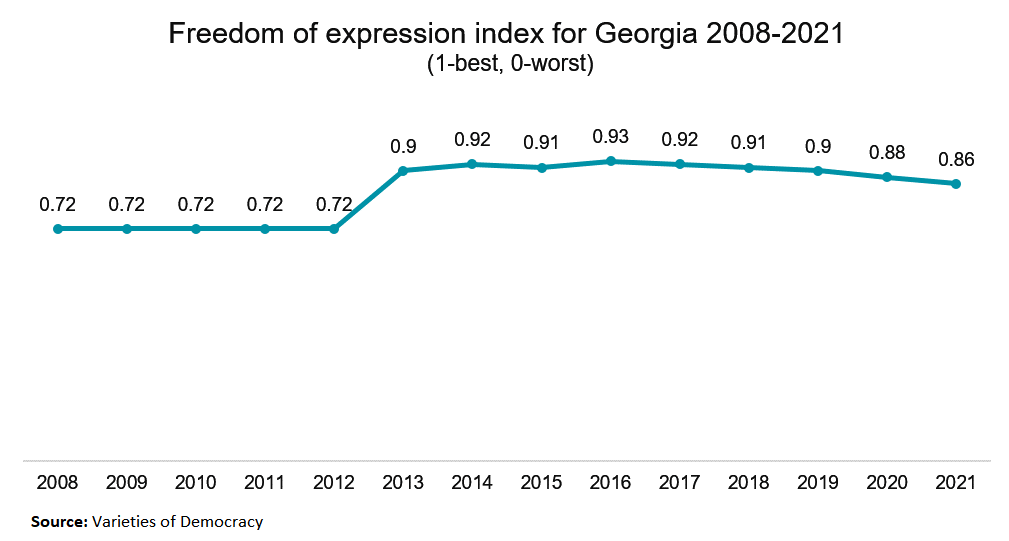
In terms of freedom of speech, a third of Georgians believe that it has improved over the last ten years. Data from the Varieties of Democracy project suggest that Georgia’s scores did improve in 2012-2013, but have declined since 2016. 
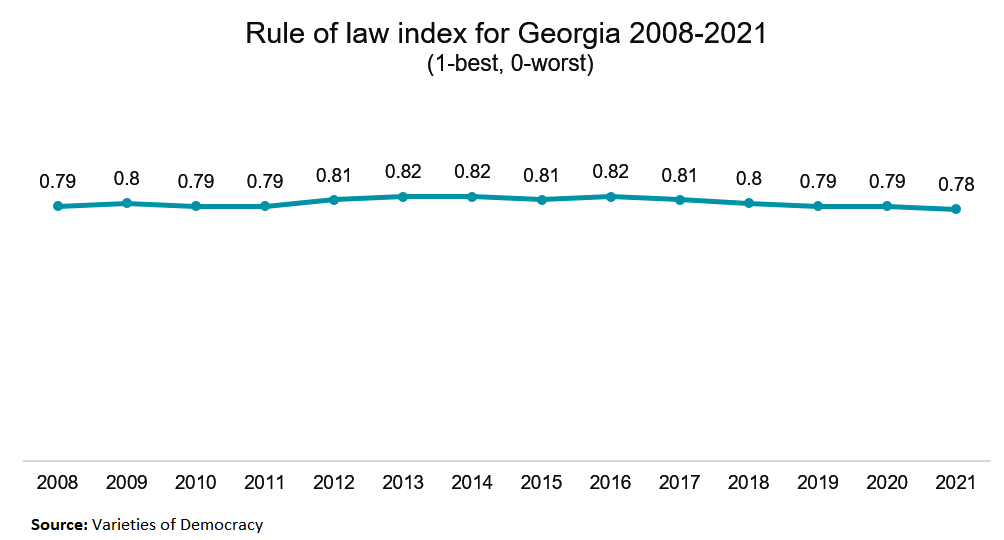
As for the court system, roughly one in three people (31%) think it has worsened over the last decade, but the Varieties of Democracy project suggests that Georgia’s score on the rule of law index has not changed since 2008. 
The public tends to think that the situation in Georgia in terms of poverty, crime, and territorial integrity has worsened over the last decade, while feeling most positive about freedom of speech and access to affordable healthcare. However, these sentiments are not reliably supported by publicly available data on the issues.

Tuesday, April 06, 2021

Drug prices as big a concern as COVID-19 for Georgians

Note: This article was first published on the Caucasus Data Blog, a joint production of CRRC Georgia and OC Media. The article was written by Avto Dolidze, a Junior Fellow at CRRC Georgia. The views expressed in this article represent the views of the author alone, and do not necessarily represent the views of CRRC Georgia, NDI, or any related entity

While Georgia’s healthcare system has faced significant challenges as a result of the pandemic, just under half of Georgians consider an issue related to COVID-19 to be among the main challenges facing the country’s healthcare system with medicine prices remaining a big worry, polling suggests. 

In the December 2020 NDI and CRRC Georgia survey, respondents were asked what the largest issue facing the healthcare system was. They were allowed to name up to three issues. The most commonly named issues were the cost of medicine (46%), access to hospitals due to COVID-19 issues (16%), and other COVID-19 related issues (25%).

When grouped by whether or not someone mentioned an issue directly related to COVID-19, the data suggest that half the public thinks issues unrelated to COVID-19 are the main issues facing the healthcare system. 

One in five respondents (19%) named only COVID-19 related issues. Almost a third (29%) named at least one COVID-19 related issue, and at least one non-COVID-19 issue. Overall, half of the population (52%) named only issues not directly related to COVID-19.


Note: The responses “Accessibility of hospitals due to COVID-19 issues”, “Accessibility of doctors for COVID-19 issues”, “Accessibility of COVID-19 tests”, and “Other COVID-19 related issues” are considered COVID-19 related issues. The responses “Cost of Medicine”, “Lack of qualification of doctors and medical personal”, “Cost of Medical care/doctor’s visits”, “Availability of hospitals and healthcare services”, “Bureaucracy of the healthcare system”, “Cost of medical supplies”, “Poor quality medicine”, “Poor hospital infrastructure and equipment”, and “Bad sanitary conditions in hospital and clinics” are not counted as COVID-19 related issues. 

There were few significant predictors of whether or not someone thinks COVID-19 is among the healthcare system’s main issues. Women and men, people in cities and villages, people in relatively wealthy and poor households, and those with higher and lower education levels were similarly more or less likely to name at least one COVID-19 related issue. However, attitudes did vary by age and ethnicity. 

Older people were more likely to be concerned about issues not related to COVID-19 than younger people, who, in turn, were more likely to be concerned about both COVID-19 and non-related issues. 

This may be unsurprising, as past analyses have shown that even though the cost of medicine is the biggest issue for all age groups, older people are particularly concerned about drug prices. Ethnic minorities were less likely to mention COVID-19 related issues than ethnic Georgians.

Note: The above chart used a multinomial regression model. The model controlled for age group (18–34, 35–54, 55+), sex (female, male), settlement type (Capital, urban, rural), education (secondary or lower, secondary technical, higher than secondary), ethnicity (Georgian, ethnic minority), and a simple additive index of durable goods owned by the respondent’s household, a common proxy for wealth. 

While COVID-19 is straining healthcare systems around the world, including in Georgia, half the public do not consider it among the largest issues facing the healthcare system in the country. Older people in particular are more concerned about the cost of medicine. 

The data used in this article is available here.

Monday, November 04, 2019

Drugs for desert? Biggest monthly household expenses in Georgia

The economy remains the main concern for people in Georgia. Together with the consumer price index and USD-GEL exchange rate rising, average household expenditures also have increased over the last couple of years. Meanwhile, according to recent data only 10% of the population has any savings. Although household expenditures have increased, what are people spending money on? The most recent CRRC-NDI survey from summer 2019 asked questions about household expenditures which provide a sense about what people spend money on in Georgia as well as who spends more on different categories of goods and services.

Most of the families in Georgia spend everything they earn. When asked about the largest monthly household expenses, everyday necessities came out on top, while leisure related expenditures were named by only a few. Food and utilities were named twice as frequently as any other expense. While this might not be a surprise, it is noteworthy that expenses on medicine came third, with more than one in three naming it as one of their largest monthly household expenses. Interestingly enough, some people, though a negligible number, still name travel, exercise, and entertainment related expenditures as the largest.


Note: Respondents were allowed to name up to three categories.

To understand how household expenditures vary between different demographic groups regression models were constructed. They included sex (male, female), age group (18-34, 35-54, 55 and +), settlement type (capital, large urban, small urban, rural), ethnic enclave status (primarily Georgian settlements, primarily minority settlements) and an additive index of ownership of different items, a common proxy for wealth.

When looking at the most common household expenses, food and utilities are on top regardless of people’s gender, age, the type of settlement they live in, or their economic situation. Nevertheless, the regression model showed that several demographic variables are useful in predicting who is more likely to have certain kinds of expenditures. For example, people who live in the capital  are less likely to name loans/installments/mortgages as their largest monthly expenditure compared to people in small urban and rural areas. People over 55 and people with lower economic standing are much less likely to name this expenditure as well, compared to people who are younger and people with higher economic standing. Also, minority settlements are less likely to name loans compared to Georgian settlements.


Similarly, there are some small differences in terms of education costs as well. People who are over 55 and men are slightly less likely to name education related expenditures compared to younger people and women. In households with higher economic standing, education related expenses are more likely to be mentioned among the largest monthly household expenditures.

One of the most interesting issues to look at is spending on medicine. It is third highest on the list, which is telling: a third of the population is spending as much or more medicine as food. There are also some interesting differences between various groups associated with medicine related expenses. People living in small urban and rural areas are more likely to name medicine among their top expenditures than those who live in the capital. Also, minority settlements are slightly less likely to mention medicine in their expenditures, than people from Georgian settlements. Similarly, younger people are one third as likely to name medicine, compared to people who are 56 or older. An additive index of ownership of household items shows that Georgians who own fewer things are more likely to say medicine is one of the top monthly expenditures in their household compared to people who own more. Differences between richer and poorer people hold even, when looking at people in different age groups. In all age groups people with higher economic standing name medicine less frequently than poorer people. Thus, older people and people with worse economic situations are more likely to name medicine as among their largest monthly expenditures. Interestingly, the same pattern is not present with medical care spending as opposed to spending on medication.


The data show that in all demographic groups in Georgia subsistence related expenses occupy the main position in household expenditures. Food, utilities, and medicine are the top expenditure categories for young and old, well-off and poor, men and women, and people in cities and rural areas. Though, there are of course some differences in expenditures between some demographic groups as well. Older people are less likely to have loans or education related expenses. Economically better off people are more likely to name these among their top expenditures. Moreover, older people and people with worse economic situations are more likely to name medicine related expenses, than younger people and those with better economic situation. Importantly, economic situation remains important even when controlling for age: better-off people are less likely to name medicine related expenses than the poor no matter their age.

Note: This blog post is based on logistic regression analyses. The dependent variable was a dummy variable for mentioning food, cost of utilities, medicine, medical care, or loans as the largest monthly household expense versus not naming this expense.  The independent variables included sex, age group, settlement type, ethnic enclave status, and an additive index of ownership of household items. The data used in the above analysis is available here. The replication code can be found here.


Monday, August 06, 2018

People’s views about who should pay for health insurance in Georgia

A previous CRRC blog post explored attitudes in Georgia towards the role of the government, and specifically, whether people think the government should act as a parent or as an employee with regards to its citizens. One very specific aspect of this issue is reflected in opinions about how much the government should be involved in coverage of health insurance expenses.

According to the findings of a survey that CRRC-Georgia carried out for Transparency International - Georgia in March, 2016, only 3% of the population reports that people should cover their and their family members’ health insurance expenses themselves, while an absolute majority (96%) says these expenses should be covered at least partly by the government. A slightly larger share of people in this group (52%) would expect the government to fully cover the population’s health insurance expenses, while according to 44%, these expenses should be covered partially by people themselves and partially by the government.

Although the two questions were asked in two different surveys, thus, direct comparison of the findings is not possible, there are demographic similarities between those who view the government as a parent and those who expect the government to fully cover the population’s health insurance expenses, on the one hand, and, on the other hand, between those who view the government as an employee and those who say that health insurance expenses should be covered partially by people themselves and partially by the government. The previous blog post highlighted that people with higher than secondary education and those residing in the capital were more likely to view the government as an employee than as a parent. Similarly, people with higher than secondary education and those living in the capital report health insurance expenses should be covered partially by people themselves and partially by the government.


Note: The answer options for the question, “What is the highest level of education you have achieved to date?” were grouped as follows: options “No primary education”, “Primary education (either complete or incomplete)”, “Incomplete secondary education”, and “Completed secondary education” were grouped into the category “Secondary or lower”. Options “Incomplete higher education”, “Completed higher education (BA, MA, or specialist degree)”, and “Post-graduate degree” were grouped into the category “Higher than secondary”.

Interestingly though, whereas the previous blog post reported that women were more likely to believe the government should act like a parent, there is virtually no difference between men’s and women’s opinions on how health insurance expenses should be covered.

To explore the data used in this blog post further, visit our Online Data Analysis platform.

Tuesday, October 15, 2013

Funding for Healthcare in the South Caucasus

Government expenditure on healthcare can be an indicator of a government's commitment to the health of its citizens. It is also important for the sustainability of health programmes. Nevertheless, the total health expenditure in all three countries of the South Caucasus is dominated by private spending, including prepaid plans and “out-of-pocket” (on the spot) payments. This blog provides a brief overview of the patterns of government spending on healthcare in the South Caucasus during recent years. The blog also links these patterns to data from the 2012 Caucasus Barometer (CB) about assessments of health, satisfaction with health, and trust in the health system.

Total expenditure on health as a percentage of GDP provides information on the level of resources invested in health relative to a country's overall wealth. In developed countries, government spending on healthcare accounts for approximately 10% of gross domestic product (GDP) or more. This percentage of resources pooled by the government is comparatively lower in the South Caucasus. It accounted for as much as 9.9% of the total GDP in Georgia, 4.3% in Armenia and 5.2% in Azerbaijan, according World Health Organization data from 2011.


Total expenditure on health is distributed between private and government expenditures, which are also unequal across the globe. In more than half of low income countries, government expenditure on health is less than 50% of total health expenditure. Where health spending is comparatively lower in general, the shortfall is made up by private spending. This can also be observed in the South Caucasus where the private amount paid for health services dominates the expenditure (reaching around 78% in Georgia and Azerbaijan, and more than 64% in Armenia). Most of the private expenditure on health in all three countries is so-called “out-of-pocket” – made by patients to both public and private providers at the time of receiving health services. Despite the fact that this method of payment can result in financial catastrophe for individuals or households, in each country in the South Caucasus “out-of-pocket” expenses amounted to 89% of total private expenditure on health.


Despite more substantial budgetary allocations to citizens’ healthcare by the government in Georgia, compared to  Armenia, the CB shows that trust in the healthcare system in these two countries is almost the same (39% and 38%, respectively-“Fully trust” and “Somewhat trust” combined). Azerbaijanis’ trust in the healthcare system is the highest among the three countries, amounting to 51%. Considering the self-evaluation of one’s health, around half of the adult Azerbaijani population rates their health as good or very good. Again, this rate is lower in Georgia and Armenia, where only about one-third of these societies think they have good health. Interestingly, these numbers are again similar despite the fact that the Armenian government has larger health expenditure than the Georgian government.


Private expenditure still dominates the healthcare expenditure in the South Caucasus. Given that large parts of these populations are poor and cannot afford to spend much on healthcare, low levels of government spending on health might have an impact on the health of citizens. Nevertheless, a higher share of government health expenditure does not necessary directly influence the quality of a healthcare system, or an individual’s level of trust or self-assessment of health. Thus, other factors ought to be taken in consideration such as evolving purchasing power parity, the general price of healthcare, or remittances.

For more information on this topic, you are welcome to visit our Caucasus Barometer database.