Showing posts with label Environment. Show all posts

Thursday, April 25, 2024

Georgians are feeling the effects of climate change

Note: This article first appeared on the Caucasus Data Blog, a joint effort of CRRC-Georgia and OC Media. It was written by Dustin Gilbreath, a Non-Resident Senior Fellow at CRRC-Georgia. The views presented in the article are the author’s alone and do not necessarily represent the views of CRRC-Georgia, Caucasian House, or any related entity.

The effects of climate change are increasingly being felt acutely in Georgia. A CRRC poll investigated Georgian people’s perception of climate change, and found that 90% of respondents considered it to be an important issue, and 75% had experienced changes in local weather patterns. 

Climate change is increasingly having catastrophic impacts around the world, from an increase in insect-borne infectious disease to a rise in deadly heatwaves, flooding, and storms. 

These impacts are also being felt in Georgia, with unpredictable weather severely impacting agriculture and winemaking, glacial melting causing an increase in natural disasters, and deadly weather events like the Black Sea storm Bettina increasing in frequency. 

However, climate change had only infrequently appeared in mainstream Georgian discourse prior to the tragic Shovi landslides

In this context, what does the Georgian public think about climate change? 

Data from a newly released CRRC Georgia poll suggest that an overwhelming majority of Georgians consider climate change important, and most believe that they have personal experience of climate changing in their area.

While few considered climate change one of the primary issues that Georgia faced, almost all believed that climate change was happening. 

To assess the relative importance of climate change, the surveyed public was asked to identify the top issues the country faced, and allowed to name two. As in most surveys, economic concerns prevailed, with 21% naming the economy and 18% naming poverty as Georgia’s top issues. In contrast, 2% named climate change and 5% named environmental protection. In total, 6% named one or the other, as some respondents named both climate change and environmental protection. 

While the data suggests that climate change is not seen as a high priority issue, it also shows that the public does nonetheless consider it to be significant. 

When asked how important or unimportant the issue was, 90% considered it to be important (31%) or very important (59%). The data paints a similar picture for how concerned the public is about climate change — 80% of the public is worried (42%) or very worried (38%) about climate change. 

While there is a high degree of sympathy towards the issue, the public is relatively unclear about the root causes of climate change. Only a third of Georgians (32%) believe that climate change is primarily driven by human action, while 42% believe it is partially natural and partially human driven. One in five (21%) believe that climate change is primarily driven by natural causes. 

While the primary cause of climate change is less than clear to the public, there is consensus on climate change being real: only 1% of respondents reported the belief that climate change is not happening at all.

The strong belief in climate change may be connected to a high prevalence of people reporting seeing the effects of climate change in their communities, and that they have experienced weather events that they take as proof of climate change. 

Three quarters (75%) of the surveyed public reported that there have been changes in their local weather patterns, and 74% agreed with the statement that ‘I have personally experienced unusual weather that I feel is clear proof of climate change’.

Regarding the specific weather events that people had noticed, unusually warm weather for the time of year, heavy rains and flooding, and sudden changes in weather topped the list. In contrast, less than 10% of respondents named heavy snowfall, large storms, and unusually cold weather.
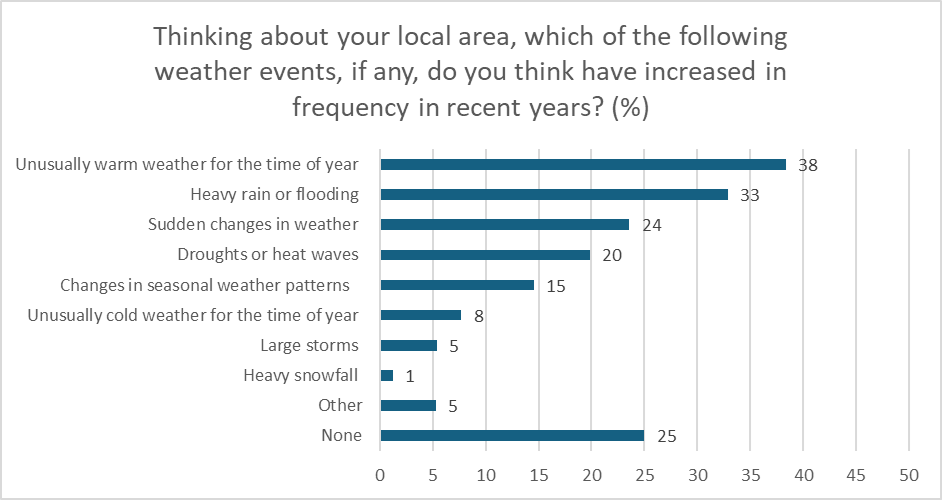
The above data shows that while climate is not a primary concern to the Georgian public it does matter to them, with people aware of the changing climate in their communities. 

This article was written by Dustin Gilbreath, a non-resident senior fellow at CRRC Georgia. It is based on a new report, available here.

Dustin works as a polling consultant for climate change-related organisations, as disclosed on his LinkedIn profile. The views within this article reflect the views of the author alone, and do not necessarily reflect the views of CRRC Georgia, any related entity, or any entity which Dustin works for.

Tuesday, November 24, 2020

How Georgians perceive environmental problems

Note: This article was co-published on the Caucasus Data Blog, a joint effort of CRRC Georgia and OC Media. This article was written by Dustin Gilbreath, Deputy Research Director at CRRC Georgia. The views expressed in this article represent the views of the author alone and do not reflect the views of CRRC Georgia, NDI, or any other entity.

While air pollution is dominant as the most important environmental issue for Georgians, a stark rural-urban divide exists with rural Georgians being one-third more likely to believe that there are no environmental problems in their communities.  

Georgia faces a number of environmental challenges, including air pollution, issues with invasive species such as the brown marmorated stink bug, and natural disasters

Data from the World Health Organization suggests that Georgia has a moderate problem with air pollution, ranking 70th in the world and, according to CRRC and NDI data from 2020, a little under half of Georgians perceive it as the biggest environmental issue in their community.  

At the same time, a quarter of the public does not think there are any environmental issues in their community, with people in rural areas particularly unlikely to think that their community faces environmental problems.

Both littering and food safety were named as the most problematic local environmental issue by 11% of respondents, while all remaining issues were named by less than 10% of the population. 

Respondents were allowed to name up to three different issues as ‘the most problematic’ in their community. Overall, 15% named three issues, 21% two issues, 31% one issue, and 32% reported that there was no issue or did not know which issues were most problematic. 

A regression analysis suggests that people with higher than secondary education named more issues than those with only a high school education. Similarly, respondents living in wealthier households named more issues than those in poorer households, controlling for other factors.  Older people named fewer issues than younger people generally. The largest difference between groups though was between settlement types. People in rural areas named half as many issues as people in Tbilisi. 

In rural areas, people were also significantly more likely to report there were no problematic environmental issues in their settlements. People in rural areas were 33 percentage points more likely, controlling for other factors, to think there are no environmental issues in their community compared to people in Tbilisi. Similarly, rural people are 17 percentage points more likely to report no environmental issue in their community than those in urban areas aside from Tbilisi.  

Not naming any environmental issue was also associated with education. People with tertiary education are seven percentage points less likely than those who completed only secondary school to say there are no issues. Similarly, people with a vocational education are five percentage points less likely to report there are no environmental issues compared with those with only secondary education, controlling for other factors. 

There were no significant differences between women and men, those in wealthier and poorer households, the employed and those not working, and people in different age groups in terms of naming at least one issue or reporting there are no issues.


Monday, March 30, 2020

Air pollution in Tbilisi nearly halved by Covid-19 measures

[Note: This article was co-published with OC Media. It was written by Ian Goodrich, a policy analyst at CRRC Georgia. The views presented in this article do not necessarily represent the views of CRRC Georgia or any related entity.]

Particulate matter in Tbilisi’s air has fallen by as much as 45% following the introduction of measures to combat the spread of COVID-19, according to analysis of air quality data by CRRC Georgia.

The findings reflect broader global trends which have seen dramatic decreases in air pollution levels in China, Italy, and the United Kingdom.

Data from the Ministry of Environmental Protection and Agriculture show a clear fall in air pollution in the Georgian capital.

The plot below examines overall pollution levels in Tbilisi over the last month, overlaid on the same period for the last three years.

It highlights key dates in the COVID-19 crisis, specifically the first registered case, on 26 February, the closure of bars and restaurants and restrictions on entry into the country on 16 March, and the declaration of a state of emergency on 21 March.


Note: Two-day rolling average of the mean of normalized values for carbon monoxide, nitrogen dioxide, sulfur dioxide, and particulate matter (PM2.5, PM10).

Total pollution appears to be lower following the closure of bars, restaurants, and borders. The data also suggest that in the case of these closures, falls in pollution appear to have preempted policy decisions. The pattern that emerges should be intuitive for anyone who has looked outside in Tbilisi over the last few weeks.

Air pollution is however strongly seasonal, peaking and falling throughout the day, week, and year. It is also closely tied to weather patterns: strong wind, for example, will disperse pollutants. Modelling allows these factors to be taken into account when determining the overall impact of Covid-19 measures.

Models have been created for levels of five key pollutants in Tbilisi, examining particulate matter (PM 2.5 and PM 10), carbon monoxide, nitrogen dioxide, and sulfur dioxide. The models adjust for seasonal factors using Facebook’s Prophet tool, and weather using daily data from NASA.

The models show that following the declaration of emergency, almost all categories of air pollution fell. The only exception to this pattern is sulphur dioxide which has remained relatively constant throughout.


The most dramatic impacts from COVID-19 related measures are seen for particulate matter pollutants (PM2.5 and PM10) with each falling by 40%–45% after the emergency declaration, approaching half their pre-crisis rate.

Interestingly, for these substances, a sharp fall was present prior to the introduction of emergency measures. It is possible that this drop may be a consequence of the decline in vehicle traffic as workplaces and recreational venues began to close.

In contrast, other substances only declined following the introduction of emergency measures. Differences in change patterns are likely attributable to the different sources of pollutants.

Notably, changes are most pronounced for particulate matter, carbon monoxide and nitrogen dioxide, substances related to transportation.

No significant change was observed for sulfur dioxide, which is more closely associated with coal and oil burning for power generation.

These pronounced changes show the profound impact of human activity on the capital’s air. The restrictions imposed in response to COVID-19 are by necessity severe, but also temporary. As life returns to normal and the crisis abates, policymakers may reflect on these changes when considering how to tackle air pollution.


Note: The data and replication code for the analysis presented above is available here. The data analysis used an interrupted time series design, a quasi-experimental method which tests for significance in difference between points in a time series before and after a cut-off. 

Monday, October 28, 2019

How many cars are there in Tbilisi’s streets?

People in Tbilisi often talk about the growing number of vehicles and problems associated with them. According to NDI and CRRC public opinion surveys, every third Tbilisi resident considers traffic, every fifth parking, and every other pollution among the most important public goods related issues in the city. These issues clearly relate to the cars on Tbilisi streets. Yet, a basic fact that could help inform policy to address these issues – how many cars drive on Tbilisi’s streets – is unknown, with different data sources indicating sharply different estimates.

The Ministry of Internal Affairs (MIA) is responsible for car registration and maintains a database of registered vehicles in the country. The number of registered vehicles are available from the MIA in annual reports and monthly updated lists of vehicles that have valid registration status. The official data suggests that at the moment there are 494,627 vehicles registered in Tbilisi. Excluding agricultural vehicles, specialized vehicles, non-motorized trailers, and two-wheeled vehicles, as some international reports do, suggests there are 462,922 light vehicles, trucks, vans and buses registered in Tbilisi. This is equivalent to 395 vehicles per 1000 residents.

While these numbers are informative, what they really say is how many vehicles are actively registered rather than driving on Tbilisi’s streets. These numbers likely differ, because the registered vehicle list includes cars that are no longer working, but still have valid registration status. These cars are not removed from the vehicle registry, because there is rarely an incentive to do so for the owner such as registration fees or fines for failing to remove the car from the registry. The exceptions to this are when inactive cars are sold for scrap or for export, because the people purchasing the vehicle often request that the owner remove it from the registry.  Given this situation, it is reasonable to believe that the actual number of vehicles driven in the city is lower than the official number of registered vehicles.

Estimating the number of cars
To estimate the number of vehicles driven in the city, the following assumptions are used:

  1. Only light vehicles, trucks, vans, and buses are included in the data analysis. Agricultural vehicles, specialized vehicles, non-motorized trailers, and two-wheeled vehicles are excluded from the data analysis, though they are provided in the MIA data. Aside from international practice, this generally makes sense: agricultural vehicles are on the streets relatively rarely compared to cars and vans. Generally two-wheeled vehicles are not considered due to their lighter impact given their lighter size and parking space needed.
  2. The analysis assumes all registered vehicles under corporate ownership are in working condition and in use, while only some individually owned vehicles are. The rationale behind this is that corporate owners (both state and private) have stronger incentives to de-register vehicles, as they appear on their balance sheets, a factor individual owners do not consider. 
  3. The share of registered vehicles in working condition is estimated using household survey data from April-June, 2016. The analysis assumes that the share of vehicles registered and in working condition has not changed significantly. 

From here, when vehicles is mentioned, it means light vehicles, buses/vans and trucks together. Otherwise, the specific group of vehicles is used (e.g. light vehicles or buses/vans and trucks). All statistics refer to Tbilisi only. When the ownership status is not specified as individual or corporate, all vehicles are included.

As noted above, there is good reason to believe that there are fewer individually owned vehicles in operation than registered in Tbilisi. Hence, survey data is used to estimate the number of individually owned vehicles in use in Tbilisi. The latest publicly available survey data comes from 2016 and is used to estimate the share of individually owned vehicles in use among all individually owned vehicles, and then based on the third assumption above, this number is used to estimate the number of vehicles in combination with 2019 official registry data.

The survey data comes from the Tbilisi Metropolitan Area Transportation Household Survey, which Systra conducted in April-June, 2016. The survey had 6,092 respondents in Tbilisi. It asked about the number of vehicles households have, the vehicle type (light car/SUV, pickup truck, van/boxcar, heavy truck, light truck, microbus or other), ownership status (owned, professional use, rented or other), and frequency of usage. Vehicles in working condition are defined as those that have driven at least one kilometer during the 12 months prior to the survey. According to the survey, there were 168,314 (+/-5,702) individually owned vehicles in use in Tbilisi in 2016.

The next step is the calculation of the share of working vehicles among individually owned registered vehicles in 2016. However, the official registry data provides information about ownership status only for 2017-2019 data, while for 2016, there are only two official statistics available: the number of light vehicles (376,962) and the number of total vehicles (440,042). Ownership status, however, is not available. Hence, to estimate the number of individually owned vehicles in 2016, this post uses the average of 2017-2019 data to estimate:
  • The share of individually owned light vehicles among all registered light vehicles and; 
  • The share of individually owned trucks, vans, and buses among all registered vehicles.
Between 2017 and 2019, the average share of individually owned light vehicles in Tbilisi was 83%. The analysis assumes that the average share of individually owned vehicles among all vehicles did not change significantly between 2016 and 2017-2019. Under this assumption, multiplying the average share of individually owned light vehicles by the total number of registered light vehicles leads to an estimate of the total number of individually owned registered light vehicles. According to the MIA data, there were 376,962 light vehicles registered in Tbilisi in 2016. Of these, approximately 313,896 of them were individually owned based on the above estimate.

As for buses/vans and trucks, the average share of individually owned buses/vans and trucks among all vehicles in 2017-2019 was 4%, which translates to 16,780 individually owned buses/vans and trucks (from 440,042 registered vehicles in 2016). Adding the two estimates leads to an overall estimate of 330,675 individually owned, registered vehicles in 2016. By comparison, the survey data from 2016 indicates that there were 168,314 (+/-5,702) individually owned vehicles that were working in 2016.  These figures taken together suggest that among registered, individually owned vehicles, 51% (+/- 1.7%, due to a survey error) are in working condition and being used.

Assuming that the share of vehicles in use is the same for individually owned vehicles and has not changed significantly in recent years, the number of individually owned light vehicles, buses/vans and trucks in Tbilisi in 2019 is approximately 186,855, out of the 367,101 registered individually owned vehicles. Assuming that all corporate vehicles are working (95,821), there are 282,676 light vehicles, trucks and buses, on the streets of Tbilisi of the 462,922 which are currently registered


Based on the above figures, there are 241 vehicles driving on Tbilisi’s streets per 1000 residents in 2019, 57% of the number that are registered in Tbilisi. The real number of vehicles in Tbilisi’s streets might still be higher than this estimate, as some vehicles are not registered in Tbilisi, but drive on its streets. At the same time, many cars registered in Tbilisi are likely to be driven outside of Tbilisi. Even taking this into account, it seems unlikely that there are so many cars that drive on Tbilisi’s streets but that are registered elsewhere that it would throw this estimate off dramatically.


Even though there are likely less cars on the road than previously thought, the problems they create are foremost in the minds of the residents of Tbilisi. In turn, the data suggests that the impact per car on the problems with parking, traffic, and pollution are larger than one might believe based on the official estimates of cars registered in Tbilisi. In turn, this suggests a clear need for policy to address the issues before they become worse.

Monday, March 11, 2019

Georgians support technical inspections of motor vehicles, even given the financial burden

[Note: This article was originally published on OC-Media. The text is also available in Georgian here. The article was written by David Sichinava, CRRC-Georgia’s Research Director, and Nino Mzhavanadze, a Junior Researcher at CRRC-Georgia. The views presented in the article do not necessarily represent the views of CRRC-Georgia, the National Democratic Institute, or any related entity.]


In 2018, the Government of Georgia decided to resume mandatory periodic technical inspection of vehicles, which was partially suspended in 2004. From January 2019, all cars are required to pass technical inspection. In 2018, heavier vehicles were required to do so. The change was spurred on by the Association Agreement with the European Union, under which Georgia took responsibility to resume inspections. More practically, the government also began inspections as Georgia’s private vehicle fleet has been recognized as the main source of air pollution in the country. A June 2018, CRRC/NDI survey finds people in Georgia overwhelmingly support the decision.

To learn whether potential costs associated with the reform such as repairing a vehicle to meet standards the technical inspections require would influence support for the reform, a survey experiment was carried out. Half of the sample (the control group) was asked, “In your opinion, is it necessary or not to have technical inspection of vehicles?” The other half (the treatment group) was asked, “In your opinion, is it necessary or not to have technical inspection of vehicles, as a result of which the car owners may be required to repair their vehicles or buy new ones?”

While these questions were randomly assigned, the share of the supporters of the reform does not differ between the two groups, which suggests that, overall, people’s support for the reform does not vary significantly when reminded of the additional costs that will be associated with the reform.
Clearly, car owners will be directly affected by the reform. However, people living in households that reported owning car(s) (41% of the population) feel enthusiastic about obligatory inspections of vehicles. Similar shares in both car-owning and non- car-owning households answered that technical inspections should be necessary.

People living in Tbilisi (96%) and urban settlements (92%) almost unanimously supported resumption of technical inspection, while residents of ethnic minority settlements were much more (62%) reluctant about the changes. There is no difference between respondents who have different perceptions of air quality. Interestingly, those who perceive the quality of air as completely satisfactory, are more likely to support the introduction of technical inspections if they are exposed to the treatment statement.

Opinions do differ along party lines, however. Those who reported the United National Movement (UNM) as the party closest to them were significantly less likely to report technical inspections were necessary (regardless of being in the treatment or control group).

There is a strong consensus among people in Georgia regarding the need for the newly introduced technical inspections for vehicles. People support the idea even when reminded of the costs associated with the reform. The survey also indicates that attitudes towards the reform significantly differ along party lines, hinting at the politicization of the issue.

The data used in this blog post is available here. Replication code is available here.

Monday, June 11, 2018

Air pollution in Georgia: Available data and the population’s perceptions

Lung cancer, strokes, and heart attacks can all be caused by air pollution, a problem that affects millions of people daily. How aware is the population of Georgia about this problem, and how important do people find the issue?

In the December 2017 CRRC/NDI survey, pollution was the second most commonly named “infrastructural” issue, with 23% of the population choosing it in the respective show card. Only roads were named more often, by 33%. Approximately equal shares of men and women named pollution: 25% of women and 20% of men; similarly, there was no difference in the frequency of naming this issue by age.

Settlement type does make a difference, though. While 42% of people living in the capital reported in 2017 that pollution was the most important infrastructural issue, 26% of people living in other urban settlements did. This option was chosen much less often by the rural population (11%) and by people living in predominantly ethnic minority settlements (5%).  Perceptions of the importance of this issue have been consistent  both nationally and in different settlement types since CRRC and NDI have started asking the question.


The public’s concern with pollution makes sense. Levels of air pollution in Georgia are higher than what is recommended by the World Health Organization (WHO). PM2.5 is particulate matter with an aerodynamic diameter smaller than 2.5 µm. By comparison, the average diameter of a human hair is 50 to 70 µm. PM2.5 is considered the deadliest type of pollution as it is smaller than other types and can do much more harm to the human body. According to the latest available information, PM2.5 was recorded at 25 in Tbilisi in 2015. The level that the WHO recommends is 10. Anywhere from 12.1 to 35.4 is considered to be in the moderate range.

The government of Georgia has not ignored the problem. The Law of Georgia on Ambient Air Protection was adopted in 1999 to deal with air pollution, and was amended a number of times since. Recently larger, more environmentally friendly buses have been integrated into Tbilisi’s public transport system, a step toward a greener city. In addition, the excise tax on older cars, which cause a greater amount of pollution than newer ones in general, have increased, thus encouraging the import of greener vehicles. Moreover, vehicle inspections for large vehicles started again this year after a 10 year hiatus, and it is planned that these will become mandatory for all vehicles from 2019.

More can be done, and there are some potential improvements that can lead to a decrease in the number of cars on the roads, and therefore improve air quality. Public transport should be more efficient, which can be, in part, accomplished through optimizing routes and timetables. Making cities more pedestrian and bike-friendly, and increasing awareness of the benefits of walking and car sharing could also ameliorate the situation. Clearly, the government would have to back many of these changes.

While the government has taken some steps to reduce air pollution, quite radical steps are still needed in Georgia before it reaches a healthy level by WHO standards. The issue is important to the Georgian public, and particularly to the population of Tbilisi.

To learn more about CRRC surveys, visit our Online Data Analysis portal.

Monday, May 22, 2017

Air Pollution in Tbilisi: What the Data Says

[Note: This is a guest blog post by Dr. Hans Gutbrod, the former Director of CRRC.]

With the recent debate on traffic safety, it may also be a good time to highlight the issue of air pollution in Tbilisi – especially as municipal elections are coming up, and citizens (and candidates) may ask themselves what issues the election should focus on.

The data is clear: citizens care about pollution and the environment. In the June 2016 survey that CRRC conducted for NDI-Georgia, pollution was seen as a key concern for residents of Tbilisi. In the capital, 38% named it as one of the most important infrastructural issues, placing it ahead of all other issues related to infrastructure. In general, all generations care, but the young a bit more. In Tbilisi, about 40% of those under 36 years of age mentioned pollution as an issue compared to 32% of those 56 and older.

Politically, the topic also seems to resonate, though less strongly with voters who tend towards the big parties. Only 33% of Georgian Dream voters and 35% of United National Movement voters reported that pollution was the number one infrastructural issue in Tbilisi (Note: the party landscape has changed since the survey). This may in part be a result of the small sample size once you do crosstabs, but could also suggest that the environment and pollution may be an issue to mobilize and rally voters around. Supporting this contention is the fact that 40% of undecided voters in Tbilisi named the issue as the most important one in Tbilisi.

Yet how bad is the situation really? It is not so easy to find out. The government does collect data at three measuring stations that have been donated by Japan, but it is made available one day late, in PDFs, and even those who have interpreted lots of data will need a significant amount of time to decipher what is going on.

A very quick glance on some random days in February suggests that the pollution in Tbilisi repeatedly exceeds limits that are considered healthy – often by a multiple.


Whatever the policy prescription, one sensible next step for citizens and parties to demand, and for the government to take, is to make this data accessible straightaway, live. Having the data, citizens could decide on what to expose themselves to, when. To have a good debate on policy, we need good data. Thus, a sensible suggestion to politicians whenever and wherever you meet them is to request that public pollution data be made available in real time.

Monday, July 18, 2016

Environmental issues in Georgia: a concern for all?

[Note: This post was first published on Friday, July 15th at the Clarion.]

By Sacha Bepoldin

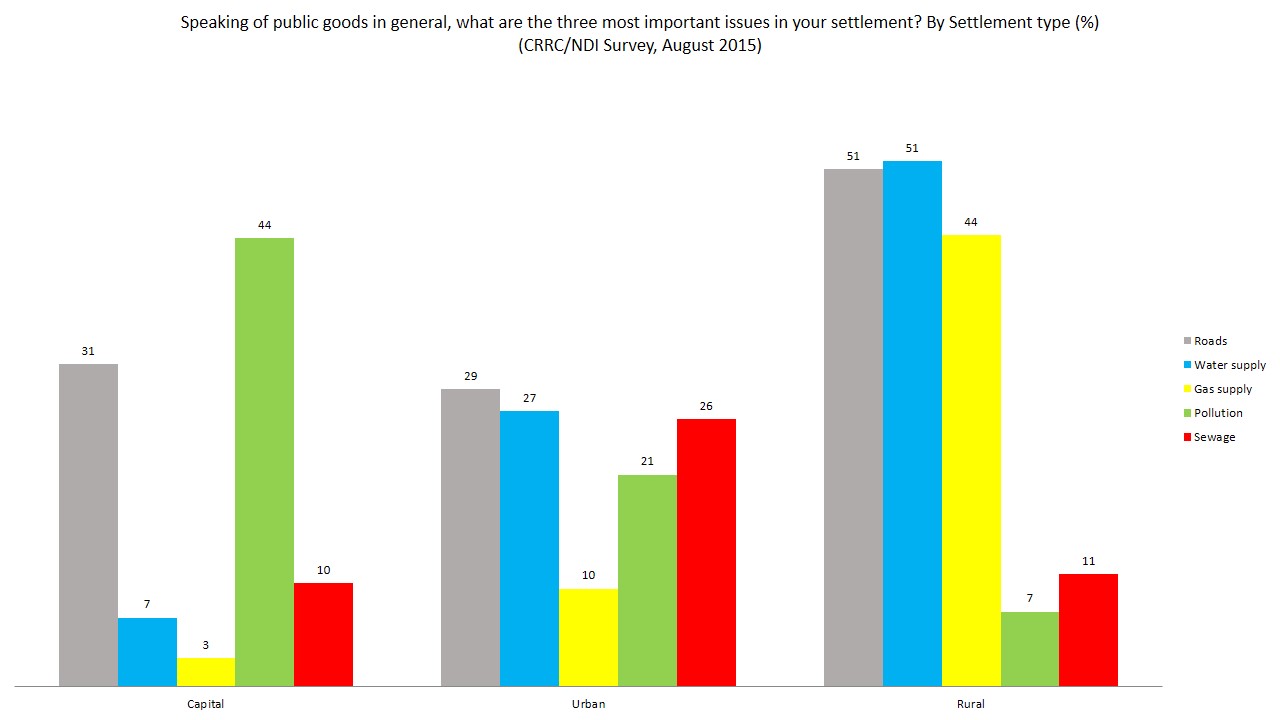
The United Nations Research Institute for Social Development (UNRISD) has highlighted that “Environmental decline adversely affects the health, well-being and livelihood opportunities of the individuals affected by pollution or natural resource depletion. Soil erosion, deforestation, the loss or depletion of animal and plant species limit the productive opportunities of vast numbers of people.” In Georgia, according to the 2009 National Report on the State of the Environment of Georgia and the 2012-2016 National Environmental Action Programme, the increasing number of natural disasters, chemical pollution of soils and progressing desertification, mainly in Shida Kartli, Kvemo Kartli and parts of Kakheti, are clear signs of man-made pollution. Both rural and urban inhabitants of Georgia are affected by environmental problems, albeit of a different nature. As public opinion data shows, people assess the importance of environmental problems differently. This blog post examines the salience of pollution as an issue for the settlement where people live and the relative importance of this problem compared to other issues, using the CRRC/NDI August 2015 survey.

One of the questions asked during the survey was, “Speaking of public goods in general, what are the three most important issues in your settlement?” Pollution was the fourth most frequently mentioned issue countrywide, after roads, water supply and gas supply. There are, however, differences in the frequency of naming these issues by settlement type. While pollution was the main issue in the capital, named by 44% of Tbilisi residents, it was named by only 7% of the rural population.


Note: The sum of answers does not add up to 100%, since respondents could name up to three issues. The charts in this blog post display only the five most frequently named issues at the national level.

At the national level, improvement of the water supply and roads are the public’s highest priorities in terms of budget spending, while pollution again ranks fourth. Pollution represents the highest priority for the population of Tbilisi, but only 1% of the rural population thinks spending on pollution should be a budgetary priority.


The rural population likely underestimates the importance of pollution and environmental issues in general. At the same time, a study conducted by the University of Gothenburg highlighted that degrading agricultural practices affect 35% of farmland in Georgia, which is already scarce due to the mountainous landscape of the country. As agriculture, according to official sources, is the main employment sector in the country, such practices threaten the lifestyle and economic opportunities of a large share of the population. Given the disconnect between lack of concern over this issue in rural settlements, on the one hand, and the likelihood that it affects the rural population, on the other hand, a communication campaign focused on environmental protection, especially in rural settlements, could help prevent further environmental problems.

To look through the data in more depth, visit CRRC’s Online Data Analysis platform.