As discussed in the first part of this blog post, the results of CRRC-Georgia’s survey conducted for the Georgian Civil Society Sustainability Initiative (CSSIGE) project in fall 2017 confirmed that both knowledge about NGOs and trust toward them is quite low in Georgia. This blog post looks at the inconsistency between low trust toward NGOs, on the one hand, and quite positive assessments of their activities, on the other hand.
The most frequent answer about the goal that, in people’s opinion, NGO members are pursuing in Georgia, is to help the population of the country in solving their problems (27%). The second most frequent answer, to receive funding/grants, was chosen from a show card by 16% of the population, and the third most frequent answer, to protect human rights in Georgia, by 13%. Thus, 40% believe the goal of NGOs is to help people in solving their problems or protecting their rights, which is an impressive share, especially given the low level of reported trust in NGOs.
When asked to assess the influence of NGOs in the development of Georgia, the findings are, again, counter-intuitive given the low level of trust. A majority (56%) assess this role as either “definitely positive” (17%) or “mainly positive” (39%), as opposed to the 14% who have chosen negative assessments (“mainly negative” according to 9% and “definitely negative” according to 5%). While 76% of those who report trusting NGOs quite logically say that NGOs’ role in the development of Georgia is positive, 5% assess this role as negative, and 13% answer they don’t know. A third of those who report distrusting NGOs assess NGOs’ role in the development of Georgia as positive and only a slightly larger share (39%) as negative.
Note: For the chart above, answer options “Fully trust” and “Rather trust” were combined into the category “Trust”, and answer options “Fully distrust” and “Rather distrust” were combined into the category “Distrust”.
It would be impossible to find out the causes of such inconsistencies without additional research. At this point, though, it is clear that both knowledge of and attitudes toward NGOs in Georgia are neither systematic nor coherent. Focus groups conducted for the same project suggest one possible explanation for this inconsistency – while not trusting NGOs, the participants’ dominant attitude was that NGOs would not do harm either. Moreover, a belief was reported that life in Georgia is better with NGOs than without them.
To have a closer look at the data, visit CRRC’s online data analysis platform.
Monday, February 18, 2019
NGOs in Georgia: Low trust, high expectations? (Part 2)

Monday, February 11, 2019
NGOs in Georgia: Low trust, high expectations? (Part 1)
Over the last decade, people in Georgia have reported rather low levels of trust toward NGOs. At the same time, when asked during surveys to assess specific aspects of NGO activities, the answers have usually been positive. This blog post is based on the findings of a survey on attitudes toward NGOs collected by CRRC-Georgia in fall, 2017 for the Georgian Civil Society Sustainability Initiative (CSSIGE). The first part of this blog post looks at the most up-to-date data on knowledge of NGOs in Georgia and reported levels of trust toward them. The second part explores the inconsistency between low trust toward NGOs in Georgia, on the one hand, and quite positive assessments of their activities, on the other hand.
Less than a third of the population of Georgia (28%) report trusting NGOs. Most people, though, are either indifferent (37% “neither trusting, nor distrusting” NGOs) or cannot answer the question (17%). The reported level of trust toward NGOs is comparable with the level of trust toward the courts and political parties, with one notable difference: the share of those who cannot answer the question is highest when trust toward NGOs is assessed. This may suggest that people do not always have a clear understanding of what NGOs are for or what they do in Georgia.
To gain an understanding of how solid people’s knowledge of NGOs is, the following question was asked, “I will now name several organizations. Please tell me whether it is an NGO or not. If you have not heard of any of these organizations, tell me you have not heard of it.” Two out of the 10 organizations asked about did not exist in Georgia at the time of the fieldwork.
Note: NGOs are marked with one asterisk (*). Organizations that are not NGOs are marked with two asterisks (**). Organizations that did not exist in Georgia at the time of the fieldwork are marked with three asterisks (***). Correct answers are highlighted in green.
Of the organizations asked about, only the status of the Parliament of Georgia was correctly identified by a large majority (87%). It also had the lowest share of “Don’t know” responses. Over half of the population was correctly informed about the Labor Party, Georgian Young Lawyers’ Association (GYLA), and the Rustavi 2 TV network. It is quite rare, however, that people consistently provide correct answers about all the organizations asked about. Leaving aside the answers about the two organizations that did not exist at the time of the fieldwork (“Association of the Unemployed” and “Society for Spreading Literacy”), less than 2% of the population answered about all other organizations correctly. This suggests that knowledge of NGOs is highly fragmented in Georgia.
As seen in the table above, the population has better knowledge about the status of six organizations: the Parliament of Georgia, the Labor Party; GYLA; Rustavi 2; Aldagi (an insurance company); and Transparency International – Georgia. Yet, the share of the population who named the correct status of all these organizations is only 16%. Below, this group is referred to as the “better informed population.”
Surprisingly, the better informed population does not report trusting NGOs in Georgia at a different level than people who are less informed about NGOs. These two groups differ only when it comes to the share of those answering “Don’t know”: while 5% of the better informed population responded so, 19% of the rest of the population did.
NGOs have not yet secured the population’s trust in Georgia. Still, the population reports rather positive assessments of specific aspects of NGO activities as will be discussed in the second part of this blog post next Monday.
To have a closer look at the data, visit CRRC’s Online data analysis platform.
Monday, July 25, 2016
Civic engagement in Georgia
Participation in various forms of social life can help people solve important social problems without the government’s involvement, which will eventually contribute to the formation of civil society. Different characteristics, including gender, age and settlement type, influence people’s participation in these activities. The results of CRRC’s 2015 Caucasus Barometer survey allow us to find out which of the 12 activities included in the questionnaire, the population of Georgia was engaged in most during the six months prior to fieldwork and how this engagement differs by gender, age and settlement type.
A majority of Georgia’s population (58%) reports having helped friends or neighbors with household chores or childcare during the last six months, while a very small share (6%) answered that they have signed a petition or written a letter, or made a phone call to a TV/radio program (5%). A rather small share reports having attended a public meeting to discuss issues that are important for the community (17%).

Note: Only the share of those answering “Yes” is presented in the charts throughout this blog.
The finding that a majority of the population reports helping friends or neighbors with household chores is unsurprising, given that Georgia is a country where trust, cooperation and compassion between members of primary social groups (such as family, friends, etc.) is especially strong. As CRRC’s 2011 report “An Assessment of Social Capital in Georgia" pointed out, bonding (within group) social capital is rather strong in Georgia, while bridging social capital, which links representatives of different social groups, is weaker.
People living in different types of settlements report different levels of participation in these activities, and differences are especially apparent between those living in the capital and rural settlements. For example, 62% of the Tbilisi population donated money to a church or a mosque during the last six months, while 52% of people living in rural settlements reported the same. A smaller share of the rural population reported making a contribution to a non-religious charity, including donations by sms and giving money to beggars, compared to the urban population. However, a larger share of people living in rural settlements helped friends or neighbors than the share that did so in Tbilisi or other urban settlements. As for volunteering, there are no visible differences between people living in different settlement types.

Involvement in these activities is significantly lower among people who are older than 56, while people between the ages of 18-35 and 36-55 participate at similar rates.

Interestingly, a larger share of men compared to women helped someone to resolve a dispute, volunteered, and helped a friend or neighbor with household chores. The only activity where women’s involvement is higher than men’s is donating money to a church or mosque.

This blog post has looked at the Georgian population’s involvement in different activities, and how this involvement varies by age, sex and settlement type. To see more data from the Caucasus Barometer survey, visit CRRC’s online data analysis tool.
Monday, April 27, 2015
NGOs and the Georgian public's expectations
The so-called third sector which consists largely of non-governmental organizations is diverse in Georgia, with organizations focusing on issues ranging from LGBT rights to political party development. To what extent these issues match up with the “demand” of the population though is still an open question. This blog post provides a snapshot of which issues Georgians think NGOs actually address and compares it with what Georgians think NGOs should be doing more of. Ultimately this provides an approximation of the “perceived supply” and “perceived demand” for NGO services in Georgia from the population’s perspective.
In the 2014 Volunteering and civic participation survey funded by USAID and conducted by CRRC-Georgia, Georgians were asked, “In your opinion, what issues do the NGOs in Georgia address most frequently?” and “What issues would you like to see NGOs addressing more often?” Georgians reported that NGOs most frequently address elections, healthcare and/or social assistance, minority rights, and media and freedom of speech. Significantly, the second most common response to the first question was “don’t know” (22%). This supports the findings in a previous blog post, according to which a large share of the Georgian public fails to correctly identify organizations as NGOs or non-NGOs.
In contrast, Georgians most often mention “increasing prices, poverty or unemployment” as issues which, in their opinion, NGOs should address more often. They also think that NGOs should focus much more on healthcare/social assistance and education, even though they believe that NGOs already work on these issues to a certain extent.

Note: The results do not add up to 100% as respondents were allowed to select up to three answers to each question from a show card.
The gap between what Georgians think NGOs should be doing more often and what they think NGOs actually do is apparent in a number of important areas. While the population most commonly believes that NGOs work on election issues, only 5% want them to work more in this field. The greatest gap between what Georgians think NGOs are doing and what they think they should be doing more of is on issues related to increasing prices, poverty or unemployment. While NGOs may not be the right agents to affect change on the economy, policy issues aside, this expectation coincides generally with what Georgians consistently report to be the greatest problems in the country – unemployment and poverty. Answers “Healthcare and social assistance” and “Education” come in next with the greatest gaps between what the population perceives NGOs are doing and what they think NGOs should be doing.

Note: Only gaps that are larger than 10% are shown.
What accounts for these gaps? The fact that NGOs and their activities are frequently funded by donors rather than the general public in Georgia may explain some of the discrepancies. While donor priorities often coincide with what the population demands, this is not always the case and hence, NGOs may address particular issue(s) that donors believe to be important, but which the population may be unaware of or uninterested in.
A second factor which could contribute to these gaps is the communication strategies of NGOs. As noted in a prior blog post, a large share of the population is not well informed about NGOs. This likely implies that information on what NGOs are working on does not reach the general public. Hence, there may be a number of NGOs working on poverty, healthcare, or education, but compared to those working on elections and minority rights, their communications are less effective.
A third potential factor, which is closely related to the second, is the role of the mass media. The two issues which Georgians are most likely to think are covered by NGOs, elections and minority rights, consistently receive concentrated media attention, clustered around specific events. The 2012, 2013, and 2014 elections and the May 17, 2013 IDAHOT demonstration come to mind in this regard.
What other issues do you think are at play when thinking about what NGOs are working on and where their efforts should be directed? Join in the conversation on Facebook or in the comments section below.
Monday, April 20, 2015
In the know about NGOs in Georgia
The civil society sector in Georgia is populated by a wide diversity of actors from national chapters of well-known international NGOs like Transparency International – Georgia to local NGOs such as the Civil Society Institute. With this great diversity of voices in the sector, and in light of Bidzina Ivanishvili’s recent announcement that he intends to investigate the heads of a number of NGOs, it is interesting to look at the knowledge that the population of Georgia has about NGOs. This blog post looks at how well people can identify whether an organization is an NGO or not, based on CRRC-Georgia’s 2014 Survey on Volunteerism and Civic Participation, funded by USAID. In this survey, respondents were asked, “I will now name several organizations you may know. Please tell me which of these, in your opinion, is an NGO, and which is not,” and a list of 15 organizations, some NGOs, some state agencies, and some commercial enterprises, was read to them. Answer options for each organization included NGO, not an NGO, never heard [of the organization], don’t know, and refuse to answer.
One of the most prominent findings is that a large share of the Georgian population reports not knowing whether the majority of organizations asked about are NGOs or not. Of 2140 respondents, 151 responded “Don’t know” in respect to every organization, which, when weighted, corresponds to almost 6% of the population. For individual organizations, “Don’t know” responses varied from 11% (Parliament of Georgia) to 40% (Open Society Georgia Foundation).

Note: In the chart above, NGOs are marked with an asterisk (*).
The following chart shows the share of those who have correctly identified whether an organization was or was not an NGO. Unsurprisingly, 85% of the population is aware that the Parliament of Georgia is not an NGO, but still, 15% failed to provide a correct answer. The Georgian Young Lawyers Association (GYLA) was the second most correctly identified organization (also meaning that it is probably the most widely recognized NGO in Georgia). GYLA aside, other NGOs were correctly identified by between 30% (Identoba) and 47% (Liberty Institute) of the population. Georgians were least likely to know that USAID and British Petroleum are not NGOs.

This section of the survey had one trick question. The organization “Association of Unemployed People” does not actually exist in Georgia and was included in the list of 15 organizations to check how thoughtfully the respondents were answering the questions. The correct response in respect to this organization was “Never heard of,” and only 31% of Georgians responded so. About a third reported that it was either an NGO or not an NGO, and 36% responded “Don’t know,” a somewhat more correct answer.
Still, Georgians quite often know – and admit – that they do not know whether an organization is an NGO or not. In order to gain a better understanding of Georgians’ knowledge of NGOs, a scale was generated for this blog post based on the 15 questions discussed above. The scale ranges from -15 to 15, with -15 being an incorrect response to each of the 15 questions (equivalent to total absence of knowledge or totally inaccurate knowledge) and 15 being a correct response to every question (equivalent to very good knowledge). “Don’t know,” “Refuse to answer” and “Never heard of” responses were coded as 0, since respondents presumably were reporting accurately that they did not know or had never heard of an organization. In the case of the (non-existent) Association of Unemployed People mentioned above, the answer “never heard of” was coded as a correct response, while both “NGO” and “not an NGO” were coded as incorrect responses.

The results are positive in that, generally, while Georgians do not necessarily know a great deal about whether an organization is or is not an NGO, they do know that they don’t know this, and report accordingly. Overall, Georgians reported more correct answers than incorrect ones. The highest score on the scale was 15 (4 respondents in total) and the lowest was -8 (1 respondent), with an average score of 4.6. Approximately 4% of the population scored below 0 (meaning that their knowledge is extremely poor, even though they may think otherwise), 12% scored 0 (meaning that they report not knowing about NGOs, but are not necessarily misinformed), and 84% scored 1 or above.
Considering the above, the question who knows more and who knows less about NGOs comes to the fore. One difference that appears when looking at average scores is that those with some higher education know more about NGOs than those with either secondary technical education or secondary or lower education.

Age is another interesting characteristic which shows some difference between groups, although the differences by age are smaller than those by education. The most knowledgeable age group is those between the ages of 36 and 55 (average score 5.03), while the least knowledgeable age group includes those 56 years old and older (average score 4.05). The youngest age group (18-35 year olds) scores between the two, with an average score of 4.61.
This blog post has looked at knowledge of NGOs in the Georgian population. While many Georgians do not know if a large number of organizations are or are not NGOs, many also recognize this fact by saying that they have either never heard of or do not know if an institution is or is not an NGO. Moreover, more Georgians identified organizations correctly, rather than incorrectly. Those with at least some tertiary education score higher on average than those with secondary technical education, and those with secondary education or lower score the lowest.
To explore the data in greater depth, take a look at the 2014 Volunteerism and Civic Education survey on the Online Data Analysis tool.
Tuesday, March 24, 2015
Neighborhoods and neighbors in urban and rural Georgia


Friday, February 06, 2015
Getting to the streets: Who is more inclined to protest in Georgia?
While elections bring citizens to vote on a regular basis thus fulfilling the minimal ̶ necessary but not sufficient ̶ condition for democracy, as set out by Schumpeter in 1942, petitions, demonstrations and various forms of organized protests are also an effective way for citizens in democratic societies to both exercise the power of the sovereign in between elections and to express discontent with elected representatives. These activities become more popular when other forms of institutional or civic channels are absent, dysfunctional, or alien to the majority of the population.
Georgia has had quite a rich experience with protests and demonstrations after independence in 1991. These have been mainly driven at efforts to change the government, although the last couple of years have seen demonstrations of a social nature with regards to LGBT (both pro- and anti-LGBT rights) and women’s rights. Authors like McAdams (1982) and Van Zomeran et. al (2008) use people’s perceptions of a movement’s efficacy to bring the expected/desired change, among other factors, in order to explain their willingness to participate in such movements. Thus, the more people perceive an activity as efficacious for the aimed outcome, the more they are willing to take part in it. Given the above, it is interesting to explore whether perception of efficacy of protest actions is equally characteristic for different socio-demographic groups, and if not – representatives of which groups are more inclined to perceive protests and demonstrations as efficacious and eventually take part in them in Georgia.
Using data from CRRC-Georgia’s 2014 survey Volunteering and civic participation in Georgia, funded by USAID through the East West Management Institute, this blog post explores who is more inclined to participate in demonstrations based on the perceived efficacy of actions. Efficacy is measured through agreement or disagreement with the statements, “For me, actions like holding peaceful demonstrations to demand something from the government are pointless, because the government will do whatever it wants anyway,” and “I think that holding peaceful demonstrations is important, because in this way the government is forced to take into consideration people’s demands,” which were originally two opposing statements offered to respondents. In tangent to these questions, the blog post explores how the answers of people with different levels of education, household economic situations and a background of recent participation in public meetings or political rallies differ based on perceived efficacy of peaceful demonstrations.
While there were minor differences in the level of perceived efficacy of demonstrations by gender, age and settlement
type, visible differences were observed by level of education. The chart below demonstrates that the higher peoples’ level of education in Georgia, the more they tend to see peaceful demonstrations as an efficacious tool to affect government decision-making. Thus, 78% of those with higher education report perceiving demonstrations as important in forcing the government to take into consideration people’s demands, compared to 64% of those with secondary or lower education.

Note: Level of education was re-coded as follows: “no primary education”, “primary education”, “incomplete secondary education” and “completed secondary education” into “secondary or lower”; “incomplete higher education”, “completed higher education” and “PhD or Post-Doctoral” into “Higher”. Both here and in the following charts in this blog post, agreement and strong agreement with any of the two opposing statements offered to the respondents were grouped during data analysis. The option “agree with none of the statements,” as well as answers “Do not know” and “Refuse to answer” were excluded from the analyses.
A poor economic situation may also lead to belief in efficacy of and, eventually, participation in protest actions. Although one may expect that people who report that money is not enough for food and/or clothes are more likely to participate in a peaceful demonstration in order to influence the government in Georgia, survey data suggests that this is not the case. In fact, the worse people perceive their household’s economic condition to be, the less they are inclined to see peaceful demonstrations as an efficacious tool to influence the government. Thus, 42% of Georgians that report money is not enough for food see protests as pointless, compared to only 19% of those that report having a very good household economic condition (those who report they can afford to buy expensive durables or anything they need).

Note: In the question on household economic situation, options “We can afford to buy some expensive durables” and “We can buy anything we need” were combined during the analysis. Options “Do not know” and “Refuse to answer” were excluded from the analysis.
Although Georgians that participated in meetings and/or rallies in the past 6 months appear to be more optimistic than others in relation to the efficacy of demonstrations, roughly one in five people that reported previous participation do not see demonstrations as efficacious in influencing decision-making. Rather than pessimistic, as would be the case with those that have not tried to engage in such activities, this segment of active citizens may better be described as disappointed.

Note: Two different questions were used to measure participation in a political rally or a public meeting. During the analysis, the answer “Yes” to at least one of these questions was classified as “I took part in a political rally and/or a public meeting in the past 6 months” and the rest were classified as “I took part in neither a political rally nor a public meeting in the past 6 months.” Options “Do not know” and “Refuse to answer” were excluded from the analysis.
This blog post has shown that those that recently participated in public meetings or rallies, as well as more educated and wealthy Georgians perceive peaceful demonstrations as more efficacious in affecting government decision-making, compared to those who have not recently participated in meetings or rallies, are less educated and are poorer. If perceived efficacy of demonstrations would define choices on whether to participate in a demonstration or not, then one can expect the rich, the educated and the people that were recently active in public meetings or rallies to be the first to get to the streets for a demonstration.
How does this match up with your understandings of protestors in Georgia? Join in the conversation on our Facebook page, here.
To learn more about the data, check out the 2014 Policy, Advocacy, and Civil Society Development in Georgia report or refer to CRRC’s online data analysis tool.
Monday, January 05, 2015
Voter Participation and Civic Engagement in Georgia and Armenia

Monday, July 07, 2014
Facebook usage in Azerbaijan
On February 3rd, 2014, Facebook celebrated its 10th anniversary. According to the World Map of Social Networks December, 2013 statistics, Facebook is the world’s most popular social network with more than one billion users. It is followed by QZone with 552 million users, Vkontakte (190 million users), Odnoklassniki (45 million users), and Cloob (1 million users). However, it is important to note that social network usage is not distributed evenly geographically. In some countries different social networks have more usage than Facebook: for example, QZone in China, Vkontakte and Odnoklassniki in Russia, and Cloob in Iran. This blog post examines the usage of Facebook and its popularity among different age and gender groups in Azerbaijan.
In Azerbaijan, according to the annual Caucasus Barometer (CB) survey, 57% of the respondents reported using the Internet in 2013. Use of social networking sites was reported as the most popular activity on the Internet. Other activities, such as searching for information (49%), downloading/listening/watching music/videos (36%), and using Skype (33%) were also mentioned.
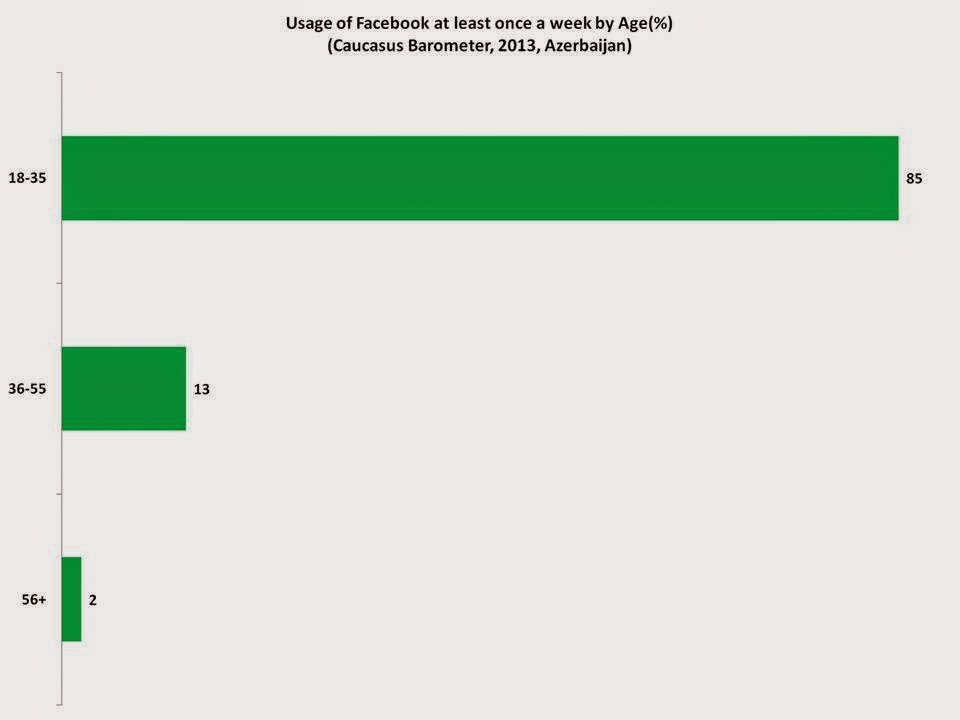
Facebook is the most popular social network in Azerbaijan, and it is used quite frequently.According to the CB, 16% of all respondents in Azerbaijan actively use Facebook. Moreover, 49% of Internet using respondents in Azerbaijan use Facebook at least once a week. Most Facebook users are males (65% according to Socialbakers statistics from 2014, 68% according to the CB), and the majority are young people aged 18-35 years old (72.8% according to the Socialbakers from 2014, and 85% according to the CB).

Among the respondents of the CB, almost 1/3rd of active Facebook users are posting news, personal observations or photos (30%). Other frequent Facebook activities mentioned by CB respondents in Azerbaijan included: commenting on other people’s posts and photos (26%), chatting (20%), and reading or viewing news-feeds (18%).
Besides connecting people as a tool for communicating with friends and family, Facebook has also made it easier to share opinions about information. Most CB respondents in Azerbaijan (88%) did not find it hard to express their opinion on Facebook. However, 5% of respondents expressed difficulty. Notably, posting opinions on FB is harder for women than men (10% of female respondents consider it hard to express their opinions on Facebook, while only 3% of male respondents express similar difficulty).
According to Statistics Brain Facebook data from 2014, the average number of friends per person on Facebook is 130. In Azerbaijan, 39% of CB respondents said they had 51-100 friends, whereas 37% of respondents had less than 50 friends on Facebook. Only 18% of respondents had more than 100 friends. The evidence suggests that for most Facebook users in Azerbaijan, the social network is a platform for connecting with their relatives and close friends; preferring a more selective form of communication, rather than communicating their thoughts, ideas and personal information to a larger audience.

To get more information about the Caucasus Barometer data and others activities by CRRC, we recommend following us on our Facebook page here. To learn more about Facebook usage in Azerbaijan and other South Caucasus republics, we recommend accessing Caucasus Barometer data here with our Online Data Analysis (ODA) tool.
By Aynur Ramazanova
Monday, March 17, 2014
Russia, Georgians, and the State
With Russia’s recent military intervention in the Ukraine, some commentators have begun to compare Ukraine to Georgia in 2008. In August 2008 Russian troops entered Georgian territory, resulting in the expulsion of the ethnic Georgian populations of the breakaway territories of South Ossetia and Abkhazia. Thus, there is speculation that the Crimea will become separated from Ukraine as South Ossetia and Abkhazia became separated from Georgia. Markets have also strongly responded to the recent Russian intervention as the value of the ruble and the Russian stock exchange has fallen. As a result, the Russian central bank injected around ten billion dollars into currency markets to stabilize the value of the ruble. Furthermore, Russian president Vladimir Putin has aimed to tighten up the proposed Eurasian Customs Union that some see as a revival of the Soviet state. Although Georgia’s participation in the customs union was not strictly ruled out by former Georgian Prime Minister Bidzina Ivanashvili, the priority of Georgia is an Association Agreement with the European Union according to parliamentary speaker Davit Usupashvili. With this context in mind, this post examines support for joining the Eurasian Economic Community (a precursor organization to the Eurasian Customs Union), support for the Georgian government’s involvement in business, and whether Georgians think being critical of the government is important for a good citizen. These factors are all seen as connected to how Georgians today perceive the Soviet past, and how this past relates to the present.
Georgians are nearly evenly divided on whether the state should be more like a parent (47%) or like an employee (53%). The 2013 Caucasus Barometer asked respondents to indicate whether they feel that “People are like children; the government should take care of them like a parent,” or that “Government is like an employee; the people should be the bosses who control the government.” This question gives some understanding about what relationship Georgian’s feel they should have with their state. Those with positive connotations towards the Soviet past may be more inclined to respond that the government should be like a parent. The following chart shows that 53% of Georgians who think the government should be like a parent, also support membership in the Eurasian Economic Community. Furthermore, the graph shows that Georgians who think that the state should be like a parent are 15% more likely to support Georgia’s membership in the Eurasian Economic Union.

Note: “Do not support at all” and “rather not support” were combined in this graph to form “Do not support.” “Rather support” and “Fully support” were combined into “Support.”
Georgians who support the idea that the government should be more like a parent are also more likely to support an increase in government ownership of businesses. Support for Eurasian Economic Community membership is also strongest among those who think government ownership of business should increase.

Note: The data here has been collapsed from a 10-point scale where 1 indicated most disagreement with the proposed statement and 10 indicated most agreement with the proposed statement. Data from points 7 through 10 are shown indicating agreement with each statement. Data from points 5 and 6 are shown indicating neither disagreement nor agreement. Data from points 1 through 4 are shown indicating disagreement with each statement.
The following graph shows that Georgians who think it is important for a good citizen to be critical of the government are more likely to think that the government should be like an employee.

This blog shows that Georgians are more or less divided when it comes to whether the government should be like a parent or an employee. In looking at Georgians who think that the government should be more like a parent, it appears that they are also more likely to support membership for Georgia in the Eurasian Economic Community. Moreover, parent-like government supporters put less emphasis on the importance of being critical towards the government as a quality of a good citizen. To further investigate how Georgians feel about their government, we recommend exploring the data further using our ODA tool here.
Wednesday, January 15, 2014
Youth Activism in the South Caucasus
For many people in the South Caucasus, voting in elections is their main form of political participation. The 2012 CB shows that the majority (all ages) of Georgians (91%), Armenians (84%) and over half of Azerbaijanis (68%) say they would participate in presidential elections if they were held next Sunday. Similarly, when asked if they voted in the last national election, well over half in all three countries said yes - 86% in Georgia, 80% in Armenia, and 61% in Azerbaijan.
Opinions on whether or not people would vote in upcoming presidential elections are similar between those 18-25 and 26+ years old in Armenia and Georgia. However, in Azerbaijan, youth 18-25 (63%) are slightly less likely than the rest of the population (70%) to say they would vote in an upcoming presidential election.

Considering that presidential elections and other national elections are different (e.g., parliamentarian elections), a higher proportion of Georgian (75%) and Armenian (73%) youth said they voted in the last national election, compared to 37% of Azerbaijanis 18-25 years old who said the same. Interestingly, more youth said they would vote in a future presidential election than those who said they voted in a previous national election—a difference of 7% in Armenia, 13% in Georgia, and 26% in Azerbaijan.


** Statement 2: People should not participate in protest actions against the government, as it threatens stability in our country.
In some contexts, young people’s involvement in civil engagement, via such activities as volunteering, participating in a charity organization and attending public meetings, have been proven to increase their chance of also becoming politically active. In the survey, respondents were asked to mention if they had participated in various activities during the previous 6 months. Contributing to charity and giving to churches/mosques are the most popular activities. Volunteerism attracts more young people in Armenia. Furthermore, activities that are closer to the political sphere such as attending public meetings are less popular –although higher in Georgia.

For more information on youth activism in the South Caucasus, please visit our Caucasus Barometer database.
Wednesday, April 10, 2013
Memory, Youth, Political Legacy and Civic Engagement (MYPLACE): ‘Interpreting the Past’ work package in Telavi
Tuesday, November 13, 2012
Trust and Agency in Azerbaijan: Personal Relationships versus Civic Institutions


Wednesday, September 26, 2012
To Vote or Not to Vote? Civic Participation in Georgia
As Georgians prepare for parliamentary elections set for October 1, 2012, political parties have entered the final stage of the pre-elections race. One of the important attributes of active citizenship and civic engagement is voting in elections. This blog explores Georgians’ attitudes toward voting in elections based on age group and gender differences. In this regard, CRRC conducted a countrywide survey in 2011 on Georgians’ attitudes about volunteerism and civic participation in Georgia. The survey revealed that 75% of Georgians living in the capital think that voting in elections is a very important characteristic of a good citizen. Over half of those living in urban (68%) and rural (57%) areas also believe that a good citizen should participate in voting. However, Georgians in the capital seem to be more engaged in political processes in the country than those in urban and rural areas.


Thursday, April 12, 2012
Georgian get-togethers: Private Problems versus Politics