Showing posts with label Freedom of expression. Show all posts

Monday, September 14, 2015

The Georgian public on journalists


Over the last month, a number of scandals have emerged on the Georgian media landscape. On August 7th, Rustavi 2, a national television station often associated with the previously governing United National Movement (UNM), had its assets frozen in response to Kibar Khalvashi’s claim that he was wrongfully denied his ownership rights of the station during the UNM’s governance. More recently, cancellation of two political talk shows was announced on Imedi TV, another national station, owned by Badri Patarkatsishvili’s family. Imedi later stated that it was not cancelling the talk shows. Two weeks ago, it was announced that two more political talk shows face cancellation (see here and here). Suspicions have been voiced that these cases are related to the upcoming 2016 Parliamentary elections. Considering the recent scandals, an understanding of how Georgians view journalists is important as the public’s view of them proxies the public’s trust in the media they consume. This blog post takes a look at attitudes towards journalists reported during the May 2015 Transparency International – Georgia public opinion poll, conducted by CRRC-Georgia.

On the whole, Georgians are quite ambivalent about journalists. To start, more than half of the Georgian population reports that they neither trust nor distrust journalists. This response is more or less equally characteristic for various segments of Georgian society, with roughly half of the representatives of every education level, age group, settlement type, and gender reporting so. Slight differences are present – those with at least some tertiary education, the young, and Tbilisi residents are all slightly less trusting of journalists than those who are less educated, older, and live outside the capital. Georgians report neither trusting nor distrusting journalists more often than representatives of any of the other professions or institutions asked about on the survey, including judges, police, doctors, teachers, NGOs, the President, Parliament, Prime Minister, and local government. Slightly more Georgians, though, report trusting journalists than distrusting them (25% versus 18%).


Note: The original five-point scale was recoded into a three-point scale. “Fully trust” and “Trust” were combined into the category ‘Trust’ on the chart above, while “Fully distrust” and “Distrust” were combined into ‘Distrust.’ “Neither trust nor distrust” was not recoded. Education levels were also recoded. ‘Secondary or lower’ includes individuals with only primary education, some secondary education, and completed secondary education. ‘Tertiary education’ includes those with some higher education, Bachelor’s degrees, Master’s degrees and PhDs. ‘Secondary technical’ education was not recoded.

The wide spread “neither trust nor distrust” attitude must in part stem from the perception that journalists in Georgia lack independence and are not working with the average person’s interests in mind. Half of the Georgian population believes that “Georgian journalists, as a rule, protect the political interests of the owners of media outlets,” though different people may have different attitudes to this issue. In addition, only a third of the public agrees with the statement that “Georgian journalists, as a rule, represent the interests of people like [me]”, and 32% agree with the statement that “Georgian journalists cover events superficially”. On a bright note, however, twice as many Georgians agree with the statement “Georgian journalists are highly professional” compared with those who disagree.
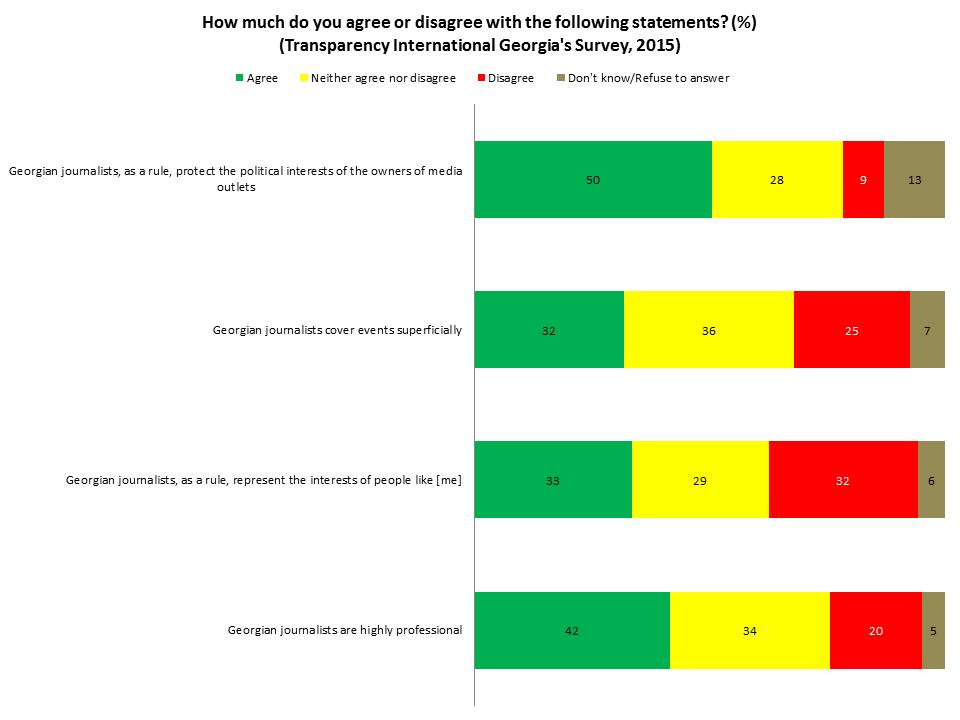

Note: Originally, the responses were recorded on a five-point scale where code 1 meant “Fully disagree” and code 5 meant “Fully agree“. For the chart above, codes 1 and 2 were combined into ‘Disagree’ and codes 4 and 5 were combined into ‘Agree.’ ”Neither agree nor disagree” was not recoded.

The findings suggest the journalists in Georgia need to work with the interests of ordinary people, not the owners of media outlets, in mind. If they do so, the population’s trust towards them will likely increase. To learn more about Georgians’ attitudes towards the media, have a look at the findings of the Media survey in Georgia here.

Monday, May 11, 2015

Under surveillance: Public perceptions of safety while talking on the phone in Georgia


Illegal government surveillance is an issue which has been intensely debated in recent years in Georgia. Surveillance related legislation was adopted in 2010 and allowed law enforcement agencies to have unlimited access to telecommunication servers and hence to monitor everyone’s phone conversations at any time. Before 2012 Parliamentary elections, this legislation was criticized by the Georgian Dream Coalition (GDC) and was expected to be significantly altered after GDC came to power in 2012. This, however, did not happen, and the new surveillance law passed in 2014 did not change the situation much, allowing the Ministry of Internal Affairs to maintain direct and unlimited access to surveillance equipment.

A survey commissioned by Transparency International – Georgia (TIG) and conducted by CRRC-Georgia in 2013 included a number of questions about Georgians’ perceptions of privacy while talking on the phone. This blog post presents the results of this survey and shows that the majority of Georgians report restraining from sharing critical opinions about the government while talking on the phone, while a quarter of Georgia’s population believes that the government listens to everyone.

When asked, “In Georgia today, do you think or not that people like yourself have the right to openly say what they think?” 76% of Georgians answered “yes,” according to CRRC’s Caucasus Barometer survey in 2013. However, when the TIG survey asked, “Would you share a critical opinion about current political events in Georgia with a friend over the phone?” 69% of Georgians answered negatively. Importantly, similar attitudes were recorded when the question was asked about sharing a personal secret with a friend, which demonstrates that Georgians do not feel comfortable or safe talking on the phone, and, generally, do not consider phones a secure means of communication, irrespective of the topic they are discussing.


The results presented in the chart above are hardly surprising, taking into consideration that a quarter of the population reports that they believe the government listens to everyone’s phone conversations, and a further 39% answer “Don’t know” or “Refuse to answer” – an extremely large share, suggesting that people didn’t feel comfortable answering this question.

In addition, 18% of Georgians think that the government monitors his/her internet activities including email, social networks and forums. People agree with the latter statement irrespective of which sector they are employed in – public or private. However, people working in the public sector are almost twice as likely to express uncertainty about whether or not the government listens to everyone.


The data also shows that, in Tbilisi, 28% think that the Georgian government listens to everybody and monitors people’s internet activities, while this share is smaller in other urban settlements.

The data discussed in this blog post tells us more than just about Georgians’ perceptions of illegal surveillance. These perceptions are important as they can effect civic engagement significantly. People who think that the government is following their internet activities and listening to their phone conversations are likely to limit discussing politics through the internet and phone, as well as publicly which, in turn, limits public discussion and critical evaluation of current events. Even though this data was collected in 2013, when the new surveillance legislation had not yet passed, how much do we expect public perceptions to have changed since?

The upcoming data from TI Georgia’s 2015 survey, to be available shortly, will show whether these perceptions have changed since 2013. Meanwhile, you can learn more about the 2013 results here.

Tuesday, May 07, 2013

Freedom of Press in the South Caucasus


Freedom of press is one of the indicators of a free society (e.g., immunity of communications media from censorship or governmental control). Freedom House’s 2012 analysis of Freedom of Press found that only 14.5% of the world’s population live in countries with a free press, while 45% have a partly free press, and 40.5% live in an environment without a free press. As for the South Caucasus region, Georgia was classified as having a partly free press ranking 111 out of 197 countries, similar to Bangladesh, Kenya and Mauritania which were among countries classified as partly free. Both Armenia (rank 149) and Azerbaijan (rank 172) were classified as having a “not free” press. This blog discusses the changing situation with regard to media freedom in the South Caucasus, as well as perceptions of trust in the media. It also highlights a gap between media freedom and trust in media in the region.
The Freedom of Press survey was first conducted in 1980 and has annually assessed the level of media freedom and editorial independence worldwide ever since. Freedom House provides analytical reports for 197 countries and territories and assigns them with a total score from 0 (best) to 100 (worst). The score is composed of 23 methodological questions that are divided into three categories: legal, political and economic environment. Primary attention is given to the political environment for press circulation, referring to the ability to operate freely and without fear of persecution. The degree to which each country permits the free flow of news and information determines the classification of its media as “Free,” “Partly Free,” or “Not Free.” Countries scoring 0 to 30 are regarded as having a “Free” media, while scores of 31 to 60 indicate “Partly Free”, and 61 to 100 represents “Not Free”.
In 2012 Georgia was the only country to make significant improvement in the region of Central and Eastern Europe and Eurasia – it moved from 55 to 52 points (out of 100). This was primarily due to the establishment of new publications, the issue of a broadcast license to a media group critical to the government (TV9), and enforced provisions for media ownership. However, a few deficiencies have remained. For instance, the Georgian National Communications Commission has been broadly reported to have limitations, delays in the access to information, and a lack of independence from political parties.
The report also identified Azerbaijan, Russia and Kazakhstan as countries of special concern in the region (i.e. not free). Freedom House’s country overview of Azerbaijan explains that journalists continue to be persecuted and imprisoned, authorities use economic and political pressure to maintain control over major media outlets, and the 2000 Law on Mass Media remains inoperative.
In Armenia, press freedom also remains restricted. The media environment remains controlled despite several amendments and legal protections that have been in place since the 2008 presidential election. In addition, close ties between government authorities and media owners encourage journalist self-censorship, particularly in the broadcast sector.
Freedom House data also allows us to follow its Freedom of Press index over time. According to the index, freedom of press has worsened (again, 0=best and 100=worst) in Armenia and Azerbaijan since 1994. Furthermore, while press freedom in Armenia has worsened from 1994 to 2009, there was a slight improvement from 2009 to 2012. The freedom of press index has fluctuated more in Azerbaijan, although it steadily deteriorated from 2004 to 2012. Georgia’s index sharply improved from 1994 to 2000, after which it worsened from 2000 to 2009, and began improving again from 2009 to 2012.


It is also difficult to find a direct link between changing freedom of press since 1994 and trust in the media. According to the Caucasus Barometer (CB) survey, the level of trust in the media has also varied in these countries from 2008 to 2012. The overall picture that emerges after combining results from the CB and the freedom of press index is interesting. Although the Freedom of Press index has slightly worsened from 2011 to 2011 in Azerbaijan, trust in the media during that period sharply increased. On the contrary, Georgian trust in the media has decreased since 2009 although the index of freedom of press improved. Thus, the freedom of press index does not directly tell us much about how much societies trust media. 


The South Caucasus has not yet achieved a completely free press. However, according to Freedom House, freedom of the press index is improving in Georgia, whereas the index is stable in Armenia and worsening in Azerbaijan. This blog discussed major criticisms about the press environment by Freedom House, as well as the interchanging level of trust in the media in the South Caucasus.
You are invited to see the full 2012 Freedom House report and to find out more about trust in institutions using the CRRC Caucasus Barometer.


Wednesday, May 01, 2013

A Contradiction Between Civil Liberties and Democracy in Azerbaijan


Many conversations about civil liberties focus on the freedom of expression and belief, associational and organizational rights, rule of law, personal autonomy and individual rights. According to Freedom House, these civil liberties play an essential role in measuring the robustness of democracies worldwide. CRRC data from the 2012 Caucasus Barometer (CB) shows a disjoint between perceptions of democracy and civil liberties in Azerbaijan. Specifically, the data suggest that in Azerbaijan, which is categorized as a Not-Free country according to the Freedom House 2012 rankings, people perceive that their country is either a full democracy or one with minor problems more than the other two South Caucasus countries. This blog reveals the ambiguity of the relationship between civil liberties and perceptions of democracy in Azerbaijan and provides comparisons with Georgia and Armenia.

Democracy means something different to different people. The perception of democracy is different in three countries of the South Caucasus. For instance, even though the Economist Intelligence Unit rankings show Azerbaijan as an authoritarian regime, Azerbaijanis themselves perceive their country to be more democratic than citizens in Armenia and Georgia. Despite the fact that Azerbaijanis recognize a number of weaknesses of civil liberties in their country (e.g., an unfair court system and controlled freedom of expression), the 2012 CB shows that about half of the population assess Azerbaijan as a full democracy or democracy with minor problems.


Less than a half of Azerbaijanis identified the most recent national election (2010 parliamentary election) as fair, compared to 54% of Armenians (2012 parliamentary election) and 87% of Georgians (2012 parliamentary election). Azerbaijanis are also more skeptical about their participation in elections and its importance for citizens although voting in fair elections is an essential feature of a functioning democracy. Two thirds (68%) of Azerbaijanis say they would participate in a presidential election the following Sunday, and approximately one fourth (24%) doubt that voting is important for citizens. While these results focus specifically on electoral process, they are also major indicators of civil liberties.


Freedom of assembly and expression are additional indicators of democracy. Over half of Armenians (66%) and Georgians (55%) agreed that people should take part in protest actions against the government to show the government that the people are in charge, whereas only 29% of Azerbaijanis said the same. There is a similar tendency regarding freedom of expression. Just under half of the Azerbaijan population (47%) think people have the right to openly say what they think (in comparison with two thirds in other two countries). Additionally, 19% of Azerbaijanis agreed that it is important for a good citizen to be critical towards the government, compared to more than half of Georgian and Armenian populations (55% and 53% respectively).


CB data also suggest a strong feeling of inequality before the law and government in all three countries. Only half of the populations in Azerbaijan and Georgia believe that people are treated fairly by the government, whereas one fifth of Armenians agreed. Additionally, the results are even more controversial regarding the legal system; only around one tenth (approximately 13%) of each population believes their court system treats everyone equally. This means that laws, policies, and practices do not guarantee equal treatment of various segments of the population. However, one third of Azerbaijanis trust in their court system although the majority does not believe that it is equal for everyone.


Despite problems with certain civil liberties in the South Caucasus, many people still believe that their country is a democracy or a democracy with minor problems. This is most recognizable in Azerbaijan where many people distrust court system, question the fairness of elections, and remain concerned about the right to criticize the government or participate in protest actions. Moreover, the Economist Intelligence Unit named Azerbaijan a strong authoritarian regime although half of the population believes it is represented by a democratic government or a democracy with minor problems. This seeming contradiction in perceptions of democracy as measured by subjective and objective measures would be an excellent topic for further research.

If you want to explore more about these questions, visit the 2012 Caucasus Barometer dataset