Showing posts with label Democracy. Show all posts

Tuesday, March 07, 2023

Is People’s Power designed to make Georgian Dream look good?

Note: This article first appeared on the Caucasus Data Blog, a joint effort of CRRC-Georgia and OC Media. It was written by Koba Turmanidze, President of CRRC-Georgia. The views presented in the article are the author’s alone, and do not necessarily reflect the views of CRRC-Georgia or any related entity.

A CRRC Georgia study found that positioning Georgian Dream as more moderate than its spin-off group, People’s Power, increased support for the ruling party. 

A popular study suggests that when a person goes for a date, they will be more liked if they take a similar, but slightly less attractive companion with them. Likewise, political parties often look better for their voters when they position themselves against a similar, but less appealing opponent. 

This blog shows how the same principle works in Georgia, and how the ruling Georgian Dream party appears to be boosting its support by arguing with its ‘friendly rival’, the People’s Power movement.  

In summer 2022, three Georgian Dream MPs announced that they were leaving the ruling party to ‘speak more freely’; in practice, this meant criticising the West, including ‘personal attacks’ on the US ambassador, and suggesting that the West wanted to drag Georgia into war. 

More politicians later joined the three MPs, and established the Peoples’ Power movement. Its members remained in the parliamentary majority together with Georgian Dream, which raised questions as to whether People’s Power was a true opponent to Georgian Dream or just a satellite party, intended to advance the ruling party’s more radical policies and boost support amongst anti-Western groups within Georgia’s electorate. 

The latter suspicions have been further strengthened by the ambiguous reaction of Georgian Dream’s leadership to the radical anti-Western statements from their new, ostensible opponents. While Irakli Kobakhidze, the ruling party chair, largely endorsed what People’s Power were saying, Prime Minister Irakli Gharibashvili spoke out against the statements, warning against potential damage to relations with the US. 

Even more tellingly, when the foreign agent law was tabled by People’s Power, Georgian dream’s leading figures were quick to express their support for the bill, despite its ostensibly separate roots. 

To investigate whether Georgian Dream could expect any benefit from its radical knock off party, CRRC-Georgia designed and carried out a survey experiment in November 2022. We randomly split a sample of 1,219 respondents into four groups.

The first, a control group of respondents, were told that politicians from People’s Power had criticised the US ambassador and suggested that the US wanted to drag Georgia into the war in Ukraine.

The second group were told both the above and that Irakli Kobakhidze had issued a note not denying the statement. 

The third group was told about People’s Power’s allegations, but added Irakli Gharibashvili’s comment that such statements would weaken Georgia’s relations with the US. 

The fourth group was informed about all three statements: the original anti-Western statement from People’s Power, Irakli Kobakhidze’s note which did not contradict the statement, and the opposing comment by Irakli Gharibashvili. 

Finally, all respondents were asked about whom they would vote for if elections were held tomorrow.

The data show that the comment that differentiated Georgian Dream from its supposed opponent was most beneficial to the ruling party. 

The Prime Minister’s disagreement with the statement increased Georgian Dream’s expected support by eight percentage points: 19% of respondents voted for Georgian Dream on hearing only the anti-Western statement, but on exposure to Gharibashvili’s counter-statement, support for the party reached 27%. 

Importantly, this share of the vote is in the population overall, rather than amongst those who would actually vote in an election, suggesting that the actual effect in an election could be much larger. 
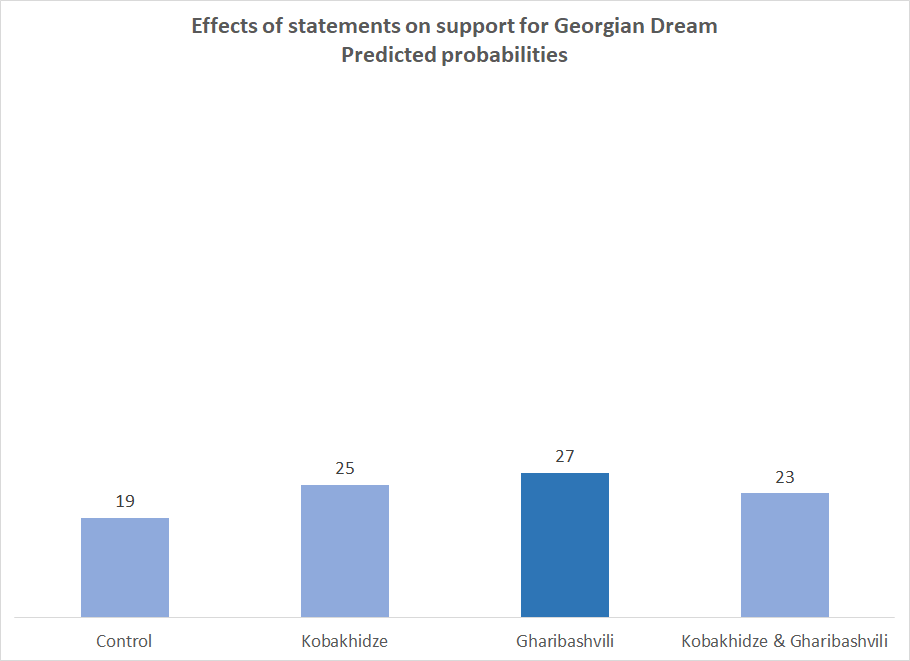
It is noteworthy that only the counterstatement on its own had a statistically significant effect: neither agreeing with the statement nor hearing both agreement and disagreement changed support for the ruling party in a statistically significant manner. 

These findings are in line with similar studies from democracies and less democratic locales: radical spin-off parties tend to benefit the ruling party more than the party that splits off. 

In this study, on average only 3% said they would support People’s Power across all scenarios. However, the impact of the statement was significant for the ruling party when they decided to appear less radical in comparison. 

Notably, the experiment was conducted with a focus on the country’s Western orientation, which is a matter of national agreement: large majorities support Georgia joining the EU and NATO. It is not clear if the ruling party would still gain support from appearing to be the more attractive option in discussions of issues around which there is less consensus. 

While this could have been tested out with the foreign agent law, ostensibly attributable to People’s Power, the ruling party has resolutely put its weight behind the law since its introduction. Whether Georgian Dream returns to positioning itself as more moderate than its spin-off group remains to be seen.

Read in Georgian on On.ge.

Tuesday, February 28, 2023

Democratic hypocrisy in Tbilisi

Note: This article first appeared on the Caucasus Data Blog, a joint effort of CRRC-Georgia and OC Media. This article was written by Dustin Gilbreath, a Non-resident Senior Fellow at CRRC-Georgia and Givi Siligadze, a Researcher at CRRC-Georgia. The views presented in the article are the authors’ alone, and do not necessarily reflect the views of CRRC-Georgia, the National Endowment of Democracy, or any related entity.

A CRRC Georgia survey found that people living in Tbilisi were more willing to accept democracy-eroding policies if they believed that their preferred party was in power. 

New data released in a CRRC-Georgia policy brief today suggests that a substantial portion of voters in Georgia’s capital tend to be hypocritical in their attitudes towards democracy-eroding policies, being more likely to support them if the party they prefer controls government. However, most do not support anti-democratic policies at all.

Following the first round of municipal elections in October 2021, CRRC-Georgia conducted a representative survey of Tbilisi, in which 1254 randomly sampled individuals took part. Half of the respondents were asked to imagine that their preferred party had won the next parliamentary elections while the other half were asked to imagine their preferred party had lost. 

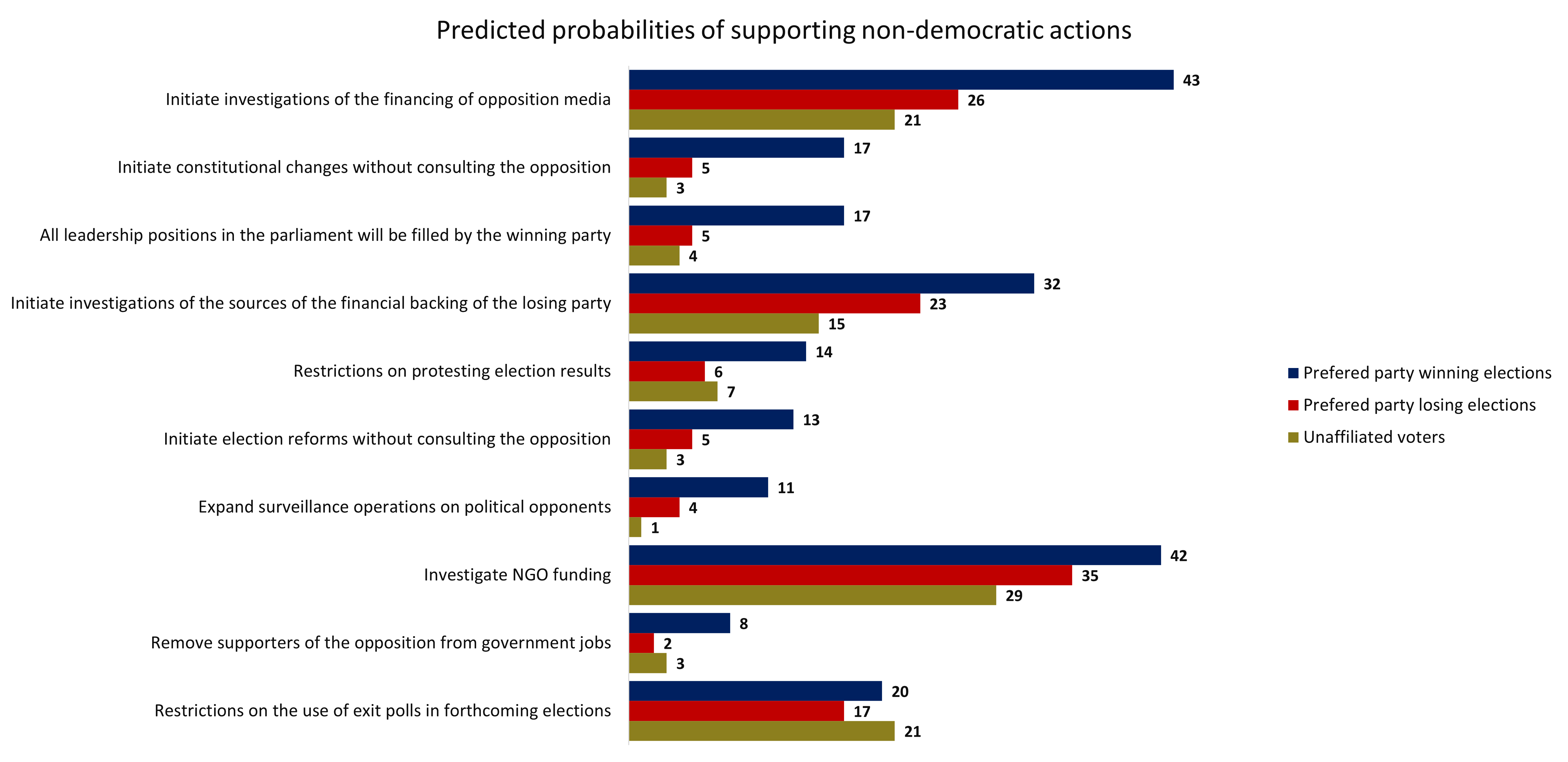
Afterwards, respondents were asked whether they would support ten different policies, as shown in the chart below. 

Support for each policy varied from 30% (investigation of NGO funding) to 4% (removing supporters of the losing party from government jobs). Support for most policies was low overall, with investigation of NGO funding (30%), initiating investigations of opposition media (25%), investigating the financial backing of the losing party (20%), and restricting the use of election polls (17%) the most supported. 

Other policies such as putting restrictions on protesting election results, giving all leadership positions in parliament to the winning party, initiating constitutional changes without consulting the losing party, initiating electoral reforms without consulting the new opposition, and expanding surveillance operations against political opponents were supported by less than 10% of the Tbilisi public.

However, views on the above propositions varied significantly based on whether or not respondents imagined that their preferred party had won the election. 

The share supporting initiating investigations of the financing of opposition media increased by 12 percentage points if they imagined that their preferred party had won compared to when their preferred party had lost the election.

Support for excluding opposition supporters from leadership positions in parliament and initiating electoral reform without consulting the opposition both increased by 10 points in response to imagining one’s preferred party had won.

The share supporting initiating constitutional changes without consulting the opposition increased by nine points, and the share supporting investigations of the sources of the losing party’s financial backing increased by eight points in response to imagining that a preferred party had won.

Support for restricting protests of election results doubled in response to imagining a preferred party had won, as did support for expanding surveillance of political opponents.

Overall, the data showed that knowing that their preferred political party had won elections increased a person’s tolerance for democracy-eroding policies for one question on average, meaning that the support of voters living in Georgia’s capital for democracy-eroding policies is heavily conditional on the party in power. 

The above pattern is not unique to Georgia, and has been similarly documented in established democracies. However, it does call for reflection among partisans in Georgia. 

Indeed, an alternative framing of the analysis is that imagining your party has lost elections gives one greater support for democracy. Whether partisans in Georgia are willing to pursue that perspective is, however, another matter.

Read in Russian on Jnews.

Tuesday, February 14, 2023

Are individual Georgians politically polarised?

Note: This article first appeared on the Caucasus Data Blog, a joint effort of CRRC Georgia and OC Media. It was written by Givi Silagadze, a Researcher at CRRC-Georgia, The views presented in the article are of the author alone, and do not necessarily reflect the views of CRRC-Georgia, the National Endowment for Democracy, or any related entity.

CRRC Georgia data found that individual political polarisation — how committedly partisan a person is — is relatively low in Georgia, despite concerns about the country’s polarisation as a whole. 

Political polarisation is seen as a critical issue in Georgia, so much so that overcoming it is a condition for Georgia’s bid to secure candidate status in the European Union. Indeed, many argue that political polarisation is one of the main causes of Georgia’s democratic backsliding. 

Past research has shown that political polarisation has not led to diverging views on policy or ideology in society. Rather, views seemingly only diverge on individual politicians and explicitly partisan events, like the Rose Revolution and major elections. . 

Newly released research from CRRC Georgia suggests that at most three in ten Georgians can be categorised as affectively polarised, meaning that they distrust an opposing party regardless of their views on policy.

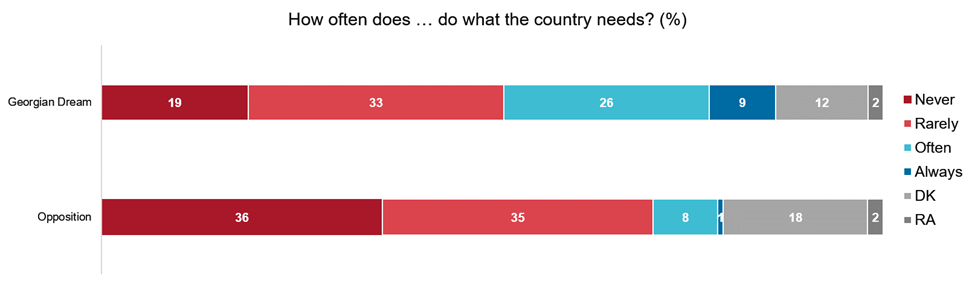
In the newly released study, respondents were asked how often they thought the ruling party and opposition did what the country needed. 

Half of the electorate (52%) thought that the ruling Georgian Dream party rarely or never did what the country needed, while 35% reported that the ruling party often or always does what the country needs. As for the opposition, 71% of the public thinks that the opposition rarely or never does what the country needs, and only 9% of Georgians believe the opposition often or always does what the country needs.

To measure polarisation, the two questions were combined to construct a variable that measures whether an individual is politically polarised.

The logic behind the approach is that people who respond similarly to the two questions can be considered less polarised — they believe that both parties either work for the country or do not. In contrast, people who assess one of the two positively and the other negatively can be considered polarised. 

This produces a scale ranging from zero to four, with zero meaning that the respondent was not polarised at all, reporting identical responses to the two questions, and four meaning that the respondent was very polarised, reporting a very positive attitude towards one party and a very negative attitude towards the other.

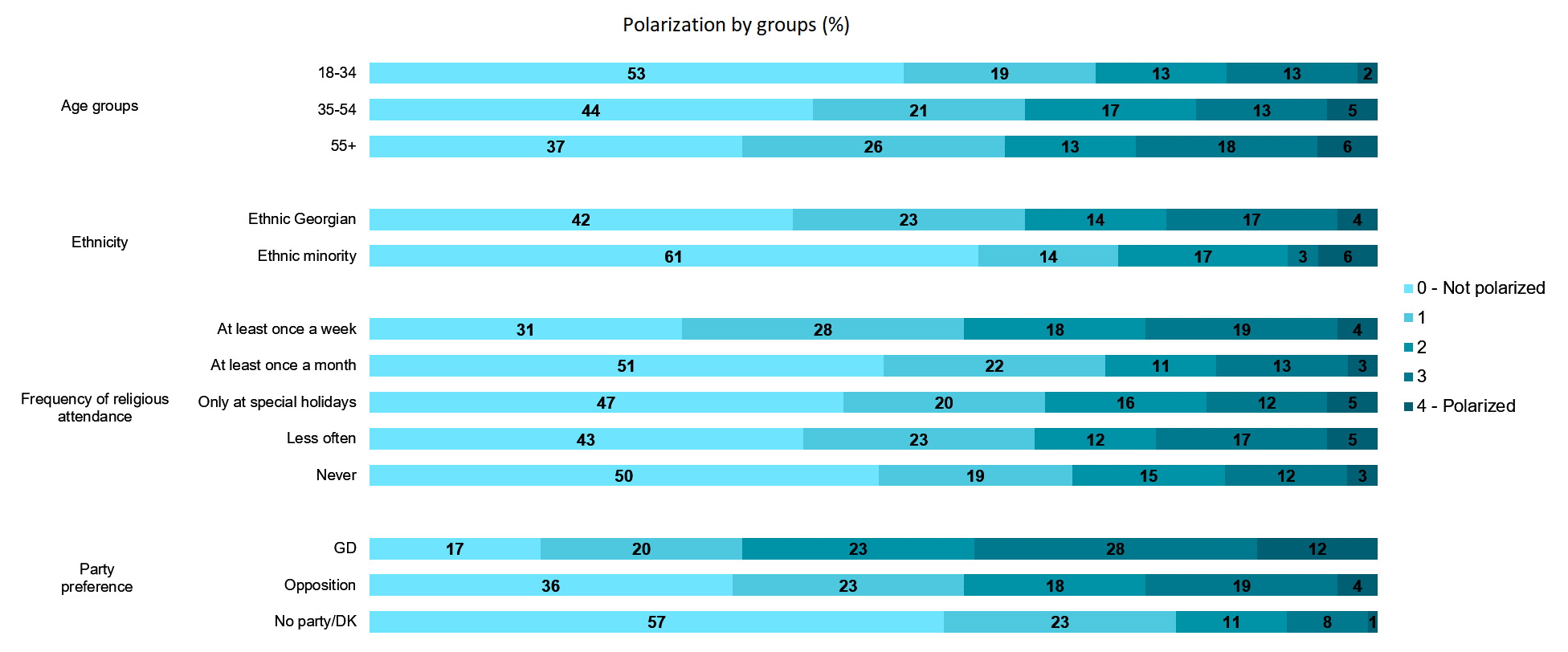
On this scale, almost half of the electorate (45%) was not polarised at all, while 4% was highly polarised. A further 15% was quite polarised, scoring 3 out of 4 on the scale. 

A regression analysis suggests that someone’s polarisation is not associated with their sex, education, settlement type, employment status, or frequency of praying (a measure of religiosity). 

On the other hand, respondent polarisation was related to age, ethnicity, frequency of religious attendance, and party preference. Older people, ethnic Georgians, people who attend religious services once a week, and partisans all tend to be more polarised than other individuals.  

It is worth noting that the analysis used two different measures of religiosity because they behave differently with respect to polarisation. 

People who attend religious services often tend to be more polarised than people who attend less frequently or do not attend religious services at all. However, when it comes to frequency of praying, people who pray often are not different from people who pray less often or never when it comes to polarisation. 

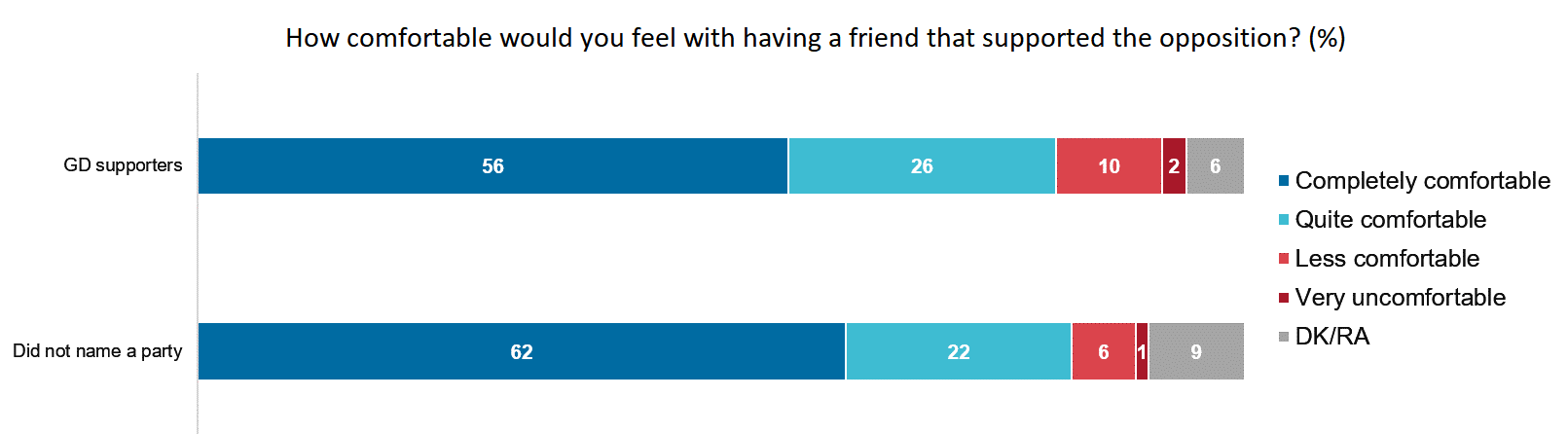
Measuring social distance among people with a party allegiance suggested that partisanship only has a moderate impact on friendships. 

Georgian Dream supporters were more likely to say that they would feel uncomfortable with an opposition-leaning friend than voters who did not support any particular party. Similarly, opposition supporters were more likely to report that they would feel uncomfortable with a Georgian Dream-supporting friend than those with no party preference. 

Regardless of these statistically significant differences, a very large majority of the public said that they would feel quite or completely comfortable with a friend with either political leaning.

While Georgian political discourse is often dominated by discussion of polarisation, the data suggests that a majority of Georgians are not polarised.

Tuesday, November 01, 2022

Georgians increasingly feel mistreated by the government

Note: This article first appeared on the Caucasus Data Blog, a joint effort of CRRC Georgia and OC Media. It was written by Eto Gagunashvili, a Researcher at CRRC-Georgia, The views presented in the article are of the author alone, and do not necessarily reflect the views of CRRC-Georgia, or any related entity.

Recent CRRC Georgia data suggests that people in Georgia’s age and foreign policy preferences affect how they feel the government is treating them.

The public’s perception of the fairness of the government’s actions is critical to governance and may reflect the quality of democracy in a country. Today, Georgians tend to feel like their country is no longer a democracy, while the public feels that people like them are not being treated fairly by the government.

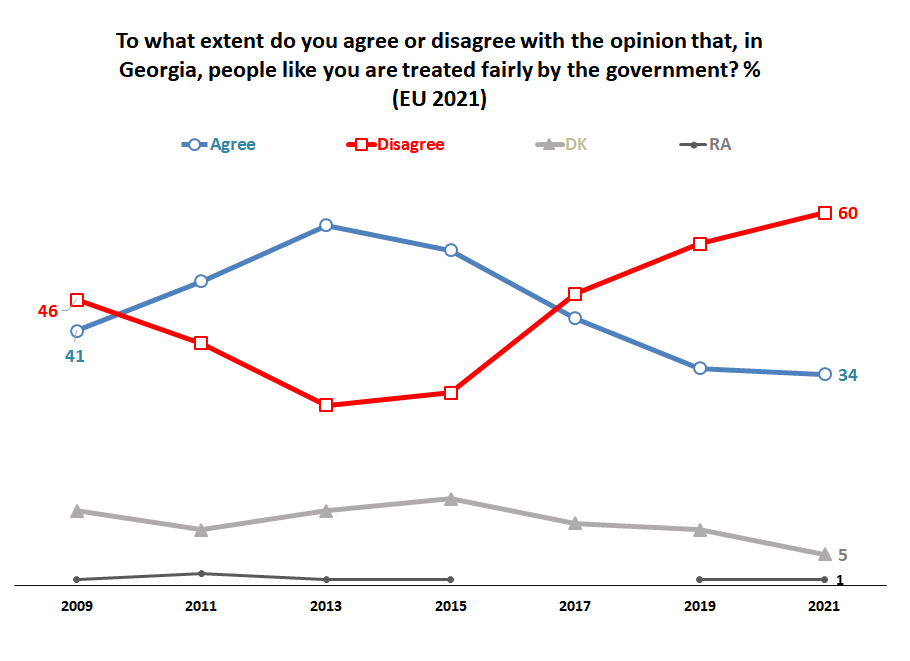
According to data CRRC Georgia collected for the Europe Foundation since 2009 through a survey on Georgian attitudes towards the EU, the share of Georgians who disagree with the opinion that people like them are being treated unfairly by the government has increased from 46% in 2009 to 60% in 2021. 

Today, twice as many people think that the government treats people like them unfairly as those who feel otherwise.

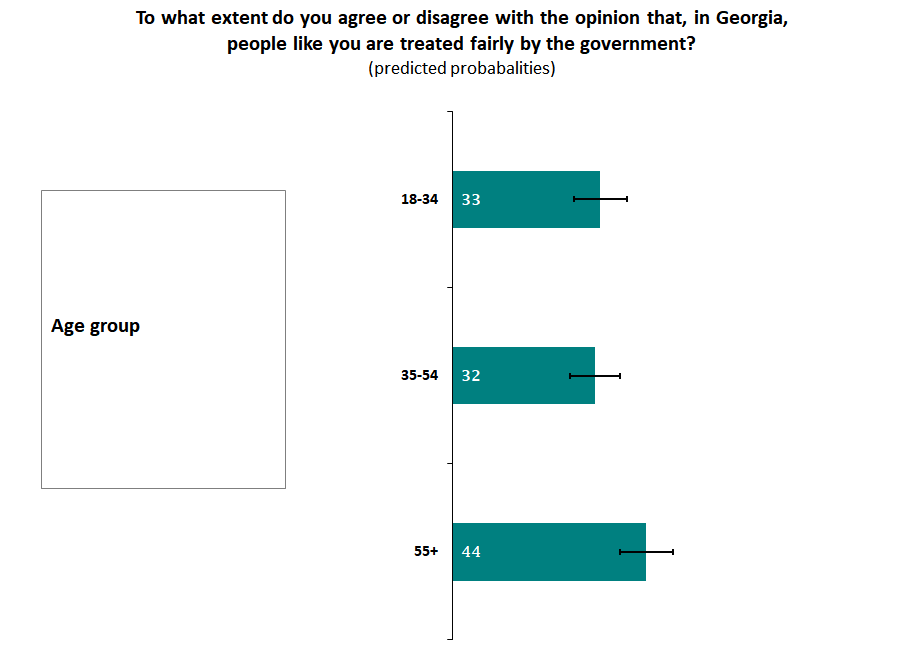
In the 2021 data, older people (55+) were more likely to agree with the opinion that in Georgia, people like them are treated fairly by the government than younger people (18–35). Other social and demographic variables were not statistically associated with whether or not someone thinks the government treats someone like them more or less fairly.

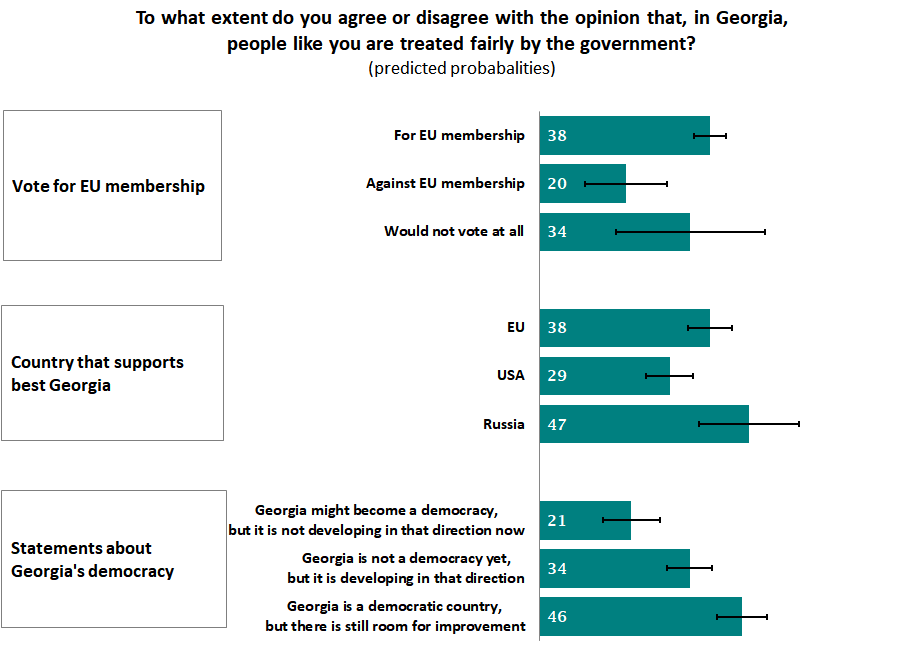
People’s perceptions of how democratic Georgia is, which country can best support Georgia currently, and support for EU membership are correlated with people’s views of whether people like them are treated fairly by the government. 

People who report that they would vote against EU membership were 18 percentage points more likely to agree that the government treats them fairly than those who report that they would vote for EU membership.

People who report that the USA can currently give the best support to Georgia were 18 percentage points less likely to agree with the statement that people are treated fairly by the government compared to people who report that Russia can best support Georgia.

People who think that Georgia is not a democracy yet, but is developing in that direction or think that Georgia is a democratic country with room for improvement were 13 and 25 percentage points more likely to agree that they are treated fairly than people who think that Georgia might become a democracy in the future, but it is not developing in that direction now. 

With the perception that Georgia’s democracy is backsliding, so too comes the public perception that the government is increasingly not treating people like them fairly. However, older people and people who think Russia can best support Georgia were more satisfied with how the government treats them. 

Note: The above data analysis is based on logistic regression models which included the following variables: age group (18-34, 35-54, 55+), sex (male or female), education (Secondary or lower; Secondary technical; Higher; type of settlement (capital, urban, rural); who can currently best support Georgia (EU, USA, Russia), how democratic Georgia is (Georgia might become a democracy in the future, but it is not developing in that direction now; Georgia is not a democracy yet, but it is developing in that direction; Georgia is a democratic country, but there is still room for improvement)Agree/disagree with the statement: "I am Georgian, and therefore I am European”); Would vote for or against EU membership? (For EU membership; Against EU membership; Would not vote at all).

Tuesday, September 27, 2022

Do politicians serve Georgia’s public interests?

Note: This article first appeared on the Caucasus Data Blog, a joint effort of CRRC Georgia and OC Media. It was written by Dustin Gilbreath, a Non-Resident Senior Fellow at CRRC-Georgia, The views presented in the article are of the author alone, and do not necessarily reflect the views of CRRC Georgia, or any related entity.

A recent CRRC Georgia and NDI poll suggests that roughly half of the Georgian public, regardless of their partisan affiliations, believe that neither the opposition nor the ruling party serves their interests.

Political polarisation in Georgia has little to do with opinions on policy. An analysis of numerous questions on the regular NDI and CRRC polling suggests that the public has consistent preferences and concerns, no matter the party they support: Georgians tend to want a pro-Western foreign policy for the country, they are concerned about the economy’s development and jobs, and they tend to be socially conservative. 

While what the public wants is relatively clear, Georgians do not see the ruling Georgian Dream party or elected opposition figures working towards providing that.

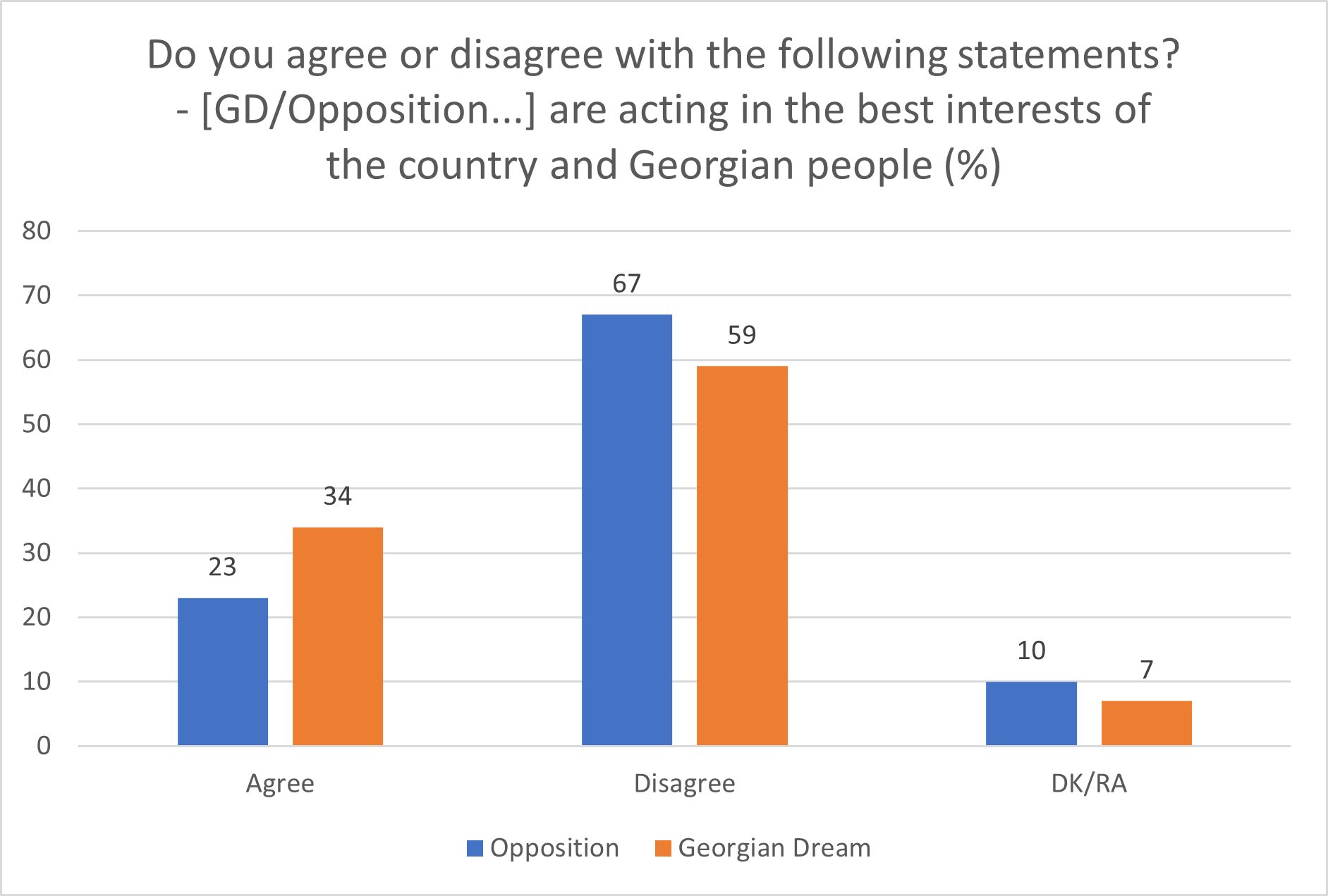
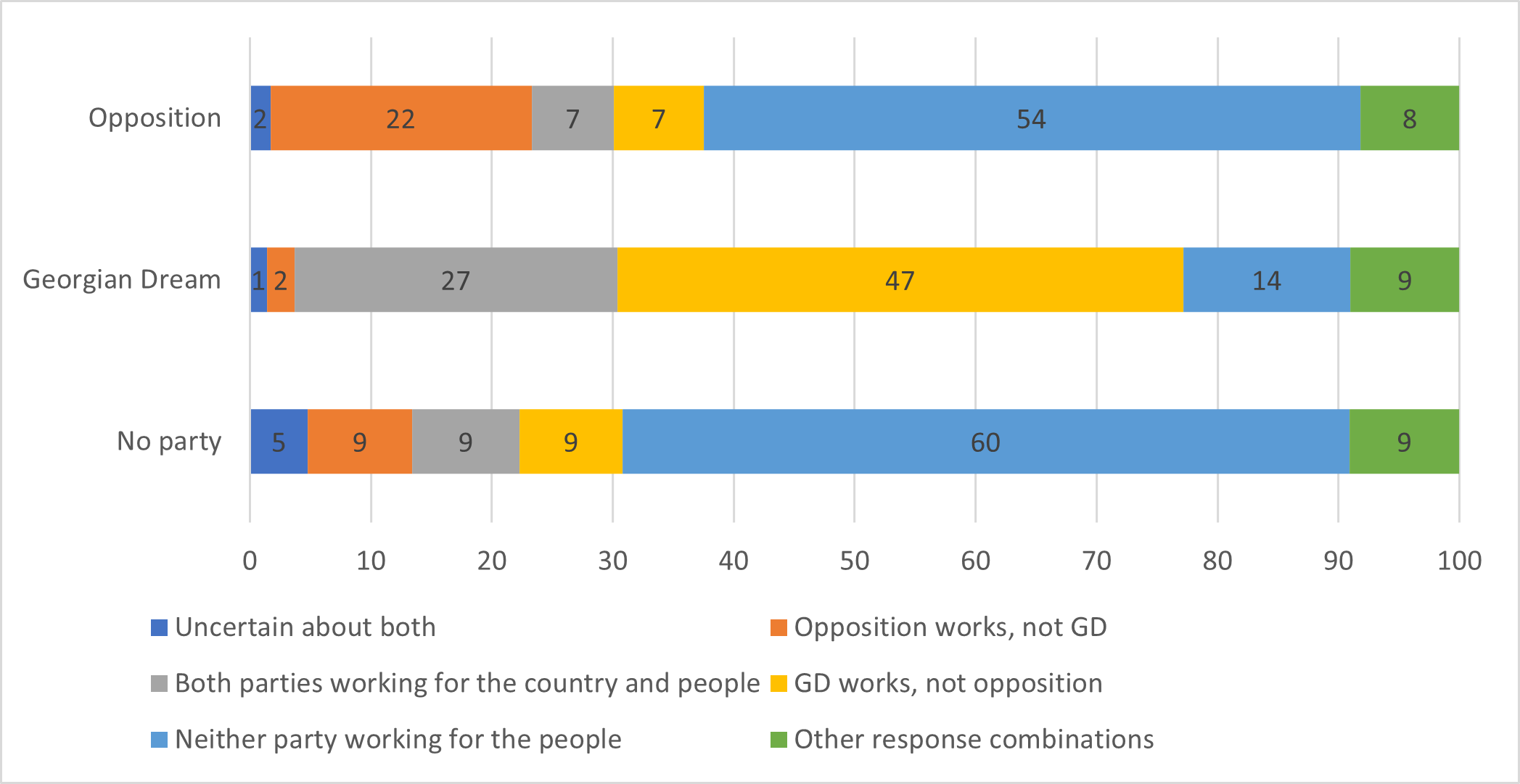
The most recent CRRC and NDI survey suggests that a majority of the public thinks that neither the opposition nor Georgian Dream serves the interests of people like them, although 11% more of the public believe that Georgian Dream serves the interests of people like them.

About half of the country (46%) says neither party acts in the best interests of Georgia or the Georgian people. 

The data show some partisan bent. About one in five (19%) say that the ruling party is working in the best interests of the country, while the opposition is not. One in ten (10%) thinks that the opposition is working in the interests of the country, while Georgian Dream is not. Only one in eight (13%) think that both parties are working in the best interests of the country.

At present, 50% of the country supports no party or has refused to answer which party they support; 27% support Georgian Dream and 24% support an opposition party.

When the above data is broken down by partisanship, the data show mistrust among partisans and non-partisans alike. Nearly half of Georgian Dream’s supporters (47%) report that their party works for the people, while the opposition does not. In contrast, 54% of opposition supporters and 60% of those that report they do not support any party say that neither the opposition nor Georgian Dream is working for the people. One in five opposition supporters (22%) report that the opposition works for the people, but Georgian Dream does not. 

The data should give politicians pause, whether they belong to the ruling party or the opposition.

If most Georgians believe their political parties are not working in good faith, that might be an indicator of a larger issue of miscommunication — whether or not the public’s fears are unfounded.

Moving away from the relentless accusations and infighting that have characterised Georgian politics in recent years and instead adopting a positive vision for the country might help Georgia’s political parties regain the trust of the public.

The data used in this analysis is available here.

Tuesday, September 20, 2022

Most Georgians believe that Georgia is not a democracy

Note: This article first appeared on the Caucasus Data Blog, a joint effort of CRRC Georgia and OC Media. It was written by Givi Silagadze, Researcher at CRRC-Georgia, The views presented in the article are of the author alone, and do not necessarily reflect the views of CRRC Georgia, or any related entity.

The share of Georgians who think the country is a democracy is at its lowest for the last decade. Supporters of the ruling party are the exception to this trend, tending to believe that the country’s democracy remains a good example for others. 

Newly released NDI/CRRC data suggests that Georgians are growing increasingly skeptical about democracy in the country. Except for supporters of the ruling Georgian Dream (GD) party, a majority of all other groups think that Georgia is not a democracy. 

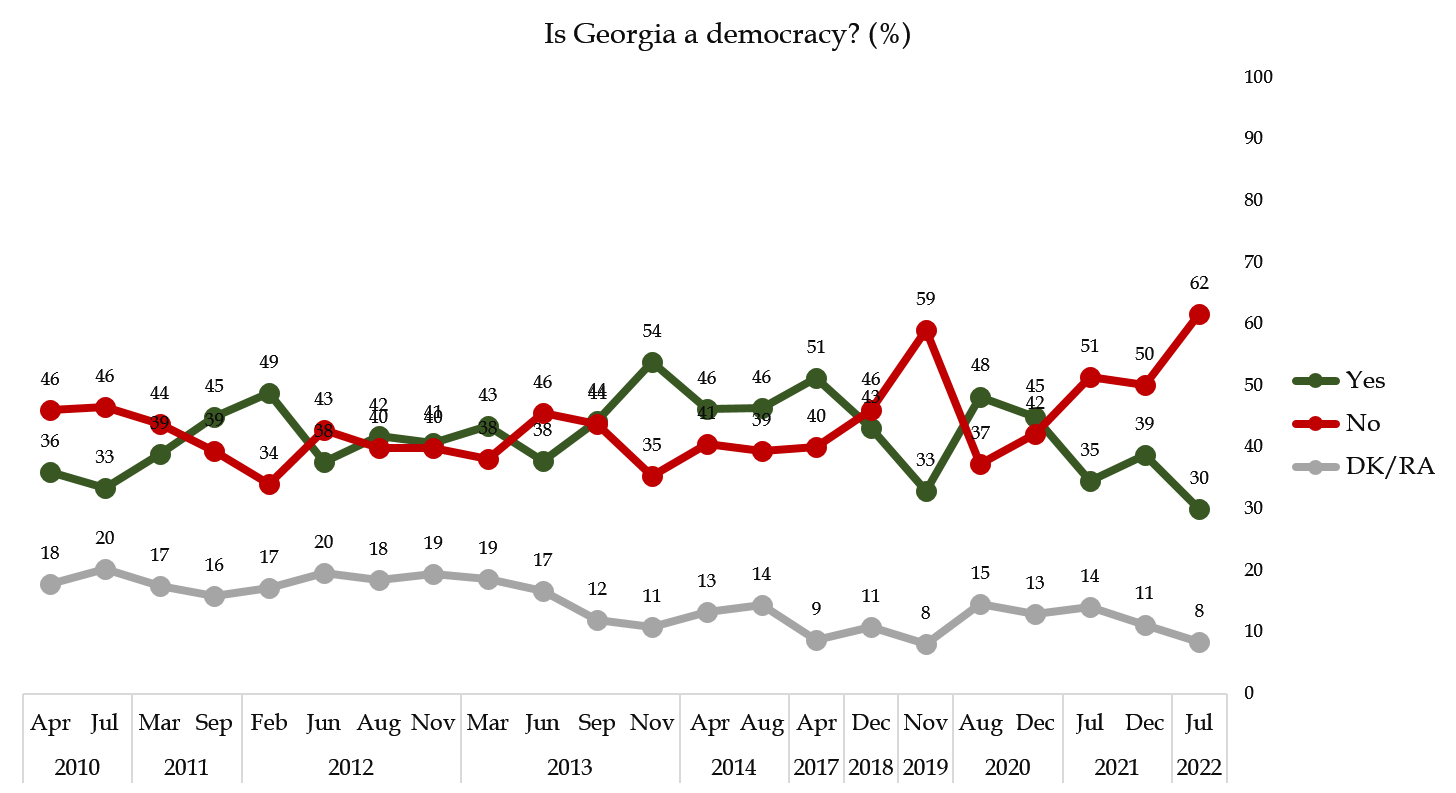
As of 2022 August, only three out of ten Georgians felt Georgia was a democracy. Since 2010, when NDI and CRRC started to ask this question in nationwide surveys, this is the lowest share of the public expressing the opinion that Georgia is a democracy. Similarly, the share of the public explicitly saying Georgia is not a democracy was highest in August 2022. 

Note: There are no data for 2015 and 2016

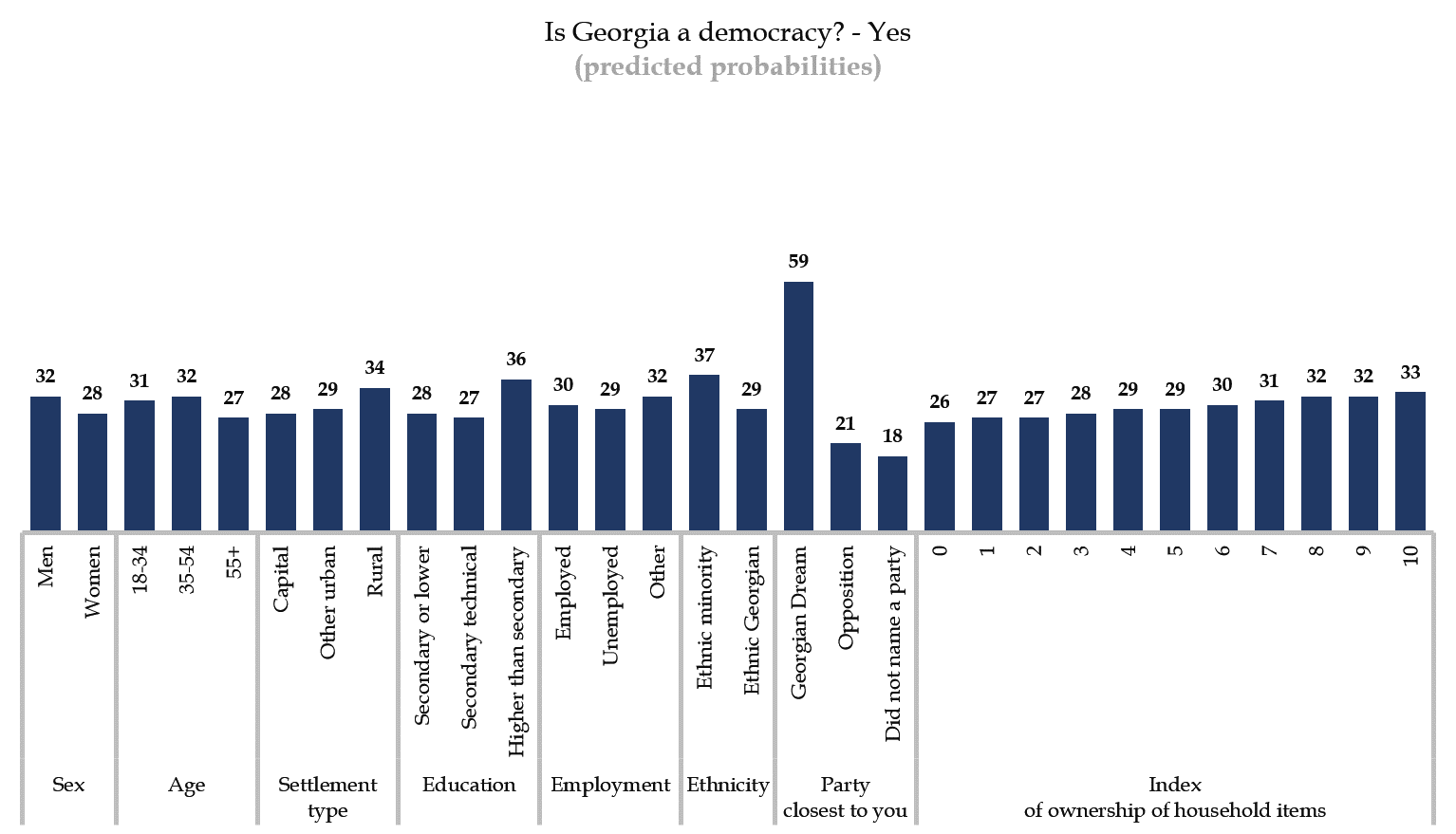
Logistic regression analysis was conducted to understand the differences between different groups. Age, sex, settlement type, employment status, ethnicity, and wealth are not associated with whether people think Georgia is a democracy or not, while education and party support are. 

People with a tertiary education are more likely to say that Georgia is a democracy than people with secondary or lower levels of formal education. However, a majority of  people of all education levels tend to think that Georgia is not a democracy. 

By far, the largest difference in attitudes to this question are between supporters of different parties. Supporters of the ruling party are 38 percentage points more likely than opposition supporters and 41 percentage points more likely than voters with no party preference to consider Georgia a democracy.

GD supporters constitute the only group in the electorate of whom a majority think that Georgia is a democracy, controlling for other factors.

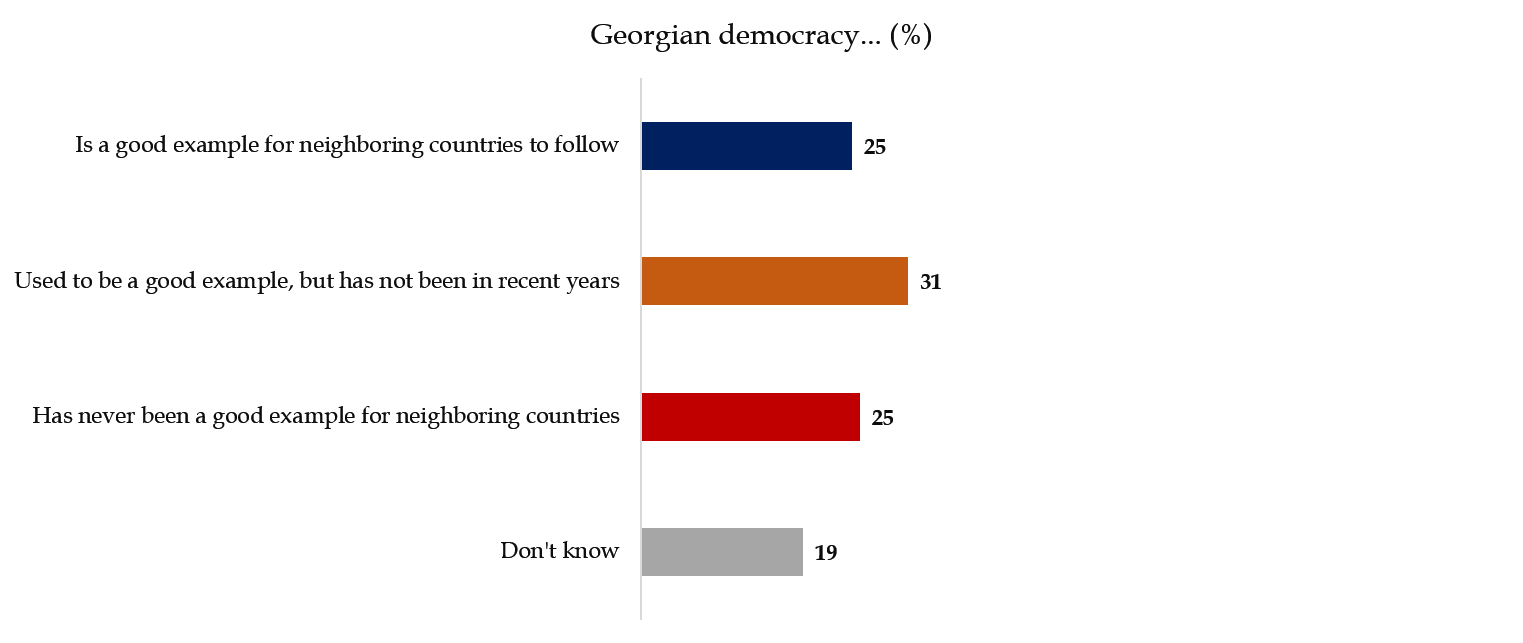
Another question on the NDI and CRRC August 2022 survey leads to similar conclusions. A quarter of the public (25%) think that Georgian democracy is a good example for neighbours, 31% believe that the country used to be a good example but ceased to be one, and another quarter (25%) feel that Georgia has never been an exemplary democracy. The remaining fifth (19%) of the electorate report that they do not know.

Multinomial regression analysis was conducted to better examine group differences. The results yielded were similar to those of the previous analysis. GD supporters hold exceptionally dissimilar and at the same time optimistic views regarding the quality of democracy in Georgia compared to the rest of the population.

Supporters of the ruling party are 35 percentage points more likely than opposition supporters and 32 percentage points more likely than non-affiliated voters to think that Georgian democracy is a good example for neighbours. GD supporters are also 30 percentage points less likely than opposition supporters and 16 percentage points less likely than non-partisans to believe that democracy in Georgia used to be exemplary, but no longer is.

The fact that the share of the public that considers Georgia to be a democracy is at its lowest since 2010 corresponds with the views of Freedom HouseThe Economist Intelligence Unit, and the Varieties of Democracy index, all of which have commented on Georgia’s democratic backsliding. 

However, GD supporters, in stark contrast to the rest of the public, tend to believe that Georgia is an exemplary democracy even in 2022. 

Note: The above data analysis is based on logistic and multinomial regression models which included the following variables: age group (18-34, 35-54, 55+), sex (male or female), education (completed secondary/lower, technical or incomplete higher education/higher), wealth (an additive index of ownership of 10 different items, a proxy variable), employment status (employed, not employed, other) ethnicity (ethnic Georgian or ethnic minority), and party identification (Georgia Dream, opposition, did not name a particular party).

Thursday, June 02, 2022

Georgians are split on election quality

Note: This article first appeared on the Caucasus Data Blog, a joint effort of CRRC Georgia and OC Media. It was written by Milord Shengelia, a junior fellow at CRRC-Georgia, and Makhare Atchaidze, a researcher at CRRC-Georgia. The views presented in the article are of the authors alone, and do not necessarily reflect the views of CRRC Georgia, or any related entity.

Data CRRC Georgia collected before the 2021 municipal elections for ISFED and after the elections for NDI shows that supporters of the ruling party and opposition were and are divided over the quality of elections in Georgia.

Views prior to the elections

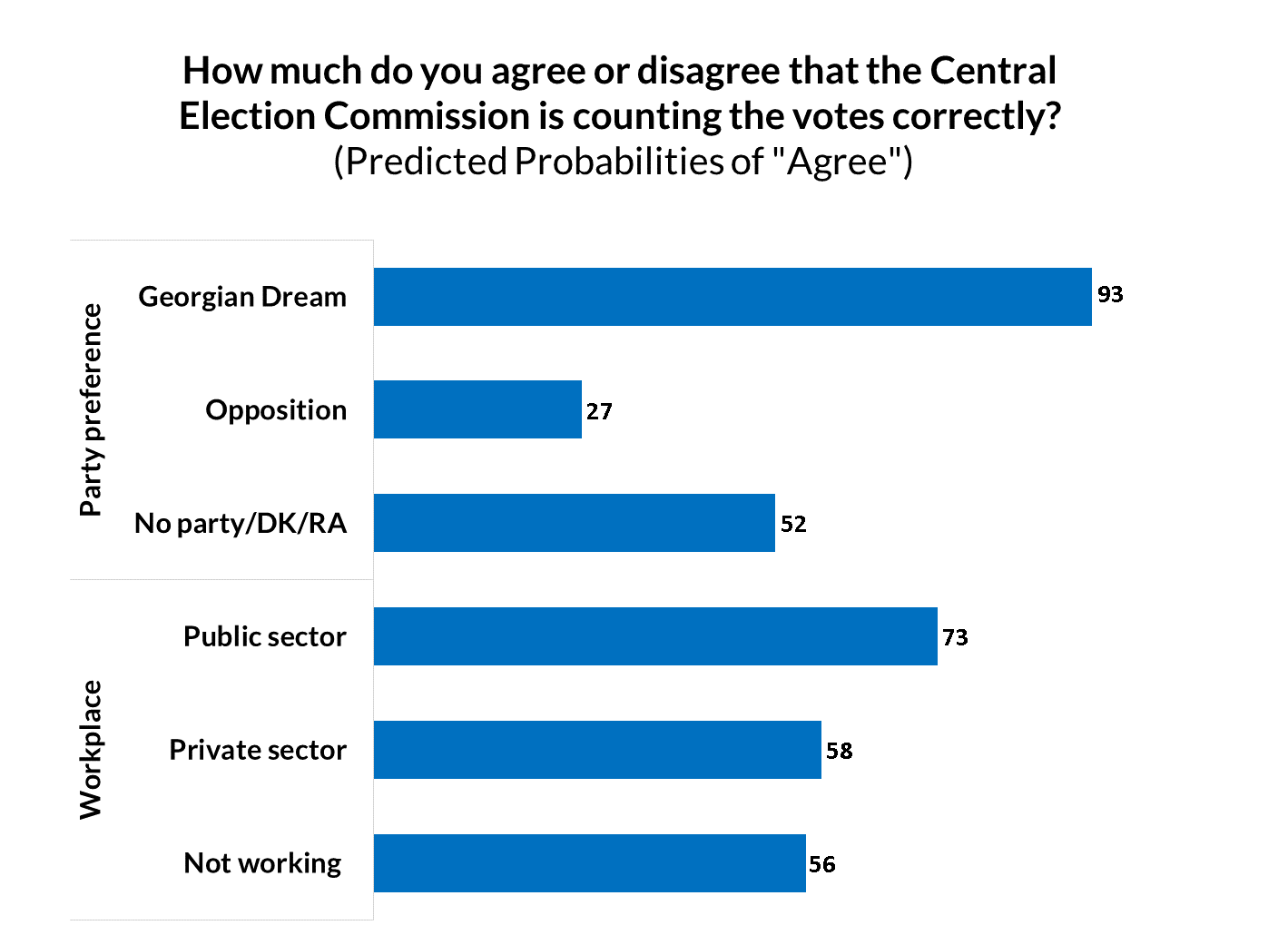
Prior to the elections, roughly half the public (46%) thought that the Central Election Commission (CEC) counted votes correctly. A regression analysis suggests that people who support the Georgian Dream were 66 percentage points more likely than opposition supporters to report thinking so, controlling for other factors. 

People who report that no party is closest to them, don’t know, or refuse to answer, had a 52% chance of saying that the CEC was counting votes correctly, which is more than the opposition, but far less than the corresponding share among Georgian Dream supporters.  

Aside from partisanship, where one works is also associated with trust in the CEC. People who work in public service were 17 points more likely to positively evaluate the vote count than people not working and people working in the private sector.

Another indicator of the quality of elections is faith in the secrecy of the ballot. 

Prior to the elections, 44% of the public said that the secrecy of the ballot could be violated in Georgia, again with a strong partisan divide in terms of views. A regression model suggests that perceptions about voting privacy are also associated with party preference. 

Opposition supporters were 36 percentage points more likely to report that it was possible for someone in Georgia to know who another person voted for than Georgian Dream supporters. 

People who did not report a party preference held views in between. 

Aside from party support, young people were less likely to think voting secrecy was protected in Georgia. 

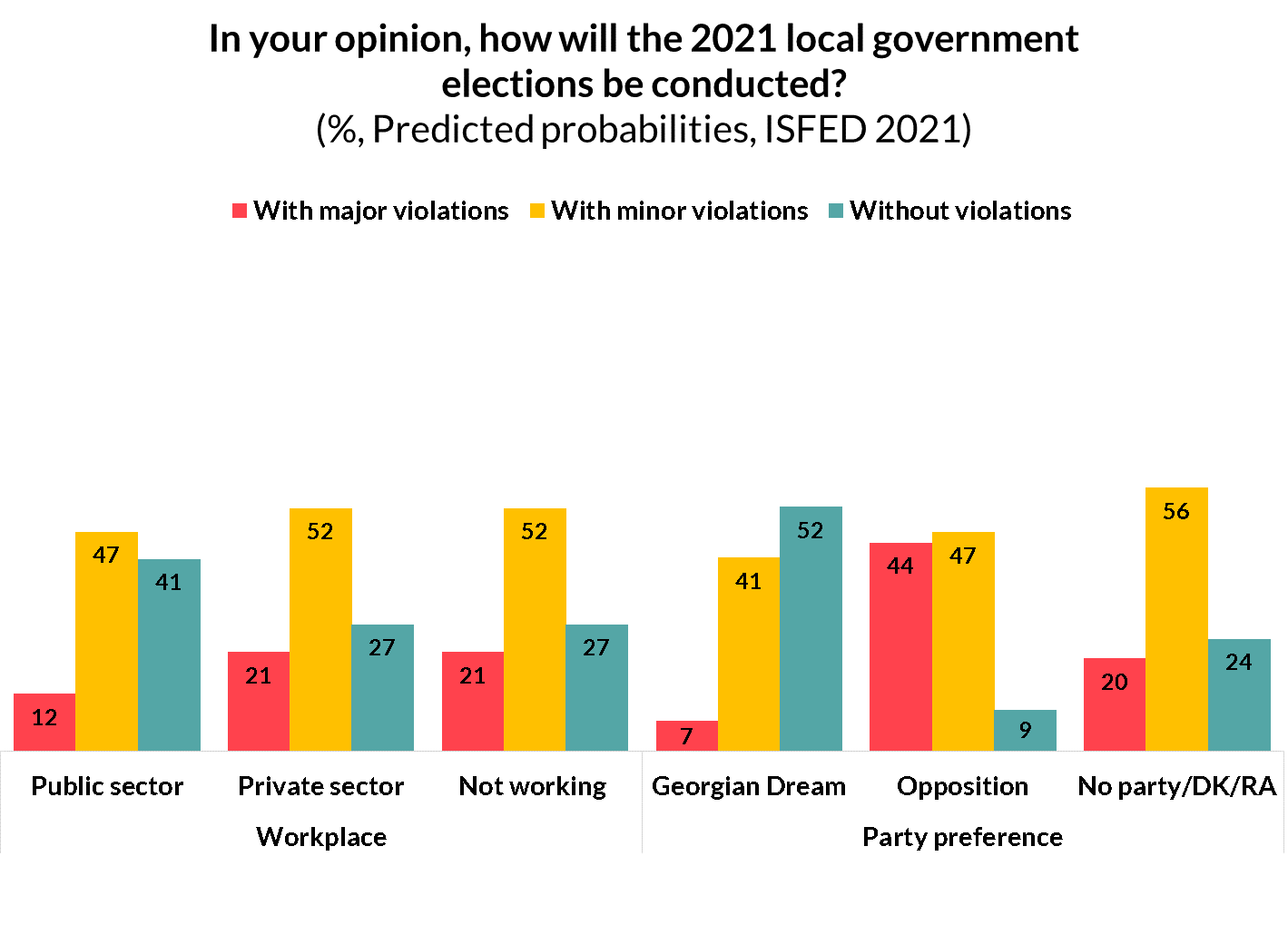
Respondents were also asked how the 2021 local government elections would be conducted. Almost 60% of respondents mentioned that the election would be conducted with either major or minor violations. While 23% said there would not be violations.  

A regression model indicates that opposition supporters were more pessimistic about the quality of elections than supporters of Georgian Dream. Controlling for other factors, opposition supporters had a 44% chance of saying that the elections would be conducted with major violations, 37 percentage points more than Georgian Dream supporters.  

Aside from partisanship, private sector workers and those who do not work were more pessimistic about election quality prior to the vote. More specifically, people who worked in the private sector and those who dido not work had a 21% chance of saying that the elections would be conducted with major violations, while 12% of public service workers reported the same.

Note: The results presented in the above charts came from regression models. The regressions included the following variables: sex (male or female), age group (18–35, 35–55, 55+), settlement type (capital, urban, rural), ethnic group (ethnic Georgian or other ethnicity), educational attainment (secondary or lower, secondary technical, higher than secondary), workplace (Working in the public sector, Working in the private sector, Not working), party preference (Georgia Dream supporter, opposition supporter, or supports no party/DK/RA), wealth (an additive index of ownership of 10 different items).

Views following the elections

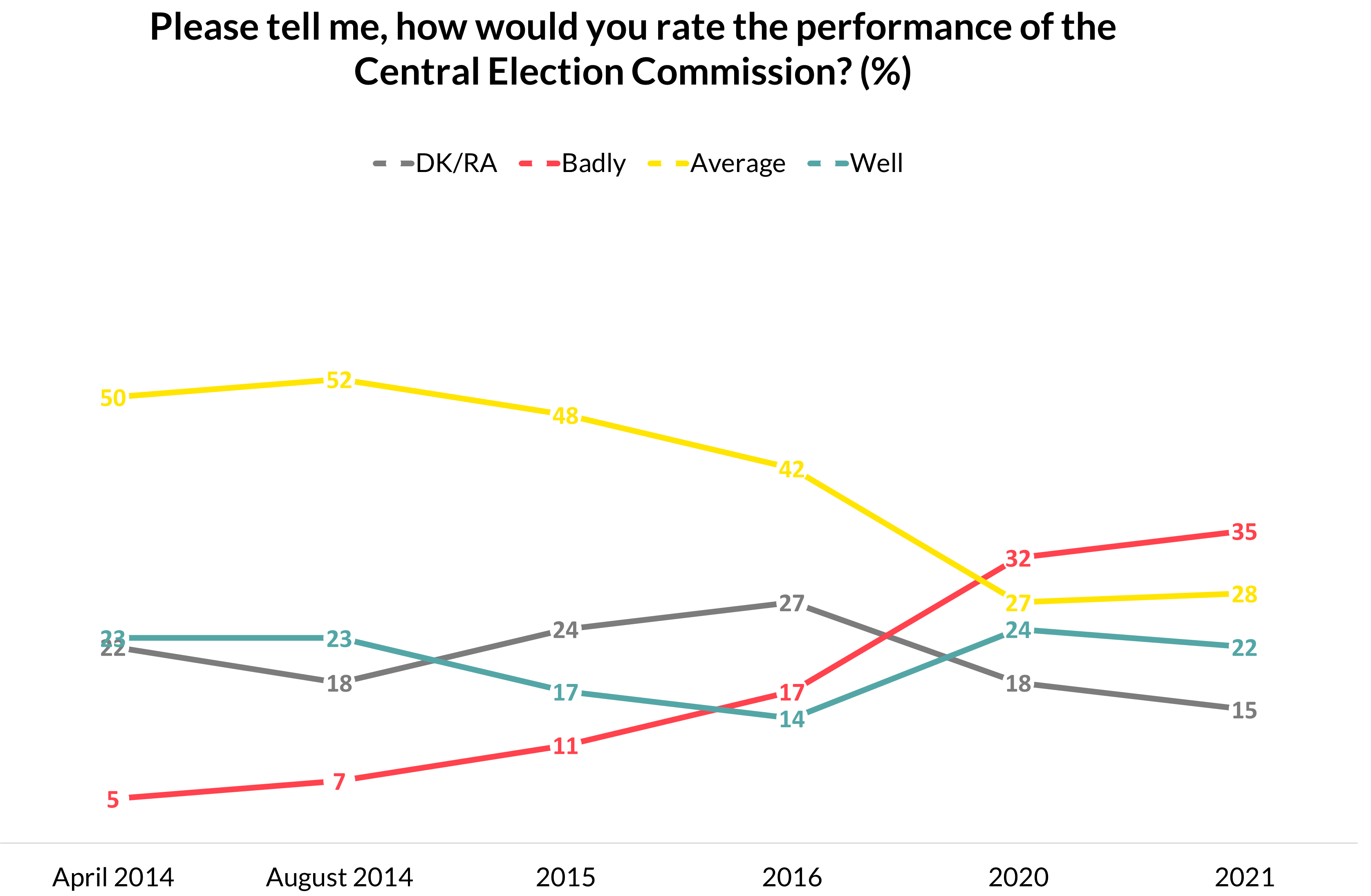
Data from NDI and CRRC Georgia’s regular polling efforts suggested that pessimism about the CEC’s performance has grown over time. In December 2021, seven times as many people (35%) assessed the CEC’s performance as poor compared with in April 2014 (5%). 

While positive assessments have fluctuated slightly over the years, neutral performance assessments have roughly halved. 

Note: In some cases in the above, graphs may not sum to 100%. This is generally due to rounding error.

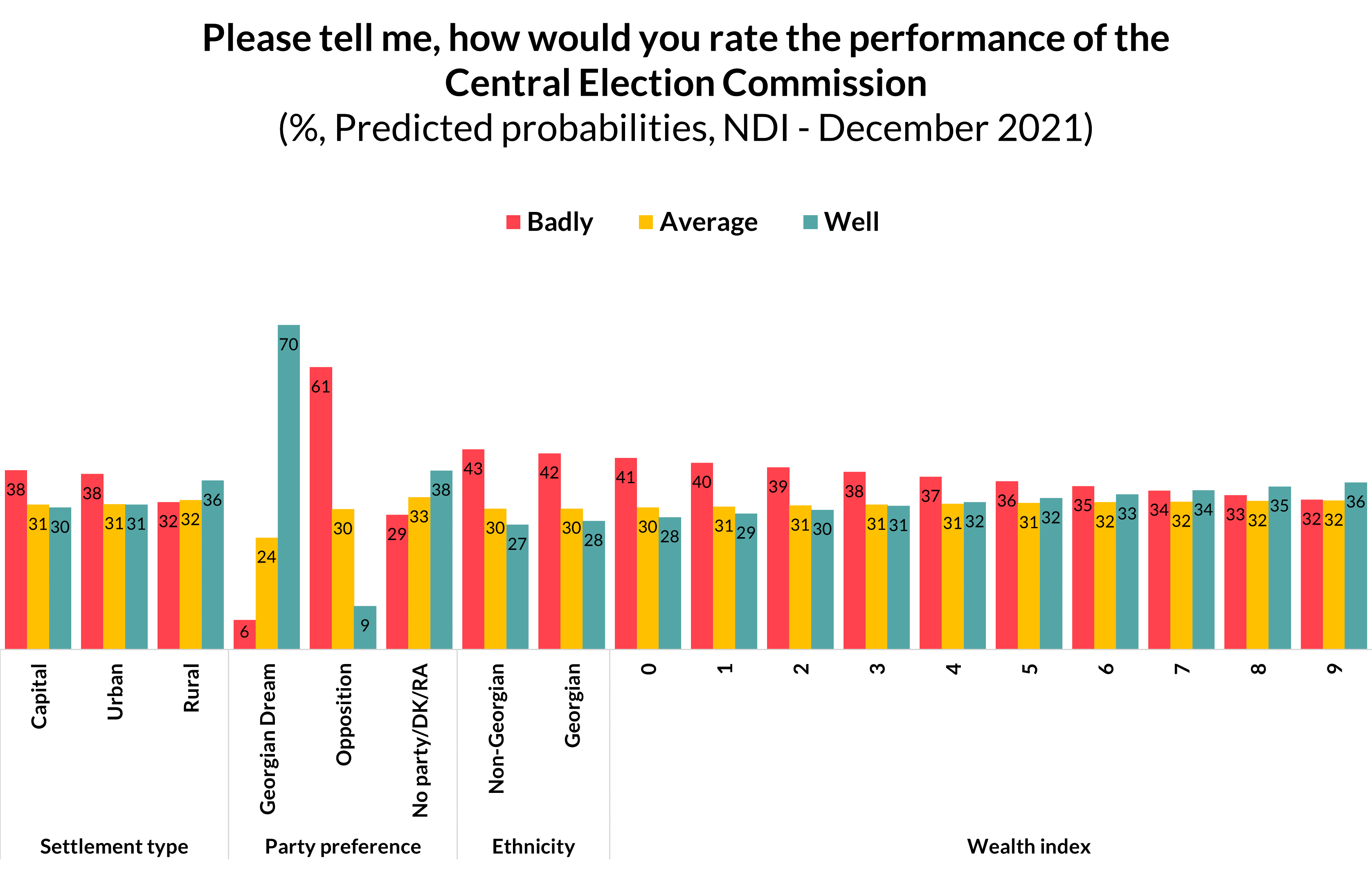
A regression analysis suggests that a number of factors were associated with CEC performance assessments following the elections, including settlement type, ethnicity, partisanship, and wealth.

A regression analysis shows that the largest difference in people’s views stems from their political preferences. Georgian Dream supporters were almost 8 times more likely than opposition supporters to rate the CEC’s performance positively and around 3.7 times more likely to do so compared to those who do not report a party preference. 

Correspondingly, those who are not Georgian Dream supporters were significantly more likely to assess the CEC’s performance as poor. 

Aside from partisanship, a number of factors predicted people’s views. People in Tbilisi and other cities were slightly more likely to assess the CEC’s performance poorbadly than people in rural areas. 

Ethnic Georgians were more likely to have negative attitudes towards the CEC’s performance than ethnic minorities. The wealthier a household is, the less likely it was to evaluate the CEC's work badly. 

The above analysis is based on an ordinal regression model. The model includes age groups (18-34, 35-54, 55+), sex (male, female), settlement type (capital, urban, rural), education (secondary or lower, technical, tertiary), ethnicity (Georgian, ethnic minority), wealth (ownership of 10 different items, a proxy variable), and party preference (Georgian Dream supporter, opposition supporter, or supports no party/DK/RA).

The above analysis shows that regardless of the objective quality of elections in Georgia, there is a clear problem with regards to elections being viewed as legitimate across the political spectrum.

The data used in this article is available here. Replication code for the above analysis is available here.

Tuesday, May 24, 2022

How does Georgia’s democracy compare with countries granted EU candidacy?

Note: This article first appeared on the Caucasus Data Blog, a joint effort of CRRC Georgia and OC Media. It was written by Givi Silagadze, a researcher at CRRC-Georgia. The views presented in the article are of the authors alone, and do not necessarily reflect the views of CRRC Georgia, or any related entity.

The government’s decision to bring forward their application was spurred by Ukraine’s application several days prior as well as mounting pressure from Georgian society.

Despite the extraordinary circumstances, some argue that full integration could take decades unless standards for accession to the EU are lowered.  

Countries aspiring to become EU members must meet several demanding criteria to be considered eligible for membership, known as the Copenhagen criteria. These can be categorised into three groups: (1) political criteria largely relating to democracy, the rule of law, and human rights, (2) economic criteria, and (3) administrative and institutional capacity. 

Georgia, alongside Ukraine and Moldova, is now waiting for the EU to either grant them candidate status or reject their application, which would be a major blow for Georgia’s EU aspirations. 




According to data from Freedom House and Varieties of Democracy, all of the countries that became EU member states during the last two decades had a higher level of democracy when they were granted candidate status than Georgia does in 2022. 

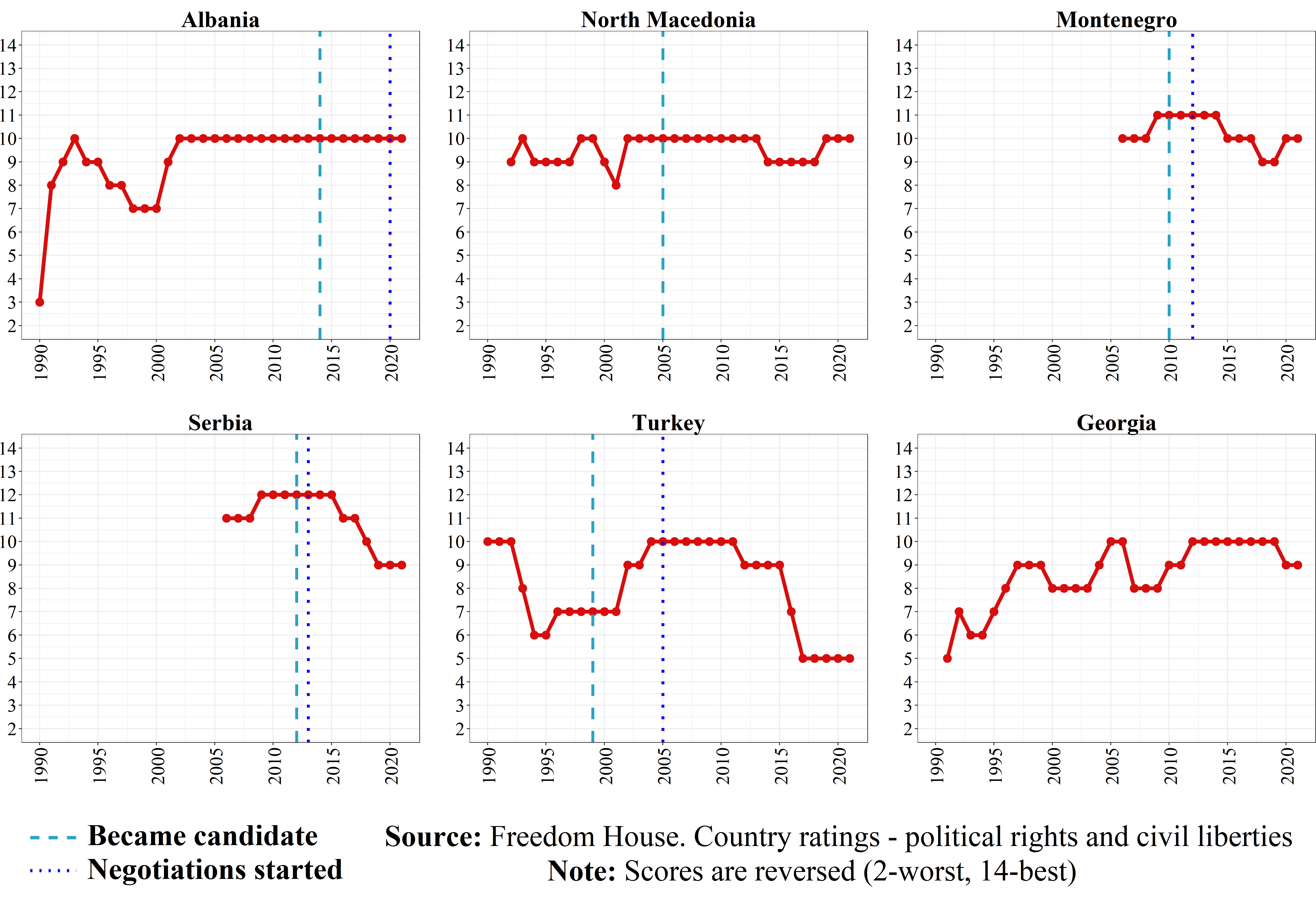
However, Georgia has higher democracy scores than other countries granted candidate status which have not yet become EU member states. 

Georgia vs countries that became EU members in the last two decades

Freedom House scores suggest that all the countries that became EU members over the last two decades were more democratic during their application than Georgia in 2022 when applying for EU membership. 

This observation holds for the moment these countries were granted candidate status and negotiations for accession were opened up until they officially became EU member states.

Click to enlarge.

Data from the Varieties of Democracy project (V-Dem) suggest a slightly different picture. 

According to V-Dem’s electoral democracy index, Georgia’s democracy in 2022 is similar to the level of electoral democracy of Bulgaria and Romania when they were granted candidate status as well as when they became members of the EU in 2007. 

Click to enlarge.

Moreover, Romania’s scores on the electoral democracy index when the EU opened accession negotiations with the country as well as when it became a full-fledged member of the union were slightly worse than Georgia’s scores on the same index in 2022. 

The V-Dem dataset also contains a more demanding democracy index, known as the liberal democracy index. This index shows a similar picture. Romania is the only country that became a member of the EU in the 21st century that had lower scores on the liberal democracy index when the EU opened accession negotiations with it than Georgia in 2022.

Click to enlarge.

Georgia vs countries granted candidate status yet to join the EU 

According to Freedom House, some of the countries that were offered the EU candidate status but are yet to become full-fledged members had comparable levels of democracy with Georgia during the period when the EU granted them candidacy. 

Albania and North Macedonia had only slightly better scores (10 for both) than Georgia in 2022 (9) when they were officially considered candidate countries.

As for Turkey’s democracy, it had lower Freedom House scores in 1999 when granted candidate status (7) than Georgia in 2022 (9). However, accession negotiations with Turkey were conditioned on improvements in its democracy score, and negotiations did not start until its Freedom House score improved to 10 out of 14.

Click to enlarge.

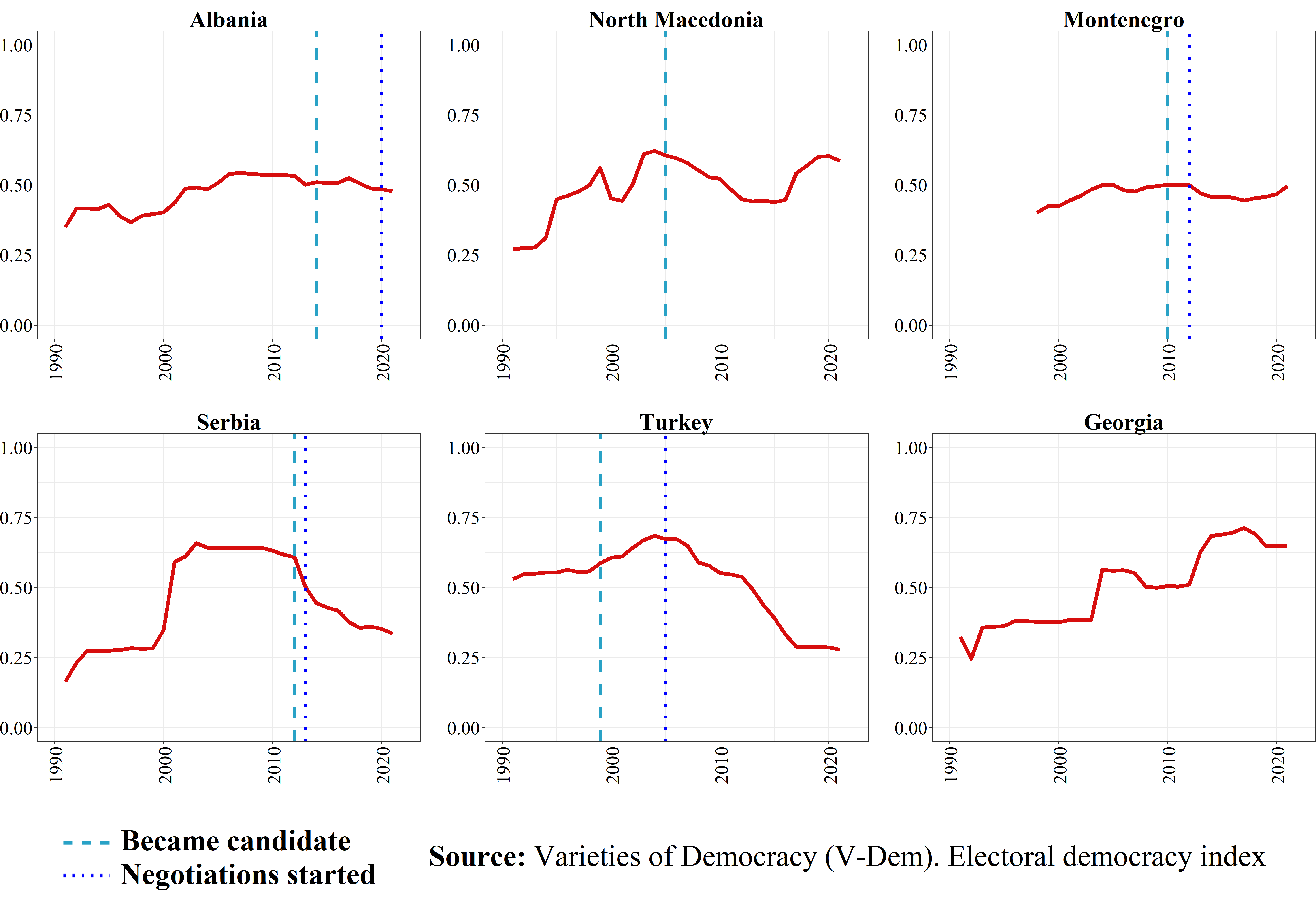
Data from the Varieties of Democracy project (V-Dem) present a different portrait. According to V-Dem’s electoral democracy index, the level of Georgia is more democratic in 2022 than five other countries when they were given candidate status. 

Click to enlarge.

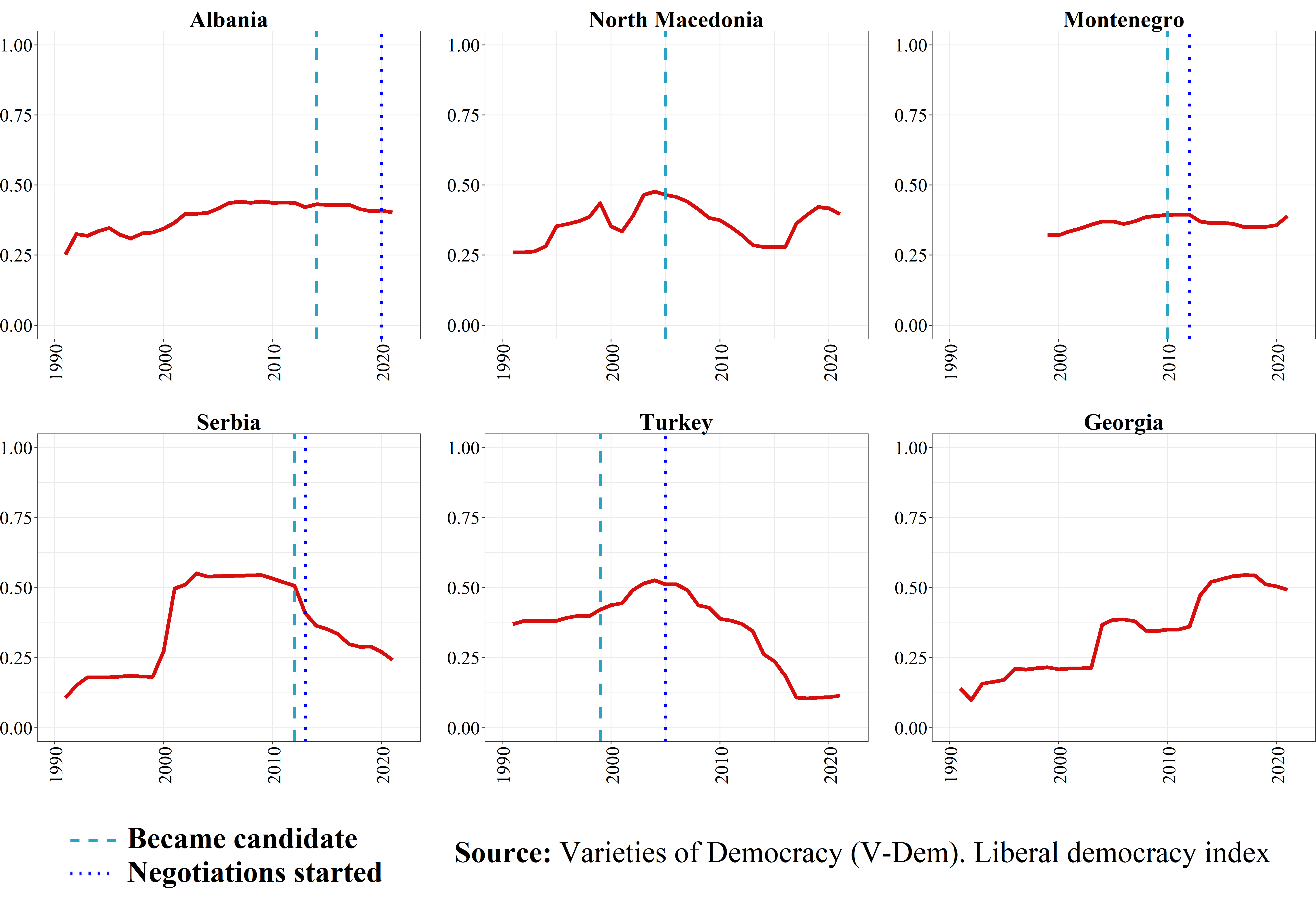
Similarly, the Liberal Democracy Index suggests that Georgia’s democracy in 2022 is stronger than that of Albania, North Macedonia, Montenegro, and Turkey when they were given candidate status. 

As for Serbia, its scores on the index when it was granted candidate status in 2012 were the same as Georgia’s in 2022.

Click to enlarge.

Even though the quality of Georgia’s democracy lags behind EU member states, international democracy indexes suggest that Georgia is as democratic, sometimes more so, than other current candidates when they were granted candidacy status.