Showing posts with label Values. Show all posts

Tuesday, August 16, 2022

What makes a good Georgian citizen?

Note: This article first appeared on the Caucasus Data Blog, a joint effort of CRRC Georgia and OC Media. It was written by Julia-Maria Xavier, an International Fellow at CRRC-Georgia. The views presented in the article are of the author alone, and do not necessarily reflect the views of CRRC Georgia, or any related entity.

A CRRC survey shows that Georgians tend to agree that social values factor more into the making of a good citizen than political engagement.

Respondents were asked six questions relating to good citizenship. Of these markers of good citizenship, the importance of helping those worse off, following traditions, and volunteering were the most supported behaviours.

When asked about the importance of a good citizen to support people who are worse off, 97% thought it was very or rather important. When asked about the importance of following traditions, 92% thought it was very or rather important. Volunteering had the lowest consensus rate within this group, with 90% agreeing that it was very or rather important.

Behaviours generally associated with good citizenship included the importance of being critical towards the government, the opposition, and partaking in protests. Respondents who thought it very or rather important to be critical of the government and opposition did so at 70% and 68%, respectively. The least supported marker of good citizenship was protesting, at 56%.

Factoring in demographic characteristics offers the ability to see which of these markers of good citizenship has broad support across society and which are more divisive.

For the first group of questions in which there is 90% or higher agreement, models only explored whether a respondent reported that behaviour was very important or not. For the second set of attitudes, models looked at whether people felt a behaviour was important or not.

The data shows uniform support across social and demographic groups regarding supporting people who are worse off.

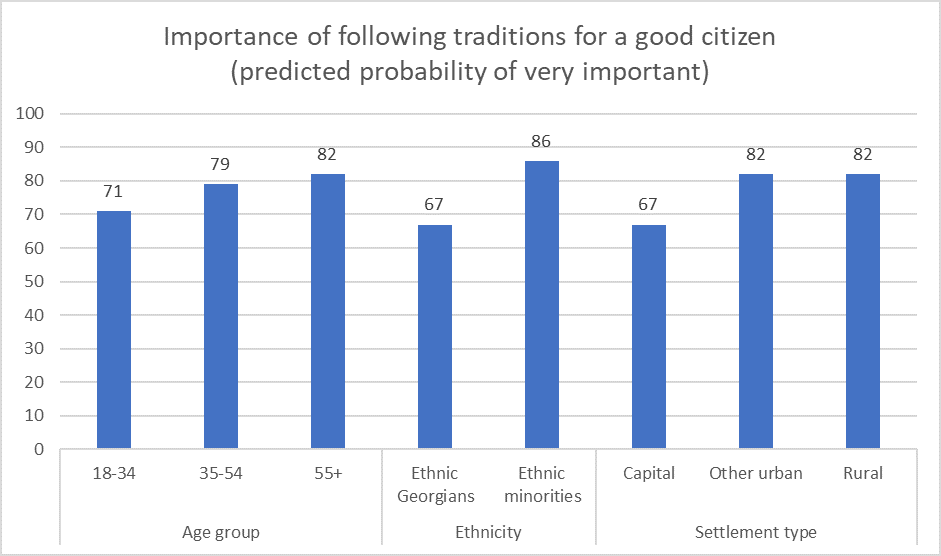
When it comes to following traditions, there are differences between a number of groups. Young people (18-34) were 11 percentage points less likely than those 55+ to think that it is very important for good citizens to follow traditions. Ethnic minorities were 19 percentage points more likely than ethnic Georgians to believe it very important. Those living in the capital were 15 percentage points less likely than those in urban and rural communities to think that following traditions is very important for good citizenship. Gender and employment were not associated with attitudes on this question.
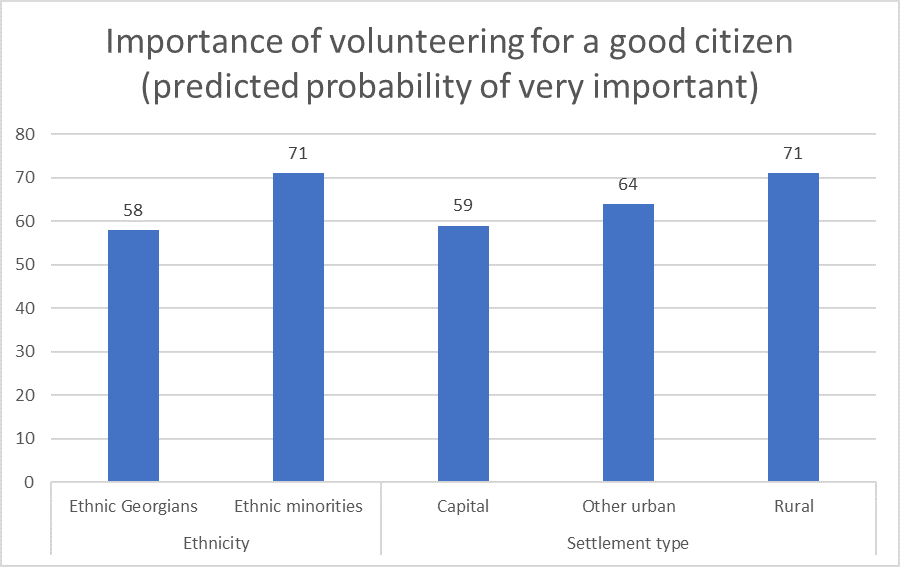
Attitudes toward volunteering also vary by ethnicity and settlement type. Ethnic Georgians were 13 percentage points less likely to view volunteering as very important to being a good citizen than ethnic minorities would.

In Tbilisi, volunteering was five percentage points less likely to be considered very important compared to other urban areas and 11 points less likely to be considered very important compared to rural areas. Age, gender, and employment did not have a significant association when controlling for other factors.
The data shows much more significant variation in terms of the importance of political behaviour for good citizenship.

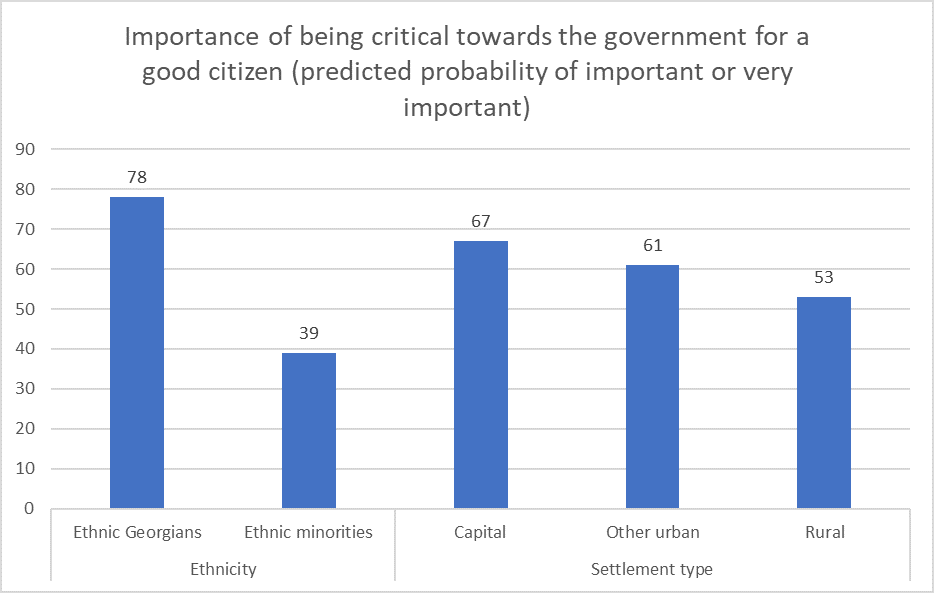
With regard to being critical of the government, ethnic Georgians were 39 percentage points more likely to think that it was important compared to ethnic minorities. Those in the capital were 14 percentage points more likely than those in rural areas to think it important. Age, gender, and employment were insignificant when controlling for other factors.
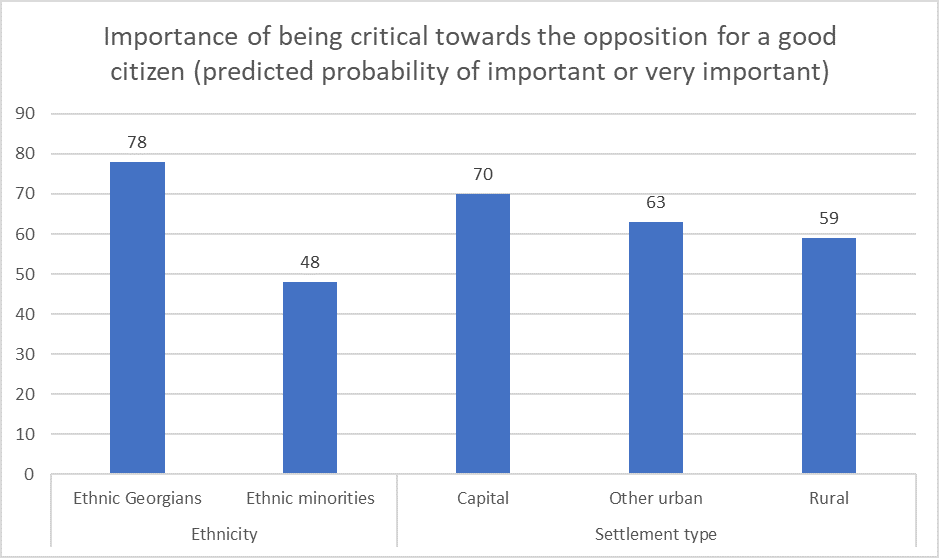
When asked about the importance of being critical towards the opposition, ethnic minorities were 30 percentage points less likely to think it was important than ethnic Georgians. Those in the capital were 11 points more likely to think it important than those in rural areas. Gender, and employment, when controlling for other factors, are not associated with attitudes on this question.
The last marker of good citizenship is participation in protests. Young people (18-34) were 13 and 10 percentage points more likely than those aged 35-54 and 55+ to view this as an important aspect of good citizenship. Ethnic Georgians were 27 percentage points more likely to think protests were important for good citizenship than ethnic minorities. There was no meaningful difference between settlements, genders, or employment statuses when controlling for other factors.
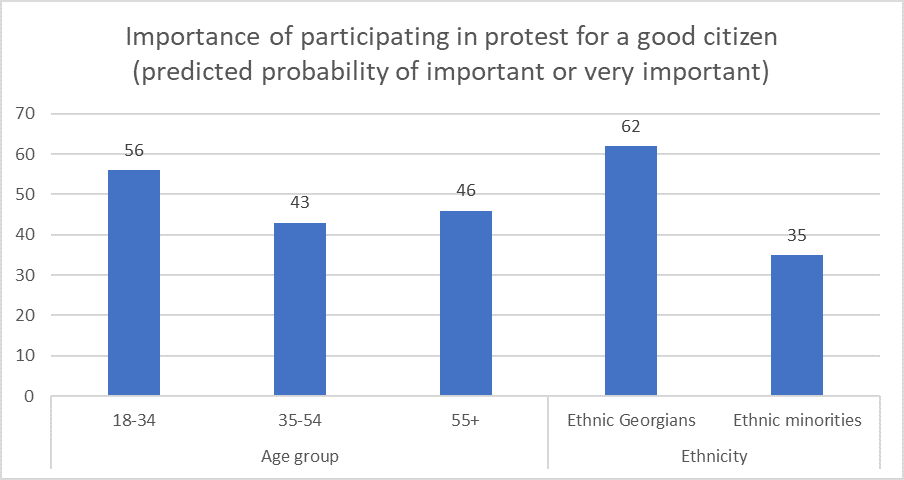
The above data shows that Georgians tend to emphasize supporting fellow citizens and following traditions rather than engaging in politics when they think about what it means to be a good citizen.

The data used in this article is available here. Charts only display statistically significant associations between variables.

The views expressed in this post are the author’s alone, and do not necessarily reflect the views of the Europe Foundation, CRRC Georgia, or any related entity.

Tuesday, December 07, 2021

Georgians are still conservative, but attitudes are slowly changing

Note: This article first appeared on the Caucasus Data Blog, a joint production of CRRC Georgia and OC Media. It was written by Kristina Vacharadze, Programs Director at CRRC Georgia, and Anano Kipiani, a Researcher at CRRC Georgia. The views presented in this article do not represent the views of CRRC Georgia, the Europe Foundation, or any related entity.

Newly released data from the Knowledge of and Attitudes towards the European Union in Georgia survey, which CRRC Georgia carried out for the Europe Foundation, suggests that the public’s attitudes are changing about women having pre-marital sex and children out of wedlock. 

While in 2015, 69% of Georgians thought that it was never justified for a woman to have pre-marital sex, 55% did in 2021, a 14 percentage point decline. During this same period, there was a 10 percentage point increase in the share of people reporting that it is sometimes or always justified. A large amount of these changes took place between 2019 and 2021, with an 11 percentage point decline in thinking pre-marital sex was never justified for women, while there was a six percentage point increase in thinking it is justified at least some of the time.

Similarly, attitudes towards women having children out of wedlock have changed. In 2015, 57% said it was never justified. In 2021, 42% did. The share reporting that it is sometimes or always justified increased from 37% to 47% in the same period. 

Young people aged 18-34 are generally more liberal than older people regarding women having sexual relationships before marriage and having children without being married.  Comparing the most recent wave to the 2019 data suggests that people under the age of 55 are becoming more liberal about women having children outside wedlock, while older people’s attitudes did not shift significantly. With regard to having pre-marital sex, the data suggest that younger people (18-34) and older people (55+) became more liberal, while the age group in between did not change their views. 


Generally speaking, people living in Tbilisi are less conservative than people living in other areas. While this remains true in the 2021 data, the changes described above stem from people in rural areas becoming more liberal on pre-marital sex and women having children outside of marriage.  In contrast, views in urban areas did not change significantly between 2019 and 2021.


The data shows that people with higher than secondary education are more tolerant about both issues than people with a lower level of education. The change in views observed between 2019 and 2021 primarily stems from changing views among those with tertiary education. 

Generally, ethnic Georgians are more tolerant towards women having sexual relations before marriage and having children outside of it. The gap between ethnic Georgians and ethnic minorities expanded in 2021, as compared with 2019. Ethnic minorities’ views have shifted little in recent years on either issue. 

Analyses by gender did not show any difference with regard to women having pre-marital sex. Although gender plays a role in attitudes towards women having a child without being married, women more often say that it is acceptable than men. Attitudes among men and women moved in a similar manner between 2019 and 2021.

People became less conservative towards pre-marital sex and women having children outside of wedlock in 2021. The data tends to suggest that rural people, young people, and those with higher education became more liberal during this period. 

The data presented in the above article is available here.

Monday, August 20, 2018

Views on marital (in)fidelity in Georgia

According to 86% of adults in Georgia, cheating on one’s spouse can never be justified, according to CRRC’s 2017 Caucasus Barometer (CB) survey findings. Another 12% also reported disapproving of cheating, but refrained from a radical “never” answer and choose relatively softer options. Only about 2% openly agreed, albeit with different strength of agreement, with the position that cheating on one’s spouse can be justified. While these answers are expected to be influenced by social desirability bias, they are still interesting indicators of views on marital (in)fidelity in Georgia. Importantly, the distribution of answers has been quite stable since 2011.

Based on the 10-point scale used in CB2017 to record answers to the question, “To what extent, in your opinion, can cheating on one’s spouse be justified or not?” a new binary variable was created for the analysis presented in this blog post, where those answering “Never” (code 1) are considered separately, and their answers are compared to the answers of those who chose all other codes from the show card, i.e. who consider cheating potentially justifiable although do this to varying degrees. Thus, the new variable compares those who report they would not justify cheating under any circumstances, and those who can either think of certain justification(s) for cheating or directly justify it. Answers “Don’t know” and “Refuse to answer” (less than 1% of the total) were excluded from the analysis.

Age, gender, marital status and settlement type would be expected to be crucial in exploring divisions of public opinion on this issue. Counterintuitively, though, the small differences in answers by age, gender, and marital status are all within the margin of error. On the other hand, people living in the capital, other urban settlements and rural settlements do answer this question differently. The population of Tbilisi stands out in its tolerance for cheating, with 22% reporting varying degrees of readiness to justify it.

Thus, it is not the basic demographic variables per sè that more or less divide public opinion in respect to (un)acceptance of cheating in Georgia. Living in the capital versus the rest of the country makes more of a difference. Although the majority of the population of Tbilisi reports that cheating on one’s spouse can never be justified, compared to the rest of the population of Georgia, twice as large a share of Tbilisi dwellers report at least some tolerance to marital infidelity.

To have a look at the Caucasus Barometer data, visit CRRC’s Online Data Analysis portal.

Monday, January 22, 2018

What are young people’s values and how are these different from older generations’ values in Georgia?

[Note: This blog post summarizes the findings of an article written by CRRC-Georgia researcher Tamar Khoshtaria and published in The Journal of Beliefs and Values in August, 2017.]

As Georgian society is going through social and cultural changes, it is important to understand people’s beliefs and values. Comparing the values of young people to those of the older generations is also important. This blog post summarizes the findings of a study that examined the values of young people aged 18 to 25, and analysed how these values are different from the values of older people in Georgia, based on both quantitative (World Values Survey, 2014) and qualitative data (40 in-depth interviews conducted in 2016). The study looked at values, perceptions, attitudes and tolerance towards different minority groups in Georgia. It concludes that in many cases, the younger generation shares more modern views and values, while the older generations are more inclined to support traditional values and hold conservative points of view.

The study used Shalom H. Schwartz’s theory of basic values, which identifies ten basic values:

  1. Self-direction: Independent thought and action-choosing, creating, exploring; 
  2. Stimulation: Excitement, novelty, and challenge in life; 
  3. Hedonism: Pleasure and sensuous gratification for oneself; 
  4. Achievement: Personal success through demonstrating competence according to social standards;
  5. Power: Social status and prestige, control or dominance over people and resources;  
  6. Security: Safety, harmony and stability of society, of relationships, and of self; 
  7. Conformity: Restraint of actions, inclinations, and impulses likely to upset or harm others and violate social expectations or norms;  
  8. Tradition: Respect, commitment and acceptance of the customs and ideas that traditional culture or religion provide the self; 
  9. Benevolence: Preservation and enhancement of the welfare of people with whom one is in frequent personal contact; 
  10. Universalism: Understanding, appreciation, tolerance and protection for the welfare of all people and for nature. 

In his empirical work, Schwartz used short verbal portraits which describe a person as having a certain goal, aspiration or wish and point implicitly to one of the ten value types. After hearing a verbal portrait, respondents had to evaluate to what extent the person described was like or not like him or her. These verbal portraits were used during the 2014 World Values Survey (WVS) conducted in Georgia. During qualitative interviews (conducted independently from the WVS), respondents could provide detailed accounts of their attitudes. 

The quantitative and qualitative data show similar results. Quantitative data analysis suggests that Schwartz’s higher-ordered values ‘conservation’ (which includes the basic values of ‘security’, ‘conformity’, and ‘tradition’) and ‘self-transcendence’ (which includes the basic values of ‘benevolence’ and ‘universalism’) are very important for people of all age groups in Georgia. Over 70% in all age groups evaluated the persons described in the verbal portraits representing these five basic values as being ‘very much like them’ or ‘like them.’ When it comes to these basic values, the young generation, in general, does not differ much from the older generations.


On the other hand, there are some values which were assessed quite differently by people in different age groups. When looking at the basic values ‘self-direction’, ‘stimulation’, and ‘hedonism’ (representing the higher-ordered value of ‘openness to change’), there are differences by age group. Compared to older generations, a larger share of young people identified themselves with a person to whom it is important to think up new ideas, take risks, and have a good time.


Similarly, the basic values of ‘achievement’ and ‘power’ (representing the higher-order value of ‘self-enhancement’) have been assessed differently by young people and people of older generations. While being successful is important for 66% of young people, the share is lower among older people. In addition, while ‘being rich, and having a lot of money and expensive things’ was not reported as an important value in Georgia, the share of those valuing this kind of ‘power’ is slightly larger among young respondents than it is among the older ones.

The second part of the study focused on tolerance towards different minority groups, measured by a question about which groups of people respondents would not want as their neighbours. The least tolerated group in Georgia is homosexuals. People of all generations would not like to have them as their neighbours. Still, the answers of young people suggest more tolerance and openness to different minority groups.


Note: A show card was used for this question. Respondents could name as many answer options as they wanted. 

While some values (e.g. ‘security’, ‘conformity’, ‘tradition’, ‘benevolence’, and ‘universalism’) are almost equally important to young and old people in Georgia, the young generation identifies more with values like ‘self-direction’, ‘stimulation’, ‘hedonism’, and ‘achievement’. In addition, the young generation is slightly more tolerant towards different minority groups.

For detailed results, see the full article in the Journal of Beliefs and Values.

Monday, May 18, 2015

Attitudes reported by Georgian parents and the qualities they find important for children to learn


The vast majority of Georgians (90%) agree with the statement that one of their main goals in life has been to make their parents proud, according to the 2008 World Values Survey (WVS). It would be hard to overestimate the importance of family for Georgians, and the same is true for the attention paid, on the one hand, to raising children and, on the other hand, caring for elderly family members. But to what extent do parents themselves share the values they claim are important for children to learn? WVS data provides us with the opportunity to find answers to this question by comparing the qualities that Georgian parents report as important for children to learn with their own attitudes and values that they report while answering a number of survey questions.

According to WVS data, 76% of adult Georgians had at least one child in 2008, and throughout this blog post, we focus on parents’ responses. The absolute majority – 90% – of parents report it is especially important for children to learn to work hard, be responsible (81%), be tolerant and respect other people (72%), have religious faith (67%), and be independent (52%).


Do the parents themselves possess these qualities? In order to answer this question, let’s take a closer look at parents’ attitudes towards hard work, tolerance, religiosity and independence.

Hardworking? According to WVS data, about 20% of parents who name hard work as an especially important quality for children to learn, ‘neither agree nor disagree’ or ‘disagree’/’strongly disagree’ with the statements that ‘people who don’t work become lazy’ and ‘work should always come first, even if it means less free time’ (22% and 21%, respectively). Furthermore, 29% of these parents ‘neither agree nor disagree’ or ‘disagree’/’strongly disagree’ with the statements that ‘work is a duty toward society.’ We can, therefore, claim that it appears that some parents want their children’s generation to be harder working than they are themselves.

Tolerant? 93% of those parents who said that ‘tolerance and respect for other people was an especially important quality for children to learn, named homosexuals among the groups they would not like to have as neighbors. Furthermore, 37% of them would not like to be neighbors with people of a different religion, and 23% report the same about people of a different race and immigrants/foreign workers, thus hardly passing a hypothetical test on tolerance.

Religious? 97% of parents who name this value as important for children to learn claim to be religious people themselves, and 90% say that God is very important in their lives. However, when it comes to religious practice, the share of parents who pray or attend religious services is relatively low – 28% say they do not take moments of prayer, meditation or contemplation, and 61% report attending religious services only on special holidays or less often.

Independent? The absolute majority (94%) of parents who name independence as an especially important quality for children to learn, ‘strongly agree’/‘agree’ with the statement that they decide their goals in life by themselves. However, 21% of these parents still live with their parents instead of leading an independent life, and 40% of these adults still living with their parents are between 36 and 45 years old, an age group at which one is not too young to be expected to take care of oneself. Even though those living together with their parents often due to economic problems which many Georgian families face, or in order to take care of their parents, one could argue that it is also a sign of mutual dependence between adult children and their parents. In a number of cases, even if adult children can afford to live separately, they often prefer to stay with their parents. The latter can be regarded as a sign of dependence.

To conclude, Georgian parents want children to be hardworking, responsible, tolerant, and independent, and to have religious faith. As the findings presented in this blog post show, some of the parents naming these very qualities, however, fail to share these values themselves. The best demonstration of this is, probably, the large share of parents who mention ‘tolerance and respect for other people,’ but do not want to have homosexuals or people of a different religion or race as their neighbors.

What do you think? Share your thoughts on the CRRC Facebook page, here, or in the comments section below.

Monday, August 18, 2014

One step forward, two steps back? European integration in Georgia after the Association Agreement


So far, 2014 is shaping up to be the year that Georgia might begin to reap the benefits of its pro-EU and pro-NATO foreign policy. In June, Georgia signed the EU Association Agreement despite fears over Russian agitation. NATO has indicated its readiness to discuss a “substantive package” for Georgia, if not a Membership Action Plan. However, despite these gestures towards closer cooperation, some elements of the decision to sign the Agreement have caused friction. For example, the introduction of an anti-discrimination law in April, that contained protection for sexual minorities, was designed to make the Georgian legal environment more EU-compatible. However, the introduction of this protection resulted in backlash from the Georgian Orthodox Church (GOC). Thus, although the signing of the Association Agreement is widely seen by Georgians as a step forward for the country, friction over values has the potential to push the integration agenda back.

The Association Agreement is a sign of strengthening political and economic ties with Europe. However, movement towards a shared cultural space and value system has received less attention in the run-up to the signing. As survey results from the 2013 Survey on Knowledge and Attitudes toward the EU show, political, economic and institutional ties were often cited as anticipated outcomes of the Agreement. Legal reforms aimed at lessening discrimination and protecting minority rights were not an integral part of the public debate about what EU integration would mean for Georgia.


Note: This survey was conducted by CRRC-Georgia for the Eurasia Partnership Foundation. The respondents could select one option from a show card

The adoption of the European-style anti-discrimination law in April 2014 has sparked a debate about the compatibility of traditional Georgian values with European norms, especially with respect to the protection of sexual minorities. This suggests that the widespread public support (88%) for strengthening ties with the EU in Georgia may be dependent on assumptions about the political or economic nature of the EU, rather than norms and values. Legal reforms related to the Association Agreement have had an immediate impact on Georgian life (unlike closer political and economic ties), and there are an estimated 350 EU laws in the pipeline. The law itself bans all forms of discrimination, whether on the basis of language, gender, religion or sexual orientation. Although the anti-discrimination law is just one of many legal components to the EU-Georgia cooperation, the vocal reaction of the GOC against the inclusion of sexual minorities, which the Patriarch deemed “the legalization of illegality,” suggests that the journey towards greater European integration might pose some challenges.

During a street party that followed the signing of the Association Agreement on June 27, 2014, the Patriarch addressed the crowd with a message of celebration and caution. While describing the event as “a happy day”, the Patriarch reinforced the idea that moving closer to Europe is “not only a huge honor, but also a huge responsibility” for a country with its own ancient culture and values. This is important, especially since that the majority of Georgians (82%) trust their religious institutions – much more than those who trust in the EU (33%). Moreover, in 2013, 52% of Georgians said that they would vote against EU membership because of harm to Georgia’s culture and traditions. Thus, it will be interesting to see whether this percentage increases in 2014. In an article in Foreign Policy, Peter Pomerantsev noted that, “the church's [GOC] opposition to some EU principles puts it on a de facto collision course with EU integration policy."


Thus far, the signing of the Association Agreement has resulted in a celebratory mood in Georgia. If integration is to continue moving forward, continued public support and the commitment of Georgian politicians, EU representatives and religious spokespeople will each be key. This blog has explored the climate in Georgia following the signing of the Association Agreement. It has also focused on attitudes towards the new anti-discrimination law and trust in the EU, as well as in religious institutions. You can read more analysis on trends in Georgians’ attitudes towards the EU here. Also, please visit our Online Data Analysis tool.

Monday, December 31, 2012

Comparing Societal Values in the South Caucasus

Values and traditions can shape the ways in which people behave and perceive themselves and others within and across societies. Drawing on data from the 2012 Survey on Social Capital, Media, and Gender in Azerbaijan and the 2011 Survey on Social Cohesion in Armenia, this blog explores different values that, according to Azerbaijanis and Armenians, characterize contemporary Azerbaijani and Armenian societies, respectively. Based on CRRC’s surveys, people in Azerbaijan and Armenia reveal many similar values that define their societies today. In addition, the blog addresses the importance of family in Georgia, using the 2008 World Values Survey (WVS).

Ihe majority of Azerbaijanis think that having children (92%) and a family (89%) is very important in Azerbaijani society. Azerbaijanis also named respect for the Republic of Azerbaijan (84%), the elderly (83%), traditions (81%), and for the Azerbaijani language (77%) as building blocks of the society. 74% of the population places importance on education. Finally, according to the CRRC survey, respect for the history of Azerbaijan (74%) and respect for religious institutions (71%) also characterize contemporary Azerbaijani society.


Similar to Azerbaijanis, the overwhelming majority of Armenians think that having children (96%) and a family (92%) are important in Armenian society. The majority of Armenians also regard education (85%) and respect of traditions (82%) as rather important. Respect for the history of Armenia (78%), for religious institutions (77%), the Armenian language (76%), the Republic of Armenia (74%), and respect for elderly (66%) are also said to define Armenian society today.


The CRRC data show that the majority of Azerbaijanis and Armenians share similar values that they believe characterize their respective societies.  While CRRC did not conduct these particular surveys in Georgia, the 2008 WVS did ask Georgians about the importance of family in their lives. In this regard, 89% of Azerbaijanis, 92% of Armenians, and 99% of Georgians said that family plays an important role in their respective societies.


Thursday, November 29, 2012

Armenia and Azerbaijan: Language, Ethnicity, Religion, and National Values


This blog looks at public attitudes on whether or not speaking the titular language, belonging to the predominant religion or sharing national values are perceived as necessary to be a member of Armenian or Azerbaijani society. Data from the 2012 survey on Social Capital, Media and Gender conducted in Azerbaijan and the 2011 survey on Social Cohesion conducted in Armenia show that sharing national values, belonging to the predominant religious group, and speaking the titular language are important for being considered members of Armenian or Azerbaijani society by much of these populations.  

74% of Armenians think it is not possible to belong to Armenian society without sharing the national values, while a minority of Armenians (21%) think it is possible to belong to Armenian society if one does not share Armenian national values. Less than half of the Azerbaijani population (44%) believes that it is possible to belong to the Azerbaijani society without sharing national values. 

                                              Figures may not sum to 100% due to “Don’t Know” and “Refuse to Answer” responses.


Language can play a functional role by bringing together or dividing social groups. In Armenia, 65% of the population believes it is not possible to belong to Armenian society if one does not speak the Armenian language. Similar to sharing national values, just under half (48%) of Azerbaijanis think it is not possible to belong to Azerbaijani society if one does not speak the Azerbaijani language. 

                                              Figures may not sum to 100% due to “Don’t Know” and “Refuse to Answer” responses.


Public attitudes on ethnicity and belonging are similar in the two countries. In Armenia, which is the most ethnically homogenous country of the former Soviet Union (98% ethnic Armenian), more than half of the population (53%) thinks it is possible to belong to Armenian society as well as belong to an ethnic group other than the titular majority. Similarly, the 2012 survey in Azerbaijan shows that 54% agree that it is possible to belong to Azerbaijani society and to a different ethnic group at the same time.  

                                               Figures may not sum to 100% due to “Don’t Know” and “Refuse to Answer” responses.


While attitudes on ethnicity and belonging are similar in both countries, there is a striking difference in whether or not the populations believe a person can belong to their respective society if they do not belong to the predominant religion. Over half of Armenians (66%) say it is not possible to belong to Armenian society if a person does not belong to the Armenian Apostolic Church. In contrast, about one third of the Azerbaijani population (34%) says the same with respect to Azerbaijani society and being Muslim.   

                                          Figures may not sum to 100% due to “Don’t Know” and “Refuse to Answer” responses.


These CRRC surveys show that there are strong opinions on the relationship between holding national values, speaking the titular language, belonging to the predominant religion, having a non-titular ethnicity, and belonging to Armenian or Azerbaijani society. To explore about these and related questions, please visit  http://www.crrc.ge/oda/ and http://www.crrccenters.org/activities/research/?id=52.


Friday, March 16, 2012

Perceptions of Good Citizenship in Georgia


What do Georgians consider good citizenship to mean? The issue of good citizenship is important, especially because of Georgia’s expressed democratic aspirations. This blog looks at how Georgians perceive their responsibilities as citizens and how their attitudes towards good citizenship have changed in the past two years. The results indicate that mass attitudes and beliefs are gradually changing and that now, compared to 2009, Georgians take a more active view of citizens’ responsibilities.

Modern theories of democracy put a special emphasis on mass values and beliefs as a main force for achieving democracy (See Inglehart and Welzel, 2010 for a summary of modern theories on democracy). Several scholars (Lipset 1959, Deutsch 1961) have argued that citizens and their attitudes play a crucial role in bringing about and sustaining democracy. 

In 2009 and 2011 CRRC conducted a survey in Georgia entitled, “Knowledge and Attitudes toward the EU in Georgia”. Georgians were asked to consider the level of importance of certain activities or values in order to be a good citizen. The data shows that a majority of Georgians think supporting people who are worse off than themselves is one of the most important responsibilities of a good citizen. Paying taxes, protecting traditions, and obeying laws are also considered to be important by the vast majority of Georgians. Moreover, the importance of supporting the poor, protecting traditions and obeying laws has remained almost unchanged in the past two years. 


Note: Respondents were asked, “To be a good citizen, how important would you say it is for a person to...?” The answer options shown in this figure were collapsed into two categories (important and not important) from “not important at all, rather not important than important, rather important than unimportant and very important”.

In contrast, the importance of civic and political participation has notably increased from 2009 to 2011. Voting in elections—an issue closely related to democratization—gained more importance for Georgians in 2011 (92%) than in 2009 (86%). The shift from a passive to more active view of citizens’ responsibilities is further confirmed by the following results.


Since 2009, there has been an increase in the percentage of Georgians who think that forming their own opinions independently of others, being critical towards the government, and working as a volunteer are important for good citizenship. In addition, the number of people who think that participation in protests is important for a good citizen nearly doubled in 2011. These results indicate that mass values and beliefs are gradually changing in Georgia. 

There is a difference between the first and second group of activities in terms of the effort they require from citizens. Protecting traditions and obeying laws are consistently considered important to be a good citizen by the majority of Georgians; however, attitudes towards certain forms of political participation and criticism are changing over time. Yet, helping the poor, obeying rules and protecting traditions are not sufficient to sustain democracy, especially without a certain level of political participation and criticism. Thus, it will be interesting to see how values and attitudes towards the characteristics of good citizenship continue to change, and if they influence democratization in Georgia—a country which has also been influenced by its Soviet past. 

If you are interested in finding out more about Georgians’ attitudes towards EU Institutions or democratic values, you can access the survey’s associated report here. Moreover, both datasets are free and available online at the link above. You are also invited to explore the dataset on CRRC’s fun Online Data Analysis tool.

Wednesday, April 15, 2009

Public Opinion in Azerbaijan and the Islamic World

A colleague of ours recently went to Washington D.C for a presentation by WorldPublicOpinion.org, an international network of research centers studying public opinion. Here is what she reported:

I attended an event on the release of a new study on public opinion in the Islamic world on terrorism, al Qaeda, and US policies. Although the research includes Azerbaijan, the study’s focus is the region in immediate proximity to Israel and Afghanistan. Most of the results of the poll are quite predictable. In general terms, the perception of US goals and policies are that they are driven by economic interests, a desire to spread Western values, democracy and Christianity.

For those that find it useful, these are some of the findings in Azerbaijan:

- 81% disapprove of attacks on civilians in US and 75% disapprove of attacks on US civilians working in Islamic countries


- 66% think that the US having naval forces based in the Persian Gulf is a bad idea

- 77% think that the majority of the people in the Middle East disapprove of the US having naval forces based in the Persian Gulf


- 65% think that the US seeks to weaken and divide the Islamic world

- 60% think that its goal is to spread Christianity

- 90% believe that it is a US goal to maintain control over the oil resources of the Middle East

- 78% think that the US tries to promote international laws for other countries, but is hypocritical because it often does not follow these rules itself

- 47% think that the US is often disrespectful to the Islamic world, but out of ignorance and insensitivity

- 37% think that the US purposely tries to humiliate the Islamic world

- On Islamist participation in politics: 75% think all people should have the right to organize themselves into political parties and run candidates, including Islamist groups
As you can see, the findings are aimed at formulating policy implications for the new US administration.

Interested in further information? Here is where you can access the full report and the questionnaire for the survey.

Wednesday, February 04, 2009

Christian Welzel from World Value Survey visits CRRC

Christian Welzel, Professor at Jacobs University in Bremen and Vice President of the World Values Survey (WVS), held a lecture on his findings at the Tbilisi State University on the 23rd of January. The World Values Survey has conducted five waves of surveys from 1981 to 2007. In total, this has given them coverage of 90 % of the world’s population and representative national data for 97 societies. The data of WVS gives a general position on values for surveyed societies, indicates the direction of trends and illustrates their subsequent impact on social, political and economic life.


Here are some interesting points of the lecture:

  • Data from the Global Value Surveys contradict the assertion of an ongoing global convergence of values/ideas. While data tend in the same “emancipatory” direction in all global regions, they do so parallely. Consequently, regional differences in values do neither decrease nor increase.
  • Happiness has been increasing steadily since 1981 in the world (amongst 45 of 52 surveyed countries). The only societies that have experienced regression in this respect were the post-socialist countries during the 90’s. The incentives for enhancing happiness are, according to Welzel, increasing levels of democratization, tolerance and economic development.
  • Secular values, encompassing variables such as levels of inter-ethnic tolerance and gender equality, are generally increasing in the world. However, a few countries are experiencing notable regression, amongst which Russia and Turkey stands out.
  • Levels of national pride are generally lower in countries that have suffered losses in wars (Japan) or have gone through stages of major disintegration (Russia).

The lecture included a presentation of an updated “global culture map” (similar to the previous Inglehart-Welzel map, shown below). Christian Welzel explained the two sets of dimensions that make out the axis’s that creates an illustration of how the general worldviews between cultural regions differ. The South Caucasian countries are juxtaposed in the “Ex Communist” cultural sphere. In spite of all their differences, the South Caucasus countries are tightly packed together (note that this is mid-90’s data though, and that Welzel's newest map is a little different).

The Traditional vs. Secular-rational values axis reflects importance of religious values, i.e. on issues such as deference to authority, divorce, abortion etcetera. The Survival vs. Self-expression axis is, other than a scale for economic development, an indication on how much individuals in a given society can concentrate on self expression values that gives priority to issues, such as, tolerance, gender equality and decision-making in economic and political life.

As regards the World Value Surveys data for the South Caucasus, one can not track changing trends in the region since it has only been included in one of the wave of surveys (1994-1999). However, good news: the Eurasia Partnership Foundation (CRRC’s mothership) has sponsored data to be collected in Georgia in 2008. We will let you know as soon as the data is available.

A journalist's account of the lecture is here. Want to investigate the works of the World Value Surveys, access other graphs or conduct you own online analysis? Click here.

Monday, April 02, 2007

World Values Survey | Visualizing where we are

This is the Inglehart-Welzel map based on the World Values Survey. Up front, note that much of this data comes from the mid-1990s. Still, it's an impressive overview and various positions on this map correlate with other attitudes. Where the Caucasus is, the endorsement of divorce, single child families, respect for authority and post-materialist values are far away. Disaggregated and in response to direct questions, Armenia is least happy, Georgia in between and Azerbaijan happiest.

All these details are well documented on the exemplary website (see above), which also contains more material that may be interesting to explore.

How has the Caucasus changed? We integrated some key questions from the World Values Survey questionnaire into this year's Data Initiative, so stay posted for updates on recent changes. (Moreover, some other surveys have been using similar questions, but we don't yet have the data sets.)