Showing posts with label Minorities. Show all posts

Tuesday, October 25, 2022

Georgians increasingly agree that minority groups face challenges in Georgia

Note: This article first appeared on the Caucasus Data Blog, a joint effort of CRRC Georgia and OC Media. It was written by Sasha Slobodov, an International Fellow at CRRC-Georgia, The views presented in the article are of the author alone, and do not necessarily reflect the views of CRRC-Georgia, or any related entity.

In a recent CRRC survey on discrimination in Georgia, more Georgians agreed that a range of minority groups face challenges in the country than did three years prior, and they increasingly agree on the main issues that those groups face. 

A survey on hate crime, hate speech, and discrimination in Georgia CRRC Georgia conducted for the Council of Europe in 2018 and 2021 found a number of changes in attitudes among the Georgian population toward the issues that minority groups face.

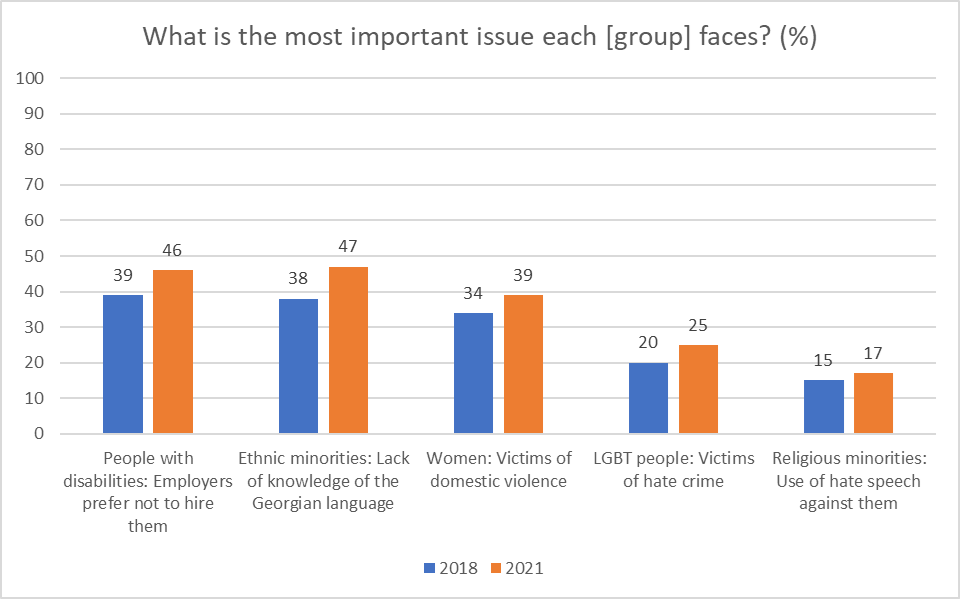
When asked what the biggest issue was that ethnic minorities faced in Georgia, the most frequently noted issue was lack of knowledge of the Georgian language in both 2018 (38%) and in 2021 (47%). For religious minorities, hate speech was believed to be the main issue they faced in both 2018 (15%) and 2021 (17%). 

For women, in 2018, domestic violence was the issue (34%) most commonly cited, increasing to 39% in 2021. As for people with disabilities, a plurality of the public believed that employers preferring not to hire people with disabilities was the main issue they faced in 2018 (39%). This rose to 46% in 2021.  Being a victim of hate crime was considered the largest issue for LGBT people (20%). This number increased to 25% in 2021.

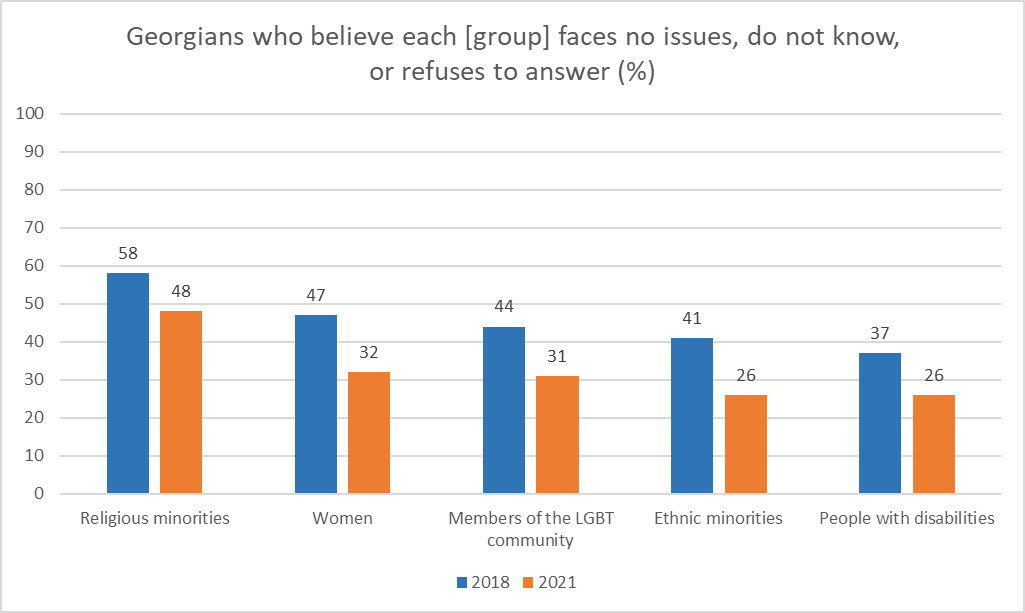
In both years, when asked what the main issues faced by each minority group were, respondents were also given the option to answer that the group faced no issues. Across all groups, the number of respondents who believed that the minority faced no issues decreased. Religious minorities were most often perceived to have no issues (38% in 2018, 27% in 2021), followed closely by women (34% in 2018, 17% in 2021), and then ethnic minorities (26% in 2018, 11% in 2021). The lowest percentage of respondents believed that people with disabilities (17% in 2018, 9% in 2021) and LGBT people (17% in 2018, 9% in 2021) faced no issues at all. 

Many respondents reported that they did not know what the most important issue different minority groups faced was. People were least aware of the issues that LGBT people face (22% in 2018, 18% in 2021), followed closely by religious minorities (19% in 2018, 20% in 2021), and people with disabilities (19% in 2018, 16% in 2021). In both 2018 and 2021,14% reported that they did not know what the primary issue faced by ethnic minorities was. Few people also said they did not know what issues women face, at 12% in 2018 and 14% in 2021.

The above data suggests that Georgians increasingly agree on the biggest issues minority groups face, and that the share of people who believe that minority groups face no issues decreased between 2018 and 2021. Respondents were more likely to agree on the primary issues faced by people belonging to ethnic minorities, people with disabilities, and women, meaning that majorities and minorities were likely to give increasingly similar responses. There was less consensus about the major issues LGBT people and religious minorities face.

Tuesday, August 17, 2021

A different kind of social distance

Note: This article first appeared on the Caucasus Data Blog, a joint effort of CRRC Georgia and OC Media. It was written by Nino Zubashvili, a researcher at CRRC Georgia. The views expressed in the article are the author’s alone and do not reflect the views of CRRC Georgia, or any related entity. 

While the pandemic made ‘social distance’ about physically staying apart from one another, long before that, social distance in the social sciences measured inter-group acceptance, tolerance, and/or prejudice. The same approach is used in post-conflict settings to measure the extent of alienation between conflict divided societies, with studies suggesting that social boundaries grow between people across conflict lines when there is a lack of interaction. 

CRRC’s Caucasus Barometer survey has examined two dimensions of social distance over the years: 

  • Approval of women of one’s ethnicity marrying into another ethnicity, measuring willingness to have an immediate and close relationship with a person;
  • Approval of people of one’s ethnicity doing business with another ethnicity, measuring willingness to have a less immediate and intimate, but still close relationship with another ethnicity. 

Data from the Caucasus Barometer survey has regularly shown that Georgians are more accepting of doing business with other ethnicities, rather than of marrying them. The data from 2019 suggests a similar trend. 

The data also indicates that Georgians feel similarly distant to those living on the other side of the conflict line (i.e. to Abkhazians and Ossetians) as to ethnic minorities living in Georgia (Armenians and Azerbaijanis). 

Time series data shows that Georgian disapproval of doing business with or women marrying Abkhazians or Ossetians has not changed much over the last decade. Disapproval of such social interactions even decreased slightly. As in 2019, the differences in approval of doing business with or women marrying Abkhazians or Ossetians have been more or less in line with the approval of such interactions with Armenians and Azerbaijanis living in Georgia over the years. 


Further analysis suggests that different factors are associated with the acceptance of business and familial relations with different ethnicities. 

Trust in others is associated with the acceptance of inter-ethnic business relations. People who are generally trusting are more likely to be accepting of business relations with all groups noted here compared to those who believe that one cannot be too careful in dealing with people. 

Age is associated with acceptance of business relations with some ethnicities, with younger age groups being slightly more accepting compared to older age groups. 

Gender and ethnicity are associated with acceptance of business relations with some ethnicities. Women and ethnic Georgians appear to be less accepting in this regard. 

Interestingly, while several factors are related to acceptance of business relations with Abkhazians, Ossetians, and Azerbaijanis living in Georgia, only generalized trust is associated with acceptance of doing business with Armenians living in Georgia. 

Religious affiliation, household income, and employment situation are associated only with acceptance of doing business with Azerbaijanis (not presented on the chart below).

Other demographic variables, such as settlement type, educational attainment, several economic well-being measures, the importance of religion in daily life, and interest in permanent emigration did not show any association with approval of doing business with any of the ethnicities noted here. 


The factors associated with approval of inter-ethnic marriage differ from those associated with approval of doing business with other ethnic groups. 

The importance of religion in daily life is associated with acceptance of women marrying all of the ethnic groups considered here. Those that do not find religion important in daily life are notably more accepting of inter-ethnic marriage. 

Higher education is also associated with higher levels of acceptance in all cases.

Generalised trust is associated with acceptance of marrying Abkhazians and Ossetians only, with trusting people again being more accepting compared to those who generally have low trust in people. 

Age is associated with acceptance of marriage of some ethnicities, with younger age groups again being slightly more accepting compared to older groups. 

Willingness to emigrate permanently is associated with acceptance of women marrying Armenians living in Georgia. Ethnicity, religious affiliation, and frequency of attendance at religious services are associated only with acceptance of women marrying Azerbaijanis living in Georgia (not presented on the chart).

Settlement type, employment status, and other economic well-being measures are not associated with approval of marrying any of the above mentioned ethnicities, controlling for other factors. 


The social distance between the population of Georgia proper and Abkhazians and Ossetians, has changed little over the last decade, at least on the Georgian side of the line. Yet, the data from the last decade shows that the population felt as distant from Abkhazians and Ossetians as they do with Armenians and Azerbaijanis living in Georgia. This demonstrates a challenge for reconciliation with societies on the other side of conflict lines as well as the integration of ethnic minorities into society. While general trust is consistently associated with the approval of inter-ethnic business relations among these groups, the importance of religion in daily life and educational attainment seem to be more important factors in the acceptance of inter-ethnic marriage.  

Note: The data used in the article can be found on CRRC’s online data analysis tool. The analysis of whether people approve or disapprove of doing business or marrying people of another ethnicity was carried out using logistic regression. In all cases, regression models included the following demographic variables: sex (male, female), age group (18–35, 35–55, 55+), ethnic group (ethnic Georgian, another ethnicity), settlement type (capital, other urban, rural), educational attainment (secondary or lower education, higher than secondary education), employment situation (working, not working); economic well-being measures: household total income (medium or high, low or none), how often family does not have money enough for food (often, less often, never); religion related measures: religious affiliation (Orthodox Church, other), frequency of attendance of religious services (frequently, sometimes, rarely, never), the importance of religion in daily life (important, not important); as well as interest in permanent emigration (interested, not interested), generalized trust (you cannot be too careful, neutral, most people can be trusted). These variables were tested independently in separate regression analyses that controlled for the demographic variables.

 For ease of reading, OC Media's style does not to use qualifiers such as ‘de facto’, ‘unrecognised’, or ‘partially recognised’ when discussing institutions or political positions within Abkhazia, Nagorno-Karabakh, and South Ossetia. This does not imply a position on their status.
Monday, May 16, 2016

Fearing for the children – how living with children affects homophobic attitudes in Tbilisi

Following the controversial events of May 17, 2013, CRRC-Georgia conducted a survey in order to gauge the opinions and attitudes of the adult residents of Tbilisi towards homosexuals and their rights. Among the various outputs following the survey was  a series of blog posts exploring statistical predictors of homophobia. The findings indicated that a low level of education was one of the strongest predictors of homophobia among Tbilisi residents and that men had a higher probability of being homophobic than women, particularly when the men believed that homosexuality was an inborn rather than an acquired trait. This blog post looks deeper into the predictors of homophobia in Tbilisi by testing for a statistical relationship between homophobia and living in a household with one or more children under the age of 18. Our findings suggest that there is a significant relationship between these two variables, although it is different for men and women.


Unlike the previous series of blog posts on homophobia, weighted data is used for the descriptive analysis in order to make more accurate projections about the attitudes of Tbilisi residents. As was the case with the previous blog posts, we measure homophobia using the question, “[Whom] would you not wish to be your neighbor most?” Respondents were asked to choose one of the six groups presented on a show card: drug addicts, black people, adherents of a different religion, people having different political views, homosexuals, and criminals. Those who chose homosexuals (31% of those who answered this question) were deemed to be homophobic.

As the chart below shows, overall, there is no difference in the share of people reporting homophobic attitudes between those living in households with children and those living in households without children (32% and 31%, respectively). The findings, however, are very different separately for men and women. Specifically, we find that the share of Tbilisi females who are homophobic is 7% higher when one or more children live in their household, while it is 13% lower among men.


Logistic regression confirms the importance of having one or more children living in the household as a predictor of homophobic attitudes. According to the model, women with child(ren) in the household are 207% more likely to be homophobic when age, gender and education are controlled for. For men, though, the likelihood decreases.

So why do women tend to be more homophobic when they live with children, and why do men tend to be less homophobic? While further research focused specifically on this issue would be needed to determine the exact cause behind this finding, one possible explanation to the first part of the question is that women may be confusing homosexuality for pedophilia; another possibility is that women may be afraid that homosexuals potentially living next door might influence children into homosexuality (especially provided that, according to the findings presented in a previous blog post, women, more so than men, believe homosexuality to be an acquired trait). In regards to the second part of the question, men may feel that their masculinity has been confirmed once they have children (see here for more information), and thus they feel less threatened. It should be noted, however, that this latter explanation would only apply to those men who have their own children, while the survey data only tells us whether they live in a household with children, but not whether those children are or are not their offspring. For this reason, it may be useful in future studies to investigate the effect of having one’s own child(ren) on homophobic attitudes, in addition to more generally living with children.

The findings presented in this blog post show that women are more likely to be homophobic when there are child(ren) living in their household whereas the opposite is true for men. This finding suggests possible approaches to address homophobia, such as information programs speaking directly to mothers, and women in general, regarding the “nature versus nurture” debate, pedophilia, the nature of homosexual companionship, and the harms of viewing homosexuality as an abnormality. For men this may be more of a struggle with personal sexual identity and insecurities. In any case, a dialogue on the root-causes of homophobia is an important part to combating discrimination against sexual minorities.

The dataset of this survey, as well as respective documentation are available at CRRC’s Online Data Analysis portal.

Monday, May 25, 2015

Perceived (in)equality in the courts in Georgia - the poor in trouble


The judiciary is essential to the functioning of a state. Hence, not only is its good performance important, but so are perceptions of the courts’ impartiality. In 2011 and 2014, CRRC-Georgia conducted two nationally representative public opinion polls funded by East-West Management Institute and the United States Agency for International Development. The surveys explored Georgians’ knowledge, trust and perceptions of the judiciary. Survey findings suggest that the situation has not changed much during this period, although there was a slight increase in the share of the population who reports completely agreeing that, in Georgia, everyone is equal before the law – from 34% in 2011 to 43% in 2014. Nevertheless, there are still representatives of certain social groups that people do not expect the courts will treat impartially.


During the survey interviews, a number of scenarios were offered to the respondents about representatives of various groups who were hypothetically charged with the same crime they did not commit. The respondents were asked who, in their opinion, would be more likely to be found guilty – rich or poor; Georgian or non-Georgian; Orthodox or non-Orthodox; heterosexual or a representative of a sexual minority.

While over 60% of the population claims in 2014 that Georgians and non-Georgians, Orthodox and non-Orthodox, heterosexuals and a representative of a sexual minority have the same chance of being found guilty or innocent when charged with an identical crime they did not commit, the population thinks that being rich or poor does make a difference – 43% answer that a poor person is more likely to be found guilty. Importantly, though, the most frequent answer reported by 49% in 2014 is that both a rich person and a poor person have the same chance of being found guilty or not guilty. Interestingly, 52% of the residents of the capital report a poor person is more likely to be found guilty, while only 40% think a rich person and a poor person will have the same chance in court. This suggests that the population in Tbilisi is less likely to perceive courts as impartial compared with the population in the rest of the country.

Note:  Don’t know and refuse to answer responses are not displayed on the chart.

Thus, although from 2011 to 2014 there was a slight increase in the perception that in Georgia everyone is equal before the law, almost half of the population still does not expect the courts will treat the rich and the poor equally.

For more information about the surveys on the judiciary, please take a look at the data here. A report comparing the results of the two waves can be found here.

Monday, November 24, 2014

Exploring Homophobia in Georgia: Part 5

This is the fifth and final blog post in a series analyzing the findings of CRRC-Georgia’s 2013 May 17 survey in Tbilisi and presents evidence-based policy recommendations which address the issue of widespread homophobic attitudes. The previous blog posts in this series can be found here: Part 1, Part 2, Part 3, Part 4.
 
As discussed in previous blog posts, the main statistical predictors of homophobia among Tbilisi adults are:
  • Sex, with males at a higher risk of having homophobic attitudes than females;
  • Level of education, with those with higher educational attainment being at a lower risk of having homophobic attitudes;
  • Tolerance and adherence to liberal values, with those not sharing these values being at a higher risk of having homophobic attitudes;
  • A perception that homosexuals are a threat to the country, with those believing that homosexuals endanger Georgia being at a higher risk of having homophobic attitudes.

These empirical findings provide crucial information for policy makers to plan policy intervention(s) aimed at decreasing the level of homophobic attitudes and promoting tolerance and respect for the rights of all minorities, including sexual minorities.

We recommend that targeted interventions are made in the legal and educational spheres. The former is important, because Georgia still lacks legal guarantees for the protection of rights of minorities and enforcement mechanisms to punish violations of those rights. This is especially evident for sexual minority rights. The widely debated anti-discrimination bill, initiated by the Government of Georgia in April, 2014, has caused a division of opinions in society, which, in part, was caused by protests emanating from the Georgian Orthodox Church and other religious organizations. Although the initial definition of the target group of those protected by this bill included sexual minorities and a new institution of “equality protection  inspector” was introduced (as well as fines for discriminating against individuals or entities), due to pressure from religious as well as some non-religious circles, the revised draft of the bill presented to  and passed by  Parliament was much softer than the original one and lacked crucial wording  defining concrete mechanisms for the protection of the rights of minorities.

Hence, we recommend that government of Georgia should ensure it does not fall under the influence of religious institutions, including the Georgian Orthodox Church, while drafting and implementing policies aimed at the protection of the rights of minorities. In particular, it must be ensured that the anti-discrimination bill is an efficient tool for the protection of minority rights and ensures sufficient and effective protection of minority rights through effective enforcement mechanisms.  

Education has been shown to be the most important socio-demographic factor which inculcates against homophobic attitudes among Tbilisi adults, and this finding is not specific to Georgia. Education is universally associated with the acceptance of liberal values, and the more educated an individual, the higher is the probability that they will be more tolerant, even in cases when liberal values are not specifically promoted in the process of formal education. Hence, it is hard to overestimate the importance of education in addressing the issue of homophobia and intolerance more generally.

A course on civic education was introduced in Georgian secondary schools in 2006 for high school pupils, covering issues such as basic human rights, gender equality, structure of government, international legal documents, and elections among other topics. Although this course has not proven to be highly effective yet  , it has the potential to become an important tool in promoting liberal values and understanding the importance of accepting diversity in society.

We recommend that the Ministry of Education and Science of Georgia:
  • Strengthens   the existing course on civic education and introduces the subject in primary schools with younger pupils as well, rather than in high school only;
  • Implements a comprehensive training program for teachers of civic education on issues such as equality, tolerance, and human rights.
 
These recommendations can and should be implemented at the national level. In doing so, they will have a positive effect not only in Tbilisi, but throughout the country.

Tuesday, April 01, 2008

Focus Groups | some basic local lessons

We have recently conducted 20 focus groups across Georgia. (More on the content later.)

Here are some basic tips and tricks we found useful.

  • Rewards: 15 GEL phone cards; that seems just about right: not overpaying, but still attractive.
  • Recruitment: on the street, at sampling points a couple of days in advance; we get definitive agreement from 20 people, write down their phone number and address, and then send out a taxi to pick up the respondent before the event; we did NOT screen for articulacy and ended up with a few laconic focus group members, but never more than one or two per group. In future, we may ask a quick AND complex question (a typical screen is something like"if you could only pick one skill, which skill would you like to have, playing an instrument or a team sport? And tell us why?"), to select even better.
  • Timing: amazingly, we started several of the focus groups EARLY since everyone was there already; so we turned the reserve away, with the 15 GEL phone card as a reward for showing up. Typically, groups ran 2 hours, and that worked fine.
  • Numbers: we had 10 people per group, which was OK considering that we had some less outspoken participants; otherwise, it would have been just a bit too much; small things matter: narrow tables ended up isolating participants at the end.
  • Discussion Guide: on that, we spent a lot of time. We think we got that right.
  • Mirrors: nice to have, of course, but we opted for a camera, with a live feed (see photo) into the next room; we briefly thought about purchasing the cameras, but then decided the wiser course was to hire a professional local journalism organisation.
  • Minority areas: for Kvemo Kartli and Samtske-Javakheti, we brought in facilitators from Azerbaijan and Armenia. Many people told us that you couldn't use Baku Azerbaijani language in Marneuli, but it turns out that our Baku-based facilitator got along very well (although some people seemed shy of her 'high' language, and responded in Russian); maybe this would change in rural areas, but in Marneuli city, Azerbaijani language is not an issue.
  • We always had a facilitator and a note-taker, even if the latter is a bit of a luxury since we had full transcripts, it serves a good support function.
We hope others doing research will find some of this helpful. Any suggestions for good screening questions?

Monday, March 03, 2008

Book Review | The Post-Soviet Wars: Rebellion, Ethnic Conflict and Nationhood in the Caucasus | Christoph Zürcher

The earliest books that came out about the Caucasus after the collapse of the Soviet Union were firsthand accounts of events. Now, a second spate of books, which attempt to apply analytical frameworks to the turbulent events that occurred have the breakup of the Soviet Union are beginning to appear. Christoph Zürcher’s The Post-Soviet Wars: Rebellion, Ethnic Conflict and Nationhood in the Caucasus, published with New York University Press, falls into this category. The book examines where wars occurred in the Caucasus (Georgia, Nagorno-Karabakh and Chechnya) and where they didn’t (Dagestan and Ajara) and places those cases studies within the context of the international quantitative literature that attempts to explain why internal wars occur.

Those who are knowledgeable about the Caucasus will find much information they have already come across. However, for those interested in international conflict who possess little regional understanding, the tersely written detail provides a good overview.

To whet your appetite for some of the details about why wars started in the Caucasus, Zürcher argues that, in Georgia, anti-Soviet rhetoric allowed for no maintenance of Soviet institutions, increasing the likelihood of conflict, since state institutions utterly collapsed as a result. Furthermore, the fallback on nationalist rhetoric, which was seen as the only way of creating a cohesive political force, then alienated both Abkhaz and Ossetians. Zürcher, perhaps controversially, also claims that Armenian politics looked very similar to Baltic politics (and different from Georgian and Chechen) in that the same type of state weakness did not exist. However, Zürcher makes the claim, which has been echoed in much of the democratization commentary about Armenia, that instead of the Baltic states’ orientation towards Europe, Armenia’s politicians unified around war in Nagorno-Karabakh, creating an anti-reform minded regime.

From a more technical standpoint, the book is a rare breed within the political science literature, as it is specifically concerned about testing existing theories about internal wars by examining a series of cases studies. In doing so the volume seeks to refine those theories. While this type of book is out of vogue because the academic nomenklatura does not perceive the endeavor as groundbreaking, it serves an important role in refining theories, something Zürcher does throughout the book.

So what does Zürcher find in relationship to the international quantitative literature? Several variables that are generally cited as determinants of internal war do not appear to hold true in the Caucasus: low economic development and mountainous terrain do not help in explaining the conflagrations in the Caucasus. Despite the Caucasus being mountainous, most conflict occurred in urban environs or in the plains. In the conflicts where mountains played a role, the guerillas (which conflict theory supposes are aided by mountains) had the mountains against them. In fact, Zürcher seeks to refine the theory about the relationship between mountains and war and suggests several plausible alternative hypotheses, part of the intellectual merit of the book. One interesting hypothesis is that mountains are a proxy for the cheap recruitment of male soldiers, since mountainous areas often have high unemployment rates and hence a male population ready to mobilize.

The volume also reinforces the idea found in the international quantitative literature that state weakness often plays an important role – perhaps much more so than underdevelopment – as does the role of one ethnic group constituting the majority of the population. This ethnicity argument is well-highlighted with Zürcher’s case study of Dagestan, where ethnicity did not play the same role as in Georgia, Armenia or Chechnya, in part because of the fact that no ethnic group had a majority.

Overall, this reviewer found the findings sound, but would have like to see more analysis of some of the interesting proxy variables discussed above. This, however, could form the basis of a new and fruitful conflict research agenda in the Caucasus.

This book review was also printed in The Georgian Times.

Thursday, February 08, 2007

Minority Youth in Georgia

Nino Japaridze analyzed what is needed to integrate Azeri and Armenian youths into Georgian public life.

What are some of their main grievances? The focus groups (ethnic minorities and Georgians) in Tbilisi, Marneuli, Bolnisi and Akhaltsikhe showed that education is a major problem. Minorities don’t know Georgian, and therefore said that they were not able to participate in the national university entrance exams. As a consequence, they were not happy about the educational reform.

What else? Youths say they need employment. They also want places for entertainment, a space that is for them to socialize. Drug addiction was mentioned as a big problem.

Japaridze's recommendations are not new, but almost by default one sounds like a broken record when talking about minority integration:

  1. give minority groups the feeling that grievances are being heard and addressed;
  2. offer Georgian language classes;
  3. provide training courses on rights, so that citizens know and can exercise their rights;
  4. start regional healthcare reform;
  5. facilitate investment, to reduce unemployment.
Additionally, Japaridze used the CRRC Data Initiative 2004 to analyze the attitude of South Caucasians toward certain groups of people (homosexuals, drug addicts, alcoholics, those with HIV, and people having tuberculosis). According to the data, Georgians are most tolerant, with Armenians second, followed by Azerbaijanis. Most respondents prefer marriage with the same nationalities, but regarding friendship a third of the respondents express no national preferences.

Details on our website.

Tuesday, December 12, 2006

Georgians living in Gali

Rusudan Velidze analyzed the living conditions of the Georgian population living in Gali, in Abkhazia. For those unfamiliar with the circumstances, these mostly are (Georgian) Megrelians, and the area is under control of the de facto Abkhaz authorities.

The researcher, on a CRRC research stipend, conducted face-to-face, in-depth interviews with 60 respondents in 2005. After the change of the Georgian government in 2003, the number of population returning to Gali increased, but their economic condition remains harsh.

Some of Velidze's main findings include: most of the respondents believe that the war was triggered artificially and that Shevardnaze’s government contributed to the escalation of the conflict. As for the current government, the population trusts it more and hopes that the territorial integrity of Georgia will be restored.

After establishing Georgian schools in the district, the educational problems are more or less resolved. There are 32 Georgian schools, charging a monthly fee of 4 to 7 GEL. The level of education is good. But healthcare remains one of the major problems. The healthcare system is disorganized and there exists only one hospital in the district, which lacks medical supplies and qualified doctors.

The main information source for the population is television. Georgian, Russian and Abkhaz TV channels are available in the district. Velidze also reports that the Georgian population does not have any relationship with Abkhaz people and do not know much about their everyday life.

A Georgian language report is on our Website, and more detail available from Velidze directly.