Showing posts with label Youth. Show all posts

Tuesday, July 05, 2022

Young people in Georgia want the government to focus on education

Note: This article first appeared on the Caucasus Data Blog, a joint effort of CRRC Georgia and OC Media. It was written by Tamuna Khoshtaria, a Senior Researcher at CRRC-Georgia. The views presented in the article are of the author alone, and do not necessarily reflect the views of CRRC Georgia, GFSIS, or any related entity. 

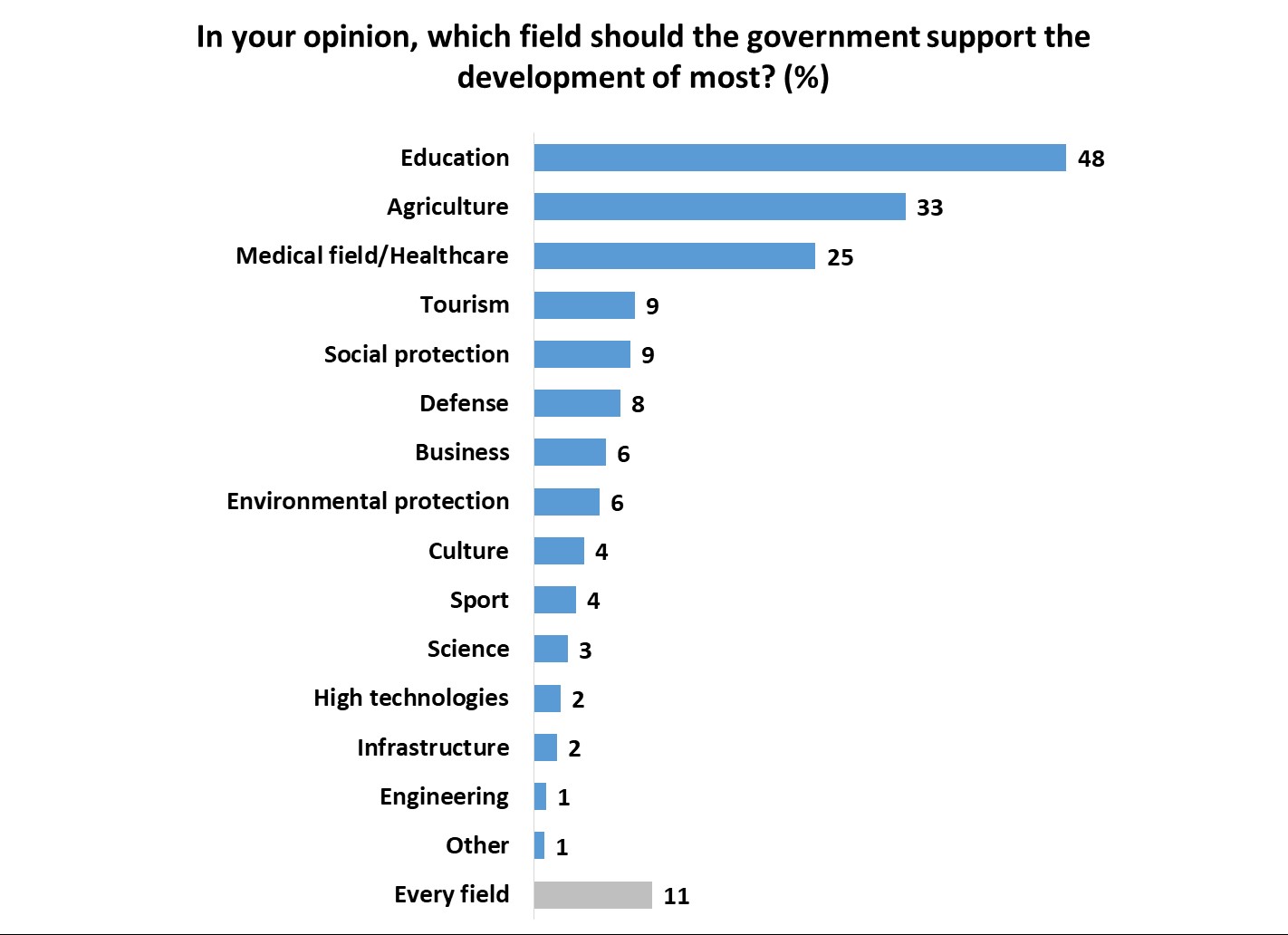
study conducted in 2021 by CRRC Georgia for GFSIS focusing on the values and political activism of young people in Georgia shows that education is the primary field that young people aged 18–29 in Georgia want to be strengthened. 

Young people prioritise the development of education above other domains. Almost half of young people (48%) mentioned education when asked what field the government should support most. The next most common response was agriculture, which was named by a third (33%). Healthcare came in third, with a quarter of respondents naming this as a priority.

Note: Respondents could name up to two answers. Therefore the numbers do not add up to 100%.

A regression model suggests that whether young people prioritise education varies according to a number of factors.

Women were eight percentage points more likely to name education than men. 

Young people in rural areas named education less (49%) than those in the urban areas (56%) and the capital (57%). 

The younger a person was, the higher the chance they named education. The probability of someone aged 18–21 naming education was 61% compared to 48% for someone aged 26–29. 

Those with at least some tertiary education also name education more often. Young people with some tertiary education were 13 percentage points more likely to name education than young people with only secondary education.

That university students and recent graduates think that education should be a top priority may point to dissatisfaction with the quality of higher education. 

Other data in the study supports this conjecture. 

When asked to what extent the level of education in Georgian higher education institutions was satisfactory, almost half of those with at least some tertiary education expressed dissatisfaction in contrast to about one-third with secondary education.

Aside from demographics, young people’s attitudes towards the West also predicted whether or not they think education should be a top priority. Young people who said that integration with the European Union or NATO was very important to them were more likely to say that education should be a top priority compared to those who report EU/NATO integration was quite important or not that important.

Overall, the findings suggest that education is a top priority for young people aged 18–29 in Georgia. This is especially important for young women, those under 22, those living in the capital, those with experience in higher education, and those with pro-Western attitudes.  

The views presented in the article are the author’s alone and do not necessarily reflect the views of GFSIS, CRRC Georgia or any related entity. 

Note: The analysis above is based on a logistic regression model.  The variables included in the regression include sex, age group, settlement type, and level of education. The analysis which included attitudes towards NATO and EU integration was conducted using a second and third model, where importance of NATO/EU integration were included as categorical variables in addition to the aforementioned variables. The data used in this blog post are available here.

Monday, May 20, 2019

Grit among young people in Georgia

Angela Duckworth’s concept grit has gained a great deal of attention in recent years. Grit, described as some combination of perseverance and passion, has gained this attention, because the data suggest it is associated with a number of positive outcomes like employment and completion of education. In 2018, CRRC-Georgia measured the grit of over 2500 young people (15-35) within a baseline evaluation for World Vision’s SAY YES Skills for Jobs project (funded by the European Union within EU4YOUTH program) which is taking place in Mtskheta, Akhaltsikhe, Adigeni, Kutaisi, Zestaponi, Bagdati, Senaki, and Zugdidi. The data suggest that grit is good predictor of positive outcomes in Georgia as is it is in other contexts.

The grit scale is made up of 12 questions, measured on a five point scale, which were asked to a representative sample of young people in World Vision’s project area. The chart below shows the average score for each of the 12 statements.

The grit scale (average score on the above statements) is quite a good predictor of labor force participation. A person is considered outside the labor force if they do not have a job and are not interested in one, looking for one, or able to start one. A person is considered in the labor force if they are employed or are looking for a job, can start one, and are interested in one. The chances of whether someone will be in the labor force increase significantly as an individual’s grit increases. This pattern holds when adjusting for other factors including age, sex, parental education level, whether the person was displaced by a conflict, family size, and municipality. The chart below shows the probability of participation in the labor force adjusted for each these factors. It suggests that all else equal, if a person moved from the lowest score observed (1.4) to the highest (5), their chances of participating in the labor force would increase from 47% to 82%, a 35 percentage point increase in the probability of labor force participation.

The pattern is also quite consistent when looking across different demographic groups, with the pattern holding for women and men, people of different ages, from different socio-economic backgrounds, affected and not by the conflicts in the country, from large and small families and in the different municipalities the survey was carried out in.

The above data may suggest that grit may help in getting a job in Georgia, a positive story given that people often think connections are more important than hard work for finding a job. Given this, it also suggests that the grit scale works in Georgia as in other contexts, giving some amount of validity to it outside the United States where it has been used extensively.

The views presented in the above blog post are the author’s alone and do not represent the views of World Vision or the European Union.


Monday, March 04, 2019

Choosing a profession: who should decide young people’s career paths?

Choosing a career path is one of the most important decisions that people make in their life. For some, it might be a complicated and anxiety-riddled experience. One reason is that the process of choosing a career begins at a young age when a person may not have thought about what they want to do with their lives. For this, among many other reasons, parents often play a role in deciding what their children study at university, which is often though not always associated with their profession.  However, there are a number of arguments about why it is better to allow a child to choose their own career paths.  Based on the CRRC/NDI June 2018 survey, this blog post describes the adult population of Georgia’s views about whether parents or their children should choose their career, and describes how opinions differ by a number of demographic characteristics.

The survey asked respondents, ”Which of the following statements do you agree with: ‘When choosing a profession [profession has a similar meaning to university major in the Georgian language], the parents [should decide] because a parent knows better what will be useful for his/her child’ or ‘When choosing a profession, the child [should decide] even if the parent thinks that the child is making a mistake.‘”

A majority (75%) of the population agreed that when choosing a profession the child should decide, while 23% answered that the parent(s) should. People living in the capital are more likely to  agree (85%) that the child should decide than people who live in rural settlements (68%). People between the ages of 18-35 are more likely to agree with the statement that children should decide than people of other age groups.  Level of education also is associated with whether people think that children or their parents should decide a child’s future profession. People who have higher than secondary education are more likely to agree with the statement that the child should decide than people with a lower level of education.  Interestingly, there is no visible difference between the answers of people who live in households with children (under 18) and people who do not. Nor is there a difference between men’s and women’s views regarding this issue. Similarly, ethnic minorities and majorities express similar opinions. These results are supported by a logistic regression analysis.

Note: Answer options “Agree with neither”, “Don’t know”, and “Refuse to answer” are not shown on the chart above. The combined share of these responses options was under 4%. 

Overall, most people in Georgia report that when choosing a profession, the child should decide even if the parent thinks that the child is making a mistake.  This opinion is supported more often by people who live in the capital, have higher than secondary education, and young people (18-35).

To explore the data used in this blog post further, visit our Online Data Analysis platform. The results of the regression noted above are available here.

Monday, June 01, 2015

What do children and young people in Georgia need to be well and happy?

Georgia ranks 134th out of 156 countries in the United Nations World Happiness Report 2013. The list is topped by some of the Northern and Central European countries – Denmark, Norway and Switzerland – whereas central African states such as Togo, Benin and Central African Republic appear in the bottom positions. Interestingly, all of Georgia’s neighbors score higher than Georgia, with Russia in 68th, Turkey in 77th, Azerbaijan in 116th, and Armenia in 128th place. This ranking takes into account GDP per capita, life expectancy, perceptions of corruption, freedom to make life choices, etc., but what do people and particularly children and young people, think they need for happiness and well-being? This blog post provides some insight into the subject based on a preliminary qualitative study on perceptions of children and young people on well-being conducted in Tbilisi by CRRC-Georgia for the MYWEB project. Twenty in-depth interviews and four focus groups were conducted in November of 2014. 

Taking into consideration their age (11-19 years old), the groups of children and young people who took part in the research largely fit into the ego identity and role confusion category of adolescence identified by prominent psychoanalyst Erik Erikson (1950, 1963). This period is important as children start becoming more independent and thinking about their future careers, relationships, families, and society. At this stage of development, children have to learn the roles they will occupy as adults, and it is interesting to see what the views of youth at this crucial stage of development are on well-being and happiness.

Happiness, well-being and life satisfaction are often discussed together in studies trying to measure human happiness. Unsurprisingly, respondents in the MYWEB study often used well-being and happiness as concepts which complemented each other. Young people identified parents/family, health, financial stability, success and freedom as major components needed for happiness and well-being.

Parents were noted as an important part of well-being and happiness for children of all ages in the study. However, while at 11 one needs to have parents around to feel well and happy, at 18, happiness is related to one’s independence from parents. 

My parents are the most important people for me. They are the ones who bring me up and take care of me [Interview_Girl_12]. 
[Happiness is] doing what you want without your mother and father [Interview_Girl_17].

Even though teenagers crave independence, their parents’ opinions remain highly valued to them. 

While at the onset of the ego identity and role confusion category, children indicate that closeness to and the health of their parents and family are central parts of happiness and well-being, as the years go by, more abstract and value-based concepts appear. 15-16 year old respondents were especially inclined to mention freedom as a major component of well-being and happiness. For example, a 15 year old girl stated, “I think everyone [young people] wants the same – to be free, to be themselves.” A few of them stressed the importance of freedom in general, while others thought of freedom as the ability to do what you want, to say what you want and to choose what you want starting from minor everyday things to choosing a career. In the later years of the ego identity and role confusion category, a set of rights and responsibilities emerges and becomes important for well-being and happiness including the right to vote, drive, have a bank account, and buy cigarettes and alcohol. 

I turned 18, and I gained some rights. I am getting a driver’s license, for example. I opened a bank account, not to mention alcohol and cigarettes [Focus-group_Boy_18].

Importantly, young people in their late teens are also thinking about responsibilities, which vary from study workload to taking more of a lead in their own lives and thinking more about how to live in practical terms.

Even though children and young people sometimes differ in their perceptions of what the most important components of happiness and well-being are when asked about the present, their views are largely similar when asked what will matter for their happiness and well-being as they grow to their parents’ age. All study participants saw themselves having families and children of their own, having jobs/careers and being healthy.

For more on the MYWEB project, see the project website here.

Monday, March 09, 2015

Georgian youth: EU aspirations, but lacking tolerance

Public opinion polls consistently show that the majority of Georgians want to be a part of the European Union. Young people in Georgia are especially pro-Western, often claiming to share the same values as their peers in the West, according to the survey Knowledge and attitudes toward the EU in Georgia funded by the Eurasia Partnership Foundation and conducted by CRRC-Georgia. Yet, when it comes to acceptance of specific opinions and attitudes divergent from their own, Georgian youth are not always open and tolerant. This blog post compares young Georgians’ level of tolerance and liberal attitudes with that of the youth from other European countries using the results of a survey of young people (16 to 25 years old) conducted in the framework of the Memory, Youth, Political Legacy, and Civic Engagement (MYPLACE) project, carried out in 14 European countries. In each, two settlements were chosen for survey fieldwork. In Georgia, these were Kutaisi and Telavi, and the fieldwork was conducted in fall 2012 by CRRC-Georgia.

Georgian youth assess overall respect for human rights in the country far worse than youth in Croatia, Russia, the UK, and East and West Germany (the project was carried out in East and West Germany separately). Survey results demonstrate that a large majority (up to 70%) of youth in Kutaisi and Telavi think that there is little respect for individual human rights in the country. This can be explained in part by the fact that prior to the start of fieldwork in fall of 2012, videos of torture in Georgian prisons leaked to the media. This led to mass demonstrations, and eventually, spurred on a change of government through October, 2012 parliamentary elections.

Although young Georgians were critical of the extent to which human rights were respected in the country in general, they themselves reported a lack of interest in the rights of sexual and ethnic minorities. Young people’s interest in LGBT rights was particularly low – only 13% of the youth surveyed in Georgia reported that they were interested in LGBT rights, while 68% said they were not interested. Young people in Russian survey locations showed a similar disinterest in LGBT rights, while in all other countries reported interest in LGBT rights was higher, exceeding 20% in Croatia and the United Kingdom, and 40% in both East and West Germany. The lack of interest in Georgia could be interpreted as a lack of respect for the rights of these minorities.

Note: The 11-point scale used for this question was re-coded during the analysis, with original codes 0-3 being labeled as “Not interested”, 4-6 – as “Average interest” and 7-10 as “Interested”.

In Georgia, the above interpretation was partially confirmed by events which followed several months after fieldwork. On May 17, 2013, on the International Day against Homophobia and Transphobia (IDAHO), Georgian society, including the youth, demonstrated its intolerance towards sexual minorities. Thousands of angry people led by representatives of the Georgian Orthodox Church violently attacked Georgian LGBT-rights activists gathered to commemorate the day. This violence “resulted in 17 people being injured – 12 of whom were hospitalized, including three policemen and a journalist.”

When it comes to the rights of other ethnic groups and foreign nationals – and most notably, migrants – Georgian youth seem to be more accepting than with sexual minorities. Nonetheless, the level of tolerance reported in Georgia is low compared to other countries. About 40% of young people in the Georgian survey locations “strongly agree” or “agree” with the statement that “migrants should have the same rights to welfare (social assistance/support) as people from Georgia.” On the other hand, 38% “strongly disagree” or “disagree” with this statement. Compared with other countries, only Russian young people seem to be less tolerant, with 46% disagreeing with this statement. In surveyed European Union countries, young people are more open to other nations and a higher percentage agrees with the above statement. This data demonstrates that when it comes to immigrants, young people’s way of thinking in Georgia is more in line with young people living in Russia than those living in the EU.
 

Tolerance and openness to whatever is not considered “Georgian” is often absent among Georgian youth. Therefore, it seems too early to talk about deeply rooted liberal attitudes and tolerance of the youth in Georgia – these values, rather characteristic of EU countries, have not yet developed in Georgia, and many young people are not yet ready to accept different views or to respect and support the interests and rights of minorities in the country.

To learn more about the MYPLACE project, visit the project website. To view more results of other CRRC surveys, visit our Online Data Analysis tool.

Monday, May 05, 2014

Abortion Rates in Azerbaijan

The Merriam-Webster dictionary defines abortion as a “termination of a pregnancy after, accompanied by, resulting in, or closely followed by the death of the embryo or fetus.” According to the United Nations' publication, World Abortion Policies, 2011, by 2009 roughly 97% of countries in the world had made abortion legal to save a woman’s life. The legal grounds and regulations on the issue of abortion vary from country to country. World Abortion Policies data from 2011 distinguishes seven main grounds for the permission of abortion: (1) to save a woman’s life, (2) to preserve a woman’s physical health, (3) to preserve a woman’s mental health, (4) in case of rape or incest, (5) because of fetal impairment, (6) for economic or social reasons, and (7) upon request.

The issue of abortion is complicated in Azerbaijan. Results from the Caucasus Barometer 2013 (CB) show that 36% of Azerbaijanis think that having an abortion can never be justified. This is lower than 62% of Georgians and 46% of Armenians who say the same. Notably, 20% of the population of Azerbaijan in 2013 did not know whether having an abortion should be justified or not, and 10% refused to answer – much higher number than in the other two countries.


According to the UN World Abortion Policies data from 2013, Azerbaijan has the lowest rate of abortion among the three South Caucasus Republics. The rate is 11.4 per thousand women aged 15-44, whereas it is 16.9 per thousand in Armenia and 26.5 per thousand in Georgia. The State Statistical Committee of Azerbaijan's (AzStat) data shows similar results – 11.5 per thousand women aged 15-49 (in 2012). However, according to AzStat the abortion rate in Azerbaijan has been steadily rising from 7.8 per thousand in 2000 to 11.5 per thousand in 2012 (this increase can be partially attributed to better reporting procedures introduced in the 2000s, however, the anecdotal evidence still suggests that not all cases are registered and reported). Moreover, the highest percentage of women having an abortion is among those who are 25-29 years old and 30-34 years old (Figure 1).

Figure 1: Percentage of abortions among different age groups in Azerbaijan (2012).

Source: http://www.stat.gov.az/source/healthcare/indexen.php

Azerbaijan has the lowest abortion rate among the three South Caucasus Republics and it has the highest fertility rate. According to the World Abortion Policies 2013, Azerbaijan has 2.1 births per woman, followed by 1.7 births per woman in Armenia and 1.5 births per woman in Georgia.

When asked about the ideal number of children per family, about 22% of Azerbaijanis said “whatever number God will give us”, whereas in Armenia and Georgia 1% and 9%, respectively, said the same. Moreover, Azerbaijanis are more likely to desire more children than in Armenia and Georgia. In Azerbaijan, fewer people say they want one or two children, and 36% consider four or more children to be ideal.


If you are interested in reproductive health and family planning, we encourage you to access more Caucasus Barometer data here. You might also find statistics from the State Statistical Committee of Azerbaijan and the United Nations World Abortion Policies data useful.

By Aynur Ramazanova


Thursday, April 03, 2014

Alternating Pasts, Changing Futures

Note: This blog is re-posted from the MYPLACE project's blog. The original MYPLACE blog can be found here.

Claims to 2000 or even 3000 years of nationhood are not difficult to find in Georgia as has been amply documented (see Pelkmans 2006, Suny 1994, Rayfield 2013). The former president Mikheil Saakashvili was even fond of using the earliest human skulls found outside of Africa, in Dmansi in Southern Georgia, as proof that Georgians were “ancient Europeans.” The pride in Georgia over ancient aspects of history is palpable.  Yet, the events of more recent Georgian history often have pain and trauma attached to them.  In this historical context, the CRRC-Georgia conducted focus groups, semi-structured interviews, and observation in Telavi, focusing on YMCA Telavi’s work with IDP youth. Research data was gathered as a part of a European Union funded project, MYPLACE. Fieldwork in Telavi was conducted in order to better understand the role of historical memory in the civic engagement of young people (aged 16 to 25), and the inter-generational transition of memory in both IDP and non-IDP families.

Beginning shortly before and stopping shortly after the end of fieldwork, the historic city center of Telavi was being ‘rehabilitated’ by the government. Discussion of the rehabilitation with respondents proved an interesting lens on how history effects and produces affect in the everyday lives of young people in Telavi. Furthermore, the rehabilitation can be seen as a metonym for the government’s larger efforts at rehabilitating many sites in the country, and more importantly how these ‘rehabilitation’ and ‘development’ projects shaped citizens’ relationships with the state through the use of history and its relation to time.
As mentioned above, Georgia’s ancient history is often glorified in both every day and political discourses.  The palace of King Erekle II, a celebrated 18th century king of Eastern Georgia, is located in Telavi’s historic center. The historic center with King Erekle’s palace had functioned as a site of memory, which elicited memories of the glorious past. The process of rehabilitation, however, began not only to evoke memory of the glorious past, but also to serve as a reminder of the rule of the Mikheil Saakashvili and the United National Movement (UNM), which were responsible for initiating the rehabilitation project in Telavi.    
Participants in the MYPLACE project’s research in Telavi unanimously agreed on three things in regards to the ’rehabilitation’ of the city: the quality of works and materials used in rehabilitation were sub-standard; historical monuments were not well preserved; coordination with the local population was less than adequate. These complaints in many ways illuminate the political situation at the time of fieldwork and do so as if a light containing the political problems of the day were being projected through a prism, with the complaints emitted as rays.

The fact that, in the eyes of informants, the quality of works and materials used in rehabilitation was less than standard and the fact that the historical monuments were not well preserved points to the felt defamation of memories of the glorious past. One should remember that the sites being rehabilitated had previously evoked affects of pride in the celebrated and memorialized glorious past and served as sites of memory for this past. As one respondent stated:

I think that generally what’s happening here is the eradication of the old, and the newly made will no longer be able to preserve the history. After 50 or 100 years they [Telavians] will no longer be able to remember [the past], because it [will] no longer exists, [i.e.] that is the face [of the town] which had been preserving the history until now.

With the perceived (and actual) debasement in quality in rehabilitating the sites, the government had effectively defamed the past which they had previously tried so hard to be symbolically associated with.

This symbolic association took a variety of forms of meddling with the past, but one notable example comes from former-President Mikheil Saakashvili’s first presidential inauguration in 2004. Saakashvili, before his official inauguration came to Gelati Cathedral in the Imereti region in order to take an oath on the grave of 11th-12th century Georgian King, David the Builder. King David is accredited with the inauguration of the Georgian ‘golden age’ of the 11th-13th centuries and is known, as his name implies, for the geographic expansion and architectural development of the country. The intended symbolism that Saakashvili’s action was supposed to project was clear. Despite this symbolic gesture, complaints about construction quality, not only in Telavi but elsewhere in the country, imply that maybe Misha, as he was commonly known, will not be remembered for what he helped to build.

Moreover, the complaints of the population of Telavi regarding rehabilitation works in the town point to another inadequacy in the country at the time – an apparent lack of democracy. After 2007, the government had been sliding towards authoritarian rule (Slade and Tangiashvili 2013). Telavi respondents, in mentioning which events were important in recent history mentioned the “terror tactics” of former President Saakashvili’s party, the United National Movement (UNM), in 2007-2012. In complaining that the government had not adequately consulted with the local population about the rehabilitation works, in microcosm, a country wide issue was on display in fieldwork discussions.

Further enunciating the democratic deficit, consultations with the local population in almost all respects were non-existent.  Adding to the dismay, no contracts were signed with residents whose homes were being ’rehabilitated’ regarding when works would be finished or whether the structural integrity of homes would be taken care of. After the end of ’rehabilitation’ works, families often came home to devastated interiors, destroyed furniture, and structurally questionable domiciles.

Window frame inside of a home in Telavi center after rehabilitation of building façade. Photo by Tinatin Zurabishvili

In looking at these larger issues in microcosm, the past was obviously present in relation to the ‘rehabilitation’ of historic sites, but at the same time, the future was also being meddled in.

Ongoing construction works in and of themselves can inherently be seen as a projection into the future – a building being built today may be in response to the needs of the day but they are also for a projected future use. In looking at construction as a projection into the future, coming along with it comes a projection of what that future will be like. Thomas De Waal, in a pamphlet published by the Carnegie Foundation, characterized the rhetoric of the UNM as speaking in the “future perfect” (De Waal, 2011). Speaking in the future perfect meant that the government made statements about what the country would be and would have. The government not only projected into the future through its rhetoric, but also through construction. Construction was further accompanied by glossy brochures which were widely distributed with computer generated images of what finished buildings would be like. Works in progress were not left to the imagination alone, but an actual image was delivered along with the grounds broken for construction.

Source: Georgia Today

In Telavi, as it was elsewhere in Georgia, the projected future muddied memories of the glorious past. One young woman who was interviewed during MYPLACE fieldwork stated that she tried not to look at what was happening in the historic center and tried not to notice what was new while walking through it.  Her desire not to know is at least twofold in its avoidance. In not looking around it seems reasonable to say this informant was avoiding both the defamation of the old as was shown previously to be felt, but also the creeping reminder of the present ’terror’ and the then present government’s projected vision of the future. Sites of memory had been transformed into sites of reminder.

This future though was not to last. During fieldwork a viable opposition led and financially backed by Georgian billionaire, Bidzina Ivanishvili emerged.  Its emergence and eventual victory in parliamentary elections ruptured the future that had been projected. With the loss of positions of authority as well as moral authority, the UNM had lost its ability to project the future it saw on Georgia – their future had become part of the past. ’Rehabilitation’ works along with a number of other projects in the country were halted shortly after Ivanishvili’s Georgian Dream came to office. The halting of works in some way has preserved the sites of memory in the historic center of Telavi; their preservation though is not the kind which a preservationist would hope for, but rather, the preservation of the alteration of the sites. This preservation has thus, in turn, made sites of memory in Telavi polysemous. In preserving the alteration of the sites, now for those in Telavi, the sites are linked to both the distant past and the less than democratic recent past.

For how long the ‘rehabilitated’ buildings will serve as sites of memory of the recent past is unclear, but what is clear is present and future governments in Georgia will continue to meddle in the past and project their visions into the future thus impacting Georgians, young and old alike.
Wednesday, January 15, 2014

Youth Activism in the South Caucasus


Over the last two years, CRRC Georgia has been actively measuring the perceptions of Georgian youth on history and activism as part of a pan-European project called MYPLACE. The first results for Georgia should be ready in the coming months. Using results from the 2012 Caucasus Barometer (CB), this blog assesses the state of youth activism throughout the South Caucasus. Views related to political and civic participation are analyzed among Georgians, Armenians and Azerbaijanis between the ages of 18 to 25 years old in comparison to people over 25 years old.

For many people in the South Caucasus, voting in elections is their main form of political participation. The 2012 CB shows that the majority (all ages) of Georgians (91%), Armenians (84%) and over half of Azerbaijanis (68%) say they would participate in presidential elections if they were held next Sunday. Similarly, when asked if they voted in the last national election, well over half in all three countries said yes - 86% in Georgia, 80% in Armenia, and 61% in Azerbaijan. 

Opinions on whether or not people would vote in upcoming presidential elections are similar between those 18-25 and 26+ years old in Armenia and Georgia. However, in Azerbaijan, youth 18-25 (63%) are slightly less likely than the rest of the population (70%) to say they would vote in an upcoming presidential election.


Considering that presidential elections and other national elections are different (e.g., parliamentarian elections), a higher proportion of Georgian (75%) and Armenian (73%) youth said they voted in the last national election, compared to 37% of Azerbaijanis 18-25 years old who said the same. Interestingly, more youth said they would vote in a future presidential election than those who said they voted in a previous national election—a difference of 7% in Armenia, 13% in Georgia, and 26% in Azerbaijan.


Extra-parliamentarian participation (often called contentious politics) is harder to measure via a survey. Nevertheless, respondents of the CB 2012 had to indicate whether they agreed with the statement that “People should participate in protest actions against the government, as this shows the government that the people are in charge” (Statement 1) or “People should not participate in protest actions against the government, as it threatens stability in our country” (Statement 2), or neither. Although this is a question about intentions and not actual contentious political activism, it still allows us to better understand how protest actions are perceived in the South Caucasus. Among the total population, over half of Armenians (66%) and Georgians (54%) prefer the first statement—although almost a quarter of Georgians said they did not know or refused to answer. More Azerbaijanis prefer the second statement that people should not participate in protest actions against the government (43%), than the first statement (29%). There is also very little difference between answers from youth and the rest of the population.

* Statement 1: People should participate in protest actions against the government, as this shows the government that the people are in charge.
** Statement 2: People should not participate in protest actions against the government, as it threatens stability in our country. 

In some contexts, young people’s involvement in civil engagement, via such activities as volunteering, participating in a charity organization and attending public meetings, have been proven to increase their chance of also becoming politically active. In the survey, respondents were asked to mention if they had participated in various activities during the previous 6 months. Contributing to charity and giving to churches/mosques are the most popular activities. Volunteerism attracts more young people in Armenia. Furthermore, activities that are closer to the political sphere such as attending public meetings are less popular –although higher in Georgia.

* Including donations by sms and giving money to beggars.

For more information on youth activism in the South Caucasus, please visit our Caucasus Barometer database.

Wednesday, April 10, 2013

Memory, Youth, Political Legacy and Civic Engagement (MYPLACE): ‘Interpreting the Past’ work package in Telavi


“The historical events that happen in people’s formative years leave a permanent imprint on people’s memories” concluded one of the founding fathers of classical sociology, Karl Mannheim, in 1952. Georgian teenagers today remember living in a country where electricity failures and lack of money for basic needs were common everyday issues. Their perceptions are as dramatic as the perceptions of adults, especially for IDPs from the separatist region of Abkhazia. The experiences of young IDPs represent one of the most salient topics in Georgia’s post-Soviet history – an unexpected and often tragic reality the country has had to face since the 1990s. Since the issue is, to date, largely understudied by historians and social scientists, all we can rely on to learn more about these experiences are the narratives of IDP youth themselves. These narratives are closely connected with various aspects of post-Soviet transformation.

One of the aims of the recent Memory, Youth, Political Legacy And Civic Engagement (MYPLACE) project’s work package ‘Interpreting the Past: The construction and transmission of historical memory’ in Telavi was to reveal how IDP youth view the history of Georgia and, specifically, the period of the war in Abkhazia. Some questions examined were how young IDPs and their lives are viewed by their non-IDP peers, and how close or how distant these two groups are from each other. Through participant observation in a non-academic partner institution (YMCA-Telavi), expert interviews, and focus group discussions with young people, CRRC researchers tried to shape outlines of history and self-identification that prevail among youth. Young respondents, however, often needed additional explanations when questions about ‘official’ vs. ‘unofficial’ interpretations of history were asked.

At the beginning of the 1990s, people in Georgia had to deal with separatist movements for autonomy, the rise of militarized criminal groups and the outbreak of strife between supporters and opponents of the newly elected president. Although most of the young people that were questioned by MYPLACE did not remember life in Abkhazia (many of those born in Telavi had never been to Abkhazia), they admitted to having a very strong self-identification with the IDP group and often did not see themselves and their families staying in Telavi forever. Rather, they saw themselves returning to Abkhazia at some point after the conflict is resolved.

Young respondents also did not expect the ongoing IDP situation to last for such a long time. There was an overwhelming and long-lasting hope that IDPs would spend a much shorter time away from their homes, and that they would be able to return home relatively soon. Even today this myth of a quick return plays a very important role in the self-identification of the respondents and members of their families. Very young respondents who have spent their entire lives in Telavi are also reluctant to consider Telavi to be their true home. This shows that this group of IDPs is not fully integrated into Telavi society, in spite of having lived there for two decades.

According to official rhetoric, they should eventually be given the possibility to return to their homes in Abkhazia once the conflict is resolved and their security is guaranteed. However, there is no realistic estimate of when (and if) this could actually happen (Internal Displacement Monitoring Centre, 2012).

Discussing this experience with teenagers enables us to see the process of transmission of memory (mostly within families) regarding important and painful historical events. At the same time, we are able to observe the attitudes of young people (both IDP and non-IDP) towards the processes which have occurred in Telavi during recent years.

A schoolteacher from Telavi mentioned that many of the tragic events that she has read about in her world history books (e.g., territorial conflict, civil war, IDPs, political terror) have all happened in Georgia within the past 20 years. One of the difficult challenges for today’s Georgia is to encourage IDP youth to redefine themselves in the new environment, give them opportunities and encourage them to find their place in current Georgian history.

The full report from this project is available at the CRRC-Georgia website.


Tuesday, March 05, 2013

Visa Liberalization Prospects in Georgia – the Way Open for Temporary Emigrants?


Last week the EU Commissioner for Home Affairs, Cecilia Malmström, presented the Georgian government with a Visa Liberalization Plan between Georgia and the EU. This is significant progress from the previous Visa Facilitation Agreement from 2010 which eased the visa application process for Georgian citizens wanting to go to the EU. Under this previous agreement, the cost of an EU visa was reduced from €60 to €35 for Georgian citizens, and a maximum wait time of 10 days was established for a decision regarding the visa. However, in general the process of receiving an EU visa has remained rather complicated. Now, further reforms in document security, border control, migration, public order and human rights are required for a final agreement over an eventual visa-free regime. The final visa liberalization rules are expected to be implemented before the upcoming Eastern Partnership Vilnius Summit on November 28-29, 2013.

Yet, there may be economic and social consequences from the EU an eventual visa-free regime. As the International Organization for Migration (IOM) reveals in its country overview for Georgia, development of the country’s migration management system and a lack of economic opportunities at home are two major migration challenges facing Georgia. According to the 2012 Caucasus Barometer (CB), while only 6% of Georgians would want to permanently live elsewhere, 42% of Georgians would like to temporarily live elsewhere. 


Georgians who are unemployed and looking for a job (59%) are more interested in temporarily going abroad than those who are not interested in a job.


Additionally, students are the more interested in temporary migration than other groups.  87% of students said they would leave Georgia for a certain period of time to live somewhere else if they had a chance. Also, just over half of unemployed and less than half of those who currently have a job, are self-employed or are homemakers would like to temporarily emigrate. 


The results of the CB 2012 also show that younger Georgians are more interested in temporary emigration than those in older age groups. 67% of Georgians aged 18-35 said they would like to live outside Georgia if there was an opportunity, whereas less than half of Georgians 36-55 years old and a one-fifth of those 56 years or older said the same.


A final visa-free agreement could trigger immigration flows from Georgia to EU countries, especially as particular subsets of Georgians (e.g., younger, students, unemployed, and job-seekers) desire to leave the country for a certain period of time. Therefore, migration flows due to unemployment and difficulties while searching for a job might be controlled by promoting job counseling and placement centers, increasing employment prospects within Georgia and creating flexibility to adapt to changing labor market needs. 

To explore more about job and employment related questions in Georgia, we welcome you to download the new 2012 CB dataset here.

Thursday, September 27, 2012

Youth and Politics in Georgia

Since 2011, CRRC has been involved in the Memory, Youth, Political Legacy, and Civic Engagement (MYPLACE), a four-year project funded by the European Commission. The project aims at exploring young people’s social participation in Georgia influenced by historical contexts of totalitarianism and populism in Europe. Among others, the objectives of the MYPLACE project include (1) conceptualization of youth civic engagement and youth activism in national, regional, and European frameworks; (2) understanding and measuring cross-regional political participation of the young generation based on ethnicity, class, and gender differences; and (3) studying populist and radical youth activism in order to contribute to policymaking and the management of youth political extremism across Europe. 

This project research is based on a mixed method approach consisting of survey data, including the CRRC data, interviews, and ethnographic research instruments. This methodology aims at not only generating fresh data within the pan-European context but also measuring different levels of participation as well as understanding the meanings that young people attach to it.        
      
MYPLACE team members from CRRC have recently published a blog about youth political participation and interest in the upcoming October parliamentary elections in Georgia. To access the blog, click here

Tuesday, May 01, 2012

Ethnic versus European Identity: The Case of Georgia


As Georgia seeks a course of European integration and eventual membership in the European Union (EU), it is important to examine the Georgian population’s understanding of its own identity. CRRC data from a 2011 survey entitled Knowledge and Attitudes toward the EU in Georgia shows that a majority of Georgians (88%) think Georgia should be in the EU. But do Georgians share a European identity in addition to strongly supporting EU membership? The data shows that ethnic Georgian identity remains the prevalent sentiment in Georgia despite strong support for EU membership and the fact that just over half of the population agrees with former Georgian prime minister Zurab Zhvania’s famous phrase -“I am Georgian, and therefore I am European”. 

59% of Georgians in 2011 say they agree with Zhvania’s statement, but the picture changes dramatically when Georgians are asked about how they identify themselves more specifically. Only 16% of Georgians identify themselves as both Georgian and European, whereas over half (60%) identify as their own ethnicity only—a result more or less unchanged since 2009. Moreover, the number of people who identify as both Georgian and European comes quite close to the number of people who identify as their own ethnicity and as generally Caucasian. 


Even though identity is considered to be a relatively static variable, examining the data by age groups offers interesting insights about identity change in Georgia. The analysis shows that compared to older age groups, younger people in Georgia are more likely to both agree with Zhvania’s famous phrase and identify themselves as European. 


Moreover, the proportion of those who identify as both their own ethnicity and European is greater in the age group 18-35 than in older age groups. Even though just over half (58%) of Georgian people aged 18-35 identify only as Georgian, they are more likely to identify as both Georgian and European (25%) and are less likely to identify as both their own ethnicity and as Caucasian. These results indicate that the incidence of Caucasian identity decreases with age among Georgians, while the frequency of claiming European identity increases in younger generation. In other words, a general Caucasian identity is gradually changing along with European identity among Georgians, however ethnic identity still prevails. 

Note: “Don’t know” and “Other” answers have been excluded from the analysis.

CRRC data indicates that over half of the Georgian population identify as their own ethnicity only. Even though many Georgians agree with Zhvania’s phrase, few Georgians actually identify themselves as both their own ethnicity and European. This demonstrates that they may consider these identities to be compatible. Further analysis also indicates that young people in Georgia are the forerunners in adopting European identity. Perhaps the younger generation is more affected by strong socialization agents such as media, advertisements and consumption models that reinforce European identity. What do you think?

Interested in finding out more about Georgian attitudes towards the EU and related issues? You can access the survey’s associated report here. Both datasets are free and available online at the link above. You are also invited to explore the dataset on CRRC’s fun Online Data Analysis tool.

Thursday, July 07, 2011

MyPlace Website is up!

We have previously mentioned our participation in MyPlace, a collaborative research project covering 16 countries, and financed by the EU under Framework Program 7. Their website is now up! What is it all about? To quote from the MyPlace website:

"MYPLACE explores how young people's social participation is shaped by the shadows (past, present and future) of totalitarianism and populism in Europe.


Conceptually, it goes beyond the comparison of discrete national 'political cultures' or reified classifications of political heritage ('postcommunist'/'liberal democratic'); it is premised rather on the pan-European nature of a range of radical and populist political and philosophical traditions and the cyclical rather than novel nature of the popularity they currently enjoy.

Empirically, MYPLACE employs a combination of survey, interview and ethnographic research instruments to provide new, pan-European data that not only measure levels of participation but capture the meanings young people attach to it.

Analytically, through its specific focus on 'youth' and the historical and cultural contextualization of young people's social participation, MYPLACE replaces the routine, and often abstract, iteration of the reasons for young people's 'disengagement' from politics with an empirically rich mapping of young people's understandings of the civic and political space that they inhabit.

In policy terms, MYPLACE identifies the obstacles to, and facilitators of, young people's reclamation of the European political arena as 'my space'."

Want to find out more? Go to the project website here.

Friday, June 03, 2011

CRRC Starts Youth Engagement Research | European Project


As of June 1, CRRC has started work on a collaborative project on youth engagement, called MYPLACE. MYPLACE is an FP7 Collaborative Large-scale integrating project funded under the 2010 Social Sciences and Humanities call ‘Democracy and the shadows of totalitarianism and populism: the European experience’. It brings together a consortium of 16 research institutions from 14 European countries as well as 14 stakeholder public institutions (museums, NGOs, archive and document centres).

The coordinating institution is the University of Warwick. The coordinator is Professor Hilary Pilkington (Department of Sociology).

In addition to CRRC, the other project partners are:
  • Tallinn University, Estonia
  • University of SS Cyril and Methodius, Trnava, Slovakia
  • University of Bremen, Germany
  • Jena University, Germany
  • University of Eastern Finland, Finland
  • University of Southern Denmark, Denmark
  • ISCTE, Lisbon University Institute, Portugal,
  • ‘Region’, Ul’ianovsk State University, Russian Federation
  • Daugavpils University, Latvia
  • Ivo Pilar Institute of Social Sciences, Zagreb, Croatia
  • Pompeu Fabra University, Barcelona, Spain
  • University of Debrecen, Hungary
  • Manchester Metropolitan University, UK
  • Panteion University of Athens, Greece
The project runs from June 1st 2011-31 May 2015.

MYPLACE stands for Memory Youth Political Legacy And Civic Engagement. The project investigates how young people’s social participation is shaped by the shadows of totalitarianism and populism in Europe.

Why is this an important question to ask? The current generation of young people is united by the experience of growing up in a Europe that is largely free of both right and left-wing authoritarian regimes. They also share the lack of any first-hand memory of the cold war and the associated fears and prejudices that divided Europe or direct experience of living under a communist, authoritarian or fascist political regime. At the same time, they share the experience of growing up in the first global economic crisis in the post-World War Two period, which we might expect to provide the far right a fertile ‘recruitment’ ground. Moreover, because the current generation of young people in Europe has little or no experience of extremist and populist politics, it may be particularly vulnerable to radical political agendas.

Why is it important to ask this question now? In the current context of economic recession political parties and movements of the far right are becoming increasingly visible. In the 2009 European parliamentary elections, far-right political parties won substantial support in a number of EU member states. They also made parliamentary representation breakthroughs in countries where they have had little previous success. This is a pattern repeated in a number of European countries in national and regional elections.

In this context MYPLACE asks how young people’s engagement with the past is likely to shape their reception to contemporary populist political agendas. It draws no simple ‘straight lines’ from ‘authoritarian’ pasts to precarious democratic presents or futures. It is premised on the assumption that radical and populist political and philosophical traditions are pan-European and cyclical rather than embedded in discrete national ‘political cultures’ or based on rigid classifications of political heritage (‘totalitarian’, ‘communist’, ‘fascist’) and open to ‘healing’ through ‘democratization’. This makes the project genuinely trans-European.

Expertise in youth studies of the project partners means we start with a clear understanding of young people not as passive objects of political manipulation but as active political agents. Evidence from a number of ‘colour revolutions’ in countries of former communist Europe as well as anti-globalization, anti-poverty, anti-war and anti-cuts campaigns, indeed suggests that young people’s political consciousness is not a blank canvas and that young people are not only mobilised but can effectively network, organise and lead major political actions.

MYPLACE is interdisciplinary, bringing together researchers trained in a range of social sciences (sociology, politics, anthropology, psychology and cultural studies). It will include a large scale survey in 14 countries to measure young people’s political and civic participation and attitudes. Interviews and focus groups will be used to understand the meanings young people attach to such participation as well as to explore how these meanings are transmitted across generations. Around 50 ethnographic case studies of young people’s actual civic participation and political activism will also be conducted across the countries of the project.

Policy makers and practitioners are involved in the project from its outset through nationally based Youth Policy Advisory Groups. Through these groups, the project will implement its objective of creating an active and sustainable dialogue between academic, public and policy institutions. The project’s findings will feed into regional, national and EU level policy making centres as well as a range of youth activist, anti-racism/xenophobia networks. An important objective of the project is to inform policy-makers about the range of political and civic activities in which young people are involved, rather than focusing on ‘problems’ in the youth sphere.


If you want to know more, the contact details for further information about the project are the following:
  • Project Coordinator: Hilary Pilkington, Dept of Sociology, University of Warwick, h.pilkington [att] warwick.ac.uk
  • Project Manager: Martin Price, Dept of Sociology, University of Warwick, M.R.Price [att] warwick.ac.uk

Project website: http://www.fp7-myplace.eu/ 


For CRRC Tina Zurabishvili will be the lead on most of this project, and we will inform you about further updates through our blog. Get in touch if you want to find out more. 

Monday, July 20, 2009

Introducing More Subtitling in Georgia | Policy Supported by Evidence

Georgian parliament is set to debate the introduction of broader subtitling (to replace dubbing) of foreign-language films on television. From the research point of view, this is excellent public policy. There may be some aesthetic disadvantages to subtitling, and viewers may take some time to get used to subtitles rather than voiceovers, but overall the educational advantages far outweigh any possible disadvantage.

Subtitling, rather than dubbing, has long been associated with superior foreign language ability. Countries that subtitle generally tend to be good in foreign languages. Examples include the Scandinavian countries, but also Netherlands. Several transition countries have taken the clever decision to go for subtitling, in order to further boost foreign-language ability. In Georgia (and the Caucasus generally), English is not spoken very widely.


http://mediadeskpoland.eu/upload/PP_Comite_media_280708_FINAL.pdf
Yellow: subtitles; Red: dubbing; Green: voiceover.

Countries that dub systematically tend to be relatively poor in foreign languages, examples including Germany (in spite of fairly high-quality teaching in schools), France, and Spain, and even worse in their pronounciation. Georgia has great opportunities if it develops extensive foreign language skills in English, maintains the skills in Russian, and ideally adds yet other languages (French, Persian, Turkish, German). Subtitling is one important step in that right direction.

The research evidence for this is strong. Danish and Romanian high school students, according to a 2003 Danish study, outperform German and Italian students in English comprehension. Denmark and Romania provide subtitles, Germany and Italy dub foreign-language films. In one study, 25% of Dutch primary school children said that they learned more English from television than at school. Scandinavian success in educational tests is consistently linked to subtitling on TV. Many other experimental setups have demonstrated the positive impact of subtitling on foreign language acquisition, including a better understanding of pronunciation (see Koolstra, 2002). Realistically, Georgia would have to invest dozens of millions to achieve a comparable impact through teaching across schools, and would still not reach the out-of-school population.

However, there is another important argument in favor of subtitling -- but one that is less obvious. Average families in Georgia watch television for around three hours per day. International studies have shown that television has a negative impact on children and youth -- but this impact could be reversed if children watch television in a foreign language, with subtitles. Studies demonstrate that television with subtitles helps children to learn reading (more strictly speaking: text recognition, or "decoding"), since they need to rely on subtitles to recognize what is being said (Koolstra, 1997). In other words, by subtitling, television becomes a powerful educational instrument that strengthens the link to written language per se, including one's own national language.

This draft law is an excellent public policy initiative by the government. It is cheap, comprehensive, turns a potential problem (TV consumption by children and youths) into a real asset, and could increase educational levels. From the research point of view, the available evidence suggests that subtitling deserves unqualified support.

Koolstra, C.M., Peeters, A.L., & Spinhof, H. (2002). The pros and cons of dubbing and subtitling. European Journal of Communication, 17(3), 325-354.
Koolstra, C.M., van der Voort, T.H.A., & van der Kamp, L.J.Th. (1997). Television's Impact on Children's Reading Comprehension and Decoding Skills: A 3-Year Panel Study. Reading Research Quarterly, 32(2), 128–152.

Tuesday, November 27, 2007

Labor Dynamics in Armenia | Youth Unemployment

In May 2007, the World Bank released a two volume report on Armenia's labor dynamics (click here for the overview page). Unfortunately, most of the report is based almost wholly on Armenian National Statistical Service (NSS) data from 2003 and 2004. Given the problems with Armenian statistical data and the fact that the statistics may already slightly outdated, the results should be read critically.

However, the volume has an exceptionally interesting chapter on "Youth Employment and Unemployment." The most immediate and striking fact is the idleness rate (defined as those who are neither working or in school) divided by the total youth population among youth aged 15-24 in Armenia. According to the NSS, over a third of young Armenians neither work nor study. Such a large cohort of unemployed youth is worrying since it prevents socialization into the labor market and may provide other negative social consequences, such as cycles of dependence and increased likelihood of drug and or alcohol addiction. Also, alarming is the passiveness of those who dropped out of the labor market; the majority of those who dropped out the labor market are not looking for a job.

Supporting findings from the CRRC Data Initiative, the World Banks reports data from the "Survey of Unemployed Youth" 2005. This survey found that networks play the most important role in finding a job. This, of course, puts a damper on incentive to complete professional training or improve skills and instead places a premium on increasing social connectedness. (So all that collective loitering outside the university may be worthwhile after all.)

The report, mirroring other reports, also found that particularly vocational and technical schools are not adapting to the needs of the job market, increasing the rate of dropout, since skill gained in these schools are viewed as useless. This situation is particularly grave, since these schools have no relationships with the job market.

Such high youth unemployment may be a large explanatory variable in the continuing outflow of migrants in Armenia. The question of labor migration is also addressed in the World Bank report.