Showing posts with label Law. Show all posts

Monday, July 01, 2019

Judges in the criminal justice system: A new study

What is the role of judges in the criminal justice system? Are there obstacles that judges face to providing fair, impartial, and human rights oriented justice? A new study on the role of judges in the criminal justice system collected the opinions of city court and court of appeals judges and lawyers in February-March 2019. The report was released on June 26th.


CRRC Georgia conducted the study on the role of judges within the project “Facilitating Implementation of Reform in the Judiciary” (FAIR), funded by the European Union and implemented in partnership with Human Rights Education and Monitoring Center (EMC) and the Institute for Development of Freedom of Information (IDFI).

The study attempted to identify issues that judges and lawyers find important for the expansion of the role of judges, their evaluations of the role of judges, and any needed changes in a number of domains, including: administrative offenses, competitiveness in criminal law, closing cases at the pre-court hearing stage, plea bargaining, punishment policy, the role and status of victims, domestic violence, and drug crime. In addition, the report provides information on general issues such as the mechanism for appealing to the Constitutional Court.

Some of the findings include:

  • Some judges and lawyers described a need to change the Code of Administrative Offences. The exact definition of different offenses was of particular focus in this regard;
  • The absence of the burden of proof when discussing administrative offences was named as a challenge, especially if there is only testimony or the protocol of an administrative body representative in the case; 
  • When discussing the Criminal Procedure Code, judges and lawyers named two main domains for the expansion of the role of judges: 
    • Giving judges the right to ask questions without the consent of the parties and; 
    • The ability to demand expert testimony;
  • Some judges and lawyers also find it necessary to equip judges with the right to change the terms of plea agreements;

When it comes to the role of victims:

  • A large number of judges see no need for change. 
  • A smaller share noted that victims should have the right to present evidence and to appeal if the Prosecutor’s Office rejects their request;

With domestic violence cases:

  • Judges name insufficient evidence and witnesses changing or rejecting testimony as the main challenges; 
  • Lawyers report it is important to investigate the reasons victims change their testimony or refuse to make it again and to take into consideration their social-economic background when discussing the case;

With drug-related crimes:

  • Judges see no need to expand their rights to check the reliability of the sources of investigative information;
  • According to a small number of judges, they should have some ability to check the reliability of the source of investigative information;
  • In contrast, most lawyers think it is necessary that judges check the reliability of the source.

Overall, the study suggests the need for a number of legislative changes, the expansion of the role of judges in the criminal justice process, and their increased activity in terms of appeals to the Constitutional Court to overcome legislative shortcomings. The full study report with a detailed summary of the views of legal professionals for each topic is available in Georgian, and the executive summary is available in English.

Monday, March 31, 2014

This land is my land and this land is your land


On June 28, 2013 the Georgian parliament passed a law placing a moratorium on agricultural land sales to foreigners until the end of December 2014. Agriculture has been called one of the pillars of the Georgian economy as 53% of Georgians were employed in agriculture in 2011 according to a European Union Neighborhood Programme report. Furthermore, agricultural investment has been the focus of both the current Georgian Dream coalition government, as well as the previously governing United National Movement. As a blog by the International School of Economics at Tbilisi State University highlights, the question then becomes, if Georgia wants to invest in agriculture, where will the money come from if not abroad? This blog looks at how Georgians feel about doing business with different ethnic groups as well as how Georgians feel about Georgian women marrying outside their ethnic group. The post also considers knowledge of foreign languages in rural areas in order to highlight that communication between Georgian and foreign farmers would be difficult without a common language.

Approximately 2,000 Indian farmers settled in Georgia according to a 2013 BBC report. This led to the incitement of protests particularly in the eastern Georgian province of Kakheti in 2013. The 2010 Caucasus Barometer asked Georgians how they felt about doing business with Indians. Results of the survey showed that 64% of rural Georgians approved of doing business with Indians compared to 71% of Georgians in Tbilisi. By looking at how Georgians living in rural areas feel about doing business with other ethnic groups, we can see how the Georgians most likely to be involved in agricultural activity might be inclined to working with foreign agricultural investors. The following graph shows that doing business with Iranians, a group that has also been reported to be investing in agricultural land in Georgia, is approved of by 59% in rural areas, compared to 86% in Tbilisi.


A further way of gauging how rural Georgians feel about foreigners is looking to whether they approve of Georgian women marrying other ethnic groups.  Though Georgians generally are against marriage to foreigners, rural residents consistently disapprove of Georgians marrying other ethnic groups more often than Tbilisi based Georgians. The following graph shows this relationship for Russians, the ethnic group which Georgians are most likely to approve of Georgian women marrying. Notably, rural Georgians approve 15% less than Tbilisians. This question may be related to rural support of the moratorium. Although the CB 2013 does not ask whether respondents would like to have foreign neighbors, presumably rural inhabitants would be less likely to want foreign neighbors if they are unlikely to support the marriage of a local woman to a foreigner.


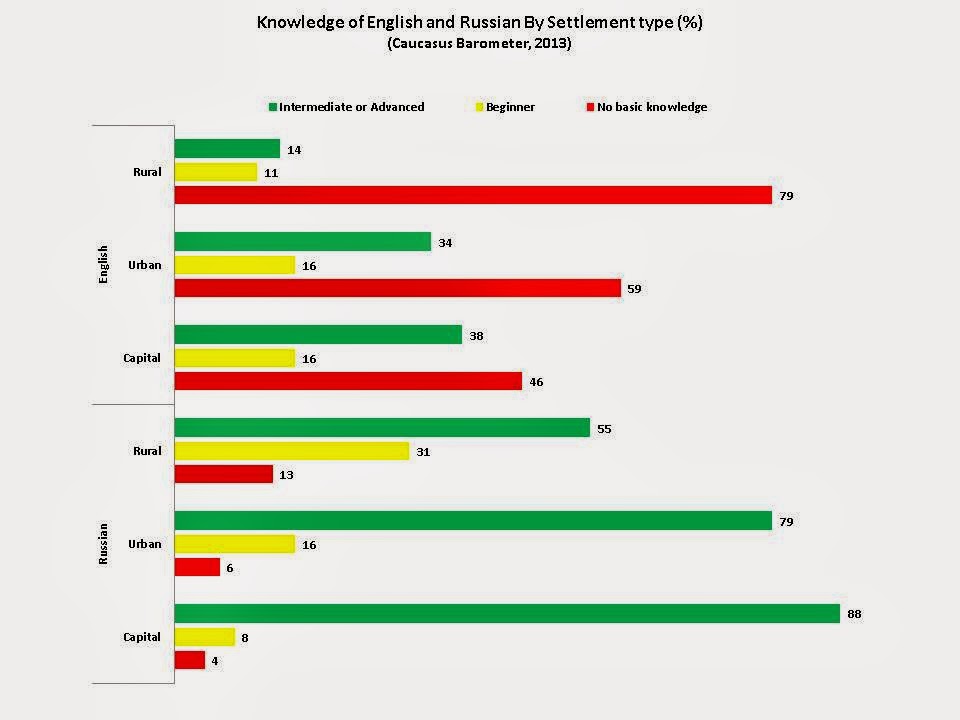
An additional factor to consider is that rural residents are much less likely to speak a foreign language compared to urban or capital based residents. The majority of rural Georgians (80%) report having no basic knowledge of English compared to 46% of Tbilisi’s residents reporting no basic knowledge of English. Furthermore, 44% of rural residents report having either no basic knowledge or a beginner’s level of Russian, compared to 12% of Tbilisi residents who say the same.
 Note: Responses of Intermediate and Advanced were combined in this graph.

With the language barrier, it could be difficult for Georgian and foreign farmers to form relationships and communicate effectively. In order to avoid the language barrier, a number of companies have brought their own labor force to the country, including the Xinjiang Hualing Group which operates a small factory town on the outskirts of Kutaisi. Despite this, many foreign farmers who have moved to Georgia report hiring Georgians, especially during the harvest season. This could be a further factor which has conditioned the relationships existing between local and foreign farmers, as well as future relations between them.

This blog post has looked at the perspectives of rural residents on doing business with members of other ethnic groups as well as their level of knowledge of English and Russian. It shows that rural Georgians are much less likely to approve of doing business with other ethnicities, and that rural residents are much less likely to have knowledge of Russian or English. With these factors in mind, support for the ban on agricultural land sales may be more understandable. If residents in rural areas, many of whom are involved in agriculture, are less likely to be able to communicate with foreigners and are more likely than other Georgians to disapprove of relationships with them, then would they want them as neighbors? To explore these issues further, we recommend using our ODA tool here or reading this blog post detailing the extent of foreign agricultural holdings posted on the Transparency International Georgia website.

Wednesday, January 25, 2012

Georgian Attitudes to Judicial Independence | EWMI JILEP report

Recently we undertook extensive research into judicial independence in Georgia for EWMI. This is what EWMI just put up on the website:


On January 24, 2012 CRRC presented a study entitled, “Attitudes towards the Judicial System in Georgia.” The study was supported by the Judicial Independence and Legal Empowerment Project (JILEP), implemented by the East West Management Institute (EWMI) and funded by USAID.

Since 2003, much has been done to reform the Georgian judicial system including the establishment of a High School of Justice, restructuring of the High Council of Justice, and major changes in the makeup of the judiciary and prosecutor’s office. However, these successes have been accompanied by serious concerns, particularly regarding judicial independence. International organizations from the Council of Europe to the US State Department have urged further reform of the system.

Relatively little research has been conducted to ascertain how Georgians themselves feel about their judicial system. It is with this in mind, that the East West Management Institute engaged the Caucasus Research Resource Center (CRRC), to undertake a comprehensive study of public attitudes toward the judicial system. CRRC employed a methodology that included citizen surveys, focus groups, and interviews which resulted in robust findings grounded in both quantitative and qualitative data analysis.

Representatives of the Georgian judiciary, non-governmental and international organizations working in the area of rule of law attended the presentation.

The link to the article is here. And find the report, which we tried to keep crisp and accessible while also rich in nuance and detail, by clicking here.

Friday, July 08, 2011

Georgia Adopts Law on the Status of Religious Minorities

On July 5, 2011 Georgia adopted a new legislative amendment into the country’s civil code stating that religious minority groups with “historic ties to Georgia” or those defined as religions by members of the Council of Europe can register as legal entities of public law. The initial draft of the law specifically mentioned the Roman Catholic Church, Muslim and Jewish communities, Armenian Apostolic Church and the Evangelical Baptist Church as having “close historic ties with Georgia”. However, the final draft did not specifically name these five groups.

The criminal code and Article 19 of the Georgian Constitution address freedom of religion and belief in the country. However, prior to this week Georgia was one of few post-Soviet countries that did not have a statutory law or government resolution on either religion or the legal status of religious associations. The 2002 Concordat between the Georgian government and the Georgian Orthodox Church (GOC) is the exception.

The GOC has considerable influence in Georgian society as the majority (80-84%) of the population belongs to the Orthodox Church. 10-13% identify as Muslim, 4% as Armenian Apostolic and there are less numerous religious minority groups such as Roman Catholics and Evangelical Baptists (2002 census and CB 2010). Additionally, Article 9 of the Georgian Constitution “recognizes the special importance of the Georgian Orthodox Church in Georgian history but simultaneously declares complete freedom of religious belief and confessions, as well as independence of the church from the state.”

The new law has received considerable public interest and a flurry of media attention, especially in light of the importance of religious issues in the country. Annual data from the Caucasus Barometer survey shows that certain aspects of religion are significant. Attendance at religious services is relatively low (18% of the population attends once a week or more, 17% once a month, 52% attends either only special holidays or less often and 11% never attends). However, 84% of Georgians trust religious institutions and 90% of the population considers religion to be important in daily life (2010 Caucasus Barometer).

The law has gained criticism from the GOC and several Georgian opposition parties, including the Christian Democratic Movement, the New Rights Party and Our Georgia-Free Democrats. The passing also takes place soon after a meeting between Patriarch Ilia II of the GOC and Catholicos Garegin II of the Armenian Apostolic Church in June regarding status and property issues of the respective churches in Armenia and Georgia.

Opponents view the law as undermining the GOC’s role in the country and as having a negative effect on relations between Georgia’s ethnic and religious minority groups. They also argued for more lengthy public discussion about the issue. In contrast, for the ruling party, the passing of the law can be seen as an important step in Georgia’s democratization and as fulfilling the country’s international obligations with respect to freedom of religion. One of the most important follow up questions will be what it specifically means for religious minority groups to register as legal entities of public law.

What do you think? Do you think the new law is a step in the right direction?

Monday, February 14, 2011

Access to Justice in Central Asia | Coming Up

We are in the process of completing a major research project in Central Asia (Kazakhstan, Kyrgyzstan, Tajikistan) on Access to Justice. It concentrated in particular on vulnerable groups, and how they could get access to justice. Sponsored by the Finnish Ministry of Foreign Affairs, the project involved a nationwide survey in each of the countries, over 70 in-depth interviews, plus focus groups and an extensive literature review.

We looked at what respondents thought were some of the biggest legal problems that individuals in their country faced. Divorce figured prominently among those, making women's access to justice particularly relevant.

We also asked who inviduals would turn to on various issues, when there were problems. You see sharp differences between the countries. 


We asked about trust in institutions, and among the list these are the least trusted. (Yes, that's not yet comprehensive information for you, but hopefully will whet your appetite for more.)


And we dug deeper, within the countries, to understand how people looked at the courts. Again, here a preview. It suggests that according to Kazakh citizens, competence is not the main problem in the courts.


The first presentation of results will happen on February 15 in Almaty (sorry for the short notice, but if you were likely attendee you probably received a separate invitation), and a more detailed report is out soon. Drop us a line in case you're interested in a preview, in exchange for giving us some feedback on it.

Wednesday, February 02, 2011

Observations while Traveling through Samegrelo | Agriculture and Petty Crime

Much has been written about agriculture in Georgia, and the need to develop it extensively. Our upcoming reports on social capital (currently still under review with the donor) have some material on that. The typical concerns are well established: although fertile, Georgia is actually importing food. More than 50% of the employed work in agriculture, but it only contributes around 10% to GDP. And more than 50% of Georgia's arable land lies fallow.

The reasons are also familiar: privatization separated the land into small parcels that were not viable for modern farming. The people left in the countryside often are conservative and skeptical, and not quick to adopt more productive methods. They do not cooperate, and thus cannot mobilize sufficient resources to develop their land.

Traveling through Samegrelo recently highlighted another challenge. The structure of landholdings makes them particularly vulnerable to petty crime. Often the holdings are away from people's houses, so that they cannot guard them. During planting season seeds, seedlings and little plants can be stolen from the field at night, so that investing into better plants is not very attractive. Moreover, shepherds don't always respect fields that have just been fenced off anew, and let their cows trott into enclosures; or cut the fence to let a stray cow out, without repairing it.

During harvest season, the problem is even more pronounced. Unless you harvest early, your crop is at threat. And if you harvest early, you may be doing damage to the fruit. For some of the crop, the harvest season is quite long, so that the fields remain vulnerable over several weeks.

If you have a small holding, it is hard to address this problem. Sleeping outdoors on your field will only get you so far, and is not sustainable over time.  With average landholdings being around less than two hectares (one hectare being a bit bigger than a soccer field), the plots are too small to pay for a security guard. Typically you will need two guards, so that they can support each other. Professional security firms would charge up to $1,000 per month. This makes it particularly difficult to experiment with higher value crops (say, avocado) since you may need a security guard to protect a handful of plants. Easier to fall back on what you have always done. 

Planting in Samegrelo. This effort has fences, two security guards constantly, night vision goggles, and is about to add a trained guard dog.

We are curious whether other people have heard about this problem. If it indeed appears to be a challenge, it would be worth researching this in more detail. The government could help address this issue by providing more security through increased policing and curbing road access, together with introducing stiff sentences to signal that stopping agricultural theft is important for Georgia's economic development. Comments and ideas?

Friday, May 16, 2008

Creative Commons for the Caucasus! | A real opportunity

Many readers will already be aware of the concept of Creative Commons. The basic idea is to facilitate collaboration, interaction and people adding value to each other's online work. Creative Commons provides licenses for sharing easily, without giving up some of the author's basic rights. A great exposition of this entire concept is given by the founder of the entire idea, Lawrence Lessig, in an engaging TED talk (you didn't think that intellectual property rights could be that entertaining, did you?). See below.

Now that larger idea is extremely important in the South Caucasus as well. There is a lack of ideas, there's a lack of great materials for people to use, to teach, to read, to share, especially in the local languages. And conversely, there's little respect for authorship, and for the people that have created valuable content.

Introducing Creative Commons in the South Caucasus could be one step to alleviate this: not just by providing the licenses along the "build it and they'll come" expectation, but using the very process to advocate ideas of online interaction and sharing, and recreation.

And: this is precisely what Eurasia Partnership Foundation is about to do. They invite applications until the end of the month, hoping that some qualified groups will apply to port the licenses, and to popularize the concept. Hopefully, this will help to start the debate.

So for anyone interested in the web, or in Intellectual Property issues this really is a unique opportunity. Find a gang of like-minded people, apply, and get paid to popularize what you care about. Check the website of Eurasia Partnership Foundation for more detail. (The project is running in all the three countries, but I'm just linking the Georgian site.)

Here is the talk: