Showing posts with label European Social Survey. Show all posts

Wednesday, April 26, 2023

Life Satisfaction And What People Teach Their Children

Note: This article first appeared on the Caucasus Data Blog, a joint effort of CRRC-Georgia and OC Media. It was written by Dr. Tamar Khoshtaria, a Senior Researcher at CRRC-Georgia. The views presented in the article are of the author alone, and do not necessarily reflect the views of NDI, CRRC-Georgia, or any related entity.


Data from the European Values Study (EVS) of 2017 suggests that values commonly taught to children in different countries appear to be linked to how satisfied communities are with their lives. CRRC Georgia has compared the results between Russia, Georgia, Armenia, Azerbaijan, and a handful of European countries.

Most people in the world seek satisfaction with their lives; however, whether one experiences it is a matter of numerous potential factors.

One plausible contributor to life satisfaction could be the values parents or society instil in young people.

Data from the European Values Survey suggest that countries where larger shares of the public are satisfied with their life are more likely to teach their children about tolerance, respect, and independence.

Hard work tends to be associated with lower levels of life satisfaction, a trait commonly reported in the South Caucasus and Russia.

The European Values Survey suggests that Northern European countries reported the highest level of happiness and life satisfaction: data from 2017 suggested that over 90% of respondents living in Iceland (95%), Norway (94%), and Sweden (94%) say they are ‘very’ or ‘quite happy’. In addition, of the 36 countries covered in the survey, Iceland (74%), Norway (72%), and Finland (72%) reported the highest levels of satisfaction with life.

In contrast, only about one-third of people in Armenia (33%), Azerbaijan (33%), and Russia (32%) reported they were satisfied with life. Georgia stands somewhere in between, with 45% of its respondents claiming to be satisfied.

After Ukraine (18%) and Bulgaria (17%), Georgia has the highest share of people who say they are dissatisfied with their lives (14%).
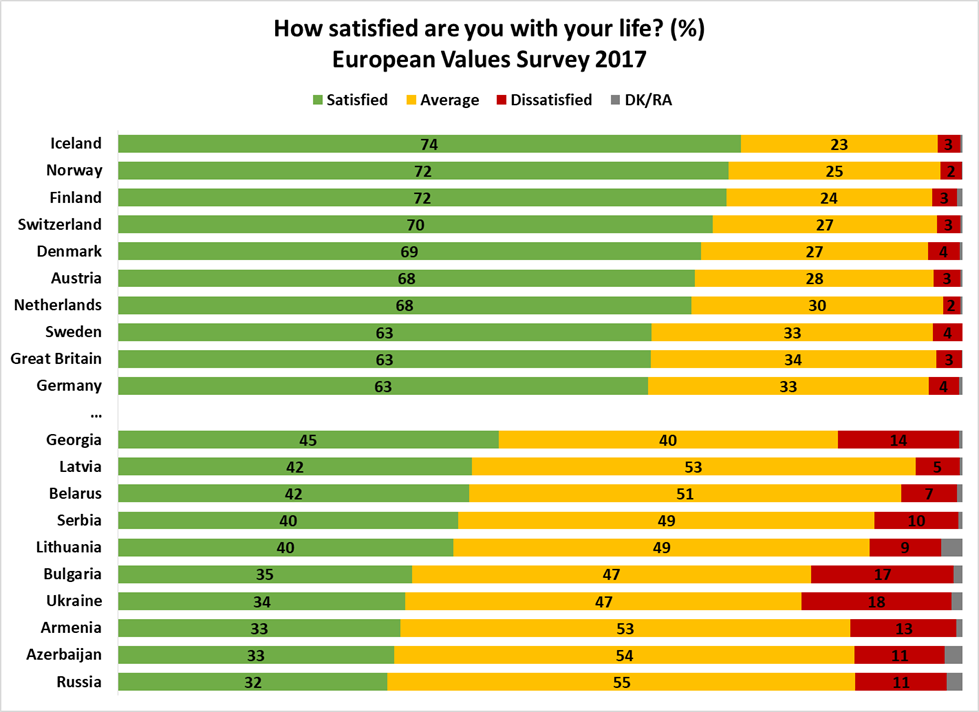
Note: Respondents assessed life satisfaction on a 10-point scale, where 1 meant dissatisfied and 10 meant satisfied. Responses 1, 2 and 3 are labelled as dissatisfied on the chart above. Responses 4, 5, 6, and 7 are labelled as average, and 8, 9 and 10 are labelled as satisfied. The above chart does not include all countries in the survey due to space limitations. The graph above presents the 10 most and least satisfied countries in the study.


When looking at countries that are most and least satisfied with their lives and comparing them to Georgia, we see that these countries tend to have different ideas on what qualities are the most desirable for their children to learn.

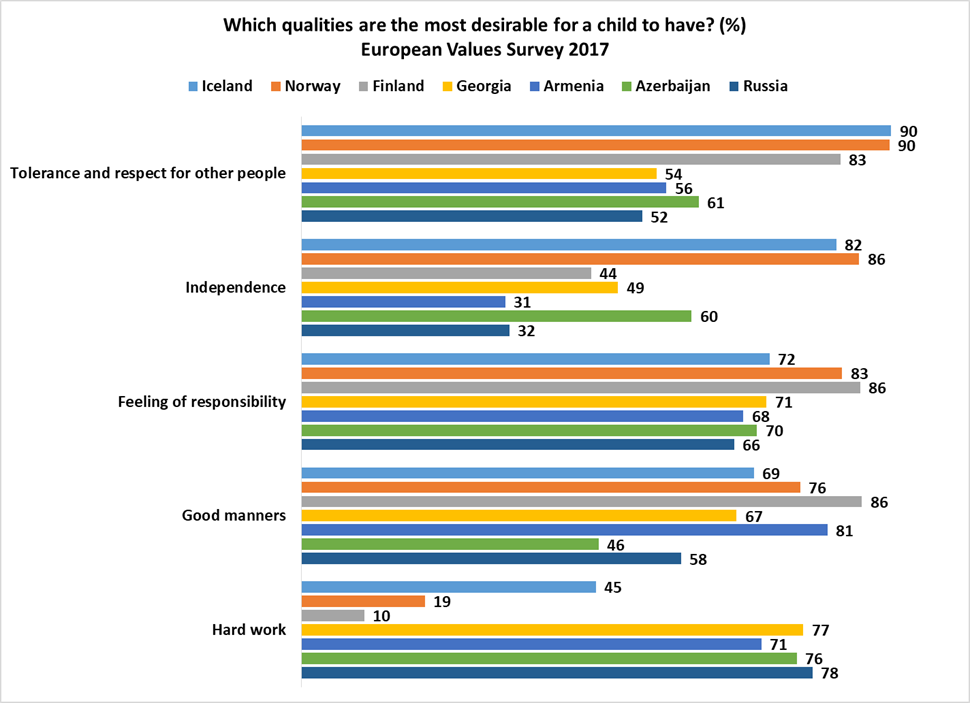
In the countries most satisfied with their lives — Iceland, Norway, and Finland — tolerance and respect for other people were named by over 80% of respondents. This share is significantly lower in Georgia (54%) as well as in the countries where people are least satisfied with their lives — Armenia (56%), Azerbaijan (61%), and Russia (52%).

In Iceland and Norway, though not in Finland, independence is named by over 80% of the public as a highly desirable quality for a child. The share of people naming this quality as most desirable is significantly lower in Azerbaijan (60%) and Georgia (49%) and even lower in Armenia (31%) and Russia (32%).

While over 70% of respondents name hard work as the most desirable quality which a child should have in the South Caucasus and Russia, the percentage is significantly lower in Iceland (45%), Norway (19%), and Finland (10%).

Some qualities were deemed desirable in all seven countries, such as having a sense of responsibility and being well-mannered.
 

Several patterns also stand out for specific countries. For example, 62% of people in Finland think determination and/or perseverance are desirable qualities, while religious belief is more desirable in Georgia (50%) than in all other countries.

Being able to save money and thrift was valued the most in Russia at 49%.  A number of other characteristics show relatively little in terms of distinctive patterns. 


The above data show that the most satisfied people in Europe live in Iceland, Norway, and Finland, while the least satisfied live in Armenia, Azerbaijan, and Russia. Georgia stands somewhere in between.

People who are most satisfied with their lives are more likely to teach their children qualities such as tolerance and independence, while the least satisfied communities are more likely to emphasise the importance of hard work.

Responsibility and good manners are generally valued in all of these countries, while religious faith is more important in Georgia than in the other seven countries explored in this article.

The data used in this article is available here.

Wednesday, November 13, 2013

Perceptions of Court System Fairness in the South Caucasus

Ann Bennett Lockwood, an American attorney, politician and author once said that, “If nations could only depend upon fair and impartial judgments in a world court of law, they would abandon the senseless, savage practice of war”. For many, the credibility of a government is judged by the fairness of its judicial system. For instance, Michel Rosenfeld (2001) argued that a fair justice system creates respect and faith in government by saying that, “If a citizen implicitly or explicitly endorses a law or legal regime, the latter can be considered subjectively fair.” Therefore, trust in judiciary system can be seen as a reflection of government performance, and is interpreted as one of the major conditions for a functioning democracy. Trust also signifies the perceived legitimacy of a particular institution. Data from the 2010 European Social Survey (ESS) shows that the perceived legitimacy of a country’s justice system may improve compliance with the rule of law more than the risk of punishment. Due process and equal protection before the law are stipulated in the Georgian (Article 14), Armenian (Article 14) and Azerbaijani (Article 25) constitutions. Yet, these populations tend to be skeptical about the practice and security of these constitutional rights. This blog discusses opinions and perceptions about the justice system in each of these countries.

According to 2010 ESS data, Eastern and some Southern European countries tend to be less trusting of both police and court systems than Nordic countries, as well as less believing that these institutions are legitimate holders of judicial power. In the case of court systems, the South Caucasus populations are also skeptical. Each year the Caucasus Barometer (CB) asks respondents to assess their level of trust towards their court system. According to the 2010 CB, just under one third of Azerbaijanis (30%), and less than one fifth of Armenians (17%) and Georgians (18%) said they trusted their respective court system (the sum of “fully trust” and “somewhat trust”). In the latter two countries, the trust in the court system fell by 5% and 13%, respectively during the last 2 years (from 2011 to 2012). In contrast, Azerbaijanis have indicated slightly more confidence in their court system – trust increased from 24% in 2011 to 30% in 2012.

For a broader length of time, from 2009 to 2012, the level of trust in the court system has remained relatively similar in Azerbaijan (a change of 3%), and in Armenia (a change of 5%), while it has decreased by 8% in Georgia. In the 2011 CB, these populations were asked if “Bringing a case to the court will make the problem worse.” Comparing the results, 36% of Armenians, 36% of Azerbaijanis and 13% of Georgians agreed with this notion.


From 2009 to 2011 the CB also asked to what extent people agreed or disagreed with one of the following statements--“The court system in their country favors some citizens” or “The court system in their country treats all citizens equally”. The results indicate that most frustration about the court system is felt in Armenia where two thirds (67%) of the population in 2011 thought that the court system was unjust and favored some citizens. However, this percentage has gradually decreased from 81% in 2009. A similar situation is observed in Georgia where from 2009 to 2011 these figures fell from 52% to 37%. In Azerbaijan the percentage change from 2009 to 2011 was low at 3%. Thus, the majority of adult citizens in Armenia and Azerbaijan believe that their court system treats favors some citizens over others. It is thus noticeable that the more the court system is perceived to favor some citizens is, the less there is trust in the court system.


Despite the fact that the independence of courts is guaranteed by the constitutions and laws of Georgia, Armenia and Azerbaijan, many people in the South Caucasus still believe that the court system is unjust. A fair justice system can help to create an environment in which those subjected to a crime can seek justice, and those committing a crime can be held accountable under the law.

If you would like to explore more about trust in various institutions in the region, please visit http://www.crrc.ge/oda/