Showing posts with label Drugs. Show all posts

Tuesday, August 23, 2022

How do Georgians feel about drug users?

Note: This article first appeared on the Caucasus Data Blog, a joint effort of CRRC Georgia and OC Media. It was written by Dr. Tinatin Bandzeladze, a Researcher at CRRC-Georgia. The views presented in the article are of the author alone, and do not necessarily reflect the views of CRRC Georgia, or any related entity.

Drugs have been slowly but surely finding their way into the everyday lives of Georgians for years now; in 2020 alone, CRRC Data suggested that drug users in Georgia, at a very minimum, spent $1.5 million on drugs through the dark web between February and August.

And yet, data from CRRC Georgia’s Caucasus Barometer suggests that drug users are still widely stigmatised in Georgia, creating a barrier to harm reduction and prevention programming and possibly standing in the way of reducing the harm of illicit drugs in Georgia through prevention-oriented policies.

Data from 2017, 2019, and 2021 Caucasus Barometer surveys suggest that the only group which people would least like to have as neighbours are criminals. Drug users take second place in the most recent wave of the survey, previously being tied in this position with homosexual people.  In 2021, 27% of the public reported they would least like to have a drug user as a neighbour. This share has not changed significantly, with movement remaining within the margin of error since 2017.  

Whether or not a respondent named a drug user varied with age, ethnicity, and settlement type.

Controlling for other factors, people over 55 are 15 percentage points more likely than people aged 18-34 to mention drug users as unwanted neighbours. 

Ethnic Azerbaijanis are 36 percentage points more likely than ethnic Georgians to name drug users as undesirable neighbours.

Settlement type is also associated with negative attitudes toward drug users. People in Tbilisi are 17 percentage points more likely than residents of other urban areas and 12 percentage points more likely than rural residents to rule out drug users from a list of potentially undesirable neighbours.

Employment, marital status, educational attainment, and religion are not associated with attitudes towards drug users in Georgia — at least not as measured by this variable.
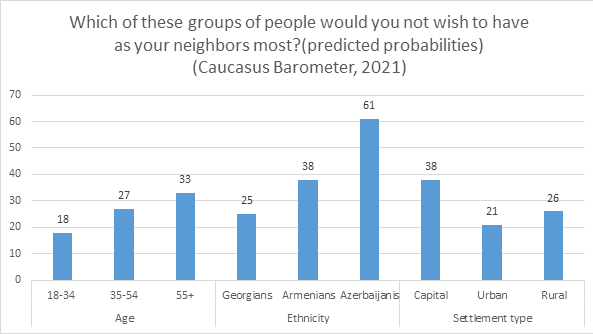
The above data suggests that drug users are stigmatised in Georgia, with many implicitly preferring to have a criminal as a neighbour rather than a drug user. In turn, this suggests that the stigma drug users face may be a barrier to the effective implementation of harm reduction policies and programming in the country.

Note: The data used in the blog can be found on CRRC’s online data analysis tool. The analysis of which groups had different attitudes towards drug users was carried out using logistic regression. The regression included the following variables: sex (male, female), age group (18-35, 35-55, 55+), ethnic group (ethnic Georgian, ethnic Armenian and ethnic Azerbaijani), settlement type (capital, urban, rural), educational attainment (primary, secondary, technical or higher education), employment situation (working or not), marital status (married or single) and religion (Orthodox Church, other Christian groups, or Islam). The outcome variable was whether or not a respondent mentioned drug users.


Friday, March 14, 2008

Intravenous Drug Users in Tbilisi | Survey Data

As part of a four part series, Save the Children in cooperation with a host of other organizations have released reports from survey data they have collected from Female Sex Workers (FSWs) and Intravenous Drug Users (IDUs). All of the surveys are funded by USAID. This entry reviews the Tbilisi report on IDUs. If you are interested in the other reports, please contact us.

It has been a conundrum for many why the number of HIV infected is not higher in Georgia (Georgia is low prevalence country, less than 5%, as defined by UNAIDS, but data is weak, since surveillance is bad), since it is estimated that there are 250,000-280,000 IDUs in Georgia, which accounts for around 5% of the total population -- an astounding figure. To understand the dynamics of IDUs and its relation to HIV infection other diseases a Behavioral Surveillance Survey (BSS) has been carried out three times -- in 2002, 2004 and 2006. The survey methodology uses a referral method, since sampling IDUs is no easy task. While providing good information, it does no present a representative sample of these people and when discussing the data, one must keep in mind various biases in the data, which may be present. However, the data points to trends that are generally positive, and it may be that Georgia will be able avoid a much larger HIV crisis.

So, what did the 2006 data show? Similar to 2004, the report found stability in the type of drugs injected. Most IDUs in the sample report injecting Subutex and also having started to use Antihistamines. In 2002, however, most users reported using heroin.

Also, in terms of good news, 96% of those who reported having paid sex (30% of the male sample -- about the same as in 2004), reported using a condom. The number who pay for sex and use a condom is substantially up from 2004, which hopefully indicates and increase in awareness of the dangers of unprotected sex. However, males users report not using condoms with their stable sex partner. In other good news, knowledge about HIV among drug users is also rising, at least in the sample, however remains low overall. Only 37% of the sample could correctly identify the six mechanisms of transmitting HIV. However, only 15% of the sample in 2002 could do so.

On the bad news front, respondents who inject seems to be getting younger and younger. There was a 10% jump from 2002 to 2006 in the those who started injecting between 15 and 19 years old.

Again, if you are interested in the whole report, please get in touch.

Sunday, December 10, 2006

Drugs Use Survey of Georgian Students, 2003

The Georgian Research Institute on Addictions (GRIA) in 2003 conducted a survey of about 700 students in Tbilisi's universities.

52.6% of male respondents say they have used hashish at least once. About 8% of males responded that they smoked it regularly over the last year, with a total of 4% claiming they used it very regularly over the last 30 days.

The data probably is unreliable (I have not seen the actual study), but the one interesting feature is that only 3.4% of female respondents say they had ever used hashish. And none said they use it regularly. Overall, this seems to tally with the results from CRRC's Data Initiative on smoking: there is a very strong gender discrepancy, with around 5% of female Georgian respondents admitting to smoking (whereas around 45% of males say they smoke).

According to the Ministry of Interior, 2004 prices for 5 g of marijuana are roughly 7-9 US dollars.

Source: Georgian Research Institute on Addiction, Georgia Today, 8-14 December 2006