Note: This article first appeared on the Caucasus Data Blog, a joint effort of CRRC-Georgia and OC Media. It was written by Teimuraz Kobakhidze, a Junior Researcher at CRRC-Georgia. The views presented in this article are the author’s alone and do not necessarily reflect the views of CRRC Georgia, NDI, or any related entity.
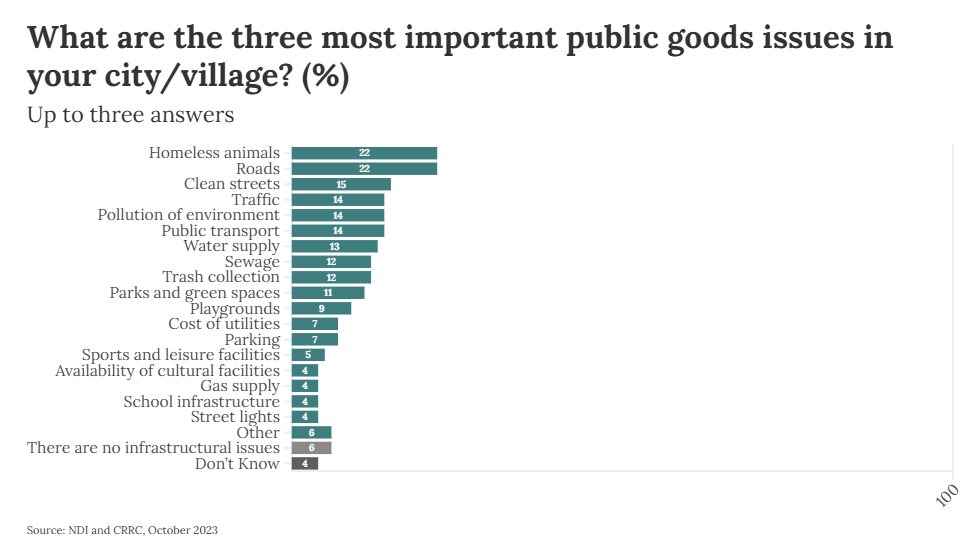
Stray animals have increasingly become a top public goods issue amongst the Georgian public. Data from an October 2023 CRRC/NDI survey found that 22% of people named stray animals as a top issue, tying it at the top of public priorities with roads.
According to a 2023 official census by the Animal Monitoring Agency, there are over 30,000 street dogs in Tbilisi, only a third of whom have been spayed or neutered. It was the first such census to be conducted since 2015.
To address this issue, in December 2023, the government’s Environmental Protection and Natural Resources Committee introduced the law ‘Regarding Domestic Animals’, which was intended to address many details of domestic animal welfare, ranging from the number of pets a person can own to stray animal population control. Breaking the law can lead to fines of up to ₾3,000 ($1,050).
Animal welfare has also become a top concern for the Georgian public, who consider the issue among the highest priorities in their local communities.
According to data collected in an October 2023 NDI/CRRC survey, stray animals was tied for the top public goods issue across Georgia, with 22% of the public naming it as a top issue, the same share which named roads.
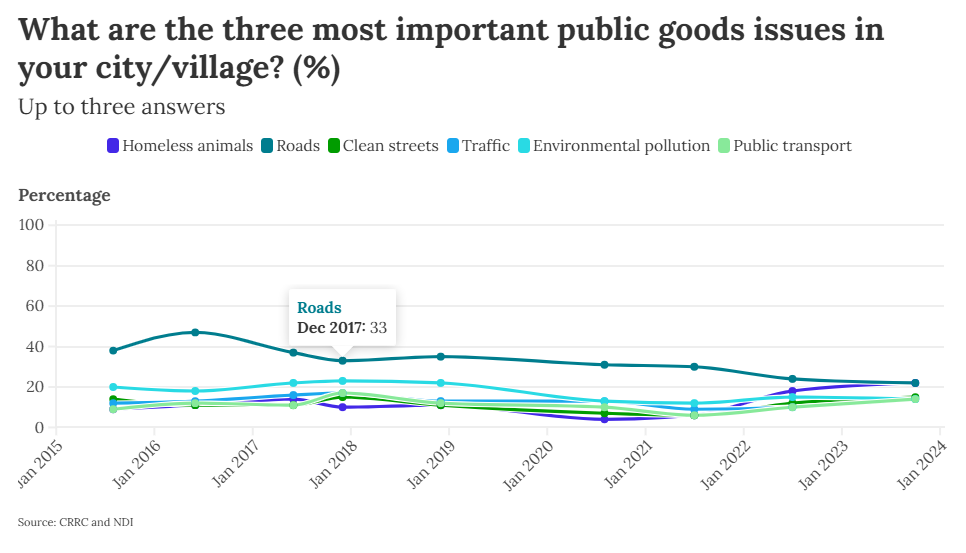
This issue has been growing in importance for the Georgian public.
While 4% and 6% named this issue in 2020 and 2021, respectively, the share rose to 18% in 2022, with a new high in 2023.
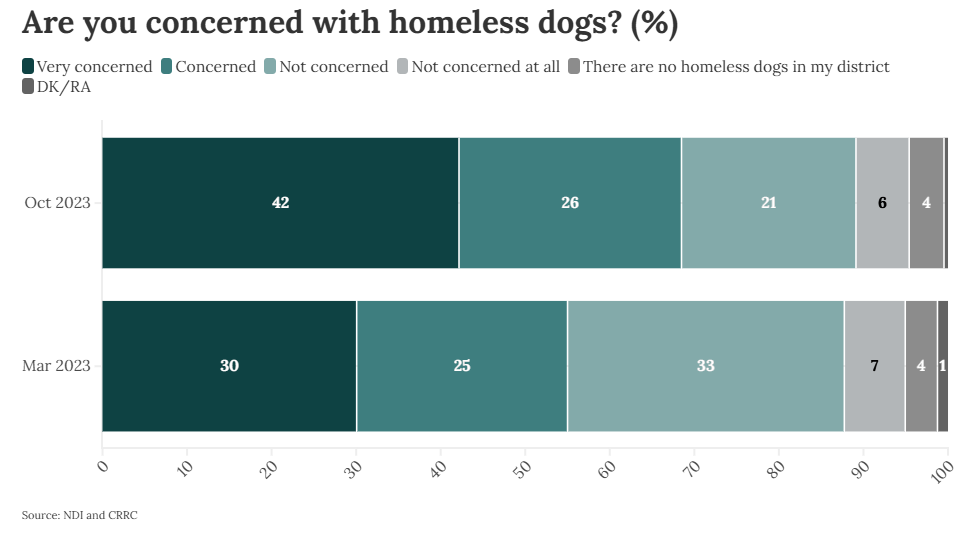
This rise is reflected in the share of the public concerned with street dogs. Between March and October of 2023, the share reporting that they were concerned with street dogs rose by 13 percentage points from 55% to 68%.
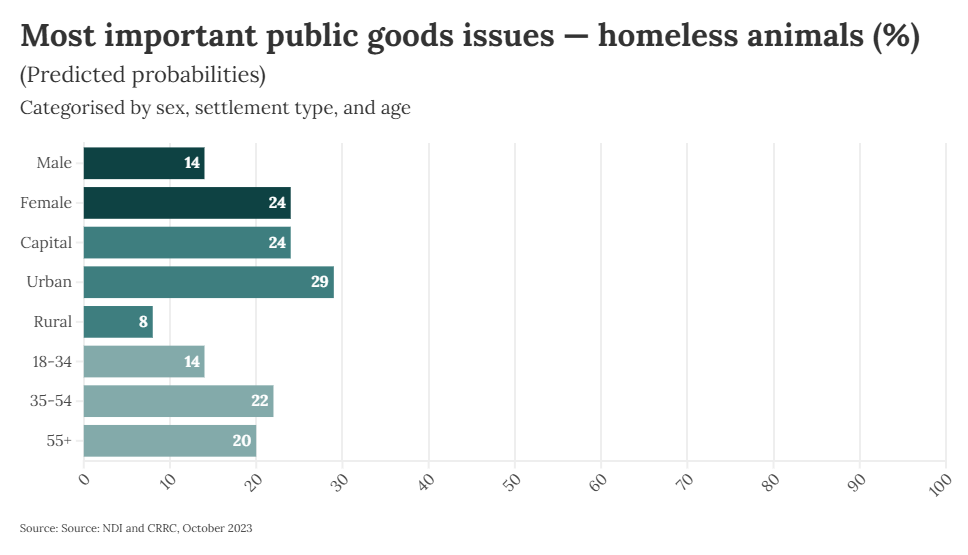
According to the data collected by CRRC/NDI, people’s prioritisation of and concern with stray animals varied by a number of characteristics.
People in urban areas outside Tbilisi were more than three times as likely to name stray animals as a top public goods issue compared to people in rural areas. Within Tbilisi, people were three times more likely to prioritise the issue as a top public concern compared to those in rural areas.
Women were 10% more likely than men to name stray animals as a priority, while people aged 35 and older were more likely to report the issue compared to people aged between 18–24.
Education level was not associated with attitudes on this issue.
Attitudes also varied among different social and demographic groups on the second question in the survey asking how concerned the public was about stray dogs.
Women were eight percentage points more likely to report being concerned than men. Similarly, people with a higher education were eight points more likely than those with a secondary education or less to report being concerned with street dogs. Concern did not vary by settlement type or age.
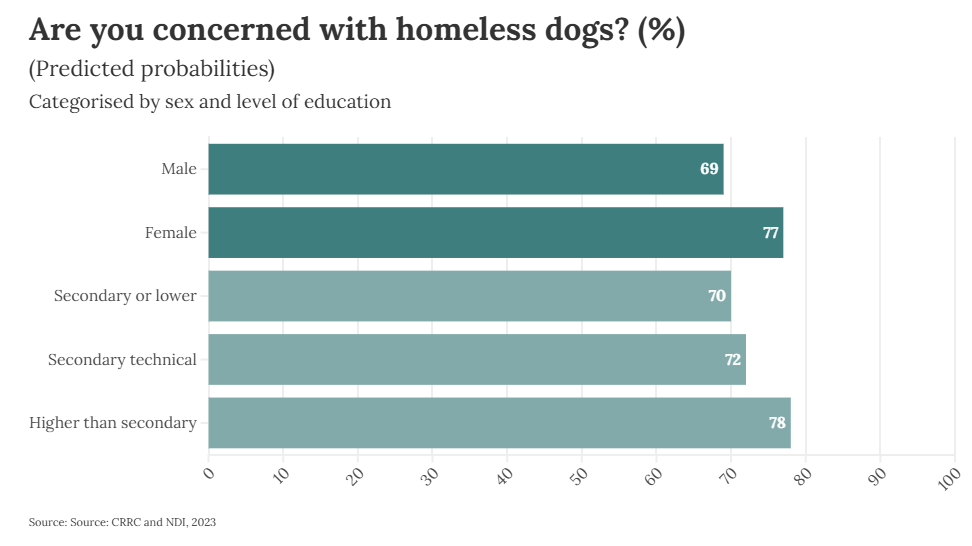
As can be seen from the above data, concern for street animals and their priority as a public goods issue appears to be on the rise in Georgia, with women, individuals with a higher education, and those over the age of 35 paying particular attention to the issue.
The data in this article come from a series of regression models. The independent variables included age group (18-34, 35-54, 55+), sex (male or female), settlement type (Tbilisi, other urban, or rural), education level (secondary or lower, secondary technical, higher than secondary). The models looked at 1) whether or not someone named homeless animals as a most important public goods issue, and 2) whether or not the respondent was concerned about homeless dogs. The survey had a total of 1,278 respondents.