Showing posts with label Security. Show all posts

Tuesday, May 23, 2023

What Makes People Feel Insecure in Georgia?

 Note: This article first appeared on the Caucasus Data Blog, a joint effort of CRRC Georgia and OC Media. It was written by Dustin Gilbreath, a Senior Non-Resident Fellow at CRRC Georgia. The views presented in the article are of the author alone, and do not necessarily reflect the views of NDI, CRRC-Georgia, or any related entity.


A CRRC analysis found that Georgians who feel insecure in Georgia mostly attribute this to economic insecurity, but also express concern about a wider array of harder security issues.

Georgia has faced numerous crises in recent years; from the pandemic, to the results of the war in Ukraine, via political controversy and uncertainty.

It is consequently perhaps unsurprising that almost half the public is uncertain about how they will fare economically in five years’ time. This is reflected in recent data, which shows that economic insecurity is the main reason why Georgians feel insecure in Georgia. However, a wide array of harder security issues also contribute to people feeling insecure in the country.

In the December 2022 NDI and CRRC Survey, the public was asked whether they felt insecure or secure living in Georgia. A third reported that they felt either very insecure living in Georgia (8%) or more insecure than secure (26%). By comparison, about half of the public reported that they were more secure than insecure (47%). One in five (19%) felt that they were very secure living in Georgia.

Why do people feel insecure?
Amongst those who felt insecure living in Georgia, economic issues were the main reasons given for their sense of insecurity.

The top three issues named were poverty, inflation, and unemployment, with between 34% and 39% of respondents naming one of these options.

Crime was identified as the main reason for feeling insecure by a third of relevant respondents, and political instability by one in five. Healthcare and the high price of drugs were named by 7% and 10% of relevant respondents, respectively. Harder security issues such as the war in Ukraine, and instability in the Caucasus were named by relatively few; 5% and 1%, respectively. 


Note: Because respondents could name up to three responses to this question, the data does not sum to 100%.

The above issues were grouped into economic, hard security, and social policy related issues. Economic issues included poverty, inflation, and unemployment. Crime, violence, political instability, territorial integrity, the war in Ukraine, actions by Russia towards Georgia, and instability in the Caucasus were grouped into hard security issues. All other options were grouped together into social policy issues.

While the most commonly cited issues are mainly economic, people’s concerns were multifaceted. The data found that 66% of those who felt insecure named at least one economic issue, 62% named at least one hard security issue, and 32% named one social policy issue, suggesting that similar shares of people are concerned about at least one economic issue and at least one hard security issue. 

WHO FEELS INSECURE?

Given the dominance of economic issues as a reason for feeling insecure, it is perhaps unsurprising that people living in poorer households are more likely to feel insecure, and cite economic issues more than people living in relatively well-off households.

A number of other patterns are also present.

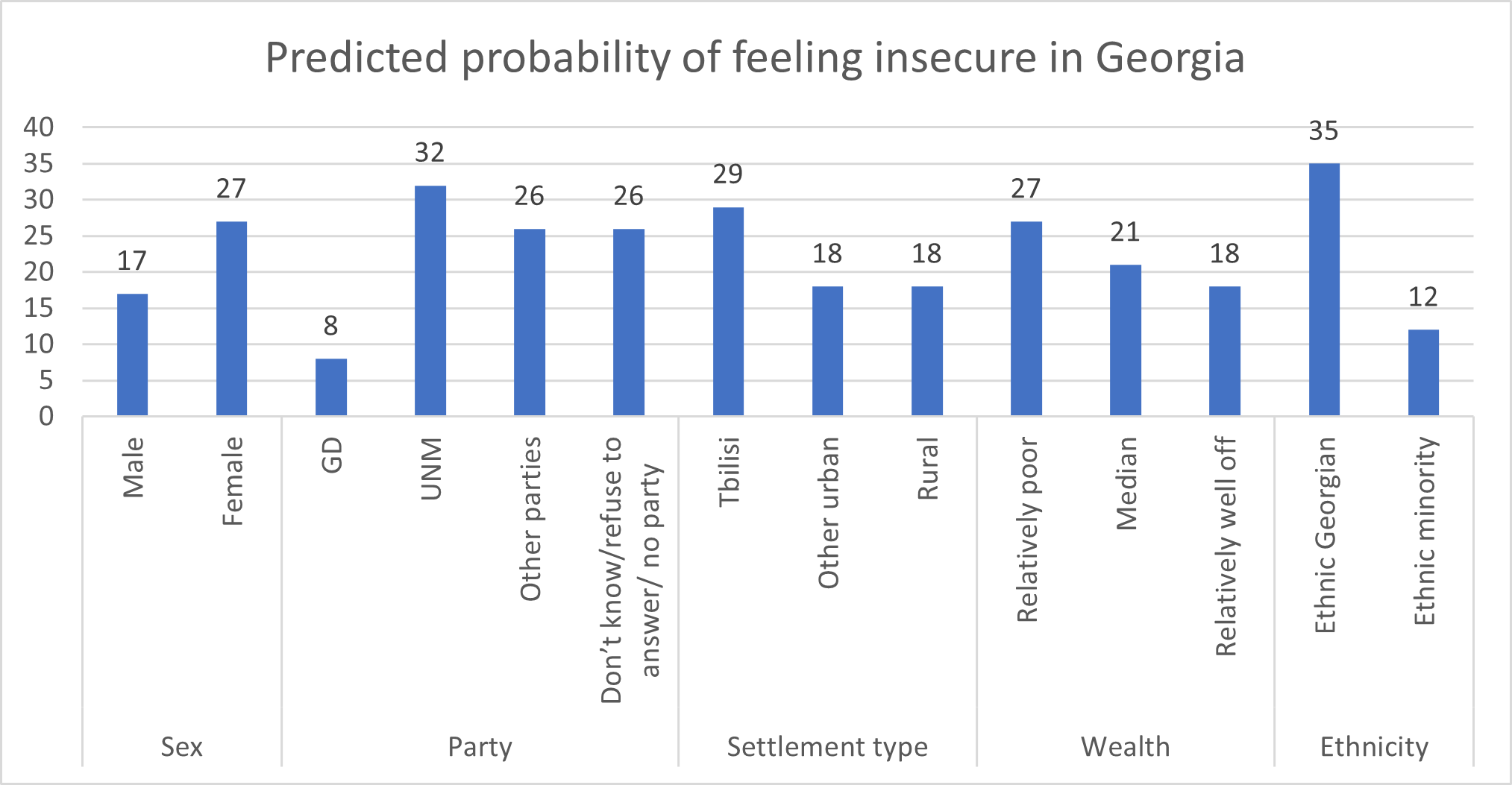
Women are ten points more likely to feel insecure in Georgia, controlling for other factors, than men. 

People in Tbilisi are 11 points more likely to feel insecure than people outside Tbilisi. 

Ethnic Georgians are 23 points more likely to feel insecure in Georgia than ethnic minorities.

Supporters of the United National Movement, Georgia’s main opposition party, are 24 points more likely to feel insecure in Georgia than supporters of the ruling Georgian Dream party. People who support other parties or report not supporting any party are 18 points more likely to feel insecure in Georgia than supporters of Georgian Dream.
 

The above data shows that a third of Georgians feel insecure in the country. While recent large-scale instability in Georgia has related more to hard security issues, such as the war in Ukraine, the data shows that economic insecurity remains the greatest concern for people who feel insecure in the country.

Note: The social and demographic breakdowns shown in the article above were generated from a regression analysis. The analysis had whether or not someone felt insecure as the dependent variable. The independent variables included age group (18-34, 35-54, 55+), sex (male or female), settlement type (Tbilisi, other urban, or rural), education level (secondary, vocational, tertiary), wealth (an index of durable goods owned by the respondents’ household), ethnicity (ethnic minority or ethnic Georgian), employment (working, unemployed, or outside the labor force), and party support (Georgian Dream, United National Movement, other opposition, refuse to answer/don’t know/no party). This article only reports on statistically significant differences between groups.

The data used in this article is available here.

Wednesday, May 11, 2022

Georgian public opinion on the SSG files

Note: This article first appeared on the Caucasus Data Blog, a joint effort of CRRC Georgia and OC Media. It was written by Dr. David Sichinava, research director at CRRC-Georgia and Otto Saldadze, a researcher at CRRC-Georgia. The views presented in the article are of the authors alone, and do not necessarily reflect the views of CRRC Georgia, or any related entity. 

On 13 September 2021, gigabytes of secret files allegedly belonging to Georgia’s State Security Services (SSG) were leaked and sent to various Georgian media outlets. 

The files contained classified intelligence on multiple clerics of the Georgian Orthodox Church and journalists that the SSG had gathered since 2014. The subjects of the alleged surveillance, including priests and top clerics of the Georgian Orthodox Church, refrained from commenting, while the Georgian government labelled the leaks as a ‘provocation aiming to alter the outcomes of elections’, blaming the country’s opposition parties for the leaks.

While the scandal was soon overshadowed by the clandestine arrival of Georgia’s former president, Mikheil Saakashvili, and his subsequent imprisonment, data from CRRC Georgia’s September omnibus survey shows that the majority of the country’s population did not know about these leaks.

The survey, which was conducted in the last weeks of September 2021, asked respondents whether they were aware that files belonging to the security services were leaked to the media. The majority, 59%, said no, only slightly more than a third (36%) reported they knew about the files, while 5% refrained from answering the question.

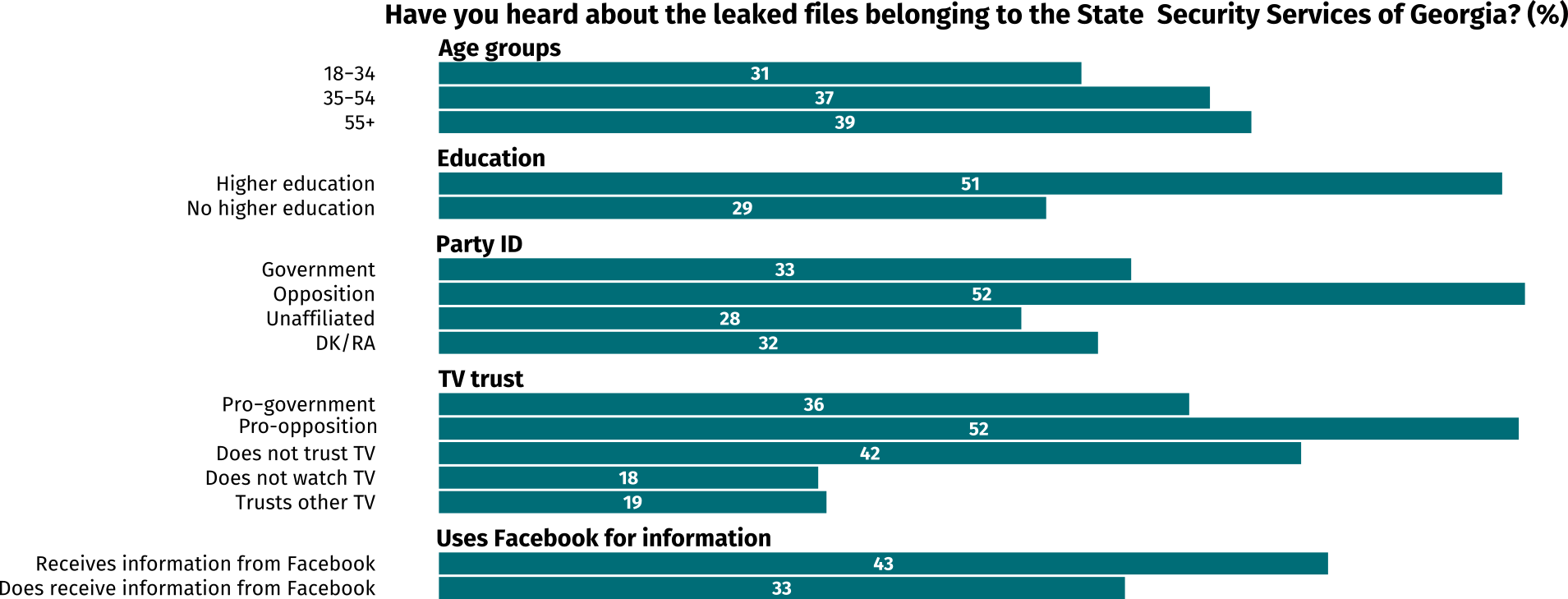
Older people, those with higher education, and respondents who use Facebook to receive information were more likely to be aware of these leaks. More importantly, opposition supporters are more likely to know about leaks (52%) than supporters of the Georgian Dream Party (33%), unaffiliated respondents (28%), or those who did not know or refrained from answering which party they supported (32%).

Similarly, more Georgians who trust pro-opposition TV channels to receive news on politics know about the leaks (52%) than those who trust pro-government stations (36%), do not trust any station (42%), trust other stations (19%), or do not watch television at all (18%).

Arguably, these discrepancies in awareness could stem from how Georgia’s TV stations cover news and whom the Georgian public trusts for their news. An earlier analysis showed that Georgians’ political sympathies are highly correlated with what television stations they follow to get news on politics. In the same vein, according to a media monitoring report from the Georgian Charter of Journalistic Ethics, Georgian stations were covering the leaks in a different manner and intensity, which might explain the discrepancy in the audience’s knowledge. While pro-government media talked about the leaks intermittently, opposition TV stations framed the story as breaking news. 

A similar trend can be seen in the social media posts that Georgian TV channels shared on Facebook. According to Crowdtangle data, a social media listening tool, the share of Facebook posts that mentioned leaks constituted from 4.5% to 5.2% out of all Facebook posts shared in September 2021 on opposition outlets such as Kavkasia and Formula. Pro-government TV stations, such as Rustavi 2, Imedi, POSTV, and the Georgian Public Broadcaster were less likely to mention leaks in their Facebook posts.

Those aware of leaks feel ambivalent about whether or not they show authentic information. While some politicians and journalists have confirmed that the conversations described in the files took place, only 31% of the respondents who have heard of leaks believed in the authenticity of leaks. 41% could not answer whether or not the contents of leaked files reflected the truth, while 13% thought that the allegations described in leaks were inauthentic. About 15% said that they were not aware of the content of leaks, despite being aware of the leaks themselves. 

Whose interests do leaks serve?

The Georgian Orthodox Church first blamed media for leaks and accused them of plotting an attack on the church. Public officials were quick to point the finger at the opposition. Georgia’s Prime Minister, Irakli Gharibashvili, while confirming the usage of wiretapping for ‘law enforcement reasons’, blamed Mikhail Saakashvili for undermining the authority of the Georgian Orthodox Church through leaks, as did the head of the SSG. Mamuka Mdinaradze, Georgian Dream’s parliament chair, alleged that the opposition was secretly planning to release another batch of wiretaps amidst the looming municipal elections.

Unlike Georgian Dream politicians, Georgians were largely ambivalent when asked about who benefitted from leaks. The majority (49%) of those aware of leaks were unsure whose interests the leaks served. About a quarter (25%) points at the opposition, while 16% felt they served the government. More opposition supporters (26%) said that leaks benefitted the government, while only 4% of those affiliated with the Georgian Dream agreed to it. Fewer mentioned that leaks benefitted particular individuals. Only 1% named Saakashvili, while 2% felt the Georgian media profited from the leaks.

Who bears the responsibility for the leaks?

For most Georgians who were aware of the leaks, the government bears responsibility (58%). Notably, the majority of opposition supporters (79%) and unaffiliated respondents (63%) put the blame on the government, with the plurality among the Georgian Dream supporters (43%) and those who do not know or refused to say their party affiliation (47%) shared the same opinion. Only a few named particular individuals (8%), the opposition (7%), or the media (4%). Still, a hefty 27% were undecided regarding who was responsible for the leaks.

Amidst official promises that law enforcement agencies were investigating leaks, some journalists were questioned, and the Prosecutor’s Office even visited several media outlets. Nonetheless, no official updates for the public have been made so far. 

Given the above, Georgians were sceptical about whether the investigation would move forward. When asked whether or not the leaks will be investigated, about 37% of those aware disagreed, while 34% were ambivalent. Only 29% of interviewees were sure that leaks would be investigated. While most Georgian Dream supporters (55%) believed that leaks will be investigated, only 17% of opposition supporters and 20% of those who are unaffiliated reported the same.

While wiretaps remain a powerful tool for Georgian authorities, many Georgians remain sceptical about whether or not the SSG should have this power. Three-quarters of those aware of the leaks said that the security services should not secretly listen to the government, public officials, or the opposition. About 80% believe that journalists and the clergy should not be targeted by the SSG for wiretapping, while 88% disagree that intelligence services should listen to ordinary citizens.

[Read more on OC Media: Georgian Dream pushes ahead with invasive new surveillance bill]

The leaks of SSG files stirred much noise in the Georgian media in the weeks leading to the 2021 municipal elections. Still, as data from CRRC Georgia’s omnibus survey shows, the knowledge of and attitudes towards leaks strongly correlate with Georgians’ consumption patterns of the country’s increasingly polarized media landscape. While leaks again confirmed the extent of wiretapping by the SSG, it seems that knowledge of this is confined to partisan echo chambers.

Monday, December 23, 2019

Who believes Georgia will regain its territorial integrity?

Territorial integrity is frequently cited by Georgians as one of the most important national issues, but the relative salience of Georgia’s territorial conflicts has declined since the 2008 Georgian-Russian war. Evidence from the 2013 Caucasus Barometer suggests that there is a high level of uncertainty about when or if the conflicts will be resolved and that there is little public support for any type of settlement involving less than the full restoration of Georgia’s territorial integrity (such as high levels of autonomy for Abkhazia or a confederation state).

Georgians are split in their expectations about whether the country’s territorial integrity will be restored: when asked in the March 2018 CRRC-Georgia/NDI survey whether they agree or disagree that Georgia’s territorial integrity will be restored in the next 15 years, 35% agreed and 38% disagreed (the rest didn’t know or refused to answer). What might explain this variation in attitudes towards the future of Georgia’s territorial integrity? To find out what predicts these attitudes, this blog uses multinomial logistic regression analyses and data from the March 2018 CRRC-Georgia/NDI survey.

Beliefs about whether territorial integrity will be restored are likely to be related to a more general optimistic or pessimistic outlook on Georgia’s prospects: it is plausible to assume that people who think the country is going in the right direction are more likely to agree that territorial integrity will be restored and vice versa. Evidence from the analysis supports this: a person who believes that Georgia is going in the right direction is more likely to agree that territorial integrity will be restored compared to someone who believes that Georgia is not changing at all, and a person who believes that Georgia is going in the wrong direction or not changing at all is more likely to disagree that territorial integrity will be restored.

Perhaps more surprisingly, the analysis also suggests that support for joining the European Union and NATO and a belief that US military assistance to Georgia has increased are good predictors of a belief that territorial integrity will be restored. Even controlling for a general attitude about the direction in which Georgia is going, respondents who approve of the government’s aim to join NATO and the EU and who believe that US military assistance has increased are more likely to say they agree that territorial integrity will be restored.

Support for joining the EU and NATO are highly correlated, so two separate models were run – one using a question on approval of NATO membership, and one using a question on approval of EU membership. In model 1, approval of joining NATO is positively associated with a belief that territorial integrity will be restored. Those who believe US military assistance has increased are also more likely to have this belief. In model 2, which includes the question on EU rather than NATO membership, we see a similar pattern: support for EU membership and a belief that US military assistance has increased are both positively associated with a belief that Georgia’s territorial integrity will be restored. The effect of NATO support on believing territorial integrity will be restored is stronger than the effect of EU support on this belief.


It should be noted that the absolute number of respondents who believe that US military assistance has increased is quite small (19%). Still, 50% of this group believe that Georgia’s territorial integrity will be restored. Another variable from a question relating to defence issues provides some further insights. In both models, a belief that Georgia’s defence capabilities have worsened is associated with being less likely to agree that territorial integrity will be restored compared to those who believe those capabilities have stayed the same. However, believing that Georgia’s defence capabilities have improved is not associated with agreeing that territorial integrity will be restored.

One possible interpretation of these findings is that attitudes about the prospects for territorial integrity are not about military capabilities per se, or about international alliances and Euro-Atlantic integration alone, but more specifically about external military support. While the association between support for EU membership and believing territorial integrity will be restored may cast doubt on this interpretation, there is some evidence from the same survey that people support EU membership not only because of the potential economic benefits, but also for the prospects of greater security and, albeit to a far lesser extent, as a way of helping restore territorial integrity. However, respondents were not asked how they thought territorial integrity would be restored (or what would prevent it from being restored), so it is not possible to draw such conclusions from this survey and further research is necessary to fully explain these attitudes.

Note: The analysis uses multinomial logistic regression. The dependent variable is belief in whether territorial integrity will be restored in 15 years (‘Agree’, ‘Disagree’, ‘Don’t Know’). The base category is ‘Don’t Know’. The tables show the predicted probabilities for the following independent variables (with base category in parentheses): political direction the country is going in (no change), EITHER approval/disapproval of the government’s goal to join the EU (don’t know) OR approval/disapproval of the government’s goal to join NATO (don’t know), if Georgian defence capabilities have improved/worsened (stayed the same), if US military assistance to Georgia has increased/decreased (stayed the same). The other independent variables are sex, age group, settlement type, ethnic minority domain, and party support. The following variables were recoded as dummy variables and tetrachoric correlation was used to test the extent to which pairs of variables were correlated with each other: approval/disapproval of NATO membership, approval/disapproval of EU membership, country direction, US military assistance, and Georgian defence capabilities. The relatively high correlation between support for NATO and EU membership meant that they were not used in the same regression. All other pairs are independent of each other. 

Replication code of the full analysis is available here. The data used are available here.  


Monday, July 29, 2019

Perceived Threats to Georgia’s Security

Russian aggression is a key security issue for Georgia. In August 2008, a war broke out over the South Ossetia region with Russia party to the war. Since the war, there have been attempts to restore economic and diplomatic relations between the two countries. Some in Georgia support a policy of having closer ties with Russia. Still, the April CRRC/NDI 2019 survey shows that the public continues to see Russia as a threat.

A majority of the population of Georgia (59%) perceives Russia-related threats as the top threat to Georgia’s security. About a fourth (24%) of the population named other issues. Around a fifth (18%) cannot identify a threat to national security of Georgia and answered “don’t know”.

Note: The threats to Georgia’s national security considered as Russia related include the response options: “Occupation of Abkhazia and South Ossetia”, “Russian propaganda”, “Russian military aggression”, “Economic dependency on Russia”, and “Energy dependence on Russia”. 

Further analysis shows that threat perceptions vary with ethnicity, settlement type, sex, and education level. Compared to ethnic Georgians, Azerbaijanis and Armenians are more likely to name other threats as the top issue for Georgia. In addition, minorities tend to report “don’t know” more often compared to ethnic Georgians. Compared to people in rural areas, those who live in the capital report “don’t know” rarely. People with secondary or lower levels of education say “don’t know” more often than people with higher education. Women are less likely to name other threats compared to men.


Note: On the above chart, base variables for each category are as follows: male, 18-34 age group, Georgian ethnicity, rural, higher than secondary education, and Georgian Dream supporter. The category “No party” consists of individuals that responded none or don’t know when asked which party was closest to them. The liberal group consists of New Rights, Bakradze-Ugulava - European Georgia, the Republican Party, the Free Democrats, the New Political Center – Girchi, the Movement State for the People, Political Platform - New Georgia, and European Democrats. The other grouping consists of the Alliance of Patriots of Georgia, Free Georgia, Democratic Movement – United Georgia, Left Alliance, Industry will save Georgia/Industrialists, the Georgian Conservative Party, the Georgian Labor Party, the Unity of Georgian Traditionalists, Tamaz Mechiauri for United Georgia, and Georgian Troupe.

Different political parties have different views about Georgia’s relationship with Russia. Yet, there is no significant difference between Georgian Dream (GD) and United National Movement (UNM) supporters when it comes to threat perceptions. However, compared to GD supporters, those who identify with liberal parties are less likely to name other threats. In contrast, supporters of parties in the other grouping compared with liberal ones tend to name threats besides Russia more often. Those who report that they do not support a particular party are more likely to report they do not know what Georgia’s top security threat is, and they are less likely to mention a Russian threat.

While parts of Georgia are occupied by Russia, some do not see Russia related threats as the primary security issues the country faces. Still, a majority do. Ethnic minorities tend to name Russian threats less than ethnic Georgians. Support for different parties is also associated with threat perceptions, with parties outside the mainstream being less likely to name Russia as a threat.

Note: The above analysis is based on a multinomial logistic regression analysis, where the dependent variable is the top threat to Georgia’s national security. The independent variables are party support, gender, age group, ethnicity, settlement type, education, and household economic status. Replication code of the full analysis is available here. The data used in the blog is available here.