Showing posts with label Bureaucracy. Show all posts

Tuesday, April 18, 2017

Why the civil service? The civil service as seen by civil servants in Georgia

The civil service plays an important role in the development of a country. Thus the competence and motivation of civil servants matter. An online survey of civil servants conducted by CRRC-Georgia for NATO-PDP in December 2015 – January 2016 was one of the first attempts in Georgia to study civil servants’ perceptions of and attitudes towards their job. This blog post provides a brief overview of some of the findings, focusing on reported reasons for choosing to work in the civil service, the advantages and problems civil servants see with their jobs, as well as general assessments of civil servants’ motivation to work.

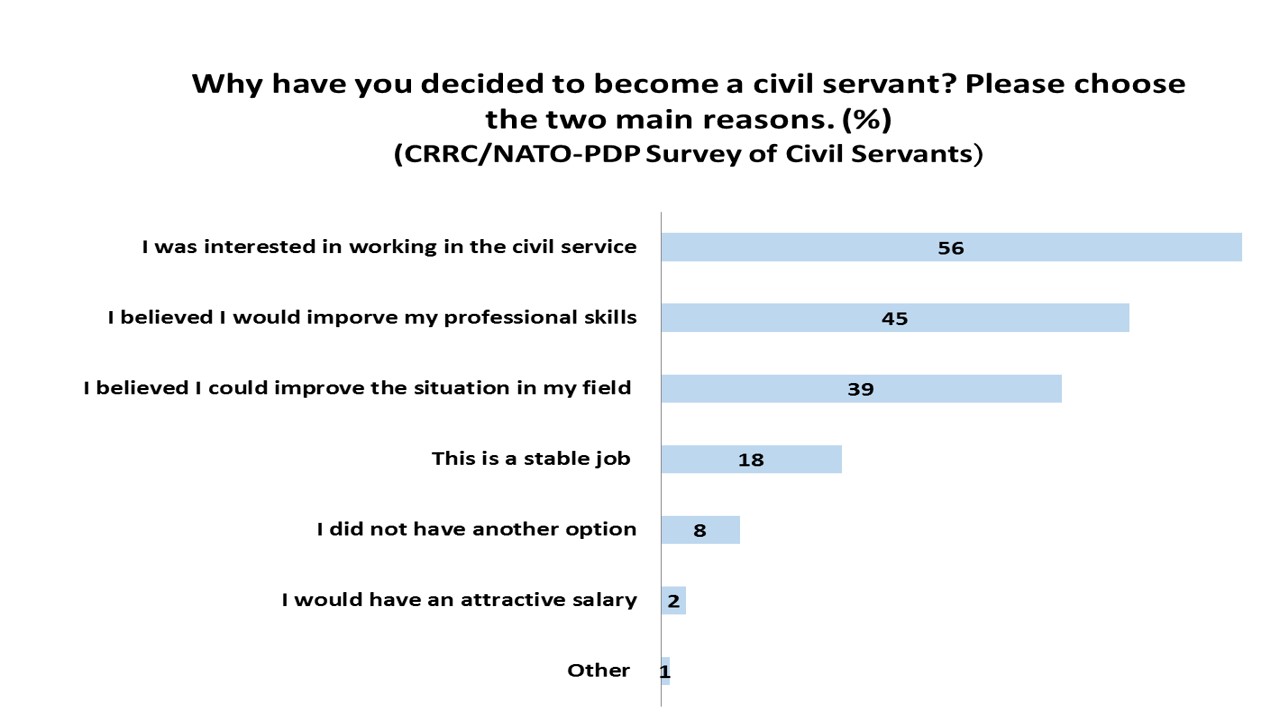
Slightly over a half of civil servants (56%) reported that the main reason they chose their job was an interest in working in the public sector. Forty-five percent hoped to improve their professional skills. The third most frequently named reason was a hope to improve the situation in their field. Importantly, a rather small share of civil servants (18%) reported a “stable job” as a reason for choosing to work in the civil service, and only 2% named an “attractive salary”.


About half of civil servants named the opportunity to contribute to the development of the country as the main advantage of working in the civil service. The opportunity to acquire new professional skills was the second most frequent answer, while the opportunity to make new connections, work one’s way up within the organization, and work with competent colleagues were named rarely.


Civil servants most frequently assessed the motivation to work of those in the civil service as average (50%). Positive assessments, though, are much more frequent than negative ones (36% vs 15%).

Note: To a certain extent, in response to most of the questions in this survey, civil servants tended to pick answers that can be considered socially desirable. Hence, social desirability bias is likely to have affected other responses as well, including assessments of other civil servants’ motivation to work. In order to avoid this bias in the case of this question, a very general wording was used: “How would you assess civil servants’ motivation to work?” This question measures civil servants’ reported perceptions of their colleagues’ motivation. To a certain extent, social desirability bias likely still influenced responses. However, this influence should be less than if the question had been asked about the respondent herself. 

Should the 50% of “average” assessments be considered a problem? Probably. The state invests financial resources in the improvement of civil servants’ professional skills, and the country, overall, is interested in a high productivity of their work. Undoubtedly, motivation encourages productivity. Thus, higher motivation will also lead to a more efficient use of public resources.

While trying to increase civil servants’ motivation in Georgia, it is important to consider the problems they face. The most frequently named problem is a lack of professionally competent civil servants. A fear of losing one’s job and poor infrastructure come in second and third, followed by a fair number of other problems.


Addressing these problems may improve civil servants’ motivation to work. As a result, the country would benefit from higher productivity among civil servants.

Monday, December 08, 2014

State capacity in the South Caucasus: How do you measure how much the state can do?


State capacity is a concept which has gained wide interest from political scientists in recent years as an important concept for economic development and regime classification, yet it still lacks agreed upon definitions and indicators. Its definitions vary, with different scholars highlighting different aspects of the concept based on their angle on the subject, but some definitions of state capacity are broader than others. A good example of a broad definition of state capacity is “the state’s ability to implement public policy” (Rogers and Weller, 2014).

The lack of agreement on indicators and definitions is due to the inherent multidimensionality of the concept. This multidimensionality is well exemplified by Fjelde and De Soya’s 2009 article which identifies state capacity as a state’s ability to coerce, co-opt, and cooperate with society. While the authors provide indicators for these capacities, their schema seems more to describe a state’s relationship and interactions with citizens rather than state capacity in and of itself.

The fact that different scholars have theorized different capacities including fiscal capacity, bureaucratic-administrative capacity, and coercive capacity as component parts of state capacity further illuminates the multidimensionality of the concept. This blog post looks at three of the many possible indicators which could be used to gauge state capacity in the South Caucasus: revenue excluding grants as a share of GDP for fiscal capacity, taxes on income, profit, and capital gains as a share of total revenues for bureaucratic-administrative capacity, and military expenditures as a share of central government expenditures for coercive capacity. So, how strong are the South Caucasus states?

Fiscal capacity is considered one of the most important state capacities by most authors as without the financial means to accomplish a stated policy, that policy will likely never be realized in practice. The graph below presents World Bank data for state revenue excluding grants as a share of GDP and shows how much the South Caucasian governments collect from their societies. What appears most prominently is that Azerbaijan’s fiscal capacity far outstrips that of Georgia and Armenia, which exhibit similar levels of extraction. It is important to keep in mind here that revenue consists not only of taxes but also funds collected through fines, fees, and resource rents. The latter are particularly important for Azerbaijan as the government received 54% and 65% of state revenues from oil and gas in 2005 and 2011 respectively. Without its oil wealth, Azerbaijan would collect significantly less in revenues.


Definitions of bureaucratic-administrative capacity often center on a state’s ability to collect and manage information (Hendrix, 2010). This capacity is central to a state’s ability to act and likely enables a state to have fiscal and coercive capacity. For example, if a state is unable to gather information on potential militants within its territory it will be unlikely that it can coerce or co-opt them into compliance. In order to successfully cooperate with society, information gathered must be channeled into usable and comprehendible forms which enable the government to act.

Income, profit, and capital gains taxes as a share of total taxes are a useful indicator of bureaucratic-administrative capacity. While at first glance it may be taken to indicate fiscal capacity, income taxes are more closely related to bureaucratic-administrative capacity, because this form of taxation is both a relatively difficult and relatively desirable tax to collect (Rogers and Weller, 2014). The desirability of income tax stems from the fact that it generally provides a revenue stream which does not drastically fluctuate. In most circumstances, however, it is a relatively difficult tax to collect (though the system of income tax payment by employers has lowered this difficulty in Georgia, Transparency International Georgia has noted that non-compliance with income tax remains problematic). As such, the share of income tax as a percentage of total state revenues proxies how well a state can extract from and manage information on its population. The graph below presents taxes on income, profits and capital gains (two other taxes which are similar to income tax) as a percentage of total taxes collected. The graph demonstrates that Georgia’s bureaucratic-administrative capacity on this measure is higher than that of Armenia or Azerbaijan. While Azerbaijan’s relative weakness in this sector is likely caused by hydrocarbon revenues, Georgia’s relative strength likely comes from the reforms in tax collection and enforcement, which started with the tax code passed in 2005.


A final important capacity of state is its ability to coerce its population; without the capability to put down paramilitaries or suppress violent groups, a state can quickly devolve into chaos. Taking military expenditures as a share of central government expenditures as an indicator of coercive capacity, the graph below gives a possible indication of coercive capacity. This indicator, though, also likely describes the changing relative importance of coercion to each state over time, as one would expect the share of total expenditures dedicated to military expenditures to increase if security issues became relatively more important – hence Georgia’s relatively high expenditures in 2008, which are largely a result of the 2008 August War with Russia. When looking at the figures, it is important to note that Azerbaijan’s budget is significantly larger than either Georgia’s or Armenia’s and as such has a much larger absolute level of coercive capacity.


This blog post has looked at three of the many possible indicators of state capacity. For readers interested in the subject, this 2010 article by Cullen Hendrix goes through a wide variety of indicators, although the data set used does not include any of the South Caucasus countries.

Have any ideas about other indicators? Join the conversation on Facebook or at CRRC-Georgia’s office on December 10th for the Works-in-Progress talk: State/party capacity and constraints on state action: Operationalizing and indexing state capacity in Georgia and Armenia.


Friday, December 08, 2006

Snapshot: Border Crossing Armenia-Georgia

Earlier this morning some observations that in themselves can almost serve as indicators:

  • Number of trucks waiting on Armenian customs, headed towards Georgia: 51
  • Number of interlocutors who had any idea what the reason for the actual problem was: 0
  • Number of types of uniforms worn by officials on the Armenian side: 5 (probably more)
  • Number of officials, or people acting as officials, wearing no recognisable uniform on the Armenian side: 6 (likely more)
If you want to get a first class fake $20 bill, pay your $30 Armenian visa with a $50 banknote. I have now twice seen the friendly Armenian official returning a fake 20$ bill as change for the 50$ he received. Visually, the bill is almost perfect. The only significant difference is in its feel. (Recently, it was claimed that large-scale production of counterfeit currency can be traced to South Ossetia)