Showing posts with label Covid-19. Show all posts

Tuesday, August 02, 2022

Georgia’s uneven post-pandemic economic recovery

Note: This article first appeared on the Caucasus Data Blog, a joint effort of CRRC Georgia and OC Media. It was written by Dustin Gilbreath, a Non-resident Senior Fellow at CRRC-Georgia. The views presented in the article are of the author alone, and do not necessarily reflect the views of CRRC Georgia, or any related entity.

Saying that COVID-19 changed the world is perhaps an understatement. Although a health catastrophe first and foremost, economies also plunged with the emergence of wide-ranging restrictions on activity. World Bank data suggests the global economy shrank between 2019 and 2020 by approximately 3.3%. In Georgia, the corresponding figures were a 6.7% decline in the size of the economy. 

As COVID-19 restrictions have been largely removed, the world has witnessed an economic recovery, albeit combined with the highest rate of inflation seen in recent memory. Despite wide-ranging rhetoric around building back better, data from a newly released World Bank study, which CRRC Georgia conducted, suggests that while the economy is recovering, many groups are facing greater barriers to re-entering the workforce.

Since December 2020, CRRC Georgia has been conducting a series of telephone surveys for the World Bank. The results of the survey show a clear rise in the share of the public that is engaged in employment. While 32% of the public (over the age of 18) reported having a job in December 2020, 43% did in March of 2022.

Still, this data indicates that employment has yet to recover to pre-pandemic levels, with 51% of the public reporting that they had been employed prior to the pandemic.

 

While the economy is clearly recovering, the data also show that recovery in employment is unequal.

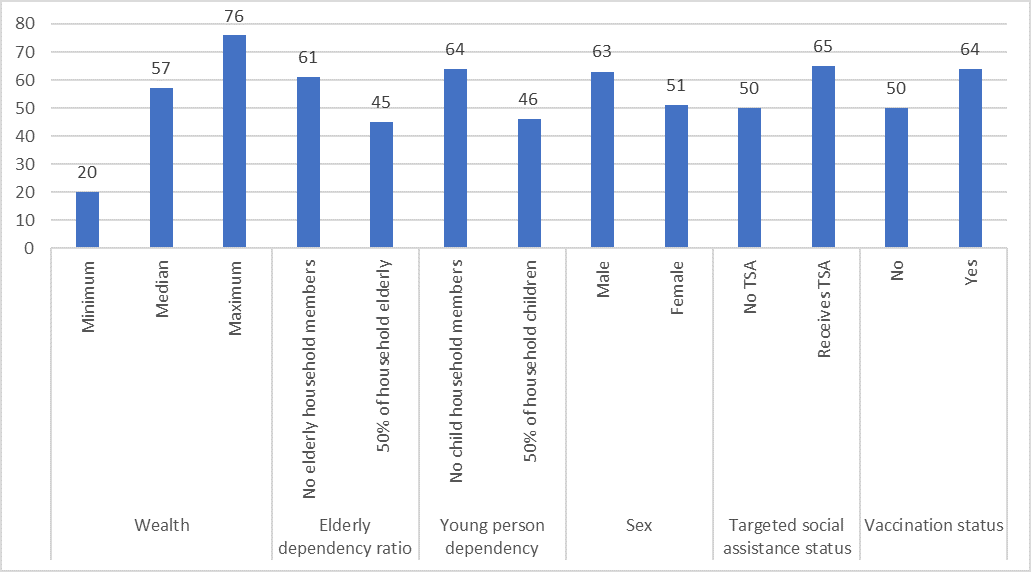
Regression analysis comparing people who lost a job during the pandemic and have not returned to employment to people who lost a job during the pandemic and did return to work suggests that a number of traditionally economically disadvantaged groups face larger challenges in re-entering the workforce.

Women who lost a job during the pandemic are 12 percentage points more likely not to be working at present than men, while people in poor households are substantially less likely to have re-entered the workforce.

In addition, the more elderly people there are in a household, the less likely someone who lost a job during the pandemic is to have returned. 

Similarly, in households with relatively large shares of children, people who lost a job during the pandemic are significantly less likely to be working today than in households with fewer children. 

People who did not get vaccinated are 14 percentage points less likely to have returned to the workforce than people who did get vaccinated.

In the one bright point in the analysis, people in families that receive targeted social assistance were more likely to return to work than in families that do not receive social assistance.

In contrast, there are no significant differences between age groups, settlement types, households with more and fewer members, people of different education levels, ethnic groups, and people who did and did not catch COVID-19 after controlling for the factors shown in the chart above.

Women, people with greater numbers of elderly people, and greater numbers of children in them all remain less likely to be employed at present than men and people without children or elderly people in the household.

This suggests that domestic work and care work burdens related to the pandemic may be at play in people’s lack of return to the workforce. However, this would require further research to confirm.

In the above context, actors working on Georgia’s economic recovery should look into policies which can support a more equal recovery.

Note: The data this article is based on is available here. The analysis of which groups have and have not returned to the workforce was conducted using a logistic regression which controlled for the following variables: Age (18-34, 35-54, 55+); Sex; Settlement type (Tbilisi, other urban, rural); Household member count; Education level (tertiary or not); Child dependency ratio (share of household 18 or under); Elderly dependency ratio (share of household over the age of 64); Received targeted social assistance aside from an old age pension; Caught COVID 19/ had a family member with COVID 19 or not; Vaccinated against COVID 19 or not; Ethnicity (Ethnic Georgian or ethnic minority); Wealth index (A simple additive index of ownership of a number of durable goods within a household).

Wednesday, April 27, 2022

Georgians are becoming less satisfied with the government’s COVID response

Note: This article first appeared on the Caucasus Data Blog, a joint effort of CRRC Georgia and OC Media. It was written by Natia Liluashvili, a junior fellow at CRRC-Georgia. The views presented in the article are of the author alone, and do not necessarily reflect the views of CRRC Georgia, or any related entity.

In the two years since the first coronavirus case was detected in Georgia, roughly 1.6 million people have caught COVID-19 in the country, and more than 1 in 235 people have died due to the virus.

The most recent wave caused by the Omicron variant resulted in over 5% of the country having an active case of COVID-19 at the same time.

During this wave, the government abolished the green passport requirement and lifted most restrictions on businesses. This approach stands in contrast to the government’s approach at the start of the pandemic, which included lockdown policies. But what does the public think of how the government has handled the pandemic?

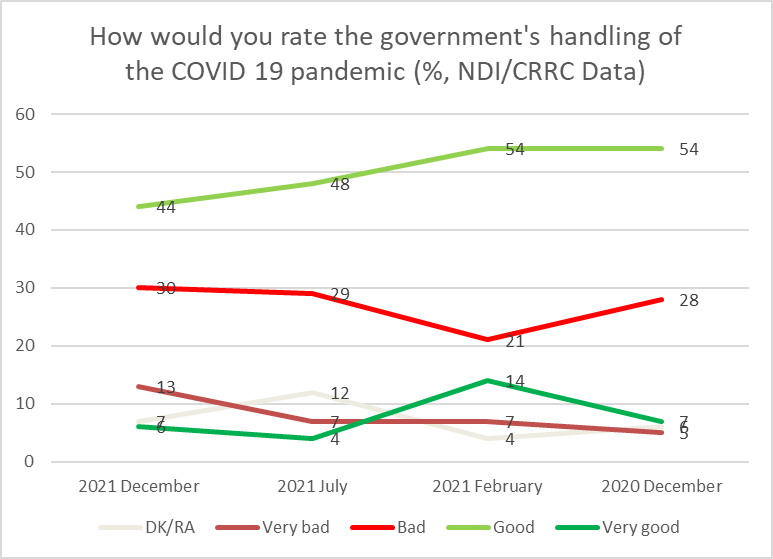
In December 2020, Georgia was in partial lockdown. According to data from the 2020 NDI/CRRC survey, 61% of the public thought the government handled the pandemic well or very well, while 33% rated the government’s handling of the pandemic negatively.

In February 2021, the number of people who positively assessed the management of the pandemic increased to 68%, while only 28% thought that they did a bad job. Notably, this survey took place during the period in which Giorgi Gakharia, Georgia’s former prime minister, withdrew from politics.

Unlike his predecessor, Irakli Garibashvili began to open up the country. At the same time, Georgia started to provide vaccines. Against this background, in July 2021, positive attitudes towards the government’s handling of the pandemic declined to 52%.

In December 2021, the number of daily confirmed cases increased dramatically, which was also reflected in the mortality rate. According to the latest NDI data, half the population (50%) think that the government was handling the pandemic well, with negative attitudes towards the government’s handling of the pandemic increasing from 36% to 43%.

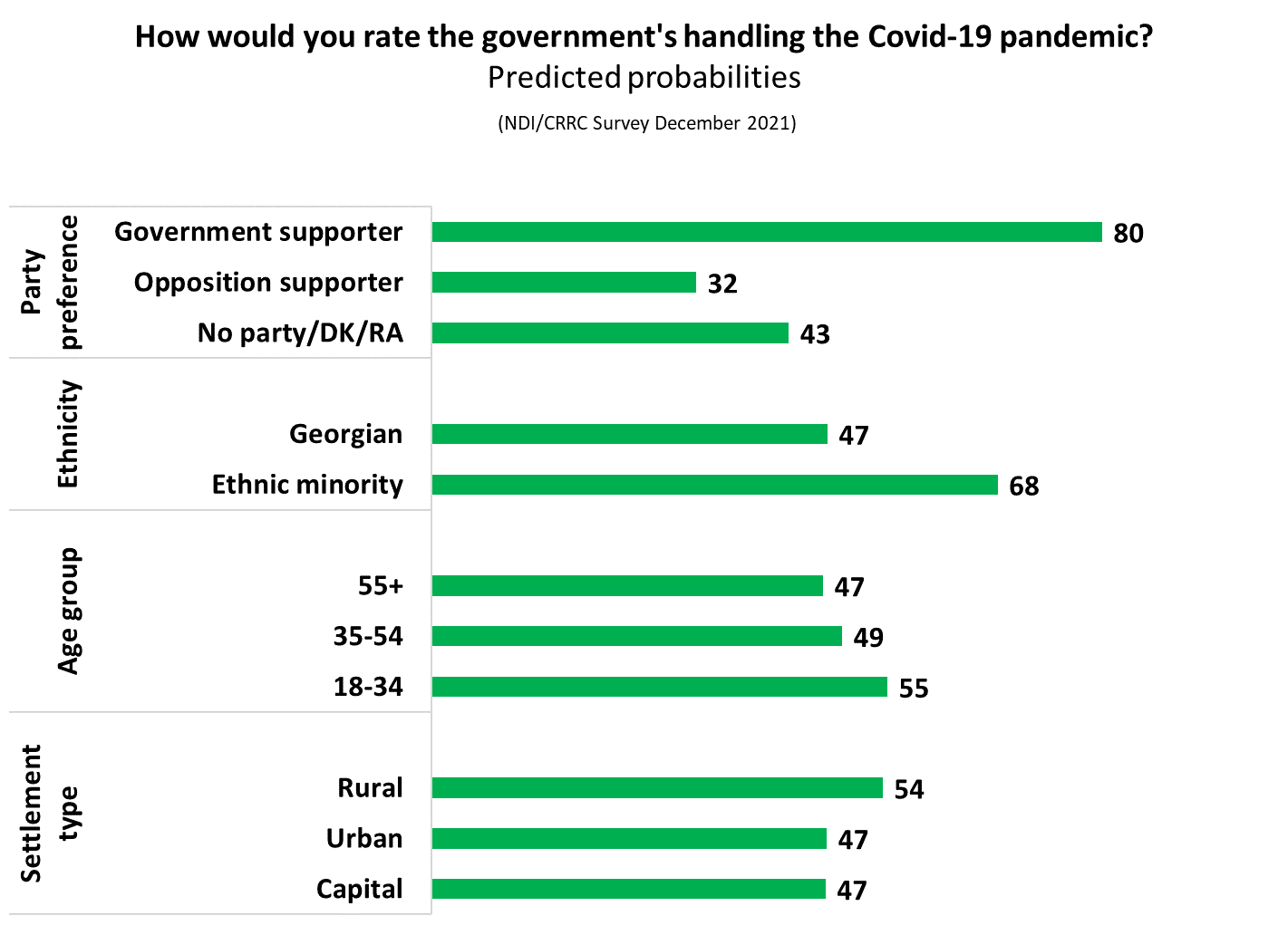
A regression analysis of the December 2021 data shows that the attitudes towards government policies differ significantly by party preference, ethnicity, age group, and settlement type.

People in rural areas have more positive attitudes towards the government’s handling of the pandemic than people in urban areas. Compared to the elderly, young people are more likely to think that the government is handling the COVID-19 pandemic well. Ethnic Georgians also hold less favourable attitudes than ethnic minorities, while Georgian Dream supporters are substantially more positive about the government’s policy than those who support the opposition or no party at all.

Note: This chart was generated from a regression model. The model includes gender (male, female), age group (18–34, 35–54, 55+), settlement type (capital, urban, rural), education (secondary or lower, secondary technical, tertiary), household composition in terms of having children under 12 (have children under 12, do not have children under 12), household composition in terms of having members over 60 (have members over 60, do not have members over 60),  household composition in terms of having members with severe chronic disease (have member with serious chronic disease, do not have member with serious chronic disease), ethnicity (Georgian, ethnic minority), party respondent names as closest to his/her views (Georgian Dream, opposition party, did not name a party (don’t know, refuse to answer, or no party affiliation)).

Even though the number of people who think that the Government is handling the pandemic well is slowly declining, it is high, especially in rural areas, among older people, and among ethnic minorities.

The data this article is based on is available here.

Tuesday, April 20, 2021

The evolution of feelings towards the pandemic

Note: This article was written by Mariam Mamatashvili, a Junior Fellow at CRRC Georgia. The article first appeared on the Caucasus Data Blog, a joint production of OC Media and CRRC Georgia. The views presented in the article reflect the views of the author alone, and do not necessarily reflect the views of CRRC Georgia or any related entity.

It’s been over a year since the first coronavirus case was recorded in Georgia, and attitudes towards the pandemic have continued to change.

CRRC Georgia’s Omnibus survey has tracked attitudes towards the COVID-19 pandemic since April 2020. Data from the most recent wave of the survey, in January, suggest that Georgians increasingly believe that the worst is already behind us. 

In April 2020, Georgia had low COVID-19 case counts. Given this as well as the difficult situations in other countries, it is perhaps unsurprising that 45% of the public believed that the worst of the virus was yet to come. At the same time, 26% thought that the virus would not be a major problem, and 14% thought that the worst had already passed.  

The data shows somewhat counterintuitive results in early October. Although case counts were rising quickly during the fieldwork period (6–16 October) and had been on the rise since September, the view of the plurality (48%) shifted to thinking that COVID-19 was not going to be a major problem. One potential reason for this pattern is that Georgia had experienced relatively few cases over the summer compared to the outbreaks witnessed internationally.  

In January 2021, a plurality of Georgians thought that the worst of the pandemic was already behind the country. This is in a context where the number of new cases had declined substantially after the November-December peak.  

At the same time, the share reporting that COVID-19 is not a major problem declined to 15%, which is unsurprising given that more than one in twenty people has caught the virus, and the economy has contracted.

The above patterns tend to hold across different age groups, sexes, and settlement types, but a number of differences between groups are present in the data.

In the most recent data, people with lower levels of education tended to be more uncertain and people with higher levels of education were more likely to think that the worst is behind us. 

Women were nine percentage points more likely than men to think that the worst is behind us. In contrast, men were more likely to think that the Coronavirus will not be a major problem.

People at or above the age of 55 were more likely to be uncertain than younger people. They were also significantly less likely to think that the worst is behind us. 

People living in rural areas were also substantially more likely to be uncertain in their views than people in urban areas.

Those who were working also tended to think that the worst is behind us slightly more often than people who were not working, who report slightly more pessimistic attitudes.


While in April, the public tended towards thinking that the worst was yet to come, in January people tended to report that the worst of the pandemic was behind us. 

The sense that the coronavirus was not going to be that large a problem declined in January compared with early October. Those with a higher education, women, people who have jobs, and younger people were more likely to think that the worst was behind us.

The data discussed in this blog is available here.

Wednesday, April 14, 2021

Why do Georgians not want to vaccinate?

Note: This post first appeared on the Caucasus Data Blog. It was written by Dr. Tsisana Khundadze, a Senior Researcher at CRRC Georgia. The views expressed in this post represent the author's alone, and do not represent the views of CRRC Georgia, NDI, or any related entity.

With two kinds of vaccines against COVID-19 already available in Georgia, the public’s attitude towards vaccination is becoming more and more important. So why are Georgians so sceptical of coronavirus vaccination?

While willingness to get vaccinated against COVID-19 was not high even in June or December 2020, it is logical to suppose that hesitation would only have increased after the unfortunate case of a young nurse passing away shortly after receiving the AstraZeneca COVID-19 vaccine on 18 March. 

As the data from February 2021 CRRC/NDI survey shows, even before this incident, in February, only around a third of Georgians were willing to be vaccinated against COVID-19, with the largest concern being related to the quality of the vaccine.

The CRRC/NDI telephone survey from February 2021 showed that while around 40% of Georgians think that the government’s plan for COVID-19 vaccination is effective, the rest either thinks that it is not effective or are not sure about the plan. When asked about actually vaccinating against COVID-19, only 35% of Georgians said they will vaccinate, while a majority (53%) reported they would refuse

When it comes to the reason why people are hesitant to be vaccinated, a lack of trust in the quality of COVID-19 vaccinations dominates. Also, 1 out of 5 people who are not willing to vaccinate, think that we can handle the pandemic without vaccination. Some of the people who are not willing to vaccinate also attribute their decision to health-related issues. 

Besides these reasons, 1 out of 20 vaccine-hesitant  Georgians said they are generally against vaccination or believe that vaccination has alternative goals.

Note: Question was asked only to those who did not say they would vaccinate.

Who is most sceptical of vaccination?

In order to better understand Georgians’ attitudes towards COVID-19 vaccination and the reasons for hesitance, a regression model was run. The analysis showed that men were around 1.3 times more likely to say they would vaccinate than women. People over 54 were again 1.3 times more likely to say they would vaccinate than younger people. People with higher than secondary education were around 1.5 times more likely to be willing to vaccinate than those with secondary technical or secondary education. 

Regression analysis also showed that Georgian Dream supporters were 1.5 times more likely to say they would vaccinate, compared to opposition supporters or people who do not identify with any political party. 

Interestingly, people who named TV or the internet as their main source of information about COVID-19 were more likely to be willing to vaccinate, with internet users being more likely to say so than people who named other sources as primary. 

There were no significant differences between people of different settlement types and employment statuses after controlling for other factors.

Note: This and the following charts were generated from a regression model. The model includes sex (male, female), age group (18–34, 35–54, 55+), settlement type (capital, urban, rural), education (secondary or lower, secondary technical, tertiary), employment status (employed, not employed), party support (Georgian Dream, opposition, did not name a party), and source of information about COVID-19 (TV, Internet/Facebook, other).

As for the reasons for not vaccinating, regression analysis shows that the quality of the vaccine was around 1.2 times more likely to be questioned by women than men. Opposition supporters were almost twice as likely to say they don’t trust the quality of COVID-19 vaccines. 

People who named TV as their main source of information about COVID-19 were more likely to question the quality of the vaccine compared to people who named the internet or other sources as primary. 

There were no significant differences between people of different ages, settlement types, education levels, or employment statuses.

Who thinks we can handle the pandemic without vaccination?

Regression analysis also showed that men were 1.5 times more likely to state that they believed we can handle the pandemic without vaccination. Younger people were 1.9 times more likely to say the same, compared to people over 54. 

Inhabitants of the capital were also 1.6 times more likely to think we can handle the pandemic without vaccination than people living in rural areas. Georgian Dream supporters were more than two times as likely to think so as opposition supporters. 

Finally, people who named the internet as their main source of information about COVID-19 were 1.4 times more likely to say we can handle the pandemic without vaccination than people who name TV as their primary source. 

No significant differences between people of different education levels and employment statuses were present.

Regression analysis also suggested that when it comes to being against vaccination in general and attributing alternative goals to the vaccination process, education was the only factor that makes a difference in people’s opinions. 

People with secondary or lower education were 1.9 times more likely be against vaccination in general or attribute alternative goals to vaccination, than people with higher education. 

There were no significant differences between people of different sex, age, settlement type, employment status, party affiliation, or sources of information about COVID-19.

February 2021 data from the CRRC/NDI survey showed that the majority of Georgians are not convinced of the effectiveness of the government’s COVID-19 vaccination plan and also are not willing to vaccinate against COVID-19. 

The most common reason for not doing so was a lack of trust in the quality of the COVID-19 vaccine and belief that pandemic can be handled without vaccination. 

Men, older people, people with higher education, Georgian Dream supporters, and those who receive information about COVID-19 primarily from the internet were more likely to be willing to vaccinate. 

When it comes to reasons for not vaccinating, women, opposition supporters, and people who name TV as their main source of information about COVID-19 were most likely to doubt the quality of the vaccine, while men, younger people, inhabitants of the capital, Georgian Dream supporters, and people who name the internet as their main source of information were most likely to believe that we can handle the pandemic without vaccination. 

Additionally, people with secondary or lower education were more likely to be against vaccination in general and attribute alternative goals to it than people with higher education.

For more data on people’s attitudes towards various issues see the CRRC/NDI February 2021 survey dataset on CRRC’s online data analysis tool.


Tuesday, November 17, 2020

How coronavirus messaging could provide a moral license to misbehave

[Note: This article was published on the Caucasus Data Blog, a joint effort of CRRC Georgia and OC Media. It was written by Dustin Gilbreath, Deputy Research Director at CRRC Georgia. The views expressed in this article are the author's alone and do not represent the views of CRRC Georgia or any related entity.]

In Georgia, it would appear that informing people that others are acting responsibly in the pandemic could in fact lead to the opposite behaviour.

Communications have been critical to attempts to prevent the spread of COVID-19 globally, and it is unclear what the best strategy for doing so might be. In Georgia, it would appear that informing people that others are acting responsibly in the pandemic could in fact lead to the opposite behaviour.

A common tool to change behaviour through communications is the use of social norming. 

Social norming informs people of what other people are actually doing, and in turn, more people often start doing the same. This tool has been successfully used to encourage numerous forms of pro-social behaviour from paying taxes to lowering drinking among university students.  But sometimes, it does not work and can even backfire. 

The results of a survey experiment CRRC Georgia conducted in June 2020 suggest that had social norming been used towards the end of the COVID-19 lockdown to encourage people to stay at home, it might have backfired.

During the lockdown, stay at home was the motto of the day. Yet, over the course of the lockdown, the public increasingly began to go out to socialise.  Men in particular became more likely to socialise as time went on.

To test whether social norming could potentially change behaviour, CRRC Georgia ran a survey experiment. In the survey, one group of people were told that the majority of the public had stayed home the week prior. A second group was told that the majority of the people of their sex had stayed home the week prior. A third group was not told anything. Next, respondents were asked whether or not they planned on going out the following week. 

The experiment found statistically and substantially large effects on the provision of information. People who found out that most people stayed at home were 18 percentage points more likely to report they intended on going out to socialise the following week.  

The sex-specific information led to a 12 percentage point increase in people’s intention to go out and socialise.


The effects were uniform across different social and demographic groups. Women and men, old and young, people with and without a higher education, and those who did and did not leave the house the week prior to the survey were not affected in a significantly different manner by the treatments. The effect was similar across settlement types as well.

So what happened? One plausible hypothesis is that instead of the treatment inducing social norming, it enabled moral licensing. When people do something good, they often then feel like it is fine to do something not so good afterwards. This process is known as moral licensing.

The above experiment could have potentially led people to believe that, collectively, Georgia has done well. As a contributor to that success, they may have felt that next week, they should reward themself by going out to socialise. 

While plausible, further experimentation is needed to untangle exactly what happened.

What is clear is that, at least in some contexts, attempts at social norming can have adverse impacts. This underlines the point that communications campaigns need to test before they talk.

Thursday, July 23, 2020

Covid-19 Monitor: New Report on Georgian Public Opinion on the Covid-19 Crisis

Today, CRRC Georgia released a report on public opinion in Georgia on the Covid-19 crisis. The report includes data collected between late April and early June, 2020. During this time, CRRC Georgia conducted weekly public opinion surveys and presented the results on a weekly basis to policy makers, local NGOs and the international community. 

The study covered a wide range of issues from disinformation to food insecurity and employment. Some of the key findings include:
  • The public’s assessments of the performance of a wide range of institutions became significantly more positive during this period;
  • The vast majority of the public approved of the nearly all of the policies that the government implemented during the crisis;
  • Between a third and a quarter of the population lost a job during the crisis;
  • The majority of households experienced at least some level of food insecurity during the crisis;
  • Median household incomes roughly halved during the crisis;
  • People tended towards favoring opening up the economy during the crisis to exercising caution;
  • There is widespread misinformation around vaccines in Georgia, and belief in misinformation is strongly correlated with whether or not someone would want a vaccine for Covid-19 if one were available six months from now;
  • Misinformation was present but not widespread during the crisis. For example, 9% of the public believe that 5G infrastructure spreads the virus;
  • Only 4% of Georgian Orthodox Christians attended Easter Liturgy, as opposed to 44% the year prior;
  • Few people believe that there will be a second wave of the virus, and there would be less support for implementing restrictions on different freedoms if a second wave took place.
The full report is available here. The six datasets are available from CRRC Georgia’s online data analysis tool.

Monday, April 27, 2020

Who trusts the healthcare system in Georgia?

[Note: This article was co-published with OC Media. It was written by Rati Shubladze, a policy analyst at CRRC Georgia. The views presented in this article do not represent the views of CRRC Georgia or any related entity.]

Trust in healthcare institutions is important, especially during a pandemic like the current COVID-19 outbreak. In the name of public health, numerous individual freedoms and economic activities are restricted.

Without trust in the messages of public health officials, measures aimed at preventing the spread of the virus are less likely to be complied with, exacerbating the spread of the virus.

The recent events surrounding attendance at religious ceremonies and healthcare highlights the importance of trust in health institutions. The tensions between the church and healthcare professionals, including a public verbal clash between a high ranking church official and the National Center for Disease Control and Public Health, show this.

Indeed, despite recommendations from healthcare specialists to stay home, the Orthodox Church in Georgia still held Easter liturgy with parishioners in attendance.

This situation leads to the questions: who is more or less likely to trust healthcare officials in Georgia and does this trust interact with religious belief?

The 2019 Caucasus Barometer Survey provides some answers to these questions. The data was collected in mid-autumn 2019, before the current crisis. This has both advantages and disadvantages.

On the one hand, attitudes could not have been influenced by the current crisis. Therefore, the responses allow an understanding of who would be more or less predisposed to trusting healthcare institutions before the crisis and therefore who would be more or less likely to comply with healthcare institution mandates.

On the other hand, the data do not enable an understanding of how trust has changed in response to the current crisis.

At the time of the 2019 Caucasus Barometer survey, the plurality (43%) of Georgians trusted the country’s healthcare system. This is a relatively high level of trust compared to other institutions.

Out of 15 social and political institutions, the healthcare system was the fourth most trusted institution.


Further analysis using demographic variables, including settlement type, age, gender, employment, internet usage, minority status, and education suggests that males, those living in rural areas, ethnic minorities, and those that do not use the internet have higher chances of trusting the healthcare system, controlling for other factors. Other demographic factors do not show statistically significant differences.


Note: The original healthcare trust questions was asked using a 5-point scale. For the purpose of analysis, the options ‘fully trust’ and ‘rather trust’ were coded as ‘trust’ and options ‘fully distrust’ and ‘rather distrust’ were coded as ‘distrust’. The variables about ethnicity and Internet usage were also recoded. The minority status variable codes the following ethnicities as non-Georgian: Armenian, Azerbaijani, Russian, Kurd or Yezidi, other Caucasian, and other ethnicities. In the internet usage variable, options ‘at least once a week’, ‘at least once a month’, and ‘less often’ were coded as ‘less often’; ‘never’ and ‘do not know what the internet is’ were coded as ‘never’. 

Importantly, three of the above characteristics are interconnected, as minorities mostly dwell in rural areas of Georgia, and internet usage is least common in rural areas and among ethnic minorities.

Indeed, the higher levels of trust among these groups could be because minorities and rural people are more likely to trust public institutions generally.

Given the situation surrounding public health officials and the church, it is important to understand whether there are interactions between trust in religious institutions and healthcare officials.

Indeed, the Caucasus Barometer data suggest trust toward religious institutions is associated with trust in the healthcare system. However, the observed relation tells us more about the phenomenon of general institutional trust. The results are similar when the relation between trust in the healthcare system and trust toward other institutions, like the army, police, banking system, or media are examined.

A second way of looking at it that does not suffer from trust being correlated with trust is through looking at the association between frequency of attending religious ceremonies and trust in healthcare institutions.

Caucasus Barometer 2019 data suggest no statistically significant association between trust in the healthcare system and how frequently people attend religious ceremonies, controlling for other demographic factors.

Based on this, the church-going population appears to have been no more or less likely to trust healthcare officials before the COVID-19 crisis.

Prior to the COVID-19 crisis, trust toward the healthcare system was associated with where people live, ethnicity, sex, and internet usage. Religiosity did not appear to be related to trust in the healthcare system before COVID-19. Whether these factors still hold true remains to be seen.

To explore the Caucasus Barometer 2019 survey findings for Georgia, visit CRRC’s Online Data Analysis portal. Replication code for the data analysis is available at CRRC’s GitHub repository here

Tuesday, April 21, 2020

Study suggests large numbers in Georgia to celebrate Easter in church

Note: This article was co-published with OC Media. It was written by Koba Turmanidze, President of CRRC Georgia. The views presented in this article do not necessarily reflect the views of CRRC Georgia or any related entity.

Research by CRRC Georgia suggests that a large number of Georgia’s Orthodox Christians intend to celebrate at Church.

As Easter celebrations approach in Georgia, a study by CRRC Georgia suggests that a large number of Georgia’s Orthodox Christians still intend to celebrate at Church. The survey of Facebook users found that around 40% of people who usually celebrate Easter in Church intended to do so again this year despite the pandemic.

With Easter celebrations approaching, quarantine rules have become even stricter: driving of private cars has been forbidden and movement in and out of the four largest cities of Georgia has been restricted.

While most organisations are closed or are working digitally, the Georgian Orthodox Church has continued traditional services. Moreover, the church has refused to call on believers to celebrate Easter at home, and the government seems unwilling to enforce emergency rules on the Church.

Instead, the Prime Minister has hinted that it is the responsibility of citizens to stay home, while the churches should remain open. ‘I’m sure that wise citizens will guess that they should not place responsibility on the church and should not want to hear the call from the church – don’t come to the church’, he stated.     

This is not the first time government officials have used subtle suggestions, or nudges, with the goal of altering people’s church-going habits.

Earlier this month, Paata Imnadze, the highly regarded deputy head of the National Centre for Disease Control and Public Health also voiced a similar view.

‘I would like to address Christian believers. Let’s protect our mother-Church, and our priests, by praying at home and not going to church.’

While such nudges often succeed in changing people’s attitudes and even behaviours, CRRC Georgia’s research shows that in the current situation, this approach may not be working.

To test the impact of Imnadze’s ‘nudge’ on people’s intentions to go to church for Easter celebrations, CRRC Georgia conducted an experiment using Facebook’s A/B test tool.

The tool disseminates two or more announcements which will randomly show up in Facebook users’ news feeds. In this case, Facebook users were randomly shown advertisements to fill out one of the two versions of a questionnaire: one included Imnadze’s statement as an introduction to the survey, while the other did not. The two surveys were identical in every other respect. 

The randomised test was active for 72 hours from 11–14 April and reached 240,000 users, accumulated 22,100 clicks, and resulted in 7,560 completed questionnaires.

Of the 7,560 adults, 42% read or saw Imnadze’s statement before filling out the questionnaire. Analysis of the results did not show any impact from the nudge.

In the two groups, 16% reported that they would celebrate Easter in the church. As expected, far more respondents reported celebrating Easter in the church in the past (38%), suggesting that people have adapted their plans to the emergency situation.

Yet the nudge played no role: regardless of being in the treatment or control group, about 60% of respondents who usually would celebrate Easter in Church reported they would stay home this year, while about 40% still planned to go to church.


Importantly, there was no effect of the nudge across different demographic groups (e.g. men and women, older and younger people).

Further analysis looked at different factors that correlate with whether people changed their choice to celebrate Easter at the Church.

Respondents’ religiosity shows an unsurprising pattern. Frequent churchgoers and respondents who consider religion important in their lives were more likely to stay loyal to their past practise of celebrating Easter in the church than less religious respondents (i.e. those who go to church less frequently and consider religion less important).

Perhaps unsurprisingly, concern about the spread of COVID-19 makes respondents more cautious, and hence, more likely to change Easter celebration practice from church to home.

Women, people with tertiary education, and older respondents are also more likely to move Easter celebrations from church to home, whereas employed respondents are less likely to change their past practice of celebrating in the church.

While the survey gathered a large number of responses, the results should be read with caution.
The survey is clearly not representative of the population of Georgia, which is reflected in a different demographic profile of the Facebook respondents.

Unlike nationally representative surveys, the Facebook sample overrepresented women (82%), the employed (61%), the university-educated (65%), and younger people (the average age was 37). Moreover, it is hard to say whether the survey represents Facebook users in Georgia, since respondents self-selected into the survey.

Nevertheless, the group that saw and did not see Imnadze’s message on the survey were very similar, with identical demographic profiles. Hence, if the treatment and control groups answered the Easter celebration question differently, this could be attributed to the reminder of Imnadze’s nudge.

While it is not possible to exclude the possibility that the tested and similar nudges already impacted the respondents before they completed the Facebook survey, the findings still suggest that subtle suggestions are not sufficient to change people’s Easter holiday plans.

While a significant share of respondents changed their usual ways of celebration, a reminder of Imnadze’s suggestion did not change this.

Religiosity seems to be an obstacle towards adaptation to the current situation: while many believers and frequent churchgoers reported they would celebrate from home, many are still unconvinced and will likely help spread the virus this Sunday unless emergency rules are enforced on the Church as elsewhere in the country.

Monday, April 13, 2020

As COVID-19 sends political campaigning to Facebook, will polarisation increase?

[Note: This article was co-published with OC Media, here. The article was written by Dustin Gilbreath, Deputy Research Director at CRRC Georgia. The views presented in the article do not necessarily reflect the views of CRRC-Georgia or any related entity.]

With Georgia in an election year and traditional face-to-face campaigning out of the question given the COVID-19 outbreak, the importance of Facebook in Georgian politics is only likely to grow.

Facebook is an important part of Georgian politics. Political campaigns are fought, and public opinion thought to often be formed on the platform.

The Government of Georgia and the ruling Georgian Dream party found it so important that they even set up numerous fake accounts posing as news sources, some of which Facebook later took down.

The perceived importance of Facebook is likely well-deserved. Among the 70% of Georgians that use the internet at least sometimes, it is by far most people’s most frequent activity; 72% of the public reports that one of their main three online activities is using Facebook, according to the NDI and CRRC November and December 2019 survey.

Given this, the question emerges, do Facebook users in Georgia have different political attitudes than non-users?

An analysis of the November and December 2019 NDI survey suggests that they have relatively similar attitudes to other internet users with one key exception — Facebook users have stronger opinions on political issues.

This suggests that if political campaigning moves further onto Facebook, people’s views could become more entrenched leading to more political polarisation.

On the November/December NDI and CRRC survey, respondents who reported using the internet were asked how often they encounter political news on Facebook. Among the response options was, ‘I do not use Facebook’, which 8% of internet users reported.

Based on this figure and a question on internet usage, a third (31%) of the public report not using the internet, 64% report using the internet and Facebook, and 6% use the internet, but not Facebook.

To understand who was more or less likely to be part of these different segments of society, a statistical model controlling for age, settlement type, household wealth, education level, and sex was run.  The data suggest that Facebook users and internet users who do not use Facebook are more demographically similar to each other than those that do not use the internet.

The results suggest that people who use the internet but not Facebook are less likely to live in urban areas outside Tbilisi, are older (average age of 47 versus 39), and more likely to be male.

Those who use the internet but do not use Facebook compared to people who do not use the internet live in wealthier households, are more likely to have a higher education, are younger (average age of 47 versus 60), and are more likely to live in urban areas outside the capital and rural areas than in Tbilisi.

When comparing those who use Facebook to those who do not use the internet, the pattern is similar.

Given the large role that Facebook plays in politics in Georgia, it would be reasonable to assume that people who use Facebook and people who do not but are still online might have different political views.

To explore this issue, a matching analysis was used to identify individuals that are similar along demographic lines, except for the fact that they either use Facebook or they use the internet, but not Facebook.

The results show few differences. The two groups do not have significantly different preferences for political parties. They both also tend to assess government performance similarly. They are equally likely to report that they are going to vote in the next parliamentary elections. They are also no more or less certain in who they are going to vote for.

There is one important difference, however — people who use Facebook are more likely to express their opinions. People who use the internet but not Facebook reported they don’t know and refused to answer questions significantly more often than people who use Facebook in this survey.


This finding has a number of potential interpretations. It may suggest that Facebook is informing people about politics in the country, and therefore, they can respond to the survey questions, which focus on politics, more easily.

It could also suggest that Facebook is polarising in Georgia. People that use the platform are significantly less likely to report uncertainty on the wide variety of issues asked about on the survey, hinting at stronger opinions.

Aside from these potential explanations, caution is warranted in interpreting Facebook as causing these patterns. Another potential interpretation is that people who do not use Facebook but are online are more cautious in sharing their opinions in public.

This would explain why they refused to answer more often and are not engaged in a platform that thrives on people sharing news about themselves and their views on politics. However, working against this view is the fact that both groups reported equal comfort in expressing their opinion in a quasi-public forum.

Taken together, the data suggests that there are relatively few differences between people who are on Facebook and not on Facebook but still using the internet, with one key distinction. People using Facebook are more likely to express their opinions.

This may point to Facebook either serving as a tool to inform the public or as a source of division. Alternatively, Facebook may draw the already more opinionated and informed. Potentially, it is both.

In either case, if politics is increasingly concentrated on Facebook in light of the COVID-19 outbreak, Georgian voters may become more informed and opinionated about politics. With stronger opinions, polarisation too may become stronger in Georgia.

Note: The data used in the above is available here. Replication code for the analysis is available here. In some cases in the above, figures may not sum to 100%. This is generally due to rounding error.

Wednesday, April 01, 2020

How think tanks can support the COVID-19 response through survey data

[Note: This article was originally published at On Think Tanks. It was written by CRRC Georgia's deputy research director, Dustin Gilbreath. The views expressed in this article do not necessarily reflect the views of CRRC Georgia or any related entity.]

COVID-19 is likely to be the largest challenge the world has faced since the Second World War. In the last two weeks, unemployment claims in the US have exceeded the highest number recorded during the great recession. And the virus is expanding at an exponential rate. While some governments have responded in a generally effective manner (for example Georgia), many have been laggards in their response.

Just as think tanks played a critical role in the aftermath of the Second World War, they too can play a role in supporting governments through and after the present crisis. Providing accurate, timely, and actionable quantitative research is one such way that think tanks could provide immediate support to response efforts. While John Hopkins University is mapping COVID-19 data to enable an understanding of the virus’s spread, there is a clear need for data on a wide array of other issues.

Here I run through some of the main challenges and areas in which governments will need data to inform their response, and share a research proposal concept note, in the hope that it will support other think tanks to develop their own proposals and work towards better-informed solutions faster.

Social measures to contain the virus

At present, the main challenge facing the world is containing the virus. While this is a medical phenomenon, it is also clearly a social one. Indeed, social distancing and self-isolation are the key strategies being promoted at the moment. For these to be effective, however, compliance is critical. Public opinion polls have the potential to not only estimate levels of awareness of important practices, but also which groups are more or less likely to comply with them. With this public opinion data, government efforts can be more targeted at encouraging social distancing and isolation among different groups.

Economic consequences
The economic downturn is the second major issue the world faces. With all but essential businesses shutting down in many countries, and lower consumer demand across a wide range of sectors even if businesses remain open, the world is clearly headed for recession. But how many people have lost jobs? And in which sectors? Which regions have been hardest hit? Again, public opinion polls can provide estimates for all of these.

Governments traditionally rely on large samples of face to face interviews for economic statistics. This means that economic data is unlikely to be forthcoming in the near future. In its place, telephone surveys have the potential to provide a reasonably accurate understanding of how many people are out of work or facing issues around food security, among other economic issues.

Cross-cutting issues
Aside from containing the virus and the economic collapse directly, polling has the potential to address a wide range of cross-cutting issues, from gender divisions in care work to Russian propaganda.

For example, around the world, women do a disproportionate amount of unpaid care work. With children home from school, the increased levels of care work may mean that the crisis impacts women more than men along some domains. Surveys can measure these and help inform policy efforts to alleviate these impacts.

Disinformation or propaganda is another key issue with important implications during the crisis. To take an example from Georgia, Russia has long spread propaganda in the country about the Lugar Lab, suggesting that it is a biological weapon development centre. The Lab has played a critical role in Georgia’s response to the virus. Opinion polls can enable an immediate understanding of how propaganda is spreading and inform messaging efforts against Russian propaganda.

An example survey research data concept note
Clearly, surveys have the potential to inform a wide array of policies. Indeed, in places like the UK, the Government has already commissioned them to inform response efforts. However, developing countries are less likely to be able to afford or have experience in polling in response measures. Given this, donors need to step up now more than ever to enable a strong response.

In support of helping think tanks do just this, here is CRRC-Georgia’s concept note for survey data collection to inform the COVID-19 response in Georgia. Although, at the time of writing, we have not received funding (if you want to fund something like this, do get in touch), we felt that this proposal might help other organisations to rapidly create their own proposals, in turn cutting down the time between proposals and funding being delivered to enable effective response. Response time aside, we hope sharing the proposal will encourage potential collaboration and learning from each other (we’d be happy to hear others thoughts on this).

Monday, March 30, 2020

Air pollution in Tbilisi nearly halved by Covid-19 measures

[Note: This article was co-published with OC Media. It was written by Ian Goodrich, a policy analyst at CRRC Georgia. The views presented in this article do not necessarily represent the views of CRRC Georgia or any related entity.]

Particulate matter in Tbilisi’s air has fallen by as much as 45% following the introduction of measures to combat the spread of COVID-19, according to analysis of air quality data by CRRC Georgia.

The findings reflect broader global trends which have seen dramatic decreases in air pollution levels in China, Italy, and the United Kingdom.

Data from the Ministry of Environmental Protection and Agriculture show a clear fall in air pollution in the Georgian capital.

The plot below examines overall pollution levels in Tbilisi over the last month, overlaid on the same period for the last three years.

It highlights key dates in the COVID-19 crisis, specifically the first registered case, on 26 February, the closure of bars and restaurants and restrictions on entry into the country on 16 March, and the declaration of a state of emergency on 21 March.


Note: Two-day rolling average of the mean of normalized values for carbon monoxide, nitrogen dioxide, sulfur dioxide, and particulate matter (PM2.5, PM10).

Total pollution appears to be lower following the closure of bars, restaurants, and borders. The data also suggest that in the case of these closures, falls in pollution appear to have preempted policy decisions. The pattern that emerges should be intuitive for anyone who has looked outside in Tbilisi over the last few weeks.

Air pollution is however strongly seasonal, peaking and falling throughout the day, week, and year. It is also closely tied to weather patterns: strong wind, for example, will disperse pollutants. Modelling allows these factors to be taken into account when determining the overall impact of Covid-19 measures.

Models have been created for levels of five key pollutants in Tbilisi, examining particulate matter (PM 2.5 and PM 10), carbon monoxide, nitrogen dioxide, and sulfur dioxide. The models adjust for seasonal factors using Facebook’s Prophet tool, and weather using daily data from NASA.

The models show that following the declaration of emergency, almost all categories of air pollution fell. The only exception to this pattern is sulphur dioxide which has remained relatively constant throughout.


The most dramatic impacts from COVID-19 related measures are seen for particulate matter pollutants (PM2.5 and PM10) with each falling by 40%–45% after the emergency declaration, approaching half their pre-crisis rate.

Interestingly, for these substances, a sharp fall was present prior to the introduction of emergency measures. It is possible that this drop may be a consequence of the decline in vehicle traffic as workplaces and recreational venues began to close.

In contrast, other substances only declined following the introduction of emergency measures. Differences in change patterns are likely attributable to the different sources of pollutants.

Notably, changes are most pronounced for particulate matter, carbon monoxide and nitrogen dioxide, substances related to transportation.

No significant change was observed for sulfur dioxide, which is more closely associated with coal and oil burning for power generation.

These pronounced changes show the profound impact of human activity on the capital’s air. The restrictions imposed in response to COVID-19 are by necessity severe, but also temporary. As life returns to normal and the crisis abates, policymakers may reflect on these changes when considering how to tackle air pollution.


Note: The data and replication code for the analysis presented above is available here. The data analysis used an interrupted time series design, a quasi-experimental method which tests for significance in difference between points in a time series before and after a cut-off.