Showing posts with label Tbilisi. Show all posts

Tuesday, February 28, 2023

Democratic hypocrisy in Tbilisi

Note: This article first appeared on the Caucasus Data Blog, a joint effort of CRRC-Georgia and OC Media. This article was written by Dustin Gilbreath, a Non-resident Senior Fellow at CRRC-Georgia and Givi Siligadze, a Researcher at CRRC-Georgia. The views presented in the article are the authors’ alone, and do not necessarily reflect the views of CRRC-Georgia, the National Endowment of Democracy, or any related entity.

A CRRC Georgia survey found that people living in Tbilisi were more willing to accept democracy-eroding policies if they believed that their preferred party was in power. 

New data released in a CRRC-Georgia policy brief today suggests that a substantial portion of voters in Georgia’s capital tend to be hypocritical in their attitudes towards democracy-eroding policies, being more likely to support them if the party they prefer controls government. However, most do not support anti-democratic policies at all.

Following the first round of municipal elections in October 2021, CRRC-Georgia conducted a representative survey of Tbilisi, in which 1254 randomly sampled individuals took part. Half of the respondents were asked to imagine that their preferred party had won the next parliamentary elections while the other half were asked to imagine their preferred party had lost. 

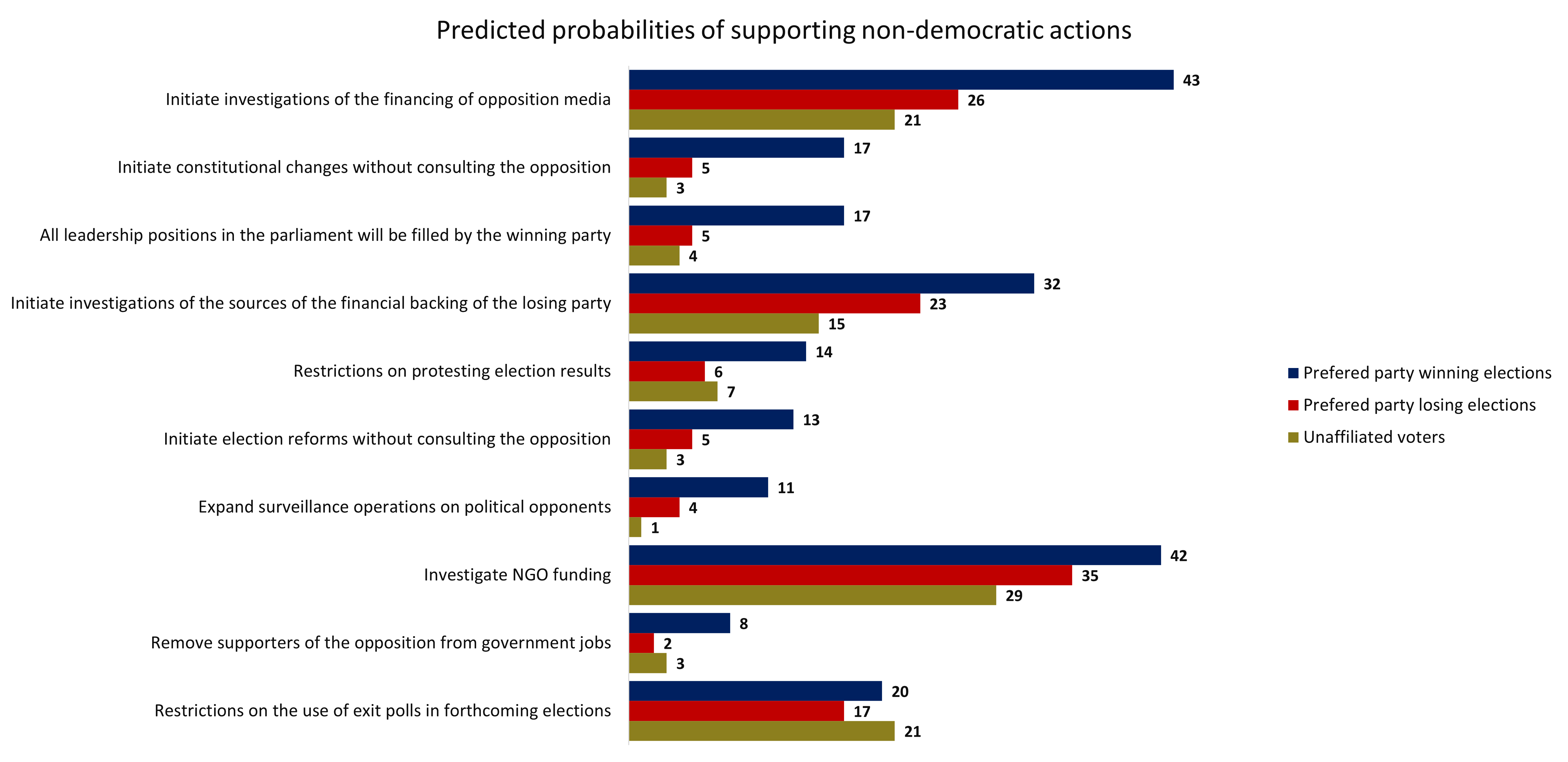
Afterwards, respondents were asked whether they would support ten different policies, as shown in the chart below. 

Support for each policy varied from 30% (investigation of NGO funding) to 4% (removing supporters of the losing party from government jobs). Support for most policies was low overall, with investigation of NGO funding (30%), initiating investigations of opposition media (25%), investigating the financial backing of the losing party (20%), and restricting the use of election polls (17%) the most supported. 

Other policies such as putting restrictions on protesting election results, giving all leadership positions in parliament to the winning party, initiating constitutional changes without consulting the losing party, initiating electoral reforms without consulting the new opposition, and expanding surveillance operations against political opponents were supported by less than 10% of the Tbilisi public.

However, views on the above propositions varied significantly based on whether or not respondents imagined that their preferred party had won the election. 

The share supporting initiating investigations of the financing of opposition media increased by 12 percentage points if they imagined that their preferred party had won compared to when their preferred party had lost the election.

Support for excluding opposition supporters from leadership positions in parliament and initiating electoral reform without consulting the opposition both increased by 10 points in response to imagining one’s preferred party had won.

The share supporting initiating constitutional changes without consulting the opposition increased by nine points, and the share supporting investigations of the sources of the losing party’s financial backing increased by eight points in response to imagining that a preferred party had won.

Support for restricting protests of election results doubled in response to imagining a preferred party had won, as did support for expanding surveillance of political opponents.

Overall, the data showed that knowing that their preferred political party had won elections increased a person’s tolerance for democracy-eroding policies for one question on average, meaning that the support of voters living in Georgia’s capital for democracy-eroding policies is heavily conditional on the party in power. 

The above pattern is not unique to Georgia, and has been similarly documented in established democracies. However, it does call for reflection among partisans in Georgia. 

Indeed, an alternative framing of the analysis is that imagining your party has lost elections gives one greater support for democracy. Whether partisans in Georgia are willing to pursue that perspective is, however, another matter.

Read in Russian on Jnews.

Tuesday, October 12, 2021

What issues are important for Tbilisi residents?

Note: This article first appeared on the Caucasus Data Blog, a joint effort of OC Media and CRRC Georgia. It was written by Givi Silagadze and Dustin Gilbreath. The views expressed in this article are the authors’ alone and do not represent the views of NED, CRRC Georgia or any related entity.

The first round of the 2021 municipal elections were short on substantive discussions of local issues. But with the second round coming, what does the Tbilisi public want from their local government? 

Following the 30 October elections, the US Embassy in Tbilisi pointed out that a ‘lack of focus on local issues was a missed opportunity’. The OSCE, meanwhile, lamented that national political framing of the elections ‘overshadowed local issues’. 

A new survey of nearly 3,000 Tbilisians which CRRC Georgia conducted with the support of the National Endowment for Democracy suggests that the local issues that the population of Tbilisi is most worried about are jobs, traffic, air pollution, and public transport. 

Most people were satisfied with their utility infrastructure and unsatisfied with parking, their building’s appearance, and yards. 

When it comes to public transport, the public thinks things have been getting better in recent years. In this regard, they continue to prioritise the development of public transportation over car infrastructure. The public also wants to see green spaces prioritised over private development.

Most important issues

Even though unemployment is a national rather than a local issue, Tbilisi residents were most worried about the lack of jobs in the city. 

A quarter (24%) of people living in Tbilisi named unemployment as the most important problem in their community. Aside from employment, the public named traffic, air pollution, and public transport most frequently. One in seven (13%) Tbilisi residents named traffic as the top problem, 11% reported air pollution, while 10% thinks public transport is the most important issue in the city. 


Regression analysis suggests that men, people with lower education levels, those without jobs, and people living in poorer households were significantly more likely to name unemployment than women, people with higher education levels, the employed, and people from richer households.

As for traffic, supporters of the ruling party, younger people, men, and people living in wealthier households were significantly more likely to report traffic than supporters of the opposition or unaffiliated voters, older people, women, and people living in poorer households. 

IDPs were significantly less likely to name air pollution as a key concern than non-IDPs. No other differences were identified on these issues between different groups.

Housing infrastructure

Respondents were asked about issues in and surrounding their buildings. Tbilisi residents seemed to be most satisfied with utilities infrastructure, such as gas and electricity infrastructure, and light fittings. More than 80% of the public was satisfied with the above communal infrastructure. 

On the other hand, people were most unsatisfied with parking, the condition of yards, and their building’s appearance.


A simple additive index was created with the above 12 housing items, and regression analysis was conducted. The analysis suggests that men, people without jobs, supporters of the Georgian Dream Party, and people living in wealthier households were most satisfied, while women, employed people, supporters of the opposition or unaffiliated voters, and people living in poorer households were least satisfied with their communal infrastructure.

Cars VS public transport

A plurality (45%) of Tbilisi residents said the situation regarding car traffic had improved over the last four years. A third believed it had gotten worse (34%), and roughly a fifth said it had not changed (18%). 

This issue seems particularly partisan with party affiliation being the only statistically significant predictor. More specifically, Georgian Dream supporters were 40 percentage points more likely than opposition supporters and 32 percentage points more likely than unaffiliated voters to think that the situation had improved. 

Attitudes towards public transportation were more positive. Three in five Tbilisi residents (63%) said the situation regarding public transport had improved over the last four years. One in seven (16%) believed it had gotten worse, while 13% thought it had not changed. 

Attitudes towards public transport were a partisan issue as well, with supporters of the ruling party being 33 percentage points more likely to say it had gotten better than opposition supporters. Aside from partisanship, people living in wealthier households had significantly more positive views than people living in poorer households.

As for bus lanes, the public tended to approve of more bus lanes, even at the expense of slowing car traffic. Roughly four in five Tbilisi residents (79%) were in favour of constructing new bus lanes, even if that would make transportation by private cars slower. Only 11% of Tbilisi residents said new bus lanes should not be constructed and that unrestricted car traffic was more important. Regression analysis suggests that men and car owners were less supportive of constructing bus lanes.

In general, the public tended to prioritise improving public transport over building new roads and parking spaces. A majority (63%) of Tbilisi’s population thought improving public transport should be a higher priority for the city. 

Construction and recreational spaces

The survey asked about the government’s role in the construction business. Four in five people living in Tbilisi (82%) thought that the government rather than the construction business should decide where, what, and how something should be built. Regression analysis suggests that, all else equal, opposition supporters and employed people were less supportive of government regulations.

Overall, the survey showed that Tbilisi’s population was most concerned with jobs, traffic, public transportation, and air pollution. 

As for communal infrastructure, people tended to be unsatisfied with their building’s appearance, the state of their yards, and parking. 

Most people were satisfied with gas and electricity infrastructure and light fittings. 

The public generally supports the construction of bus lanes and tends to think that the situation regarding car traffic as well as public transportation has improved over the last four years. However, there is a stark partisan divide with supporters of the Georgian Dream party significantly more likely than other groups of society to think the situation had become better in this regard. 

Finally, Tbilisi residents would like their city government to play an active role in regulating the construction business.

Note: The above data analysis is based on logistic and multinomial regression models which included the following variables: age group (18-34, 35-54, 55+), sex (male or female), education (completed secondary/lower or incomplete higher education/higher), wealth (an additive index of ownership of 10 different items, a proxy variable), employment situation (working or not), IDP status (forced to move due to conflicts since 1989 or not), ethnicity (ethnic Georgian or ethnic minority), and party identification (Georgia Dream, opposition, no party/DK/RA).

Tuesday, September 28, 2021

What do Georgians think about Tbilisi Pride?

Note: This article first appeared on the Caucasus Data Blog, a joint effort of CRRC Georgia and OC Media. It was written by David Sichinava, Research Director at CRRC Georgia, and Otto Saladze, a researcher at CRRC Georgia. The views presented in the article are the authors' alone, and do not reflect the views of CRRC Georgia or any related entity.

On 5 July, a homophobic riot broke out on the streets of Tbilisi, leading to injuries and possibly a death. While Georgia’s population is generally conservative, what do people think of the events of 5 July, and how have these views shifted since a similar riot on 17 May 2013?

On the morning of 5 July 2021, hundreds of Georgians responded to the calls of the Patriarchate of Georgia and far-right, pro-Russian, and anti-Western groups to protest against the planned Tbilisi Pride march. 

Ostensibly planned as a peaceful prayer in the front of the Kashueti Saint George Church, located on Tbilisi’s Rustaveli Avenue, violence soon broke out. Protestors, overwhelmingly male, ransacked the offices of Tbilisi Pride, the organisers of Pride Week, and of the Shame Movement, an activist group. 

The protestors turned rioters dispersed a camp of anti-government protestors in front of the country’s parliament building. The mob assaulted more than fifty journalists, one of whom passed away a week later.

The events of 5 July were reminiscent of those of 17 May 2013, when a similarly violent mob, also supported by the Georgian Orthodox Church and various far-right groups, attacked a handful of queer rights activists on Rustaveli Avenue who were marking International Day Against Homophobia, Biphobia, and Transphobia. The police’s inaction in both situations seemingly further emboldened the mobs.

But what do Georgians think about the events of 5 July? Data from CRRC Georgia’s omnibus survey shows that while most Georgians think that holding a pride march posed a danger to the country, the majority is against the violence that took place and supports the freedom of speech and expression enshrined in the country’s constitution. 

Importantly, compared to 2013, the majority of Tbilisi residents do not approve of physical violence — even against those who, in their view, threaten national values.

Awareness of the 5 July events

Eighty-five percent of Georgians have heard about the 5 July events in Tbilisi. Those that had heard about the rallies found out on TV (69%) or social media (45%). One in ten heard about the riots from acquaintances who were not there, while one in fifty claimed to have heard directly from witnesses to what happened.

The majority of Georgians who had heard about the 5 July events were unsure who the organisers of either the Pride March (65%) or the counterdemonstration (67%) were. 

Sixteen percent said that the Tbilisi Pride civic organisation organised the Pride March, while 11% named LGBTQ+ people. Some (5%) mentioned outside forces or foreigners, while 4% named the opposition United National Movement.


As for the violent counterdemonstration, 15% of those who had heard of the 5 July events said that ordinary citizens were behind it. In total, 8% reported that radical groups and leaders organised the counterdemonstration, including the Georgian March, Guram Palavandishvili, and Levan Vasadze

Seven percent named the Georgian Orthodox Church while 5% believe that the government and the ruling Georgian Dream party organised the counterdemonstration.

Would holding a march have endangered Georgia, in the public’s view?

Many politicians, including the prime minister of Georgia, Irakli Gharibashvili, refrained from supporting the Pride March. Gharibashvili even alleged that through organising the Pride March, ‘radical opposition groups’ were stirring up ‘civic unrest’ and ‘chaos’ in the country.

While half of Georgians (52%) who had heard of the 5 July events said the Pride March could have endangered Georgia, more than a quarter (26%) thought it would not have created problems. Additionally, 22% were unsure.

There was relative consensus on this across major social and demographic groups. Still, fewer young people (48%) believed the Pride March posed a danger than people aged 35–54 (57%). Similarly, young people were less uncertain and more likely to think the march would not have been a threat.

Tbilisi residents too were less likely to agree that Tbilisi Pride would have harmed Georgia (46%) than people in other settlements, and were more likely to believe that the Pride March was not a threat. 

While a similar proportion of people from across the partisan spectrum perceived danger in the Pride March, opposition supporters were more likely to disagree with this perception. 

While most (54%) still agreed that organising a pride march would have endangered the country, 35% disagreed. Supporters of the government, and those who were unaffiliated or refrained from reporting their political sympathies, were more likely to be uncertain in their views than opposition supporters.

What did the public think of the violence?

While with the church’s blessing, far-right groups violently retaliated against activists and media workers on 5 July, few in Georgia approved of such conduct. 

Ninety-one percent of Georgians who had heard about the 5 July events said that physical violence is unacceptable in any circumstance. 

Sixty-nine percent disagreed with the proposition that violence was admissible against a group that jeopardised national values. 

Three-quarters of Georgians (74%) fully or partially agreed that the country’s constitution should grant freedom of expression to anybody, regardless of their racial, ethnic, religious, or sexual identity.

How do Georgians evaluate the response of different actors?

Opinions are split when it comes to the assessment of how different actors responded to the 5 July events, with a significant proportion of the country’s population having ambiguous views. 

Forty-two percent positively evaluated the police’s work, while 30% negatively assessed how law enforcement agencies handled the situation. 

Forty percent had a positive outlook on the church’s actions, with 30% negatively evaluating the Georgian Orthodox Church’s handling of the 5 July events. 

More Georgians (36%) had positive views of journalists’ work than negative (29%). 

Roughly similar shares of Georgians had positive (33%) and negative (30%) views of the prime minister’s actions during the events.

The plurality of Georgians were ambivalent when assessing the work of president Salome Zourabishvili and foreign embassies. More Georgians think positively about Zourabishvili’s handling of the situation (25%) than negatively (21%), yet more people either viewed her response as neither positive nor negative or were uncertain about it. 

About thirty percent negatively evaluated the work of foreign embassies, as opposed to 17% who saw their actions during the 5 July events in Tbilisi positively, though again, people were mainly ambivalent or uncertain. The majority (64%) negatively assessed how the Tbilisi Pride organisation handled the situation.

How have attitudes changed in Tbilisi since the 2013 riots?

A set of similar questions were asked to Tbilisi residents in late May 2013 about the 17 May 2013 homophobic riot

In 2013, about 57% of Tbilisi residents believed that an anti-homophobia rally would have endangered Georgia, while 30% disagreed. 

After eight years, while the plurality of Tbilisians still believes in the dangers of the Pride March, more agree that such events do not threaten Georgia.

Compared to 2013, the opinions of Tbilisi residents on whether physical violence is acceptable against those endangering national values have shifted significantly. 

In 2013, half of Tbilisians said they approved of violence in such circumstances, while 46% disapproved. 

According to the omnibus data, eight years later, almost three-quarters of people living in the country’s capital disagree that physical violence is acceptable against those endangering Georgia’s national values.

The 5 July events shocked Georgia. While the country’s population is socially conservative and religious, the majority does not approve of violence, even against those who, in their view, might present a threat to national values. 

Importantly, survey results also suggest that compared to 2013, Georgians’ attitudes have shifted. While a plurality of Tbilisi’s residents still believe that LGBTQ-themed events pose a threat, the proportion of those who think so has decreased by almost ten percentage points. 

Seemingly, Georgians slowly but steadily have come to the view that violence is unacceptable, contrary to what some church leaders and politicians might have called for.

Note: This analysis makes use of a multinomial regression model predicting Georgians’ attitudes on whether holding a Pride March have endangered Georgia or not. Covariates include standard sociodemographic characteristics such as gender, age, settlement type, education, ethnic identity, partisanship, and a durable goods index. Replication of the analysis is available here.


Monday, October 28, 2019

How many cars are there in Tbilisi’s streets?

People in Tbilisi often talk about the growing number of vehicles and problems associated with them. According to NDI and CRRC public opinion surveys, every third Tbilisi resident considers traffic, every fifth parking, and every other pollution among the most important public goods related issues in the city. These issues clearly relate to the cars on Tbilisi streets. Yet, a basic fact that could help inform policy to address these issues – how many cars drive on Tbilisi’s streets – is unknown, with different data sources indicating sharply different estimates.

The Ministry of Internal Affairs (MIA) is responsible for car registration and maintains a database of registered vehicles in the country. The number of registered vehicles are available from the MIA in annual reports and monthly updated lists of vehicles that have valid registration status. The official data suggests that at the moment there are 494,627 vehicles registered in Tbilisi. Excluding agricultural vehicles, specialized vehicles, non-motorized trailers, and two-wheeled vehicles, as some international reports do, suggests there are 462,922 light vehicles, trucks, vans and buses registered in Tbilisi. This is equivalent to 395 vehicles per 1000 residents.

While these numbers are informative, what they really say is how many vehicles are actively registered rather than driving on Tbilisi’s streets. These numbers likely differ, because the registered vehicle list includes cars that are no longer working, but still have valid registration status. These cars are not removed from the vehicle registry, because there is rarely an incentive to do so for the owner such as registration fees or fines for failing to remove the car from the registry. The exceptions to this are when inactive cars are sold for scrap or for export, because the people purchasing the vehicle often request that the owner remove it from the registry.  Given this situation, it is reasonable to believe that the actual number of vehicles driven in the city is lower than the official number of registered vehicles.

Estimating the number of cars
To estimate the number of vehicles driven in the city, the following assumptions are used:

  1. Only light vehicles, trucks, vans, and buses are included in the data analysis. Agricultural vehicles, specialized vehicles, non-motorized trailers, and two-wheeled vehicles are excluded from the data analysis, though they are provided in the MIA data. Aside from international practice, this generally makes sense: agricultural vehicles are on the streets relatively rarely compared to cars and vans. Generally two-wheeled vehicles are not considered due to their lighter impact given their lighter size and parking space needed.
  2. The analysis assumes all registered vehicles under corporate ownership are in working condition and in use, while only some individually owned vehicles are. The rationale behind this is that corporate owners (both state and private) have stronger incentives to de-register vehicles, as they appear on their balance sheets, a factor individual owners do not consider. 
  3. The share of registered vehicles in working condition is estimated using household survey data from April-June, 2016. The analysis assumes that the share of vehicles registered and in working condition has not changed significantly. 

From here, when vehicles is mentioned, it means light vehicles, buses/vans and trucks together. Otherwise, the specific group of vehicles is used (e.g. light vehicles or buses/vans and trucks). All statistics refer to Tbilisi only. When the ownership status is not specified as individual or corporate, all vehicles are included.

As noted above, there is good reason to believe that there are fewer individually owned vehicles in operation than registered in Tbilisi. Hence, survey data is used to estimate the number of individually owned vehicles in use in Tbilisi. The latest publicly available survey data comes from 2016 and is used to estimate the share of individually owned vehicles in use among all individually owned vehicles, and then based on the third assumption above, this number is used to estimate the number of vehicles in combination with 2019 official registry data.

The survey data comes from the Tbilisi Metropolitan Area Transportation Household Survey, which Systra conducted in April-June, 2016. The survey had 6,092 respondents in Tbilisi. It asked about the number of vehicles households have, the vehicle type (light car/SUV, pickup truck, van/boxcar, heavy truck, light truck, microbus or other), ownership status (owned, professional use, rented or other), and frequency of usage. Vehicles in working condition are defined as those that have driven at least one kilometer during the 12 months prior to the survey. According to the survey, there were 168,314 (+/-5,702) individually owned vehicles in use in Tbilisi in 2016.

The next step is the calculation of the share of working vehicles among individually owned registered vehicles in 2016. However, the official registry data provides information about ownership status only for 2017-2019 data, while for 2016, there are only two official statistics available: the number of light vehicles (376,962) and the number of total vehicles (440,042). Ownership status, however, is not available. Hence, to estimate the number of individually owned vehicles in 2016, this post uses the average of 2017-2019 data to estimate:
  • The share of individually owned light vehicles among all registered light vehicles and; 
  • The share of individually owned trucks, vans, and buses among all registered vehicles.
Between 2017 and 2019, the average share of individually owned light vehicles in Tbilisi was 83%. The analysis assumes that the average share of individually owned vehicles among all vehicles did not change significantly between 2016 and 2017-2019. Under this assumption, multiplying the average share of individually owned light vehicles by the total number of registered light vehicles leads to an estimate of the total number of individually owned registered light vehicles. According to the MIA data, there were 376,962 light vehicles registered in Tbilisi in 2016. Of these, approximately 313,896 of them were individually owned based on the above estimate.

As for buses/vans and trucks, the average share of individually owned buses/vans and trucks among all vehicles in 2017-2019 was 4%, which translates to 16,780 individually owned buses/vans and trucks (from 440,042 registered vehicles in 2016). Adding the two estimates leads to an overall estimate of 330,675 individually owned, registered vehicles in 2016. By comparison, the survey data from 2016 indicates that there were 168,314 (+/-5,702) individually owned vehicles that were working in 2016.  These figures taken together suggest that among registered, individually owned vehicles, 51% (+/- 1.7%, due to a survey error) are in working condition and being used.

Assuming that the share of vehicles in use is the same for individually owned vehicles and has not changed significantly in recent years, the number of individually owned light vehicles, buses/vans and trucks in Tbilisi in 2019 is approximately 186,855, out of the 367,101 registered individually owned vehicles. Assuming that all corporate vehicles are working (95,821), there are 282,676 light vehicles, trucks and buses, on the streets of Tbilisi of the 462,922 which are currently registered


Based on the above figures, there are 241 vehicles driving on Tbilisi’s streets per 1000 residents in 2019, 57% of the number that are registered in Tbilisi. The real number of vehicles in Tbilisi’s streets might still be higher than this estimate, as some vehicles are not registered in Tbilisi, but drive on its streets. At the same time, many cars registered in Tbilisi are likely to be driven outside of Tbilisi. Even taking this into account, it seems unlikely that there are so many cars that drive on Tbilisi’s streets but that are registered elsewhere that it would throw this estimate off dramatically.


Even though there are likely less cars on the road than previously thought, the problems they create are foremost in the minds of the residents of Tbilisi. In turn, the data suggests that the impact per car on the problems with parking, traffic, and pollution are larger than one might believe based on the official estimates of cars registered in Tbilisi. In turn, this suggests a clear need for policy to address the issues before they become worse.

Monday, August 20, 2018

Views on marital (in)fidelity in Georgia

According to 86% of adults in Georgia, cheating on one’s spouse can never be justified, according to CRRC’s 2017 Caucasus Barometer (CB) survey findings. Another 12% also reported disapproving of cheating, but refrained from a radical “never” answer and choose relatively softer options. Only about 2% openly agreed, albeit with different strength of agreement, with the position that cheating on one’s spouse can be justified. While these answers are expected to be influenced by social desirability bias, they are still interesting indicators of views on marital (in)fidelity in Georgia. Importantly, the distribution of answers has been quite stable since 2011.

Based on the 10-point scale used in CB2017 to record answers to the question, “To what extent, in your opinion, can cheating on one’s spouse be justified or not?” a new binary variable was created for the analysis presented in this blog post, where those answering “Never” (code 1) are considered separately, and their answers are compared to the answers of those who chose all other codes from the show card, i.e. who consider cheating potentially justifiable although do this to varying degrees. Thus, the new variable compares those who report they would not justify cheating under any circumstances, and those who can either think of certain justification(s) for cheating or directly justify it. Answers “Don’t know” and “Refuse to answer” (less than 1% of the total) were excluded from the analysis.

Age, gender, marital status and settlement type would be expected to be crucial in exploring divisions of public opinion on this issue. Counterintuitively, though, the small differences in answers by age, gender, and marital status are all within the margin of error. On the other hand, people living in the capital, other urban settlements and rural settlements do answer this question differently. The population of Tbilisi stands out in its tolerance for cheating, with 22% reporting varying degrees of readiness to justify it.

Thus, it is not the basic demographic variables per sè that more or less divide public opinion in respect to (un)acceptance of cheating in Georgia. Living in the capital versus the rest of the country makes more of a difference. Although the majority of the population of Tbilisi reports that cheating on one’s spouse can never be justified, compared to the rest of the population of Georgia, twice as large a share of Tbilisi dwellers report at least some tolerance to marital infidelity.

To have a look at the Caucasus Barometer data, visit CRRC’s Online Data Analysis portal.

Monday, July 30, 2018

Most dog owners in Tbilisi vaccinate their dogs, but few spay or neuter them

Based on the findings of a phone survey of the population of Tbilisi, conducted by CRRC-Georgia for the British charity Mayhew in November, 2017, 15% of Tbilisi households have one or more dogs at home. A majority of dog owners reported their dogs were vaccinated at the time of survey, but few spay or neuter them.

Only 5% of Tbilisi dog owners reported having never visited a veterinarian, although it should be kept in mind that the margin of error is rather high when analyzing the relatively small group. Almost all dog owners who visit veterinarians do this for the purpose of vaccination, while other reasons include hygiene and grooming, parasite control, and accident/trauma, each reported by approximately 1/5th of dog owners.

Vaccination is important to protect both dogs and humans from diseases like rabies. An absolute majority of dog owners (97%) reported they have vaccinated their dogs. However, only about one in five dog owners reported their dogs were sprayed or neutered. The following reasons for not spaying or neutering dogs were named most frequently:

  • The dog owners wanted their dog(s) to have puppies;
  • They were against either of these practices for ethical reasons; 
  • They saw no need to spay/neuter their dog(s).

Spaying and/or neutering dogs is important not only from the point of view of controlling the dog population, but it also may reduce dogs’ risk of cancer. The findings presented in this blog post suggest there is a need to raise the awareness of Tbilisi dog owners on the importance of spaying and neutering their dogs. Importantly, when providing reasons why they did not spay or neuter their pets, dog owners did not mention that they do not trust veterinarians. This suggests that veterinarians could potentially be trusted communicators for awareness raising activities.

To explore the data in this blog post more extensively, visit CRRC’s Online Data Analysis portal.

Monday, July 02, 2018

The population of Tbilisi on street dogs

Street dogs are a common sight on the streets of Tbilisi. How do people’s attitudes towards them vary by age, gender, and whether or not someone lives in the center or outskirts of the city? Results of a November 2017 phone survey CRRC-Georgia carried out for a British charity Mayhew provide some answers to these questions.

Forty per cent of Tbilisi’s population reported positive attitudes towards street dogs, 39% neutral, and 20% negative. Women and men and people in central and non-central neighborhoods of Tbilisi report positive and negative attitudes at similar rates. People over the age of 56 report negative attitudes slightly more often than people under this age.


Why do the 20% of the population who report negative attitudes not like street dogs? Their majority (67%, although margins of error are higher for this relatively smaller subgroup) report a “general fear of dogs” as the main reason. The data suggests that women fear dogs more than men, which is not a finding unique to Tbilisi. Research from other contexts (e.g. see here and here) also indicates that women in general are more likely to report fearing dogs than men.

To explore the data in this blog post, visit our Online Data Analysis portal.

Monday, June 11, 2018

Air pollution in Georgia: Available data and the population’s perceptions

Lung cancer, strokes, and heart attacks can all be caused by air pollution, a problem that affects millions of people daily. How aware is the population of Georgia about this problem, and how important do people find the issue?

In the December 2017 CRRC/NDI survey, pollution was the second most commonly named “infrastructural” issue, with 23% of the population choosing it in the respective show card. Only roads were named more often, by 33%. Approximately equal shares of men and women named pollution: 25% of women and 20% of men; similarly, there was no difference in the frequency of naming this issue by age.

Settlement type does make a difference, though. While 42% of people living in the capital reported in 2017 that pollution was the most important infrastructural issue, 26% of people living in other urban settlements did. This option was chosen much less often by the rural population (11%) and by people living in predominantly ethnic minority settlements (5%).  Perceptions of the importance of this issue have been consistent  both nationally and in different settlement types since CRRC and NDI have started asking the question.


The public’s concern with pollution makes sense. Levels of air pollution in Georgia are higher than what is recommended by the World Health Organization (WHO). PM2.5 is particulate matter with an aerodynamic diameter smaller than 2.5 µm. By comparison, the average diameter of a human hair is 50 to 70 µm. PM2.5 is considered the deadliest type of pollution as it is smaller than other types and can do much more harm to the human body. According to the latest available information, PM2.5 was recorded at 25 in Tbilisi in 2015. The level that the WHO recommends is 10. Anywhere from 12.1 to 35.4 is considered to be in the moderate range.

The government of Georgia has not ignored the problem. The Law of Georgia on Ambient Air Protection was adopted in 1999 to deal with air pollution, and was amended a number of times since. Recently larger, more environmentally friendly buses have been integrated into Tbilisi’s public transport system, a step toward a greener city. In addition, the excise tax on older cars, which cause a greater amount of pollution than newer ones in general, have increased, thus encouraging the import of greener vehicles. Moreover, vehicle inspections for large vehicles started again this year after a 10 year hiatus, and it is planned that these will become mandatory for all vehicles from 2019.

More can be done, and there are some potential improvements that can lead to a decrease in the number of cars on the roads, and therefore improve air quality. Public transport should be more efficient, which can be, in part, accomplished through optimizing routes and timetables. Making cities more pedestrian and bike-friendly, and increasing awareness of the benefits of walking and car sharing could also ameliorate the situation. Clearly, the government would have to back many of these changes.

While the government has taken some steps to reduce air pollution, quite radical steps are still needed in Georgia before it reaches a healthy level by WHO standards. The issue is important to the Georgian public, and particularly to the population of Tbilisi.

To learn more about CRRC surveys, visit our Online Data Analysis portal.

Monday, June 26, 2017

CRRC’s Fifth Annual Methodological Conference: In Search of Methodological Innovation

CRRC’s fifth annual Methodological Conference took place on June 23 and 24, 2017 in Tbilisi. This year the conference’s focus was on policy analysis in the South Caucasus, and the search for methodological innovation. Over 50 participants representing institutions in the United States, United Kingdom, Georgia, Azerbaijan, Armenia, Russia, and Canada attended.

Alexis Diamond of the Keck Graduate Institute (KGI), San Francisco gave an opening address for the conference titled: Deliberate ignorance: The dangers of knowing too much too soon. The talk covered a wide range of issues in evaluation, however, emphasis was placed on the importance of honest evaluation.
The first day of the conference had four sessions, with papers on a wide variety of subjects from the geographies of polarization and inequality in Tbilisi to a field experiment on marshrutka safety and a machine learning approach to profiling tax awareness in Armenia. 
The opening slide of David Sichinava’s presentation on Spatial Patterns of Emerging Inequalities in Tbilisi, Georgia.
The second day of the conference was dedicated to workshops. Alexey Levinson of the Levada Center, Moscow lead a workshop on open-ended group discussions and Aaron Erlich of McGill University discussed the fundamentals of multiple imputation. The conference also included workshops on case studies in public health, web surveys, and synthetic controls.
Aaron Erlich discussing why and when to use multiple imputation.
For more information, the full conference program can be accessed here.

Monday, May 22, 2017

Air Pollution in Tbilisi: What the Data Says

[Note: This is a guest blog post by Dr. Hans Gutbrod, the former Director of CRRC.]

With the recent debate on traffic safety, it may also be a good time to highlight the issue of air pollution in Tbilisi – especially as municipal elections are coming up, and citizens (and candidates) may ask themselves what issues the election should focus on.

The data is clear: citizens care about pollution and the environment. In the June 2016 survey that CRRC conducted for NDI-Georgia, pollution was seen as a key concern for residents of Tbilisi. In the capital, 38% named it as one of the most important infrastructural issues, placing it ahead of all other issues related to infrastructure. In general, all generations care, but the young a bit more. In Tbilisi, about 40% of those under 36 years of age mentioned pollution as an issue compared to 32% of those 56 and older.

Politically, the topic also seems to resonate, though less strongly with voters who tend towards the big parties. Only 33% of Georgian Dream voters and 35% of United National Movement voters reported that pollution was the number one infrastructural issue in Tbilisi (Note: the party landscape has changed since the survey). This may in part be a result of the small sample size once you do crosstabs, but could also suggest that the environment and pollution may be an issue to mobilize and rally voters around. Supporting this contention is the fact that 40% of undecided voters in Tbilisi named the issue as the most important one in Tbilisi.

Yet how bad is the situation really? It is not so easy to find out. The government does collect data at three measuring stations that have been donated by Japan, but it is made available one day late, in PDFs, and even those who have interpreted lots of data will need a significant amount of time to decipher what is going on.

A very quick glance on some random days in February suggests that the pollution in Tbilisi repeatedly exceeds limits that are considered healthy – often by a multiple.


Whatever the policy prescription, one sensible next step for citizens and parties to demand, and for the government to take, is to make this data accessible straightaway, live. Having the data, citizens could decide on what to expose themselves to, when. To have a good debate on policy, we need good data. Thus, a sensible suggestion to politicians whenever and wherever you meet them is to request that public pollution data be made available in real time.

Monday, August 15, 2016

What can CRRC’s Caucasus Barometer survey tell us about internal migration in Georgia?

According to existing estimates, the stock of internal migrants is much larger than the stock of international migrants worldwide. In Georgia, however, internal migration is largely overlooked and there is very little data available on the number and distribution of internal migrants. The National Statistics Office of Georgia (Geostat) regularly collects data on internal migration in the country via an Integrated Household Survey. The Public Service Development Agency, on the other hand, is in charge of population registration by place of residence. Several indicators of internal migration in Georgia can also be found in CRRC’s Caucasus Barometer (CB) survey. This blog post discusses one such indicator: whether, at the time of interview, adults in Georgia lived in the same settlement where they were born. Results of the latest, 2015 wave of CB are presented in this blog post.

About half of the population of Georgia (49%) reported having been born in a settlement where they lived and were interviewed at the time of the survey. An extremely small share (under 3%) reported being born outside the country. The rest are internal migrants – a quarter (25%) were born in another settlement, but in the same region of the country, and almost a quarter (23%) in a settlement in another region of the country. Thus, although we do not know the details of their migration (e.g., at what age, or for what reason they migrated), we can estimate that roughly half of the population of the country (48%) are internal migrants. Importantly, this CB finding is in line with Geostat’s estimates, according to which the share of internal migrants constituted 54% in 2014.

Differences between internal migrants and non-migrants by settlement type, age and, especially, gender are quite striking. Unsurprisingly, the share of internal migrants is highest in the capital, with 65% of Tbilisi’s population born elsewhere in Georgia. Villages, on the other hand, house the highest share of non-migrants. Nonetheless, 41% of the rural population was not born in the villages where they resided at the time of the survey.


When it comes to age differences, the share of internal migrants is highest among the oldest segment of the population (58% of those over 60 years old), and gradually decreases with age. Although differences by age groups are statistically significant, these differences are not particularly large.


While 62% of females report not being born in the settlement where they currently live, roughly half as many men (34%) report the same. This may be related to the tradition of women moving to their husbands’ households after marriage. Thus, in the absolute majority of cases when spouses are from different settlements, it would be a wife moving to another settlement, rather than a husband.


Although it might have been expected that those with higher education would more likely be internal migrants than those with lower levels of education, CB data does not suggest any significant differences between internal migrants and non-migrants in Georgia by level of education.
Preliminary analysis of CB 2015 data lets us estimate that about half of the population of Georgia can be considered internal migrants. Most strikingly, internal migrants and non-migrants differ by gender, with women being internal migrants about twice as often as men. There are relatively small differences between internal migrants and non-migrants by age and settlement type.

CRRC’s Caucasus Barometer data can be explored at our online data analysis platform.

Monday, July 25, 2011

Engagement without recognition?

The Abkhaz and South Ossetian conflicts did not emerge in the 2008 August war. However, they escalated in the early 1990’s when both territories engaged in wars of secession and there are different approaches to the resolution of these conflicts. For the EU, these are regional issues with broad security implications. However, from the viewpoint of the Georgian government, Abkhazia and South Ossetia are primarily internal political issues. Tbilisi claims both territories as integral parts of Georgia even though it has not been exercising full control over either entity for several years.

Georgian public opinion supports government claims over these two territories. Data from CRRC’s 2009 survey entitled, “Knowledge and Attitudes Towards the EU” in Georgia shows that territorial integrity was the most mentioned issue of significance for Georgia.

The question in this survey asked the respondents to name up to 3 most important issues facing Georgia without ranking. This methodology is different than that used in the Caucasus Barometer where respondents are asked to indicate the most important issue facing the country.

Moreover, 43% of Georgians mentioned the restoration of territorial integrity as an important issue with which the international community can help. For example, many Georgians believe that issues involving territorial integrity (65%) and national security (68%) will improve if Georgia joins EU. This is in light of the fact that 46% of Georgians expect a major military conflict with Russia in the next 5 years and 80% of Georgians consider joining NATO to be an important issue (CB 2010).

No approach to resolving these conflicts (e.g., neither the August war, nor isolation of both territories) has brought any resolution to date. With regard to the Abkhaz conflict specifically, data from the CB 2010 shows that ideas about what would be the most important activity to resolve the Georgian-Abkhaz conflict is split between 18% of Georgians who would like to see greater involvement by civil society, 18% who prefer the signing of a non use of force agreement with Abkhazia, and 20% of Georgians who don’t know what would be best.


In contrast to the Georgian view, the EU sees the cases of Abkhazia and South Ossetia as regional issues with broader security implications, rather than as internal Georgian problems. Many academic circles in the EU and USA suggest a policy of “engagement without recognition” towards Abkhazia and South Ossetia. For example, in the 2010 October edition of the Washington Quarterly, Lincoln Mitchell and Alexander Cooley wrote that “pledging enduring support for Georgia’s territorial integrity is somewhat meaningless” because the more both breakaway regions are pressured to choose between Tbilisi and Moscow, they will choose latter. According to them, the more these areas are isolated by the international community, the more likely they are to increase their dependence on Moscow. In addition, the European Union Institute for Security Studies suggests that the “engagement without recognition” policy might be beneficial for Georgia as well because it does not question Georgia’s territorial integrity, nor does it force Georgia to recognize the self-proclaimed independence of both regions.

How do you think Georgia should deal with its "breakaway" territories?

Which way to go?

Tuesday, August 31, 2010

CRRC's Media-Monitoring Project: TV Coverage of the Election Campaigns

How do the Georgian media frame political information for its viewers? This was an especially relevant question during the lead-up to the May 30th local elections, and a subject of much public debate. To add greater insight to this debate, CRRC-Georgia, at the UNDP and European Delegation’s request, carried out a media-monitoring project of Georgia’s six major television channels.

Five weeks before and one week after the May 30th local government and Tbilisi mayoral elections, CRRC monitored the six TV channels – the Georgian Public Broadcaster, Rustavi 2, Kavkasia, Maestro, Imedi, and Real TV – and produced a media-monitoring report comprising of quantitative and qualitative elements.

In the quantitative section, factors such as the tone of coverage of each candidate and party, and the ratio of direct and indirect speech for candidates within the allocated time were measured. Meanwhile, in the qualitative part, components such as hidden advertisements, objective vs. neutral coverage, and black public relations were evaluated, among others.

Full access to both the quantitative results and the final report can be found on the UNDP’s website.

Wednesday, June 16, 2010

Language Learning in Georgia

In winter 2008, CRRC together with the American Councils conducted some research on the ways foreigners learn languages in Georgia. Hans Gutbrod and Malte Viefhues have recently published a paper in CRIA, analyzing the results and providing interesting insights into incentives to language learning and the importance of Georgian and Russian for foreigners in the country.

The data indicates that while Georgian is very important for living in Georgia, Russian is more useful in a professional context. This could explain why, on average, the respondents – many of whom have worked in different CIS countries – have a better level in Russian than in Georgian. As these languages serve in different domains, knowing one did not keep the respondents from learning the other: 87 percent of the respondents with Russian skills know some Georgian as well.

To read the full paper, visit the CRIA's website.

Friday, March 14, 2008

Intravenous Drug Users in Tbilisi | Survey Data

As part of a four part series, Save the Children in cooperation with a host of other organizations have released reports from survey data they have collected from Female Sex Workers (FSWs) and Intravenous Drug Users (IDUs). All of the surveys are funded by USAID. This entry reviews the Tbilisi report on IDUs. If you are interested in the other reports, please contact us.

It has been a conundrum for many why the number of HIV infected is not higher in Georgia (Georgia is low prevalence country, less than 5%, as defined by UNAIDS, but data is weak, since surveillance is bad), since it is estimated that there are 250,000-280,000 IDUs in Georgia, which accounts for around 5% of the total population -- an astounding figure. To understand the dynamics of IDUs and its relation to HIV infection other diseases a Behavioral Surveillance Survey (BSS) has been carried out three times -- in 2002, 2004 and 2006. The survey methodology uses a referral method, since sampling IDUs is no easy task. While providing good information, it does no present a representative sample of these people and when discussing the data, one must keep in mind various biases in the data, which may be present. However, the data points to trends that are generally positive, and it may be that Georgia will be able avoid a much larger HIV crisis.

So, what did the 2006 data show? Similar to 2004, the report found stability in the type of drugs injected. Most IDUs in the sample report injecting Subutex and also having started to use Antihistamines. In 2002, however, most users reported using heroin.

Also, in terms of good news, 96% of those who reported having paid sex (30% of the male sample -- about the same as in 2004), reported using a condom. The number who pay for sex and use a condom is substantially up from 2004, which hopefully indicates and increase in awareness of the dangers of unprotected sex. However, males users report not using condoms with their stable sex partner. In other good news, knowledge about HIV among drug users is also rising, at least in the sample, however remains low overall. Only 37% of the sample could correctly identify the six mechanisms of transmitting HIV. However, only 15% of the sample in 2002 could do so.

On the bad news front, respondents who inject seems to be getting younger and younger. There was a 10% jump from 2002 to 2006 in the those who started injecting between 15 and 19 years old.

Again, if you are interested in the whole report, please get in touch.

Friday, January 12, 2007

Baku, Yerevan and Tbilisi: Similarities and Differences

The term metropolis has gained increased intellectual backing in recent years. Indeed, several social researchers have postulated that, due to the dyanism of large cities, cities will continue to look more theoretically similar to each other. A postulate of this theory is that urban and rural communities within the same countries will continue to diverge in terms of behavior on a wide range of issues. Samvel Manukyan's research locates itself within this debate and begins to develop some indicators for comparing urban development across the South Caucasus. The scholar conducted a cross-country analysis of the sociopolitical processes in the capital cities of Baku, Yerevan and Tbilisi.


By analyzing the regional CRRC Data Initiative (DI) 2004 database, Manukyan constructed several typologies of SC capitals’ societies and used mathematical methods to explain the socioeconomic, political, demographic and cultural trends in the region. For instance, he introduced the term “traditionality index,” which is a function of various elements of social behavior. Among other results, he found that men and women in Tbilisi had the most liberal behavior, followed by Yerevan; and that people were most conservative (traditional) in Baku. Overall, Manukyan found that the post-Soviet transition has led to the reconstruction of national self-identification across the South Caucasus capitals. In his 150-page report the researcher developed tools (indices) to measure how the three South Caucasus capitals follow specific patterns in terms of freedom of behavior, as well as the level of tolerance both within and across societies. In his research, the fellow cooperated with Irakli Sakandelidze from Georgia and Inshallah Gafarov from Azerbaijan.

Not surprisingly, the research shows that the South Caucasus cities may not have many of the characteristics of metropolises. However, the research creates a framework to investigate the continuing transitions on the capital cities of Baku, Tbilisi and Yerevan.

Manukyan's report, in Armenian, is available here.