Showing posts with label Georgia. Show all posts

Friday, December 05, 2025

Public Perceptions of Georgia's Potential Involvement in a War

Most Georgians believe it is unlikely the country will become involved in a war, though a significant minority remain unsure. Perceptions of war risk differ across demographic groups and are strongly shaped by political views and media trust.

Further analysis shows that perceptions of the likelihood that Georgia may become involved in any war is associated with demographic factors such as age, education, and type of settlement. Older individuals (55+) are 15 percentage points while people between 35 and 54 years of age are 11 percentage points less likely to believe that Georgia will become involved in a war compared to younger people. Those with a technical secondary education perceive a higher risk of involvement than people with a lower level of education. Meanwhile, rural residents are more uncertain about the likelihood of war and are also less likely to think that war is likely.  

Notably respondent’s sex, employment status, ethnicity or household wealth does not significantly influence this perception.

Media trust is another important factor. Those who do not trust television are 12 percentage points more likely, and those who do not watch TV channels are 8 percentage points more likely, to perceive a higher risk of war compared to those who trust Imedi TV. Notably those who report that they trust Rustavi 2 for news on politics and events are 13 percentage point less likely to believe that Georgia will stay out of a war compared to those who trust Imedi TV.

Political preferences also appear to influence perceptions around the likelihood of war. People who support opposition parties are 10 points more likely to say that Georgia is likely to become involved in any war. Respondents who did not provide a party preference about party support are 5 percentage points more likely to respond “Don’t know” to the war risk question and 11 percentage points less likely to say war is unlikely compared to Georgian dream supporters.

Furthermore, beliefs about who is responsible for the war inUkraine are also associated with perceptions of the likelihood that Georgia will become involved in a war. Respondents who blame Ukraine or Ukrainian President Volodymyr Zelensky for the war are 9 percentage point more likely to perceive that it is unlikely Georgia will be involved in any war, compared to those who blame Russian President Vladimir Putin.

In contrast, respondents who answered “Don’t Know” regarding responsibility are 19 percentage points less likely to believe that Georgia’s involvement in any war is unlikely, compared to those who blame Russia or Putin. Furthermore, those who are uncertain about who holds responsibility are also more likely to be undecided about Georgia’s potential involvement in a war, with 24 percentage point higher likelihood of choosing “Don’t Know” about risk of war. Finally, those who blame Ukraine or Zelensky are 10 points less likely to be undecided about Georgia’s potential involvement in a war compared to those who blame Russia or Putin.

Finally, perceptions of the country’s political direction are also linked to how people assess the risk of Georgia becoming involved in a war. People who believe Georgia is going in the right direction are 16 percentage points more likely to say war is unlikely compared to those who think it’s going in the wrong direction. Respondents who don’t know how the country is doing politically are less likely to say war is unlikely and more likely to say they don’t know about a risk of war. Those who think there’s no change in the political direction are 7 percentage points more likely to say “Don’t know” about a risk of war.

Finally, respondents who support Georgia’s EU membership are 9 percentage points less likely to believe that it is likely Georgia will become involved in a war, compared to those who do not support EU membership. In contrast, support for NATO membership shows no significant association with perceptions of war risk.

Overall, perceptions of Georgia’s potential involvement in a war is shaped not only by demographics, but also by political views, media trust, beliefs about responsibility for the war in Ukraine, perceptions of the country’s domestic politics and support of EU membership. Those who do not trust TV or watch TV are more likely to perceive a higher risk of Georgia’s involvement in a war. People who support opposition parties are also more likely to view the risk of involvement as higher. On the other hand, those who believe Georgia is going in the right direction are more likely to say war is unlikely, while those who feel there is no change in the political direction are more likely to say “Don’t know” about the risk of a war. Similarly, respondents who blame Ukraine or Zelensky for the war are more likely to think that Georgia will not become involved in any conflict. Notably, support for Georgia’s EU membership is associated with a lower perceived likelihood of the country becoming involved in a war.

This article was written by Eto Gagunashvili, a researcher at CRRC Georgia.

Tuesday, July 08, 2025

Armenians and Georgians are more interested in domestic politics than foreign affairs

Note: This article first appeared on the Caucasus Data Blog, a joint effort of CRRC-Georgia and OC Media. This article was written by Kristine Jintchveleishvili, a junior researcher at CRRC Georgia. The views presented in this article are the author’s alone and do not necessarily reflect the views of CRRC Georgia or any related entity.

According to data from the 2024 Caucasus Barometer, Armenians and Georgians are more interested in domestic rather than international politics, and Armenians are generally more politically interested than Georgians.

In Armenia, regression analysis shows that several factors are associated with interest in international politics. For one, women are less likely to be interested compared to men. Separately, older individuals (Aged 55 and older) are about twice as likely to be interested in international politics compared to people aged 18–34. Education is another important factor — people with less than a tertiary education are less likely to be interested in international politics compared to those with higher levels of educational attainment.

For interest in domestic politics, regression analysis in Armenia shows that older individuals are significantly more interested than younger people. Those aged 55 and older are 27 percentage points more likely to be interested in domestic politics compared to the youngest age group (18–34). Education also plays a role, with individuals lacking tertiary education showing less interest. Wealth is also correlated with interest. People who live in relatively wealthy households are more likely to be interested in Armenia’s domestic politics compared to those who own less.

Settlement type, ethnicity, and employment status are not statistically significant predictors of interest in international or domestic politics in Armenia.

The pattern for interest in international politics is somewhat similar in Georgia. Women in Georgia are less likely to be interested in international politics compared to men, and older individuals are more interested compared to younger ones — people aged 55 and older are twice as likely to be interested in international politics compared to those aged 18–34.

In turn, people living outside of Tbilisi, whether in urban or rural areas, are less likely to be interested in international politics compared to people living in the capital. Additionally, ethnic minorities show lower levels of interest compared to ethnic Georgians.

Finally, wealth is positively associated with interest in international politics — those with the highest wealth levels are more likely to be interested compared to those with less.

Regarding domestic politics in Georgia, regression results demonstrate that rural residents are less likely to be interested in domestic politics compared to people living in the capital. Older individuals and relatively well-off people show greater interest in domestic politics as well.

Education level and employment status were not associated with interest in either international or domestic political affairs in Georgia.

Despite the differences between the two countries, the trend is consistent across both Armenia and Georgia — more people are interested in domestic politics than international politics. The data also shows that Armenians are generally more politically interested than Georgians.

The results presented in this article came from a regression model of the 2024 Caucasus Barometer  dataset. The regressions included the following variables: sex (male or female), age group (18–34, 35–54, 55+), settlement type (capital, urban, rural), ethnic group (ethnic majority or ethnic minority), educational attainment (tertiary or less than tertiary), employment (working, not working), and wealth (ownership of 13 different durable goods, a common proxy for wealth).

Tuesday, May 27, 2025

Happy Georgians are young, wealthy, and religious

Note: This article first appeared on the Caucasus Data Blog, a joint effort of CRRC-Georgia and OC Media. This article was written by Otar Jintcharadze and Nino Anchabadze, Junior Researchers at CRRC Georgia. The views presented in the article are the authors’ alone and do not necessarily represent the views of CRRC Georgia or any related entity.

However, happiness varies with demographic and social variables.

The Caucasus Barometer data suggests that happiness decreases with age. Older individuals (55+) are 19 percentage points less likely than young people (18–34) and 16 percentage points less likely than people aged 35–54 to report feeling happy.

The data also demonstrates a positive correlation between wealth and happiness. Individuals in the fourth quartile of asset ownership are 15 percentage points more likely to report feeling happy compared to those in the bottom quartile.

The Caucasus Barometer also asked respondents about the importance of religion in their daily lives. According to the data, Georgians who consider religion ‘very important’ are eight percentage points more likely to report being happy compared to those who consider religion as only ‘rather important’ or ‘not important’.

Education level, ethnicity, employment status, and settlement type were not significant predictors of happiness in Georgia.

Tuesday, May 13, 2025

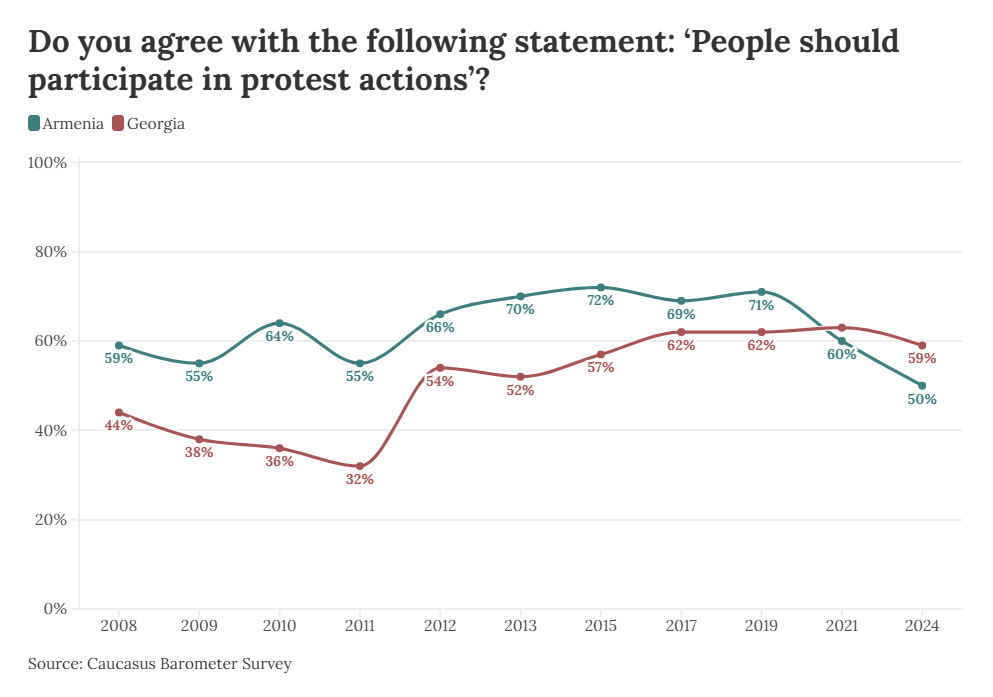
Do Armenians and Georgians support protests?

Note: This article first appeared on the Caucasus Data Blog, a joint effort of CRRC-Georgia and OC Media. This post was written by Tamar Uzunashvili, a Junior Fellow at CRRC Georgia. The views expressed in this post do not necessarily reflect the views of CRRC Georgia or any related entity.

A regression analysis of 2024 data demonstrates that attitudes vary among different social and demographic groups.

Gender and education were significant predictors of supporting protest in Armenia. Men were more likely than women to have a positive attitude towards participating in protests by 16 percentage points.

People with tertiary education were 22 percentage points more likely to support protest participation compared to those with secondary or lower education, and 10 percentage points more likely to support protests than individuals with secondary technical education.

People in Yerevan were more likely to support participation in a protest than people who live in rural or urban areas, where the probability of supporting protests was almost equal.

In Armenia, younger people (18–34) were more likely to support protests than older people (55+).

Wealth, partisanship, and employment did not predict attitudes in Armenia.

In Georgia, the data shows that people were more likely to support protests than oppose them across settlement types. At the same time, individuals who live in the capital were more likely to have positive attitudes toward protests than people in other urban or rural areas.

The data also varied across age groups, with young people (18–34) being substantially more likely to support protests than those who are 55 and older.

Those who support Georgian Dream were less likely to have a positive attitude toward protests than individuals who do not support any political party. People who support the opposition and those who refused to report which party they support had similar attitudes to individuals who did not support any party.

Employment was also a factor, with employed individuals more likely to support protest participation than those who were not employed.

Gender and wealth were not associated with attitudes towards protests in Georgia.

Support for protests is generally high in both Georgia and Armenia, though on the decline in Armenia. Across both countries, younger people are more inclined to support protests.

The analysis in this article makes use of logistic regression analysis. The analysis includes gender (male and female), settlement type (capital, urban, and rural), age group (18–34, 35–54, and 55+), education (secondary and lower, secondary technical, and higher than secondary), a wealth index (0–13), employment (employed and unemployed) and partisanship (no party, Georgian Dream, opposition, and refused to answer) as predictor variables.

Wednesday, April 10, 2024

Georgians are split on economic relations with Russia

Note: This article first appeared on the Caucasus Data Blog, a joint effort of CRRC-Georgia and OC Media. It was written by Zachary Fabos, a Researcher at CRRC-Georgia and Milorsh Shengelia, a Researcher at CRRC-GeorgiaThe views presented in the article are the author’s alone and do not necessarily represent the views of CRRC-Georgia, Caucasian House, or any related entity.

Despite significant negative public sentiment towards Russia’s relations to Georgia, a 2023 CRRC survey found that there were mixed opinions on Georgia’s economic ties to Russia. 

In CRRC Georgia’s 2021 Caucasus Barometer Survey, 66% of Georgians surveyed identified Russia as the country’s main enemy. However, NDI and CRRC Georgia’s October 2023 survey data found that those surveyed had a variety of opinions on Georgia’s economic relations with Russia. 

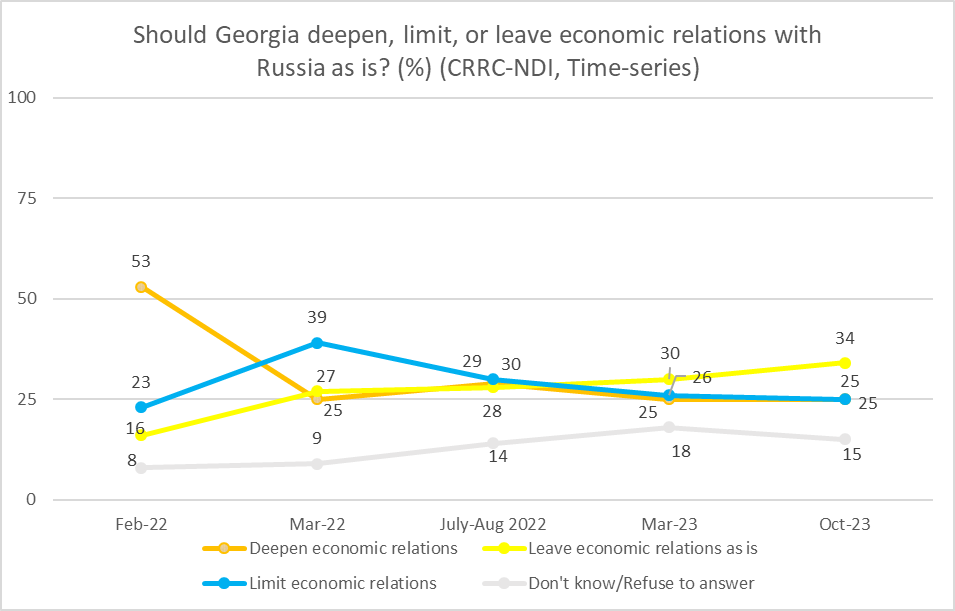
Georgian support for deepening economic relations with Russia reached a peak of 53% in February 2022, just before Russia’s invasion of Ukraine. A month later, in March 2022, support for the opposite — limiting economic relations — was at its highest at 39%. Since then, support for deepening relations has remained steady, while support for limiting relations has declined, with each position supported by a quarter of the surveyed public as of October 2023. At the same time, there has been an uptick in support for leaving relations as they stand, at 34%. 

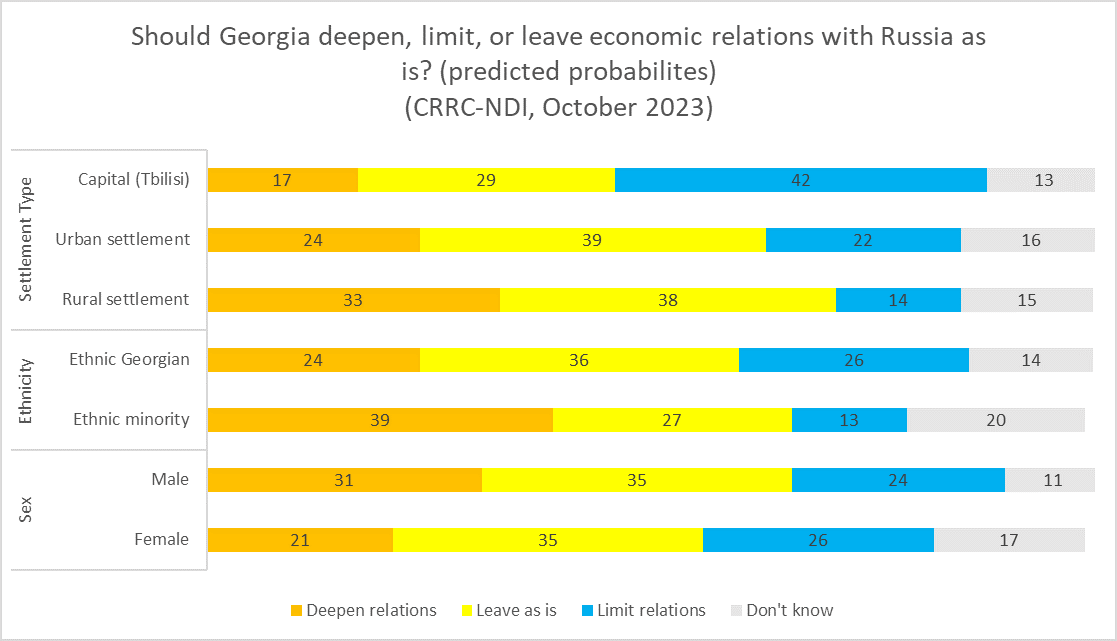
Opinions on how to manage Georgia’s economic relations with Russia vary with settlement type, ethnicity, and gender. 

Tbilisi residents were 20 percentage points more likely to support the idea of limiting economic relations with Russia than those living in other urban settlements, and 28 points more likely than those in rural communities.

Ethnic minorities are 15 percentage points more likely to report the country should deepen economic relations with Russia, while men are 10 points more likely to support deepening economic relations with Russia than women. 

The share in favour of maintaining relations as they stand tends to be stable amongst social and demographic groups, with 35-39% of the different demographic groups holding this view, controlling for other factors. The two exceptions to this pattern are Tbilisi residents, who as noted previously tend to believe that relations should be limited, and ethnic minorities, who are more likely to believe relations should deepen.

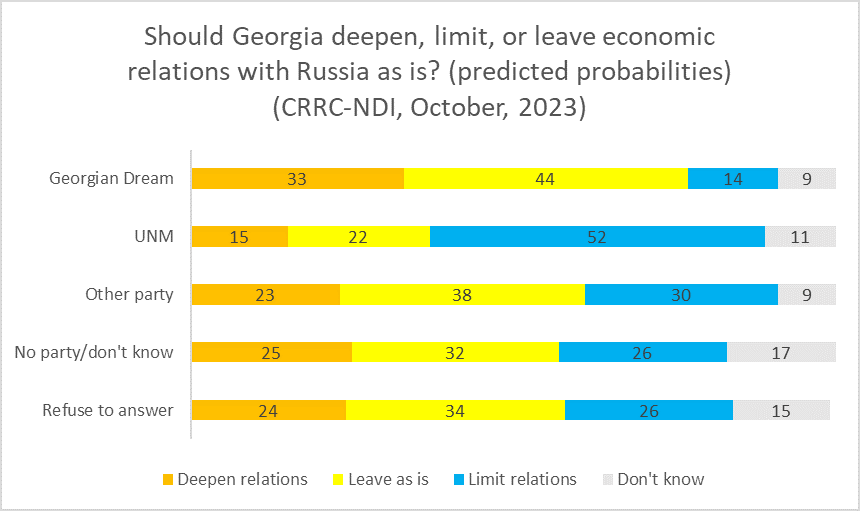
Aside from demographic factors, partisanship predicts attitudes towards Georgia’s economic ties with Russia. 

The largest difference of opinions along party lines is between supporters of the ruling Georgian Dream party and the United National Movement (UNM). After controlling for other factors, supporters of the ruling party are twice (33%) as likely as UNM supporters (15%) to favour deeper economic relations with Russia. UNM supporters are also nearly four times as likely (52%) to think relations should be limited compared with Georgian Dream supporters (14%), controlling for other factors.

Georgian society is split on how the country’s economy should interact with Russia’s, and these differences of opinion vary substantially along social, demographic, and partisan lines. 

Note: The analysis in this article makes use of multinomial regression analysis. The analysis included gender (male, female), age group (18-34, 35-54, and 55+), settlement type (capital, urban, rural), education (secondary/ secondary technical/ lower, and tertiary), ethnicity (ethnic Georgian, ethnic minority), employment (not employed, employed), a wealth index (0-10), and political party support (No party/don’t know/Georgian Dream, UNM, other party, and refuse to answer), as predictor variables. 

This article was written by Milord Shengelia and Zachary Fabos, researchers at CRRC Georgia. The views presented in the article are the authors’ alone and do not necessarily represent the views of CRRC Georgia, or any related entity.

Tuesday, February 13, 2024

Young, in the city, and online: most Georgians use more than one social media platform

Note: This article first appeared on the Caucasus Data Blog, a joint effort of CRRC-Georgia and OC Media. It was written by Zachary Fabos, a Researcher at CRRC-Georgia. The views presented in the article are the author’s alone and do not necessarily represent the views of CRRC-Georgia, Caucasian House, or any related entity.

A CRRC Georgia survey found most Georgian respondents use more than one social media platform, with younger people and people living in cities using a greater variety of platforms. 

According to Georgia’s National Statistics Office, 96% of Georgia’s internet users use social media. While social media’s popularity in Georgia is clear, which platforms are most used and who uses the most platforms? 

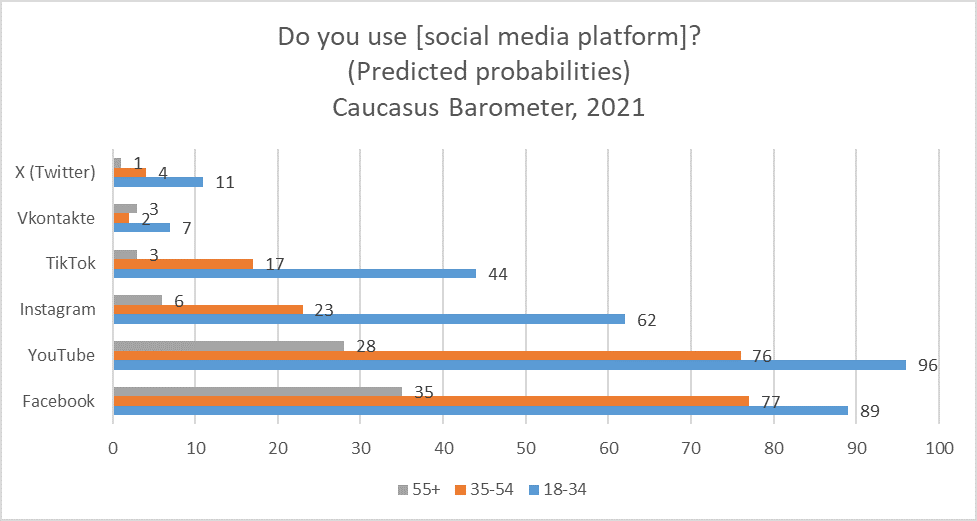
According to the 2021 Caucasus Barometer survey, 68% of Georgians use the internet daily. The most frequently mentioned destinations for those online are Facebook, with 69% of survey participants using the site, followed by YouTube, with 61% of respondents using the platform. Use of other sites such as Instagram (26%), TikTok (19%), Odnoklassniki (6%), Twitter (5%), and Vkontakte (5%) trails in comparison. 

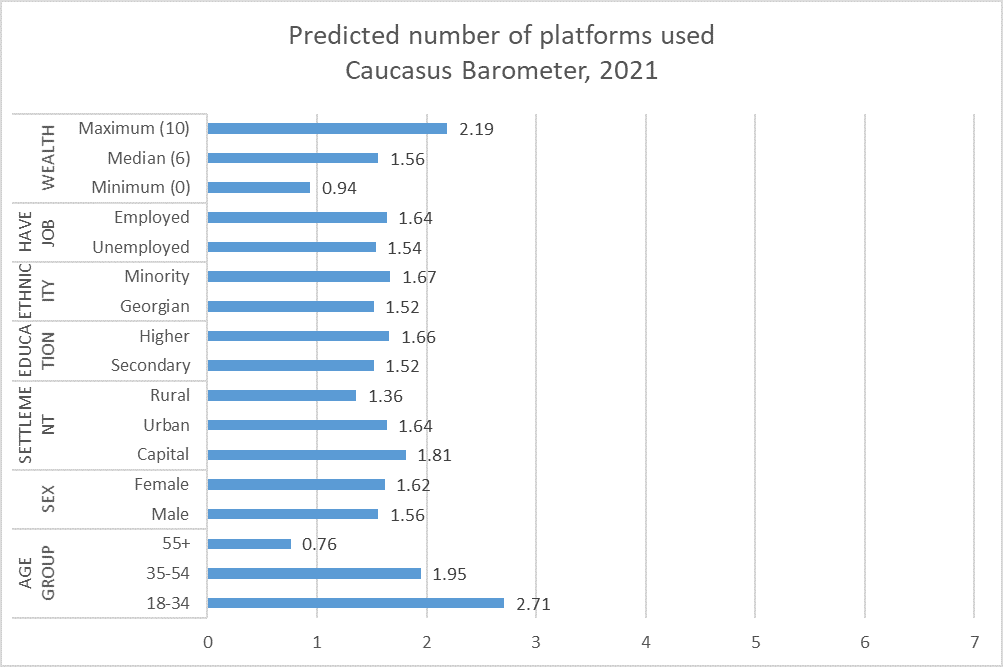
An analysis found the number of different platforms respondents reported using, with the data suggesting that the average number is two.

When this data is broken down, it shows that among demographic factors, the strongest predictor of using a diversity of platforms is age. On average, people aged 18-34 use three platforms while those 55+ use only one, controlling for other factors. Those aged 35-54 use two platforms, controlling for other factors. 

Aside from age, the number of platforms someone uses is also associated with settlement type. People living in rural settlements use one platform, while those in Tbilisi and other urban settlements use two on average, controlling for other factors.

Employment status, ethnicity, education level, and sex are not correlated with the number of platforms a person uses.

The above pattern holds across the different platforms asked about on the survey — young people (18-34) are more likely than people in older age groups to use each platform asked about on the survey, controlling for other factors.

The above data shows that young people both use a more diverse set of social media platforms than older people, while also using each and every social media platform asked about more often than people 35 and older.

This article was written by Zachary Fabos, a Researcher at CRRC Georgia. The views presented in the article are the author’s alone and do not necessarily represent the views of CRRC Georgia or any related entity.

Note: The analysis in this article makes use of logistic regression analysis. The analysis included gender (male, female), age group (18-34, 35-54, and 55+), settlement type (capital, urban, rural), education (secondary/ secondary technical/ lower, and tertiary), ethnicity (ethnic Georgian, ethnic minority), employment (not employed, employed), and a wealth index (0-10), as predictor variables. 

The data used in this article is available here.

Tuesday, February 06, 2024

Does Georgia’s public want gender-balanced politics?

Note: This article first appeared on the Caucasus Data Blog, a joint effort of CRRC-Georgia and OC Media. It was written by Elene Ergeshidze, a Researcher at CRRC-Georgia. The views presented in the article are the author’s alone and do not necessarily represent the views of CRRC-Georgia, Caucasian House, or any related entity.

CRRC Georgia surveyed the Georgian public on attitudes towards gender equality in politics and obstacles faced by women in politics in Georgia. 

Gender equality in politics is an important issue globally, and Georgian policy on the issue has been developing in recent years. Georgia introduced mandatory gender quotas for proportional party lists in 2020, extending this provision until 2032. The legislation stipulates that at least one out of four candidates submitted to the Central Election Commission, and provides financial support to parties that nominate more women. 

Despite these policy changes, much remains to be done to ensure gender equality in practice. In the 2020 parliamentary elections, only three political parties and one electoral bloc benefited from the financial incentive mechanism for nominating more female candidates than the mandatory gender quotas required. A study on mandatory gender quotas in Georgia found that in 2022, women still made up only 19% of Georgia’s parliament. 

Harassment directed at politicians is also a significant barrier. A CRRC study found that female politicians in Georgia more frequently faced online violence (abusive and harassing comments) related to their personal life than male candidates and politicians, in the two months before the 2020 parliamentary elections. 

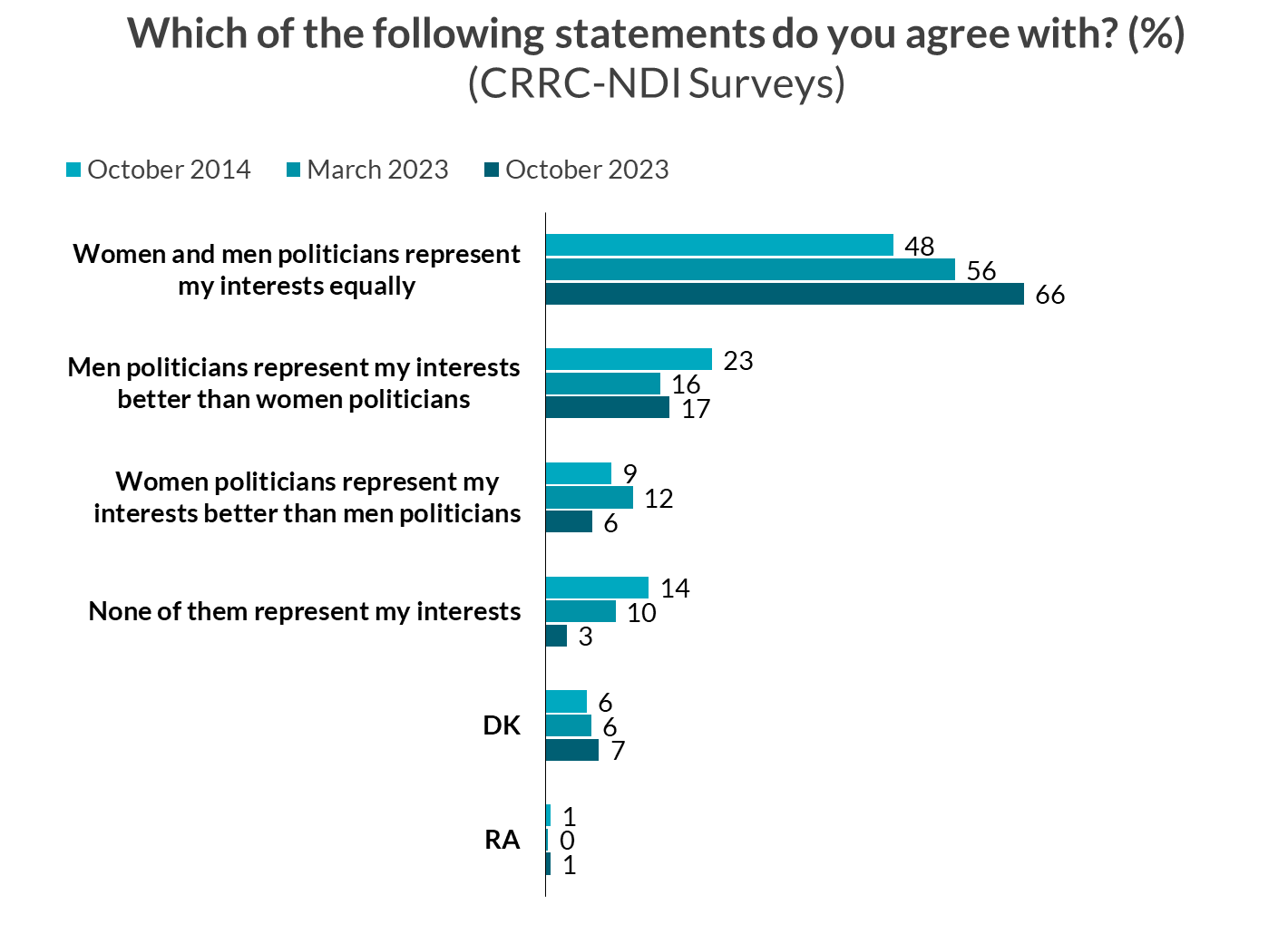
Despite those challenges, data from the NDI and CRRC October 2023 survey suggest that the public’s attitudes are becoming more approving of gender equality in politics.

Two thirds of those surveyed believed that female and male politicians represented their interests equally. This marked a 10 percentage point increase compared to March 2023, and an 18 point increase compared with October 2014, when CRRC first asked the survey question. 

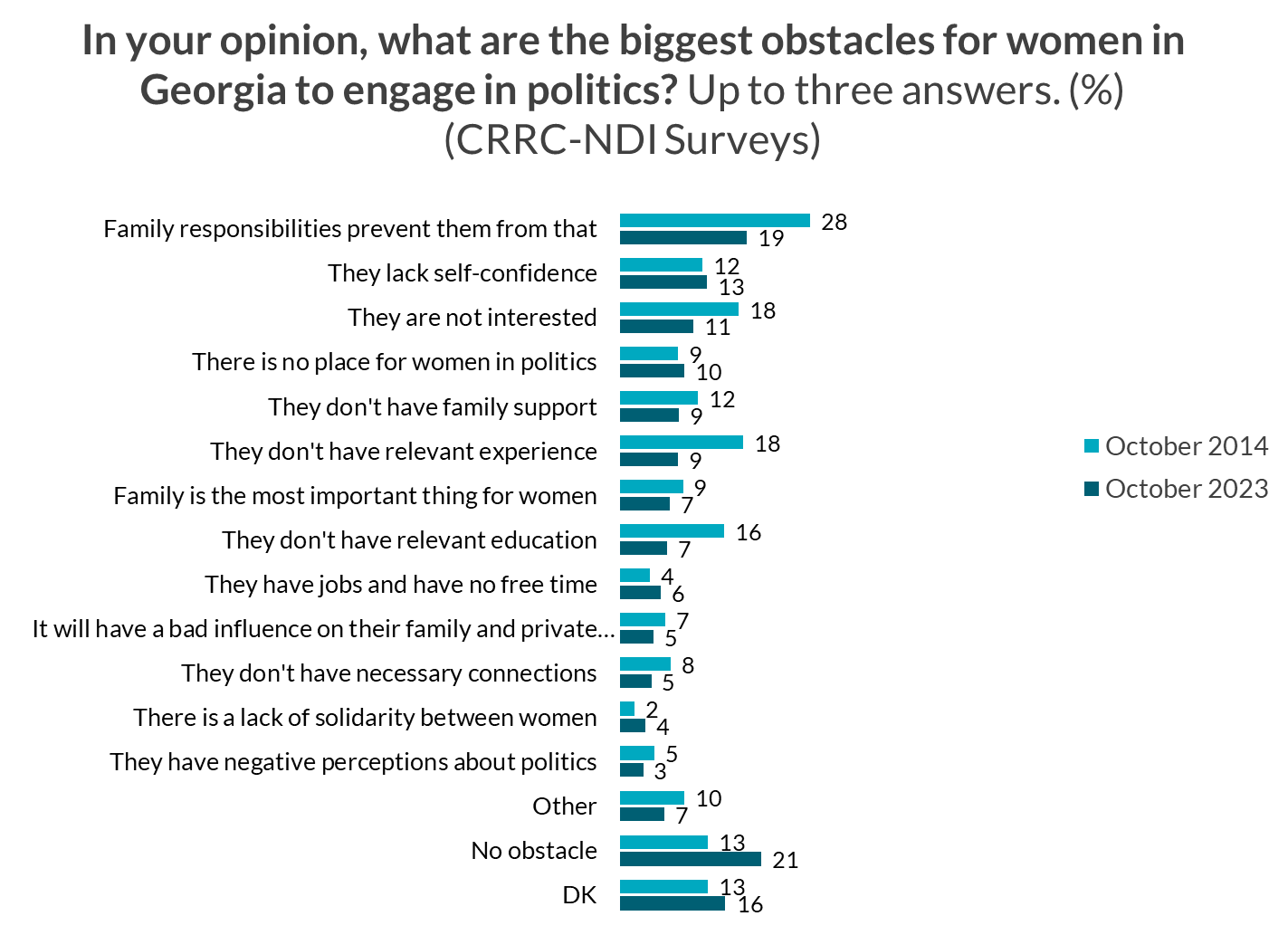
The survey also asked respondents what they believed were the largest obstacles preventing women in Georgia from engaging in politics. Respondents were allowed to name up to three issues. 

The most frequently named obstacles were family responsibilities (19%), a lack of self-confidence (13%), and women having no interest in politics (11%). One in ten (10%) reported the perception in the public that there was no place for women in politics was an obstacle, and 9% believed women were hindered by a lack of family support. 

However, these attitudes have also changed in the past decade. There was a nine percentage point drop in the share of those who named family responsibilities as an obstacle compared to 2014. The share reporting that women had a lack of interest in politics also decreased by seven percentage points. The percentage of respondents who named a lack of relevant experience and education halved, moving from 16% to 7% and 18% to 9%, respectively. 

However, there was also a seven percentage point increase in the share of respondents who stated that women face no barriers to engagement in politics since 2014. 

The above data shows substantial progress toward greater acceptance of gender equality in politics. 

Despite the belief that some issues, such as family responsibilities and a lack of self-confidence, remain barriers preventing women from entering politics, the decreasing percentage of respondents citing these as obstacles suggests a changing landscape in the country.  

Tuesday, January 30, 2024

Trust and political independence in Georgia’s interior ministry

Note: This article first appeared on the Caucasus Data Blog, a joint effort of CRRC-Georgia and OC Media. It was written by Tinatin Bandzeladze, a senior Researcher at CRRC-Georgia and Mariam Kobaladze, a senior Researcher at CRRC-Georgia. The views presented in the article are the author’s alone and do not necessarily represent the views of CRRC-Georgia, Caucasian House, or any related entity.

A CRRC survey found that trust in Georgia’s Interior Ministry and the police is closely tied to perception of the ministry’s political independence, or lack thereof. 

In summer 2022, CRRC Georgia and the Social Justice Center partnered on a nationwide public opinion survey on state and personal security. It found that while the Interior Ministry was one of the most trusted institutions in the country, many respondents were concerned that the ministry lacks transparency and political impartiality.

Georgia’s Interior Ministry is largely made up of and closely associated with the country’s police, with police officers often seen as representatives of the ministry. Previous research has demonstrated that police need public trust to effectively carry out their mandate to fight crime and maintain public safety

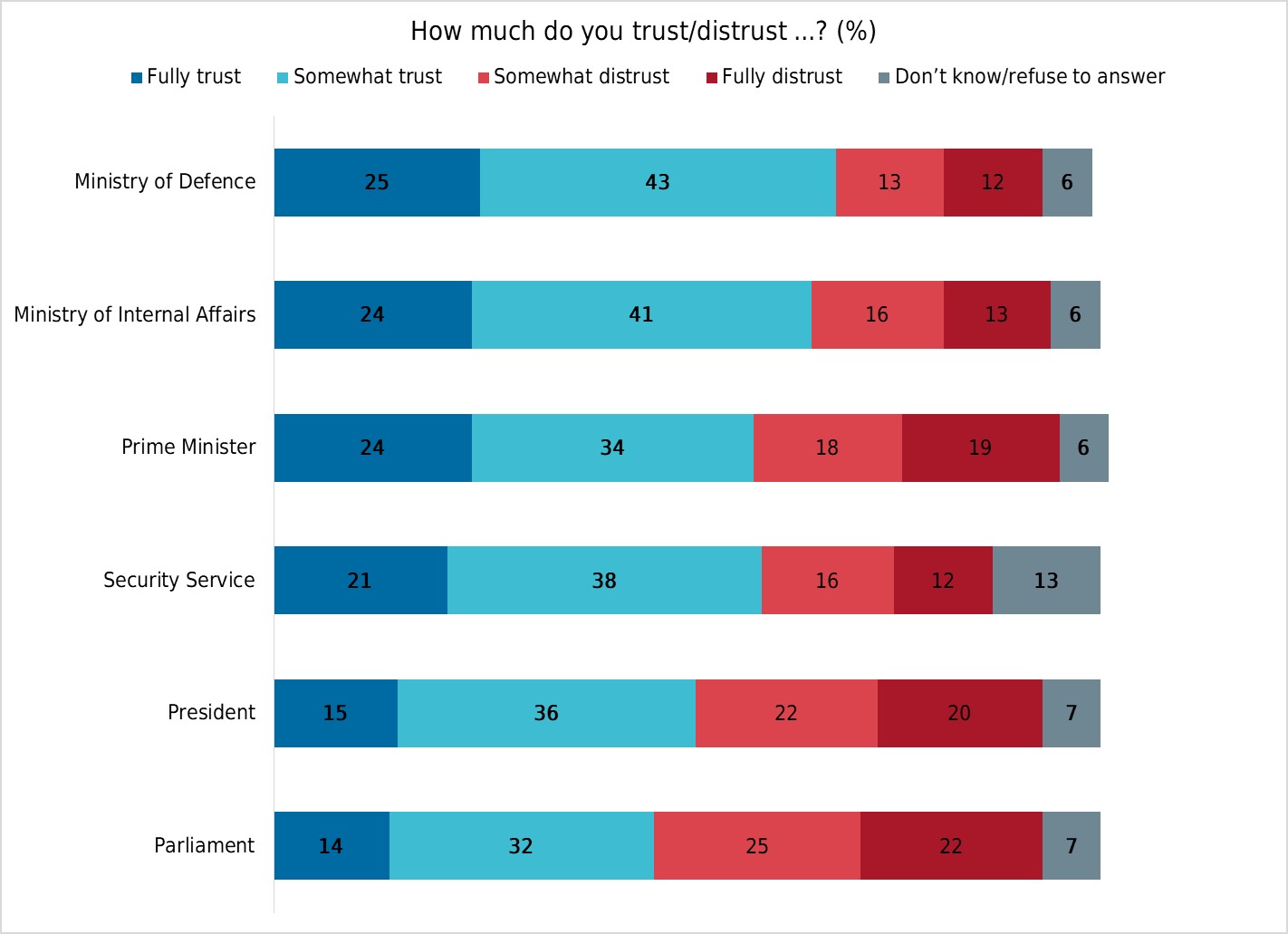
According to the 2022 survey, a majority of the Georgian public trust the Interior Ministry. About two thirds (65%) of the public has full or partial trust in the ministry. This is lower than that of the Defence Ministry (68%), but outperforms the Prime Minister (58%), the State Security Service (59%), the President (51%), and the Parliament (46%). 

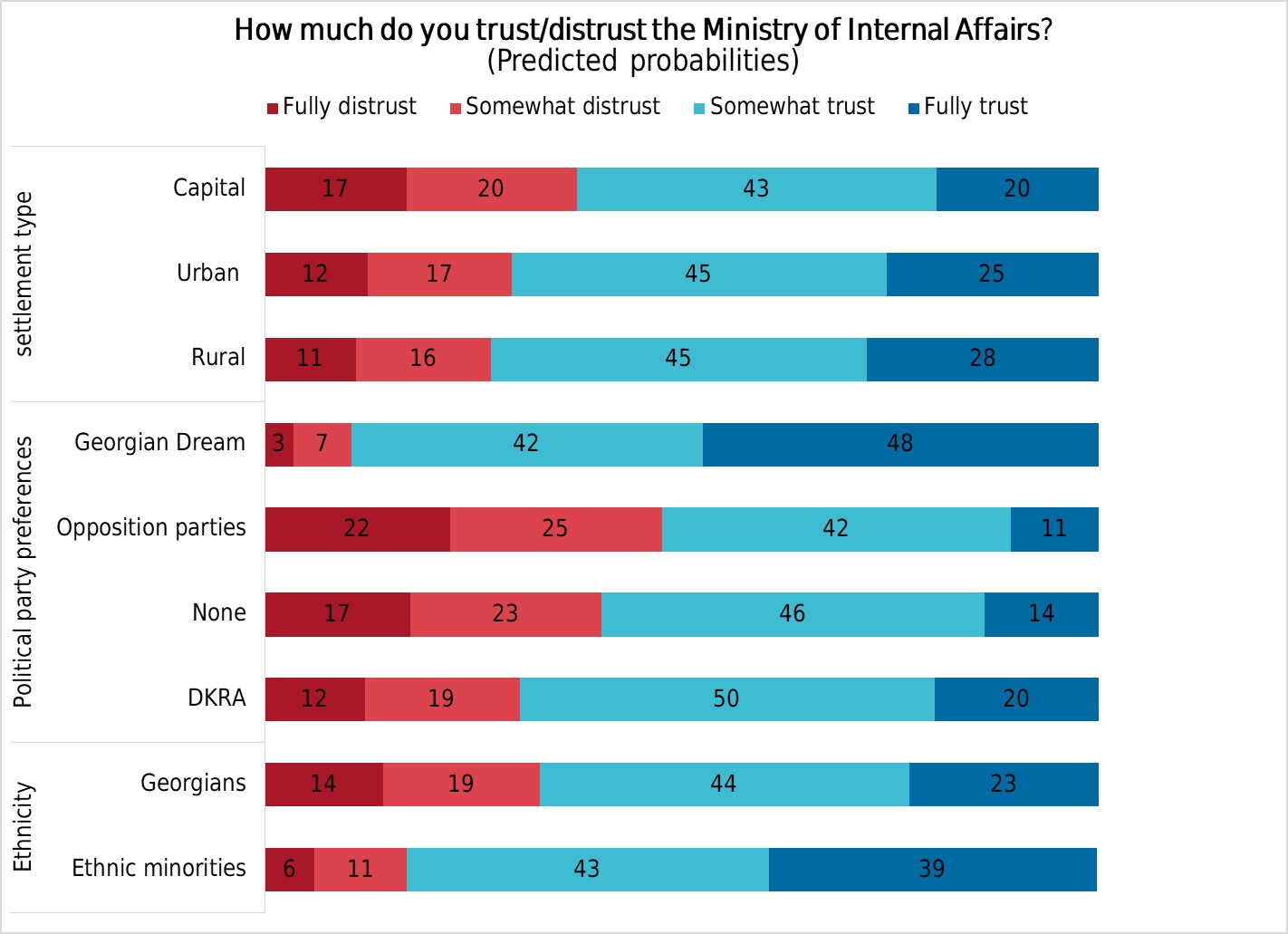
Trust in the Interior Ministry varies with a number of social and demographic characteristics.

Residents of Tbilisi are less likely to fully trust the Interior Ministry than residents of other cities and people in rural areas. 

Trust in the ministry is also associated with party preferences. People who support the ruling Georgian Dream party are more inclined to fully trust the ministry than supporters of opposition parties and those who support no party. Almost half of ruling party supporters fully trust the Interior Ministry. 

Ethnic minorities fully trust the Interior Ministry at nearly twice the rate of ethnic Georgians. 

Other demographic characteristics do not predict trust in the ministry.

Research by others suggests that trust in the police is connected more to perceptions of police fairness than with perceptions of police effectiveness in dealing with crime. 

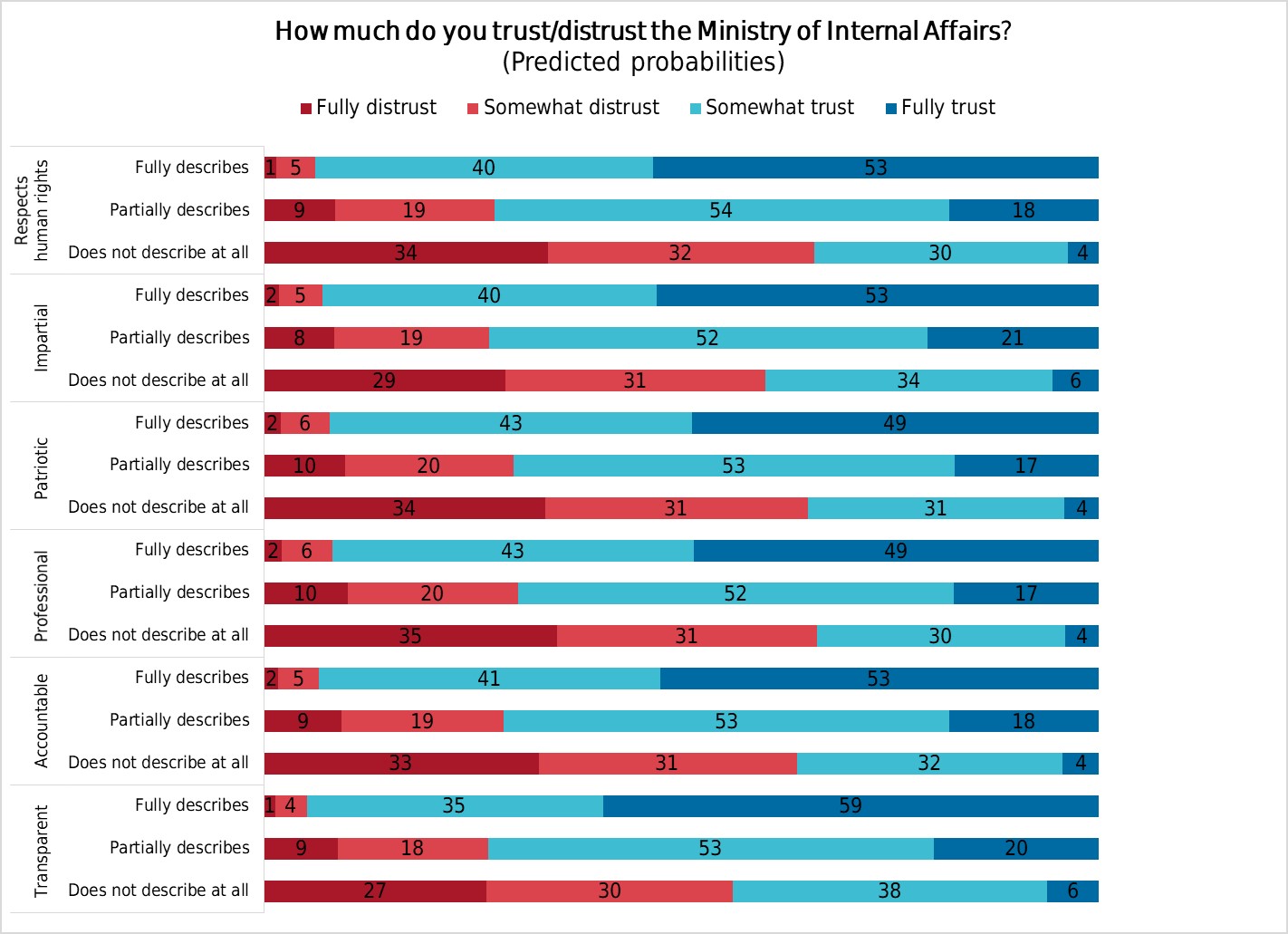
In relation to that, the study also asked about whether the public perceived the Interior Ministry as patriotic, professional, impartial, and transparent. The surveyed respondents viewed the ministry as patriotic (23%) and professional (23%) more frequently than they perceived it to be impartial (15%) and transparent (14%). 

The above opinions are associated with trust in the Interior Ministry. Those that think these characteristics fully describe the ministry, also nearly unanimously trust it. In contrast, majorities of those that do not think each characteristic describes the ministry also mistrust it. 

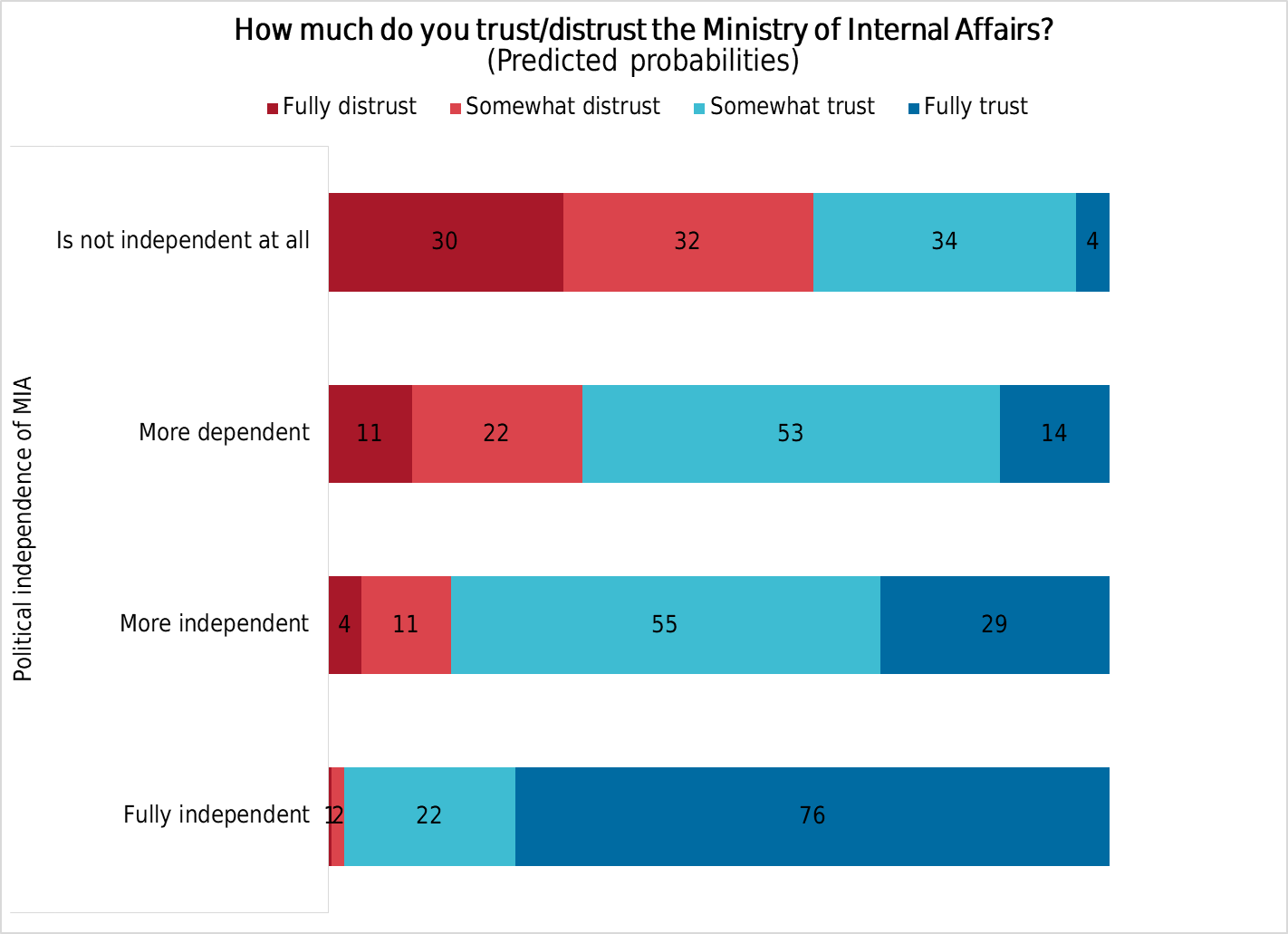
Respondents were also asked if they believed the Interior Ministry was independent from politics. Only 9% of those surveyed felt that the Interior Ministry was fully independent from political influence, while 23% believed it was more independent than dependent. On the other hand, 47% reported believing that the ministry had no political independence or it was more politically ‘dependent’ than independent. The remaining 21% did not know or refused to answer the question. 

The data indicate that opinions regarding political independence strongly predicted trust in the ministry. While there was a 62% chance an individual would fully or partially distrust the Interior Ministry if they believed it was not independent at all, the likelihood dropped to 2% among those who believed it was fully independent. 

While a majority of Georgians reported trusting the Interior Ministry, and thereby the police, in 2022, relatively few reported they were transparent and impartial, with only a third of respondents viewing them as politically independent. A belief that the ministry lacks independence as well as a lack of belief that it is transparent, accountable, professional, patriotic, impartial, and respects human rights are strong predictors of whether people trust the institution.

Note: This blog makes use of ordinal logistic regression analysis. The dependent variable was trust in the MIA, with don’t know and refuse to answer responses removed. The independent variables included:  sex, age, employment status, level of education, a wealth index, settlement type, political sympathy and ethnic identity.