CRRC-Georgia’s survey conducted in August 2017 for the United Nations’ Food and Agriculture Organization (FAO) asked about livestock owned by rural households in Georgia, including cows, bulls, buffalo, pigs, sheep, and goats. Cows and bulls were reported to be owned most commonly. Some of the questions the project addressed the division of tasks between men and women in taking care of livestock, while other questions tried to find out whether there were gender differences in making major decisions related to livestock and livestock products.
Men and women reported spending about the same amount of time on animal care during a regular day. However, men were reported more frequently to feed the animals and take them to pasture. In contrast, milking animals, whenever relevant, was most often reported to be done by women. The task of taking care of animals when they get sick was most often reported to be shared equally by male and female members of a household.
Note: Households consisting of only male or only female members were excluded from the analysis in this blog post. Original answer options “Mostly hired men”, “Mostly hired women” and “Hired men and women equally” were combined into the category “Hired workers”.
If livestock or any livestock products were sold, decisions were reported to be taken most often jointly by male and female members of the household. When it comes to selling, vaccinating or registering livestock, however, the next most common response was “mostly male members of the household.”
While there are gender differences in taking care of livestock in rural Georgia, when it comes to decision making, people report most often that men and women make decisions together.
To explore the issue in greater depth, see CRRC-Georgia’s report for FAO. To explore the data, visit our online data analysis portal.
Tuesday, July 24, 2018
Livestock care and livestock-related decision making in rural Georgia: Are there any gender differences?

Monday, July 18, 2016
Environmental issues in Georgia: a concern for all?
[Note: This post was first published on Friday, July 15th at the Clarion.]
By Sacha Bepoldin
The United Nations Research Institute for Social Development (UNRISD) has highlighted that “Environmental decline adversely affects the health, well-being and livelihood opportunities of the individuals affected by pollution or natural resource depletion. Soil erosion, deforestation, the loss or depletion of animal and plant species limit the productive opportunities of vast numbers of people.” In Georgia, according to the 2009 National Report on the State of the Environment of Georgia and the 2012-2016 National Environmental Action Programme, the increasing number of natural disasters, chemical pollution of soils and progressing desertification, mainly in Shida Kartli, Kvemo Kartli and parts of Kakheti, are clear signs of man-made pollution. Both rural and urban inhabitants of Georgia are affected by environmental problems, albeit of a different nature. As public opinion data shows, people assess the importance of environmental problems differently. This blog post examines the salience of pollution as an issue for the settlement where people live and the relative importance of this problem compared to other issues, using the CRRC/NDI August 2015 survey.
One of the questions asked during the survey was, “Speaking of public goods in general, what are the three most important issues in your settlement?” Pollution was the fourth most frequently mentioned issue countrywide, after roads, water supply and gas supply. There are, however, differences in the frequency of naming these issues by settlement type. While pollution was the main issue in the capital, named by 44% of Tbilisi residents, it was named by only 7% of the rural population.
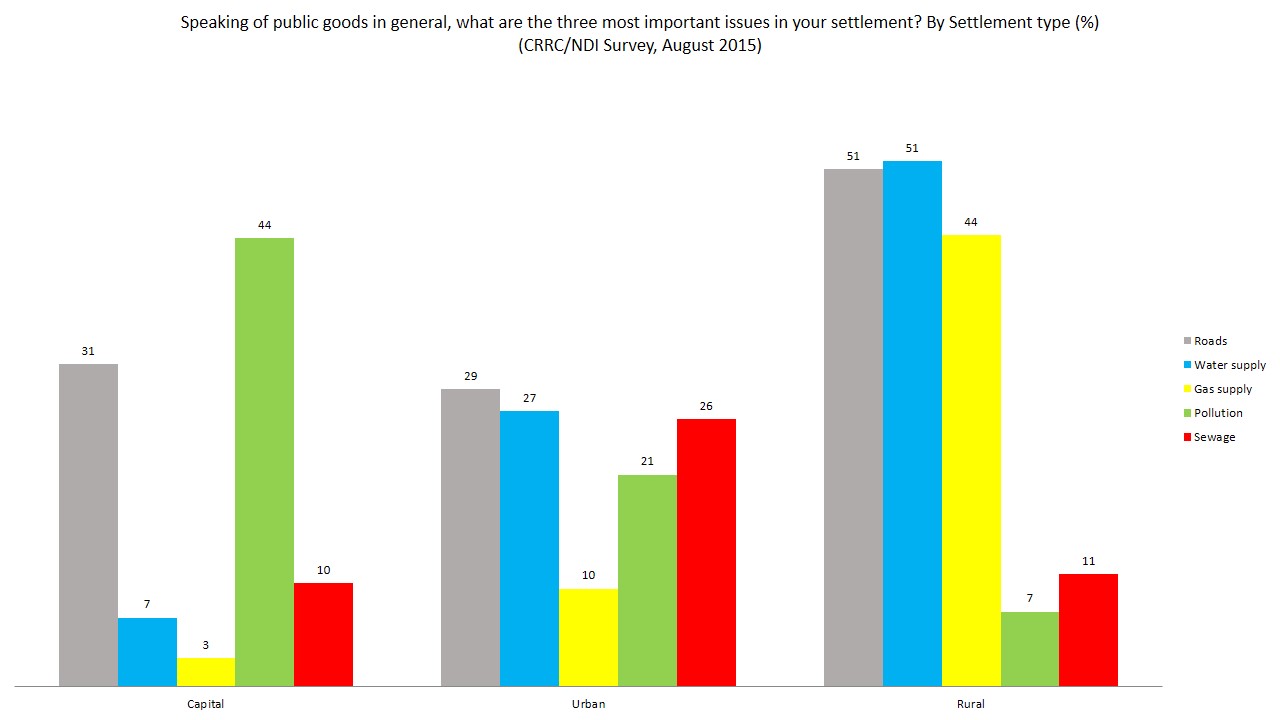
Note: The sum of answers does not add up to 100%, since respondents could name up to three issues. The charts in this blog post display only the five most frequently named issues at the national level.
At the national level, improvement of the water supply and roads are the public’s highest priorities in terms of budget spending, while pollution again ranks fourth. Pollution represents the highest priority for the population of Tbilisi, but only 1% of the rural population thinks spending on pollution should be a budgetary priority.

The rural population likely underestimates the importance of pollution and environmental issues in general. At the same time, a study conducted by the University of Gothenburg highlighted that degrading agricultural practices affect 35% of farmland in Georgia, which is already scarce due to the mountainous landscape of the country. As agriculture, according to official sources, is the main employment sector in the country, such practices threaten the lifestyle and economic opportunities of a large share of the population. Given the disconnect between lack of concern over this issue in rural settlements, on the one hand, and the likelihood that it affects the rural population, on the other hand, a communication campaign focused on environmental protection, especially in rural settlements, could help prevent further environmental problems.
To look through the data in more depth, visit CRRC’s Online Data Analysis platform.
Tuesday, March 24, 2015
Neighborhoods and neighbors in urban and rural Georgia