Showing posts with label Government. Show all posts

Thursday, March 23, 2023

რა სარგებლობა მოაქვს ხალხის ძალას მმართველი პარტიისათვის?

 ერთი კვლევის თანახმად, პაემანზე უფრო მოეწონებით თუ თან ნაკლებად მომხიბლავ მეგობარს გაიყოლებთ. ანალოგიურად, ხშირად ამომრჩევლის თვალში პარტიაც უფრო კარგად წარმოჩინდება, როდესაც მსგავს, თუმცა, ნაკლებად მიმზიდველ ოპონენტთან პაექრობს.


ეს ბლოგი აჩვენებს თუ როგორ მოქმედებს მსგავსი პრინციპი საქართველოში და როგორ შეუძლია "ქართულ ოცნებას" მხარდაჭერის გაზრდა თავის ფსევდო მეტოქე ხალხის ძალასთან კამათით.

2022 წლის ზაფხულში ქართულ ოცნებას გამოეყო პარლამენტის სამი წევრი, რათა უფრო "თავისუფლად ელაპარაკათ". სინამდვილეში ეს ნიშნავდა დასავლეთის კრიტიკას, პირადად აშშ-ის ელჩის კრიტიკას და განცხადებებს, თითქოს დასავლეთი საქართველოს რუსეთ-უკრაინის ომში ითრევდა.

მოგვიანებით პარლამენტის სამ წევრს სხვებიც შეუერთდნენ და მოძრაობა ხალხის ძალა დააარსეს. თუმცა, მოძრაობის წევრი დეპუტატები საპარლამენტო უმრავლესობაში დარჩნენ. ამან კითხვა გააჩინა: ხალხის ძალა ნამდვილად უპირისპირდებოდა ქართულ ოცნებას თუ უბრალოდ, მისი სატელიტი პარტია იყო ანტიდასავლურად განწყობილი ამომრჩევლის მისამხრობად?

ხალხის ძალის განცხადებებზე მმართველი პარტიის ლიდერების ბუნდოვანმა რეაქციებმა ეს კითხვა კიდევ უფრო გააღრმავა. მაშინ, როცა პარტიის თავმჯდომარე ირაკლი კობახიძემ ხალხის ძალის ანტიდასავლური განცხადებები მეტწილად მოიწონა, პრემიერმა ღარიბაშვილმა მათ მოუწოდა, რადიკალური განცხადებებით არ დაეზიანებინათ ურთიერთობები აშშ-თან.

ასევე მრავლისმთქმელი იყო მხარდაჭერა, რომელიც ქართული ოცნების ლიდერებმა გამოუცხადეს ხალხის ძალის მიერ ინიციირებულ კანონპროექტს უცხოური გავლენის აგენტების შესახებ.

შეიძლება თუ არა, ქართულმა ოცნებამ თავისი რადიკალი განაყოფისგან რაიმე სარგებელი მიიღოს? ამის გასაგებად CRRC-საქართველომ 2022 წლის ნოემბერში საზოგადოებრივი აზრის გამოკითხვის ფარგლებში ექსპერიმენტი ჩაატარა. გამოკითხვისათვის შერჩეული 1 219 რესპონდენტი შემთხვევითი წესით ოთხ ჯგუფში გავანაწილეთ.

პირველ (საკონტროლო) ჯგუფში რესპონდენტებს ვაცნობეთ, რომ ხალხის ძალამ აშშ-ის ელჩი გააკრიტიკა და განაცხადა, რომ აშშ-ს საქართველოს რუსეთ-უკრაინის ომში ჩათრევა უნდოდა.

მეორე ჯგუფში რესპონდენტებს ხალხის ძალის განცხადება გავაცანით, თუმცა, დამატებით ირაკლი კობახიძის კომენტარის შესახებაც ვაცნობეთ, რომელმაც არ უარყო ხალხის ძალის განცხადებები.

მესამე ჯგუფში შემავალ რესპონდენტებს ხალხის ძალის განცხადება გავაცანით, თუმცა, დამატებით ვუთხარით ირაკლი ღარიბაშვილის კომენტარის შესახებაც, რომ მსგავსი განცხადებები აშშ-თან საქართველოს ურთიერთობებს ასუსტებდა.

მეოთხე ჯგუფში რესპონდენტებმა ხალხის ძალის განცხადებასთან ერთად კობახიძის მხარდამჭერი კომენტარიც მოისმინეს და ღარიბაშვილის კრიტიკული შენიშვნაც.

დასასრულს, ოთხივე ჯგუფში რესპონდენტებს ვკითხეთ, ხვალ რომ არჩევნები
ჩატარებულიყო, ქართულ ოცნებას მისცემდნენ ხმას, ხალხის ძალას თუ რომელიმე სხვა პარტიას.

მონაცემთა ანალიზი გვაჩვენებს, რომ ქართული ოცნებისათვის ყველაზე მომგებიანი გამოდგა განცხადება, რომელმაც ის თავისი ფსევდო ოპონენტისაგან ყველაზე მეტად განასხვავა. კერძოდ, პრემიერ ღარიბაშვილის კრიტიკულმა შენიშვნამ, რომელიც ხალხის ძალის ანტიამერიკულ განცხადებას არ დაეთანხმა, მმართველი პარტიის მხარდაჭერა 8 პროცენტული პუნქტით გაზარდა: მხოლოდ ხალხის ძალის ანტიამერიკული განცხადების მოსმენის შემდეგ ოცნებას მხარს ამომრჩევლების 19 პროცენტი დაუჭერდა, მაგრამ როცა რესპონდენტებმა ოცნების ლიდერისაგან ამ განცხადების კრიტიკაც მოისმინეს, მხარდაჭერა 27 პროცენტამდე გაიზარდა.

ფოტო: CRRC Georgia

აღსანიშნავია,რომ სტატისტიკურად მნიშვნელოვანი გავლენა მხოლოდ ღარიბაშვილის მიერ ხალხის ძალის განცხადების კრიტიკას ჰქონდა. კობახიძის კომენტარს ოცნების მხარდაჭერაზე გავლენა არ ჰქონია, ისევე, როგორც კობახიძის მხარდამჭერი და ღარიბაშვილის კრიტიკული კომენტარების ერთად მოსმენას.

ეს მიგნებები სხვა კვლევების შედეგებთანაც თანხვედრაშია; მათი მიხედვით, როგორც დემოკრატიულ, ისე ნაკლებად დემოკრატიულ ქვეყნებში რადიკალურ პარტიებს ხშირად უფრო მეტი სარგებელი მმართველი პარტიისთვის მოაქვთ, ვიდრე საკუთარი პარტიისთვის.

ჩვენი კვლევის თანახმად, ხალხის ძალას ამომრჩევლის მხოლოდ 3 პროცენტი დაუჭერდა მხარს. ხოლო მმართველი პარტიის მხარდაჭერა მთელი 8 პროცენტული პუნქტით გაიზარდა, როცა მათმა ლიდერმა სტრატეგიული პარტნიორის მიმართ ნაკლებად რადიკალური პოზიცია დაიჭირა.

აღსანიშნავია, რომ ამ ექსპერიმენტში გამოვიყენეთ განცხადებები ქვეყნის დასავლური ორიენტაციის შესახებ, რაც მეტწილად ეროვნული კონსენსუსის საგანია: მოსახლეობის დიდი უმრავლესობა მხარს უჭერს საქართველოს ნატოსა და ევროკავშირში გაწევრიანებას. გასარკვევია, გაზრდის თუ არა მმართველი პარტიის მხარდაჭერას ხალხის ძალასთან ისეთ საკითხზე დისკუსია, რომელზეც საზოგადოებაში ნაკლები თანხმობაა.

ამის პირველი მნიშვნელოვანი ტესტი შესაძლოა, ყოფილიყო ხალხის ძალის საკანონმდებლო ინიციატივა უცხოური გავლენის აგენტების შესახებ, თუმცა მმართველმა პარტიამ თავიდანვე ამ ინიციატივის მხარდაჭერა აირჩია. მომავალში გამოჩნდება მოინდომებს თუ არა ქართული ოცნება თავის რადიკალ განაყოფთან შედარებით პოზიციის უფრო ზომიერად წარმოჩენას.

შენიშვნა: სტატიაში წარმოდგენილი შეხედულებები ეკუთვნის ავტორს და არ წარმოადგენს On.ge-ის პოზიციას. მასალა ქვეყნდება OC Media-სთან პარტნიორობის ფარგლებში, რომლის შედეგად, გამოცემის სტატიები ამიერიდან ოთხ ენაზე გავრცელდება. საქართველოში OC Media-ს პარტნიორი On.ge-ა. სტატია ინგლისურად შეგიძლიათ წაიკითხოთ აქ. ეს სტატია დაწერა CRRC საქართველოს პრეზიდენტმა კობა თურმანიძემ. სტატიაში წარმოდგენილი შეხედულებები არის მხოლოდ ავტორის შეხედულებები და არ წარმოადგენს CRRC საქართველოს ან მასთან დაკავშირებული რომელიმე სუბიექტის შეხედულებებს.


Tuesday, September 27, 2022

Do politicians serve Georgia’s public interests?

Note: This article first appeared on the Caucasus Data Blog, a joint effort of CRRC Georgia and OC Media. It was written by Dustin Gilbreath, a Non-Resident Senior Fellow at CRRC-Georgia, The views presented in the article are of the author alone, and do not necessarily reflect the views of CRRC Georgia, or any related entity.

A recent CRRC Georgia and NDI poll suggests that roughly half of the Georgian public, regardless of their partisan affiliations, believe that neither the opposition nor the ruling party serves their interests.

Political polarisation in Georgia has little to do with opinions on policy. An analysis of numerous questions on the regular NDI and CRRC polling suggests that the public has consistent preferences and concerns, no matter the party they support: Georgians tend to want a pro-Western foreign policy for the country, they are concerned about the economy’s development and jobs, and they tend to be socially conservative. 

While what the public wants is relatively clear, Georgians do not see the ruling Georgian Dream party or elected opposition figures working towards providing that.

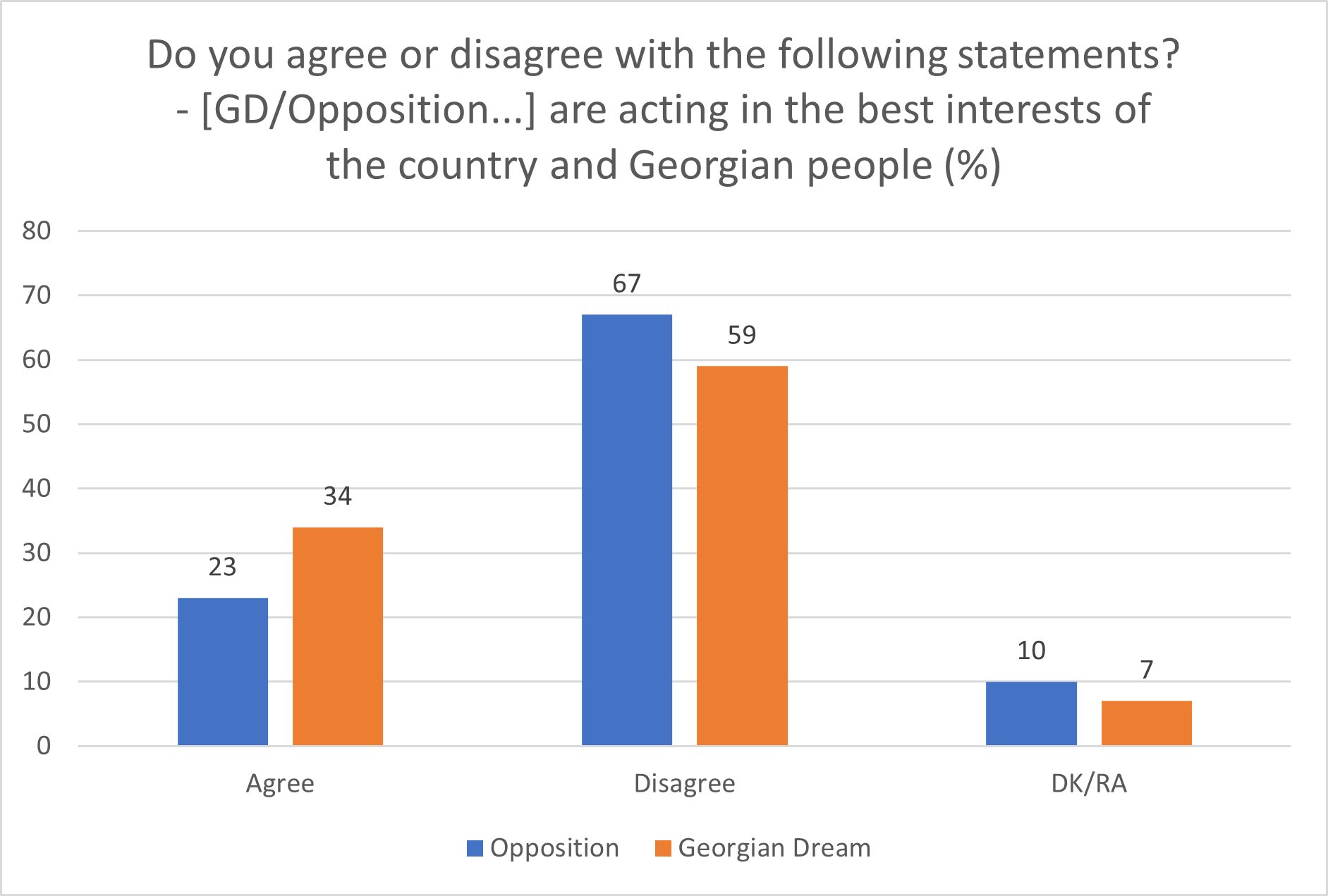
The most recent CRRC and NDI survey suggests that a majority of the public thinks that neither the opposition nor Georgian Dream serves the interests of people like them, although 11% more of the public believe that Georgian Dream serves the interests of people like them.

About half of the country (46%) says neither party acts in the best interests of Georgia or the Georgian people. 

The data show some partisan bent. About one in five (19%) say that the ruling party is working in the best interests of the country, while the opposition is not. One in ten (10%) thinks that the opposition is working in the interests of the country, while Georgian Dream is not. Only one in eight (13%) think that both parties are working in the best interests of the country.

At present, 50% of the country supports no party or has refused to answer which party they support; 27% support Georgian Dream and 24% support an opposition party.

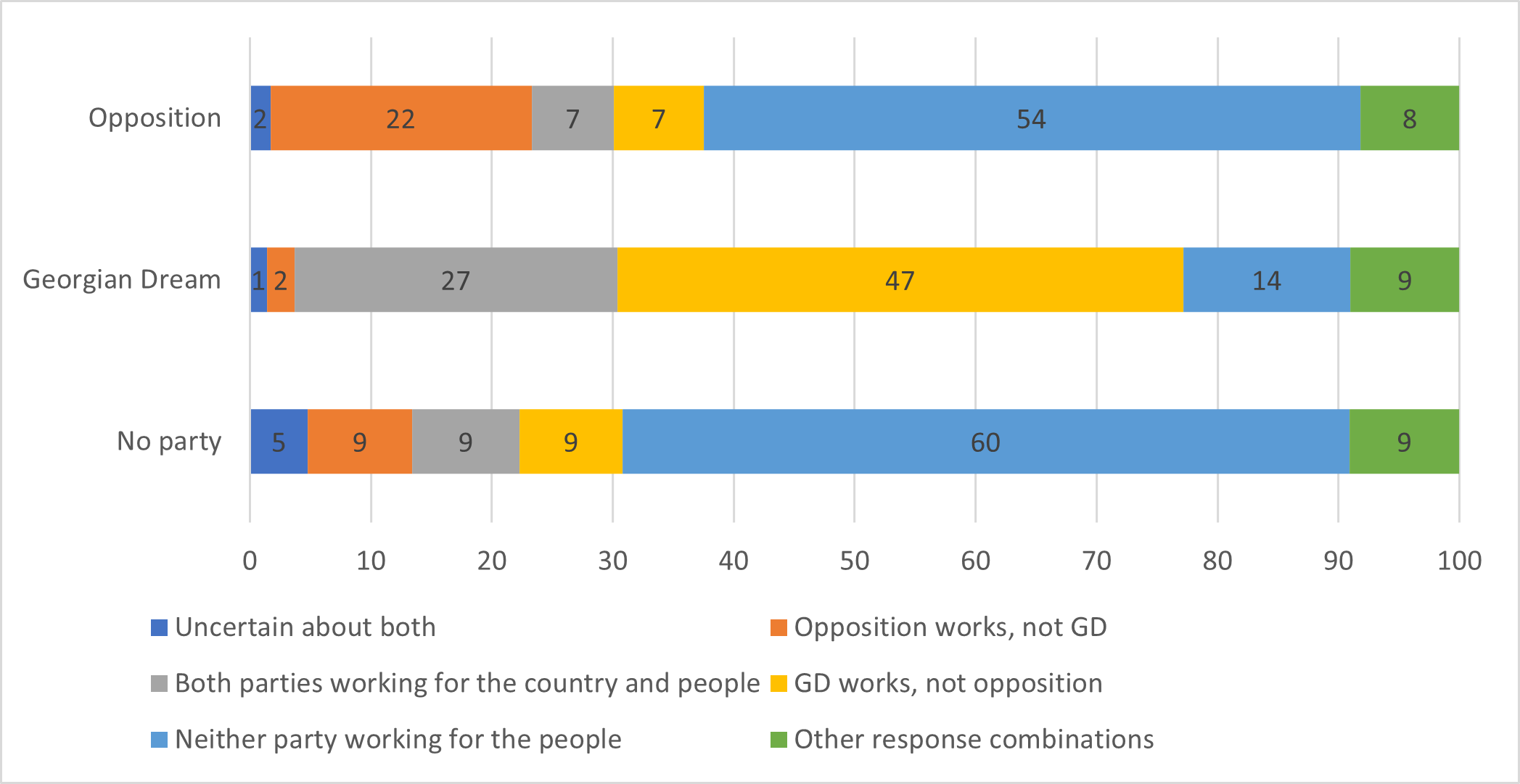
When the above data is broken down by partisanship, the data show mistrust among partisans and non-partisans alike. Nearly half of Georgian Dream’s supporters (47%) report that their party works for the people, while the opposition does not. In contrast, 54% of opposition supporters and 60% of those that report they do not support any party say that neither the opposition nor Georgian Dream is working for the people. One in five opposition supporters (22%) report that the opposition works for the people, but Georgian Dream does not. 

The data should give politicians pause, whether they belong to the ruling party or the opposition.

If most Georgians believe their political parties are not working in good faith, that might be an indicator of a larger issue of miscommunication — whether or not the public’s fears are unfounded.

Moving away from the relentless accusations and infighting that have characterised Georgian politics in recent years and instead adopting a positive vision for the country might help Georgia’s political parties regain the trust of the public.

The data used in this analysis is available here.

Tuesday, September 06, 2022

Who’s to blame for Georgia’s EU candidacy debacle?

Note: This article first appeared on the Caucasus Data Blog, a joint effort of CRRC Georgia and OC Media. It was written by Dr. David Sichinava, Makhare Atchaidze, and Nino Zubashvili, CRRC-Georgia. The views presented in the article are of the authors alone, and do not necessarily reflect the views of CRRC Georgia, or any related entity.

As Georgian officials ramp up their anti-Western rhetoric, recent CRRC Georgia data suggests that most Georgians are uncertain who to blame for the country’s failed European Union membership bid.

On 17 June 2022, the European Commission decided not to grant Georgia EU candidate status, unlike Ukraine and Moldova. In its memo, the Commission recognised the country’s ‘European perspective’, while pointing at an extensive list of issues it needs to address before its candidacy bid is re-examined.

Officials in Brussels later explained that the EU will return to discussing Georgia’s candidacy status ‘sometime in 2023’, by which time the country is supposed to implement reforms addressing political polarisation, the judiciary, and ‘de-oligarchisation’ among a number of other concerns.

Following the announcement, Tbilisi became the epicentre of mass protests attended by tens of thousands of disappointed citizens. Protestors blamed the government for its inaction. Many alleged that the ruling Georgian Dream party deliberately tanked EU membership candidacy talks.

In the lead-up to the announcement, Georgia’s actions placed the bid into question; the country’s political leadership, including the country’s Prime Minister Irakli Gharibashvili, hinted that they would, “say everything” if the European Union decided ‘unfairly’ on the country’s candidate status. 

On the other hand, Irakli Kobakhidze, the chair of Georgian Dream, bluntly stated that if Georgia were to go to war against Russia, it would ‘have been guaranteed EU candidate status by December’. Adding fuel to the fire, the pro-government outlet Imedi ran a poll asking respondents what Georgia should do if the west asked the country to get involved in a war against Russia. Unsurprisingly, the majority said that the country should reject such a proposal.

As emotions have tempered, CRRC-Georgia’s omnibus survey clarifies how Georgians feel about the candidacy status controversy. Fielded in late July, the survey shows that most Georgians reject Georgian Dream politicians’ allegations that the country’s EU membership status was somehow contingent on Georgia’s involvement in a war against Russia.

Instead, people tend to blame the government’s inaction, polarisation, and the country for simply not meeting membership requirements.  Yet another rather worrying trend shows a small but statistically significant shift in the support for Georgia’s EU membership.

Who is to blame?

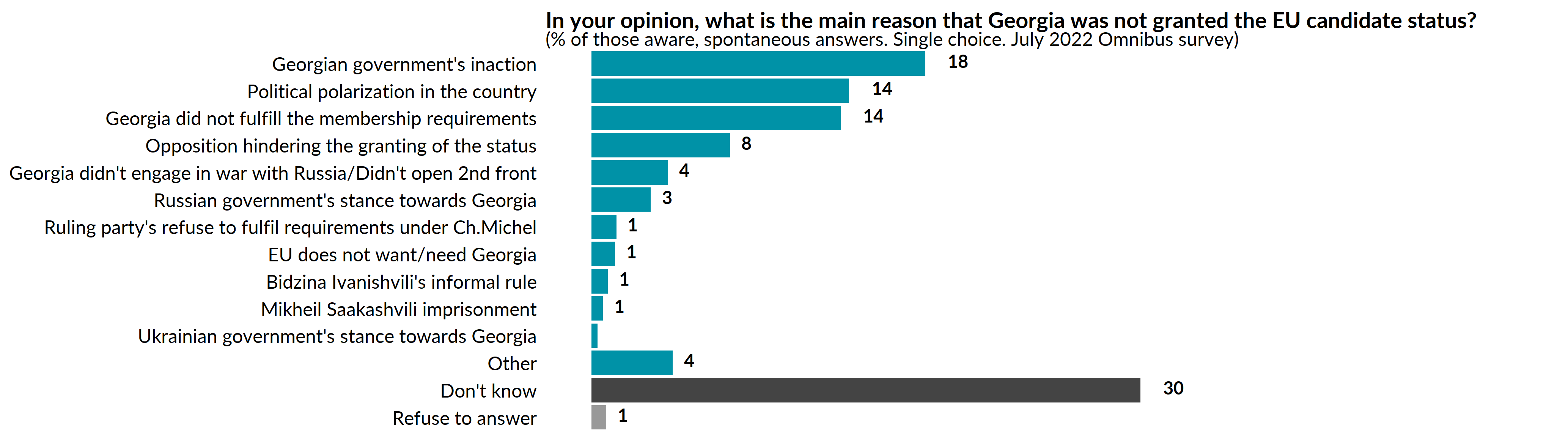
Overall, three-quarters of Georgians (76%) know the EU did not grant Georgia candidate status. Those who knew about it were asked what they thought the main reason behind the European Commission’s decision was. A third (30%) were uncertain. About a fifth (18%) blamed the Georgian government’s inaction, while equal proportions (14%) attributed this to political polarisation in the country and Georgia not fulfilling the requirements set for membership.

A further 8% believed that Georgia was not granted candidate status due to opposition meddling and sabotage. Fewer (4%) said that this happened because Georgia did not get involved in a war against Russia, with 3% blaming the Russian government. Close to 1% named options such as the government not complying with the agreement brokered by the President of the European Council Charles Michel, or that the EU does not need Georgia, Bidzina Ivanishvili’s supposed informal rule, former President Mikheil Saakashvili’s imprisonment, and the Ukrainian government’s stance towards Georgia. Close to 5% named other options or refused to answer.
Does the public believe the West asked Georgia to start a war with Russia?

No — most Georgians do not think that the EU candidacy bid was contingent on the country starting a war with Russia. Respondents were initially informed that some Georgian politicians claimed that Georgia would have only become an EU candidate if the country had waged war against Russia or opened a ‘second front’.

Next, they were asked whether or not it was true that Georgia would only be granted candidate status if it was involved in a war. Sixty per cent of Georgians said that this claim was either not true at all or mostly not true. Only one in six (17%) believed that the claim was either mostly or absolutely true. Importantly, close to a quarter (23%) were unsure, while a further 1% refused to answer.

Partisanship, place of residence, ethnicity, wealth, and education predict whether or not someone believed the statement. While a majority across the political spectrum reported that the statement that Georgia would have gained candidate status if it had engaged in a war against Russia is false, about a quarter of Georgian Dream supporters believe in the statement. Almost two-thirds of opposition supporters and those who say that no party is close to their views say that the statement is false. More than one-third of respondents who do not know or refuse to state their political preferences are ambivalent about whether or not the above-mentioned statement is true or false.
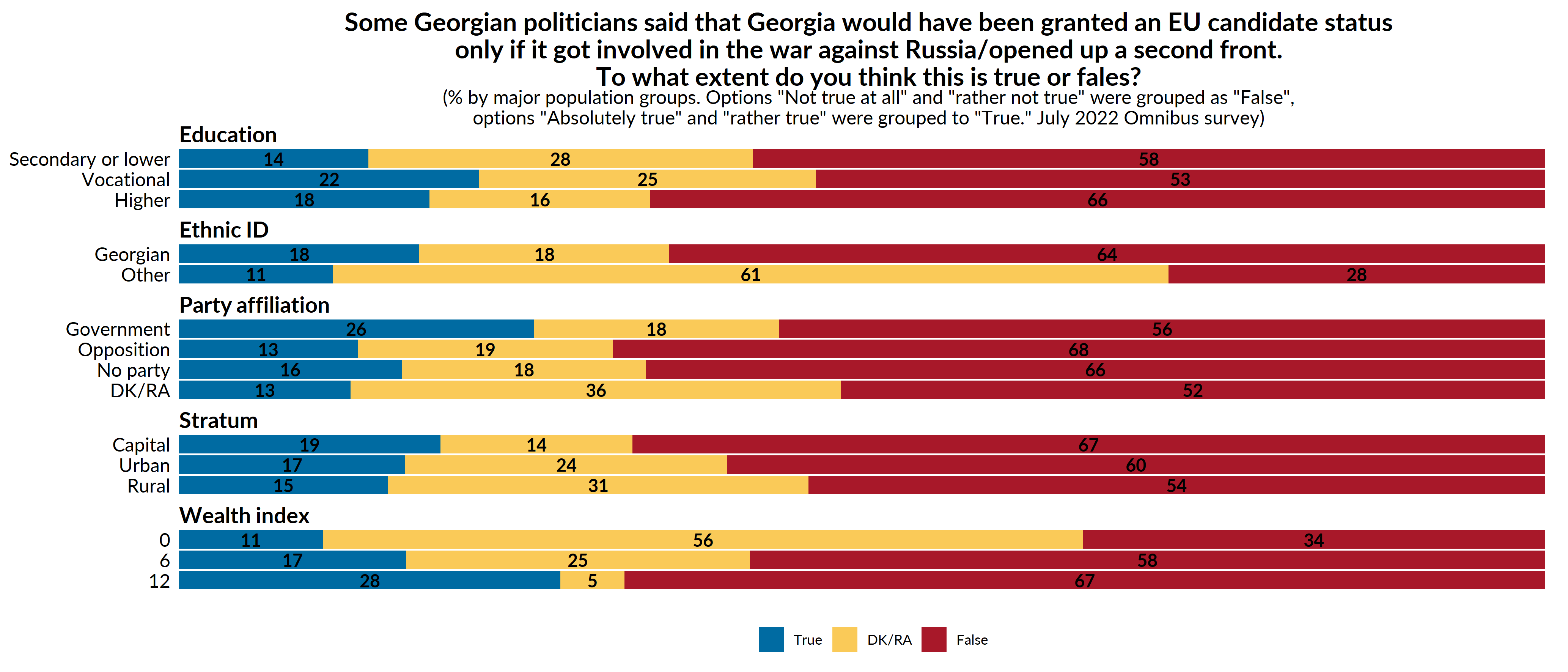
Ambivalence predominates among ethnic minorities and those with lower socio-economic standings. Notably, it also declines with increases in wealth: those who are most well-off are also the most polarised when assessing whether or not the statements about Georgia’s involvement in the war are true.

Where to now?

The European Commission handed Georgia an extensive list of priorities it expects the country to deliver on for candidacy status. The poll shows that most Georgians are sceptical that the government will be able to implement the necessary reforms the EU requested.

When asked whether or not they expect the Georgian government to implement the reforms, the plurality (45%) says they do not expect it to happen, with 17% saying they are not expecting reforms to move forward and 29% believing that it is more unexpected than expected by the end of the year.

By comparison, 29% expect the Georgian government to comply with the EU’s recommendations, about a quarter believe that it is more expected than unexpected that the government will implement the reforms, and 4% think that it is totally expected that the government will complete necessary reforms for Georgia’s EU candidacy status. A quarter of Georgians are unsure (25%).

Several civil society activists suggested that a technocratic government should oversee the implementation of the reforms. When asked whether or not they approved of creating a technocratic government tasked with implementing the reforms needed to fulfil the EU candidacy criteria, the plurality (42%) said they disapproved, 29% approved. More than a quarter were uncertain (26%).

Who is an oligarch?

Among the conditions the EU set for Georgia was the ‘implement[ation] of the commitment to “de-oligarchisation” by eliminating the excessive influence of vested interests in economic, political, and public life’.

While the opinion did not give a conclusive answer as to whom the Commission considered to be an oligarch, Georgian officials were quick to respond. In a 12 July Facebook post, Irakli Gharibashvili, the country’s prime minister, fiercely rebuked the suggestion that Bidzina Ivanishvili, the founder of Georgian Dream and a former Prime Minister, is still in charge.

Gharibashvili even penned another letter to Ursula von der Leyen, the President of the European Commission, where he requested that she distance herself from a European Parliament resolution that called for sanctioning Ivanishvili.

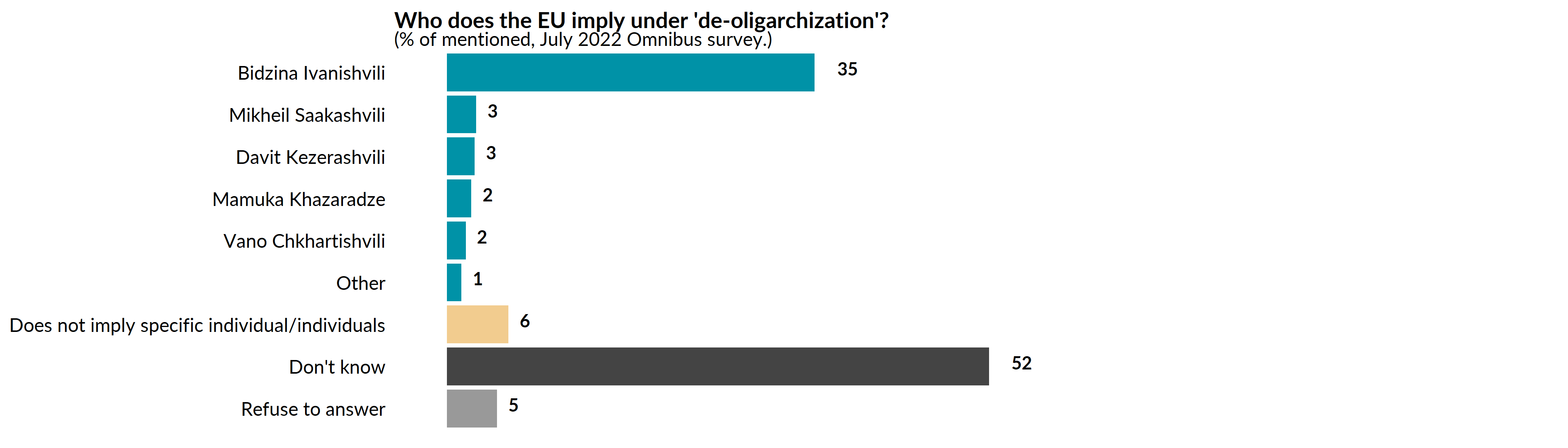
CRRC Georgia asked who the public thinks the EU considers an oligarch in their statement. Notably, more than half said that they didn’t know who the European Commission was hinting at. Among those that did have a concrete response, a third (35%) consider Ivanishvili to be the oligarch in question. Few (3%) named the currently imprisoned Former President Mikheil Saakashvili or Davit Kezerashvili, a businessman and a former defence minister. A further 2% named Mamuka Khazaradze, a co-founder of TBC Bank and the Lelo party, or Vano Chkhartishvili, a Shevardnadze-era businessman and alleged power broker under Ivanishvili. 

Interestingly, those who support Georgian Dream (51%), non-partisans (55%), and those that don’t know which party is closest to their views (62%) are more likely to be uncertain, while a majority of the opposition supporters (60%) believe that the EU was singling out Ivanishvili.
Is Euroscepticism spreading among Georgians?

CRRC Georgia’s omnibus survey shows that most Georgians (68%) still support the country’s membership in the EU fully (53%) or partially (15%). This is slightly less, though still broadly comparable, to previous levels of support in earlier surveys. The 2020 Caucasus Barometer showed that five percentage points more (73%) expressed full or partial support for EU membership.

In a similar survey fielded in mid-March 2022, EU support stood even higher at 75%, indicating a seven-point decrease over the course of five months. Still, this finding should be viewed with some caution, given that the surveys had different questions, which in turn can moderate or exaggerate support.
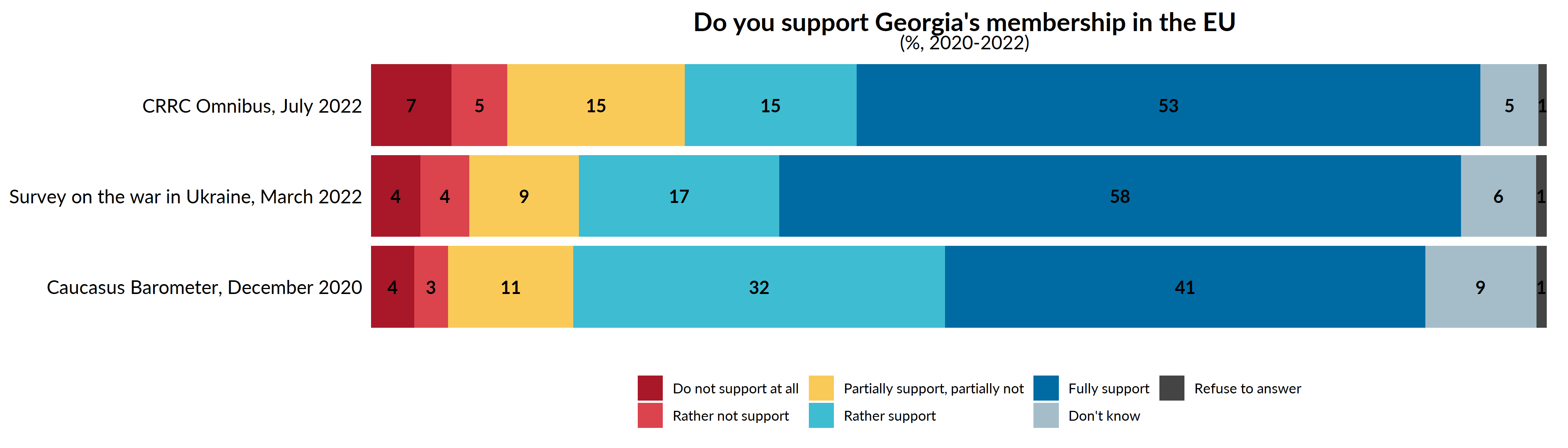
The decline in support for Georgia’s EU membership appears to stem from changing views among Georgian Dream supporters. In the 2020 Caucasus Barometer survey, Georgian Dream supporters backed Georgia’s EU membership by eight percentage points more compared to the July 2022 survey (68%).

Many in Georgia are afraid that the controversy surrounding EU candidacy might undermine public support for Georga’s EU membership. CRRC Georgia’s omnibus poll paints a rather complex picture. EU support runs high, and the majority disagrees with the baseless allegations that the West is dragging the country into a war against Russia. Nevertheless, survey results hint that some Georgians, particularly supporters of Georgian Dream, might be questioning their support for the EU. Whether this is the start of a real shift in public opinion or a statistical blip remains to be seen.

Note: Differences across groups are identified using regression models. Reported figures might not sum up to 100 due to rounding errors. A replication code for the analysis above is available here. Marginal frequencies and crosstabulations are available here.

Tuesday, July 05, 2022

Young people in Georgia want the government to focus on education

Note: This article first appeared on the Caucasus Data Blog, a joint effort of CRRC Georgia and OC Media. It was written by Tamuna Khoshtaria, a Senior Researcher at CRRC-Georgia. The views presented in the article are of the author alone, and do not necessarily reflect the views of CRRC Georgia, GFSIS, or any related entity. 

study conducted in 2021 by CRRC Georgia for GFSIS focusing on the values and political activism of young people in Georgia shows that education is the primary field that young people aged 18–29 in Georgia want to be strengthened. 

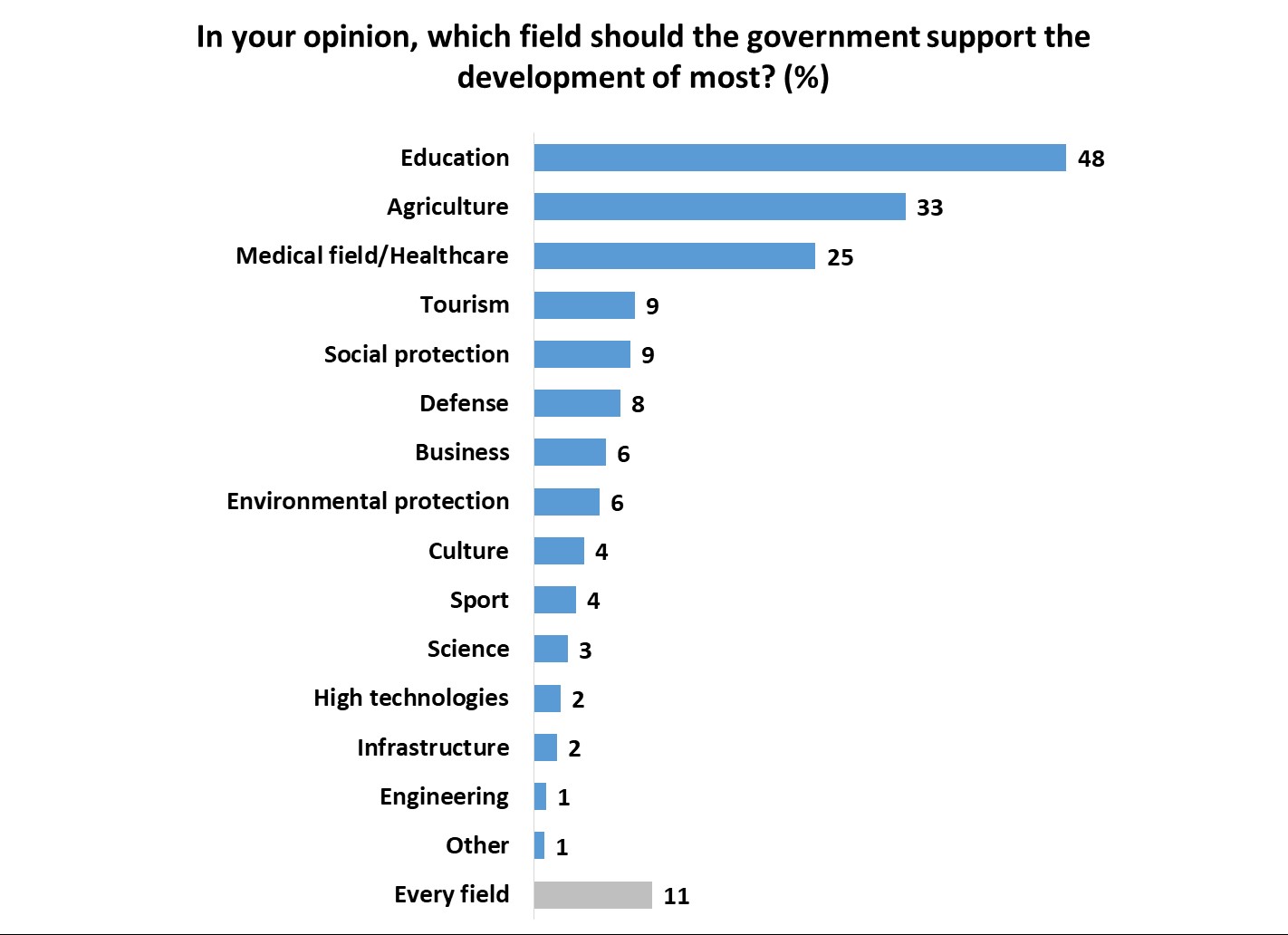
Young people prioritise the development of education above other domains. Almost half of young people (48%) mentioned education when asked what field the government should support most. The next most common response was agriculture, which was named by a third (33%). Healthcare came in third, with a quarter of respondents naming this as a priority.

Note: Respondents could name up to two answers. Therefore the numbers do not add up to 100%.

A regression model suggests that whether young people prioritise education varies according to a number of factors.

Women were eight percentage points more likely to name education than men. 

Young people in rural areas named education less (49%) than those in the urban areas (56%) and the capital (57%). 

The younger a person was, the higher the chance they named education. The probability of someone aged 18–21 naming education was 61% compared to 48% for someone aged 26–29. 

Those with at least some tertiary education also name education more often. Young people with some tertiary education were 13 percentage points more likely to name education than young people with only secondary education.

That university students and recent graduates think that education should be a top priority may point to dissatisfaction with the quality of higher education. 

Other data in the study supports this conjecture. 

When asked to what extent the level of education in Georgian higher education institutions was satisfactory, almost half of those with at least some tertiary education expressed dissatisfaction in contrast to about one-third with secondary education.

Aside from demographics, young people’s attitudes towards the West also predicted whether or not they think education should be a top priority. Young people who said that integration with the European Union or NATO was very important to them were more likely to say that education should be a top priority compared to those who report EU/NATO integration was quite important or not that important.

Overall, the findings suggest that education is a top priority for young people aged 18–29 in Georgia. This is especially important for young women, those under 22, those living in the capital, those with experience in higher education, and those with pro-Western attitudes.  

The views presented in the article are the author’s alone and do not necessarily reflect the views of GFSIS, CRRC Georgia or any related entity. 

Note: The analysis above is based on a logistic regression model.  The variables included in the regression include sex, age group, settlement type, and level of education. The analysis which included attitudes towards NATO and EU integration was conducted using a second and third model, where importance of NATO/EU integration were included as categorical variables in addition to the aforementioned variables. The data used in this blog post are available here.

Wednesday, April 27, 2022

Georgians are becoming less satisfied with the government’s COVID response

Note: This article first appeared on the Caucasus Data Blog, a joint effort of CRRC Georgia and OC Media. It was written by Natia Liluashvili, a junior fellow at CRRC-Georgia. The views presented in the article are of the author alone, and do not necessarily reflect the views of CRRC Georgia, or any related entity.

In the two years since the first coronavirus case was detected in Georgia, roughly 1.6 million people have caught COVID-19 in the country, and more than 1 in 235 people have died due to the virus.

The most recent wave caused by the Omicron variant resulted in over 5% of the country having an active case of COVID-19 at the same time.

During this wave, the government abolished the green passport requirement and lifted most restrictions on businesses. This approach stands in contrast to the government’s approach at the start of the pandemic, which included lockdown policies. But what does the public think of how the government has handled the pandemic?

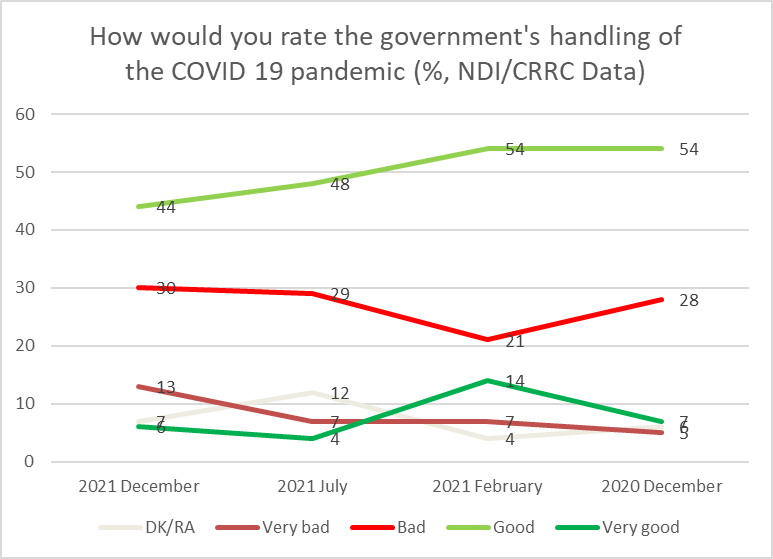
In December 2020, Georgia was in partial lockdown. According to data from the 2020 NDI/CRRC survey, 61% of the public thought the government handled the pandemic well or very well, while 33% rated the government’s handling of the pandemic negatively.

In February 2021, the number of people who positively assessed the management of the pandemic increased to 68%, while only 28% thought that they did a bad job. Notably, this survey took place during the period in which Giorgi Gakharia, Georgia’s former prime minister, withdrew from politics.

Unlike his predecessor, Irakli Garibashvili began to open up the country. At the same time, Georgia started to provide vaccines. Against this background, in July 2021, positive attitudes towards the government’s handling of the pandemic declined to 52%.

In December 2021, the number of daily confirmed cases increased dramatically, which was also reflected in the mortality rate. According to the latest NDI data, half the population (50%) think that the government was handling the pandemic well, with negative attitudes towards the government’s handling of the pandemic increasing from 36% to 43%.

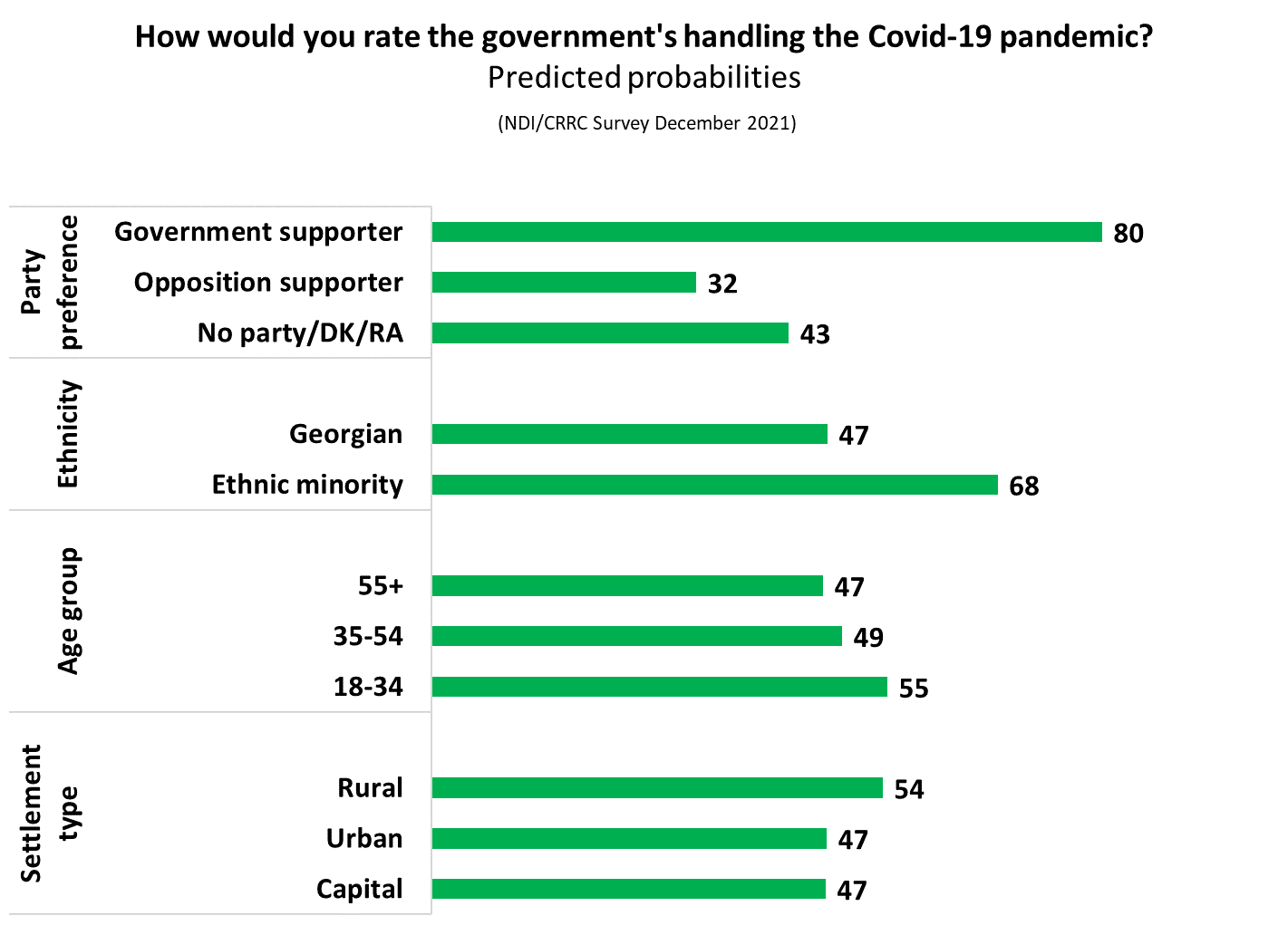
A regression analysis of the December 2021 data shows that the attitudes towards government policies differ significantly by party preference, ethnicity, age group, and settlement type.

People in rural areas have more positive attitudes towards the government’s handling of the pandemic than people in urban areas. Compared to the elderly, young people are more likely to think that the government is handling the COVID-19 pandemic well. Ethnic Georgians also hold less favourable attitudes than ethnic minorities, while Georgian Dream supporters are substantially more positive about the government’s policy than those who support the opposition or no party at all.

Note: This chart was generated from a regression model. The model includes gender (male, female), age group (18–34, 35–54, 55+), settlement type (capital, urban, rural), education (secondary or lower, secondary technical, tertiary), household composition in terms of having children under 12 (have children under 12, do not have children under 12), household composition in terms of having members over 60 (have members over 60, do not have members over 60),  household composition in terms of having members with severe chronic disease (have member with serious chronic disease, do not have member with serious chronic disease), ethnicity (Georgian, ethnic minority), party respondent names as closest to his/her views (Georgian Dream, opposition party, did not name a party (don’t know, refuse to answer, or no party affiliation)).

Even though the number of people who think that the Government is handling the pandemic well is slowly declining, it is high, especially in rural areas, among older people, and among ethnic minorities.

The data this article is based on is available here.

Monday, August 12, 2019

Georgian Language Proficiency and Perceptions of Government Performance among minorities in Georgia

Integration of ethnic minorities into Georgian society is a significant challenge. As a result of ethnic Armenians and Azerbaijanis’ linguistic separation from ethnic Georgian compatriots, some research suggests their ability to participate in government has been low. Indeed, programming aimed at minority integration in Georgia often focuses on language skills. But, the question remains, how do ethnic minorities that are proficient in Georgian perceive the government? The April 2019 CRRC and NDI data suggest that, while ethnic Armenians that speak Georgian at an advanced level have worse attitudes towards government performance in Georgia, ethnic Azerbaijanis that speak Georgian at an advanced level have better attitudes.

Ethnic Azerbaijanis and Armenians generally have positive perceptions of the current government. Almost two thirds (62%) of ethnic Azerbaijani’s and about half (51%) of ethnic Armenians rate the current government as having performed well or very well. By comparison, Georgians rate government performance more negatively.


Further analysis, however, suggests that ethnic Armenian’s perceptions of the government are more negative if they report they have an advanced proficiency in Georgian. In contrast, ethnic Azerbaijani’s perceptions of government are more positive when they report knowing Georgian at more advanced levels.


Knowledge of Georgian language among ethnic minorities is associated with perceptions of government performance. However, for Armenians knowledge is associated with more negative attitudes, while for Azerbaijanis it is associated with more positive attitudes.

Note: The above analysis is based on an ordered logistic regression analysis, where the dependent variable is the respondent's perceptions of the current government's performance. The independent variables are knowledge of Georgian interacted with ethnicity and sex, age group, education, , household size, employment status, settlement type, and household economic status. Replication code for the above analysis can be found here

Tuesday, April 18, 2017

Why the civil service? The civil service as seen by civil servants in Georgia

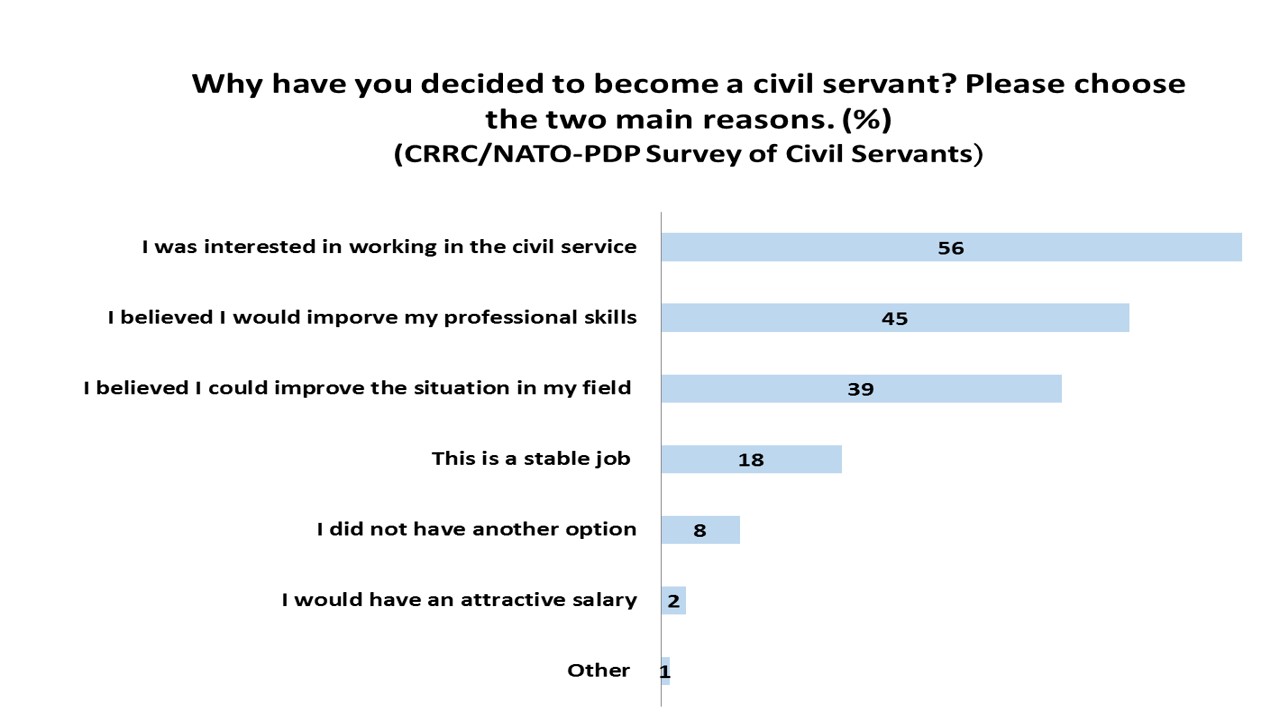
The civil service plays an important role in the development of a country. Thus the competence and motivation of civil servants matter. An online survey of civil servants conducted by CRRC-Georgia for NATO-PDP in December 2015 – January 2016 was one of the first attempts in Georgia to study civil servants’ perceptions of and attitudes towards their job. This blog post provides a brief overview of some of the findings, focusing on reported reasons for choosing to work in the civil service, the advantages and problems civil servants see with their jobs, as well as general assessments of civil servants’ motivation to work.

Slightly over a half of civil servants (56%) reported that the main reason they chose their job was an interest in working in the public sector. Forty-five percent hoped to improve their professional skills. The third most frequently named reason was a hope to improve the situation in their field. Importantly, a rather small share of civil servants (18%) reported a “stable job” as a reason for choosing to work in the civil service, and only 2% named an “attractive salary”.


About half of civil servants named the opportunity to contribute to the development of the country as the main advantage of working in the civil service. The opportunity to acquire new professional skills was the second most frequent answer, while the opportunity to make new connections, work one’s way up within the organization, and work with competent colleagues were named rarely.


Civil servants most frequently assessed the motivation to work of those in the civil service as average (50%). Positive assessments, though, are much more frequent than negative ones (36% vs 15%).

Note: To a certain extent, in response to most of the questions in this survey, civil servants tended to pick answers that can be considered socially desirable. Hence, social desirability bias is likely to have affected other responses as well, including assessments of other civil servants’ motivation to work. In order to avoid this bias in the case of this question, a very general wording was used: “How would you assess civil servants’ motivation to work?” This question measures civil servants’ reported perceptions of their colleagues’ motivation. To a certain extent, social desirability bias likely still influenced responses. However, this influence should be less than if the question had been asked about the respondent herself. 

Should the 50% of “average” assessments be considered a problem? Probably. The state invests financial resources in the improvement of civil servants’ professional skills, and the country, overall, is interested in a high productivity of their work. Undoubtedly, motivation encourages productivity. Thus, higher motivation will also lead to a more efficient use of public resources.

While trying to increase civil servants’ motivation in Georgia, it is important to consider the problems they face. The most frequently named problem is a lack of professionally competent civil servants. A fear of losing one’s job and poor infrastructure come in second and third, followed by a fair number of other problems.


Addressing these problems may improve civil servants’ motivation to work. As a result, the country would benefit from higher productivity among civil servants.

Monday, February 06, 2017

The state procurement system in Georgia: Companies’ views (Part 2)

The first part of this blog post presented findings about Georgian companies’ participation in the state procurement system. This post provides an overview of companies representatives’ assessments of the state procurement system and how these assessments differ depending upon the company’s participation or non-participation in the state procurement process.

Company representatives report that their main sources of information about state procurement include the websites of procuring state entities (17%) and the State Procurement Agency’s Unified Electronic System (16%). However, representatives of companies that do not participate in state procurement report that they do not or cannot get information about the state entities’ procurement tenders.


Note: The number of answer options was not limited during the interviews.

Most companies (60%) report trusting the State Procurement Agency, with only a small share (8%) saying they do not trust it. At the same time, almost a third of companies (30%) say they don’t know whether they trust the Agency or not. Notably, representatives of companies which have never bid on state procurement tenders answer “don’t know” more frequently than representatives of companies that have. Moreover, representatives of the companies which have participated in the state procurement process at least once report trusting the Agency more often than the non-participating companies. This result likely indicates that the participating companies’ experiences working with the State Procurement Agency were positive.


Responses to the question, “How much do you agree or disagree that companies which have connections with the government win tenders?” also vary based on whether companies have experience participating in the state procurement system. Representatives of companies that have such experience disagree with this statement more often. Moreover, representatives of companies which have not participated in the state procurement system respond “don’t know” twice as often as participating companies.


Around one third (36%) of the companies that have participated in state procurement think that tenders are often “tailored” to one specific company and the goal is to ensure that this particular company wins. However, almost half (48%) of the participating companies do not agree with this statement. While 27% of the companies which have participated in the state procurement system agree with the statement that tenders may be repeatedly rejected by the procuring side with the aim of awarding the contract to a particular company through simplified tender, almost half disagree with this statement.


Note: This question was asked to the representatives of the 17% of companies that have participated in the state procurement system.  

As the findings presented in this blog post show, representatives of companies that have participated in the state procurement system at least once assess the State Procurement Agency’s work more positively. Most of them trust the Agency and believe that there is no need to have connections with the government to win tenders. Most representatives of companies that have not participated in the state procurement system have difficulty stating their opinion on these issues. The findings presented in this blog post indicate that the State Procurement Agency should do more to raise awareness among companies about the state procurement system.

To explore this topic more, take a look at CRRC-Georgia’s report Survey of companies on state procurement.