Monday, March 28, 2016

Changing issue salience in Georgia after 2008


While territorial integrity was named by the majority of the population as the most important issue facing Georgia in late 2008 and 2009, in the aftermath of the 2008 war with Russia, the focus has since shifted to economic issues and, first of all, unemployment. Similar changes took place in the population’s priorities regarding support from the EU. This blog post discusses this change using data from the four waves of Europe Foundation’s Knowledge and attitudes towards the EU in Georgia survey conducted by CRRC-Georgia in 2009, 2011, 2013 and 2015.

In parallel to the decline in perceived relative importance of territorial integrity between 2009 and 2015, there has been a clear rise in perceived importance of economic issues. While territorial integrity and lack of jobs were named as the most important issues in 2009 (both named by 53% of the population), lack of jobs and poverty are now in the fore.

Note: A show card with 18 answer options was used for the question “What do you think are the three most important issues facing Georgia at the moment?” and up to three answers were accepted per interview. Only the most frequently mentioned answer options are presented in the chart above.  

The same trend appears when it comes to the topics in relation to the EU which Georgians are interested in getting more information about. In 2009, 29% reported wanting more information about trade relations between Georgia and the EU, while 41% did so in 2015. In 2009, 52% reported wanting more information about the EU’s role in conflict resolution, while 35% did so in 2015.
 

Note: A show card with 11 answer options was used for this question, and up to three answers were accepted per interview. Only the most frequently named answers are presented in the chart above. 

Investment in Georgia’s economy is now the most frequently mentioned kind of support Georgia’s population wants from the EU, while previously it was help with the restoration of territorial integrity.

Note: A show card was used for this question. Only the most frequently named answers are presented in the chart.

While immediately after the 2008 war with Russia, territorial integrity was named as the most important issue in Georgia, today economic issues are named by the majority of the population. Corresponding changes took place in respect to the areas Georgians want support from the EU on.

To find out more, visit CRRC’s online data analysis platform.

Monday, March 21, 2016

Body Mass Index in Georgia


Monday, March 14, 2016

The population of Georgia on immigrants


Unlike emigration, immigration to Georgia is a relatively recent and small in scale phenomenon. The country attracts a diverse group of immigrants from a variety of countries that arrive for educational, work, business or family reunification purposes. Data on immigrant flows and stocks are collected by GeoStat and the Public Service Development Agency of Georgia (PSDA), but since current regulations do not require that citizens of more than 100 countries coming to Georgia even for relatively extended periods of time (e.g., up to 12 months) apply for residence permits or otherwise register, existing residence statistics only provide an estimate of the number of immigrants in the country.

In many societies, including traditional ones with little or no previous experience of immigration, attitudes towards immigrants are rarely welcoming. The findings of a few empirical studies on the subject suggest that Georgia is no exception. CRRC’s 2015 Caucasus Barometer survey tried to find out more about the dominant attitudes in Georgia towards immigrants, defined during the survey as foreigners that have stayed in the country for a period longer than three months. This blog post provides the results of preliminary analysis of CB 2015 findings on the topic.

Only about a third of the population claims to have had any form of contact with immigrants: 9% report they’ve been in contact with them “quite often”, and another 17% have been in contact with them, but not much. The majority of the population (72%) reports never having any contact with immigrants. Unsurprisingly, those living in the capital report interacting with immigrants more often, but even in Tbilisi, 64% reports never having communicated with them.

Irrespective of whether people have or have not had personal contact with immigrants, they are still able to report certain attitudes towards them. Only 9% could not answer the question, “How would you characterize your attitude towards the foreigners who come to Georgia and stay here for longer than three months?” As for the rest, a large majority (61%) describes their attitude as neutral, while 25% describe it as good and 5% as bad. Importantly, as is often the case (among many others, the French and Italian examples are rather convincing), the more people have been in contact with immigrants, the better attitudes they tend to report towards them.


Note: For the question, “Have you had any form of contact with foreigners in Georgia who have stayed here for longer than 3 months?” answer options “Yes, I’ve often been in contact with them” and “Yes, I’ve rarely been in contact with them” have been combined for this blog post, and answer option “Refuse to answer” (less than 1% of all answers) was excluded from the analysis. For the question, “How would you characterize your attitude towards foreigners who come to Georgia and stay here for longer than three months?” answer options “Very good” and “Good” have been combined and labeled as “Good”, while answer options “Very bad” and “Bad” have been combined and labeled as “Bad”. The answer option “Refuse to answer” (less than 1% of all answers) was excluded from the analysis.

Similarly, more of those who have been in contact with immigrants believe that foreigners will contribute to the economic development of Georgia.


As it is the case in many other countries, in Georgia direct interaction with immigrants seems to be one of the most important conditions determining attitudes towards them – however, a very small share of the population of Georgia report having had direct interaction with immigrants. On the one hand, this may indicate that despite the existing myth that lots of foreigners are in the country, their number is actually not that high. On the other hand, this also means that the attitudes of the majority of the population towards immigrants are based on indirect information, which may be inaccurate.

To find out more, visit CRRC’s online data analysis platform.


Monday, March 07, 2016

Volunteerism in Georgia between 2013 and 2015: attitudes and practice


Did the 2015 Tbilisi flood affect the level of volunteerism in Georgia? A recent article on volunteerism, based on CRRC’s 2013 Caucasus Barometer (CB) survey data, argued that the apparent large-scale volunteering efforts following the flood “stirred the hope that volunteerism is on the rise in Georgia”. Based on the soon to be released 2015 CB data, this blog post looks at whether there has been a change in the reported level of volunteering and in the attitudes towards it by settlement type, age and level of education.

CB data from recent years shows that the share of the population of Georgia that thinks volunteering is important for a good citizen has slightly increased. The same is true for the reported level of volunteering. The gap between the two indicators, however, is impressive.


Note: For the question “In your opinion, how important or unimportant is it for a good citizen to do volunteer work meeting the needs of the community without expecting compensation?” only the share of those who chose codes 7 through 10 on a 10 point scale, where code 1 meant “Not important at all” and code 10 meant “Extremely important”, is shown on the charts and analyzed in this blog post. For the question “Which of these activities have you been involved in during the past 6 months? - Did volunteer work without expecting compensation” only the share of those who answered “Yes” is shown on the charts and analyzed in this blog post. 

Actions
In some socio-demographic groups, there are small changes in the reported level of volunteering between 2013 and 2015, although these often are within the margin of error. While only 14% of the population of Tbilisi reported doing volunteer work in 2013, 21% did so in 2015. Nationwide, the reported level of volunteering slightly increased in the 18-35 year old age group and among those with higher education, while it stayed the same in other age groups and among those with secondary technical or secondary or lower education.


Note: The answer options for the question, “What is the highest level of education you have achieved to date?” were grouped as follows: options “No primary education”, “Primary education (either complete or incomplete)”, “Incomplete secondary education”, and “Completed secondary education” were grouped into “Secondary or lower”. Options “Incomplete higher education”, “Completed higher education (BA, MA, or specialist degree)”, and “Post-graduate degree” were grouped into “Higher than Secondary”.

Attitudes
Small positive changes can be observed between 2013 and 2015 in reported attitudes towards volunteering in all socio-demographic groups. In 2013, fewer Tbilisi residents thought that volunteering was important for a good citizen compared to other urban and rural dwellers. In 2015, however, the picture reversed. Assessments of the importance of volunteering also changed in the 18-35 year old age group countrywide, increasing from 66% in 2013 to 75% in 2015.


To sum up, although the reported level of volunteering at the national level did not increase after the June 13th Tbilisi flood, there was a small increase in Tbilisi as well as among the young people and those with higher education. Nationwide, the perception that doing volunteer work is important for a good citizen also slightly increased. In many cases though, the increase is within the margin of error. Hence, further observations will be needed to see if the trend continues.

Although a large gap still remains between the reported level of volunteering and the share of the population reporting positive attitudes towards it, the changes presented in this blog post might indicate that volunteering has a chance to become more widespread in Georgia. Notably, some literature on volunteering argues that volunteering in times of crisis creates a sense of community and solidarity, which was apparent among volunteers after the Tbilisi flood. Memories of volunteering could both inspire and serve as an example for Georgian citizens to volunteer more.

To learn more about volunteering in Georgia, take a look at the Volunteering and Civic Participation in Georgia survey and our previous post on volunteering: Georgian society’s attitudes towards forced “volunteering”.

Monday, February 29, 2016

What the population of Georgia wants to know about the EU and how people want to be informed


The Government of Georgia (GoG) recently announced a plan to better inform the public about European Union (EU) programs in Georgia and their benefits. This effort is important, because the population often does not have accurate information about the EU and Georgia’s relations with it, as described in a recent blog post, as well as in a more comprehensive report. Nonetheless, roughly half of the Georgian population reports they would like to get more information on the EU, and this share has remained steady since 2013. This blog post aims at understanding how the EU and GoG could best design their information campaign about Georgia-EU relations by covering topics Georgians are most interested in. To do so, we take a look at the 2013 and 2015 waves of Europe Foundation’s Knowledge and attitudes towards the EU survey which was conducted by CRRC-Georgia.

To start, existing knowledge about the EU is rather limited. Only 27% of the population of Georgia knew in 2015 that the EU had between 21 and 30 member states, while 23% chose an incorrect answer. Most importantly, half of the population responded that they did not know the answer or refused to answer the question. These findings are roughly the same as in 2013

The population’s level of education seems like an understandable place to turn for possible explanations for the lack of knowledge. However, 46% of those providing an incorrect answer to the respective question report having at least some higher education – in fact, the shares of people with various levels of education are the same irrespective of whether they answered this question correctly or incorrectly.


Note: During the interviews, a show card was used for the question, “How many member states are currently in the EU?” The options from the show card have been recoded for this chart. The option “Incorrect” combines options “Up to 10 [member states]”, “From 11 to 20”, “From 31 to 40”, and “More than 40.” The option “Correct” corresponds to the option “From 21 to 30 [member states]”. Reported level of education has also been recoded for this chart. The options “Complete or incomplete primary”, “Incomplete secondary”, and “Complete secondary” have been combined into category “Secondary or lower education”. The options “Incomplete higher [education]”, “BA”, “MA”, and “Postgraduate” have been combined into the category “At least some higher education”.

When assessing how interested people are in various areas of knowledge about the EU, there is obviously a great deal of interest in the EU’s potential practical benefits for Georgia. Forty-one percent of those who report they would like to get more information about the EU want to have more information on Georgia-EU trade relations, consistent with the finding that economic reasons are named most frequently when Georgians are asked why they support the country’s membership in the EU. Unemployment and poverty being at the top of people’s concerns, it again isn’t surprising that the Georgian population is interested in the socio-economic situation in the EU.

Note: A show card was used for this question. Only the most frequently named answers are presented in the chart. 

Although 35% of those who would like to get more information on the EU mentioned that they would like to have more information on the EU’s role in conflict resolution, when asked what the EU Monitoring Mission does in Georgia, only 20% answered that it helps regulate the situation in the areas affected by the 2008 August War. Forty one percent reported they did not know the answer.

Television was identified by the Georgian Government in 2013 as the main source of information for Georgians about the EU and European integration. However, 40% of the population reported in 2015 that, in their opinion, there was little or no information on the EU on TV – almost twice as much as in 2013.


Note: A 5-point scale was used to record answers to the question, “How much information about the EU do you get from TV?” On the original scale, code ‘1’ corresponded to the answer “No information at all” and code ‘5’ corresponded to the answer “A lot of information”. For the analysis presented in this blog post, answer options ‘1’ and ‘2’ of the original scale have been combined and labeled as “Little / No information”. Option ‘3’ was not recoded and is labeled ”A fair amount of information”. Answer options ‘4’ and ‘5’ were combined and labeled as “A lot of information”. Options “Don’t know” and “Refuse to answer” (less than 5% if combined) were excluded from the analysis. 

Thus, on the one hand, about half of the Georgian population reports wanting to have more information about the EU, and its main source of information is TV. On the other hand, in 2015 more people reported that they receive little or no information on the EU from TV than did so in 2013. But efforts like the harmonization of Georgian legislation with EU legislation in areas such as the common market, sectoral policy, law, freedom, and security require wide ranging and costly reforms before leading to practical benefits. This means the reforms require public support if they are to be sustained. Therefore, it is increasingly important that TV broadcasters and other media find a way to keep Georgians informed about the EU and the country’s European integration. 

If the EU and GoG concentrate their communication efforts on the practical benefits for regular people, they are likely to succeed in sustaining the high level of approval towards European integration in the country.  

Monday, February 22, 2016

Trends in Scientific Output in the South Caucasus: 1996-2012


Increases in the quantity of peer reviewed publications, on the one hand, and citations, on the other hand, are believed to measure scientific progress. In the 1960s, efforts to document, explore and explain trends in scientific progress gave rise to the quantitative study of science and science policy – Scientometrics. The SCImago Journal & Country Rank Portal covers the period from 1996 to 2014 and provides indicators that help us examine the dynamics of scientific output worldwide, including in the countries of the South Caucasus (SC). In this blog post, we present the following indicators: 
  • Number of publications in peer reviewed journals by academics affiliated with the country’s scientific institutions;
  • The ratio of cited peer reviewed publications to uncited ones;
  • International collaboration, measured by the ratio of peer reviewed publications co-authored by individuals from different countries.

The number of peer reviewed publications by authors from all three South Caucasus countries has increased between 1996 and 2012. The chart below shows a notable increase after 2002.


Importantly, the number of both cited and uncited publications has been increasing in each scientific discipline. The ratio of cited to uncited publications, however, has declined slightly, as the chart below shows. 

At the same time, international collaboration, measured as the ratio of SC authors’ peer reviewed publications co-authored with authors from other countries, seems to have increased between 1996 and 2012. As the chart below shows, Azerbaijan falls behind, while international collaboration is slowly but steadily increasing in Armenia and Georgia. 


To sum up, the number of peer reviewed publications is the most rapidly growing indicator, suggesting positive developments in the scientific community of the countries of the South Caucasus. However, it seems that there is still work to do when it comes to the impact of the publications by scholars in the South Caucasus.

To learn more on the subject, take a look at this comparative analysis of the scientific output of Armenia, Azerbaijan and Georgia; this study which examines trends in the development of science in the CIS countries, and this article (in Georgian) focused on Georgian academic institutions. 

Monday, February 15, 2016

Dwellings in Georgia's cities

View of Tbilisi from Turtle Lake (Photo by Mariam Kobaladze)

According to the World Bank, Georgia has become more urbanized since the collapse of the Soviet Union. The shift from a planned to a market economy was accompanied by increasing regional disparities, and more people moved to large urban centers looking for economic opportunities and better living conditions. As a result, more than half of the country’s population (57.5%) currently lives in urban settlements, according to the 2014 census. Based on the STEP Skills Measurement Survey conducted in March and April 2013 in urban settlements in Georgia by CRRC-Georgia on behalf of the World Bank, this blog post looks at the type of dwellings where the urban population lives, including data on the number of rooms per dwelling, type of floor covers and toilets, as well as the ownership status of these dwellings at the time of the survey. The survey data was released in 2015 and, for the time being, is the most recent data available.

The majority of Georgia’s urban population (78% of the population of Tbilisi and 53% of the population of other towns and cities) lives in apartments in large apartment blocks with more than ten apartments. Only 14% of Tbilisi residents live in single family houses compared with 41% of residents of other urban settlements.


When it comes to ownership, 83% of Tbilisi residents and 90% of the residents of other towns and cities own their dwellings. Only 9% of Tbilisi residents and 3% of the residents of other urban settlements rent their homes or apartments.

About one third of residents of urban settlements live in three-room dwellings. One- and two-room dwellings are more common in the capital, while five-room or larger dwellings are more common in the non-capital urban settlements.


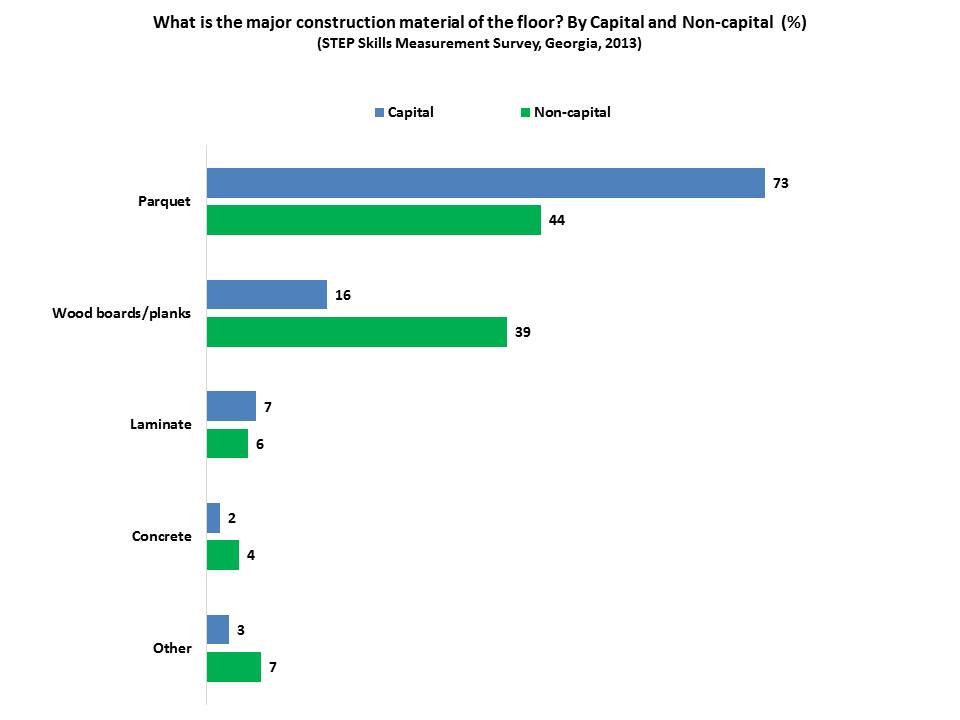
Parquet floors are the most common flooring material in Tbilisi, where 73% of floors are made from parquet. The respective share in other urban settlements is 44%. The next most common flooring material is wood boards used in 16% of dwellings in Tbilisi and 39% in other urban settlements.


As the survey was only conducted in urban settlements, it is not surprising that most of the dwellings have flush toilets connected to a piped sewer system (97% in Tbilisi and 79% in other urban settlements). Still, there are dwellings that have pit latrines with slab (2% in Tbilisi and 11% in other urban settlements).

Note: The sum of answer options exceeds 100% due to the rounding. 

Thus, most urban Georgians reside in apartments in large apartment blocks. About a third of the urban population lives in dwellings that have two or three rooms. Most people own the dwellings they live in. Notably, there are still homes in the cities that do not have toilets connected to the sewage system.
To explore this topic more, have a look at the data, here.

Monday, February 08, 2016

Playing on traditions: Has Russia’s propaganda worked?

Has Russian influence in Georgia increased in recent years? While the political elite and civil society leaders argue a lot about this issue, in an August 2015 survey, CRRC and NDI asked people what they think. Findings presented in a recent blog post show that a significant share of Georgians (44%) perceives Russian influence as having increased since 2012. This number is all the more alarming considering that only 17% think that the EU’s influence has increased during the same period. Paradoxically, all this is happening against the backdrop of Georgia’s declared EU aspirations and a number of important EU-related foreign policy achievements. This blog post explores how recent efforts of Russian propaganda may have contributed to a decline in support for EU membership.

European Initiative – Liberal Academy Tbilisi (EI - LAT) recently conducted research on Russian soft power and hard power policy in Georgia and published a policy brief highlighting specific mechanisms used by Russia to increase its influence in Georgia. The research findings suggest that there is evidence of increased Russian influence on Georgia, and the brief describes some of its mechanisms. According to the document: 

"Political myths are one of Russia[n] propaganda[‘s] most important tools in Georgia. Russian propaganda is often built on emotional messages to create and strengthen negative stereotypes of ethnic, religious and sexual minorities, discrediting the western political or cultural space and supporting homophobic and xenophobic opinions among the public. By cultivating these myths, Russia [presents] itself as Georgia’s only ally with a common identity, [religious] faith, history and culture. Simultaneously, it portrays the West as a threat to all the above-mentioned values."

While this statement is based on qualitative research findings, it finds support in CRRC’s public opinion survey data. In 2009, 2011, 2013 and 2015 CRRC conducted four waves of The Knowledge of and Attitudes towards the European Union in Georgia (EU survey) survey, funded by the Europe Foundation (formerly the Eurasia Partnership Foundation). These surveys’ findings show that, overall, the Georgian population’s reported support for Georgia’s EU membership has decreased between 2013 and 2015.


The EU survey data shows that Georgians increasingly perceive the EU as a threat to Georgian traditions. These traditions are extremely important for the people in Georgia who believe that preserving traditions is more important for a good citizen than being critical towards government or working as a volunteer. Thus, the above discussed mechanism of cultivating anti-Western myths may be very efficient in altering Georgia’s pro-Western course.

In fact, according to the EU survey data, the fear that the EU will harm Georgian culture and traditions has increased in Georgian society over the past seven years, especially after 2013. The 12% increase in the share of those who fully agree with the statement, “The EU threatens Georgian traditions,” over two years is a significant change and indicates the existence of a mechanism amplifying this fear.


The same attitude is demonstrated in the answers to another question asked on the same survey. About a third of Georgians believe there will be less respect for Georgian traditions if the country becomes an EU member. Notably, the share of those who think that respect for Georgian traditions will decrease significantly has doubled since 2013. 


The increasing fear that Georgia’s membership in the EU could threaten the country’s traditions can be considered another indicator or outcome of Russian propaganda discussed in detail by EI – LAT. Although this blog post does not prove that there is a direct causal relationship between Russia’s propaganda and changes in public attitudes towards the EU, the CRRC/EF data clearly show three trends that are, most probably, interrelated: 

1. Traditions are very important for Georgians; 
2. The EU is increasingly perceived as a threat to Georgian traditions; 
3. Although still at a high level, direct support for EU membership has declined. 

Based on both CRRC/EF and EI-LAT findings regarding Russia’s propaganda, we can assume that Russia’s propaganda was not only well informed and well planned, but also successful to a certain extent: the fear that the EU will harm Georgian traditions appears to have contributed to a decrease in the number of supporters of Georgia’s EU membership. This result is likely facilitated by the public not being well-informed about the EU, specifically – its commitment to preserve national traditions and supporting cultural heritage. 

The findings presented in this blog post shows that empirical research can be used not only for planning a successful propaganda campaign (by getting information on the most sensitive and important aspects of a given society), but also for detecting propaganda mechanisms and, potentially, taking counter measures.

Further research is essential and should focus on exploring the nature of the fear of “losing” traditions, as well as what people mean by Georgian traditions, as suggested by the Europe Foundation in a recent report. The findings also suggest that an awareness raising campaign on what EU membership actually implies is crucial for combating anti-Western propaganda.

If you would like to explore  Georgians’ attitudes towards the EU more, the data used for this post is available on CRRC’s online data analysis platform. As always, we welcome further analysis and your comments on our Facebook or in the comments section below.

Monday, February 01, 2016

The Georgian public's perceptions of the EU’s and Russia’s influence on the country


Numerous news reports in 2015 focused on foreign influence in Georgia (for instance, see the Financial Times, The Washington Post, Al Jazeera, the Wall Street Journal, Foreign Policy, the BBC, Foreign Affairs for some of the stories related to Russian influence), but how does the Georgian public see the situation? This blog post takes a look at how much influence the Georgian public think two foreign powers, the EU and Russia, have on Georgia compared with how much influence they think these powers should have, using August 2015 National Democratic Institute (NDI) and CRRC-Georgia survey findings.

The Georgian public thinks that Russia has more influence on Georgia than it should have. Forty-nine percent of Georgians assess Russia’s political influence on Georgia as somewhat or very high, while only six percent thinks it should be so. Sixty-eight percent think Russia’s political influence on Georgia should be low or that they should have no influence at all. When it comes to cultural influence, the mismatch is smaller although the pattern remains similar – 43% of Georgians assess Russia’s cultural influence as low  or none, while 58% think that it should be low  or none. When it comes to economic influence, 30% of Georgians assess Russia’s influence on Georgia as somewhat or very high, while only 12% think it should be so.


   .
In comparison with Russia, the influence that the Georgian public thinks the EU should have in Georgia is closer to influence Georgians think it does have, but there is still a mismatch, especially when it comes to assessments of political influence.


The share of Georgians who think that Russian influence on Georgia has increased since 2012 is higher than the share of those who think that EU influence has increased in the same period (44% and 17%, respectively).


When it comes to foreign influence on Georgia, Georgians clearly think that Russia has much more political, economic, and cultural influence than it should have. The assessments are much more similar in case of the EU. Notably, more Georgians perceive Russian influence as having increased since 2012 than those who think the EU’s influence has increased.

Want to explore the data in more depth? Take a look here, using our online data analysis tool.

Monday, January 25, 2016

The Georgian public’s awareness of visa liberalisation with the EU: Facts and expectations


The visa liberalisation agreement between Georgia and the EU is expected to enter in force in Summer 2016, allowing Georgian citizens holding biometric passports to enter and stay in Schengen area countries without a visa for up to 90 days in a 180-day period. EU-Georgia Visa Liberalisation Dialogue was launched in June, 2012. In February 2013, Visa Liberalisation Action Plan (VLAP) was presented to Georgian authorities. The European Commission’s December 2015 progress report stated that “given the outcome of the continuous monitoring and reporting carried out since the launch of the EU-Georgia Visa Liberalisation Dialogue, the Commission considers that Georgia meets all the benchmarks set in respect of the four blocks of the second phase of the VLAP.”  Visa liberalisation, however, in no way gives Georgians the right to work, study or become residents of Schengen area countries – for these purposes, a labor, study or immigration visa will be needed.

Visa liberalisation is considered a significant success of Georgian foreign policy and is an important step towards country’s EU integration through increased mobility. It is crucial to know, however, to what extent the population of Georgia is aware of the specific aspects of visa liberalisation, hence – how informed their opinions about this process are.

Before the European Commission’s December 2015 progress report mentioned above, CRRC’s 2015 Caucasus Barometer survey, conducted in October 2015, asked a series of questions measuring the population’s awareness of the then-expected visa liberalisation process. When asked, will successful completion of the visa liberalisation process benefit or not ordinary people living in Georgia, only 12% responded ‘no,’ while 32% answered they believed it would benefit ordinary Georgians. The remaining 56%, however, answered either “Don’t know” or said they did not know what the visa liberalisation process was (26% and 28%, respectively), with a small share refusing to answer the question. Hence, questions about specific aspects of the visa liberalisation process were only asked to those who answered either “yes” or “no” to this question i.e. just under a half (45%) of the total sample.

Importantly, only slightly over half (53%) of this group knows that only those Georgian citizens who possess biometric passports will be able to benefit from visa liberalisation, with 28% answering “Don’t know.” Even fewer (45%) are aware that the conditions of the visa liberalisation agreement will be effective only if the length of stay in EU countries does not exceed three months; this question resulted in the highest share (37% of the eligible group) answering “Don’t know.” Even more worrying is the finding showing that 42% of this group wrongly thinks that visa liberalisation will allow the Georgian citizens who have already emigrated gain living and work permits in the EU countries, without having to apply for additional residency documents – a major misunderstanding of what visa liberalisation is about.


 Note: These questions were asked only to those who answered either “Yes” or “No” to the previous question, “In your opinion, will successful completion of the visa liberalisation process benefit or not benefit ordinary people living in Georgia?” (i.e. 45% of the total sample). 

Although those living in Tbilisi tend to have slightly better knowledge compared to those living in other cities/towns or villages, the difference is not striking, and it cannot be claimed that the Tbilisi population is very well informed about specific aspects of visa liberalisation.

There are, though, interesting variations in knowledge by age. While Georgians of all age groups respond quite similarly to the question about whether or not visa liberalisation conditions apply if a person does not hold a biometric passport, younger Georgians tend to be better informed that the visa liberalisation agreement will be effective only if the length of stay in EU countries does not exceed three months and that visa liberalisation does not actually mean that Georgian citizens who have already emigrated will gain living and work permits in EU countries.


These findings strongly suggest that an awareness raising campaign about what the visa liberalisation process with the EU actually implies is crucial. A successful campaign will help to ensure that the population of Georgia has adequate expectations of it and makes informed migratory decisions to the EU countries once visa liberalisation enters into force.


Monday, January 18, 2016

Georgian society’s attitudes towards forced ‘volunteering’


Although the history and contextual background of volunteering in Europe vary from country to country, in most western societies, the development of volunteerism is associated with the emergence of civil society organizations, which appeared on the scene as a result of the crisis of the welfare state when governments could no longer manage to respond to the growing needs of society. Until the end of the 1990s the situation was different, though, in many socialist states, where the citizens were often forced to ‘volunteer’ for state controlled organizations. This practice had nothing to do with actual volunteering and would sometimes lead to human rights abuses. At the time, one of the common forms of this phenomena was ‘community service,’ e.g. organized cleaning of large public spaces, usually carried out on Saturdays (Shabatoba in Georgian). For many people living in socialist countries, it was an obligatory activity, often of a political character, and widely used by the state propaganda machine.

A number of recent studies argue that currently observed negative attitudes towards volunteering in some of the post-socialist societies are a consequence of Shabatoba and similar experiences (UNV, 2010; GHK, 2010; Ekiert and Foa, 2011). At the same time, there are other studies (UNV and UNDP, 2009) arguing that it is impossible to generalize any finding about how people felt and still feel about forced 'volunteering' practices.

Currently, attitudes towards Shabatoba-type activities are all but straightforward in Georgia. This blog post looks at how these attitudes differ by age, level of education, and previous volunteering experience, based on the findings of CRRC’s April 2014 Volunteering and Civic Participation in Georgia survey, funded by East-West Management Institute (EWMI) and the United States Agency for International Development (USAID).

According to the abovementioned UNV and UNDP 2009 study, if older generations tend to remember socialist era unpaid work programs with certain affection, for the younger generations, it is often hard to understand how such forced work could have been enjoyable. Considering this finding, one would expect younger Georgians to have less positive attitudes towards Shabatoba-type activities, compared to representatives of older generations. Surprisingly, however, the survey results show that representatives of different generations report quite similar attitudes towards potential forced ‘volunteering’ in today’s Georgia. The majority of Georgians of all age groups agree with the statement that “Georgia would be better off today, if the government forced us to volunteer,” although a slightly smaller share of young people (18-35 years old) agree with it, compared with those aged 36 and older.

Note: A 10-point scale was used to record answers to the question, the answer options for the question “In the Soviet Union there were Shabatoba-s, when people were jointly cleaning up public spaces. What do you think about having similar activities in Georgia now?” On the original scale, code ‘1’ corresponded to the opinion “We are lucky that the government does not force us to volunteer,” and code ‘10’ corresponded to the opinion “Georgia would be better off today if the government forced us to volunteer.” For this blog post, the answers were grouped as follows: codes 1 through 4 were labeled as “We are lucky that the government does not force us to volunteer.” Codes 5 and 6 were labeled as “Neither agree nor disagree with any of the statements.” Codes 7 through 10 were labeled as “Georgia would be better off today if the government forced us to volunteer.” Options “Don’t know” and “Refuse to answer” were excluded from the analysis. 

A number of studies conducted in the EU and in some of the post-socialist states (although not in Georgia) have shown that people with higher education tend to volunteer more than people with secondary education (UNV and UNDP, 2009; GHK, 2010). One might expect that the opinions about whether a government should be forcing citizens to volunteer or not would also differ by level of education. In fact, according to our survey results, those with higher education are slightly less inclined to agree with the statement that it would be better if the government forced citizens to volunteer, compared to those with secondary technical or secondary or lower education.

Note: The answer options for the question, “What is the highest level of education you have achieved to date?”  were grouped as follows: options “No primary education”, “Primary education (either complete or incomplete)”, “Incomplete secondary education”, and “Completed secondary education” were grouped into “Secondary or lower.” Options “Incomplete higher education”, “Completed higher education (BA, MA, or specialist degree)”, and “Post-graduate degree” were grouped into “Higher than secondary”.

Notably and rather unexpectedly, those who have previously been engaged in volunteering (for example, have planted a tree outside their own property or have cleaned a public space) report slightly more often that Georgia would be better off today if the government forced citizens to volunteer, compared with Georgians who have not participated in such activities.

Note: A new variable was computed for this chart based on the questions, “Have you planted a tree outside your property during the past 6 months?” and “Have you helped to clean public space during the past 6 months?”  The answer “Yes” in the new variable means participation in at least one of the abovementioned activities, and “No” means participation in neither. 

To sum up, the findings presented in this blog post are rather unexpected. The majority of Georgians think the country would be better off today if the government forced citizens to volunteer, and this attitude varies only slightly by age and level of education. Probably the most unexpected of these findings is that those with volunteering experience support this idea slightly more often than those who have not been involved in volunteering activities previously, and this correlation proves to be statistically significant, although relatively weak.

To learn more about volunteering in the South Caucasus, take a look at earlier blog posts, What We Know About Volunteering in Georgia, Volunteerism in the South Caucasus and Community support and volunteerism in the South Caucasus.  If you wish to know more about Volunteering and Civic Participation in Georgia surveys, visit our Online Data Analysis tool or take a look at the Volunteering and Civic Participation report.

Monday, December 28, 2015

People to rely on - Georgians and their social networks

[In this last blog post of 2015, CRRC Researcher Tamuna Khoshtaria reflects on one the most important aspects of Georgian society – people to rely on, i.e. relatives, friends, neighbors.]

When I was studying in Germany, the dormitory’s housekeeper told me: ‘I have seen students of many nations coming here to live, and many of them were homesick at some point, but for Georgians, it has always been the hardest to live abroad.’

He had a point. Now, almost ten years later, what keeps me in Georgia are, for the most part, my friends and the people I can rely on – my social circle. Many people around me feel the same way. The findings of CRRC’s 2014 survey on Volunteerism and Civic Engagement let us see how valuable social networks of friends, relatives and neighbors are for Georgians.

The overwhelming majority of Georgians (92%) say they have close friends. Of these, 21% report getting together with their close friends every day, 34% at least once a week, and a further 22% at least once a month. If we break down the data by gender, we see that compared to females, slightly more males manage to meet with their friends on a daily basis (24% vs 18%). Also, young people (18 to 35 years old) manage to get together with friends more frequently than those who are older (30% vs 16%).

At the same time, most people in Georgia are quite open to new friendships: 73% disagree with the statement that they already have many friends and do not need to make new friends. Roughly the same share (74%) agrees with the statement that they enjoy meeting new people.

Half of the Georgian public reports they have not gained new friends during the last 12 months. For those who did though, new friends are most often found through the old ones.

 
Note: Respondents could select more than one answer option.

Close relatives are another important part of social networks. Half of the Georgian population reports seeing close relatives who do not live in the same household at least once a month. The majority (66%) say they always or often discuss private problems with them.

Neighbors represent another important part of Georgians’ social networks. Fifty-six percent of the population says they know all the neighbors in their neighborhood. Another 24% says they know more than ten families in their neighborhood, and only 17% knows ten or less families. The share of those who know all of their neighbors is higher in rural settlements (68%), in the big cities (57%) and in other urban settlements (66%), compared to Tbilisi, where only about a third of the population (34%) report so.

Knowing their neighbors implies talking to them, and 64% of Georgians say they talk with their neighbors every day. Another 25% say they talk at least once a week. These talks with neighbors quite often turn into discussing different issues. Twenty-nine percent report always or often discussing common problems in the neighborhood, and 23% say they always or often discuss politics with their neighbors.

These results show that Georgians do not lead isolated lives. They have people around them whom they can trust and count on when it comes to good and bad times. Half (52%) of Georgians agree with the opinion that there are plenty of people they can rely on when they have problems, and 74% say there are people who would look after them if they needed to, without expecting any compensation. Importantly, this support seems to be a two-way street, as 64% of Georgians also say they can be helpful to many people outside of their families.

The people we are around and who we rely on could be the main motivation for many Georgians to stay in the country, even when there are possibilities to emigrate and improve one’s living conditions. Though it is hard to talk about others – I know I am one of those Georgians.

To learn more about the social networks of the Georgians, take a look at the data used in this post using our Online Data Analysis tool, here.

Tuesday, December 22, 2015

No, Putin is not winning Georgia away from Europe. Here are the facts.

[Editor's Note: This post was originally published on the Washington Post's Monkey Cage on Monday, December 21, 2015. The original post is available here. The views and opinions expressed in this article are those of the author alone and do not necessarily reflect the views of CRRC-Georgia or any of the sponsors of the survey which this article is based on. The data on which this article is based is available here.]

By Dustin Gilbreath

Last Friday, after years of diplomatic wrangling over the course of two administrations, the Republic of Georgia received a report from the EU green lighting visa free travel within the European Union in the near future. Yet, media accounts from earlier this year suggested that Georgia was undergoing a “Russian turn”.

That appeared to be true last May, when an NDI-CRRC public opinion poll declared that 31 percent of Georgians favored ECU membership. Have voters in the Republic of Georgia suddenly begun to prefer an affiliation with the Russian-led Eurasian Customs Union over their existing affiliation with the European Union?

If true, it would be shocking. Since its independence in 1991, Georgia has favored Europe overwhelmingly. Polling has found levels of support for the EU that Brussels could only dream of elsewhere in Europe, and serious ongoing problems between Georgia and Russia would naturally strengthen those pro-Europe leanings.

Certainly, many observers have taken that poll number to heart. Nearly a dozen publications and organizations—such as the Financial Times, the Washington Post, Al Jazeera, the Wall Street Journal, Foreign Policy, the BBC, Foreign Affairs, Carnegie Endowment, and Brookings Institution—have cited the number. It even seems to have influenced a Roll Call op-ed, the first sentence of which cited “recent news accounts” on Georgia and Ukraine. Almost every news account on Georgia at the time cited the number.

But that number hasn’t changed since 2013, when the Caucasus Barometer examined support for Georgian Customs Union membership. Moreover, the number by itself is misleading. The data show far fewer Georgians are consistently pro-Russian. ”The Russian turn” has been overstated.

Two Unions, Four preferences

In August, Georgians were asked whether they approve of the Georgian government’s goal of joining the EU and whether Georgia should join the Eurasian Customs Union. Twice as many Georgians prefer the EU to the Eurasian Union, 61% to 31%. This has been largely consistent over time, although support for the EU has had its ups and downs with a slight decline in recent years. Nonetheless, support for the Eurasian Customs Union has never been more than half the level of support for the EU.

Georgians fall into four consistent groups about union membership. Here’s the largest one: 39% say they would vote for the EU and against the Customs Union (marked in the graph below as pro-EU). Only 15 percent would vote for the Customs Union and against the EU. The joiners, 12 percent, support membership in both unions. And the isolationists, 5 percent, would vote against both unions. Another 11 percent don’t know how they feel about either union, and 17 percent had responses that didn’t really have a clear interpretation.


Why would any Georgians support economic union with the nation’s former oppressor, Russia?


To read on, please visit the Washington Post's Monkey Cage:


Wednesday, December 16, 2015

What We Know About Volunteering in Georgia

[This post originally appeared in investor.ge]

By Nino Zubashvili

Following the June 13, 2015 flood in Tbilisi, hundreds of volunteers helped to clean the disaster-affected zones of the city, which stirred the hope that volunteerism is on the rise in Georgia. In the past, studies on volunteering in Georgia conducted by non-governmental organizations (such as Helping Hand and the Civil Society Institute) claimed that volunteerism had not taken root in Georgian society, and CRRC-Georgia surveys have consistently shown a mismatch between attitudes and actions regarding volunteering in Georgia. Nonetheless, a closer look at the level of volunteering in Georgia, comparing it to Europe, and Georgian society's attitudes towards the importance of volunteering show fertile grounds for volunteerism in Georgia.

The mismatch

CRRC-Georgia's 2013 Caucasus Barometer survey findings show that 68% of Georgians find it important for a good citizen to do volunteer work. In contrast, only 19% of Georgians reported volunteering during the past six months before the survey was carried out in fall of 2013 - a clear gap between actions and attitudes. Interestingly, while the share of the population highlighting the importance of volunteerism for good citizenship increased between 2011 and 2012, the share of Georgians who actually volunteered did not change much. Notably, volunteering is still not considered as important as following traditions, voting in elections or supporting people who are worse off. 

Despite the existing mismatch, if we compare Georgia to other European states, the level of volunteering is not particularly low. A study on volunteering in the European Union carried out in 2010 by the British consultancy GHK Holdings Limited showed that the highest rates of volunteering hovered around 40%, but only in a few states (Austria, Netherlands, the UK and Sweden). In fact, European volunteering rates were largely comparable to those in Georgia, ranging from 10%-19%, and European states like Italy and Greece actually had even lower rates (less than 10%). 

Who volunteers, and who thinks it is important to volunteer?

When thinking about the prospects for the development of volunteerism in Georgia, it is important to know who tends to volunteer, which in turn would allow policy makers, NGOs and social entrepreneurs to understand where to best direct programs aimed at promoting volunteerism. The 2013 Caucasus Barometer survey findings show some differences in volunteering between socio-demographic groups. The elderly (aged 56 and older) are slightly less active (14% reported volunteering) than 18-35 and 36-55 year olds (20% and 22%, respectively), but this lower activity level could probably be explained by the infirmities of age. Interestingly, males tend to volunteer more than females (25% and 14%, respectively) and inhabitants of rural areas are slightly more actively engaged in volunteering (24%) than inhabitants of the capital (14%) and other urban areas (15%). In contrast to the European states studied in the above-mentioned GHK study, where the level of education tends to be connected with the level of volunteering, in Georgia an individual's level of education does not seem to matter with regard to involvement in volunteering. 

Like actual volunteering activity, attitudes towards the importance of volunteering do not change much by level of education, nor do they change by respondent's age or gender. Settlement type however, is a differentiating factor and fewer Tbilisians think that volunteering is important for a good citizen (60%), compared to other urban and rural dwellers (68% and 72%, respectively). This is all the more striking when we breakdown by age groups within settlement type. Even though the majority of volunteers following the 2015 floods were clearly young, in Tbilisi, young people were the least likely age-settlement group to think that volunteering was important for a good citizen. 

The level of volunteering that followed the Tbilisi flood and Georgian society's agreement that volunteering is important show that there is potential in the country for the level of volunteering to increase. Policy makers, civic society and social entrepreneurs alike should consider ways to work off of the obvious spirit of volunteerism embodied by the cleanup efforts and the already supportive attitudes towards volunteerism in Georgia. 

Interested in more data about volunteerism? Check the upcoming Caucasus Barometer 2015 data that will be available by the end of the year or take a look at the 2014 Volunteering and Civic Participation in Georgia survey at caucasusbarometer.org

Monday, November 30, 2015

Public opinion on Georgia’s EU membership prospects in 2015


If a referendum were held tomorrow, a majority of the Georgian population (61%) would vote for the country’s membership in the European Union, according to the fourth wave of the Knowledge and Attitudes towards the EU survey carried out by CRRC-Georgia for the Eurasia Partnership Foundation in May of 2015. But anyone familiar with the situation in Georgia and the politics of EU enlargement understands that EU membership is, at best, a long term prospect for Georgia. The country’s democratic consolidation and economic development, in addition to the settlement of the oft mentioned territorial conflicts in Abkhazia and South Ossetia are crucial to Georgia’s prospects for becoming a candidate for EU membership. With this in mind, what does the Georgian public think about the country’s EU membership prospects?

Generally speaking, Georgians are optimistic in their outlook on the country’s EU membership prospects. This optimism though appears to have declined in the last two years. While in 2013 roughly a third of the Georgian public believed the country would become an EU member state within five years or less (from the period of survey fieldwork), today roughly a fifth of the population believes so.

Skepticism about eventual membership also appears to have increased. While a negligible share of the population once reported that Georgia would never join the European Union, today approximately one in ten Georgians think so. Over time, the share of Georgians who are unsure of whether Georgia will ever be an EU member state has remained relatively stable at approximately two fifths of the population.


Despite the optimism still remaining about eventual membership prospects, most Georgians recognize that the country has a fair way to develop. Between 42% and 52% of them believe that Georgia is not yet ready for EU membership when it comes to Georgian legislation’s harmonization with the EU’s, having a competitive market economy, the protection of human rights and, specifically, minority rights, rule of law, and the formation of democratic institutions. The share of the population that believes Georgia is more ready than not for EU membership in the fields noted above is between 20% and 32%.


The Georgian public recognizes a number of structural barriers as impetuses to eventual EU membership. The most commonly reported barrier is the unresolved territorial conflicts in South Ossetia and Abkhazia (43%). This is followed by political instability (28%) and an underdeveloped economy (21%). The next two most frequently reported barriers are related to foreign policy – Russia (17%) and a lack of political will from the EU (12%).


Note: A show card was used. The respondents could choose up to three answer options. 

The Georgian population is aware of the barriers to the country’s membership in the EU, and between 2013 and 2015 the assessment of the country’s prospects to become an EU member have become more realistic. Take a look through the 2015 Knowledge and Attitudes towards the EU survey data using CRRC’s Online Data Analysis tool, here.

Parenting, gender attitudes and women’s employment in Georgia

In Georgia, unemployment is high, and it is higher among women than men. Policy changes are definitely needed not only to increase the employment opportunities, but also to ensure more equal employment opportunities for men and women. However, survey findings show that changes in Georgians’ attitudes towards gender roles are no less needed, as the population does not always support the idea of women having paid jobs – especially so, when they have young children. This blog post looks at what the population of Georgia thinks about working mothers and their ability to care for their children.

Women’s employment can be beneficial for families and societies in many ways. The potential benefits for children when they have working mothers were recently described in an article published by the Harvard Business School. The findings of a cross-national survey covering 24 countries suggest that it is good for children under the age of 14 if their mothers work, instead of staying at home full time. The study showed that the sons of working mothers are more caring for family members compared with the sons of stay-at-home mothers. Probably more importantly, daughters raised by working mothers had greater career success and more stable relationships than the daughters of stay-at-home mothers. Other studies indicate that the relationship between women’s attitudes early in life towards gender roles and their later employment is recursive: “women’s early gender role attitudes predict their [adult life] work hours and earnings, and women’s work hours predict their later gender egalitarianism” (Corrigall and Konrad, 2007).

In October 2014, CRRC-Georgia conducted a nationwide public opinion poll for the National Democratic Institute (NDI) on attitudes towards gender issues in Georgia. A representative sample of 3885 respondents was interviewed in order to explore their attitudes towards women’s participation in society and politics as well as ideas about how to improve women’s position in society.

The survey’s results indicate that female unemployment may not be considered a serious problem by Georgians, because women are believed to be capable of self-realization even if they do not have a job. Moreover, unemployed mother’s children are believed to be better off compared to the children of employed mothers. The chart below shows that 65% of Georgians believe “It is better for a preschool aged child if the mother does not work” and a smaller but still considerable share (37%) is more radical, disagreeing with the opinion that “Employed mothers can be as good caregivers to their children as mothers who do not work”. Over half (55%) of Georgians think that because of household responsibilities, women cannot be as successful in their career as men, and just below half of the population (44%) think that “Taking care of the home and family satisfies women as much as a paid job”.
Exploring these findings by gender shows that women are less likely to share traditional views regarding gender roles. Women are especially critical of the opinion that “Taking care of the home and family satisfies women as much as a paid job”, and 54% of Georgian women disagree with this opinion compared to 39% of men. It is also noteworthy that men have slightly but consistently higher rates of answering “Don’t know,” or refusing to answer these questions, which might mean that they are not really aware of women’s preferences and abilities when it comes to work-family balance.
Exploring the data by age shows that there is a tendency among young people to hold slightly more egalitarian views on gender roles compared to the older generations. Those who are 56 and older are less likely to think that “women and men equally need a job to feel self-realized,” than their younger fellow citizens.
To sum up, the data suggests that the higher level of women’s unemployment in Georgia compared to men’s may be caused, to a certain extent, by public attitudes towards gender roles. The good news is that women and young people share more egalitarian views, suggesting that the vicious circle between attitudes towards women’s employment in Georgia and their actual employment may have already started break down.

To take a deeper look into the data, explore it on our Online Data Analysis tool.