Wednesday, May 28, 2014

Smoking in the South Caucasus and tobacco policy in Azerbaijan

May 31st is World No Tobacco Day as declared by the United Nations. According to the World Health Organization (WHO), tobacco usage is the primary reason for chronic diseases including “cancer, lung diseases, cardiovascular diseases” among other diseases. According to WHO, as of July 2013, “nearly 80% of the more than one billion smokers worldwide live in low- and middle-income countries, where the burden of tobacco-related illness and death is heaviest.” Moreover, the general consumption of tobacco products has increased, although a tendency towards decreased consumption is observed in high-income and upper middle-income countries. In Azerbaijan, along with economic development, there is a tendency of declining consumption of tobacco products. This fact might also be associated with rising social awareness about the harm that tobacco causes to overall health.

The 2001 law of the Republic of Azerbaijan on tobacco and tobacco products covers several issues such as the prohibition of sales of tobacco products to individuals younger than 18 years old, restrictions on promoting the sale of tobacco products, and prohibition of smoking in health-care facilities, workplaces in public buildings, in all types of public transport, and in educational facilities except universities. Yet, the issue of banning smoking in public places in Azerbaijan has been consistently raised during sessions of the government’s legislative body (the Milli Majlis). However, the adoption of the law has been consistently postponed. Azerbaijan joined the WHO Framework Convention on Tobacco Control (WHO FCTC) in 2005 which implies that the signatories should apply six main tobacco control measures to reduce the demand for tobacco and its use.

These measures are known as “MPOWER” - “Monitor tobacco use and prevention policies, Protect people from tobacco smoke, Offer help to quit tobacco use, Warn people about the dangers of tobacco, Enforce bans on tobacco advertising, promotion and sponsorship, and Raise taxes on tobacco.” Unfortunately, the legal basis for enforcing these measures in Azerbaijan remains unsettled and unimplemented even though a national strategy on tobacco control was developed in 2010.

In Azerbaijan, according to Caucasus Barometer data, the number of smokers has decreased from 31% of the population in 2008 to 25% in 2013. 75% of Azerbaijanis say they don’t smoke which is similar to results in Armenia (70%) and Georgia (73%). Notably, Azerbaijan and Georgia have a lower number of hard smokers (those who smoke more than 251 cigarettes per week) which is 3% and 2%, respectively, compared to Armenia where 8% say the same.


In general, smoking is not popular among women in the South Caucasus; 98% of women in Armenia, 99% in Azerbaijan, and 95% in Georgia say they do not smoke at all. There are negative perceptions associated with women who smoke in the South Caucasus, and this attitude might affect the number of women who claim to smoke in the countries of the region. The situation among males is different; 48% of men in Azerbaijan and Georgia, and 37% of men in Armenia say they do not smoke. Additionally, the number of hard smokers in Armenia is several times larger than in the other two countries.


Smoking is most popular among middle-aged men (36-55 years old), and they also report smoking more cigarettes than younger (18-35 years old) and older (56+ years old) men.


Overall, there is a positive trend in the decreasing number of Azerbaijanis who say they smoke. This is particularly notable among young males. According to the CB, the number of non-smokers among men aged 18-35 has increased from 46% in 2008 to 54% in 2013. The situation with other age groups has not changed significantly. One reason for this may be that young people are usually more socially active, and the media and other pro-health organizations can easily communicate anti-tobacco messages to them. If you are interested in more data on smoking in the South Caucasus, please visit the Caucasus Barometer data here as well as the WHO website’s page devoted to tobacco issues here.

 By Aynur Ramazanova

Monday, May 19, 2014

Paternalism in Georgia

According to the Stanford Encyclopedia of Philosophy, paternalism is “the interference of a state or an individual with another person against their will motivated by a claim that the person interfered with will be better off or protected from harm” (from the Latin pater for father). Simply put, paternalism refers to treating people as if they were children. The Caucasus Barometer (CB) assesses attitudes toward governance among Georgians. Who thinks citizens should be treated like children by the government (i.e. the paternalistic view) rather than as employers? Using data from the CB 2013, this blog post focuses on the following qualities of citizens: education level, economic condition and source of household income in order to better understand this paternalistic view in Georgia.

According to the data, from 2009 to 2012 a plurality of Georgian citizens reported that people are like children and the government should take care of them like a parent. This trend changed in 2013 when slightly more Georgians felt that the government should behave like an employee (53%) rather than a parent (47%) – although this difference is just outside of the margin of error.


What role does education play in these attitudes? In Georgia, the negative connection between education and the paternalistic view is well evidenced; 58% of people with a secondary education or below say that the government should be like a parent, whereas 37% of Georgians with more than a secondary education share the same view.


The economic conditions of Georgians also plays a role. 53% of Georgians who say they do “not [have] enough money for food” think the government should be like a parent. A much smaller fraction (23%) of Georgians who say they have “enough money for everything needed” share the same belief. 


Additionally, there is an interesting link between a paternalistic attitude toward the role of government and the source of household monetary income in the last 12 months. A paternalistic attitude is less common (41%) when a salary is mentioned as a source of income for a household. The distribution of paternalistic and non-paternalistic attitudes splits into two equal parts if the household had monetary income from pensions and government benefits in the last 12 months.


This blog examines qualities related to support for the Georgian government behaving as a parent or as an employee. According to data from the CB 2013, education level, economic condition and sources of monetary income for a household are related to approval for a paternalistic view of government in Georgia.

More information about Georgian citizens’ paternalistic attitudes toward government can be found by reading this blog post or by exploring our data here.  


By Tamuna Chkhaidze


Tuesday, May 13, 2014

Common Challenges Facing the Elderly in Georgia

According to the World Health Organization (WHO), “Multiple social, psychological, and biological factors determine the level of mental health of a person at any point in time. In addition to the typical life stressors common to all people, older people are more likely to experience events such as bereavement, a drop in socioeconomic status with retirement, or a disability.” According to the WHO, these factors, among others, can result in isolation, loss of independence, loneliness and psychological distress in older people. D. Srinivasan, psychiatrist, at Kovai Medical Center and Hospital in Tamil Nadu, India has highlighted some common social and psychological problems faced by the elderly including, loss of confidence and sensitivity to minor symptoms of illness, a chronic state of depression when losing financial independence or mobility, emptiness syndrome when children no longer live with parents, and a sense of worthlessness and hopelessness. This blog looks at whether these factors affect the elderly population’s health in Georgia. For this reason, the blog examines the extent to which elderly (56+) people in Georgia are influenced by a sense of emptiness and loneliness, as well as the types of economic conditions in which they live.

According to survey results from the Caucasus Barometer (CB) 2011, 20% of Georgians 56 and older experienced a general sense of emptiness. By comparison, the proportion of younger age groups (18-35 and 36-55) who reported experiencing emptiness was half of that (9% and 11%, respectively).


The following chart shows that 40% of Georgians, 56 and older felt that there were enough people to whom they felt close, and 49% who more or less thought that there were enough people close to them. Only 12% rejected the idea of having a sufficient amount of close people around. However, it is also worth mentioning that exactly the same percentage (12% for each) of individuals was present in the other two younger age groups (18-35 and 36-55) who also turned down the idea (‘there are enough people to whom I feel close’).


According to survey results, a sense of emptiness (20%) and loneliness (12%) among Georgia’s elderly population is not high. One of the explanations of this tendency could be that in Georgia it is common for elderly people to continue living with their children and grandchildren. This likely gives them the opportunity to stay actively engaged in family life through taking care of grandchildren, helping other family members with running the household, as well as being taken care of whenever necessary.

This way of living gives a smaller place to thoughts of being unwanted or useless, lonely or depressed and can be considered as an alternative to some common recommendations doctors give in scope of organizing manner of living for aged people according to Amutha Kannan.

If problems are not very visible for the aged population in Georgia (from a social perspective), their economic state gives a significantly different picture. According to the CB 2011 survey results, 40% of elderly people (56+) in Georgia reported living in poor economic conditions not having enough money for food in the household. Younger Georgians, by comparison, attested to living in similar poor economic conditions and not having enough money for food in the household (24% of the 36- 55 age group and 15% of the 18 – 35 age group).


This blog post reviewed factors that negatively affect the elderly’s mental health in Georgia. Hence, in comparison to social settings for older people in Georgia, their economic conditions can be considered a serious challenge to remain physically and mentally healthy. To further explore this subject and other issues influencing aging people’s health in Georgia, we recommend exploring our data using the ODA tool here.

Monday, May 05, 2014

Abortion Rates in Azerbaijan

The Merriam-Webster dictionary defines abortion as a “termination of a pregnancy after, accompanied by, resulting in, or closely followed by the death of the embryo or fetus.” According to the United Nations' publication, World Abortion Policies, 2011, by 2009 roughly 97% of countries in the world had made abortion legal to save a woman’s life. The legal grounds and regulations on the issue of abortion vary from country to country. World Abortion Policies data from 2011 distinguishes seven main grounds for the permission of abortion: (1) to save a woman’s life, (2) to preserve a woman’s physical health, (3) to preserve a woman’s mental health, (4) in case of rape or incest, (5) because of fetal impairment, (6) for economic or social reasons, and (7) upon request.

The issue of abortion is complicated in Azerbaijan. Results from the Caucasus Barometer 2013 (CB) show that 36% of Azerbaijanis think that having an abortion can never be justified. This is lower than 62% of Georgians and 46% of Armenians who say the same. Notably, 20% of the population of Azerbaijan in 2013 did not know whether having an abortion should be justified or not, and 10% refused to answer – much higher number than in the other two countries.


According to the UN World Abortion Policies data from 2013, Azerbaijan has the lowest rate of abortion among the three South Caucasus Republics. The rate is 11.4 per thousand women aged 15-44, whereas it is 16.9 per thousand in Armenia and 26.5 per thousand in Georgia. The State Statistical Committee of Azerbaijan's (AzStat) data shows similar results – 11.5 per thousand women aged 15-49 (in 2012). However, according to AzStat the abortion rate in Azerbaijan has been steadily rising from 7.8 per thousand in 2000 to 11.5 per thousand in 2012 (this increase can be partially attributed to better reporting procedures introduced in the 2000s, however, the anecdotal evidence still suggests that not all cases are registered and reported). Moreover, the highest percentage of women having an abortion is among those who are 25-29 years old and 30-34 years old (Figure 1).

Figure 1: Percentage of abortions among different age groups in Azerbaijan (2012).

Source: http://www.stat.gov.az/source/healthcare/indexen.php

Azerbaijan has the lowest abortion rate among the three South Caucasus Republics and it has the highest fertility rate. According to the World Abortion Policies 2013, Azerbaijan has 2.1 births per woman, followed by 1.7 births per woman in Armenia and 1.5 births per woman in Georgia.

When asked about the ideal number of children per family, about 22% of Azerbaijanis said “whatever number God will give us”, whereas in Armenia and Georgia 1% and 9%, respectively, said the same. Moreover, Azerbaijanis are more likely to desire more children than in Armenia and Georgia. In Azerbaijan, fewer people say they want one or two children, and 36% consider four or more children to be ideal.


If you are interested in reproductive health and family planning, we encourage you to access more Caucasus Barometer data here. You might also find statistics from the State Statistical Committee of Azerbaijan and the United Nations World Abortion Policies data useful.

By Aynur Ramazanova


Monday, April 28, 2014

Trust in Institutions in the South Caucasus

Trust in institutions has often been thought of as negatively related to perceptions of corruption in political institutions. Every year, Transparency International publishes a Corruption Perceptions Index (CPI) which ranks countries from highly corrupt to very clean. Perceptions of corruption in the three South Caucasus countries have shifted over the years. The level of corruption in Georgia has been perceived as lower than the level of corruption in Armenia since 2007. Trust in institutions is lower in Armenia than in Azerbaijan which has the lowest ranking out of the three countries on the CPI. Azerbaijan shares similar levels of trust in institutions as Georgia which is the highest ranked South Caucasus country on the CPI. This blog post examines trust in institutions across the South Caucasus, as well as trust in international institutions.

According to the Caucasus Barometer (CB), in general, Azerbaijanis are more trusting of several institutions than Georgians or Armenians. Armenians are most likely to distrust institutions, and Georgians are most likely to respond with neither trust nor distrust. The following graph shows levels of trust in the media, court system, and parliament as three examples of trust in institutions that follow this pattern.


Note: In the graphs used in this blog post, trust is a combination of the responses ‘somewhat trust’ and ‘fully trust‘, and distrust is a combination of responses ‘somewhat distrust’ and ‘fully distrust’.

This pattern holds for nine of seventeen institutions asked about in the 2013 CB. Yet, some notable exceptions exist. Religious institutions garner a higher level of trust in Armenia and Georgia than in Azerbaijan. In contrast, trust in the president is much higher in Azerbaijan than in the other two countries. The following graph shows these trends and it is worth noting that these trends have been relatively stable over time, especially since 2009.

A third interesting trend related to trust in institutions in the South Caucasus is that Georgia shows the highest level of trust towards international institutions, such as the UN and EU. This may be due to the consistent discourse from Georgian politicians about Georgia being a part of Europe, as well as attempts by the government to further Euro-Atlantic integration.


This blog post has looked at levels of trust in institutions in the three countries of the South Caucasus. It has examined general patterns in trust, as well as exceptions to the standard pattern observed for most institutions. Finally, the blog shows that Georgians are more likely to trust international institutions.

For more information on trust in the South Caucasus, you can explore the data using our ODA tool. To gain a better understanding of why Azerbaijanis might show higher levels of trust, and why this does not present a contradiction with Transparency International’s Corruption Perceptions Index, take a look at this blog post.

Monday, April 21, 2014

Knowledge of Russian in Azerbaijan

Although over 20 years have passed since the dissolution of the Soviet Union, Russian remains the most commonly spoken language in Azerbaijan after the official language (Azerbaijani). In addition to being considered by many as a native language and used in daily life in Azerbaijan, Russian appears to be a lingua franca for communication between different ethnic groups and with other post-Soviet countries. 

According to research conducted under the supervision and request of the International Department of the Ministry of Education and Science of the Russian Federation in 2012, the number of people who speak Russian in the post-Soviet space has significantly decreased since 1991 (from 119.5 million people in 1990 to 93.7 million in 2010). There are 330 schools and more than 20 higher education institutions with Russian as a language of instruction in Azerbaijan. The number of schoolchildren studying in Russian has more than halved in Azerbaijan since 1990 (from 250 thousand students to 94.7 thousand). However, this decrease was moderate in the second decade of Azerbaijan’s independence (from 107.5 thousand to 94.7 thousand). Another interesting fact is that in Azerbaijan, the decrease in the number of schoolchildren studying in Russian was slight compared to other South Caucasus Republics (Figure 1). 

Figure 1: Number of schoolchildren studying in Russian in South Caucasus Republics in 1990/1991, 2000/2001, and 2010/2011; thousand persons. 


Source: http://voprosik.net/pozicii-russkogo-yazyka-v-mire/

According to the Caucasus Barometer 2013 (CB), today 72% of people in Azerbaijan say they have at least a beginner’s level knowledge of Russian. Results from the CB also show that approximately a fourth of the population has at least a beginner’s level in English, and about a tenth claims to speak another language besides Azerbaijani, Russian or English. These results corroborate with the 2009 census, where people had to indicate their native and spoken language, and assess their language skills. The CB shows that 7% of the population say they are advanced Russian speakers, and AzStat indicates that this percentage is 7.6%. In addition, according to AzStat, English is fluently spoken by 0.8% of people in Azerbaijan. 


According to self-assessments in the CB, Russian is mostly spoken in the capital and in urban areas (81% and 75%, respectively); 11% of people in Baku say they have an advanced level of Russian, whereas only 3% of those living in rural areas say they fluently speak Russian.


In addition, Azerbaijanis older than 56 years old are more likely to say they have a more advanced level of Russian (11%) than those who are younger. Better Russian skills among those older than 35 can be explained due to the Soviet heritage and need for a good knowledge of Russian to get a good job. 


Although predictably, but still notably, people who perceive their knowledge of Russian as higher also tend to have higher levels of education. Similarly, people with a higher education (even if incomplete) are more likely to say they have advanced English skills (12%). Most of them are students currently pursuing their education and actively learning and practicing English.

Another notable fact about the English language is that over half of people in Azerbaijan (64%) think that English should be mandatory in schools, whereas there are fewer supporters of Russian (16%) in 2013. Moreover, according to the CB, the number of supporters for English has increased (from 55% in 2011 and 2012 to 64% in 2013). The fact that English is preferred over Russian is directly related to the circumstances dictated by international economic society. Azerbaijan’s economic growth attracts more foreign companies and English is a requirement for employment in most of them. In its turn, Russian in Azerbaijan is mostly used on a daily basis.   


Interestingly, for many years Azerbaijan has had the lowest percentage of Russian speakers among the South Caucasus republics, although, in total, the number of people speaking Russian is high and the country has the largest Russian community in the South Caucasus (119.3 thousand Russian people in Azerbaijan, 7.5 thousand in Armenia, and 45 thousand in Georgia). Nevertheless, despite the decreasing number of people who speak Russian, the language remains the major foreign language of communication.

To further explore these issues, we recommend accessing Caucasus Barometer data here. To get more information about the status of the Russian language in the post-Soviet space, see this article with results of the research conducted for the Ministry of Education and Science of the Russian Federation. 

By Aynur Ramazanova


Monday, April 14, 2014

Second Languages in the South Caucasus and Georgian Education Policy

In his widely read 1983 book, Imagined Communities, Benedict Anderson wrote that English now serves “as a kind of global-hegemonic, post-clerical Latin.” In Georgia, knowledge of the English language is often important for educational opportunities as well as employment. In 2010, the Georgian government began an English teaching program called Teach and Learn with Georgia (TLG) which brought English teachers to Georgia in order to improve the level of English in the country. TLG continued with fewer teachers after the change in government in 2012. Additionally, only native English speaking teachers are now accepted for TLG, whereas non-native speakers of English had previously been accepted as teachers. With this background in mind, this blog examines which languages Georgians think should be mandatory in schools, as well as the perceived level of Russian and English knowledge in the South Caucasus, and how age relates to knowledge of Russian and English.

Survey data from the Caucasus Barometer (CB) shows that when the English language teaching program began in 2010, the majority of Georgians (75%) thought that English should be mandatory in school. The level of support for English and Russian as mandatory languages remained similar until 2011 to 2012 when support for Russian increased and support for English decreased. During this time period, a deal for Russia to join the WTO, which Georgia had been blocking, was worked out. This implied that the Russian embargo that had existed on Georgian products would be lifted in the future, as it slowly has been over the course of the last year. Furthermore, a change in government occurred in 2012, which was perceived by some international observers and Georgians as a vote to ameliorate ties with Russia. Moreover, TLG was in its second year, and though the program had experienced successes, many Georgians criticized the program for not having certified teachers, and the actions of some volunteers proved irksome to many Georgians. Between 2012 and 2013, no dramatic change occurred despite what appears to be a slight uptick in English and down-tick in Russian for 2013.


A common language can facilitate business and relationships between people. It can also facilitate the effective management of relations and communication between neighboring countries. Thus, it is important to look at which languages Armenia, Georgia and Azerbaijan share. In the CB, respondents were asked to assess whether their level of English and Russian language was no basic knowledge (1), beginner (2), intermediate (3) or advanced (4). Throughout this blog, “knowledge” of Russian and English refers to people who felt they had at least a beginner’s level of knowledge (i.e. beginner, intermediate or advanced) of the language. The survey shows that at least a quarter of people believe they have some knowledge of English in each country, and a majority say they have knowledge of Russian—especially in Armenia and Georgia.


As the graph demonstrates, knowledge of Russian continues to be far more common than English in the South Caucasus, with more than twice as many South Caucasians reporting some knowledge of Russian in all three countries compared to English. Yet, this trend may change as knowledge of English increases, especially among young people. The percentage of 18 to 35 year olds who believe they have at least some knowledge of English is at least twice as high as older age groups in the South Caucasus. Furthermore, knowledge of Russian is lowest in the youngest age group.


What does the language that Georgians want their children to learn say about how Georgia positions itself internationally? Does it tell us anything about whether or not closer ties with its neighbors are desired? For more information, please visit the following blog post about the Georgian education system and Timothy Blauvelt’s 2013 article on language in Georgia.

Monday, April 07, 2014

Happiness in Georgia

Happiness is an issue that has been the subject of philosophical and social science reflection at least since the ancient Greek philosopher Democratis (460 BC -370 BC) said, “Happiness resides not in possessions, and not in gold, happiness dwells in the soul.” This oft cited sentiment frequently comes with the suggestion that home and family are more important than material wealth. This blog post will take a look at these sentiments and examine how happiness relates to personal income, settlement type, and marital status in Georgia.

Economists have been debating whether money can “buy” happiness for decades, if not centuries. Douglas J. Den Uyl and Douglas B. Ramussen in their 2010 article have argued that Adam Smith, author of the famed book, The Wealth of Nations “was the first ‘happiness’ theorist in economics.”  Interestingly, the 2013 Caucasus Barometer shows that in Georgia, individuals with higher incomes are also more likely to say they are happy.


Note: The question, “Overall, how happy would you say you are,” was asked using a 10-point scale which was recoded to a 3-point scale (Unhappy, Neither Happy nor Unhappy, and Happy).

Although self perceptions of happiness in Georgia appear to increase with personal income, the Easterlin Paradox holds that happiness will increase with income, but only up to the point where needs and wants are met, and where having more money becomes superfluous. Judging whether the Easterlin Paradox applies in Georgia is not possible from an examination of data from the Caucasus Barometer. However, Lia Tsuladze, Marine Chitashvili , Nani Bendeliani , and Luiza Arutinovi write more about  income, economics and happiness in their 2013 article.

Settlement type also seems to be related to how happy Georgians consider themselves to be. Georgians living in urban areas (66%), including Tbilisi (67%), are more likely to consider themselves to be happy than those living in rural areas (56%).


Marital status is a third factor related to happiness in Georgia. Alfred Lord Tennyson's 1850 poem, In Memoriam: 27, states, “Tis better to have loved and lost/ Than never to have loved at all.” Despite these lines’ continued prominence today, at least in Georgia, it appears that it is better to have loved and not lost, or to have never loved at all. Georgian widows, widowers, the separated and divorced report being unhappy more than twice as much as Georgians who are married, cohabiting or who were never married.


Personal income, where one lives, and marital status appear to be related to perceptions of happiness in Georgia.  We encourage you to explore the data further using our ODA tool. We also recommend reading this blog post which examines happiness in Azerbaijan.

Thursday, April 03, 2014

Alternating Pasts, Changing Futures

Note: This blog is re-posted from the MYPLACE project's blog. The original MYPLACE blog can be found here.

Claims to 2000 or even 3000 years of nationhood are not difficult to find in Georgia as has been amply documented (see Pelkmans 2006, Suny 1994, Rayfield 2013). The former president Mikheil Saakashvili was even fond of using the earliest human skulls found outside of Africa, in Dmansi in Southern Georgia, as proof that Georgians were “ancient Europeans.” The pride in Georgia over ancient aspects of history is palpable.  Yet, the events of more recent Georgian history often have pain and trauma attached to them.  In this historical context, the CRRC-Georgia conducted focus groups, semi-structured interviews, and observation in Telavi, focusing on YMCA Telavi’s work with IDP youth. Research data was gathered as a part of a European Union funded project, MYPLACE. Fieldwork in Telavi was conducted in order to better understand the role of historical memory in the civic engagement of young people (aged 16 to 25), and the inter-generational transition of memory in both IDP and non-IDP families.

Beginning shortly before and stopping shortly after the end of fieldwork, the historic city center of Telavi was being ‘rehabilitated’ by the government. Discussion of the rehabilitation with respondents proved an interesting lens on how history effects and produces affect in the everyday lives of young people in Telavi. Furthermore, the rehabilitation can be seen as a metonym for the government’s larger efforts at rehabilitating many sites in the country, and more importantly how these ‘rehabilitation’ and ‘development’ projects shaped citizens’ relationships with the state through the use of history and its relation to time.
As mentioned above, Georgia’s ancient history is often glorified in both every day and political discourses.  The palace of King Erekle II, a celebrated 18th century king of Eastern Georgia, is located in Telavi’s historic center. The historic center with King Erekle’s palace had functioned as a site of memory, which elicited memories of the glorious past. The process of rehabilitation, however, began not only to evoke memory of the glorious past, but also to serve as a reminder of the rule of the Mikheil Saakashvili and the United National Movement (UNM), which were responsible for initiating the rehabilitation project in Telavi.    
Participants in the MYPLACE project’s research in Telavi unanimously agreed on three things in regards to the ’rehabilitation’ of the city: the quality of works and materials used in rehabilitation were sub-standard; historical monuments were not well preserved; coordination with the local population was less than adequate. These complaints in many ways illuminate the political situation at the time of fieldwork and do so as if a light containing the political problems of the day were being projected through a prism, with the complaints emitted as rays.

The fact that, in the eyes of informants, the quality of works and materials used in rehabilitation was less than standard and the fact that the historical monuments were not well preserved points to the felt defamation of memories of the glorious past. One should remember that the sites being rehabilitated had previously evoked affects of pride in the celebrated and memorialized glorious past and served as sites of memory for this past. As one respondent stated:

I think that generally what’s happening here is the eradication of the old, and the newly made will no longer be able to preserve the history. After 50 or 100 years they [Telavians] will no longer be able to remember [the past], because it [will] no longer exists, [i.e.] that is the face [of the town] which had been preserving the history until now.

With the perceived (and actual) debasement in quality in rehabilitating the sites, the government had effectively defamed the past which they had previously tried so hard to be symbolically associated with.

This symbolic association took a variety of forms of meddling with the past, but one notable example comes from former-President Mikheil Saakashvili’s first presidential inauguration in 2004. Saakashvili, before his official inauguration came to Gelati Cathedral in the Imereti region in order to take an oath on the grave of 11th-12th century Georgian King, David the Builder. King David is accredited with the inauguration of the Georgian ‘golden age’ of the 11th-13th centuries and is known, as his name implies, for the geographic expansion and architectural development of the country. The intended symbolism that Saakashvili’s action was supposed to project was clear. Despite this symbolic gesture, complaints about construction quality, not only in Telavi but elsewhere in the country, imply that maybe Misha, as he was commonly known, will not be remembered for what he helped to build.

Moreover, the complaints of the population of Telavi regarding rehabilitation works in the town point to another inadequacy in the country at the time – an apparent lack of democracy. After 2007, the government had been sliding towards authoritarian rule (Slade and Tangiashvili 2013). Telavi respondents, in mentioning which events were important in recent history mentioned the “terror tactics” of former President Saakashvili’s party, the United National Movement (UNM), in 2007-2012. In complaining that the government had not adequately consulted with the local population about the rehabilitation works, in microcosm, a country wide issue was on display in fieldwork discussions.

Further enunciating the democratic deficit, consultations with the local population in almost all respects were non-existent.  Adding to the dismay, no contracts were signed with residents whose homes were being ’rehabilitated’ regarding when works would be finished or whether the structural integrity of homes would be taken care of. After the end of ’rehabilitation’ works, families often came home to devastated interiors, destroyed furniture, and structurally questionable domiciles.

Window frame inside of a home in Telavi center after rehabilitation of building façade. Photo by Tinatin Zurabishvili

In looking at these larger issues in microcosm, the past was obviously present in relation to the ‘rehabilitation’ of historic sites, but at the same time, the future was also being meddled in.

Ongoing construction works in and of themselves can inherently be seen as a projection into the future – a building being built today may be in response to the needs of the day but they are also for a projected future use. In looking at construction as a projection into the future, coming along with it comes a projection of what that future will be like. Thomas De Waal, in a pamphlet published by the Carnegie Foundation, characterized the rhetoric of the UNM as speaking in the “future perfect” (De Waal, 2011). Speaking in the future perfect meant that the government made statements about what the country would be and would have. The government not only projected into the future through its rhetoric, but also through construction. Construction was further accompanied by glossy brochures which were widely distributed with computer generated images of what finished buildings would be like. Works in progress were not left to the imagination alone, but an actual image was delivered along with the grounds broken for construction.

Source: Georgia Today

In Telavi, as it was elsewhere in Georgia, the projected future muddied memories of the glorious past. One young woman who was interviewed during MYPLACE fieldwork stated that she tried not to look at what was happening in the historic center and tried not to notice what was new while walking through it.  Her desire not to know is at least twofold in its avoidance. In not looking around it seems reasonable to say this informant was avoiding both the defamation of the old as was shown previously to be felt, but also the creeping reminder of the present ’terror’ and the then present government’s projected vision of the future. Sites of memory had been transformed into sites of reminder.

This future though was not to last. During fieldwork a viable opposition led and financially backed by Georgian billionaire, Bidzina Ivanishvili emerged.  Its emergence and eventual victory in parliamentary elections ruptured the future that had been projected. With the loss of positions of authority as well as moral authority, the UNM had lost its ability to project the future it saw on Georgia – their future had become part of the past. ’Rehabilitation’ works along with a number of other projects in the country were halted shortly after Ivanishvili’s Georgian Dream came to office. The halting of works in some way has preserved the sites of memory in the historic center of Telavi; their preservation though is not the kind which a preservationist would hope for, but rather, the preservation of the alteration of the sites. This preservation has thus, in turn, made sites of memory in Telavi polysemous. In preserving the alteration of the sites, now for those in Telavi, the sites are linked to both the distant past and the less than democratic recent past.

For how long the ‘rehabilitated’ buildings will serve as sites of memory of the recent past is unclear, but what is clear is present and future governments in Georgia will continue to meddle in the past and project their visions into the future thus impacting Georgians, young and old alike.

Monday, March 31, 2014

This land is my land and this land is your land


On June 28, 2013 the Georgian parliament passed a law placing a moratorium on agricultural land sales to foreigners until the end of December 2014. Agriculture has been called one of the pillars of the Georgian economy as 53% of Georgians were employed in agriculture in 2011 according to a European Union Neighborhood Programme report. Furthermore, agricultural investment has been the focus of both the current Georgian Dream coalition government, as well as the previously governing United National Movement. As a blog by the International School of Economics at Tbilisi State University highlights, the question then becomes, if Georgia wants to invest in agriculture, where will the money come from if not abroad? This blog looks at how Georgians feel about doing business with different ethnic groups as well as how Georgians feel about Georgian women marrying outside their ethnic group. The post also considers knowledge of foreign languages in rural areas in order to highlight that communication between Georgian and foreign farmers would be difficult without a common language.

Approximately 2,000 Indian farmers settled in Georgia according to a 2013 BBC report. This led to the incitement of protests particularly in the eastern Georgian province of Kakheti in 2013. The 2010 Caucasus Barometer asked Georgians how they felt about doing business with Indians. Results of the survey showed that 64% of rural Georgians approved of doing business with Indians compared to 71% of Georgians in Tbilisi. By looking at how Georgians living in rural areas feel about doing business with other ethnic groups, we can see how the Georgians most likely to be involved in agricultural activity might be inclined to working with foreign agricultural investors. The following graph shows that doing business with Iranians, a group that has also been reported to be investing in agricultural land in Georgia, is approved of by 59% in rural areas, compared to 86% in Tbilisi.


A further way of gauging how rural Georgians feel about foreigners is looking to whether they approve of Georgian women marrying other ethnic groups.  Though Georgians generally are against marriage to foreigners, rural residents consistently disapprove of Georgians marrying other ethnic groups more often than Tbilisi based Georgians. The following graph shows this relationship for Russians, the ethnic group which Georgians are most likely to approve of Georgian women marrying. Notably, rural Georgians approve 15% less than Tbilisians. This question may be related to rural support of the moratorium. Although the CB 2013 does not ask whether respondents would like to have foreign neighbors, presumably rural inhabitants would be less likely to want foreign neighbors if they are unlikely to support the marriage of a local woman to a foreigner.


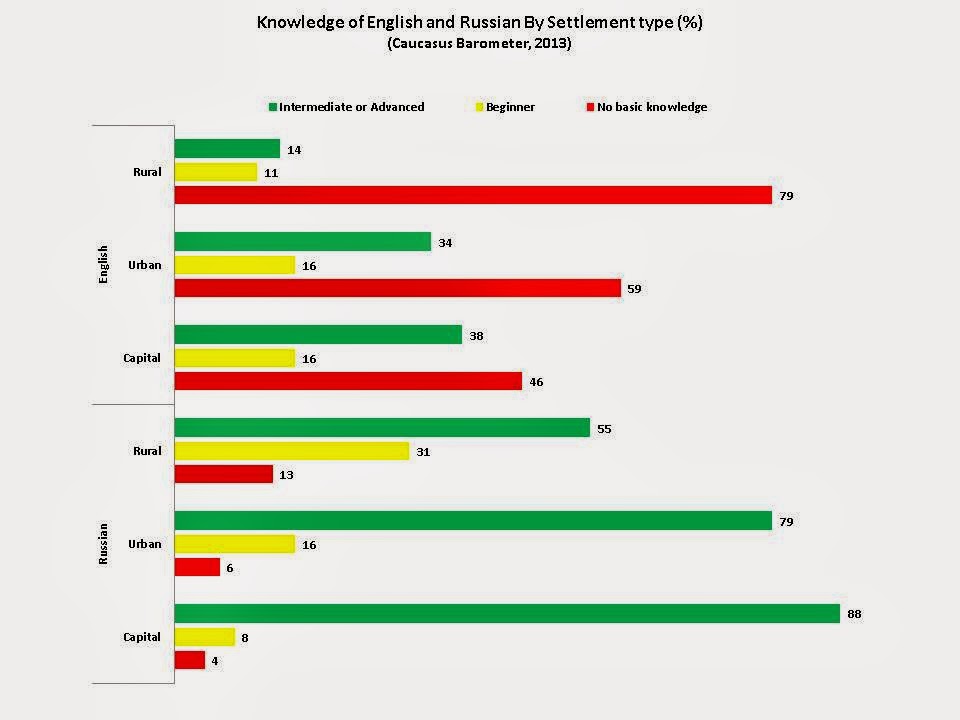
An additional factor to consider is that rural residents are much less likely to speak a foreign language compared to urban or capital based residents. The majority of rural Georgians (80%) report having no basic knowledge of English compared to 46% of Tbilisi’s residents reporting no basic knowledge of English. Furthermore, 44% of rural residents report having either no basic knowledge or a beginner’s level of Russian, compared to 12% of Tbilisi residents who say the same.
 Note: Responses of Intermediate and Advanced were combined in this graph.

With the language barrier, it could be difficult for Georgian and foreign farmers to form relationships and communicate effectively. In order to avoid the language barrier, a number of companies have brought their own labor force to the country, including the Xinjiang Hualing Group which operates a small factory town on the outskirts of Kutaisi. Despite this, many foreign farmers who have moved to Georgia report hiring Georgians, especially during the harvest season. This could be a further factor which has conditioned the relationships existing between local and foreign farmers, as well as future relations between them.

This blog post has looked at the perspectives of rural residents on doing business with members of other ethnic groups as well as their level of knowledge of English and Russian. It shows that rural Georgians are much less likely to approve of doing business with other ethnicities, and that rural residents are much less likely to have knowledge of Russian or English. With these factors in mind, support for the ban on agricultural land sales may be more understandable. If residents in rural areas, many of whom are involved in agriculture, are less likely to be able to communicate with foreigners and are more likely than other Georgians to disapprove of relationships with them, then would they want them as neighbors? To explore these issues further, we recommend using our ODA tool here or reading this blog post detailing the extent of foreign agricultural holdings posted on the Transparency International Georgia website.

Monday, March 24, 2014

Aspects of Georgian Nationalism


In Stephen Jones’ 2013 book, Georgia: A Political History since Independence, he argues that economic issues are more important to the average Georgian than issues related to nationalism. According to Benedict Anderson’s classic exegesis of nationalism, Imagined Communities, a nation is defined as, “an imagined political community - and imagined as both inherently limited and sovereign” (Anderson 2006). Anderson’s definition, in this blog post, is considered in conjunction with the oft quoted expression of Ilia Chavchavadze, “Homeland, Language, and Faith,” which referred to those things most important for Georgia in his view. As such, issues Georgians believe to be the most important issue facing the country over time and how Georgians feel about Georgian women marrying men of other ethnic groups are examined to gain an understanding about some aspects of nationalism in Georgia.

Each year the Caucasus Barometer (CB) asks (as an open-ended question), “What do you think is the most important issue facing Georgia at the moment?” The following graph shows that the only time territorial integrity, relations with Russia and peace have been more important than jobs and poverty in Georgia was in 2008 which was also the year of the August war with Russia. Notably, data collection for the 2008 CB was conducted only three months after the war. Furthermore, only one year later, economic considerations once again became the number one perceived issue facing the country. Considering that territorial sovereignty is considered to be a critical aspect of nationalism, it is interesting that Georgians have been more likely to consider economic issues to be the most important issue facing the country rather than issues related to territorial integrity.

Note: This chart has combined responses for jobs and poverty, as well as territorial integrity, relations with Russia, problematic relations with Russia and Peace. In 2008, a show card was used for this question during the Caucasus Barometer interviews. The card offered a number of issues for respondents. After 2008, a show card was not used and the open ended question mentioned above was asked. This may have effected the results to survey responses between 2008 and other years. 

A second way of assessing how Georgians feel about other ethnicities, is to examine to what extent Georgians approve or disapprove of Georgian women marrying members of other ethnic groups. The graph below shows that most Georgians do not support Georgian women marrying men of other ethnicities. This shows a certain level of social conservatism among Georgians, but this conservatism may be religious rather than ethnic as nationalism in Georgia is also tied to religion. The graph shows that Georgians have the highest level of approval for Georgian women marrying men of other ethnic groups that primarily tend to be Orthodox or another Christian group - Russians, Europeans, Americans, Abkhazians, Ossetians and Armenians.


This blog post has looked at several factors related to Georgian nationalism. It shows that economic issues have been consistently more important to Georgians than issues related to territorial integrity since 2008--a year which saw war with Russia. Finally, the blog looked at trends in how Georgians feel about Georgian women marrying men of other ethnicities and found that religion might play a bigger role than ethnicity when it comes to marriage.

To further explore issues related to nationalism, ethnicity, and economics we recommend exploring our data further using the ODA tool here, or reading Stephen Jones’ chapter on “The Myth of Georgian Nationalism.” For readers who read in the Georgian language, we also recommend this blog post on tolerance in Georgia and the South Caucasus more generally.

Monday, March 17, 2014

Russia, Georgians, and the State


With Russia’s recent military intervention in the Ukraine, some commentators have begun to compare Ukraine to Georgia in 2008. In August 2008 Russian troops entered Georgian territory, resulting in the expulsion of the ethnic Georgian populations of the breakaway territories of South Ossetia and Abkhazia. Thus, there is speculation that the Crimea will become separated from Ukraine as South Ossetia and Abkhazia became separated from Georgia. Markets have also strongly responded to the recent Russian intervention as the value of the ruble and the Russian stock exchange has fallen. As a result, the Russian central bank injected around ten billion dollars into currency markets to stabilize the value of the ruble. Furthermore, Russian president Vladimir Putin has aimed to tighten up the proposed Eurasian Customs Union that some see as a revival of the Soviet state. Although Georgia’s participation in the customs union was not strictly ruled out by former Georgian Prime Minister Bidzina Ivanashvili, the priority of Georgia is an Association Agreement with the European Union according to parliamentary speaker Davit Usupashvili. With this context in mind, this post examines support for joining the Eurasian Economic Community (a precursor organization to the Eurasian Customs Union), support for the Georgian government’s involvement in business, and whether Georgians think being critical of the government is important for a good citizen. These factors are all seen as connected to how Georgians today perceive the Soviet past, and how this past relates to the present.

Georgians are nearly evenly divided on whether the state should be more like a parent (47%) or like an employee (53%). The 2013 Caucasus Barometer asked respondents to indicate whether they feel that “People are like children; the government should take care of them like a parent,” or that “Government is like an employee; the people should be the bosses who control the government.” This question gives some understanding about what relationship Georgian’s feel they should have with their state. Those with positive connotations towards the Soviet past may be more inclined to respond that the government should be like a parent. The following chart shows that 53% of Georgians who think the government should be like a parent, also support membership in the Eurasian Economic Community.   Furthermore, the graph shows that Georgians who think that the state should be like a parent are 15% more likely to support Georgia’s membership in the Eurasian Economic Union.


Note: “Do not support at all” and “rather not support” were combined in this graph to form “Do not support.”  “Rather support” and “Fully support” were combined into “Support.” 

Georgians who support the idea that the government should be more like a parent are also more likely to support an increase in government ownership of businesses. Support for Eurasian Economic Community membership is also strongest among those who think government ownership of business should increase.


Note: The data here has been collapsed from a 10-point scale where 1 indicated most disagreement with the proposed statement and 10 indicated most agreement with the proposed statement. Data from points 7 through 10 are shown indicating agreement with each statement. Data from points 5 and 6 are shown indicating neither disagreement nor agreement. Data from points 1 through 4 are shown indicating disagreement with each statement.

The following graph shows that Georgians who think it is important for a good citizen to be critical of the government are more likely to think that the government should be like an employee.

This blog shows that Georgians are more or less divided when it comes to whether the government should be like a parent or an employee. In looking at Georgians who think that the government should be more like a parent, it appears that they are also more likely to support membership for Georgia in the Eurasian Economic Community. Moreover, parent-like government supporters put less emphasis on the importance of being critical towards the government as a quality of a good citizen. To further investigate how Georgians feel about their government, we recommend exploring the data further using our ODA tool here.

Monday, March 10, 2014

Can’t get no satisfaction. Who doesn’t want to join the EU?

On December 30, 2013 Davit Usupashivili, Chairman of the Parliament of Georgia, declared that Georgia’s top priority for the year was the signing of an Association Agreement with the EU. If signed, the association agreement will enable closer ties between Georgia and the EU. This will likely be supported by the vast majority of Georgians as 83% of ethnic Georgians say they would vote to join the EU if a referendum were held tomorrow, according to a 2014 study commissioned by the Eurasia Partnership Foundation. Still, a minority of Georgians are against closer ties with the EU. This opinion appears to be related to satisfaction with life, the perceived political situation, and one’s perceived economic standing in society. This blog explores data on those who are less supportive or against EU integration in Georgia, as well as some possible reasons for the opposition.

Given the government’s focus on EU integration, it is not surprising that Georgians with a higher level of trust in the EU are more likely to think that the country is headed in the right direction. This difference is pronounced with 30% of Georgians who fully distrust the EU and think the country is going in the right direction, as opposed to 60% of those who fully trust the EU and think the country is going in the right direction.


Note: "Politics is definitely going in the wrong direction" and "politics is mainly going in the wrong direction" were combined into "politics is going in the wrong direction." “Politics is definitely going in the right direction” and “politics is mainly going in the wrong direction” were also combined in this graph.

In addition to political satisfaction, as measured by the previous graphic, personal satisfaction seems to be related to one’s trust in the EU. Georgians who trust the EU appear to be more satisfied with life overall. For Georgians who fully trust the EU, only 21% report being dissatisfied, whereas a full 46% of Georgians who do not trust the EU report being dissatisfied with life. This trend also holds for those who support Georgia joining the EU.


Note: Overall life satisfaction on the CB 2013 questionnaire had a ten point scale. This graph converted those numbers into a three point scale. 

In understanding satisfaction with life and political satisfaction, one factor that appears important is the perceived economic position of Georgians and their household. The following graph places perceived economic rung, how Georgians feel their household is doing compared to the rest of society, and trust in the EU against one another.  As the graph shows, families that feel more confident in their economic standing are more likely to trust the EU. This trend holds largely true for families that report standing on an economic rung of 3, 4, or 5. When a family perceives itself to be at a lower economic rung in society (1, 2), then they are more likely to distrust the EU than those who perceive that they are at a higher rung in society. This is evidenced by the fact that almost two thirds (64%) of those who responded with full distrust of the EU also ranked themselves as either on the first or second rung of the economic ladder. About half (52%) of those who slightly distrusted the EU also reported being either at the first or second rung of the economic ladder. Once again, this trend also is present in support for Georgia’s accession to the EU.


Besides being personally or politically dissatisfied, what other factors do you think might be related to disapproval of closer ties between Georgia and the EU?  The data set used for this post will be available online shortly, and you too can investigate the numbers here with our online data analysis tool.

Tuesday, March 04, 2014

Health in the South Caucasus

With the recently concluded Olympics in Sochi and the controversies surrounding them, one might be interested in understanding how populations in the South Caucasus think about health and sport. What factors are related to perceptions of health in Armenia, Azerbaijan and Georgia? This blog explores perceptions of health, economic well-being, as well as whether a household limits its consumption of beef as one of many indicators related to a household’s economic situation.

South Caucasians who say they exercise for at least two hours a week are more likely to rate their health better than those who do not exercise at least two hours per week. The following graph depicts this trend in Armenia, Azerbaijan, and Georgia, and consistently shows that those who believe they are in good health are much more likely to say they exercise for at least two hours a week compared to those who report poor health.


Note: In this and following charts, the original five-point scale for the question, “Overall, how would you rate your health,” has been collapsed to a three-point scale by merging “very poor” and “poor”, and “very good” and “good.”

Additionally, people who consider their households to be on a higher economic rung in society tend to rate their health more positively. Respondents were asked to imagine there is a 10-step ladder reflecting the economic standing of all households in their country, such that the first rung corresponds to the lowest possible economic position in society, while the highest rung refers to the highest possible position. The following graph demonstrates this trend in the South Caucasus. In Georgia, where the trend is most pronounced, only 27% and 34% of families who report being on either the first or second rung report being in good health, whereas 91% and 59% of families who reported being on the fifth or fourth rung respectively, reported being in good health. This trend can be seen throughout the South Caucasus and suggests that the higher economic rung a family perceives itself to be on, the more likely they are to report good health.


Note: The first rung corresponds to the lowest possible economic position in society, while the highest rung refers to the highest possible economic position in society. Results were collapsed from an original 10-point scale.

Whether a family owns or consumes a number of consumer goods is a common indicator of well-being. The following graph looks at whether a household limits its consumption of beef and perceptions of health. As the graph indicates, families that are less likely to limit the amount of beef they eat are also more likely to report being in good health. Furthermore, the trend also largely holds for the consumption of many other foods and consumer products, as well as whether a family owns certain durable goods such as a personal computer.


This blog shows that health and perceptions of one’s household economic situation are related. Higher perceived economic status is related to more positive feelings about one’s health in the South Caucasus. What other factors might be at work when looking at how healthy one feels and how often one exercises? We encourage you to explore our data to find out more about health and exercise in the South Caucasus with our online data analysis tool here.


Tuesday, February 25, 2014

Georgia—Abkhazia

The Olympics in Sochi, Russia, took place about 30 kilometers from Russia’s border with the separatist region of Abkhazia in Georgia. As a security precaution, the Russian government has temporarily moved its border 11 kilometers into Abkhazia to create a “security zone,” at which travelers entering will have to show identification before proceeding to the actual border with Russia. Since the collapse of the Soviet Union, the status of Abkhazia within Georgia has been the subject of heated debate.  Russia has a strong political and military influence in Abkhazia and has been erecting fences and wires along the administrative boundary line with Georgia proper, as well as the area controlled by Abkhaz authorities. The 2013 Caucasus Barometer (CB) asks Georgians several questions concerning the status of Abkhazia and what they see as the best and most realistic solution to resolving its status.


Source: The New York Times

Only 13% of Georgians think that the conflict with Abkhazia will be resolved within the next five years.  29% believe that it will be resolved in six years or more, 12% believe it will never be resolved, and 46% did not know or refused to answer. Georgians are reluctant to accord Abkhazia any form of autonomy or independence, though the Georgian government currently regards Abkhazia as an autonomous republic within Georgia. Georgians overwhelmingly support having Abkhazia as a formal part of Georgia, without autonomy (74%). 33% of Georgians definitely favor giving Abkhazia a high degree of autonomy, and 24% of Georgians are open to autonomy in Abkhazia under certain circumstances. The vast majority of Georgians say they would never accept Abkhazia as an independent country (78%) or as a formal part of Russia (87%).


On an individual level, Georgian perceptions of Abkhazians have not changed significantly in recent years. Currently, 73% of Georgians approve of doing business with Abkhazians and 35% approve of Georgian women marrying Abkhazians. Approval of doing business and marrying Abkhazians is higher among Georgians living in the capital and Georgians in the 18-35 year old age group, while acceptance is lower among Georgians living in rural areas and among older age groups.


Among Georgian citizens, ethnic Georgians are more likely to approve of women of their ethnicity marrying Abkhazians. 38% of ethnic Georgians approve, compared to 26% of ethnic Armenians and 6% of ethnic Azeris living in Georgia. Similarly, 76% of ethnic Georgians approve of doing business with Abkhazians, compared to 57% of ethnic Armenians and 45% of ethnic Azeris living in Georgia.

Overall, Georgians significantly favor maintaining the territorial integrity of Georgia, with little or no autonomy for Abkhazia, but are not optimistic about a resolution taking effect in the next few years. Ethnic Georgians also strongly approve of doing business with Abkhazians, though less so of Georgian women marrying Abkhazians.