Monday, August 11, 2014

In the South Caucasus, the Enemy of my Enemy is my Friend


The three countries of the South Caucasus (Armenia, Azerbaijan and Georgia) are geographically, historically and politically bound closely together. Nevertheless, these countries often find themselves in disagreement when faced with broader geopolitical questions regarding alliances, threats and visions about the future of the region. These countries are often divided on a variety of issues, such as whether or not to join the Eurasian Union, to sign the EU association agreements, or how to vote on the legality of the independence referendum in Crimea. While the South Caucasus is certainly a region in a geographic sense, there is little evidence of a regional identity that could point towards a future of increased cooperation or cohesion. Instead, a case of ‘the enemy of my enemy is my friend’ prevails, splitting the region into supporters and adversaries of the countries across their borders, which has consequences for both trade and foreign policy.


The majority of Armenian respondents to the 2013 Caucasus Barometer (CB) questionnaire named Russia as Armenia’s biggest ally (83%), while just under half of Georgian respondents named Russia as an enemy (44%), and 7% in Azerbaijan noted Russia as the main enemy of their country. A split can be seen in the case of Turkey, as most Azerbaijanis view Turkey as an ally (91%) and just over a quarter of Armenians view Turkey as an enemy of their country (28%).

The tension that characterizes cross-border perceptions in the region makes the borders themselves highly securitized spaces. Far from a free flow of people or goods, cross-border trade and travel is restricted between Georgia and Russia, Armenia and Azerbaijan, and Armenia and Turkey following a series of wars over disputed territories.

Nevertheless, perceptions of borders can ebb and flow throughout history. Administrative boundaries can become state borders, as in the case of the South Caucasus in the early 1990s, and state borders can become as open as administrative ones, such as in the European Union. Similarly, perceptions of neighbors can vary across different issue areas. While opinions and alliances in the South Caucasus are largely polarized, the will (if not the actual ability) to trade and interact on a commercial level yields a slightly less tense picture. Countries with a strong negative perception of other countries can be extremely reluctant to engage economically with that country. However, when positions are less polarized, the approval to do business is much stronger.

The 2013 CB asked whether people approved of doing business with a range of different ethnicities. The percentage of Armenians, Azerbaijanis and Georgians who approved of doing business with the titular groups of the countries they highlighted as their main enemies is shown below.


In 2013, Azerbaijanis overwhelming felt that Armenia was the main enemy of Azerbaijan, and only 1% said they approve of doing business with Armenians. However, although 66% of Armenians said the main enemy of Armenia was Azerbaijan, a significantly higher amount said they approve of doing business with Azerbaijanis (22%). For Georgians—who have the least polarized views—although 44% said Russia was the main enemy of Georgia, the majority said they approve of doing business with Russians (80%). Economic dependence and economic hardship certainly have a role to play in this pattern, with all three countries naming economic concerns (along with territorial claims) as core problems facing their populations.

However, even though Georgian export dependence on Russia is relatively low at 7%, cross-border trade would almost certainly increase if trade were to become more feasible. While it is not clear from this data whether openness to trade is driving reductions in hostility or vice versa, it is an important reminder that the practical need to coexist has the potential to ease relations between hostile countries. In a region such as the South Caucasus where perceptions of others across borders are so polarized, seeking common ground such as the need for economic development could be a potential arena for cooperation. To explore more aspects of cross-border relations, visit the CRRC’s Online Data Analysis tool.

Monday, August 04, 2014

A look at (in)Justice in Georgia as charges are brought against ex-President Saakashvili


On July 28, 2014 charges were announced against the former Georgian president Mikheil Saakashvili concerning the abuse of power. These charges make Saakashvili the highest public official from the former UNM government to be summoned by the prosecutor’s office to date. The ruling Georgian Dream party has praised this move as proof that the judicial reforms of May 2013 have established equality before the law. However, Saakashvili has denounced the charges against him as “purely political”. CRRC data from 2013 shows that domestic belief in the impartiality of Georgia’s judicial system has been recovering since the 2012 presidential elections. However, overall confidence in court neutrality remains relatively low. An assessment of both local and international attitudes towards the impartiality of the Georgian court system is therefore key to understanding the difficulties currently faced by the prosecutor’s office. This is especially true as the office and the government alike seek to convince observers that the process of charging high-ranking ex-officials is “absolutely open”.

In 2013, just under a quarter of adult Georgians reported that courts were impartial (22%) - a level similar to previous years. In contrast, according to 45% courts favor some citizens over others (down from 55% and 53% in 2009 and 2012, respectively). More Georgians tend to think there is favoritism than those who believe citizens are treated equally before the law; the level of mistrust in the impartiality of Georgian courts is an average of 47% from 2009 to 2013, while confidence in court neutrality is an average of 18% over the same period.


Note: The original survey question was, “Which of these statements do you agree with: 1. The court system favors some citizens OR 2. The court system treats everyone equally.” Answers stating that some citizens were favored by the court system (“strongly agree” and “agree”) were aggregated to represent distrust in impartiality, whereas answers stating a belief in equal treatment of all citizens (“strongly agree” and “agree”) were aggregated to represent trust in impartiality.

Overall, only 3% of Georgians express full trust in the court system (19% say they somewhat trust the court system), and 39% is undecided over whether to trust or distrust the system. Together with this, the ongoing lack of confidence in judicial impartiality has the potential to exacerbate inter-party disputes during a time when Georgia is faced with several recent high-profile court cases. For example, in addition to Saakashvili, the former Minister of Internal Affairs Vano Merabishvili, the former Chief Prosecutor Zurab Adeishvili, the former Defense Minister Davit Kezerashvili, the former Mayor of Tbilisi Gigi Ugulava, the former Interior Minister Bacho Akhalaia and the former Army Chief of Staff Giorgi Kalandadze have all had charges brought against them recently.

The most outspoken critic of these proceedings has been the United States, which has expressed concern about the decision to put these members of the previous government on trial. This unease has been mirrored by the EU, which has stated its intention to monitor the proceedings carefully. Several US senators have warned that these events impose “unnecessary challenges in moving [bilateral relations] forward”. The UN notes that there is a backlog of legitimate complaints from the period before the 2012 elections detailing abuses such as unfair trial, torture, ill-treatment and illegal expropriation. Yet, the UN insists that the investigation should avoid “the appearance of political retribution.”

Fears over the lack of impartiality of Georgian courts have remained high even though the prosecutor’s office invited foreign experts to Georgia earlier in July. The announcement that these experts were advising the prosecution on how to handle high-profile cases was immediately linked via local media to speculation that Saakashvili might have a case brought against him. International observers have expressed concern that the accountability of the prosecutor’s office is low and that lack of public trust is a primary concern. Thus, the charges against Saakashvili risk being interpreted as a political move regardless of the motivations behind the charges or outcome, especially since domestic and international confidence in judicial impartiality is low.

Suspicion that opposition politicians are being unfairly prosecuted would be a blow to both domestic and international trust in Georgia’s democratic processes, and could entrench the strong polarization in party politics. It is yet to be seen whether greater integration with Western institutions such as the EU will be compromised by these high-profile proceedings, or whether Georgians themselves will interpret the actions of the prosecutor’s office as impartial or political. What is clear, however, is that low trust in court neutrality poses a challenge to the stated desire of the prosecutor’s office to uphold equality before the law, especially as the process can be easily impeded by claims of partiality or the abuse of power.

Monday, July 28, 2014

Are more educated women in Georgia choosing not to have children?

Some social scientists, such as Satoshi Kanazawa, argue that a woman’s education level can impact her willingness to have children. However, Linda Hirshman, a scholar of women’s issues, questions Kanazawa’s findings by arguing that reproduction is a culturally-inflected decision. Additionally, Gary Becker hypothesizes that women with higher education might not feel economic pressure such that marriage is economically advantageous. Thus, they might be more likely to postpone marriage and childbirth. The Center for Social Sciences (CSS) in Georgia provides data on gender attitudes, women’s roles and sexual behavior in Georgia. According to their 2012 presentation What Do Georgians Say about Gender Issues?!, CSS found that Georgian women are more likely to eschew dominant patriarchal views with respect to gender hierarchy in education, employment and the family. Following this debate, this blog explores the relationship between education, gender, personal income, and the perceived ideal number of children in Georgia based on the 2013 Caucasus Barometer (CB) survey data. 

Data from the Statistics Office of Georgia indicates that 57% of women are economically active, while 78% of men are economically active. From these figures we see that women’s economic activity, and subsequently women’s employment rate, is lower than men’s in Georgia. Despite this, women are more likely to have higher education than men. For example, according to the 2013 CB, out of those who say they have a higher education, 57% are women and 43% are men.  Nevertheless, the average monthly income among Georgian women is lower than men’s average monthly income. In addition, 34% of women say they do not have a personal income.  


Note: For the question “Speaking about your personal monetary income last month, after all taxes are paid, to which of the following groups do you belong?” the options ‘Up to USD 50’ and ‘no personal income’ were combined into the USD 0-50 option. 

However, despite differences in employment, average income and education, the ideal number of children for both men and women in Georgia is similar. 47% of women and 45% of men consider three children to be the most desirable number per family. For 25% of women and 23% of men, the ideal number of children is four. 


Women with a higher and secondary technical education are more likely to want three children. Women with secondary technical and secondary or lower education are more likely to say they want four or more children. The same difference between figures is apparent for the option “whatever number God will give us”- more women with secondary or lower education gave positive answers compared to the other two groups. Thus, there are different perceptions of the ideal number of children by education level. 


Note: For the question “What is the highest level of education you have achieved to date?” the options incomplete higher education completed higher education (BA, MA, or Specialist degree) and post-graduate degree are combined with the partial or complete higher or graduate education option.  No primary education, primary education (either complete or incomplete), incomplete secondary education and completed secondary education are combined with secondary or lower option.  

This blog post has reviewed whether a woman’s educational level is related to a woman’s willingness to have children in Georgia. The post has compared personal income, education level and the ideal number of children per family for men and women. It has showed data on the ideal number of children by education level for women. From the data, we can see that education level might have a minor effect towards women’s aspiration to have children in Georgia. Although, education level does not appear to effect women’s aspirations towards childbearing in general - since three is the ideal number of children according to most men and women in Georgia. However, while the difference among women with different educational backgrounds is still notable, education is not the only influence on women’s aspiration to have children in Georgia. 

For further reading, please visit the CRRC blog post on gender inequality in the South Caucasus. Information and analysis on gender statistics and women’s socio-economic conditions can be found in the annual report of the National Statistics office of Georgia. Also, please, review the Center for Social Sciences’ report on attitudes of the Georgian population on gender issues.

By Maka Chkhaidze

Monday, July 21, 2014

Friends and Enemies in the South Caucasus

On 1 April, 2014 the International School of Economics at Tbilisi State University (ISET) published a blog which described a future Transcaucasian Confederation agreement signed by the three South Caucasian states. Despite the fact that the blog was an April Fool’s Day joke, it provoked significant interest and reader response. Many political scientists who study alliances (such as Gärtner, Reiter and Rothstein) claim that a common foreign policy view is the primary motivation for countries (especially for small countries) to form alliances. Often, this view may be expressed in having a common enemy or having a common friend. If we look at the recent history of the South Caucasus, a union was formed in 1918 as the Transcaucasian Democratic Federative Republic (Transcaucasian Federation), which according to Geukjian (2012), dissolved after several weeks due to a lack of consensus on fighting a common enemy. Additionally, the idea of making a union in the Caucasus was has been expressed by different former leaders in the South Caucasus: Zviad Gamsakhurdia, Eduard Shevardnadze and Heydar Aliev, and Mikheil Saakashvili. Yet, no viable steps were taken in this direction.

The purpose of this blog is to examine whether there is a common enemy or friend by which any type of union, confederation or political alliance in the South Caucasus could be formed, or if it is merely a topic of humor. Of course, theoretically there could be other political, social or economic motivations for creating a union. However, this blog looks at data from the 2013 Caucasus Barometer (CB) on who citizens of the three South Caucasian countries think is their countries’ biggest friend and enemy.

The results below show that attitudes are noticeably different between the three countries. The majority of Armenians consider Russia to be their country’s main friend (83%), while the majority of Azerbaijanis say Turkey is Azerbaijan’s main friend (91%). Georgians views are yet again different as they most commonly name the United States (31%).


Note: In this graph the option “no one” was grouped to “other.” The “other” option also includes Ukraine, Armenia, Iran, Georgia, Poland, Germany, Israel, Lithuania, Europe, Italy, China, Belarus, Baltic countries, Czech Republic, the Netherlands, Nagorno-Karabakh, Northern Cyprus, Spain, Great Britain, Greece, Latvia, Abkhazia and Pakistan.

As for enemies, Georgians perceived Russia, Azerbaijanis named Armenia, and Armenians considered Azerbaijan as the main enemy of their countries. Both figures show that the opinions of Georgians are not as well defined as in Azerbaijan and Armenia; nearly a third of Georgians said they “don’t know” or “refuse to answer”. Thus, these are quite diverse preferences for countries in this small region.


Note: In this graph, option “no one” was grouped to “other”. The “other” option also includes USA, Iran, Georgia, Everyone, Israel, Great Britain, Czech Republic, Abkhazia, China, South Ossetia, Ourselves and Germany.

Differences in opinions regarding the European Union, in particular, are not as stark as in the cases of the perceived main friend or enemy. CB results shown below indicate that support for the EU is stronger in Georgia, but that there are stable attitudes towards the EU, although much lower, in Armenia and Azerbaijan. This could reveal a potential common foreign policy in the future.


Note: In this graph “support” is a combination of the responses “rather support” and “fully support”, and “don’t support” is a combination of the responses “rather not support” and “don’t support at all”. Question text: “To what extent would you support country’s membership in the EU?”

This blog has discussed the possibility of creating an alliance based on a commonly-perceived enemy or friend in the South Caucasus and come to the conclusion that it is not realistic in the near future. To explore similar issues, we recommend using our ODA tool here or reading this blog post detailing how the three countries perceive doing business with and getting married to one another.


By Edisher Baghaturia

Friday, July 18, 2014

Expectations and the EU Association Agreement

Today's blog post is published in collaboration with civil.ge.  One may also read the post on civil.ge here.

On June 27, 2014 Georgia, Moldova, and Ukraine signed EU Association Agreements. In Georgia, the signing has been celebrated as a step towards Euro-Atlantic integration, and a number of events were held in Tbilisi to celebrate the signing. The Association Agreement (AA) itself is wide ranging with some portions pertaining to human rights and the main focus on economic cooperation between the EU and Georgia. While the agreement has been highly anticipated by certain groups within Georgian society, there has been controversy, particularly as the association agreement relates to the protection of minority rights. A recent article on Foreign Policy Magazine’s website, and an accompanying case study by the Legatum Institute, argue that skepticism towards the EU may pop up in Georgia, in part, due to the EU’s seeming lack of engagement with the country over time. However, this trend is not new as Adrian Brisku notes in his 2013 comparative history of Georgia and Albania, Bittersweet Europe. With this background in mind, this post looks at how Georgians perceived both the EU and the Association Agreement approximately one year before the signing of the agreement. The post will review knowledge of the Association Agreement in Georgia in 2013 by settlement type and ethnic composition, expectations for the agreement by age group, and trust in the EU over time.

According to the 2013 survey,  Knowledge and Attitudes toward the EU in Georgia which was a part of the Eurasia Partnership Foundation European Integration program, 20% of Georgian citizens reported that they had heard of the EU Association Agreement. Awareness of the association agreement was highest in the capital with 30% of Georgians reporting they had heard about the association agreement. In urban and rural settlements 17% and 16% of Georgians respectively reported that they had heard about the Association Agreement.

As the graph below demonstrates, Armenian and Azerbaijani minorities in Samtskhe-Javakheti, Kvemo Kartli and Kakheti were much less likely to be aware of the Association Agreement compared to their fellow ethnic Georgian citizens. Low levels of awareness of the Association Agreement among ethnic minorities are likely due to low levels of knowledge of Georgian language in ethnic enclaves. These groups also have less access to media which is in the Georgian language. In addition, there is a lower level of internet usage reported by minorities in the aforementioned settlements (12% daily usage, 62% never using the internet), especially compared to ethnic Georgians in the capital (51% daily usage, 29% never using the internet). This is a likely barrier to access to information.


People who said they had heard about the Association Agreement were asked what they thought the agreement could bring to Georgia. Survey respondents were asked to select one answer from a list provided on a show card. Looking at the results of this question by age group shows an interesting trend. Half of young people (18 to 35) stated that the agreement would result in political closeness and tight economic integration with the EU - the stated purpose of the agreement. In contrast, those aged 35 to 55 were more likely to report EU membership for Georgia as a result of the agreement. This outcome is not ruled out by the agreement, and in some instances, the agreement has served as a stepping stone on the path to EU membership. However, it is not an explicit or likely near-term result of the signing. Notably, a number of countries which are highly unlikely to want or be considered for EU membership have signed Association Agreements, including Algeria and Chile among other countries.


The graph below shows trust in the EU over time in Georgia. In 2008 trust in the EU was at 64%, followed by a slight decrease in trust which remained stable from 2009 to 2012. Interestingly, in 2013, a decrease in the level of trust occurred with trust responses dropping 16 percentage points, distrust increasing by seven, and neither trust nor distrust increasing by eight percentage points. Thus, a more ambivalent attitude towards the EU appears to have emerged in 2012 and 2013.
Note: Respondents were asked “Please tell me how much do you trust or distrust the European Union?” In the graph above, ‘fully trust’ and ‘somewhat trust’ are combined to form “Trust” and ‘somewhat distrust’ and ‘fully distrust’ are combined into “Distrust”.

This post has shown that awareness of the Association Agreement in Georgia is lower among ethnic minorities than ethnic Georgians in Georgia, likely due to lack of access to Georgian-language media and knowledge of Georgian. It has further discussed expectations among different age groups for the agreement, showing that young adults in Georgia expect closer ties from the agreement, while 36-55 year olds are more likely to believe that the agreement will lead to EU membership. Finally, the post looked at trust in the European Union over time. While distrust has not increased, ambivalence does seem to be spreading among Georgians, particularly in 2013. To further explore issues related to international organizations and the EU in Georgia, and the South Caucasus more generally, we recommend exploring our datasets here or using our Online Data Analysis Tool here. Readers may also be interested in the blog, Can’t get no satisfaction. Who doesn’t want to join the EU? published in March 2014 on the CRRC blog.

Monday, July 14, 2014

When is a war not a war?

When is a war not a war? While it may seem commonsensical that a country cannot simultaneously be at war and at peace, the prevalence of several ‘frozen conflicts’ in the post-Soviet space defies simple categorization. If we take the conflict between Georgia and Abkhazia or South Ossetia as an example, a quick internet search shows that there was a five-day war in 2008 that ended on the 12th of August with a preliminary ceasefire agreement. Nevertheless, according to CRRC’s most recent Caucasus Barometer (CB) survey in 2013, almost no Georgians think that the conflict in Abkhazia had been resolved. Alternatively, Armenians and Azerbaijanis tend to support the idea that resolution has been achieved in Abkhazia (with 27% and 13%, respectively selecting this option), while differing significantly on their opinions about the status of their own territorial dispute over Nagorno-Karabakh (with 38% of the Azerbaijani population placing this as their highest national concern, compared to only 3% of Armenians). This raises the possibility that conflict is as much about perceptions as it is about actual military confrontation, and that national, regional and international conflict narratives can diverge significantly.

This disparity in narratives underlines a definitional problem in the political sciences when it comes to conflict resolution, war and peace. The Correlates of War project uses the annual number of casualties to track the duration of wars and conflicts on both an inter- and intrastate level. According to this project, a war is deemed over once the annual death toll drops below 1,000. The problem is that while open armed conflict might cease, a conflict can be far from resolved.

Thus, the conclusion that Georgia’s own territorial disputes can be condensed into five days underestimates the enduring negative impact of the status quo on all sides. Trade and travel are prohibited for inhabitants of Abkhazia and South Ossetia. De-isolation tops Abkhaz policy priorities, while the government in Tbilisi faces the ongoing challenge of settling and providing for internally displaced persons (IDPs).

In addition to the Georgia-Abkhazia and Georgia-South Ossetia conflicts, the conflict between Azerbaijan and Armenia over the status of Nagorno-Karabakh is also called ‘frozen’, although experts like Thomas de Waal have suggested that the term ‘simmering’ might be a more appropriate designation. CRRC data is also instructive in this regard. When asked about the top two issues facing their respective countries, 38% of Azerbaijanis named unresolved territorial disputes as the number one problem in Azerbaijan, while 3% of Armenians and 10% of Georgians said the same. The figures in Azerbaijan and Georgia strongly suggest that these issues are not ‘frozen’ (or resolved) in the minds of the local population, although economic concerns also dominate throughout the region.
This blog has shown that national perceptions of conflict can contradict both regional and international narratives. This suggests that our current measures of war and peace are missing an important dimension. The CB provides a starting point for exploring the subject of war narratives. You can find comments about past perceptions of conflict resolution for the Azerbaijani-Armenian case here and for the Georgian case here. You can also access a report on Russian public opinion towards the future of these disputes here. Annual survey data for the South Caucasus region is also available for analysis on the online CB platform.

Monday, July 07, 2014

Facebook usage in Azerbaijan

On February 3rd, 2014, Facebook celebrated its 10th anniversary. According to the World Map of Social Networks December, 2013 statistics, Facebook is the world’s most popular social network with more than one billion users. It is followed by QZone with 552 million users, Vkontakte (190 million users), Odnoklassniki (45 million users), and Cloob (1 million users). However, it is important to note that social network usage is not distributed evenly geographically. In some countries different social networks have more usage than Facebook: for example, QZone in China, Vkontakte and Odnoklassniki in Russia, and Cloob in Iran. This blog post examines the usage of Facebook and its popularity among different age and gender groups in Azerbaijan.

In Azerbaijan, according to the annual Caucasus Barometer (CB) survey, 57% of the respondents reported using the Internet in 2013. Use of social networking sites was reported as the most popular activity on the Internet. Other activities, such as searching for information (49%), downloading/listening/watching music/videos (36%), and using Skype (33%) were also mentioned.


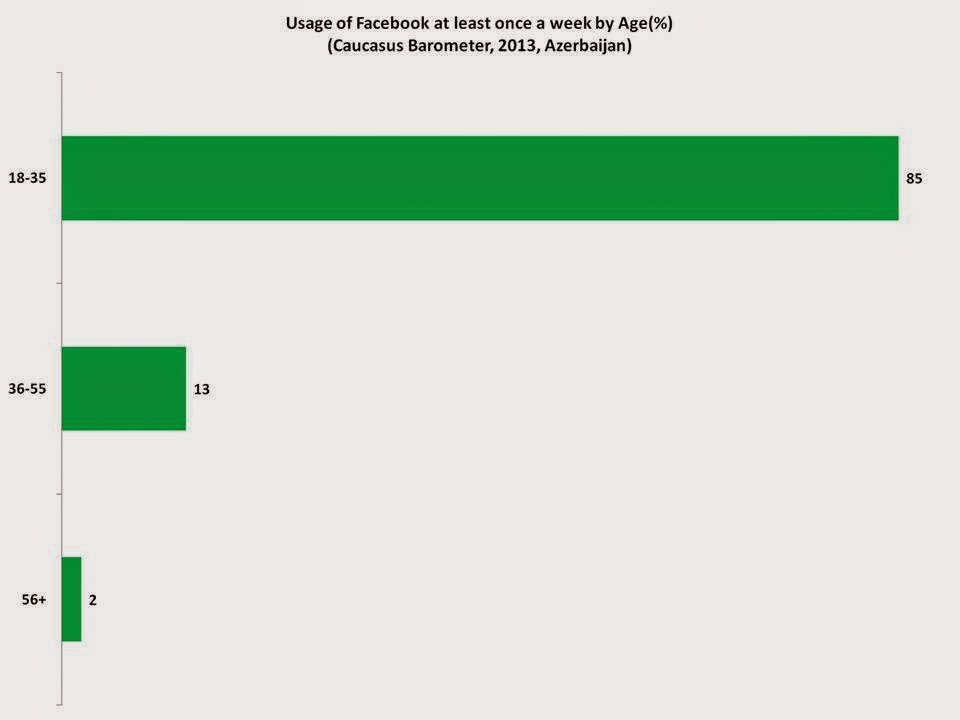
Facebook is the most popular social network in Azerbaijan, and it is used quite frequently.According to the CB, 16% of all respondents in Azerbaijan actively use Facebook. Moreover, 49% of Internet using respondents in Azerbaijan use Facebook at least once a week. Most Facebook users are males (65% according to Socialbakers statistics from 2014, 68% according to the CB), and the majority are young people aged 18-35 years old (72.8% according to the Socialbakers from 2014, and 85% according to the CB).


Among the respondents of the CB, almost 1/3rd of active Facebook users are posting news, personal observations or photos (30%). Other frequent Facebook activities mentioned by CB respondents in Azerbaijan included: commenting on other people’s posts and photos (26%), chatting (20%), and reading or viewing news-feeds (18%).

Besides connecting people as a tool for communicating with friends and family, Facebook has also made it easier to share opinions about information. Most CB respondents in Azerbaijan (88%) did not find it hard to express their opinion on Facebook. However, 5% of respondents expressed difficulty. Notably, posting opinions on FB is harder for women than men (10% of female respondents consider it hard to express their opinions on Facebook, while only 3% of male respondents express similar difficulty).

According to Statistics Brain Facebook data from 2014, the average number of friends per person on Facebook is 130. In Azerbaijan, 39% of CB respondents said they had 51-100 friends, whereas 37% of respondents had less than 50 friends on Facebook. Only 18% of respondents had more than 100 friends. The evidence suggests that for most Facebook users in Azerbaijan, the social network is a platform for connecting with their relatives and close friends; preferring a more selective form of communication, rather than communicating their thoughts, ideas and personal information to a larger audience.

To get more information about the Caucasus Barometer data and others activities by CRRC, we recommend following us on our Facebook page here. To learn more about Facebook usage in Azerbaijan and other South Caucasus republics, we recommend accessing Caucasus Barometer data here with our Online Data Analysis (ODA) tool.

By Aynur Ramazanova

Sunday, June 29, 2014

CRRC Methodological Conference on Measuring Social Inequality in the South Caucasus and its Neighborhood

The second annual CRRC methodological conference took place on the 25th of June at Tbilisi State University. With over fifty attendees and a packed program of presentations, the conference drew together policy practitioners and researchers from the South Caucasus and beyond.

This year, for the first time, there was also a number of pre-conference workshops on the 24th of June at the CRRC-Georgia offices. Michael Robbins of the Arab Barometer presented on the matching techniques he has used to examine the Arab Spring, and Mihail Peleah from UNDP Europe and CIS presented an introduction to the methodology behind the UNDP’s Social Exclusion Index.


These provided an excellent introduction to the themes of social inequality in the South Caucasus and its wider neighborhood, also giving participants an opportunity to reflect on the implications of the methodological choices that we make on the results that we generate. There was a lively discussion about how to define and work with broad topics like social exclusion and inequality, and participants showed a keen interest in how these concepts had been applied in the Arab world, North Africa, Eastern Europe and Central Asia.

During the main conference, the geographic scope was expanded further to include in-depth studies on access to higher education, water subsidies and migration push factors in Armenia, inequality in educational achievement, local government performance, and domestic violence in Georgia, access to the benefits of a more technologically connected world in Azerbaijan, visual sociology in the post-soviet space, and data collection and visualization across the South Caucasus.
The broad geographic and methodological scope of the studies, as well as the high standard of papers received made this an excellent second edition to the CRRC series of methodological conferences in the South Caucasus. For more information, the full program and papers presented at the conference can be accessed here.

Monday, June 23, 2014

Trust in local government in Georgia


On June 15th Georgian voters headed to the polls in local elections. There were problems leading up to the elections as detailed in last week's electoral notes. At present, results show a significant portion of positions in local government going to Georgian Dream Coalition (GD) candidates, though a number of races will go into second rounds. With the recent elections, one may be interested to know how Georgian citizens view their local government. This blog looks at levels of trust in local government from 2009-2013 and by settlement type (Rural, Urban, and Capital) in 2013.

In Georgia, the trend towards trust in local government over the last two years seems to be an increase in ambivalence from previous years. Between 2009 and 2013, distrust in local government has been relatively consistent, fluctuating between 16-21%, within the 5% margin of error of the Caucasus Barometer survey (CB), thus reflecting a relative stability in levels of distrust. In contrast, responses of neither trust nor distrust have increased and responses expressing trust have decreased compared with 2011. This could reflect the GD-UNM “cohabitation” in which many local government positions were still held by members of the UNM which is the current opposition while the GD holds the majority in national government institutions.

Note: In this graph and the graph below, a five-point scale has been recoded to a three-point scale with responses ‘1’ and ‘2’ coded as distrust, responses ‘3’ being coded as neither trust nor distrust, and responses ‘4’ and ‘5’ coded as trust. During the CB, respondents were read out a list of institutions and asked to “assess [their] level of trust toward each [institution] on a 5-point scale, where ‘1’ means ‘Fully distrust’, and ‘5’ means ‘Fully trust.”

Interestingly, trust in local government is much lower in Tbilisi and urban areas compared to rural areas. In rural areas, Georgians trust their local government (40%) more than twice as much as in Tbilisi (17%). Residents of the capital are more than twice as likely to express distrust in the local government with 28% reporting distrust in Tbilisi versus 12% in rural areas. Urban areas, not including Tbilisi, are more likely to express trust than Tbilisians, but interestingly express a similar level of distrust in local government as capital residents.


This blog post has reviewed levels of trust in local government over time. It shows that Georgians seem to have become ambivalent with regard to their view of local government. The blog further demonstrates that levels of trust in local government are higher in rural areas than in urban areas. If you would like to further explore issues of trust in Georgia and the South Caucasus more generally, view the blog post here, or explore the data further using our Online Data Analysis tool.

Monday, June 16, 2014

Electoral Notes- Municipal Elections, 2014

Dustin Gilbreath, a Research Consultant at CRRC-Georgia, has written electoral notes on yesterday's municipal elections which were published on the web-magazine Liberali.The notes discuss the results of the elections, background and significance, changes to electoral legislation, the pre-electoral environment, capital candidates and campaigns, and outlook for the Georgian Dream Coalition and United National Movement. To read the electoral notes, please click here.


Monday, June 09, 2014

Divorce rates in Azerbaijan

In the Principles and Recommendations for a Vital Statistics System, Revision 2 (by the United Nations), divorce is defined as “a final legal dissolution of a marriage, that is, that separation of husband and wife which confers on the parties the right to remarriage under civil, religious and/or other provisions, according to the laws of each country.” This blog post examines divorce in Azerbaijan over the years, by age group, gender and by duration of marriage. The post also explores perceptions of happiness among divorced Azerbaijanis and those who are not divorced.

Attitudes towards divorce in Azerbaijan are predominantly negative. According to the Caucasus Barometer 2013 (CB), almost half of Azerbaijanis feel that divorce can never be justified (48%).


When compared to many other countries in the world, the divorce rate in Azerbaijan is relatively low. According to the United Nations' Demographic Yearbook, the highest number of divorces in the world can be observed in Russia (4.7 per 1,000 people in 2011), Belarus (4.1 in 2012), Latvia (3.6 in 2012), Lithuania (3.3 in 2012), Moldova (3.0 in 2012), Denmark (2.8 in 2012), and the United States (2.8 in 2011). In comparison, that rate in Azerbiajan is 1.2 per 1,000 people (in 2012).

Data provided by the State Statistical Committee of the Republic of Azerbaijan (AzStat) shows that the number of divorces has decreased in Azerbaijan overall from 1990 to 2008, followed by a gradual increase from 2008.


Statistics provided by AzStat show that the first five years are the most difficult period for a marriage. This is the time during which the highest number of divorces occur in Azerbaijan. The longer the marriage, the lower the chance of divorce. Moreover, according to AzStat, the peak age for divorce among females is 25-29 years old, whereas it is 30-34 years old among men.


The 2013 Caucasus Barometer (CB) shows that women who are divorced or widowed tend to say they are less happy than men who are divorced or widowed. In Azerbaijani society, divorced females and widows suffer from a great deal of insecurity and instability, especially since the stigma about divorce is large.


If you are interested in further exploring these issues or would like more information, see the Caucasus Barometer website here.

By Aynur Ramazanova

Monday, June 02, 2014

Finding a good job in Georgia

Data on employment and perceptions about work present an interesting lens on Georgia. This is especially true since the official unemployment rate is 15% according to Geostat in 2012, and 31% of the population is unemployed and seeking work in Georgia as of September 2013, according to the National Democratic Institute. Connections, education, and professional abilities/work experience are the most common reasons cited for being able to get a good job in Georgia. However, are Georgians more likely to think that having connections is important for getting a good job if they don’t actually have many connections? What does the data tell us about perceptions of important factors for finding a good job?

One indicator of the strength of an individual’s social network is whether they feel they have people close to them who would help them in certain situations. In the 2013 Caucasus Barometer survey, participants were asked, “How likely or how unlikely is it for you to receive some help from your close relatives, friends, and neighbors” to “repair your house/apartment” or to “lend money for a month to cover your usual expenses?” The following graph shows a notable difference between those who think that it is not at all likely (10% more) that someone would help them with living expenses for a month, compared to those who think it very likely.


Note: Each column on the 1 (not at all likely) to 5 (very likely) scale originally summed to 100%. Additional factors, such as professional abilities/work experience, luck, hard work, talent, age, appearance, doing favors for the ‘right’ people, and other were also included as potential answer options. Together, these composed over a third of responses and have thus not been included in this chart for simplicity. Respondents were shown a card with possible answer options to choose from (including a don’t know, other and refuse to answer option). See this blog post for further information on other factors related to finding a good job in the South Caucasus.

Furthermore, those who felt they could not depend on someone close to them to help repair their living accommodations were more likely to report connections as the most important factor in getting a job-9% more often than those who said that it was very likely that they could expect someone to help them.

Note: Factors other than education and connections were not included in this chart.

Trust in institutions is another interesting factor related to perceptions of the most important factor for getting a job. The following graph shows that of those who fully distrust the police, 50% perceive connections to be the most important factor for finding a good job. This compares to 23% of those who fully trust the police and think having connections is the most important factor for finding a good job. This trend is most pronounced when looking at trust towards the police. Yet, a similar pattern is found when looking at trust in the health care system, education system, court system, NGOs, parliament, executive government, political parties, media, local government, the religious institution one belongs to, the ombudsman, the EU, and UN.


Note: Factors other than education and connections were not included in the chart.

Another notable, but slightly weaker trend in the graph is that education is the most important factor for those who fully trust the institution of the police. This trend is also present when one looks at the cross-tabs between most important factor for getting a job and trust in the following institutions: healthcare system, education system, court system, NGOs, parliament, political parties, media, local government, the EU, and the UN. Interestingly, trust in banks does not show the same kind of relationship.

Is it possible that Georgians without connections are more likely to emphasize and perceive that connections are the most important factor in getting a job? What role does trust in institutions play when it comes to how one perceives finding work? How do the trends presented in this blog relate to social capital? The data-set used for this post is available online here, and you too can explore it to further understand what Georgians consider important for finding a good job. Also, take a look at our previous post on the CRRC blog.