Monday, June 06, 2016
Attitudes towards public opinion polls in Georgia (Part 2)
Posted by
Anonymous
at
9:44 AM
0
comments
Labels: Caucasus Barometer, Democracy, Georgia, Government, Media, Opinion Poll, Political efficacy, Trust
Monday, May 30, 2016
People who trust NGOs are more active
NGOs play an important role in Georgian society, weighing in on issues as diverse as energy policy and the budget. An important question however is, how much do people trust NGOs and are those who trust NGOs different from those who don’t? This blog post looks at how people who report trusting NGOs in Georgia differ from those who report distrusting them in terms of their social and political engagement.
CRRC’s Caucasus Barometer surveys (CB) regularly ask about trust in NGOs. In 2015, 23% of the population reported fully or rather trusting NGOs, while about the same share reported fully or rather distrusting them. In addition, a large share of the population (42%) reported neither trusting nor distrusting NGOs. The share who answered that they “don’t know” if they trust or distrust NGOs has declined from 31% in 2012 to 14% in 2015, which may indicate that awareness of NGOs has increased in recent years. The share of the Georgian public which trusts NGOs (sum of “fully trust” and “rather trust”) has more or less stayed the same since 2011, while the share which distrusts them (sum of “fully distrust” and “rather distrust”) has increased from 9% in 2012 to 20% in 2015.
People who trust NGOs are slightly more socially and politically active (i.e. attend public meetings, vote, etc.), than those who distrust NGOs. In 2015, 25% of those who trust NGOs reported attending a public meeting during the six months prior to the survey, while only 15% of those who distrust NGOs reported doing the same. This finding has been consistent over the past few years.
Note: Answer options “fully trust” and “rather trust” are combined in the columns “Trust”, and answer options “fully distrust” and “rather distrust” are combined in the columns “Distrust”.
Those who report trusting NGOs also say they would participate in presidential elections if they were held next Sunday more often than those who distrust NGOs. In 2015, 78% of those who trust NGOs said they certainly or most probably would participate in elections if held next Sunday, while a slightly lower share (69%) of those who distrust NGOs said the same.
People who report trusting NGOs are more socially and politically active than those who distrust them, as demonstrated by CB data on public meeting attendance and intention to participate in elections.
For more on trust in NGOs in Georgia, see this Caucasus Analytical Digest article and for more data from CB 2015 take a look at our Online Data Analysis tool here.
Posted by
Anonymous
at
11:17 AM
0
comments
Labels: Caucasus Barometer, Civil Society, Georgia, NGOs, Trust
Monday, May 23, 2016
The fury before the storm
The Georgian Parliamentary by-elections held on October 31, 2015 are regarded by some Georgia watchers as a ‘final rehearsal’ for the 2016 general elections, and the results have been hotly debated. Tamar Khidasheli, who represented the Republican Party and the Georgian Dream Coalition (GDC), defeated her opponent from the Alliance of Patriots of Georgia, Irma Inashvili, by a margin of less than one percentage point. The results were met with intensive questioning not only from representatives of the Alliance, but some members of the ruling coalition as well. Opponents were especially critical of the ‘special electoral precinct’ of the Ministry of Defense where Mukhrovani Military Base personnel voted. Although, the special precinct existed during the previous elections, Khidasheli’s opponents argued that votes from the military made an outsized contribution to the victory of the Republican candidate. They also accused the former majoritarian of Sagarjo and current Defense Minister of the Republican Party, Tinatin Khidasheli, of unlawful interference in electoral matters. The situation reached a nadir when Transparency International Georgia approached the prosecutor’s office to start an investigation of the Sagarejo elections, although the investigation was later stopped. This blog post does not look at any would-be procedural violations in the Sagarejo elections, but does describe the geographic, demographic and ethnic peculiarities of voters which could have contributed to Tamar Khidasheli’s victory in the elections and will likely be of consequence to the general elections.
The absolute difference in votes between Khidasheli and Inashvili constituted only 559 votes. Votes cast at special precincts are counted at “mother” precincts, and vote counts at special precincts are published together with the “mother” precinct count. Hence, it is impossible to distinguish between the vote counts of the two. As the graph below shows, even if the results at the special precinct and its “mother” precinct were to be annulled, Khidasheli would be the likely winner. However, the margin of victory would have been only 87 votes. Clearly, every vote was significant for Khidasheli’s victory.
Note: The height of the bars corresponds to the number of votes for each candidate, the labels denote vote share. Percentages may not add up to 100% due to rounding error.
Voting patterns in Georgia differ across location, ethnicity and religious denomination. Eighty percent of Sagarejo’s population lives in rural areas, and about forty percent are ethnic Azerbaijanis. Historically, ethnic minority votes in Georgia constitute an important source of electoral support for ruling political parties. Looking at the demographic peculiarities of the Sagarejo by-elections gives interesting insights into the voting behavior of municipality residents.
The graph below shows election results disaggregated by settlement type. In urban areas, Inashvili won decisively. The race was relatively close in Georgian villages, but again the opposition candidate came out on top. In Azerbaijani precincts, the Republican candidate overwhelmed her opponent.
Note: The height of the bars corresponds to the count number of votes for each candidate, the labels denote vote share received in each settlement. Percentages may not add up to 100% due to rounding error.
While the chart above shows that votes from Azerbaijani villages were decisive for the victory of Tamar Khidasheli, when comparing the geographic and demographic peculiarities of each candidate’s supporters, it is clear that the socio-demographic make-up of Khidasheli’s voters was similar to that of participating voters overall. On the other hand, urban voters and voters from Georgian villages disproportionately supported Inashvili.
It can be argued that the victory of the ruling coalition candidate in the Sagarejo elections was largely a result of the support of ethnic Azerbaijani voters, whilst Inashvili’s supporters were mainly ethnic Georgians. This finding isn’t all that surprising, and follows a general pattern from Georgian elections past: Azerbaijanis in Sagarejo municipality almost always support the government. In 2012 parliamentary elections, the United National Movement gained 83% of votes in Azerbaijani villages, whilst in Georgian settlements the party barely won one third of votes. A year later, the Azerbaijani population of Sagarejo voted overwhelmingly (58%) for the presidential candidate of the new government.
The victory of the government-endorsed candidate in Sagarejo by-elections was mostly influenced not by the special precinct, but by the support of the municipality’s ethnic Azerbaijani population. As in the past, in the 2016 parliamentary elections, ethnic minority support for the ruling party is likely to be significant.
Posted by
Anonymous
at
10:24 AM
0
comments
Labels: Elections, Geography, Georgia, Political Parties, Politics
Monday, May 16, 2016
Fearing for the children – how living with children affects homophobic attitudes in Tbilisi
Following the controversial events of May 17, 2013, CRRC-Georgia conducted a survey in order to gauge the opinions and attitudes of the adult residents of Tbilisi towards homosexuals and their rights. Among the various outputs following the survey was a series of blog posts exploring statistical predictors of homophobia. The findings indicated that a low level of education was one of the strongest predictors of homophobia among Tbilisi residents and that men had a higher probability of being homophobic than women, particularly when the men believed that homosexuality was an inborn rather than an acquired trait. This blog post looks deeper into the predictors of homophobia in Tbilisi by testing for a statistical relationship between homophobia and living in a household with one or more children under the age of 18. Our findings suggest that there is a significant relationship between these two variables, although it is different for men and women.
As the chart below shows, overall, there is no difference in the share of people reporting homophobic attitudes between those living in households with children and those living in households without children (32% and 31%, respectively). The findings, however, are very different separately for men and women. Specifically, we find that the share of Tbilisi females who are homophobic is 7% higher when one or more children live in their household, while it is 13% lower among men.
Logistic regression confirms the importance of having one or more children living in the household as a predictor of homophobic attitudes. According to the model, women with child(ren) in the household are 207% more likely to be homophobic when age, gender and education are controlled for. For men, though, the likelihood decreases.
So why do women tend to be more homophobic when they live with children, and why do men tend to be less homophobic? While further research focused specifically on this issue would be needed to determine the exact cause behind this finding, one possible explanation to the first part of the question is that women may be confusing homosexuality for pedophilia; another possibility is that women may be afraid that homosexuals potentially living next door might influence children into homosexuality (especially provided that, according to the findings presented in a previous blog post, women, more so than men, believe homosexuality to be an acquired trait). In regards to the second part of the question, men may feel that their masculinity has been confirmed once they have children (see here for more information), and thus they feel less threatened. It should be noted, however, that this latter explanation would only apply to those men who have their own children, while the survey data only tells us whether they live in a household with children, but not whether those children are or are not their offspring. For this reason, it may be useful in future studies to investigate the effect of having one’s own child(ren) on homophobic attitudes, in addition to more generally living with children.
The findings presented in this blog post show that women are more likely to be homophobic when there are child(ren) living in their household whereas the opposite is true for men. This finding suggests possible approaches to address homophobia, such as information programs speaking directly to mothers, and women in general, regarding the “nature versus nurture” debate, pedophilia, the nature of homosexual companionship, and the harms of viewing homosexuality as an abnormality. For men this may be more of a struggle with personal sexual identity and insecurities. In any case, a dialogue on the root-causes of homophobia is an important part to combating discrimination against sexual minorities.
The dataset of this survey, as well as respective documentation are available at CRRC’s Online Data Analysis portal.
Posted by
Anonymous
at
9:32 AM
0
comments
Labels: Gender, Georgia, Homosexuality, Minorities, Policy
Monday, May 09, 2016
Trends in the Data: Public support for democracy is slowly waning in Georgia
Following the first ever peaceful transition of power in Georgia’s 2012 parliamentary elections, the country improved its position in the Freedom House and Polity IV democracy rankings. Results from the latest polls, however, show that public support for democracy in Georgia has declined over the past few years. Weakening support for democracy can pose a serious problem for the process of democratic consolidation in Georgia, that is, the institutionalization and maturation of Georgia’s democracy. Reversion to a non-democratic system is unlikely in consolidated democracies, where a democratic system is accepted as “the only game in town”. Public opinion polls make it possible to measure public’s support for democracy. This blog post looks at how attitudes towards democracy have changed in Georgia in recent years.
According to CRRC’s 2015 Caucasus Barometer (CB) survey, nearly half of the population of Georgia (47%) agrees that “democracy is preferable to any other kind of government”, and only 16% thinks that “in some circumstances, a non-democratic government can be preferable”. However, if we compare these findings with previous waves of CB, it is clear that during the past four years, support for democracy has declined in Georgia. It was rather stable from 2011 through 2013, with approximately two thirds of the population reporting that democracy is the best form of governance. While in 2011, only 8% thought that “in some circumstances, a non-democratic government can be preferable”, this share doubled in 2015. The share of those who answered ”for someone like me, it doesn’t matter what kind of government we have”, also increased during the same period.
Note: Options ‘Don’t Know’ and ‘Refuse to answer’ are not shown on the above chart. CB was not carried out in 2014.
Notably, the share of the population who consider Georgia a democracy has declined. According to CB 2011, half the population characterized Georgia as either ”a full democracy” (8%) or ”a democracy but with minor problems” (42%). In 2015, only 3% and 20% reported the same. The share of those who characterized Georgia as ”a democracy but with major problems” or ”not a democracy” increased.
It might be expected that one of the reasons why support for democracy declined would be the weakening of democratic values. Although a number of indicators can be used to test this, CRRC data do not suggest that this is the case. Support for democratic values has, in fact, visibly increased. For instance, the share of the population who agrees with the statement that “people should participate in protest actions against the government, as this shows the government that the people are in charge” has increased. Since 2012 the share of the public agreeing with this statement has been at least twice as large as the share of those who agreed with the opposite statement.
Although, over time, the share of the population who regard Georgia as a democracy declined, the data shows that freedom of speech has likely been strengthened. For instance, since 2009 the share of those who agree that in Georgia people have the right to openly say what they think increased from 55% to 72% in 2015, while the share of those disagree with the opinion halved.
There is, thus, no empirical evidence confirming that the decline in public support for democracy in Georgia is caused by the weakening of democratic values. Hence, the reasons for the decline described in this blog post likely lay elsewhere.
When Georgia’s democratic development is discussed, public opinion is often forgotten. As this blog post has tried to demonstrate, the political elite should not take public support for democracy for granted. Attitudes towards democracy, like other attitudes, may often be changing. Further research is needed to understand the causes of this, since democratic consolidation is less likely without public support.
To find out more about public attitudes in Georgia, visit CRRC’s online data analysis tool.
Posted by
Anonymous
at
12:21 PM
0
comments
Labels: Caucasus Barometer, Democracy, Democracy Index, Georgia, Trends in the Data
Monday, April 25, 2016
How the EU sees Georgia: The Georgian population's perceptions
Posted by
Anonymous
at
9:29 AM
0
comments
Labels: European Union, Survey
Tuesday, April 12, 2016
The population of Georgia on “good citizenship”
Although many people agree that being “a good citizen” is important, there is a great variety of ideas on what being “a good citizen” means. CRRC’s 2013 and 2015 Caucasus Barometer (CB) surveys asked respondents to rate the importance of the following seven qualities for being “a good citizen”: always obeying laws, supporting the government on every occasion, voting in elections, following traditions, volunteering, helping people who are worse off than themselves, and being critical towards the government. This blog post discusses Georgia’s population’s assessments of these qualities.
As in previous years, of these seven qualities, helping people who are worse off and following traditions are reported to be the most important qualities of “a good citizen” in Georgia. Always obeying laws and voting are considered somewhat less, however, still quite important qualities. At the same time, supporting the government on every occasion or being critical towards the government are not reported to be as important.
In 2015, the seven qualities have been assessed slightly differently than in 2013. The largest change is a 12% decrease in the reported importance of supporting the government on every occasion. The assessment of importance of voting in elections has slightly decreased (by 7%), although almost within the margin of error, and the importance of helping people who are worse off has slightly increased (7%).
Note: A ten-point scale was used to record answers to these questions, where code ‘1’ corresponded to the answer “Not important at all” and code ‘10’ corresponded to the answer “Extremely important”. For this blog post, codes 1 through 4 were grouped as “Not important”, codes 5 and 6 as “Neither important nor unimportant” and codes 7 through 10 as “Important”. Only the shares of those assessing the respective quality as important (codes 7 through 10 of the original scale) are shown on the charts of this blog post.
People living in the capital, other urban and rural settlements have slightly different views on what qualities a good citizen should have. Compared to the opinions of those living outside Tbilisi, voting, always obeying laws, volunteering and being critical towards the government are reported in the capital as more important, while supporting the government on every occasion – as less important. Following traditions, though, is considered highly important in all settlement types.
The data also shows that those who believe that, in general, people shape their fate themselves assign higher importance to such qualities of a good citizen as voting in elections, volunteering and being critical towards the government, compared to those who think that everything is determined by fate. The results of a Wilcoxon-Mann-Whitney test show, this finding is statistically significant.
Note: A ten-point scale was used to record answers to the question on fatalism. The original answers were recoded so that codes 1 through 5 were combined in the category “Everything is determined by fate” and codes 6 through 10 were combined in the category “People shape their fate themselves”.
Of the seven possible qualities of a “good citizen” offered in CRRC’s Caucasus Barometer survey, the population of Georgia assesses following traditions and helping those who are worse off as the most important ones. Assessments of most of the qualities of a good citizen slightly differ by settlement type. Notably, those who think that everything in life is determined by fate assign less importance to voting in elections, volunteering and being critical towards the government. For more data, visit our Online Data Analysis tool.
Posted by
Anonymous
at
11:46 AM
0
comments
Labels: Attitudes, Caucasus Barometer, Georgia, Volunteering
Monday, April 11, 2016
Attitudes toward public opinion polls in Georgia
Posted by
Anonymous
at
7:58 AM
0
comments
Labels: Caucasus Barometer, Georgia, Media, Opinion Poll, Trust
Monday, April 04, 2016
From ‘altruist’ to ‘realist’: changing perceptions of the EU in Georgia
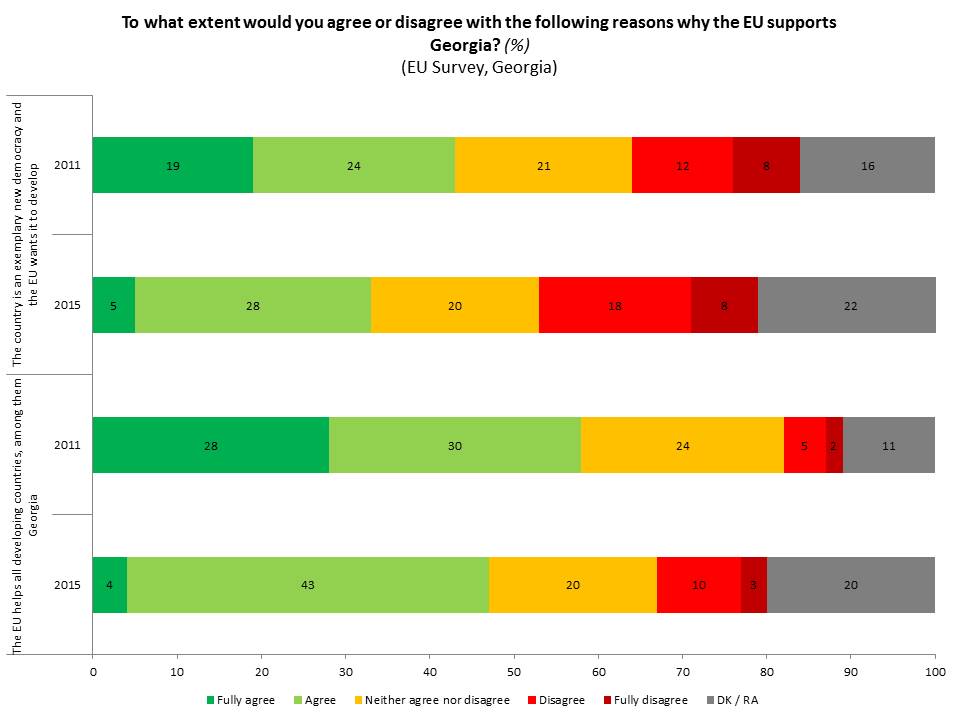
There has been a slowdown in the EU’s ‘values promotion’ in the former Soviet space, according to a recent publication by The Foreign Policy Center. As Frederica Mogherini, High Representative of the European Union for Foreign Affairs and Security Policy and Vice-President of the European Commission stated in 2015, the priorities of the reviewed European Neighborhood Policy are, “First, focus on economic development and job creation; second, cooperation on energy; third, security; fourth, migration; fifth, neighbors of the neighbors.” The statement has no mention of values. This policy shift may lead to the weakening of the image of the EU as a value oriented power, as described for example in the 2007-2013 European Neighborhood and Partnership Instrument, and there is some empirical data supporting this expectation. This blog post looks at the Georgian population’s changing perceptions of the EU’s interests in Georgia and EU-Georgia relations using findings of several waves of Europe Foundation’s Knowledge and attitudes towards the EU survey conducted by CRRC-Georgia.
The share of the population that fully agrees with the opinion that the EU supports Georgia because the country is an exemplary new democracy and the EU wants it to develop declined over the years. The share of those who fully agree that the EU helps all developing countries, among them Georgia, also declined.
The population of Georgia also thinks the EU supports Georgia in order to achieve more realpolitik goals. On the one hand, compared to 2011, less people fully agree that the EU is interested in Georgia because it wants Georgia to be a stable country and to use its territory to transport oil and gas to Europe. On the other hand, the share of those who agrees (both “fully agree” and “agree”) that the EU supports Georgia because it wants to reduce the flow of migrants towards the EU rose between 2011 and 2015. The share that agrees the EU supports Georgia because it wants stability in its neighborhood also increased.
Thus, the shift from the EU’s value oriented neighborhood policy to more realpolitik goals seems to have been noticed by the Georgian population and is reflected in its attitudes towards the EU. More people think that the EU is driven by ‘harder’ interests than in the past.
To explore the data in more depth, try out our online data analysis tool or take a look at some of CRRC’s recent blog posts (see here, here and here).
Posted by
Anonymous
at
11:09 AM
0
comments
Monday, March 28, 2016
Changing issue salience in Georgia after 2008
While territorial integrity was named by the majority of the population as the most important issue facing Georgia in late 2008 and 2009, in the aftermath of the 2008 war with Russia, the focus has since shifted to economic issues and, first of all, unemployment. Similar changes took place in the population’s priorities regarding support from the EU. This blog post discusses this change using data from the four waves of Europe Foundation’s Knowledge and attitudes towards the EU in Georgia survey conducted by CRRC-Georgia in 2009, 2011, 2013 and 2015.
In parallel to the decline in perceived relative importance of territorial integrity between 2009 and 2015, there has been a clear rise in perceived importance of economic issues. While territorial integrity and lack of jobs were named as the most important issues in 2009 (both named by 53% of the population), lack of jobs and poverty are now in the fore.
The same trend appears when it comes to the topics in relation to the EU which Georgians are interested in getting more information about. In 2009, 29% reported wanting more information about trade relations between Georgia and the EU, while 41% did so in 2015. In 2009, 52% reported wanting more information about the EU’s role in conflict resolution, while 35% did so in 2015.
Note: A show card with 11 answer options was used for this question, and up to three answers were accepted per interview. Only the most frequently named answers are presented in the chart above.
Investment in Georgia’s economy is now the most frequently mentioned kind of support Georgia’s population wants from the EU, while previously it was help with the restoration of territorial integrity.
While immediately after the 2008 war with Russia, territorial integrity was named as the most important issue in Georgia, today economic issues are named by the majority of the population. Corresponding changes took place in respect to the areas Georgians want support from the EU on.
To find out more, visit CRRC’s online data analysis platform.
Posted by
Anonymous
at
11:18 AM
0
comments
Labels: Communication, Economy, Georgia, Russia
Monday, March 21, 2016
Body Mass Index in Georgia
Posted by
Anonymous
at
9:22 AM
0
comments
Labels: BMI, Georgia, Health, Public Health, World Bank
Monday, March 14, 2016
The population of Georgia on immigrants
Unlike emigration, immigration to Georgia is a relatively recent and small in scale phenomenon. The country attracts a diverse group of immigrants from a variety of countries that arrive for educational, work, business or family reunification purposes. Data on immigrant flows and stocks are collected by GeoStat and the Public Service Development Agency of Georgia (PSDA), but since current regulations do not require that citizens of more than 100 countries coming to Georgia even for relatively extended periods of time (e.g., up to 12 months) apply for residence permits or otherwise register, existing residence statistics only provide an estimate of the number of immigrants in the country.
In many societies, including traditional ones with little or no previous experience of immigration, attitudes towards immigrants are rarely welcoming. The findings of a few empirical studies on the subject suggest that Georgia is no exception. CRRC’s 2015 Caucasus Barometer survey tried to find out more about the dominant attitudes in Georgia towards immigrants, defined during the survey as foreigners that have stayed in the country for a period longer than three months. This blog post provides the results of preliminary analysis of CB 2015 findings on the topic.
Only about a third of the population claims to have had any form of contact with immigrants: 9% report they’ve been in contact with them “quite often”, and another 17% have been in contact with them, but not much. The majority of the population (72%) reports never having any contact with immigrants. Unsurprisingly, those living in the capital report interacting with immigrants more often, but even in Tbilisi, 64% reports never having communicated with them.
Irrespective of whether people have or have not had personal contact with immigrants, they are still able to report certain attitudes towards them. Only 9% could not answer the question, “How would you characterize your attitude towards the foreigners who come to Georgia and stay here for longer than three months?” As for the rest, a large majority (61%) describes their attitude as neutral, while 25% describe it as good and 5% as bad. Importantly, as is often the case (among many others, the French and Italian examples are rather convincing), the more people have been in contact with immigrants, the better attitudes they tend to report towards them.
Note: For the question, “Have you had any form of contact with foreigners in Georgia who have stayed here for longer than 3 months?” answer options “Yes, I’ve often been in contact with them” and “Yes, I’ve rarely been in contact with them” have been combined for this blog post, and answer option “Refuse to answer” (less than 1% of all answers) was excluded from the analysis. For the question, “How would you characterize your attitude towards foreigners who come to Georgia and stay here for longer than three months?” answer options “Very good” and “Good” have been combined and labeled as “Good”, while answer options “Very bad” and “Bad” have been combined and labeled as “Bad”. The answer option “Refuse to answer” (less than 1% of all answers) was excluded from the analysis.
Similarly, more of those who have been in contact with immigrants believe that foreigners will contribute to the economic development of Georgia.
As it is the case in many other countries, in Georgia direct interaction with immigrants seems to be one of the most important conditions determining attitudes towards them – however, a very small share of the population of Georgia report having had direct interaction with immigrants. On the one hand, this may indicate that despite the existing myth that lots of foreigners are in the country, their number is actually not that high. On the other hand, this also means that the attitudes of the majority of the population towards immigrants are based on indirect information, which may be inaccurate.
To find out more, visit CRRC’s online data analysis platform.
Posted by
Anonymous
at
11:16 AM
0
comments
Monday, March 07, 2016
Volunteerism in Georgia between 2013 and 2015: attitudes and practice
Did the 2015 Tbilisi flood affect the level of volunteerism in Georgia? A recent article on volunteerism, based on CRRC’s 2013 Caucasus Barometer (CB) survey data, argued that the apparent large-scale volunteering efforts following the flood “stirred the hope that volunteerism is on the rise in Georgia”. Based on the soon to be released 2015 CB data, this blog post looks at whether there has been a change in the reported level of volunteering and in the attitudes towards it by settlement type, age and level of education.
CB data from recent years shows that the share of the population of Georgia that thinks volunteering is important for a good citizen has slightly increased. The same is true for the reported level of volunteering. The gap between the two indicators, however, is impressive.
Note: For the question “In your opinion, how important or unimportant is it for a good citizen to do volunteer work meeting the needs of the community without expecting compensation?” only the share of those who chose codes 7 through 10 on a 10 point scale, where code 1 meant “Not important at all” and code 10 meant “Extremely important”, is shown on the charts and analyzed in this blog post. For the question “Which of these activities have you been involved in during the past 6 months? - Did volunteer work without expecting compensation” only the share of those who answered “Yes” is shown on the charts and analyzed in this blog post.
Actions
In some socio-demographic groups, there are small changes in the reported level of volunteering between 2013 and 2015, although these often are within the margin of error. While only 14% of the population of Tbilisi reported doing volunteer work in 2013, 21% did so in 2015. Nationwide, the reported level of volunteering slightly increased in the 18-35 year old age group and among those with higher education, while it stayed the same in other age groups and among those with secondary technical or secondary or lower education.
Note: The answer options for the question, “What is the highest level of education you have achieved to date?” were grouped as follows: options “No primary education”, “Primary education (either complete or incomplete)”, “Incomplete secondary education”, and “Completed secondary education” were grouped into “Secondary or lower”. Options “Incomplete higher education”, “Completed higher education (BA, MA, or specialist degree)”, and “Post-graduate degree” were grouped into “Higher than Secondary”.
Attitudes
Small positive changes can be observed between 2013 and 2015 in reported attitudes towards volunteering in all socio-demographic groups. In 2013, fewer Tbilisi residents thought that volunteering was important for a good citizen compared to other urban and rural dwellers. In 2015, however, the picture reversed. Assessments of the importance of volunteering also changed in the 18-35 year old age group countrywide, increasing from 66% in 2013 to 75% in 2015.
To sum up, although the reported level of volunteering at the national level did not increase after the June 13th Tbilisi flood, there was a small increase in Tbilisi as well as among the young people and those with higher education. Nationwide, the perception that doing volunteer work is important for a good citizen also slightly increased. In many cases though, the increase is within the margin of error. Hence, further observations will be needed to see if the trend continues.
Although a large gap still remains between the reported level of volunteering and the share of the population reporting positive attitudes towards it, the changes presented in this blog post might indicate that volunteering has a chance to become more widespread in Georgia. Notably, some literature on volunteering argues that volunteering in times of crisis creates a sense of community and solidarity, which was apparent among volunteers after the Tbilisi flood. Memories of volunteering could both inspire and serve as an example for Georgian citizens to volunteer more.
To learn more about volunteering in Georgia, take a look at the Volunteering and Civic Participation in Georgia survey and our previous post on volunteering: Georgian society’s attitudes towards forced “volunteering”.
Posted by
Anonymous
at
10:58 AM
0
comments
Labels: Georgia, Volunteering
Monday, February 29, 2016
What the population of Georgia wants to know about the EU and how people want to be informed
Note: During the interviews, a show card was used for the question, “How many member states are currently in the EU?” The options from the show card have been recoded for this chart. The option “Incorrect” combines options “Up to 10 [member states]”, “From 11 to 20”, “From 31 to 40”, and “More than 40.” The option “Correct” corresponds to the option “From 21 to 30 [member states]”. Reported level of education has also been recoded for this chart. The options “Complete or incomplete primary”, “Incomplete secondary”, and “Complete secondary” have been combined into category “Secondary or lower education”. The options “Incomplete higher [education]”, “BA”, “MA”, and “Postgraduate” have been combined into the category “At least some higher education”.
Note: A 5-point scale was used to record answers to the question, “How much information about the EU do you get from TV?” On the original scale, code ‘1’ corresponded to the answer “No information at all” and code ‘5’ corresponded to the answer “A lot of information”. For the analysis presented in this blog post, answer options ‘1’ and ‘2’ of the original scale have been combined and labeled as “Little / No information”. Option ‘3’ was not recoded and is labeled ”A fair amount of information”. Answer options ‘4’ and ‘5’ were combined and labeled as “A lot of information”. Options “Don’t know” and “Refuse to answer” (less than 5% if combined) were excluded from the analysis.
Posted by
Anonymous
at
7:41 PM
0
comments
Labels: Communication, European Union, Foreign Policy, Georgia, Media
Monday, February 22, 2016
Trends in Scientific Output in the South Caucasus: 1996-2012
- Number of publications in peer reviewed journals by academics affiliated with the country’s scientific institutions;
- The ratio of cited peer reviewed publications to uncited ones;
- International collaboration, measured by the ratio of peer reviewed publications co-authored by individuals from different countries.
Posted by
Anonymous
at
11:26 AM
0
comments
Labels: Development, Research, Science, South Caucasus
Monday, February 15, 2016
Dwellings in Georgia's cities
According to the World Bank, Georgia has become more urbanized since the collapse of the Soviet Union. The shift from a planned to a market economy was accompanied by increasing regional disparities, and more people moved to large urban centers looking for economic opportunities and better living conditions. As a result, more than half of the country’s population (57.5%) currently lives in urban settlements, according to the 2014 census. Based on the STEP Skills Measurement Survey conducted in March and April 2013 in urban settlements in Georgia by CRRC-Georgia on behalf of the World Bank, this blog post looks at the type of dwellings where the urban population lives, including data on the number of rooms per dwelling, type of floor covers and toilets, as well as the ownership status of these dwellings at the time of the survey. The survey data was released in 2015 and, for the time being, is the most recent data available.
The majority of Georgia’s urban population (78% of the population of Tbilisi and 53% of the population of other towns and cities) lives in apartments in large apartment blocks with more than ten apartments. Only 14% of Tbilisi residents live in single family houses compared with 41% of residents of other urban settlements.
About one third of residents of urban settlements live in three-room dwellings. One- and two-room dwellings are more common in the capital, while five-room or larger dwellings are more common in the non-capital urban settlements.
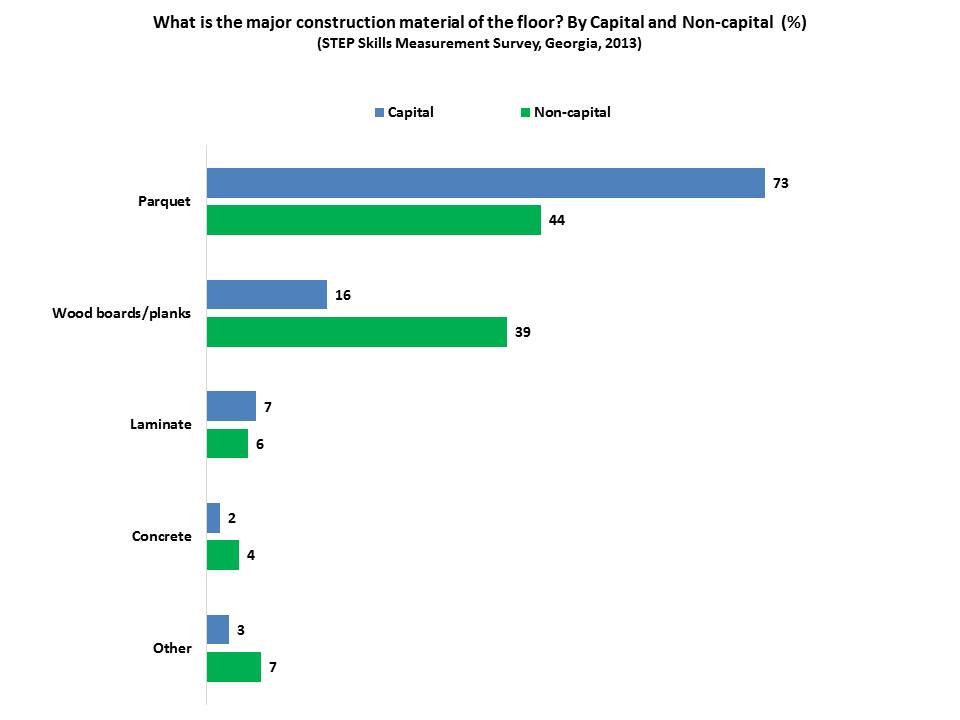
Parquet floors are the most common flooring material in Tbilisi, where 73% of floors are made from parquet. The respective share in other urban settlements is 44%. The next most common flooring material is wood boards used in 16% of dwellings in Tbilisi and 39% in other urban settlements.
As the survey was only conducted in urban settlements, it is not surprising that most of the dwellings have flush toilets connected to a piped sewer system (97% in Tbilisi and 79% in other urban settlements). Still, there are dwellings that have pit latrines with slab (2% in Tbilisi and 11% in other urban settlements).
Note: The sum of answer options exceeds 100% due to the rounding.
Thus, most urban Georgians reside in apartments in large apartment blocks. About a third of the urban population lives in dwellings that have two or three rooms. Most people own the dwellings they live in. Notably, there are still homes in the cities that do not have toilets connected to the sewage system.
To explore this topic more, have a look at the data, here.
Posted by
Anonymous
at
9:04 PM
0
comments
Labels: Georgia, Settlement, Urban Development, World Bank