Thursday, February 24, 2011

Sex, Lies and EU Red Tape

The internal workings of the European Union (EU) are notoriously yawnsome matters. However, in a survey from 2008, CRRC aimed to give an overview of Georgians’ understanding of and attitudes to the EU - including some hot topics concerning orientations towards such activities as sex before marriage, infidelity, dishonesty, and tax-paying.

Respondents were asked whether a range of these controversial activities were either ‘never justified’, ‘sometimes justified’ or ‘always justified’. Breaking down responses according to respondents from households that reported having a member who had lived in the EU for three months or more since 1993, against those from households that had no such members uncovered an interesting trend.


For example, respondents were asked whether it was ever justified for a woman to have a sexual relationship before marriage. A full 80% of respondents who had no family member who had lived in the EU reported that this was ‘never justified’, whereas only 54% of those with a family member who had lived in the EU felt the same. In terms of whether this was ‘sometimes justified’ the figures stood at 13% and 28% respectively (see table below).


A similar trend was found for attitudes to childbirth outside wedlock, as well as extra-marital affairs for both women and men. Meanwhile, though hardly anyone felt homosexuality was ‘always justified’, 10% of those with a household member who had lived in the EU felt it was ‘sometimes justified’ against only 3% of those who had no such member (see table below).


Interestingly, the same trend in attitudes held concerning such negative phenomena as lying, tax-avoidance, using criminal authorities for dispute resolution, and purchasing stolen goods. For example, while 69% of those respondents from households with no family connection to the EU feel lying for personal benefit is ‘never justified,’ only 57% of those with EU-experienced household members think the same (see table below).


If it is true that people-to-people contact creates shifts in attitudes, then a family member who has lived in the EU might ‘import’ certain value orientations into some households creating the differences manifested in the survey.

Given this, the question remains: why should having contact with someone who has lived in the EU affect individual liberalism in attitudes towards sexual matters, yet apparently negatively affect responsible social attitudes towards honesty, tax-paying, and rule of law? Is the EU a force for moral disorientation?

In answer to this, we should note that the survey does not ask if the practices in question are morally good or bad. Instead, it asks whether there might be some situations where such practices are justified. Plausibly then, those with exposure to predominantly tolerant, liberal and more relativistic values in Europe might be expected to produce flexible responses in which controversial practices are not categorically rejected on the basis of absolute moral beliefs.

So finally, perhaps we might suppose that as Georgia increases people-to-people contact through educational programs, political cooperation and trade, Georgians could slowly move towards a philosophy of ‘live and let live’.

Thursday, February 17, 2011

Liberal Education Lecture: How Can It Help Us?

Dr. John Schoeberlein, Project Director on Islam in Eurasia at Harvard University, gave a lecture at the Free University in Tbilisi on February 15th on the usefulness of a liberal education, specifically anthropology, for life, society, and the individual. He elaborated on his personal experiences as a former student and current professor of anthropology and presented some fascinating ideas on the importance of a liberal education.

“Everything is becoming more integrated. A larger toolbox is required,” Dr. Schoeberlein explained, referring to the promise of a liberal education to equip students with the critical abilities to think analytically, problem-solve, and understand larger aspects of culture and societal behavior. Additionally, he outlined fundamental characteristics and concepts that describe liberal education, such as an emphasis on general knowledge, rather than instruction on specific tasks. He also discussed the importance of the concept of choice for students to help formulate their own course of study and the notion that students must actively engage themselves and participate in class discussions. While he explained these notions, he made clear that he did not wish to impose this system on Georgians, but rather discuss it and make it available. As he stated, “...being a missionary is not what I want to be.”

He drew on some examples when describing how anthropology fits within the framework of a liberal education and imparts knowledge, which facilitates an understanding of certain phenomena. For example, he explained that corruption exists in various different contexts that cannot be explained aptly by current economic models; however, anthropology provides a useful approach to understand corruption by turning to the different and specific cultural contexts in which it exists and invoking ideas of authority, family relations, and honor. While a payment may be deemed an act of corruption by one culture, it may be accepted as social norms by another. In this way, an anthropological study draws on specific cases and allows one to understand social systems and elements of culture, which is an approach that is not only theoretical but also applicable.

Dr. Schoeberlein highlighted the applicability of anthropology with an example in which a factory manager needs to lead a team of employees with different cultural backgrounds. In this scenario, training in anthropological ideas could endow the manager with the skill to understand why each employee acts a certain way, how to motivate him or her, and what each one values.

These are just a few snippets of some of the ideas Dr. Schoeberlein presented. It would also be an interesting follow-up to try to evaluate what Georgians think about liberal education, in contrast to a vocation-based education system. We welcome your thoughts and comments on these topics!

Monday, February 14, 2011

Access to Justice in Central Asia | Coming Up

We are in the process of completing a major research project in Central Asia (Kazakhstan, Kyrgyzstan, Tajikistan) on Access to Justice. It concentrated in particular on vulnerable groups, and how they could get access to justice. Sponsored by the Finnish Ministry of Foreign Affairs, the project involved a nationwide survey in each of the countries, over 70 in-depth interviews, plus focus groups and an extensive literature review.

We looked at what respondents thought were some of the biggest legal problems that individuals in their country faced. Divorce figured prominently among those, making women's access to justice particularly relevant.

We also asked who inviduals would turn to on various issues, when there were problems. You see sharp differences between the countries. 


We asked about trust in institutions, and among the list these are the least trusted. (Yes, that's not yet comprehensive information for you, but hopefully will whet your appetite for more.)


And we dug deeper, within the countries, to understand how people looked at the courts. Again, here a preview. It suggests that according to Kazakh citizens, competence is not the main problem in the courts.


The first presentation of results will happen on February 15 in Almaty (sorry for the short notice, but if you were likely attendee you probably received a separate invitation), and a more detailed report is out soon. Drop us a line in case you're interested in a preview, in exchange for giving us some feedback on it.

Saturday, February 12, 2011

Ask CRRC | Representative Sample

Q: When conducting a survey, how do you select a sample that is representative of an entire population?

A: In order for a sample to be representative of an entire population, every member of the population must have some chance of being randomly selected. In reality, there are segments of a population that can and cannot be interviewed. Therefore, we need to understand the nature of the population for which each survey is representative.

Take the Caucasus Barometer (CB) as an example. First, we randomly select voting precincts from a list of all voting precincts that contain members of the population. Thus, every precinct has a chance of being selected.


The beginning of a long list of voting precincts from which precincts are randomly selected for sampling.

Second, CRRC randomly selects households within each of the selected voting precincts. Then, interviewers conduct a “random walk” in order to randomly select households. This random walk gives each household a chance of being selected for an interview.


This CRRC interviewer has a map of households in a selected voting precinct to assist her in her “random walk” household selection. Photo by Paul Stephens.

Third, an adult household member is randomly selected for an interview within each randomly selected household. Interviewers make a list of all adult (18 years and older) household members and randomly select one of those members for an interview. The interviewer uses a kind of random number table called a “Kish table” to randomly select one of those household members to interview. Using these three steps above, each member of the population has a chance of being selected for an interview.


This household consists of a 25 year old man, a 61 year old woman and a 24 year old woman. The 25 year old man has been randomly selected for interview.

As in any country, logistical realities mean that some segments of the country’s adult population do not have a chance of being sampled. For example, some voting precincts could not be sampled even if they were randomly selected (e.g., special voting precincts for military personnel). Also, some people might not be able to be surveyed even if they were randomly selected. This includes people who do not speak the language in which the survey is conducted or those who are not physically able to be interviewed. Other excluded groups of the population include people in prisons or hospitals. The impact of losing some of these groups is relatively little since such groups are usually so small that they are within the margin of error.

By understanding which groups of the population can and cannot be included in the sample, CRRC takes all of the steps above to ensure that samples are representative of the entire population. In addition, CRRC prints questionnaires in minority languages and recruits interviewers who speak those languages so that the CB can be described as representative of the adult population of the Republic of Georgia.

Access to justice in Central Asia | Presentation of research findings in Kazakhstan

CRRC has conducted a research project on access to justice in Central Asia. The project includes nationwide surveys in Kazakhstan, Kyrgyzstan and Tajikistan, focus groups and in-depth interviews. We will be presenting the results in Almaty, Kazakhstan, on February 15, 2010, in case any of our readers are in the region. For the rest of you, we will be making the data and reports available in March. Keep your eyes open for posts here on the blog and at the CRRC webpage. For now, here’s a snapshot of the data from the surveys:


Wednesday, February 09, 2011

Third Stage of the Junior Research Fellowship Program at CRRC-Azerbaijan Launched!

In February 11, 2011, the CRRC-Azerbaijan office launched the third stage of its Junior Research Fellowship Program, funded by the Open Society Institute Think-Tank Fund. Fifteen selected participants will attend the next round of extensive trainings that will prepare them for writing public policy papers.

The major focus of the trainings this semester will be qualitative research methods. The participants will learn how to conduct in-depth interviews, focus groups and how to perform content analysis. They will also learn tips and tricks on how to transfer data from technical charts in SPSS to attractive and understandable graphs in PowerPoint. The semester will conclude with academic writing classes in which they will exercise making citations (footnotes and endnotes) as well as writing annotated bibliographies and literature reviews.

Throughout the third stage, new, interesting and challenging competitions will be organized. By the end of the course, the fellows will be armed with new skills and knowledge, as well as the inspiration to learn more about policy analysis and to become real professionals in the field.

Wednesday, February 02, 2011

Observations while Traveling through Samegrelo | Agriculture and Petty Crime

Much has been written about agriculture in Georgia, and the need to develop it extensively. Our upcoming reports on social capital (currently still under review with the donor) have some material on that. The typical concerns are well established: although fertile, Georgia is actually importing food. More than 50% of the employed work in agriculture, but it only contributes around 10% to GDP. And more than 50% of Georgia's arable land lies fallow.

The reasons are also familiar: privatization separated the land into small parcels that were not viable for modern farming. The people left in the countryside often are conservative and skeptical, and not quick to adopt more productive methods. They do not cooperate, and thus cannot mobilize sufficient resources to develop their land.

Traveling through Samegrelo recently highlighted another challenge. The structure of landholdings makes them particularly vulnerable to petty crime. Often the holdings are away from people's houses, so that they cannot guard them. During planting season seeds, seedlings and little plants can be stolen from the field at night, so that investing into better plants is not very attractive. Moreover, shepherds don't always respect fields that have just been fenced off anew, and let their cows trott into enclosures; or cut the fence to let a stray cow out, without repairing it.

During harvest season, the problem is even more pronounced. Unless you harvest early, your crop is at threat. And if you harvest early, you may be doing damage to the fruit. For some of the crop, the harvest season is quite long, so that the fields remain vulnerable over several weeks.

If you have a small holding, it is hard to address this problem. Sleeping outdoors on your field will only get you so far, and is not sustainable over time.  With average landholdings being around less than two hectares (one hectare being a bit bigger than a soccer field), the plots are too small to pay for a security guard. Typically you will need two guards, so that they can support each other. Professional security firms would charge up to $1,000 per month. This makes it particularly difficult to experiment with higher value crops (say, avocado) since you may need a security guard to protect a handful of plants. Easier to fall back on what you have always done. 

Planting in Samegrelo. This effort has fences, two security guards constantly, night vision goggles, and is about to add a trained guard dog.

We are curious whether other people have heard about this problem. If it indeed appears to be a challenge, it would be worth researching this in more detail. The government could help address this issue by providing more security through increased policing and curbing road access, together with introducing stiff sentences to signal that stopping agricultural theft is important for Georgia's economic development. Comments and ideas?

Monday, January 31, 2011

Human rights in the South Caucasus | Similarities and differences


Human Rights Watch (HRW) has released its 2011 World Report of human rights conditions in the world. The report is based on investigations carried out by HRW staff in partnership with domestic human rights activists. Their findings show that several of the main human rights issues in Armenia, Azerbaijan and Georgia are similar for all three countries.

Freedom of assembly remains a problem in the South Caucasus. In Georgia, HRW points out several incidents where peaceful demonstrations were disrupted by the police. The November 2007 demonstrations are also mentioned and the government’s refusal to launch an investigation of the events. In Armenia, the report focuses on the authorities’ failure to investigate the excessive use of police force during the March 2008 demonstrations. Police officers convicted of excessive use of force were amnestied, opposition activists remain imprisoned and relatives of those killed in the demonstrations unsuccessfully appealed to the court for an investigation into the deaths. In Azerbaijan, the authorities continue to restrict the freedom of assembly by denying requests to hold demonstrations. Unauthorized demonstrations were dispersed and protestors detained.

In all three countries, there are several examples of ill-treatment in policy custody and the police has in many cases failed to conclusively investigate these incidents.

Georgia and Azerbaijan both held elections in 2010. The local elections in Georgia are mentioned as a positive development, despite some shortcomings, but the parliamentary elections in Azerbaijan did not meet international standards. Only one opposition candidate gained a seat in the parliament and political parties could not express their views due to restrictions in the freedom of expression, assembly and association.

Additionally, Georgia is criticized for the authorities’ handling of the eviction of internally displaced persons (IDPs) from collective centers. According to HRW, the authorities do not engage in a dialogue with the IDPs, do not provide notice in advance of the evictions, and do not offer adequate alternatives to the collective centers. In Armenia, violations of the freedom of expression are brought up as an issue. It is, however,the lack of accountability and excessive use of force related to the March 2008 events that is the main point of criticism in HRW’s country summary for Armenia. In Azerbaijan, the focus is on journalists, political activists and bloggers who were faced with criminal charges for criticizing the authorities. Several of them also suffered physical attacks by the police. The government has failed to thoroughly investigate these incidents and continues to hold political prisoners.

HRW does not seek to rate or to compare the human rights conditions between countries. Nevertheless, the annual report provides a landmark summary of the current situation of human rights across the three countries.

You can access the full HRW report here.

Wednesday, January 26, 2011

Subtitling foreign films on Georgian TV? Thanks, but no thanks!

The Netherlands and the Scandinavian countries are often given as examples of countries where the populations have a good knowledge of foreign languages. One of the explanations can be that TV shows and films are shown in their original language in these countries. Learning a foreign language is easier if you hear people speaking the language, not only in the classroom. Many agree that being exposed to other languages on the TV and in the cinemas can speed up the language learning process.

After Georgian, Russian remains the most spoken language in Georgia. According to a nationwide survey on European integration conducted by CRRC in 2009, 32 percent of the population describes their Russian language skills as advanced while only five percent rate their English skills similarly (Figure 1).

Figure 1. English and Russian language skills.

The Georgian government is determined to improve the English language skills of the population through various initiatives. One of them is the Teach and Learn with Georgia program that has the goal to recruit 1,000 native English speakers to teach English to Georgian schoolchildren. Introducing a new subtitling policy can be seen as another initiative in the same direction. Since October 2009, licensed TV stations are obliged to show 30 percent of the foreign movies in their original language with Georgian subtitles. What does the Georgian population think about this idea?

Using subtitles instead of voice translation does not appeal to the majority of the Georgian population. According to the European integration survey, only ten percent support a subtitling policy and as much as two-thirds fully disagree with such policy (Figure 2).

Figure 2. Support of subtitling policy.

After asking whether the respondents agree or disagree with the subtitle policy, CRRC presented several arguments that are used in favour of subtitles and against voice translation. Three of these arguments concern learning languages.

Only four percent of the Georgian population find the argument that subtitles in films combine entertainment and education fully persuasive. A similarly low percentage buys the argument that subtitles teach languages efficiently. Georgians are also not convinced by the argument that the Scandinavian countries have used a similar subtitling policy with great success, and that Scandinavians know many languages. One-fourth of the respondents do not find this argument persuasive at all and only three percent say it is very persuasive. Out of all the arguments the respondents were presented with, the one they found most persuasive was: For the future of our economy and to create jobs, we should understand the newest technology. We need to keep up with the world and learn languages. Ten percent believe that is a very persuasive argument.

After being presented with these arguments the respondents were asked in which way they had changed their opinions about using subtitles instead of voice translation: ten percent of the respondents said they liked the idea of subtitling better than they did before they heard the arguments. The majority did, however, not change their opinion.

According to an article in the Resonance Daily, it is not only the Georgian population that shows little interest in the idea of using subtitles instead of voice translation; the Georgian TV stations also seem to be against subtitling for reasons ranging from costs to viewers’ convenience. Have the opinions of the Georgian population changed since the subtitling policy enforcement? Is it a question of getting used to a new way of consuming movies? We welcome your thoughts on this issue.

Friday, December 17, 2010

Why do so many Armenians leave Armenia?

Our 300th post is by Ani Navasardyan, from the Civilitas Foundation in Armenia, who was working with our Georgian and Regional office for a month. 

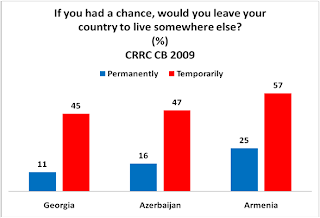
The volume of out-migration from the three countries of the South Caucasus greatly increased after the collapse of the Soviet Union in 1991. Data from the 2009 Caucasus Barometer (CB) shows that this trend continues. Fifty seven percent of Armenians want to temporarily leave Armenia, while this number is 45% in Georgia and 47% in Azerbaijan for their respective populations (See Figure 1). Twenty five percent of Armenians want to permanently leave Armenia, while this number is 11% and 16% for Georgia and Azerbaijan, respectively.

Figure 1
According to data provided by the National Statistical Agencies of Armenia, Azerbaijan and Georgia, the 2009 migration balances in these countries were -25, +1 and +34 people (in thousands), respectively. Thus, the number of people who left Armenia exceeded the number of those who entered by 25,000. In contrast, the number of people who entered neighboring Georgia and Azerbaijan was higher than the number of people who left these countries. Why do so many Armenians leave Armenia?

In all three countries, there is a general trend of younger people being more inclined to emigrate. Figure 2 shows that with respect to gender, there is a fairly even percentage of men and women who want to temporarily or permanently migrate abroad from Georgia. However, there is a higher percentage of men in both Armenia and Azerbaijan that want to temporarily or permanently migrate abroad when compared to women.

Figure 2
Yet, we find that the percentage of those who wish to leave Armenia is higher than in the other two countries. Perhaps this is due to structural factors such as regime type, level of socioeconomic inequality (unemployment, per capita GDP, Gini index), risk or presence of war, level of corruption, or social/cognitive factors including the existence of friends and family abroad, or feelings of rejection, trust or emptiness. Table 1 shows a few possible explanatory factors.

Armenia lies in between Georgia and Azerbaijan with regard to all of the structural factors: regime type, per capita GDP, unemployment rate and level of socioeconomic inequality. There is a discomfort regarding territorial disputes in all three countries (Nagorno Karabagh, Abkhazia and South Ossetia). However, the Armenian population stands out as having more friends and family abroad and as having more negative feelings. The CB shows that 56% of Armenians have a family member abroad, while this number is 40% and 37% in Azerbaijan and Georgia, respectively. These numbers are 36% in Armenia, 16% in Azerbaijan and 26% in Georgia with respect to having a close friend abroad. Moreover, more Armenian households rank money from relatives abroad as the first source of income (6%), than households in Georgia (4%) and in Azerbaijan (4%).

Why do you think the level of out migration is so much larger for Armenia in comparison to Georgia and Azerbaijan? Share your thoughts and ideas with us.

Thursday, December 16, 2010

The CRRC Team


Normally, you primarily see slides from us, with data. But at the end of the year, why not show you who makes all the research happen? So here, that is all of us (well, almost) across our three offices, and including some people who were with us until recently. Or who thought they were gone, and now find themselves back!

This is a Thank You from me to all of them. For doing great stuff and for being wonderful to work with.

To our readers out there, this also is an invitation to join our training events, or stop by and let us know about your research. Happy holidays!

Friday, December 10, 2010

TI: Corruption Reigns Worldwide; Georgia Comes Out on Top

According to Transparency International’s recently released 2010 Barometer, rates of corruption in the world are rising. Six out of ten respondents say that corruption has gotten worse over the past three years, and most alarmingly, rates of bribe-paying to the police have nearly doubled since 2006. However, as the chart below illustrates, Georgia fares extremely well in this global assessment, as the only post Soviet country in this list where less than 6% of respondents reported paying bribes in the past year. Georgia thus is way ahead of several EU countries, including Austria, France, Greece and Poland.

Armenia is already in the top three league of corruption, and Azerbaijan in the top two. Note that this matches our own corruption data from Armenia, which we collected for MAAC. We are releasing this with a press conference today. More on that to follow.


Access the full report here, and provide us with your thoughts and comments.

Policy Attitudes towards Women in Azerbaijan: Is Equality Part of the Agenda?

By Yuliya Aliyeva Gureyeva, Baku


The paper published in the 21st edition of the Caucasus Analytical Digest presents an account of how two competing policy approaches coexist in the policy attitudes towards women in Azerbaijan. The first one is largely informed by the dominant national discourse that regards women as guardians of national traditions and emphasizes traditional women’s roles as mothers and housewives. The second one is the global feminist agenda that penetrates Azerbaijan thanks to its involvement in the various international institutions and activities of the local NGOs.

The paper argues that many of the adopted state policy documents that attempted to combine these competing approaches and translate international obligations to the ‘local soil’ often fell short in addressing the discriminatory practices towards women in Azerbaijan.

Thursday, December 09, 2010

PISA 2009 | Results for Azerbaijan

Every three years, a range of countries take part in the educational PISA tests, an assessment of the competencies of 15-year olds. The tests are organized by the OECD, and have led to soul-searching and vigorous educational reforms in various countries. In the 2009 round, 34 OECD countries and 41 partner countries took part.

Among the partner countries in 2009 is Azerbaijan. The news is dramatically bad. Azerbaijan ranked 74 out of 75 participating countries, coming in above Kyrgyzstan. Ahead of Azerbaijan are countries such as Jordan, Peru, Tunisia, Colombia, Thailand. It is not just a legacy of socialism: Russia is far ahead, just under Turkey and Lithuania, and not even far from Austria.The full table is here.

It would be interesting to find out more about the variation within Azerbaijan. There must be schools that are doing better. What can one learn from them? If this issue remains unaddressed, Azerbaijan's next generation will have little to show for all the oil wealth the country received.

Friday, December 03, 2010

Food Safety in Georgia: views from retailers, producers and consumers in Tbilisi and Samtskhe-Javakheti

What do consumers in Tbilisi and Samtskhe-Javakheti think about food safety and hygiene of dairy and meat products in Georgia? What are their purchasing habits and how do they choose place and product? Are the consumers aware of their rights and responsibilities? How do producers and retailers understand consumer demands and how do they respond to those demands?

In order to get insights into consumer knowledge, awareness, demands and purchasing practices with regard to the quality, safety and hygiene of dairy and meat products in Georgia, the Caucasus Research Resource Center–Georgia (CRRC), in cooperation with Mercy Corps and GDCI, undertook a study on what drives consumer preferences in the meat and dairy sub-sectors in Georgia.

This study included various focus groups of producers and consumers in Tbilisi and Akhaltsikhe, as well as personal interviews with retailers in Tbilisi, exploring a wide range of issues connected to food safety. On the side of consumers, there was an assessment of food safety, buying practices, perceptions of health risks and consumer rights on the side of the consumers and on the side of retailers, their attitudes about national policies on food safety, understanding of consumer demand, their experiences with these issues and understanding of their own rights.


The consumer groups revealed that the participants had very little understanding or knowledge of hygiene or food safety, and primarily judged places according to general cleanliness and use of refrigerator. Also, consumers were reluctant to try new products, even if they were cheaper, because of their strong preference for familiar brands of products. The most significant findings on the side of the producers was in the rural Javakheti group. In this group, the participants revealed that they were aware of and accepted responsibility for the safety and hygiene of their food but stated that they do everything properly and that the problem lies with the consumers, who are careless and neglect to check labels and expiration dates. They were also interested in getting more information on food safety.

The results of one-on-one interviews with retailers have shown that larger retailers have more or less a uniform method of checking their products for safety, and only smaller retailers relied on trust and reputation for such concerns. There was also a consensus that the responsibility for food safety rests with the producers, and that if people were to become sick from the products, that they would reimburse them and contact the producer. The findings did show, however, a widespread lack of knowledge about hygiene and other regulations on all sides.

A final report (in English) and a summary in a PowerPoint format (in Georgian) are available at the CRRC website.

Friday, November 19, 2010

Ambassador Dieter Boden Speaks at Europe House

Ambassador Dieter Boden, a distinguished German diplomat who has served both as German Ambassador to the OSCE as well as UN Special Representative to the Secretary General, spoke at the Europe House about conflict resolution in the disputed territories of Abkhazia and South Ossetia.

Ambassador Boden worked in Abkhazia and participated actively in the mediation peace process. He drew attention to the tendency to oversimplify the conflict and suggest that the solution is Russia’s retreat from the territories and that after that the people would be easily reconciled. He said that from his experience speaking with Abkhaz youth he saw a people that were deeply traumatized, distrustful and helpless. He emphasized the great need to build confidence between the people and that the way to do this is implement confidence-building measures (CBM), and the key role of local civil society in this process. These would be projects that would aim to gradually end the patterns of animosity that have become entrenched in the almost 20 year-period since the end of the war. While emphasizing that the conflict cannot be solved without Russia’s help, he warned against the neglect of soft strategies that can help foster peace even in the absence of political opportunity for reintegration.

He spoke also about the EU’s late though vital role in the peace process, especially after the OSCE and the UN missions were discontinued after the 2008 conflict. He pointed at the strength of the EU promoting democracy, rule of law, and human rights, the development of which would bring about stabilization, but also questioned whether or not the EU has a commitment to a coherent political vision for stabilization. The possibility exists that with time other priorities can supersede the interests in peace in the South Caucasus. He sketched two perspectives on why it may not: one is that the Caucasus is an essential part of Europe and cannot afford to step back from involvement there, and the other is that it must maintain involvement to remain a credible global actor.

When responding to questions from the audience, Ambassador Boden pointed to missed opportunities for peace, including intense domestic debate surrounding the word “sovereign” in describing Abkhazia, which delayed the process of negotiation and in that time Russia and Abkhazia had deferred the UN declaration. He also stated the need to admit past mistakes and to build political dialogue around them, like how the first war in South Ossetia was started by the Georgian side. He drew a parallel to his own country, Germany, which has gone through the process of coming to terms with a painful past. Finally, in addition to confidence building measures, he said that another strategy to make Georgia attractive for South Ossetia and Abkhazia is to strengthen domestic democratic institutions.

Sunday, November 14, 2010

The Media in Armenia and Azerbaijan: Effective or Affective?

Written by Arpine Porsughyan. Re-posted from the Caucasian Knot.

Many academics argue that the influence of the media is especially strong in environments where citizens depend on a limited number of news sources. In contrast, when citizens have alternative sources of information they are less subject to the potential effects of media. Following this argument, how affective is the media in Armenia and Azerbaijan in establishing an image of the “other” in an environment where over 90 percent of the populations choose television as their primary source of information on current events with over 40 percent choosing family, friends, neighbors and colleagues as their second main source?

Well, according to the annual nationwide Caucasus Barometer conducted by the Caucasus Resource Research Centers (CRRC), a rather large percentage of people in both countries appear to agree that the media determines what people think. The figure was 39 percent in Armenia and 59 percent in Azerbaijan. Meanwhile, statistics highlighting the number of people who approve or disapprove of friendship between Armenians and Azerbaijanis illustrate that quite well. Only 28 percent of Armenian respondents approve of friendship with Azerbaijanis while just 1 percent of Azerbaijanis approve of friendship with Armenians.

Moreover, as the same theory on media effect also argues, those with little or no interest in politics are more prone to influence from the media. In Armenia, 37 percent of people are not at all interested or hardly interested in foreign policy. In Azerbaijan, that figure is 64 percent, but what about those who are interested in politics and access alternative sources of information? Academics have something to say about them as well.

Some argue that those with a strong interest in politics and access to various sources of information are subject to “biased processing,” the argument being that those that have a strong interest in politics tend to filter information based on their already existing views. Focus groups conducted by CRRC as part of the Eurasia Partnership Foundation Unbiased Media Coverage of Armenia-Azerbaijan Relations seem to support this argument. Focus groups participants, as well as active media consumers in the Armenian and Azerbaijani capitals, showed general dissatisfaction with the current state of the media in their respective countries and demanded unbiased media.

Yet, those same participants held very similar positions on the Nagorno Karabakh conflict, it being the one opined by the State.

Is there hope? Well, as CRRC’s report, Armenian and Azerbaijani International News Coverage – Empirical Findings and Recommendations for Improvement, suggests, “while the media can amplify existing tensions and reinforce differences, it also has the potential to build confidence across existing fracture lines by covering a wider spectrum of issues, diversifying sources, representing more voices than just the elite, and consciously eliminating bias from coverage.”

Social media and projects like this one, as well as Global Voices Online and the Social Innovation Camp Caucasus have been a great kick start to providing a platform for discussing issues beyond the conflict. After all, we have so much in common to discuss and we share similar concerns. In both countries the biggest concern in 2009 was the need to reduce daily spending in basic expenditures, both are worried about western influence, both perceive poverty as the biggest threat to the world, and in both countries, while generally uncertain, a significant percentage hopes that their children will be better off than they are (CRRC CB, 2009).

---
Arpine Porsughyan is freelance researcher, formerly a Regional Research Associate at Caucasus Research Resource Centers (CRRC), and the co-author of Armenian and Azerbaijani International News Coverage – Empirical Findings and Recommendations for Improvement.

Thursday, November 11, 2010

Award Ceremony of the JRFP-Azerbaijan

Here are some photos from the award ceremony of the first stage of the Junior Research Fellowship Program – Azerbaijan (JRFP) that was organized in a cozy Baku restaurant. The winners of the competition for the best policy essay were awarded iPods, and other participants who had submitted essays received book vouchers. Participants had put in months of hard work, and gone through various trainings, both online and in person, to learn more about research and academic writing. So recognition seemed to be in order -- appropriately, the ceremony was followed by a karaoke party.


More pics to follow – it was the closure of only the first stage of this program, generously supported by the OSI Think Tank Fund. The program is now in the second stage, with more in-depth training in research skills. Stay tuned for updates!

Monday, November 08, 2010

Dr. Ronald Suny Lectures in Tbilisi

On October 27, CRRC attended a lecture by well-known and accomplished scholar Dr. Ronald Grigor Suny, presently director of the Eisenberg Institute for Historical Studies and the Charles Tilly Collegiate Professor of Social and Political History at the University of Michigan. Dr. Suny presented his upcoming book, “The Young Stalin: The Making of a Revolutionary.” In his dynamic lecture, he explained his aim to approach the biography of one of the most written about historical figures of all time.

He takes the stance against one of the traditional views of biographers -- that the fame that the individual achieved was present from childhood, and the author’s task entails describing the development of these inherent traits. Much like the shift from the model of the absolute and unchanging concept of the nation to the now widely accepted view that a nation is the result of social construction and human manipulation, Dr. Suny invited the audience to consider that Stalin was not born a monster, but rather to consider what contributed to his development and formation.

Friday, November 05, 2010

Overcoming Negative Stereotypes in the South Caucasus

CRRC hosted a presentation on October 27 by Onnik Krikorian, a British journalist of part-Armenian descent and the Caucasus editor for Global Voices, entitled “Overcoming Negative Stereotypes in the Caucasus: New and Social Media in cross-border communication and conflict reporting.” Onnik spoke about the rise of the influence of blogging, Global Voices’ role in promoting grassroots individuals and groups speak their mind and connect with others, circumventing often biased and insufficient media sources. He drew upon CRRC's work on Armenian and Azerbaijani news coverage, which found both sides generally biased. Using CRRC data taken from a previous post, he looked at the unsettling numbers of Armenians and Azerbaijanis disapproving of friendship with the other group: 70% of Armenians disapprove of friendship with Azerbaijanis and 97% of Azerbaijanis with Armenians. He shared his own story of connecting with Azerbaijanis in Georgia, as he was not able to travel Azerbaijan. Through Facebook, skype, blogs, and other means of social media, he was able to put many Azerbaijani and Armenian bloggers and activists in touch, starting to corrode seemingly insurmountable obstacles.


Both Armenians and Azerbaijanis attended the presentation.

See Onnik's project site,and his slides from the presentation here:

Monday, November 01, 2010

Friends Are Hard To Come By: Friendship Divides by Gender in Azerbaijan

Close friends are an important part of life, whether we are starting a new school year as a child, a new job, or in the context of a stable and familiar environment. Whatever the backdrop, close friends help provide a social safety net where individuals can feel understood and protected against perceived obstacles and hardships. In short, friends are an important part of a sense of well-being and belonging, which affects attitudes across a wide spectrum of issues.

The Caucasus Barometer 2008 survey asked people about the number of close friends they have. Close friends were specified to mean “people who are not your relatives, but who you feel at ease with, can talk to about what is on your mind, or call on for help.” In Azerbaijan, 27% of respondents said that they had no close friends. When the results are disaggregated by gender, show a clear divide: women have far fewer close friends. Thirty-seven percent of women reported having no close friends compared to only 17% of men.


The difference is clearly striking – far more Azerbaijani women than men report having no friends. Why? Who are these women? We probed further in analyzing who these women are who say they have no friends, by examining various factors, such as frequency of religious attendance, education, internet usage, settlement type and age. The latter two revealed interesting results.

When we isolated the data by looking at the Azerbaijani women who said they had zero friends. Focusing on the settlement type, about a third of the female respondents asked in the capital and in other urban areas replied that they no friends compared with about half of rural women respondents.


The other factor that proved significant was the age of the respondents. When aggregated into three age groups, only 30% of women under 35 said they have no friends, 37% of women aged 36-55 said the same, compared to nearly half of older female respondents.


Why are so many Azerbaijani women, particularly older rural women, lacking close friendships? Perhaps the isolation of rural life combined with fewer possibilities to do communal activities are leaving women with no one to call a friend. Are they less likely to be involved in public life and activities outside the home? What could contribute to a more socially active and connected female population? Bring your ideas about this issue by responding and sharing your opinion, experience or research.