Tuesday, November 07, 2023

Only a third of Georgians believe the country will obtain EU candidate status

 Note: This article first appeared on the Caucasus Data Bloga joint effort of CRRC-Georgia and OC Media. This article was written by Givi Silagadze, a researcher at CRRC-Georgia, and Koba Turmanidze, CRRC Georgia’s president. The views presented in the article are the author’s alone and do not necessarily represent the views of CRRC Georgia, Caucasian House, or any related entity.

On 8 November, the European Commission is set to offer its recommendation on whether the EU should grant Georgia candidate status. A CRRC Georgia survey found that only a third of Georgian-speaking adults expected that Georgia would receive EU candidate status by the end of the year. 

The survey, run from 4-8 October 2023, also found a strong partisan divide. Despite having less favourable perceptions of the EU, supporters of the ruling Georgian Dream party are significantly more likely to think Georgia will be granted candidate status than  opposition supporters and people that do not support any party. 

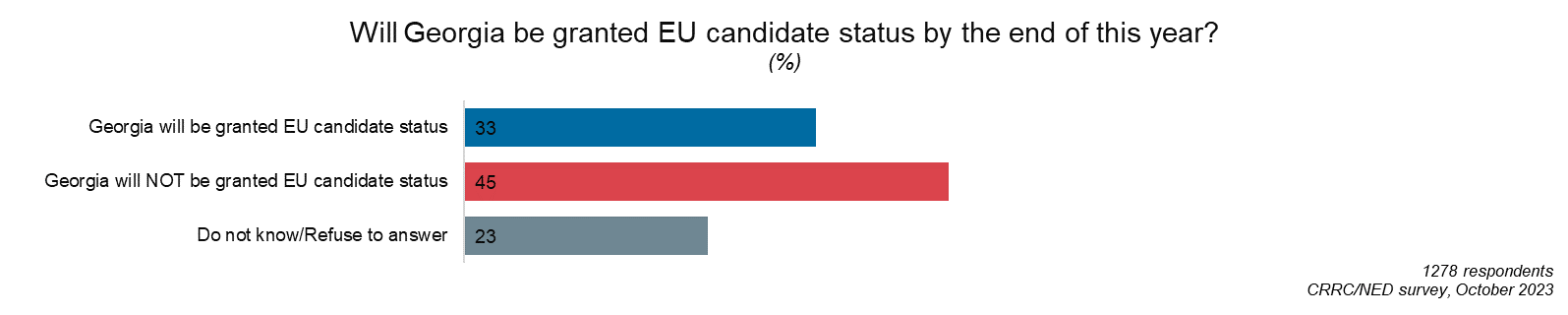
The public was asked if they expected that Georgia would be granted EU candidate status by the end of 2023. A plurality of the public (45%) believe that Georgia will not be granted EU candidate status, a third of the public (33%) believe that Georgia will receive the status, and the remaining 22% are unsure. 
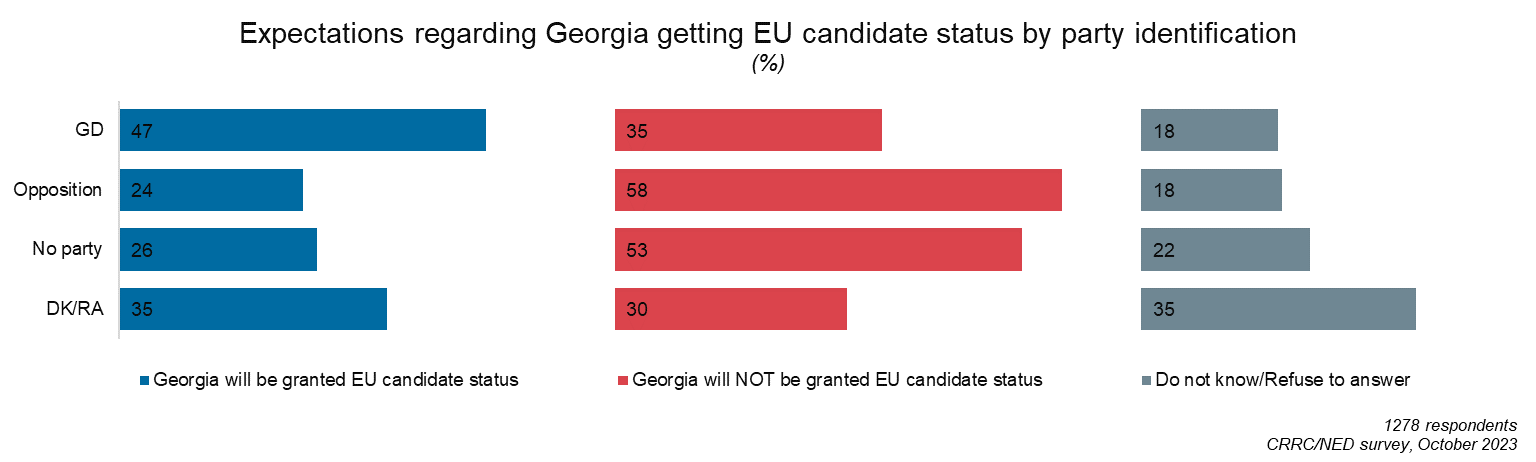
Expectations vary substantially based on which party someone supports.  Just under half of Georgian Dream supporters (47%) believe that EU candidate status will be granted, compared with one in four opposition supporters (24%). Roughly one in three ruling party supporters (35%) believe Georgia will not receive a positive decision from the EU. In contrast, a majority of opposition supporters (58%) report the same. Those that say no party is closest to them report similar attitudes to opposition supporters. 
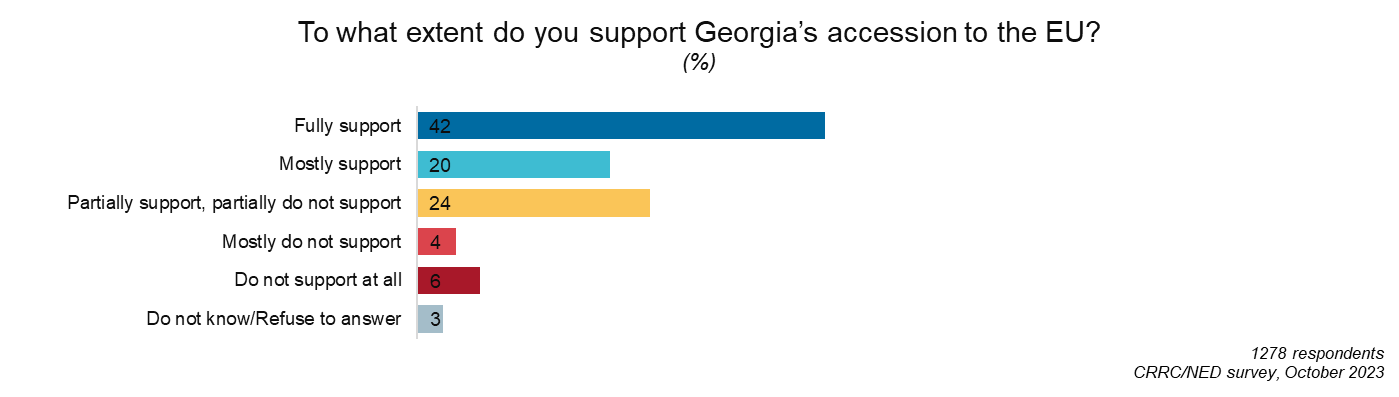
These answers are situated in a context of most Georgians supporting the country’s potential membership in the EU. Approximately two thirds (62%) of the Georgian-speaking population support membership fully or mostly, and a further quarter (24%) support it partially. Only 10% do not support the country’s membership in the EU. The remaining 3% of respondents are unsure or preferred not to respond.
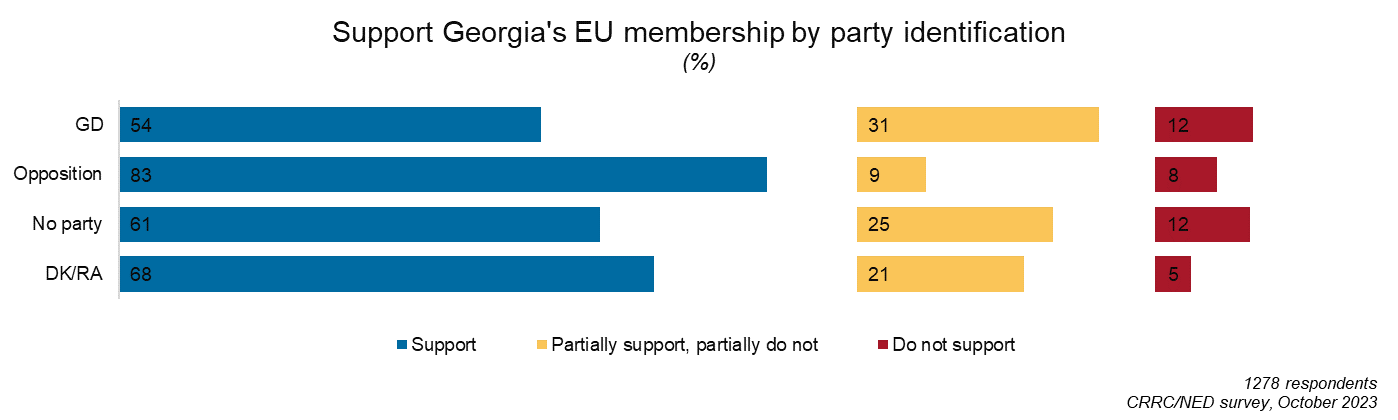
Support for the country’s membership also varies substantially with partisanship. Slightly more than half (54%) of Georgian Dream supporters support Georgia’s EU membership, around a third (31%) partially support it, and 12% do not support it. By comparison, eight in ten opposition voters (83%) support Georgia’s EU membership, one in ten (9%) only partially support it, and 8% oppose it. Six out of ten non-partisan voters (61%) support Georgia’s EU membership, a quarter (25%) partially support it, and 12% do not support it at all.  Notably, those who support no party have more similar views to those who support the ruling party than those in the opposition on this issue. 
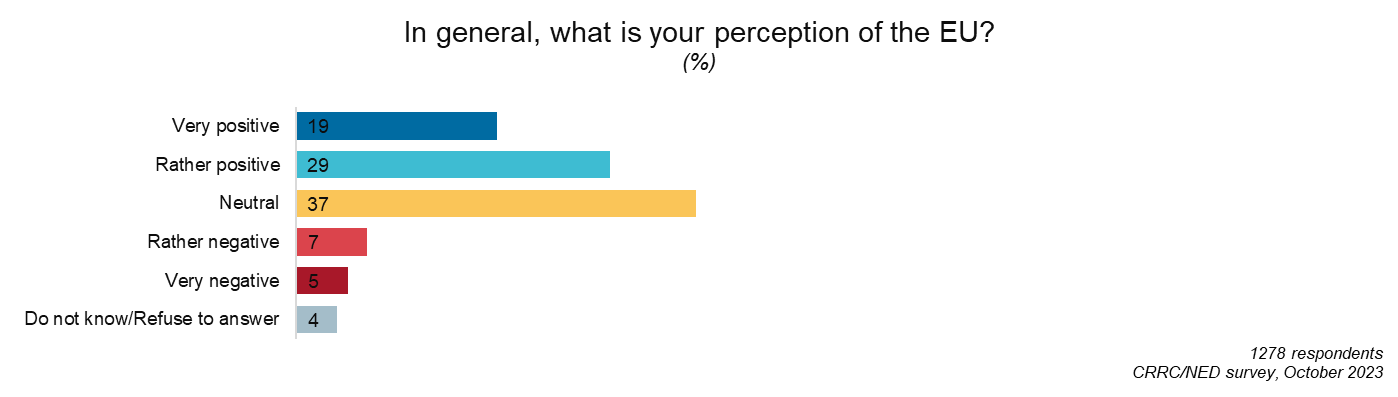
Overall, half of the population (48%) has a positive attitude toward the EU. Only one in ten Georgians (12%) has a negative perception of the EU. Slightly more than a third of the public (37%) has a neutral perception of the EU. The remaining 4% of the public are unsure or preferred not to respond.
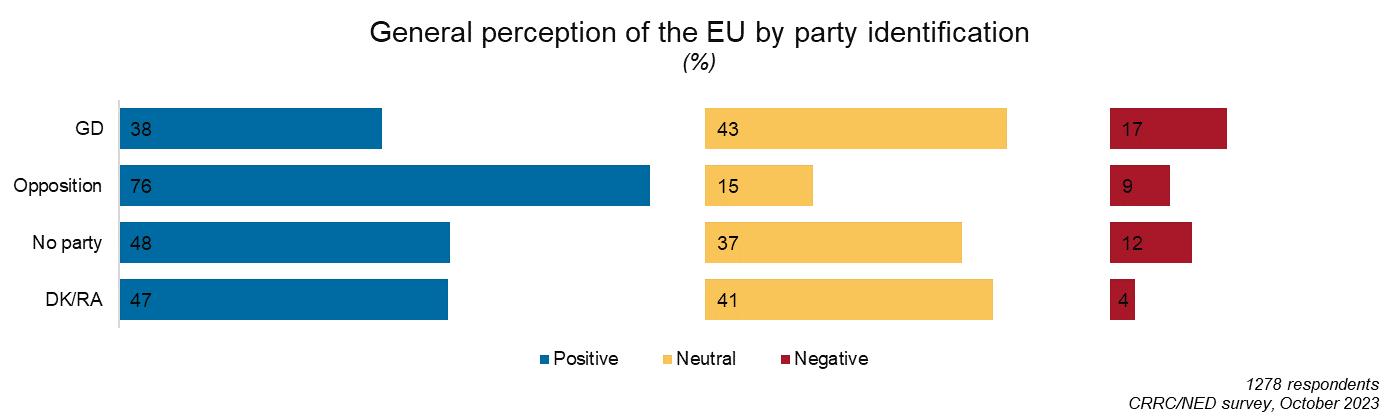
Georgian Dream supporters and opposition supporters differ substantially in terms of their general perceptions of the EU. Slightly more than a third of Georgian Dream supporters (38%) have positive perceptions of the EU, while 43% report neutral attitudes. A further 17% report negative attitudes towards the EU. In contrast, three in four opposition supporters (76%) have positive views of the EU, 15% have a neutral view, and only one in eleven (9%) report a negative attitude. As for people who do not feel close to any political party, half (48%) have a positive view of the EU, 37% a neutral view, and 12% a negative attitude. 
Only a third of Georgians believe that the country will gain candidate status. While ruling party supporters are substantially more likely to believe that the country will become a candidate, they are simultaneously far less positive about the EU than supporters of the opposition.

Note: The above differences across political groups were tested using logistic and ordinal regression models. The models controlled for the following variables: age group (18-35, 35-55, 55+), sex (male or female), education (completed secondary/lower, vocational or incomplete higher education/higher), settlement type (capital, urban, rural), party identification (Georgian Dream, Opposition, no party, DK/RA), employment (not working, working in the private sector, working in the public sector), social conservatism (low, mid-low, mid-high, high), and religious attendance (regularly, only on special occasions, rarely or never).

This article was written by Givi Silagadze, a researcher at CRRC-Georgia, and Koba Turmanidze, CRRC Georgia’s president. The article is based on data collected with the financial support of the National Endowment for Democracy (NED). The views expressed in this article are the authors’ alone and do not represent the views of NED, CRRC Georgia, or any related entity.

Tuesday, October 31, 2023

Almost half of young Georgians are on TikTok

 Note: Note: This article first appeared on the Caucasus Data Blog, a joint effort of CRRC-Georgia and OC Media. This article was written by Zachary Fabos, an International Fellow at CRRC Georgia. The views presented in the article are the author’s alone and do not necessarily represent the views of CRRC Georgia, Caucasian House, or any related entity.

A CRRC analysis of Georgian social media use has found that while Facebook remains the most popular social network in the country, almost half of young Georgians are on TikTok, with men and members of ethnic minority groups more likely to use the app.

Despite being a relative newcomer to the social media market, the popularity of TikTok, the short-form video sharing platform, is rapidly growing as a tool for accessing and engaging in entertainment and niche communities, especially among young people. This has remained the case despite controversies relating to data-sharing and state security, as its founding company, ByteDance, is China-based and has ties to China’s government. 

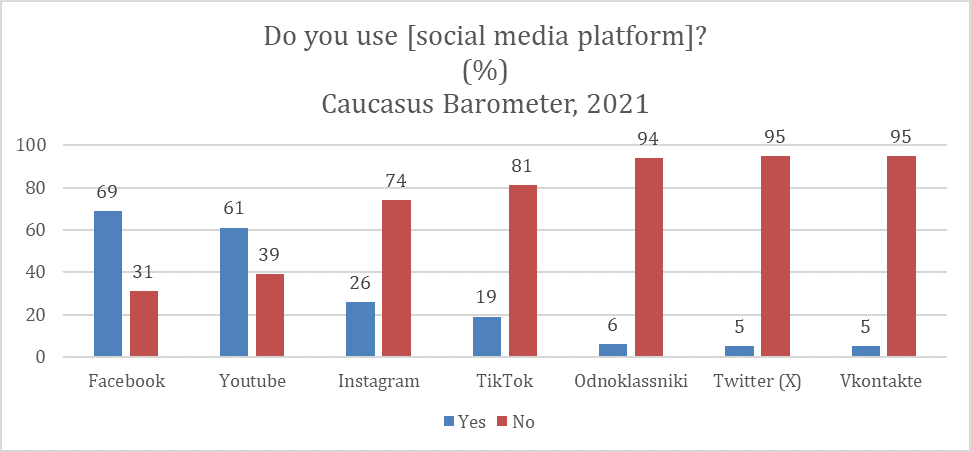
Data from the 2021 Caucasus Barometer survey shows that while TikTok is used by far fewer people than Facebook in Georgia, nearly half of young people were using the platform as of late 2021. 

Georgia’s most popular social media site by far is Facebook, with 69% of the population using the site, according to Caucasus Barometer 2021 data. Following Facebook in popularity are YouTube (61%), Instagram (26%), and TikTok (19%). Other platforms asked about included Twitter (now X) (5%), Vkontakte (5%), and Odnoklassniki (6%), which were significantly less popular. 

Who uses TikTok? 

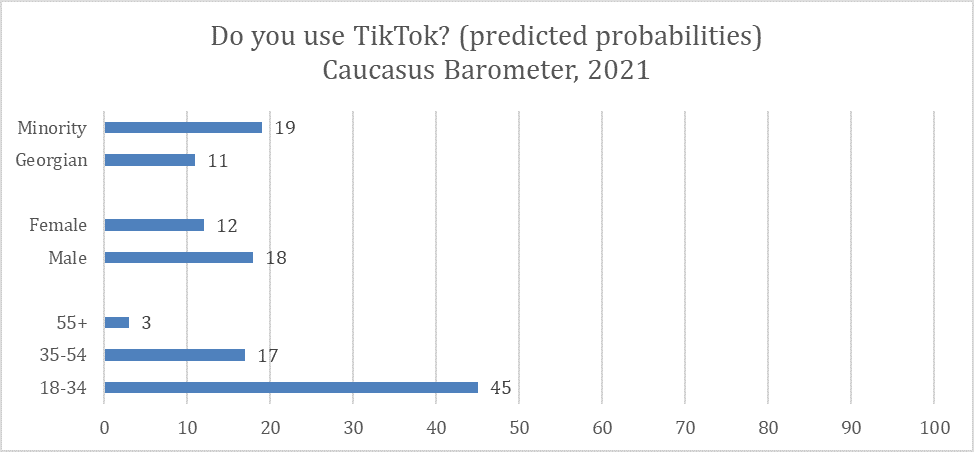
The data suggests that usage is concentrated among young people. Controlling for other factors, the youngest group of adults surveyed are 42 percentage points — 15 times — more likely to use TikTok than older people. While only 19% of the public use TikTok, a regression analysis suggests that young people (18-34-year-olds) have a 45% chance of using the platform, controlling for other factors. This compares to only a 3% chance among those 55 and older, and a 17% chance among those aged 35-54. The Caucasus Barometer only surveys adults, meaning that data for those under 18 is not available. 

Aside from age, several other factors predict TikTok usage.

Ethnic minorities are eight points more likely to use the platform than ethnic Georgians, while men are six points more likely than women to report engaging with the site. 

Where one lives, level of education, employment status, and wealth were not associated with whether someone used the platform.

Interestingly, partisanship is also associated with TikTok use. Those who supported any party were more likely to use TikTok than those who refused to answer which party they supported, did not know which party they supported, or did not support any party. 

Despite Facebook’s continued dominance of the social media market in Georgia, both the above and other Caucasus Barometer data suggest 18-34-year-olds appear to be open to engaging with and using new platforms. 

While the exact impact that it has remains to be seen, TikTok’s rapid rise in popularity among nearly half of the youngest adult demographic will likely have implications for Georgia’s relationship to entertainment, news, politics, and security. 

This article was written by Zachary Fabos, a Researcher at CRRC Georgia. The views presented in the article are the author’s alone and do not necessarily represent the views of CRRC Georgia or any related entity.

Note: The analysis in this article makes use of logistic regression analysis. The analysis included gender (male, female), age group (18-34, 35-54, and 55+), settlement type (capital, urban, rural), education (secondary/ secondary technical/ lower, and tertiary), ethnicity (ethnic Georgian, ethnic minority), employment (not employed, employed), a wealth index (0-10), and party (no party/don’t know, other party, refuse to answer, Georgian Dream, UNM) as predictor variables. 

The data used in this article is available here.

Tuesday, October 17, 2023

Attitudes towards disinformation on social media in Armenia and Georgia

 Note: This article first appeared on the Caucasus Data Blog, a joint effort of CRRC-Georgia and OC Media. This article was written by Kristine Jinchveleishvili and Nutsa Metskhvarishvili, Junior Fellows at CRRC-Georgia. The views presented in the article are the author’s alone and do not necessarily represent the views of CRRC Georgia, Caucasian House, or any related entity.

Armenian and Georgian internet users have different perspectives on the effect of social media disinformation and its effect on their respective countries, with a CRRC analysis finding that Armenians are more likely to state that social media has a negative impact on their country. 

Disinformation — information that is intended to mislead — has in recent years been a widely-discussed topic globally, particularly in relation to its presence on social media. 

An analysis of Caucasus Barometer 2021 data investigated the beliefs of Armenia and Georgia’s internet-using populations regarding the effects of online social media and disinformation on their countries. 

The survey asked respondents that use the internet — 81% of Armenia and 73% of Georgia — what effects online social media had on ‘the way things are going’ in their country. 

A clear difference was visible between Armenian and Georgian populations’ perceptions of the impact of social media. While around half (52%) of the internet-using Armenian respondents surveyed reported that social media had a mostly negative impact on their country, less than a third (27%) of internet users in Georgia reported feeling the same. 

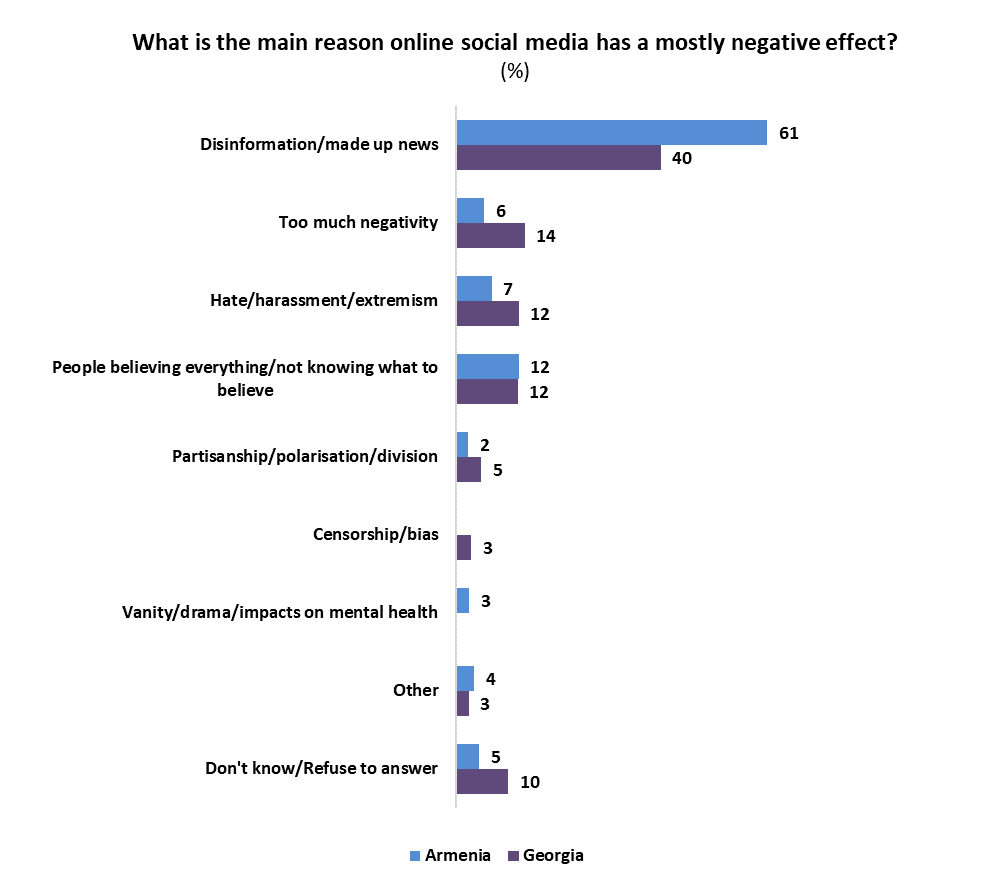
Of those who reported that the internet had a negative impact on their country, a majority in both Armenia (61%) and Georgia (40%) attributed this to disinformation or made-up news. The next most common responses were named by less than 15% of the internet-using population.

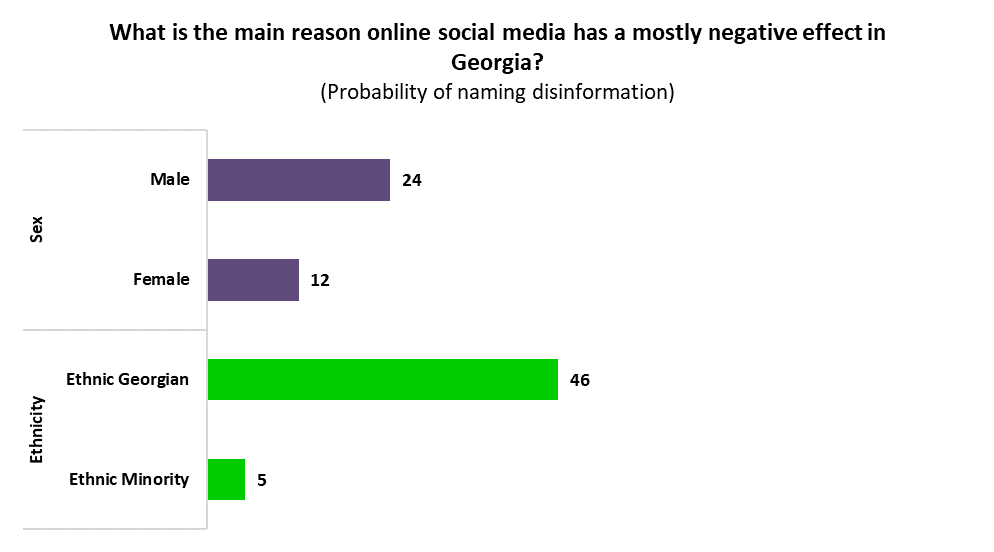
In Georgia, whether or not someone names disinformation varied with ethnicity and sex. 

Ethnic Georgians were 41 percentage points more likely to name disinformation compared to ethnic minorities, while men were 12 percentage points more likely to mention disinformation than women. 

Other socio-demographic variables such as age, settlement type, education level, employment status, and wealth were not associated with naming disinformation in Georgia. 

In Armenia, none of the variables tested were associated with believing that disinformation is the main reason social media has a negative effect. 

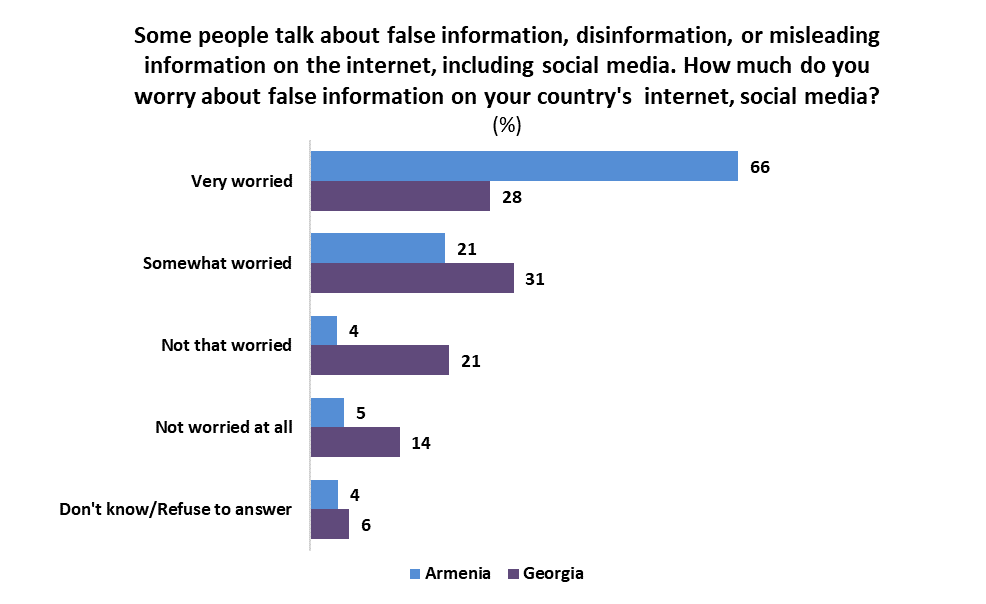
That people named disinformation as the key negative effect of social media is perhaps unsurprising, considering that, of those who considered the internet to have a negative effect, 87% of the Armenian population surveyed and 59% in Georgia reported that they were worried about the impacts of disinformation on social media.

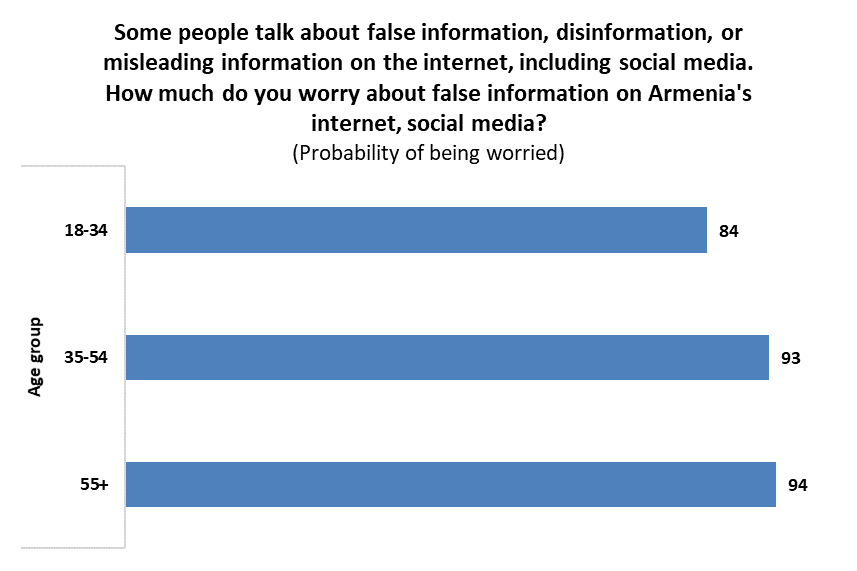
How much people report worrying about disinformation varied with age in Armenia, with people over the age of 34 more likely to be worried than younger people.  Sex, settlement type, education level, employment status, and wealth were not associated with worrying about disinformation on Armenia’s internet and social media. 

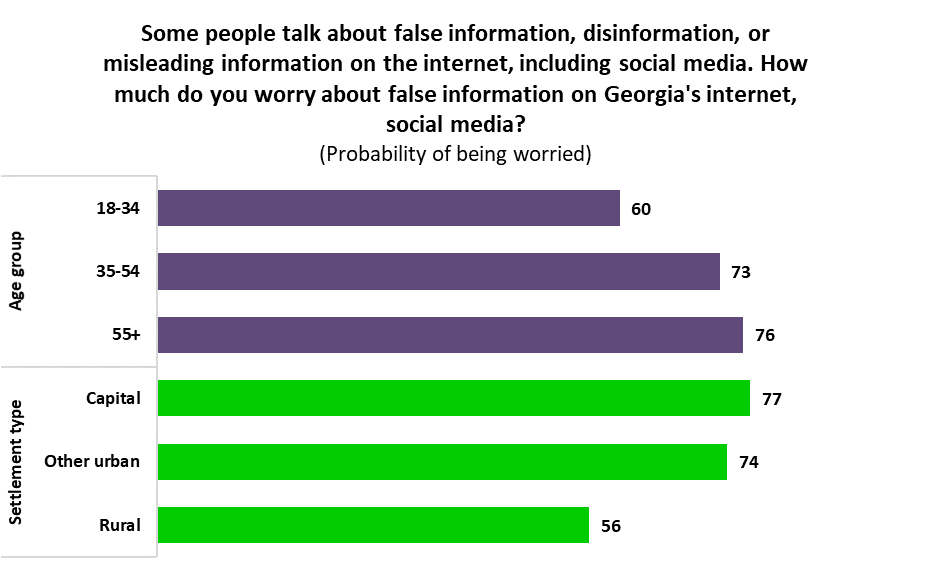
In Georgia, age and settlement type were associated with worrying about disinformation. People over the age of 34 were more likely to worry about disinformation, while people living in rural areas (56%) were less likely to worry about disinformation than people living in urban areas. Other socio-demographic variables such as sex, education level, employment status, and wealth were not associated with whether or not someone is worried about disinformation on Georgia’s internet. 

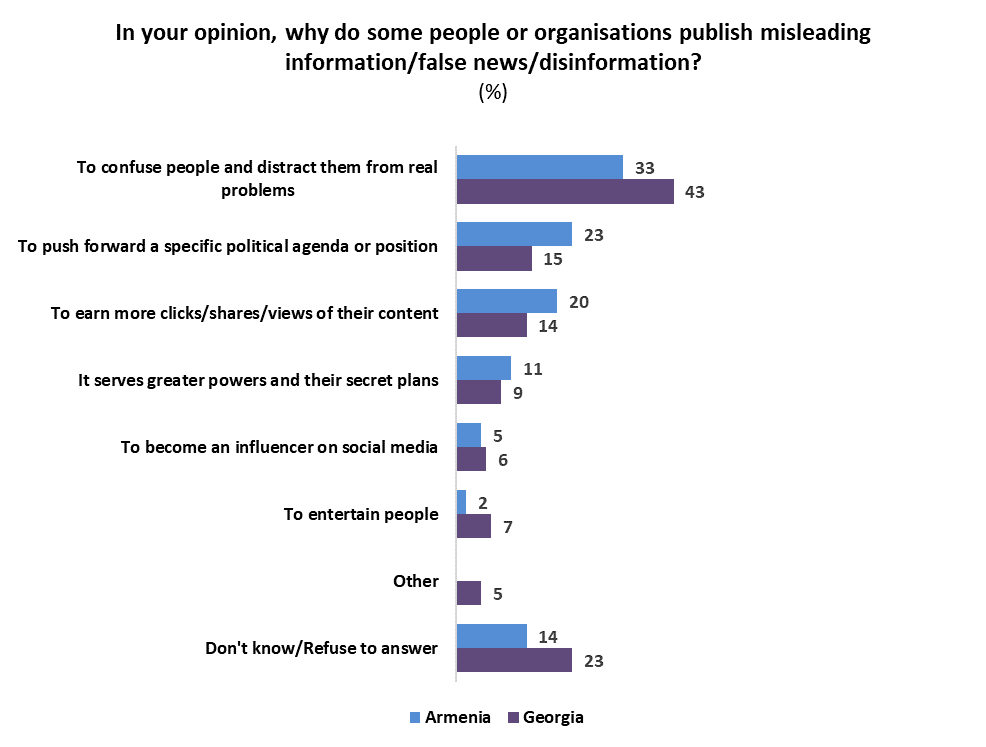
The survey also asked respondents why they think that disinformation is published. The most common reason given was to confuse people and distract them from real problems, which was chosen by 33% of Armenians and 43% of Georgians surveyed. Other common reasons given included pushing a specific political agenda or position, and earning clicks, shares or views. Relatively few of those surveyed in both countries believed that disinformation was used by ‘greater powers for their secret plans’, by those attempting to become influencers, or to entertain people. 

Most people in Armenia and Georgia are worried about what they perceive to be the negative effects of social media, and particularly disinformation. People in Armenia are more skeptical of the effects of social media and more worried about disinformation than people in Georgia. 

The regression analysis used in this article included the following variables: age (18-34, 35-54, 55+), sex (male, female), settlement type (capital, other urban, rural), education level (tertiary or not), ethnicity in Georgia only (ethnic Georgian, ethnic minority), employment status (employed or not working), and a wealth index (a simple additive index of ownership of a number of durable goods within a household). 

The views expressed in this article are the authors’ alone and do not necessarily reflect the views of CRRC Georgia or any related entity.

Tuesday, September 19, 2023

Georgia’s changing priorities at the UN General Assembly

 Note: This article first appeared on the Caucasus Data Blog, a joint effort of CRRC-Georgia and OC Media. This article was written by Givi Silagadze, a Researcher at CRRC-Georgia. The views presented in the article are the author’s alone and do not necessarily represent the views of CRRC Georgia, Caucasian House, or any related entity.

A quantitative analysis of the speeches made by Georgia’s leaders at the annual UN General Assembly found that their themes and priorities changed after the change of government in 2012, with Georgian Dream leaders more positive and discussing Russia less negatively than their predecessors. 

The UN General Assembly (UNGA), currently in its 78th session, meets annually in September and offers an opportunity for the heads of state or government of every country to raise the issues that they consider most pressing, as well as addressing an international audience from one of the highest tribunes of the world. 

Georgian political leaders have been no exception to this. Examining their speeches from 2007 to 2022 at the UNGA using quantitative text analysis allows patterns associated with the change in government in 2012 to be identified. 

Mikheil Saakashvili, the leader of the previous United National Movement (UNM) government, made longer speeches, and spoke more often, more negatively, and more harshly about Russia. In comparison, Georgian Dream’s leaders and President Salome Zurabishvili have been less likely to mention Russia, instead focusing on broader concepts such as development, security, and peace. The data suggests a clear shift in Georgia’s foreign policy discourse. 

Speech length

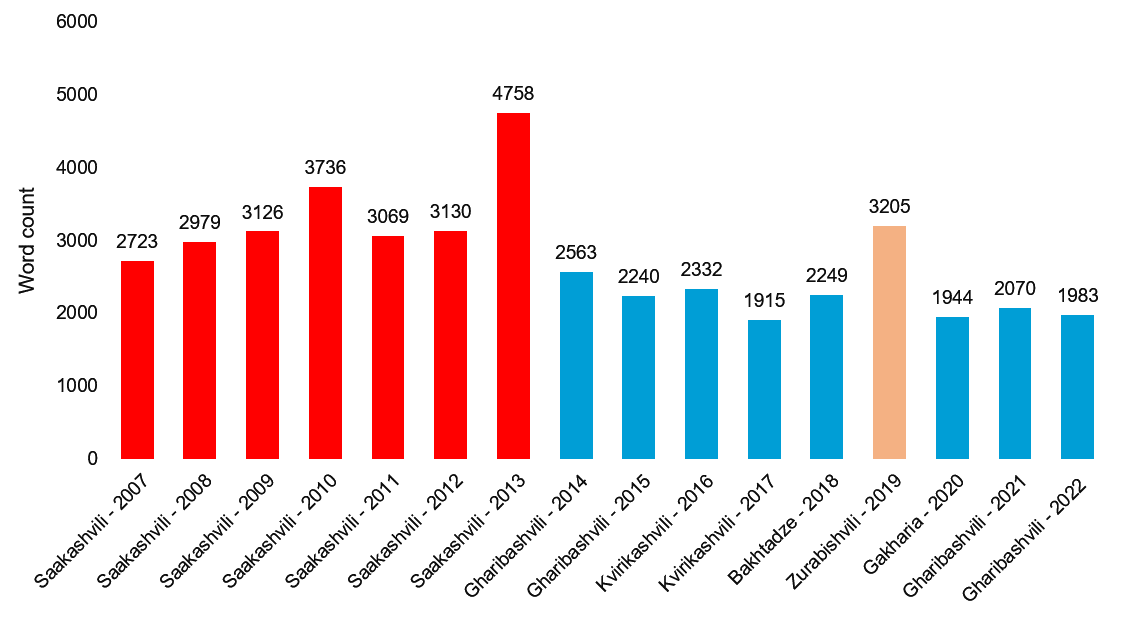
Saakashvili made longer speeches than Georgian Dream’s leaders, with his speeches on average containing 3360 words. His 2007 speech was the shortest (2723 words) and his last speech in 2013 the longest (4758 words). In contrast, an average speech after Georgian Dream took over was 2277 words, with Kvirikashvili's 2017 address the shortest (1915 words), and Zurabishvili’s 2019 speech the longest (3205 words).

General sentiment

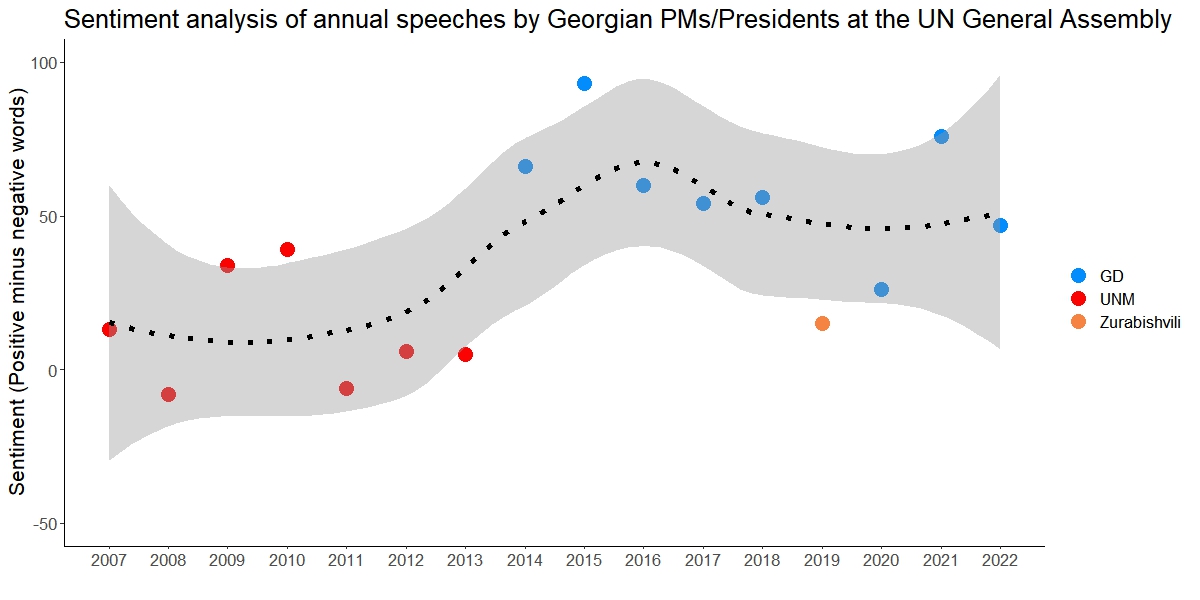
Sentiment analysis of the speeches shows that Saakashvili was generally more negative in his speeches than Georgian Dream’s Prime Ministers. The two speeches with the highest frequency of negative words are Saakashvili’s in 2008 and 2011, while the two most positive speeches are Gharibashvili’s in 2015 and 2021. However, it's important to highlight that Zurabishvili's overall sentiment differs from that of Georgian Dream leaders, with her speech recording a significantly more negative sentiment. 

Russia in Georgian leaders’ UNGA speeches

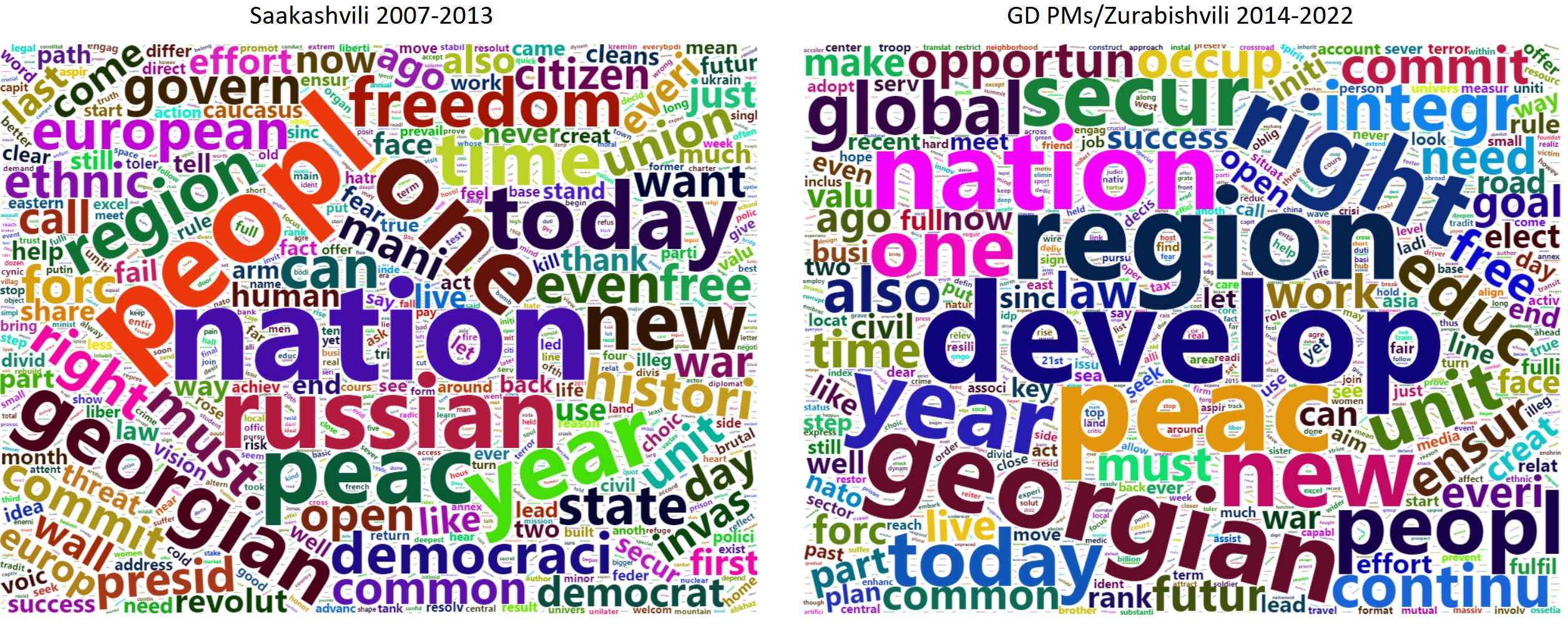
Due to the formal style of speeches at the UN General Assembly, many of the highest frequency words in Saakashvili’s speeches and those of Georgian Dream’s leaders are the same. However, there are some notable differences.

Saakashvili frequently mentioned Russia and the word ‘freedom’, while Georgian Dream’s leaders mentioned security, education, development, and human rights more frequently. 

In total, Saakashvili mentioned Russia/Russians 105 times (once in every 224 words) while Georgian Dream leaders did the same 55 times (once in every 373 words). The UNM leader mentioned freedom 51 times (once in every 461 words) while Georgian Dream’s leaders mentioned it 28 times (once in every 732 words). 

However, Georgian Dream’s leaders mentioned security 52 times (once in every 394 words), compared to Saakashvili’s 17 (once in every 1384 words). Georgian Dream also mentioned development 92 times (once in every 223 words), while Saakashvili said it 25 times (once in every 941 words). GD mentioned human rights roughly twice as often (once in every 683 words) as Saakashvili (once in every 1568 words), and referred to education 42 times (once in every 488 words) while Saakashvili mentioned it six times (once in every 3920 words). 

Note: Some of the words in the above word clouds are misspelled. This stems from the analysis method using core parts of words rather than the full word to conduct analysis, a process known as stemming. For instance, the analysis counts peace, peaceful, and peacebuilding in the same manner.

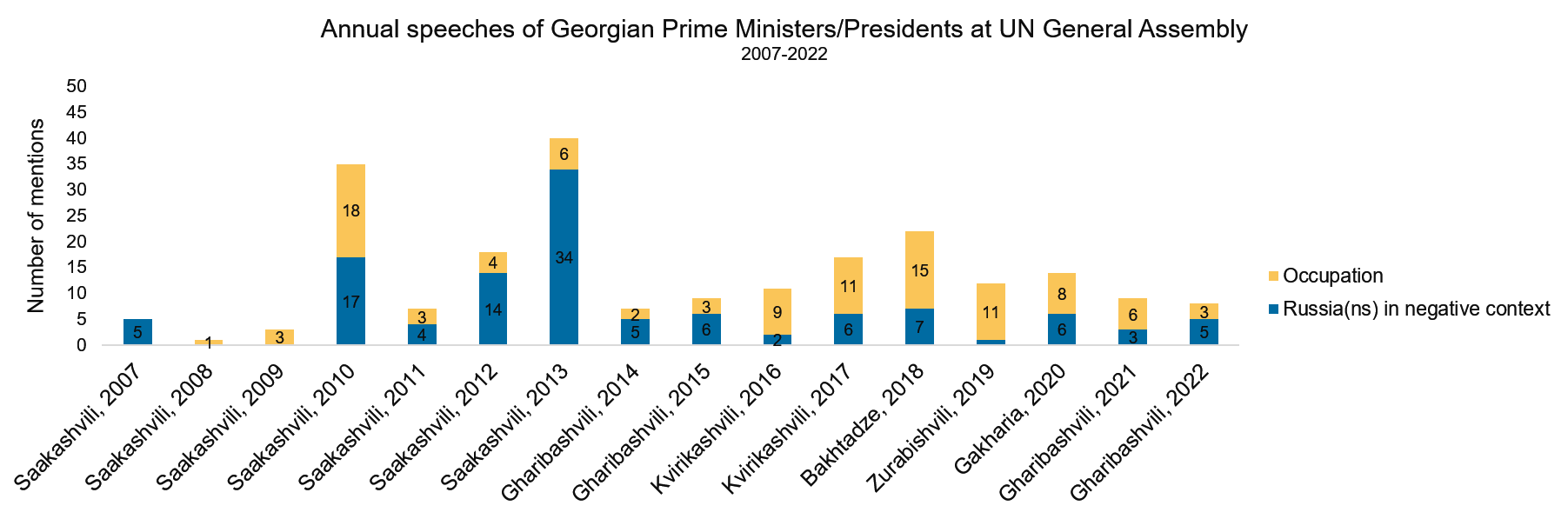
The context of the above mentions is important as well. The following graph demonstrates the number of mentions of ‘Russia’/’Russians’ in a negative context as well as the term ‘occupation’. Saakashvili referred to Russia negatively every 320 words, while GD leaders mentioned Russia in a negative context every 510 words. 

Saakashvili’s attitude towards mentioning Russia changed during his time in power. In his speeches just after the 2008 war, he did not explicitly name Russia when speaking about the country in a negative light; for example, in 2008, he stated that ‘Georgia [...] was invaded by our neighbour’. However, in his later speeches, his negative references to Russia were more explicit. In his last speech at the UN General Assembly in 2013, Saakashvili referred to Russia negatively 34 times and mentioned ‘occupation’ six times. By comparison, Georgian Dream’s leaders mentioned Russia negatively only a handful of times in their speeches. 

Note: Only direct mentions are counted. 

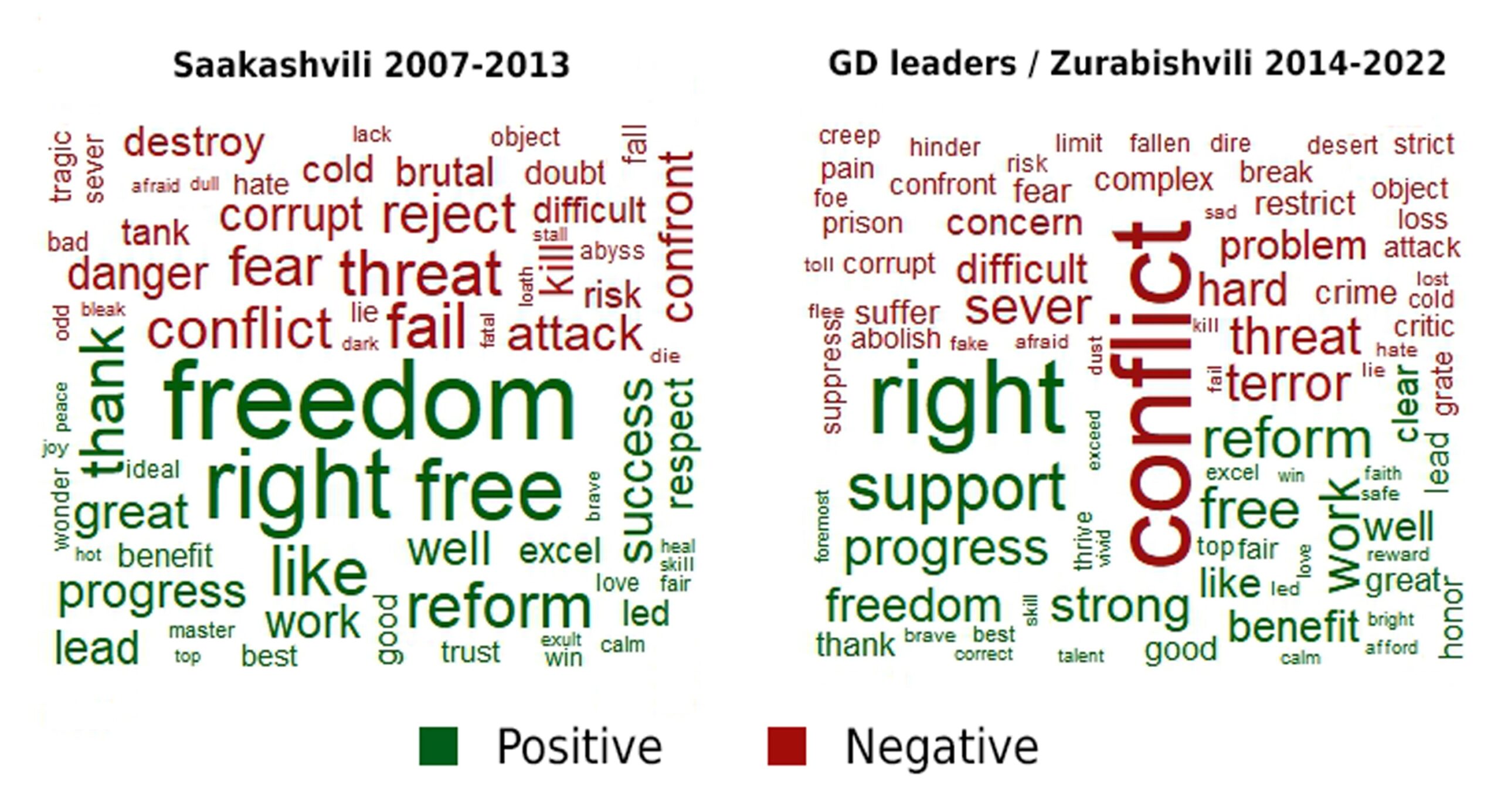
A closer inspection of sentiments suggests that Saakashvili used harsher language when referring to Russian activities in Georgia than Georgian Dream leaders. More specifically, the most frequently mentioned negative terms Saakashvili used were brutaldestroydangertankattackfearkill, and conflict. In contrast, Georgian Dream’s leaders and Zurabishvili’s highest-frequency negative words associated with Russia are conflictseveredifficultthreat, and hard

While Georgian Dream’s leaders use the term ‘terror’, it does not refer to Russian occupation. 

In terms of positive words, Saakashvili put greater emphasis on the term ‘freedom’, while Georgian Dream leaders prioritised the word ‘success’ more often. 

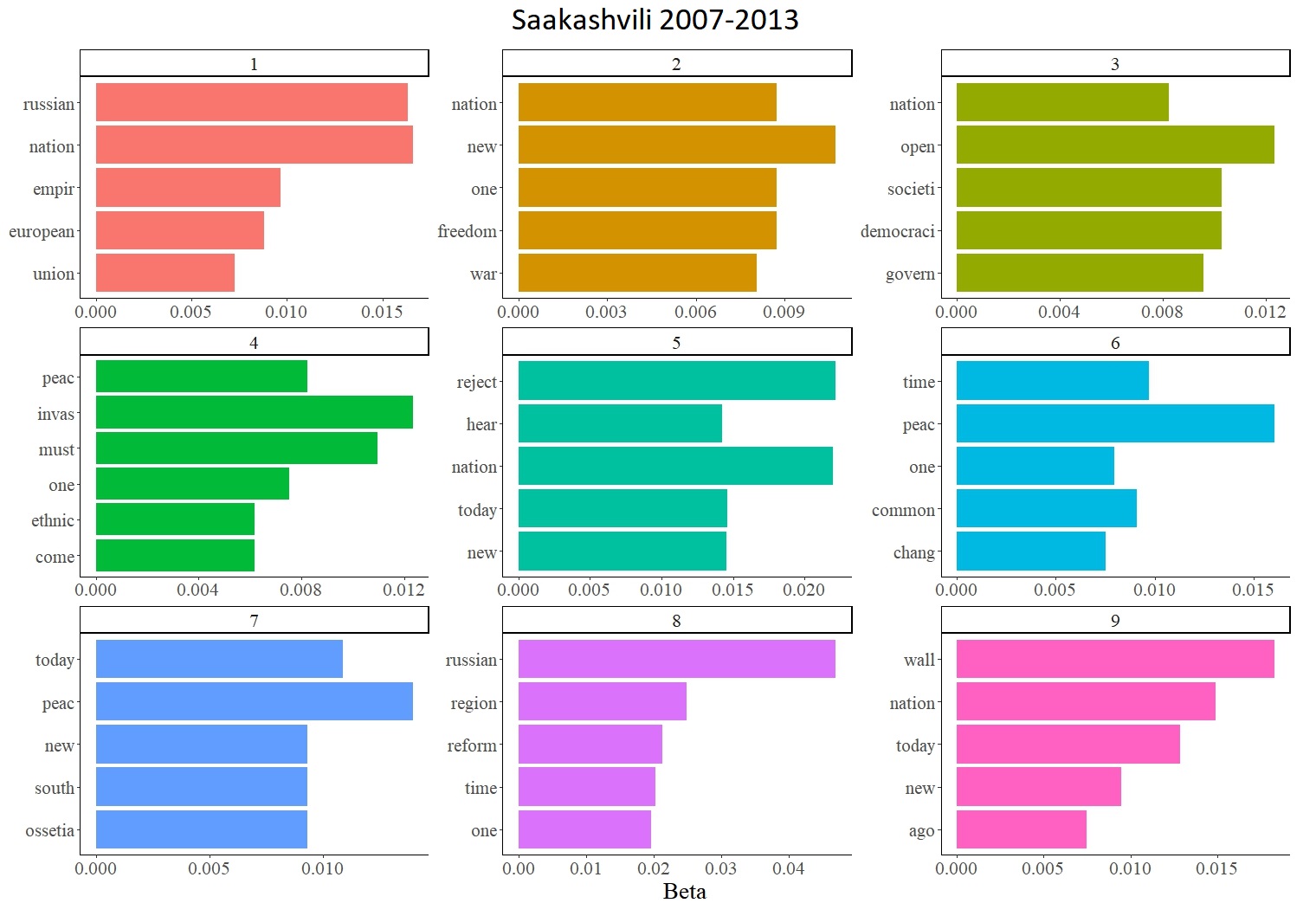
An analysis tool known as topic modeling suggests that the main themes of Saakashvili’s addresses revolve around Russia, the Georgian nation, peace, and democratic governance. Examining the top nine topics suggests there are several recurring terms in Saakashvili’s speeches at the UN General Assembly: Russia (topics 1, 8), war and invasion (topics 2, 4), new and nation (topics 2,5,9), peace (topics 6,7), and democratic governance (topic 3).

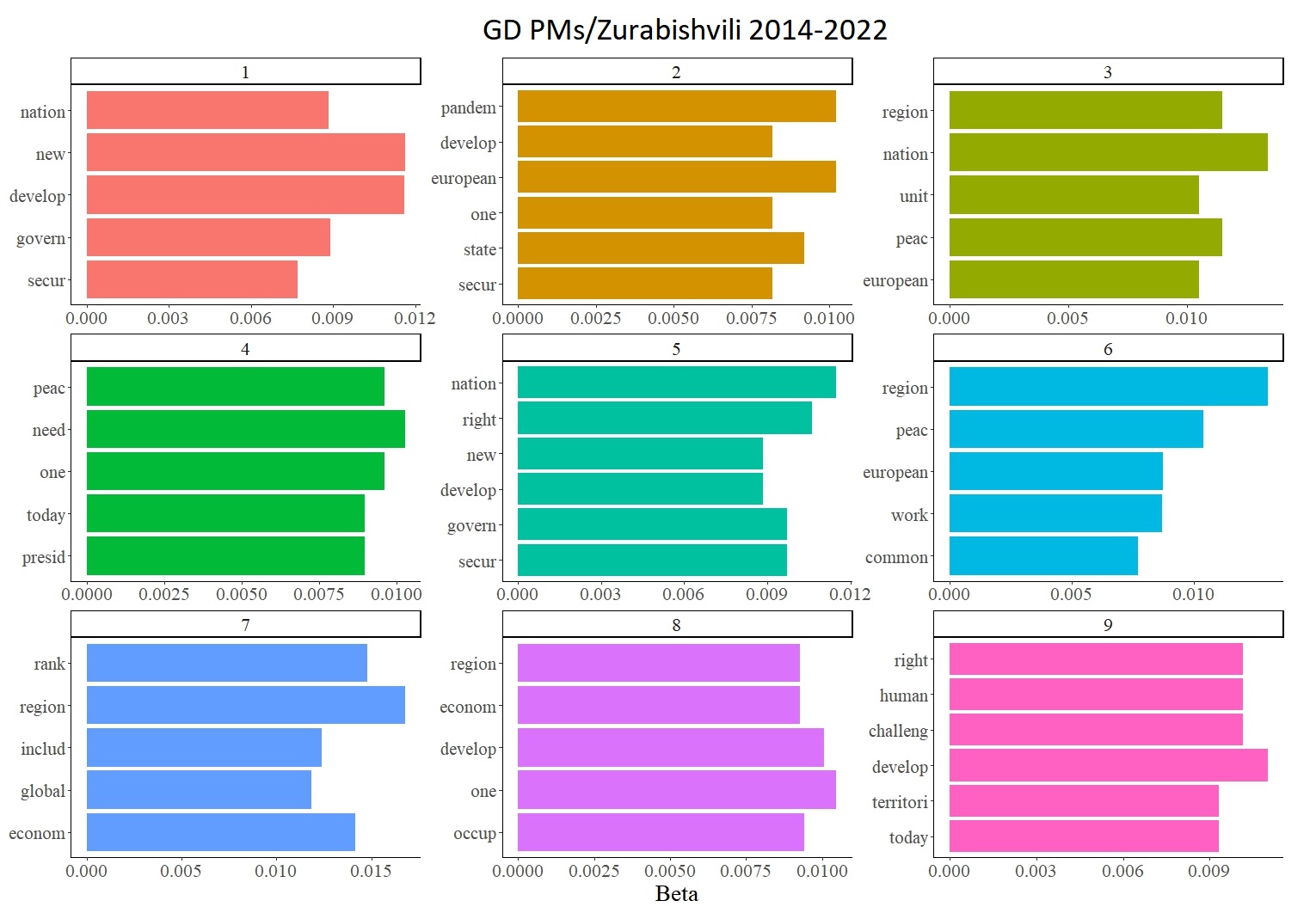
Topic modeling of the Georgian Dream PMs and Zurabishvili’s speeches suggest that their priorities differ from Saakashvili’s. In their top nine topics, none refer explicitly to Russia. Their speeches mostly focused on development (topics 1,2,5,8,9), security (topics 1, 2, 5), peace (topics 3, 4,6), Europe (topics 2,3, 6), rights (5,9), and the economy (7,8). One of the topics (8) does include the term occupation, but mainly in the context of economic development.

The above analysis suggests a shift in foreign policy priorities and Georgia’s international positioning after Georgian Dream came into power. While Saakashvili used harsher and more negative terms, and referred to Russia more regularly, Georgian Dream’s Prime Ministers have been relatively reluctant to refer to Russia explicitly. Instead, they have focused their speeches to the UN on security, development, the economy, and peace. 

Wednesday, September 06, 2023

Russian émigrés in Georgia

Note: This article first appeared on the Caucasus Data Blog, a joint effort of CRRC-Georgia and OC Media. This article was written by Givi Silagadze, a Researcher at CRRC-Georgia. The views presented in the article are the author’s alone and do not necessarily represent the views of CRRC Georgia, Caucasian House, or any related entity.

After the beginning of Russia’s full-scale invasion of Ukraine, tens of thousands of Russian nationals moved to Georgia, with many choosing to stay. A CRRC survey found that Russian respondents  in Georgia believe that Russia is not a democracy, have mixed views about Georgia’s political direction, and feel relatively secure in Georgia. 

After Russia launched a full-scale invasion of Ukraine in February 2022, Georgia emerged as a popular destination for Russian citizens fleeing their country. According to the Georgian Ministry of Internal Affairs, between February and September 2022, about 100,000 Russian nationals entered the country and chose to stay. 

Many Georgians are concerned about the influx and believe it might have a detrimental impact on the country, and the attitudes of Russian émigrés about both Georgia and Russian politics have been hotly debated. 

To understand these attitudes, in the spring and early summer of 2023, CRRC-Georgia employing non-probability based sampling methods, polled over 1,000 Russian nationals who emigrated to Georgia after February 2022. The data show that, at least for those surveyed, Russians in Georgia left due to the war, seeking security, and feel they have found it in Georgia. With regard to politics, the Russians surveyed are extremely negative about Russian President Vladimir Putin, relatively positive about opposition leader Alexei Navalny, and believe that Russia is not a democracy. 

Migrating to Georgia

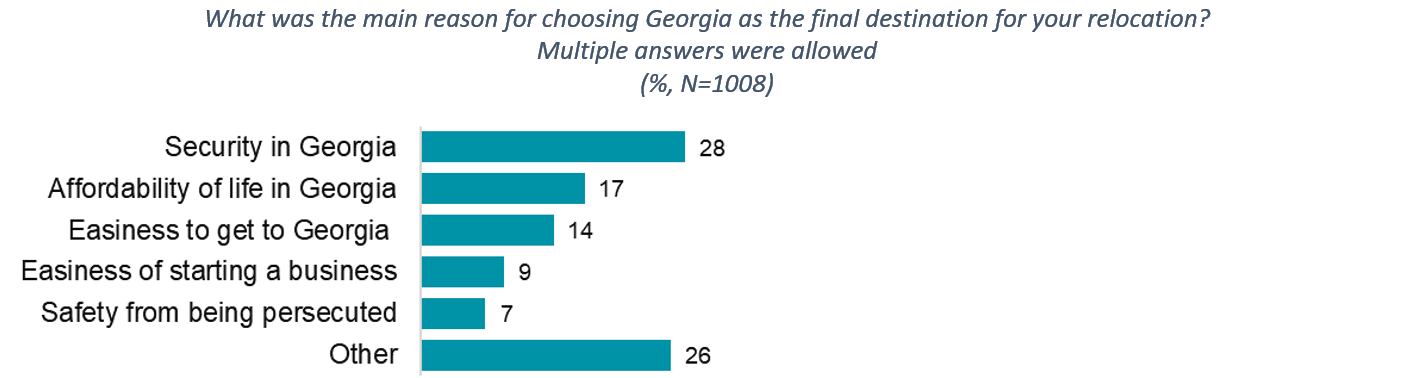
The poll asked respondents to name the primary reasons for choosing Georgia. A plurality of respondents (28%) cited security in Georgia. One in six (17%) mentioned the cost of living, and one in seven (14%) mentioned the ease of getting to Georgia. No more than 10% of respondents named the other available response options.

Three quarters of those surveyed (74%) report they have at least one Georgian friend. Nearly half (44%) reported having a Georgian friend before coming to Georgia after February 2022. More than half of the respondents (57%) stated they made new Georgian friends after moving to the country.

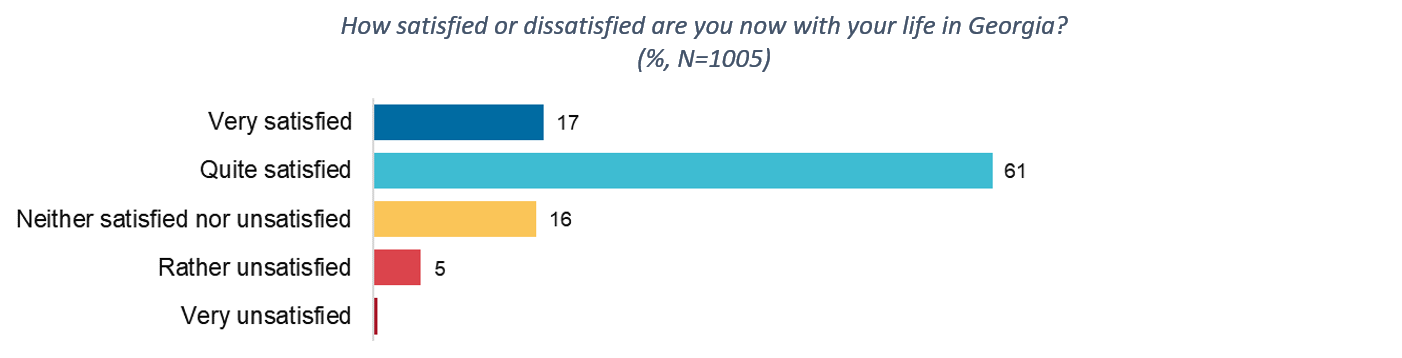
A majority (78%) say they are very or quite satisfied with their life in Georgia. One in six (16%) are neither satisfied nor unsatisfied. One in twenty (6%) report they are very or rather unsatisfied with life in Georgia.

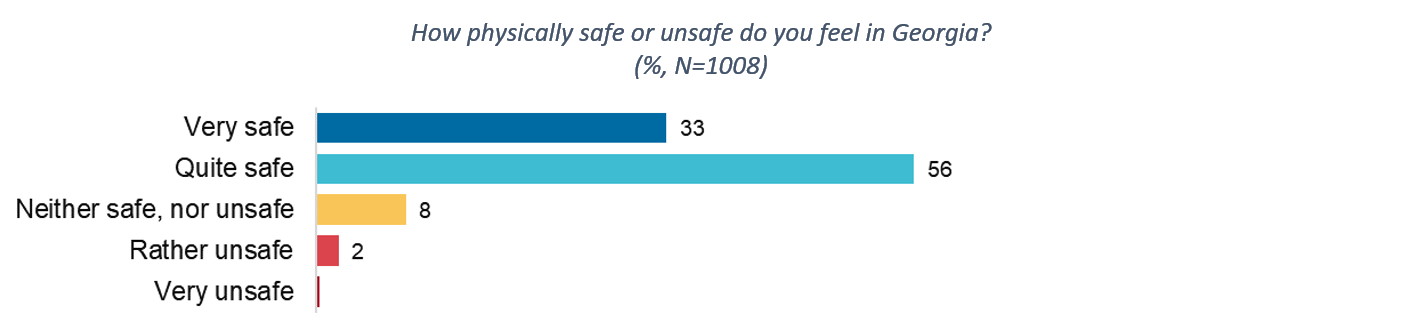
Most Russians feel physically secure living in Georgia. A third of the respondents (33%) felt very safe, and 56% said they felt quite safe. Only 8% reported feeling neither safe nor unsafe, and 3% said they felt very unsafe or rather unsafe.

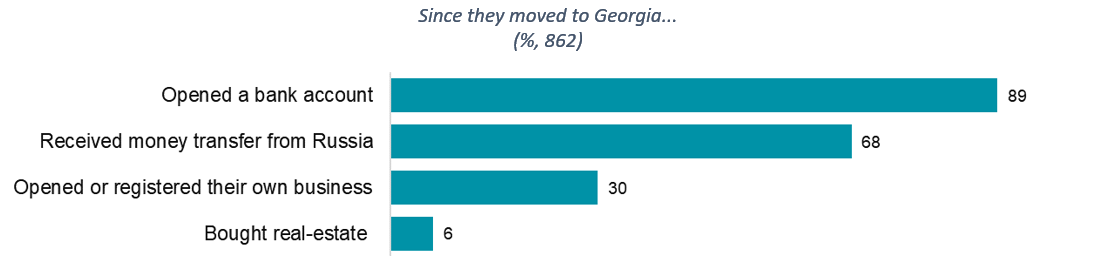
Since moving to Georgia, nine in ten respondents (89%) opened a bank account, two-thirds (68%) received money transfers from Russia, three in ten (30%) opened or registered a business, and 6% purchased real estate. 

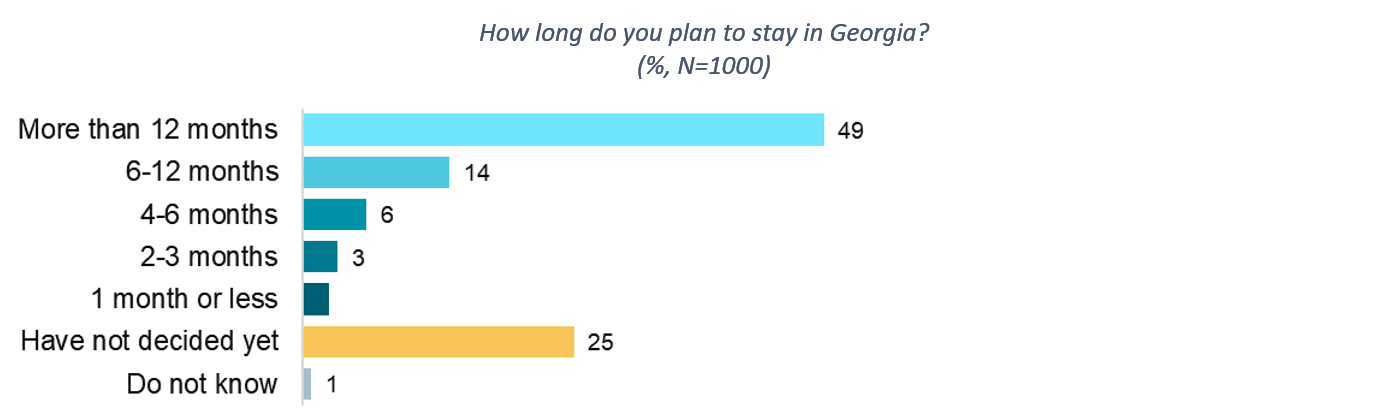
The reported duration of respondents’ stays in Georgia is mixed, with a large share uncertain of how long they’ll stay. Half (49%) plan to remain in Georgia for at least a year. A further 14% plan to spend more than six months, but less than a year. One in twenty (6%) plan to stay for more than four months, but no more than six. Other periods were reported by less than 5% of the sample. A quarter of the Russians surveyed Russians (25%) have yet to decide how long they will remain in Georgia.

The émigrés overwhelmingly trust Georgians.  Nine in ten (91%) fully or mostly trust residents of Georgia, while only 8% say that they do not trust Georgians.

Attitudes towards Georgian politics

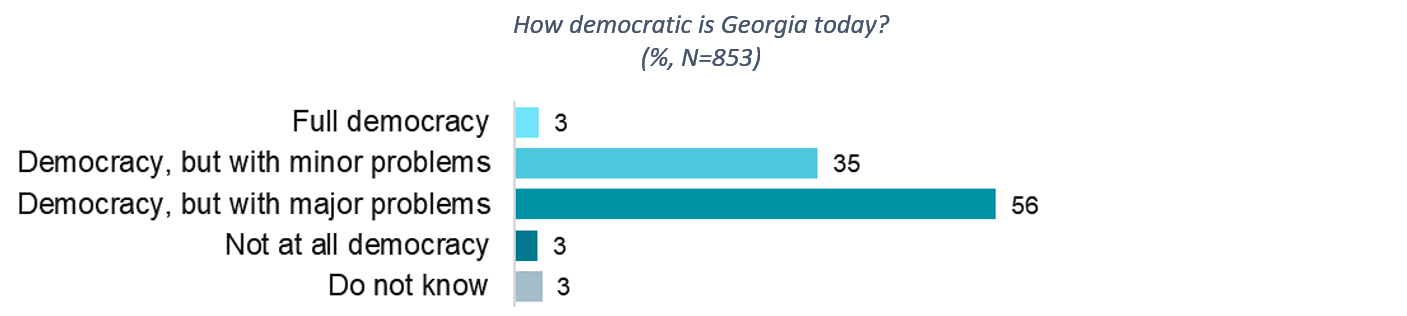
The Russians surveyed tend to think Georgia qualifies as a democracy, but they are divided over the scale of its political issues. More than a third of the respondents think Georgia is either a full democracy (3%) or a democracy with minor problems (35%). Slightly over half believe Georgia is a democracy with major problems (56%). Only 3% consider Georgia not at all democratic, and the remaining 3% do not know.

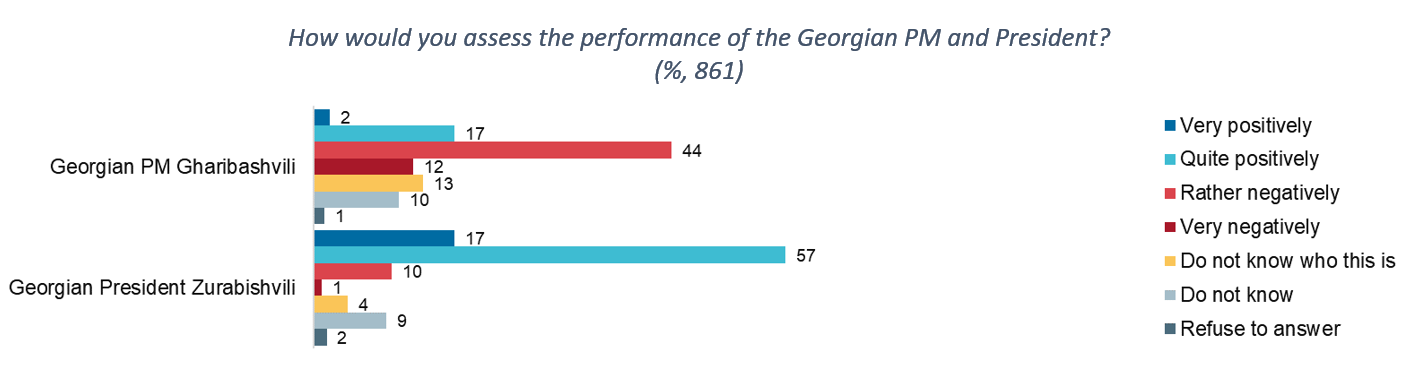
The émigrés generally rate Georgian Prime Minister Irakli Gharibashvili’s performance negatively, whereas they primarily rate that of President Salome Zurabishvili positively. Only 19% of respondents thought the PM's performance was very or quite positive, whereas 74% said the President's performance was very or quite positive.

Leaving Russia

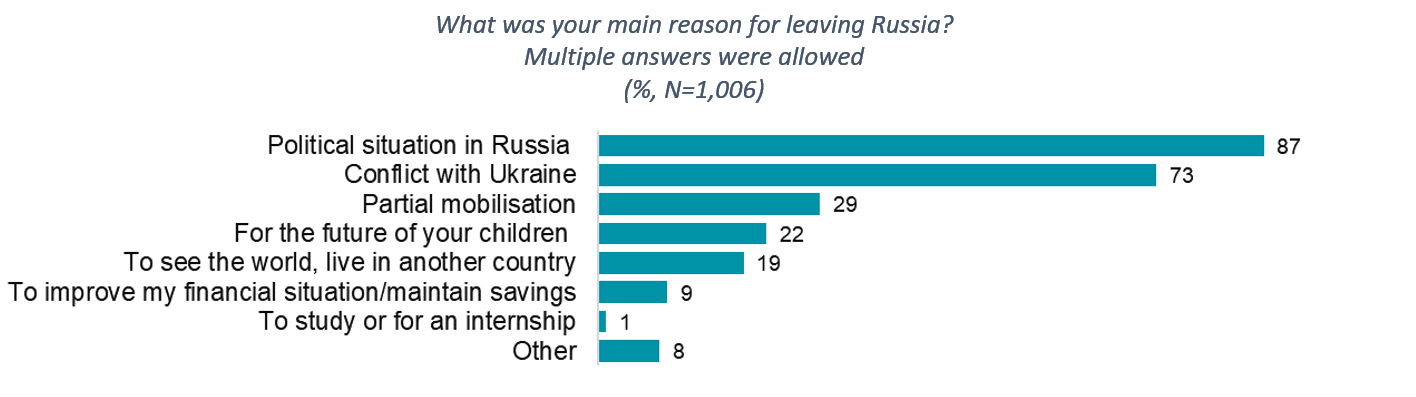
Similar to earlier studies of displaced Russians in Georgia, the major reasons for leaving Russia were the political situation in Russia, the conflict in Ukraine, and the ‘partial’ mobilisation that took place in September 2022. The political situation in Russia was cited by an overwhelming majority of responders (87%). 73% mentioned the conflict with Ukraine. Slightly less than a third (29%) of Russians polled stated the announcement of 'partial' mobilisation was among the primary triggers prompting their departure.

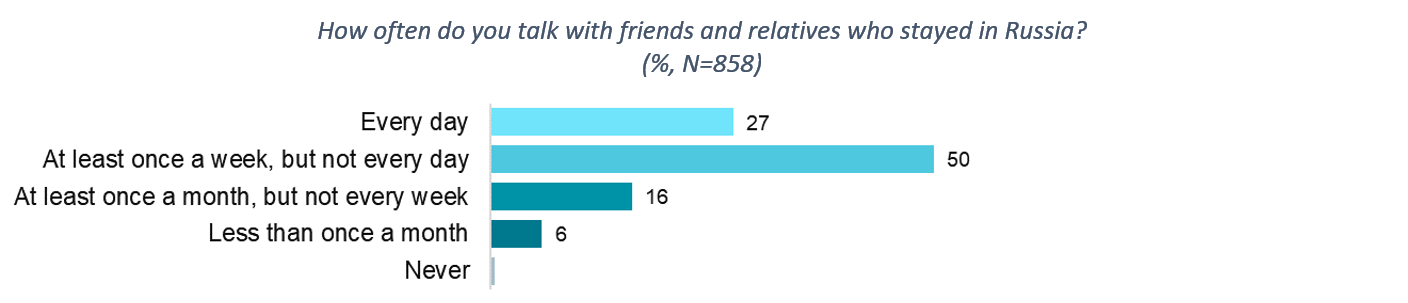
The polled Russians maintain regular contact with their friends and family who remain in Russia. A little more than a quarter of those polled (27%) said they communicated with friends and family in Russia on a daily basis. Half of those polled indicated they spoke with them at least once a week. 16% indicated they spoke with friends and family in Russia at least once a month but not every week. Fewer respondents reported talking with friends and family less often.  

Moreover, the interviewed Russians have no plans to return to Russia anytime soon. The vast majority of Russians polled (93%) said they would not return to Russia in the foreseeable future.

Attitudes towards Russian politics

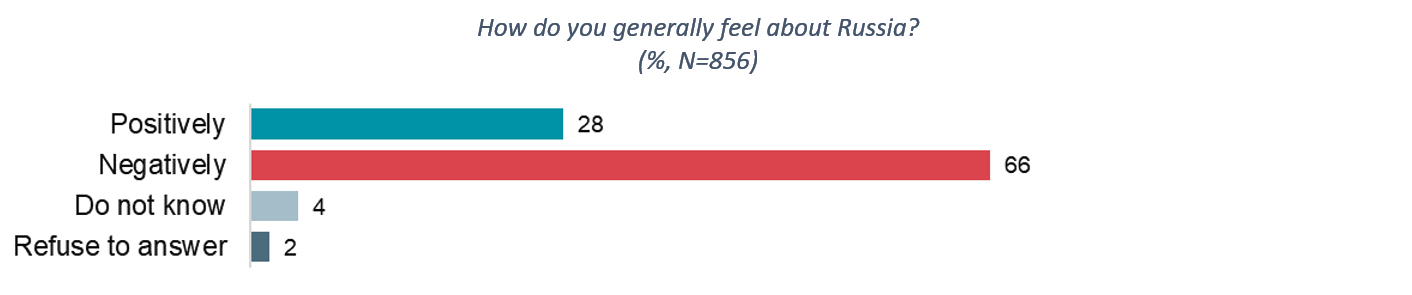
When questioned about their overall opinion of Russia, respondents tend to assess the country unfavourably. Two-thirds (66%) of Russians in the survey had negative feelings about Russia. A little more than a quarter of them (28%) were optimistic, while 6% were unsure and refused to answer the question.

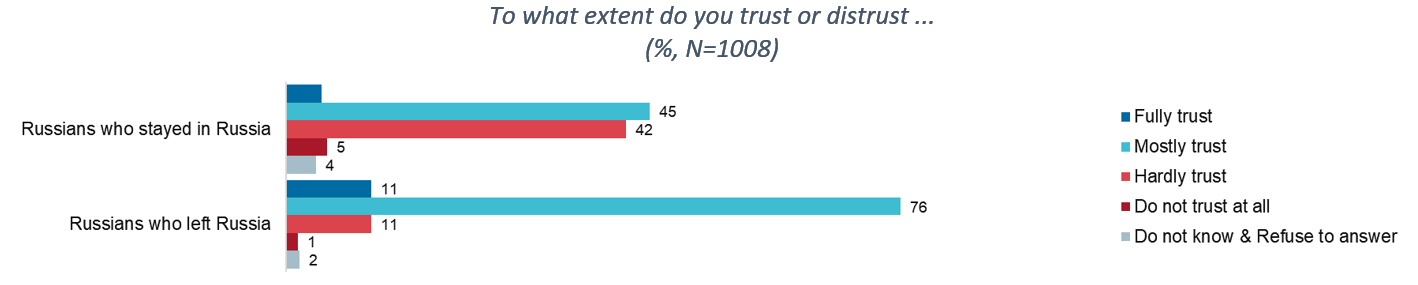
Respondents trust other Russians who left more than those that stayed. While 76% of respondents reported trusting Russians who left, 49% reported trusting Russians who stayed.

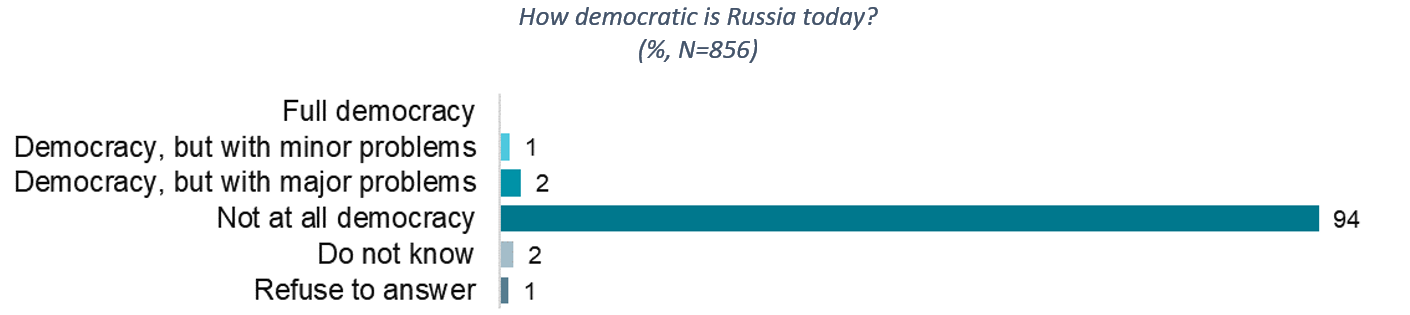
The respondents were certain that Russia does not qualify as a democracy, with 94% reporting Russia is not a democracy at all. 

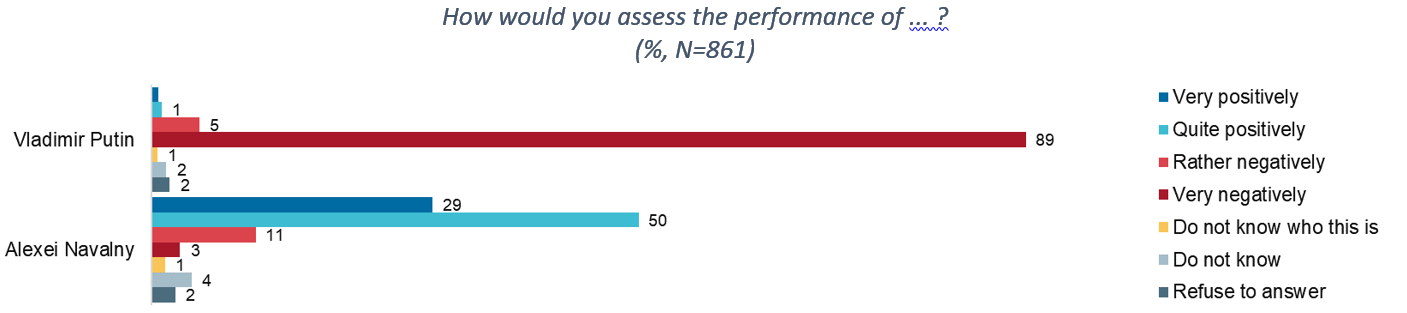
Respondents tend to evaluate Russian President Vladimir Putin very negatively and Russian opposition leader Alexei Navalny quite positively. Nine in ten respondents (89%) assessed Putin’s performance very negatively, and 5% rather negatively. Eight in ten respondents (79%) assessed Navalny’s performance positively.

The Russians interviewed in the above survey overwhelmingly left due to the war, and came to Georgia for security. The above data suggests they have found it, and they are satisfied with life here. They have relatively positive views of Georgia’s democracy, while assessing President Zurabishvili positively and Prime Minister Gharibashvili negatively. They tend to hold highly negative views of Putin, and quite positive views of Navalny. They recognise Russia is not a democracy.

This blog is based on a larger report, available here.

NOTE: Due to the non-probability sampling method, the results are only applicable to the respondents (N=1008) and not to the whole population of Russian citizens residing in Georgia.   

Tuesday, August 08, 2023

What Georgians read on Wikipedia

 Note: This article first appeared on the Caucasus Data Blog, a joint effort of CRRC-Georgia and OC Media. It was written by Hans Gutbrod, who teaches at Ilia State University. Hans was previously the Regional Director of Caucasus Research Resource Centers. The views presented in the article are of the author alone, and do not necessarily reflect the views of NDI, CRRC-Georgia, or any related entity.
Analysing the most-visited Georgian-language pages on Wikipedia gives an insight into the priorities and interests of Georgian users of the site, with some surprises.

In the depths of the internet, a little-known site listing the page views of different sites gives access to a particular treasure: the 100 most visited Georgian-language Wikipedia entries since 2015, highlighting what people have been drawn to over the last seven years. 

Some of the top pages may not come as a surprise to those familiar with the country’s attitude to its history and culture. 

For example, Georgian-language Wikipedia usage shows a strong interest in the country’s kings. David IV Aghmashenebeli (the Builder) is the third most visited page on Georgian Wikipedia, followed by Queen Tamar (5), Erekle II (10), Vakhtang I Gorgasali (11), and Parnavaz I (28). The first and only living Georgian among the top 100 is Georgian footballer and Napoli left-winger Kvicha Kvaratskhelia (48). 

Poetry, poets, and writers are also popular, led by Ilia Chavchavadze (8), The Knight in the Panther’s Skin (12), Vazha-Pshavela (14), Sulkhan-Saba Orbeliani (20), Shota Rustaveli (23), Akaki Tsereteli (25) and Galaktion Tabidze (32), and playwright and director Sandro Akhmeteli (40). The painter Niko Pirosmani (56) is also among the top 10 artists that Georgians look up on Wikipedia. Composers, however, appear not to be looked up frequently. 

Is the curiosity genuine, or are children cribbing for school? Ilia Chavchavadze is most in demand in November (26,700 views) and of least interest in August (3,900 views). This pattern seems to align with the curricular season, though perhaps it is good if teachers encourage kids to wander the pastures of ‘the largest and most-read reference work in history’. 

Sharka Blue (23) was not a name I recognised. On inspection, it turns out that Sharka Blue lists ‘Assume the Position 4’ among her oeuvre. You would be wrong to expect that to be a tactical recommendation for a debating competition.

The prominence of her page looks likely to be attributable to Georgian Wikipedia having a full list of her professional filmography — something that no other language appears to have. Only 60% of her page views are from a mobile device, when otherwise the average is above 80%.

Sharka notwithstanding, women are systematically underrepresented in Georgian Wikipedia. Queen Tamar is the only woman in the top 20, and when speaking about her, many men — especially during toasts —  will anyway insist she was so formidable as to be a mepe, a king. The next women are far down the list, with the Martyrdom of Shushanik (77), Queen Elizabeth II (79), and Saint Nino (84), making for a total of five women versus 25 men among the top 100 entries. 

Geographical information is highly sought after on Georgian Wikipedia. The fourth most popular entry is Ukraine, closely followed by the List of Countries (7), National Flags (15), Russia (18), the United States of America (22), and Earth (26). As might be expected, interest in Ukraine and Russia spiked in February/March of 2022. 

Mexico, an increasingly popular destination for those seeking to travel onward to the US, remains the 919th most visited page with stable interest across the years, suggesting that Wikipedia is not where potential migrants do their research.

The word ‘tolerance’ (85) is amongst the top 100 Georgian-language Wikipedia pages, as is ‘liberalism’ (91). Otherwise, verbs (36), adjectives (49), metaphor (80), and synonyms (86), rank high, suggesting once again that a significant proportion of the online encyclopedia’s Georgian-language users may be students. 

One odd feature in Georgia, but also Armenia and Azerbaijan, is that the single most visited page is the entry for Carles Puigdemont, the Catalan politician, with half a million page visits in total. As less than 0.2% of the visits are from a mobile device, when otherwise this is how Wikipedia is usually accessed, there probably are bots at work. 

The high-intensity visits started in early 2020 and have been high since, with a short trough across the three countries at the same time in December 2021. The Georgian page for Puigdemont was created as a translation from the Russian entry. It has been reported that Puigdemont’s associates have visited Moscow, and may have even sought assistance there. 

Georgia's most viewed page after that? Ahead of the page for the country itself, it is the entry for Europebet. Perhaps eager customers have been jumping on the first link in Google, as an accidental (if potentially informative) detour before clicking through to the gambling site. An alternative interpretation is that people are impatiently clicking on the top listing in hopes of finding news of their favourite team. 

Such sporting enthusiasm is evident in article edits. Georgia’s most edited entry is that of footballer Khvicha Kvaratskhelia (286 edits), followed by Argentinian footballer Lionel Messi (107 edits, 83rd most viewed entry), as avid fans update their players’ scores. 

Major gaps remain in what is accessible on Georgian Wikipedia. For example, while according to WHO data, 28% of children in Georgia are overweight or obese, there is no entry on the subject in Georgian that parents or health professionals might use for reference. In Armenia, at least, the English entry seems to have been translated.

Other entries remain stubs. The Georgian-language entry on inflation has 113 words. By comparison, those that read English can find an article that is more than 80 times as detailed, with over 9000 words, describing causes as well as methods of controlling inflation. With inflation in Georgia running at 12% per year, the issue matters for most families. Macroeconomic teaching and research on inflation in Georgia could be complemented by making information on the issue available to all.

Wikipedia in the region rests on the work of few contributors. When it comes to Admins, the entire Caucasus contingent would fit on a mid-sized bus: 14 in Azerbaijan, 11 in Armenia, six in Georgia, five for Megrelian, and two for the Abkhaz language. 

When things are easy to improve, they should not ever be complained about. Wikipedia squarely fits into that category. Any user can help to add information, as long as it is well-documented with a reliable source. One would hope that universities get more engaged, too, to encourage lecturers and students to add their micro-contribution to knowledge – arguably the most fruitful assignment as it serves the world, not just a single assessment. 

Wikipedia, as it turns out, does not just hold information – it also holds information about information, in telling us what is of most interest. In this way, it opens yet another window onto Georgia and onto the world. 

This article was written by Hans Gutbrod, who teaches at Ilia State University. Hans was previously the Regional Director of Caucasus Research Resource Centers. This analysis is based on a presentation at the CRRC methods conference in June 2023. For a regional comparison, see this article on EurasiaNet. The author extends a special thanks to Giorgi Melashvili for pointing out how to retrieve the listings. The full list is here. The views presented in the article are the author’s alone, and do not necessarily reflect the views of CRRC Georgia or any related entity.