Note: This article first appeared on the Caucasus Data Blog, a joint effort of CRRC-Georgia and OC Media. This article was written by Zachary Fabos, a Researcher at CRRC Georgia. The views presented in the article are the author’s alone and do not necessarily represent the views of CRRC Georgia or any related entity.
A significant portion of Georgia’s population experienced food insecurity in 2024, according to data from CRRC Georgia’s 2024 Caucasus Barometer, with over half respondents indicating they could not afford food or had to borrow money to purchase it at least once in the past 12 months.
Although the frequency of food insecurity has steadily decreased since 2015, alarmingly, over half (53%) of Georgians in 2024 still reported either not being able to afford food or needing to borrow money to purchase food at least once in the past 12 months.
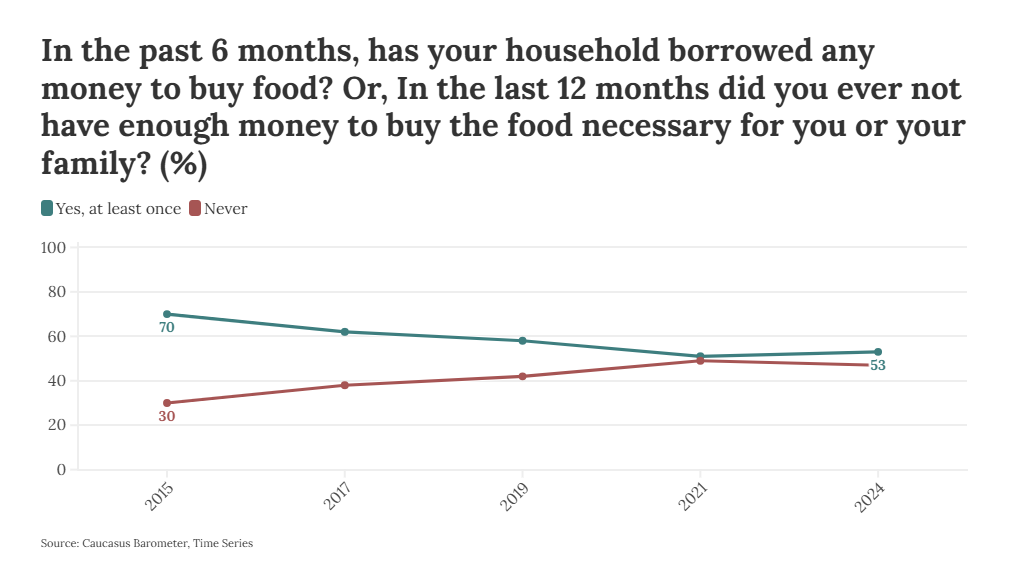
Those not having enough money to buy food at least once in the past 12 months (45%) is slightly higher than those borrowing money to purchase food, at least once in the past six months (36%). Importantly, as the survey specifically asked respondents to indicate if they borrowed money for food, it potentially undercounts the frequency in which the public faces food insecurity, as a common means of purchasing food is to request it on loan from a shop, with the promise of paying for it later.
Although widespread, food insecurity is especially concentrated among particular demographic groups.
A regression analysis, which combines not being able to afford food in the past 12 months and borrowing money to purchase food in the last six months, to represent food insecurity, demonstrates that those living outside of the capital, ethnic minorities, and those with one or more children are most likely to experience this form of poverty.
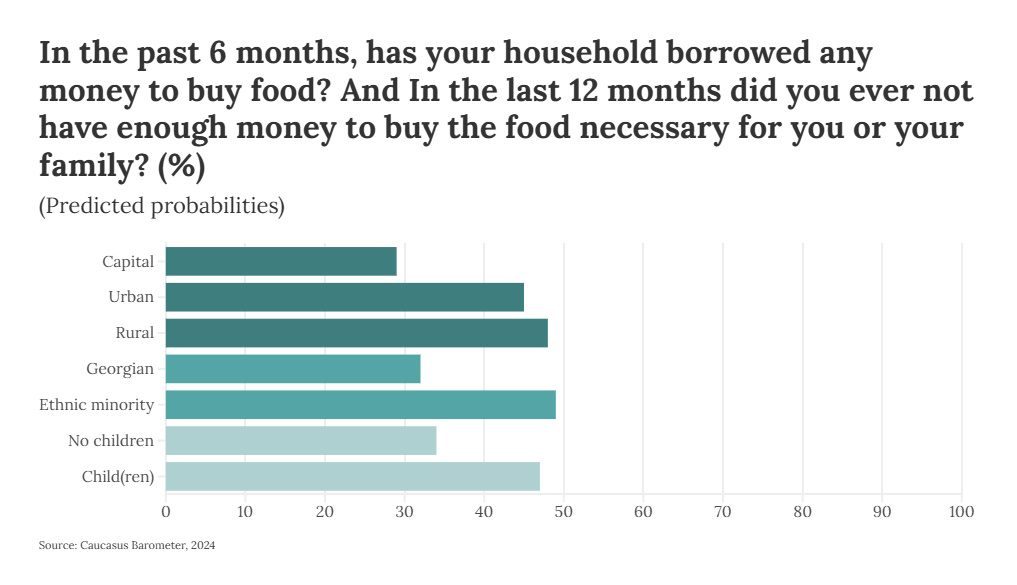
For example, ethnic minorities are 17 points more likely than ethnic Georgians to report not being able to afford food or borrowing money to purchase it.
Likewise, those living in rural and urban communities are 19 and 16 percentage points more likely, respectively, to report food insecurity in the past year, compared to inhabitants of Tbilisi, while those with one or more children are 13 percentage points more likely to experience food insecurity, compared to those without a child.
Though still a decrease from 10 years ago, the Caucasus Barometer data demonstrates there remains an alarming rate of food insecurity across all populations of Georgia, especially among ethnic minorities, outside Tbilisi, and in families with children.
Note: The analysis in this article makes use of binomial regression analysis. The analysis included gender (male, female), age group (18-34, 35-54, and 55+), settlement type (capital, urban, rural), ethnicity (Georgian, ethnic minority), and has child(ren) (has a child, does not have a child) as predictor variables.
The data used in this article can be found here.