Showing posts with label Education. Show all posts

Friday, January 16, 2026

Georgian women encouraged to get an education but not to use it

This article was written by Zachary Fabos, a Researcher at CRRC Georgia. The views presented in the article are the author’s alone and do not necessarily represent the views of CRRC Georgia or any related entity.

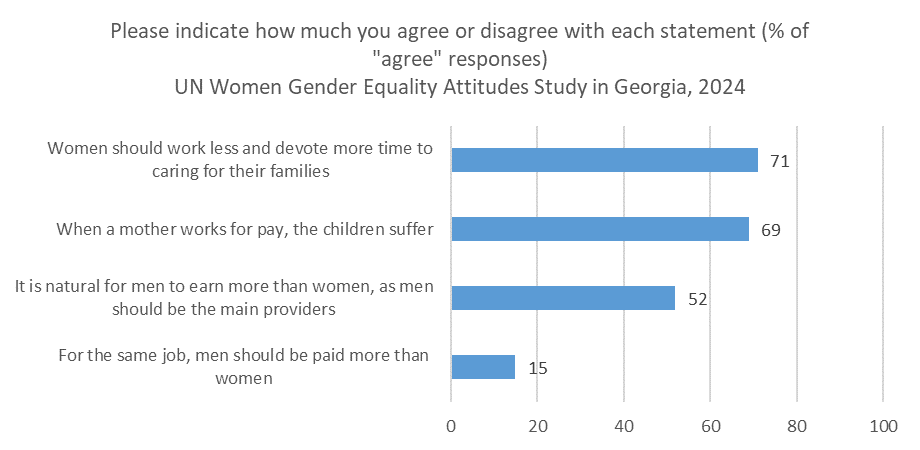
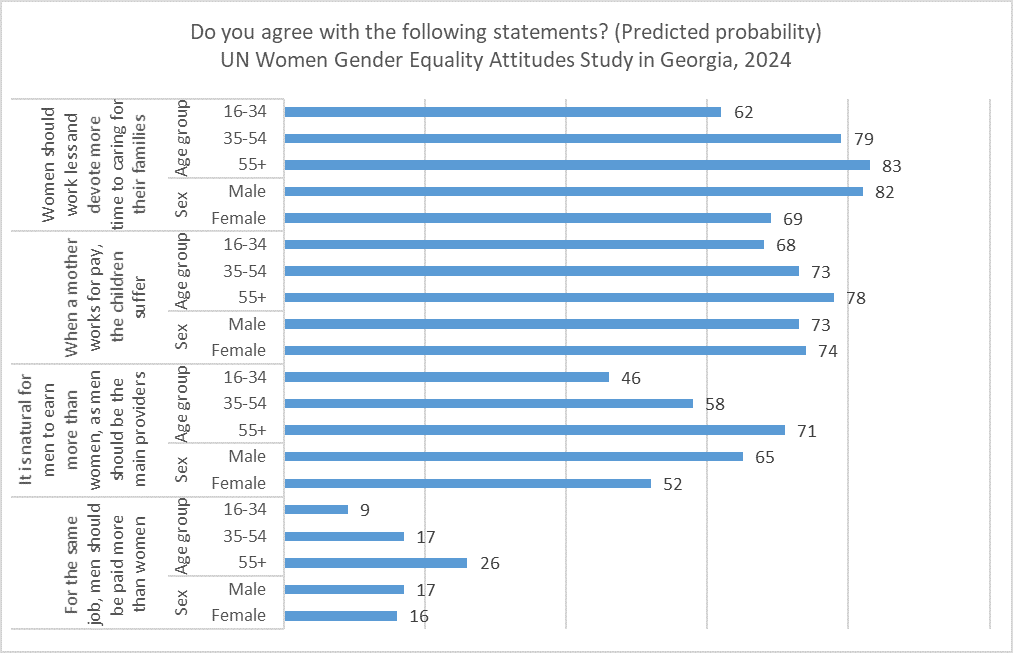
The UN Women 2024 survey shows that while Georgians strongly support equal access to higher education and equal pay for women and men, many still believe women should prioritize family care over pursuing a career. These attitudes are especially strong among older age groups and men, revealing a gap between support for women’s education and acceptance of their professional participation.

Notably, men and women are just as likely (73 and 74 points respectively) to agree that children suffer when their mother works. On the other hand, men (82 points) are 13 points more likely than women to agree that women should work less and devote more time to caring for their families. By over 13 points, men (65 points) are more likely than women to agree that men are naturally the primary providers for their families and thus should be paid more than women.

Settlement type, ethnicity, education level, and household income do not predict attitudes on these questions, once age and gender have been taken into account.

This analysis demonstrates that regardless of age and sex, Georgians are likely to agree that women should prioritize caring for their family and children rather than pursuing a career. Despite widespread agreement that boys and girls should have equal access to education and receive equal pay for the same job, this sentiment does not extend to women’s professional and career choices after completing said education.

Note: The analysis in this article makes use of binomial regression analysis. The analysis included gender (male, female), age group (16-34, 35-54, and 55+), settlement type (capital, urban, rural), ethnicity (Georgian, ethnic minority), education level (secondary or lower, vocational, and higher education) and reported household income (0-800 GEL, 801-1,600 GEL, 1,601-2,400 GEL, and 2,401+ GEL) as predictor variables.

Tuesday, April 01, 2025

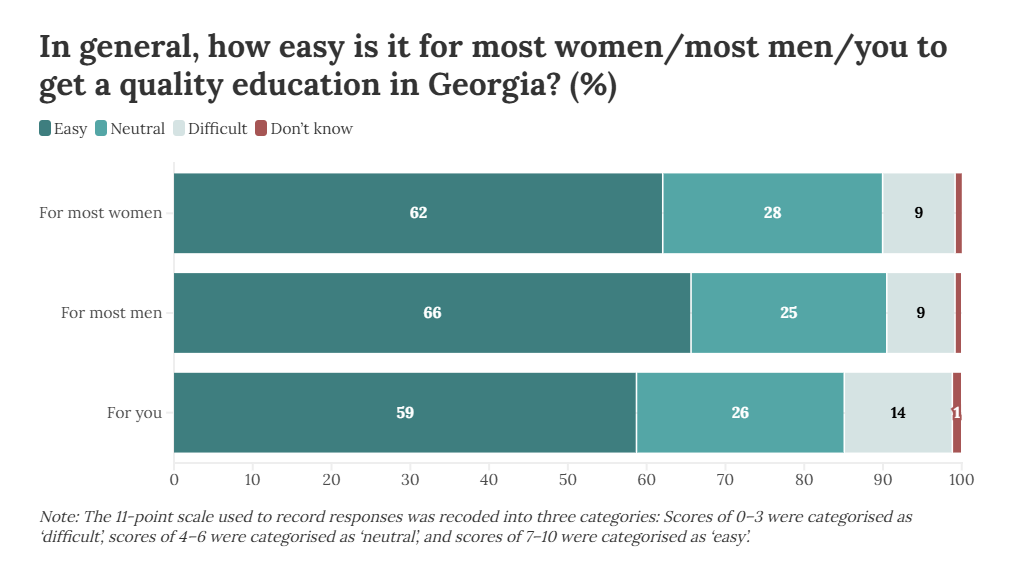
Is quality education in Georgia really accessible for all?

Note: This article first appeared on the Caucasus Data Blog, a joint effort of CRRC-Georgia and OC Media. It was written by Salome Dolidze and Kristine Vacharadze. The views expressed in the article are the authors’ alone, and do not necessarily reflect the views of CRRC Georgia, or any related entity.

Tuesday, July 05, 2022

Young people in Georgia want the government to focus on education

Note: This article first appeared on the Caucasus Data Blog, a joint effort of CRRC Georgia and OC Media. It was written by Tamuna Khoshtaria, a Senior Researcher at CRRC-Georgia. The views presented in the article are of the author alone, and do not necessarily reflect the views of CRRC Georgia, GFSIS, or any related entity. 

A study conducted in 2021 by CRRC Georgia for GFSIS focusing on the values and political activism of young people in Georgia shows that education is the primary field that young people aged 18–29 in Georgia want to be strengthened. 

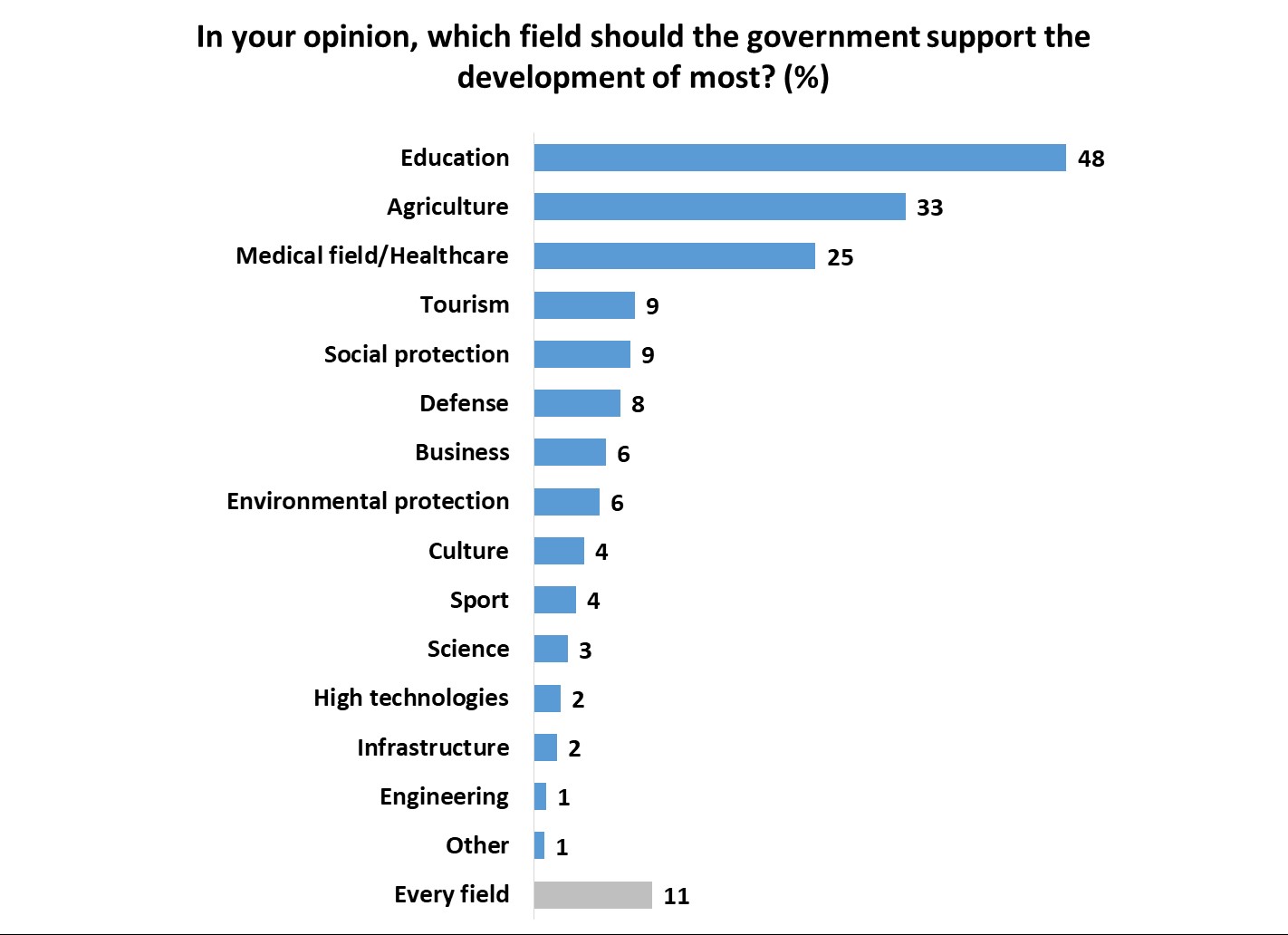
Young people prioritise the development of education above other domains. Almost half of young people (48%) mentioned education when asked what field the government should support most. The next most common response was agriculture, which was named by a third (33%). Healthcare came in third, with a quarter of respondents naming this as a priority.

Note: Respondents could name up to two answers. Therefore the numbers do not add up to 100%.

A regression model suggests that whether young people prioritise education varies according to a number of factors.

Women were eight percentage points more likely to name education than men. 

Young people in rural areas named education less (49%) than those in the urban areas (56%) and the capital (57%). 

The younger a person was, the higher the chance they named education. The probability of someone aged 18–21 naming education was 61% compared to 48% for someone aged 26–29. 

Those with at least some tertiary education also name education more often. Young people with some tertiary education were 13 percentage points more likely to name education than young people with only secondary education.

That university students and recent graduates think that education should be a top priority may point to dissatisfaction with the quality of higher education. 

Other data in the study supports this conjecture. 

When asked to what extent the level of education in Georgian higher education institutions was satisfactory, almost half of those with at least some tertiary education expressed dissatisfaction in contrast to about one-third with secondary education.

Aside from demographics, young people’s attitudes towards the West also predicted whether or not they think education should be a top priority. Young people who said that integration with the European Union or NATO was very important to them were more likely to say that education should be a top priority compared to those who report EU/NATO integration was quite important or not that important.

Overall, the findings suggest that education is a top priority for young people aged 18–29 in Georgia. This is especially important for young women, those under 22, those living in the capital, those with experience in higher education, and those with pro-Western attitudes.  

The views presented in the article are the author’s alone and do not necessarily reflect the views of GFSIS, CRRC Georgia or any related entity. 

Note: The analysis above is based on a logistic regression model.  The variables included in the regression include sex, age group, settlement type, and level of education. The analysis which included attitudes towards NATO and EU integration was conducted using a second and third model, where importance of NATO/EU integration were included as categorical variables in addition to the aforementioned variables. The data used in this blog post are available here.

Wednesday, September 23, 2020

Georgian parents are concerned about online learning

[Note: This article was co-published with OC Media on the Caucasus Data Blog. This article was written by Elene Ergeshidze. Elene is a Junior Researcher at CRRC Georgia. The views presented in the article do not represent the views of CRRC Georgia or any related entity.]

Georgia has postponed the reopening of schools in major cities due to a new surge in the pandemic, but what are the biggest concerns Georgians have with the education system?

Georgia’s new academic year started on 15 September, but physical attendance at schools and universities in major cities has been postponed until 1 October. 

Earlier this month government officials, including the Head of the National Center for Disease Control and Public Health Amiran Gamkrelidze, said schools were ready to reopen. But on 11 September the prime minister announced this would not be possible in large cities because of a record-breaking number of new coronavirus cases in the country. 

In response, parents recently started a petition saying ‘no to online schooling’, to try and push forward the shift back to face-to-face schooling.

Students in public schools in large cities have not attended education institutions physically since March, when the first COVID-19 cases were confirmed in Georgia. 

Through broadcasting live lessons for school children on the public broadcaster, distance learning became available for everyone who had access to a TV. 

Data from the period indicated that most in Georgia could access either TV or other online learning options. But, UNICEF Georgia recommended prioritising school reopening because of the negative effects of school absence on children’s health. 

In this context, what do people think are the main problems for the Georgian education system today?

The August 2020 CRRC/NDI survey asked respondents about issues that the education system is facing in Georgia. Respondents were able to name up to three answers and the most frequently mentioned issue was difficulties associated with online classes, which a quarter (27%) of respondents named. 

The next most common issues were low qualifications of teachers/lecturers (22%) and the high cost of university education (20%). 

One in ten (10%) of the population reported that there were no problems facing the education system and 19% answered ‘don’t know’.

Women were more likely to name a problem than men. A quarter of men (24%) did not know how to answer this question compared to 16% of women. Similarly, 12% of men report that there were no problems facing the education system in Georgia whereas only 8% of women reported the same. 

Who is more concerned about online education? 

A logistic regression suggests women were 15 percentage points more likely to report distance learning as an issue than men. Those living outside Tbilisi were eight percentage points more likely to report distance learning was an issue. 

Other characteristics such as age, level of education, employment status, internet usage, and wealth do not predict whether people named difficulties with online classes as a problem or not. 

These differences are perhaps unsurprising. Women are more involved in children’s upbringing and education in Georgia. Therefore, they probably have more information about issues surrounding the education system than men. 

People living in other urban or rural settlements compared to residents of Tbilisi are less likely to be able to access the internet, which is necessary for online learning.

At present, it is still an open question whether schools and universities will reopen on 1 October. Another question is how the quality of education will be affected as a result of the lack of face to face interaction, and who this will affect the most. 

What is clear is that a substantial share of the public is concerned about online education, even if they do have access to it.


Monday, February 17, 2020

Grit in Georgia

Grit, the idea that passion and perseverance are important determinants of success aside from intelligence, has gained widespread attention in recent years. This stems from the fact that grit is a strong predictor of a number of outcomes like employment and income in life. Previous analysis on this blog suggests that the grit scale is also a strong predictor of employment in Georgia among young people in a select number of rural areas. Whether this works on a nationally representative sample is however an open question. So too is the question what predicts grit in Georgia. This blog uses data from CRRC Georgia’s January 2020 omnibus survey to address these questions.

CRRC Georgia’s omnibus survey contained the full 12 question grit scale. Respondents were asked how much a set of statements described them including things such as “I always finish what I start” and “Failure does not frustrate me.” Items that indicate low grit are reverse coded. In Georgia, the data suggests that the average score is 3.59 out of 5. People score highest on the statement “I am a hardworking person” and lowest on the statement “My interests change from year to year.”


Who reports being grittier in Georgia? A regression that included age, settlement type, sex, and whether or not a person had been internally displaced suggests that people in Tbilisi and IDPs have slightly higher levels of grit, controlling for other factors. In contrast, women and men and people of different ages do not have significantly different levels of grit. Although the analysis showed statistically significant differences between settlement types and IDPs and non-IDPs, the differences are substantively small as depicted on the chart below.


The data also suggest that higher grit scores are associated with a number of achievement related outcomes. When someone’s grit score increases from two to four, their chances of being employed triple, going from 10% to 33%, controlling for other factors. Similarly, the chances that someone has completed higher education increases from 15% to 43% when a person’s grit score increases from two to four. Higher levels of income are also associated with grit.


The above analysis suggests that grit is a good predictor of success in Georgia as it has been shown to be in other locations. However, caution is warranted in suggesting there is a causal relationship at play in the above data. For instance, higher education may help develop grit rather than gritty people being more capable of completing higher education. A similar pattern could be at play when it comes to employment.

Replication code for the data analysis is available here. To find out more about CRRC Georgia’s Omnibus survey, and opportunities to include questions on the survey, click here.


Monday, January 20, 2020

The economic and educational consequences of child marriage in Georgia

[Note: This article was published in partnership with OC-Media, here. The article was written by Dustin Gilbreath, Deputy Research Director at CRRC Georgia. The views presented in this article do not represent the views of UN Women, CRRC Georgia, or any related entity.]

Widely condemned as a violation of human rights, child marriage is associated with negative health outcomes — both physical and psychological. Aside from these clear issues, a growing body of research suggests child marriage also has economic consequences for both the women who marry under the age of 18 and society at large.

A policy brief released by CRRC Georgia today shows that child marriage remains a persistent problem in Georgia for both ethnic Georgians and ethnic minorities and that it comes with significant economic consequences. Yet, the brief also suggests that interventions in the education system have the potential to alleviate the economic harm of child marriage.

The child marriage rate in Georgia has remained static over the years. Data from a UN Women study on women’s economic inactivity suggests that the share of women who have ever married in the country who did so when they were under the age of 18 has not changed beyond the margin of error over the decades.

In the 2010s, the survey suggests 14% of women who ever married did so before turning 18, the same share as in the 1950s and earlier. This finding falls in line with UNICEF’s most recent estimate of the early marriage rate in Georgia.

Still, it likely underestimates the extent of the issue to a certain extent, since people under the age of 18 at the time of the survey were not interviewed.


The data suggest that child marriage is a particularly acute problem in rural areas, with 21% of rural women who have ever married having done so under the age of 18. This is a rate twice as high as in Tbilisi (9%) and other urban areas (10%).

The study is, however, inconclusive when it comes to child marriage rates among ethnic minorities (10%) compared with ethnic Georgians (9%). This likely stems from the relatively small number of ethnic minorities within the survey; other studies have found much higher rates among Georgia’s ethnic minorities, particularly the country’s ethnic Azerbaijani population.

This finding does, however, underline the point that child marriage is not just a problem among ethnic minorities in Georgia — but also among ethnic Georgians.

The costs of child marriage

Using data from CRRC Georgia, Swiss Development Cooperation, and UN Women, I statistically matched the group of women who had married early to a group who had not but came from similar socioeconomic backgrounds. Using this matched sample, it was possible to estimate the effects of child marriage on women’s economic and educational outcomes.

The results showed that women who married under the age of 18 earned 35% less than those from similar backgrounds who did not marry as children. Moreover, they were significantly less likely to participate in the labour force.

This is in a context where women already make significantly less and participate in the labour force at significantly lower rates than men.

Educational attainment was also significantly lower among the women who married before turning 18. The women in the matched sample who married underage were 2.3 times less likely to attain a higher education than those who married later in life.

Similarly, women who married as adults were six percentage points more likely to obtain a vocational education than those who married as children.

Two-thirds of women who married under the age of 18 (64%) obtained only secondary or lower levels of education, compared with 36% of women from similar socioeconomic backgrounds who married as adults.


However, the study suggests that when women who marry under 18 attain similar levels of education as those who marry as adults, the differences in outcomes largely disappear.

The women who married as children and those who married above the age of 18 in the matched sample who had the same levels of education earned statistically indistinguishable amounts. They also participated in the labour force at similar rates.


This finding suggests clear paths to alleviating the economic harm that child marriage causes in Georgia. By supporting girls who marry under 18 to stay in and complete school, encouraging those who have left to return, and creating an enabling environment for both groups, the economic harm of child marriage could be reduced.

Child marriage has clear social, psychological, and health consequences. These matter more than, and likely contribute to, the economic consequences described above.

While the ultimate goal of policy on child marriage in Georgia should be ending it, until that time, reducing the economic harm it causes should also be a goal. The data suggest that educational interventions are potentially a beneficial place to start.

The data and replication code of its analysis are available here.


Monday, March 18, 2019

Parents think Georgia’s schools are fine. But are students actually learning?

[Note: This article was originally published here with OC-Media. It is available in Georgian here. This article was written by Meagan Neal, an International Fellow at CRRC-Georgia. The views expressed in this article do not necessarily reflect the views of CRRC-Georgia, the National Democratic Institute, or any affiliated entity.]

Around the world, an increase in the systematic collection of education data has revealed a previously invisible problem: even though more children have access to education than ever before, it does not necessarily mean they are learning. In fact, many students are progressing through school systems without mastering the basic skills necessary to fully participate in society. The gap is so stark it has become known as a ‘learning crisis’.

Given the global trends, a new wave of controversial reforms to Georgia’s school exam system, and a planned increase in the national education budget, what do Georgians think about the quality of their own education system? And should Georgia be concerned about its own students’ learning?

At first glance, public opinion suggests that education quality is not a large problem. Surveys CRRC and NDI conducted in December 2018 suggest that most people think the government is doing a good job providing education to the country’s children.

A plurality of Georgians (50%) thought that the government did a ‘somewhat good’ or ‘very good’ job providing education to all its citizens, while 34% rated the government’s performance as ‘somewhat bad’ or ‘very bad’. Among people with a child in their household currently in school, only 4% rated their family member’s school as ‘bad’ or ‘very bad’.  Most said that it was ‘good’ or ‘very good’.


At the same time, most people also think that private tutoring is necessary to study well, to graduate from secondary school, or to get into university, suggesting Georgia’s schools are falling short of their basic duties.
As the chart below shows, a slight majority (55%) said that it was necessary to have a private tutor to pass secondary school graduation exams. A large majority (73%) said that tutoring was necessary to pass the Unified National Exams to gain entrance to university. Even respondents who rated their family member’s school as ‘good’ tended to agree.


These attitudes towards tutoring could change soon. In February, the government announced that they would abolish secondary school graduation exams and change the requirements for university entrance exams. According to the government, the new measures will allow secondary schools to focus less on test preparation, give universities more autonomy to choose which exams to use for their own admissions processes, and lower expenses for parents by reducing the need for private tutoring.

In March, the Prime Minister also announced that the government would increase education spending annually until 2022 — reaching a maximum of 6% of GDP, a quarter of the country’s budget.

The perceived necessity for tutors says something about the current quality of schooling, and these reforms may be missing the point. After all, abolishing tests will not fix the system if schools are not well-equipped to teach students the essentials of secondary school in the first place. Nor will pumping in more funding lead to better outcomes if those funds are not strategically allocated towards evidence-based strategies to improve learning, rather than an increase in ‘business as usual’ inputs like school infrastructure.

So how much are Georgian students actually learning? National assessment data can give some clues. Georgia has participated in the past few rounds of PISA, an international exam of 15-year-olds’ reading and maths abilities in OECD and partner countries.

The most recent results were not great. Half of the students scored below Level 2 in reading and maths, the PISA threshold for being able to fully participate in school and society. Even having made substantial improvements since 2009, Georgia was still one of the lowest performers among PISA-participating countries in 2015.

What’s more, trends from the 2009 round of PISA as well as the 2015 round of TIMSS (Trends in Mathematics and Science Study) suggest that most of the gains in performance are driven by urban students, while rural students continue to lag behind.

Can the new reforms help address these inequities? More funding and a reduced focus on national tests could be a good thing for low-performing students — if schools and teachers have the resources and capacity to redirect the energy and funds they would spend on test prep towards better adapting their curriculum and methods to the individual needs of their students, and if they are held accountable for the learning outcomes they deliver.

But right now, like in many countries, it is not clear Georgian schools have the capacity or accountability mechanisms to do so. As Transparency International recently highlighted, government spending on education has already continued to increase over the past eight years without any goals set around actual student learning. Abolishing exams, which, for all their imperfections, can be used as an accountability mechanism, is unlikely to help this.

Despite general perceptions that Georgia’s schools are fine, the data on student achievement and the perceived need for tutors suggest a much deeper problem of learning.

In theory, increased funding could be a great opportunity to address this. But unless the government pivots this spending towards strategies that have been shown to help students learn, such as more effective pedagogy and better teacher performance and accountability, it is unlikely to have much effect.

If they draw lessons from the global conversation around learning, on the other hand, the government can work to ensure that Georgia’s students develop the basic skills necessary to succeed in life — whether they need an exam to graduate or not.

Curious about perceptions of Georgia’s education system? The data used in the above article is available here.


Monday, March 04, 2019

Choosing a profession: who should decide young people’s career paths?

Choosing a career path is one of the most important decisions that people make in their life. For some, it might be a complicated and anxiety-riddled experience. One reason is that the process of choosing a career begins at a young age when a person may not have thought about what they want to do with their lives. For this, among many other reasons, parents often play a role in deciding what their children study at university, which is often though not always associated with their profession.  However, there are a number of arguments about why it is better to allow a child to choose their own career paths.  Based on the CRRC/NDI June 2018 survey, this blog post describes the adult population of Georgia’s views about whether parents or their children should choose their career, and describes how opinions differ by a number of demographic characteristics.

The survey asked respondents, ”Which of the following statements do you agree with: ‘When choosing a profession [profession has a similar meaning to university major in the Georgian language], the parents [should decide] because a parent knows better what will be useful for his/her child’ or ‘When choosing a profession, the child [should decide] even if the parent thinks that the child is making a mistake.‘”

A majority (75%) of the population agreed that when choosing a profession the child should decide, while 23% answered that the parent(s) should. People living in the capital are more likely to  agree (85%) that the child should decide than people who live in rural settlements (68%). People between the ages of 18-35 are more likely to agree with the statement that children should decide than people of other age groups.  Level of education also is associated with whether people think that children or their parents should decide a child’s future profession. People who have higher than secondary education are more likely to agree with the statement that the child should decide than people with a lower level of education.  Interestingly, there is no visible difference between the answers of people who live in households with children (under 18) and people who do not. Nor is there a difference between men’s and women’s views regarding this issue. Similarly, ethnic minorities and majorities express similar opinions. These results are supported by a logistic regression analysis.

Note: Answer options “Agree with neither”, “Don’t know”, and “Refuse to answer” are not shown on the chart above. The combined share of these responses options was under 4%. 

Overall, most people in Georgia report that when choosing a profession, the child should decide even if the parent thinks that the child is making a mistake.  This opinion is supported more often by people who live in the capital, have higher than secondary education, and young people (18-35).

To explore the data used in this blog post further, visit our Online Data Analysis platform. The results of the regression noted above are available here.

Monday, June 04, 2018

Willingness to temporarily emigrate from Armenia and Georgia: Does education matter?

A previous CRRC blog post showed how people’s willingness to temporarily emigrate from Armenia and Georgia varied according to their belief in whether everything in life is determined by fate or people shape their fate themselves. The blog post concluded that compared to people who are not interested in temporary emigration from these countries, those who are tended to believe slightly more often that people shape their fate themselves.

There are a number of factors that contribute to an individual’s willingness to emigrate including political, economic, and social circumstances. Using data from CRRC’s Caucasus Barometer (CB) survey, this blog post looks at whether or not people who express a willingness to temporarily emigrate from Armenia and Georgia differ from others in terms of their educational attainment. Importantly, though, this question does not measure actual emigration, but rather reported intentions that may or may not result in action.

In both countries, the share of people willing to temporarily emigrate is the highest among those who have tertiary education. Importantly, this finding is consistent over time.


Note: The answer options for the question, “What is the highest level of education you have achieved to date?” were grouped as follows: options “No primary education”, “Primary education (either complete or incomplete)”, “Incomplete secondary education”, and “Completed secondary education” were grouped into the category “Secondary or lower”. Options “Incomplete higher education”, “Completed higher education (BA, MA, or specialist degree)”, and “Post-graduate degree” were grouped into the category “Tertiary”.

People with either a close friend or a close relative living abroad at the time of survey fieldwork also report more often that they would leave Georgia for a certain period of time to live somewhere else. The findings are similar in Armenia. Importantly, when looking at this indicator of migration networks, there are, again, differences by level of education. As the chart below shows, in 2017, people with higher levels of education reported having close friends abroad more often than those with lower levels of education. This finding is also consistent for CB waves through the last decade.


As the findings presented in this blog post show, in both Armenia and Georgia, people having tertiary education report an interest in temporary emigration more often than those with lower levels of education. Importantly, a larger share of people with tertiary education also have relatives and/or friends living abroad. Thus they can rely both on relatively advanced knowledge, including knowledge of foreign language(s), and on the opportunities provided by migration networks.

To learn more about CRRC surveys, visit our Online Data Analysis portal.


Monday, September 18, 2017

Private tutoring and inequality in Georgia

According to the March 2016 CRRC/TI-Georgia survey, roughly 4 in 10 households with school-aged children reported hiring a private tutor at the time of the survey for at least one subject that a child in their household was studying at school. Since the question was asked about private tutors for only subjects that pupil(s) were studying at school at the time of the fieldwork, the share of households that hire private tutors is likely higher than reported. This expectation is based on the fact that aptitude tests that are a required part of the university entrance exams for all applicants are not related to any specific school subject, yet, create a high demand for private tutoring. While, as has been noted before, private tutoring reflects economic inequalities in Georgian society, it also contributes to furthering these inequalities. This blog post looks at how the frequency of hiring private tutors in Georgia differs by settlement type and level of education of the interviewed household member.

Compared to other settlements, private tutoring is most widespread in Tbilisi. While 47% of Tbilisi households with school-aged children reported hiring a tutor for at least one school subject, only 32% of rural households reported the same.


Note: All charts in this blog post are based on the sub-sample of households with school-aged children (39% of all households). Thus, margins of error are higher for the reported findings. Answers “Don’t know” and “Refuse to answer” (less than 1% if combined) were excluded from the analysis. 

How the person interviewed was related to the child(ren) of school age living in the same household was not recorded during the interviews. Thus, we do not know his or her role in decisions about the child(ren)’s education, and specifically the hiring of private tutors. Still, we look at their level of education as a proxy for the entire household.

In cases when the household member reported having higher than secondary education, the school-aged children living in his/her household were more likely to have private tutor(s), compared to when the household member reported having secondary technical or secondary and lower education. Higher levels of education are also associated with relatively higher incomes. Hence, households where higher levels of education are reported also are likely to have more resources to cover the costs of private tutoring.


Note: Answer options to the question “What is the highest level of education you have achieved to date?” were recorded in the following way: “Primary education”, “Incomplete secondary education”, and “Completed secondary education” were combined into the category “Secondary education or lower”. “Secondary technical education/vocational education” is labeled “Secondary technical education”. “Incomplete higher education”, “Completed higher education (BA, MA, or Specialist degree)”, and “Post-graduate degree” were combined into the category “Higher than secondary education”. Answers “Don’t know” and “Refuse to answer” (less than 5% if combined) were excluded from the analysis. 

Reported private tutoring practices differ by a number of variables in Georgia. School children living in Tbilisi and in households where interviewed household members report higher levels of education tend to have private tutors more often compared to other children.

To have a closer look at the CRRC/TIG survey data, visit CRRC’s Online Data Analysis tool.


Monday, November 14, 2016

Books in Georgia


Monday, September 19, 2016

Employment and income in Georgia: Differences by educational attainment

According to the data of the National Statistics Office of Georgia for 2005-2016, there are approximately 100,000 students in Georgian tertiary educational institutions. Around the world, education generally contributes to increased individual income, and Georgia would not be expected to be an exception in this regard. Still, the role of tertiary education in the professional lives of the population of Georgia has not been studied thoroughly. Based on CRRC’s 2015 Caucasus Barometer survey, this blog post looks at the share of the population that has completed tertiary education, what share of those are employed and in what positions, how much their personal income is, and how the employment situation of those with tertiary education differs from the situation of those who did not obtain a degree.

The answers to the following questions, which used show cards are analyzed in this blog post:
  • What is the highest level of education you have achieved to date? 
    • A show card listing levels of education was used.
  • Which of the following best describes your situation?
    • A show card with the following answer options was used:
      • Retired and not working;
      • Student and not working;
      • Housewife and not working;
      • Unemployed;
      • Working either part-time or full time (even if the respondent is retired / is a student), including seasonal work;
      • Self-employed (even if the respondent is retired / is a student), including seasonal work;
      • Self-employed (even if the respondent is retired / is a student), including seasonal work;
      • Other.
  • Which of the following best describes the job you do?
    • A show card listing a hierarchy of job types was used.
  • Speaking about your personal monetary income last month, after all taxes are paid, to which of the following groups do you belong?
    • A show card with income groups was used.
Thirty percent of Georgia’s population reports having completed tertiary education (Bachelor’s, Master’s, Specialist’s or post-graduate degree). As the chart below shows, 29% of those without tertiary education report being employed compared to 49% of those with tertiary education.


Note: Answer options to the question “What is the highest level of education you have achieved to date?” were recoded in the following way: “No primary education”, “Primary education (either complete or incomplete)”, “Incomplete secondary education”, “Completed secondary education”, “Secondary technical education” and “Incomplete higher education”  were combined into “Do not have tertiary education”. Answer options “Completed higher education” and “Post-graduate degree” were combined into “Have tertiary education”.

Answer options to the question “Which of the following best describes your situation?” were recoded in the following way: “Working either part-time or full time (even if retired / a student), including seasonal work”, “Self-employed (even if retired / a student), including seasonal work” were grouped as “Employed”. Those who answered “Disabled and unable to work” and “Other” (2%) were excluded from the analysis. Answer options: “Retired and not working", "Student and not working", "Housewife and not working", and "Unemployed" were grouped as “Unemployed”. Within this group, those who answered “Yes” to the question “Are you currently interested in a job, or not?” were grouped as “Unemployed who are interested in a job”, while those who answered “No” were grouped as “Unemployed who are not interested in a job”.  

Answers “Don’t know” and "Refuse to answer” to either of these questions were also excluded from the analysis. Overall, 4% of cases were excluded. 

As for job positions, most of those with tertiary education who were employed at the time of the survey (28%) were employed as professionals (in the fields of science, healthcare, education, business, law, culture, etc.). On the other hand, most of those without tertiary education who were employed at the time of the survey (18%), reported working in the service sector (e.g., as salespersons, including personal care workers, e.g. baby sitters). 

The higher the income group, the higher is the share of those with tertiary education in it. For example, almost there are almost 2.5 times as many people with tertiary education among those who earned above GEL 600 the month before the survey, compared to those without tertiary education. A Mann-Whitney test shows that the difference between these groups is statistically significant. 


Note: Answer options to the question “Speaking about your personal monetary income last month, after all taxes are paid, to which of the following groups do you belong?” were recoded in the following way: options “GEL 601 to GEL 1000”, “GEL 1001 to GEL 2000”, “GEL 2001 to GEL 3000” and “More than GEL 3000” were grouped as “More than GEL 600”. Answer options “Up to GEL 120” and “GEL 121 to GEL 240” were grouped as “Up to GEL 240”. Those who answered “0”, “Don’t know”, and “Refuse to answer” were excluded from the analysis (36% of cases).

The findings presented in this blog post show that, like in many other countries, tertiary education plays a positive role for employment prospects in Georgia. People with tertiary education are more likely to be employed compared to those who do not have tertiary education. The largest group of those with tertiary education is employed as professionals, while those without tertiary education are most frequently employed as service workers. Importantly, the income of those with tertiary education tends to be higher. In all cases, the differences between those with and without tertiary education are statistically significant.

For more information about the impact of education, see CRRC’s earlier blog posts including Educated parents, educated children? And Connections or education? On the most important factors for getting a good job in Georgia. For more data, check out our Online Data Analysis tool.

Thursday, November 19, 2015

Educated parents, educated children?


Numerous scholars stress that parents’ level of education has a tremendous impact on their children’s educational attainment, as the parents are the first role models and teachers. According to Gratz, children of parents with higher levels of education are more likely to receive tertiary education than people whose parents have lower levels of education. There are a variety of opinions about whether a person’s educational attainment is more closely related to that of his/her father’s or mother’s; still, more and more researchers stress that both parents have an important influence on their child’s education.

This blog post is based on data from the Volunteering and Civic Participation in Georgia survey carried out by CRRC-Georgia in April-May, 2014. The findings allow us to see whether parents’ and their children’s educational attainments are correlated.

The survey provides information on:

  • Highest level of education completed by the respondent; 
  • Highest level of education completed by respondent’s mother;
  • Highest level of education completed by respondent’s father;
  • Respondent’s self-assessed proficiency in Russian and English languages, and;
  • Respondent’s self-assessed proficiency in computer use (Microsoft Office programs, excluding games). 

For the analysis performed for this blog post, the data was not weighted.

In line with what earlier studies suggest, Volunteering and Civic Participation in Georgia survey data also show that a person’s mother’s and father’s levels of education are strongly correlated. At the same time, the levels of education of both the mother and father are only moderately correlated with that of the respondent. Still, respondents’ level of education is slightly more strongly correlated with the father’s level of education than the mother’s (see the table below). However, the correlation between the levels of education of the respondent and his/her mother or father weakens when we control for the level of education of another parent.


* The level of education is measured on an ordinal scale with values from 1 to 8 ( 1 – “No primary education,” 2 – “Primary education,” 3 – “Incomplete secondary education,” 4 – “Completed secondary education,” 5 – “Secondary technical education,” 6 – “Incomplete higher education,” 7 – “Completed higher education,” 8 – “PhD, Postdoc or a similar degree”). In order to come up with both parents’ combined level of education, codes for mother’s and father’s levels of education were summed (e.g., mother’s secondary technical education, code 5 and father’s completed secondary education, code 4 would add up to code 9 on the combined scale). This combined scale ranges from 2 to 16; the higher the resulting code, the higher the level of education of both parents taken together, and vice versa. 

The chart below shows that when at least one of the parents has tertiary education, the respondent is statistically more likely to also have tertiary education compared to people with parents who do not have tertiary education. This is confirmed by results of a Kruskal-Wallis test.


* The original question on the highest level of education achieved by the respondent has been recoded. Answer options “No primary education”, “Primary education”, “Incomplete secondary education”, and “Completed secondary education” were combined into “Secondary or lower education.” Answer options “Incomplete higher education”, “Completed higher education”, and “PhD, PostDoc or a similar degree” were combined into “Tertiary education”. 
** The original variables on the highest level of education achieved by respondent’s mother and father were recoded into the variable “Parents’ education” covering all possible combinations of the parents’ level of education: (1) both parents have tertiary education; (2) both parents have secondary technical or lower education; (3) father has tertiary education, mother has secondary technical or lower education; (4) mother has tertiary education, father has secondary technical or lower education. 

As for individuals’ self-assessed proficiency in foreign languages and computer use (Microsoft Office programs, excluding games), more respondents whose parents have tertiary education  report an advanced level of knowledge in these areas compared to those whose parents’ level of education is lower. Not surprisingly, the share reporting advanced knowledge of how to use computers is even higher when both parents have tertiary education compared to when only one parent has tertiary education. Interestingly, when only one parent has tertiary education, the level of knowledge of English is reported to be higher when it is the mother who has tertiary education, rather than the father. The Mann-Whitney test shows this difference is statistically significant.


Thus, the data shows that the levels of education of both parents are strongly correlated with each other, while respondent’s level of education is moderately correlated with that of each of his/her parents. The data shows that parents’ levels of education are most strongly correlated to the child’s when the mother’s and father’s levels of education are combined. The respondent’s level of education tends to be higher when at least one of the parents, no matter whether it is the mother or the father, has tertiary education. The same is true about self-reported level of knowledge of foreign languages (English and Russian) and computer use (Microsoft Office programs, excluding games). Those whose mothers have tertiary education report better knowledge of English.

For more information about parents’ level of education and their child’s occupation, take a look at these earlier blog posts: A taxi driver’s tale, Part 1  and Part 2. Also, check out our Online Data Analysis tool.

Monday, June 22, 2015

Connections or education? On the most important factors for getting a good job in Georgia

By Nino Zubashvili

[Note: Over the next two weeks, Social Science in the Caucasus will publish the work of six young researchers who entered CRRC-Georgia’s Junior Fellowship Program (JFP) in February 2015. This is the first blog post in the series.]

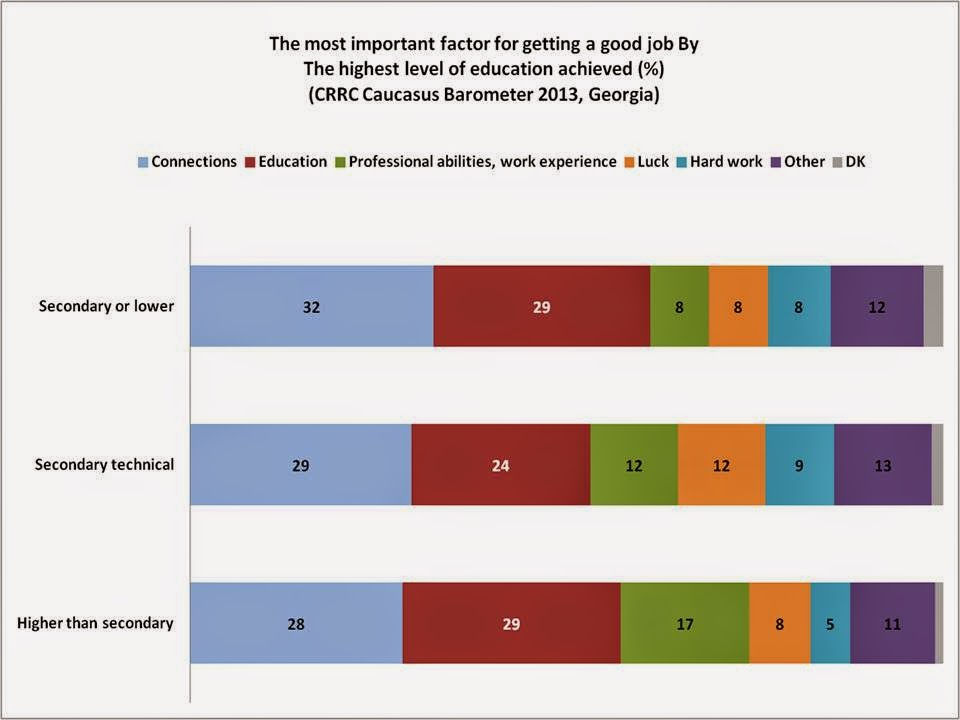
What is believed to be the most important factor for getting a good job in a country where unemployment is widely considered to be one of the biggest issues? CRRC’s 2013 Caucasus Barometer (CB) survey results show that connections (30%) and education (28%) are the most frequent answers to this question in Georgia. This finding is in line with studies on social capital in various countries, arguing that social ties provide people with better labor market opportunities (Lin, 1999; Mouw, 2003;  McDonald and Elder, 2006), as well as with studies on the role of education in the job market, finding that education is an important resource worth investing in as it provides individuals with access to employment and better chances at  obtaining well-paid jobs (Kilcullen, 1972;Smith and McCoy, 2009). Analyzing both the social ties and perceptions about what is reported as the most important factor for getting a good job, an earlier CRRC blog post, Finding a good job in Georgia, argued that Georgians without connections might be more likely to think that connections are the most important factor for getting a good job. This blog post, on the other hand, looks at how the answers about the most important factors for getting a good job differ by level of education and by employment status, with the aim of finding out who is more likely to think that education matters the most for getting a good job in Georgia.

CB 2013 data shows there is almost no difference in answers to this question between people having different levels of education. The only notable difference can be observed in relation to the perceived importance of professional abilities/work experience. While 17% of those with post-secondary education think this is the most important factor for getting a good job, 8% of those with secondary or lower education report the same.


Note: The answer options for the question, “What is the highest level of education you have achieved to date?”  were grouped as follows: options “No primary education”, “Primary education (either complete or incomplete)”, “Incomplete secondary education”, and “Completed secondary education” were grouped into “Secondary or lower”. Options “Incomplete higher education”, “Completed higher education (BA, MA, or specialist degree)”, and “Post-graduate degree” were grouped into “Higher than Secondary”. For the question, “What is the most important factor for getting a good job in Georgia?” infrequently named answer options – “Age”, “Appearance”, “Talent”, “Doing favors for the ‘right’ people”, and “Other” – were grouped into “Other”.

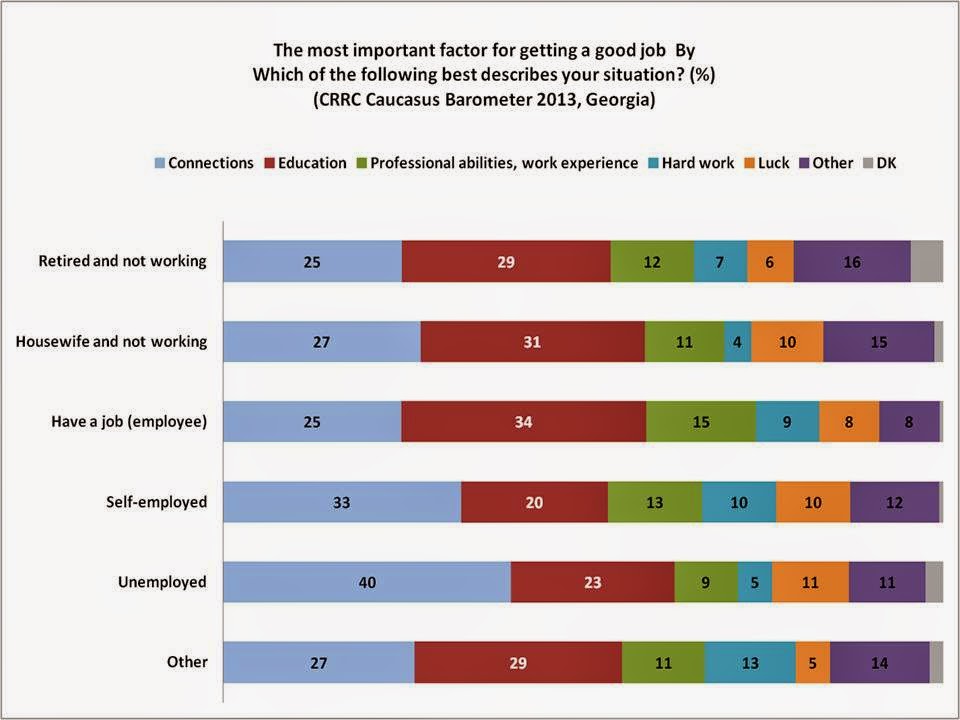
While there are few differences in perceptions about important factor(s) for getting a good job by education, such differences can be seen by employment status, and specifically between those who describe themselves as self-employed, employed and unemployed. Namely, 34% of the employed think education is the most important factor for getting a good job compared to 25% of the group who report connections. In contrast, the self-employed report that education (20%) is the most important factor for getting a good job less frequently than they report connections (33%). Those who consider themselves to be unemployed also name connections (40%) most frequently.


Note: To the question, “Which of the following best describes your situation?”, the following answer options – “Student and not working”, “Disabled”, “Other”, “Refuse to answer”, and “Don’t know” – were combined into “Other”.

This blog post has shown that while opinions about the most important factors for getting a good job in Georgia do not differ by education level, opinions do vary by employment situation. Those who describe themselves as employed more commonly think that education is the most important factor for getting a good job, while the self-employed and the unemployed most often name connections.

To learn more about CRRC surveys, visit our Online Data Analysis tool.