Showing posts with label National Democratic Institute. Show all posts

Tuesday, April 11, 2023

Who Do Georgians Blame For Russia's War in Ukraine?

Note: This article first appeared on the Caucasus Data Blog, a joint effort of CRRC Georgia and OC Media. It was written by Dustin Gilbreath, a non-resident Senior Fellow at CRRC-Georgia.The views presented in the article are of the author alone, and do not necessarily reflect the views of NDI, CRRC-Georgia, or any related entity.

In the face of conflicting narratives about the causes of the war in Ukraine, most Georgians see Russia and Putin as responsible for the conflict, but a substantial minority lay the blame with the West. Since Russia invaded Ukraine slightly over a year ago, a war of words has erupted over who is to blame for the war, with the general consensus being that Russia needlessly invaded Ukraine.

In contrast to this consensus, the Russian government has spread propaganda blaming Ukraine for the war, accusing the country’s Jewish president of being a Nazi and stating that the country needed to be ‘de-Nazified’.

Against this backdrop, and in light of Georgia’s history with Russia, what does the Georgian public think?

Data from CRRC-Georgia and the National Democratic Institute’s regular polling in Georgia suggests that most blame Russia as a whole, but an increasing proportion of the public blames Vladimir Putin specifically for the war. And while the majority of the public report that the war is Russia or Putin’s fault, one in six Georgians report that some Western actor is at fault for the war, while one in twelve blame Ukraine.

The share of Georgians blaming Russia and Putin for the war shifted in the year following the war, with the share blaming Russia declining from 67% in March of 2022, to 54% in December of 2022. There was a simultaneous rise in the share blaming Putin specifically, from 11% in March 2022 to 25% in December of that year.

A smaller but substantial proportion of the public considers the West to be responsible for the war in Ukraine. While relatively small shares blame NATO (2-3%) and the European Union (2-4%), a relatively high percentage blame the US. One in eleven (9%) blamed the United States in March, which rose to and stayed at 15% in July and December respectively.

Similarly, relatively few Georgians blame Ukraine for the war. This share stood at 5% in March 2022, rose to 11% in July 2022, and then moved to between these shares at 8% as of December 2022.

The remainder of the public is either uncertain about who to blame for the war (14-17%) or names some other factor (2%).
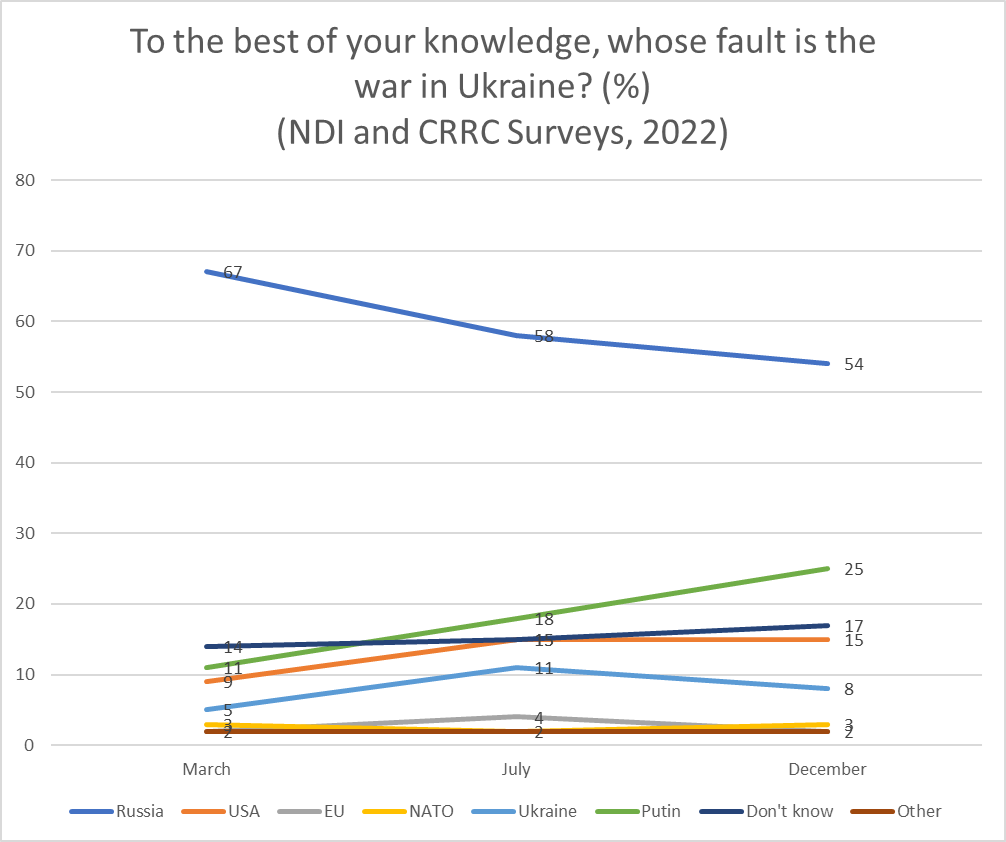
 

It is important to note that respondents could name up to three responses. Therefore, the shares do not necessarily sum to 100% on the chart above. In the first wave of the survey, Vladimir Putin was not specifically asked about, but respondents still named him. In subsequent waves of the survey, Vladimir Putin was added as a response option.

In the most recent wave of the survey, 59% of the public named only Russia or Vladimir Putin as responsible for the war. One in nine (11%) suggested that only Western actors were at fault for the war. A further 7% named at least one Western actor and one Russian actor. The remainder were mostly either uncertain on how to respond (15%) or refused to answer (1%). Other respondents blamed Ukraine as well as some combination of Russian and Western actors.

Who blames who?

The data suggest that men, people belonging to ethnic minorities, and Georgian Dream supporters are more likely to consider the West (including the US, EU, and NATO) at least somewhat responsible for the war, than are women, ethnic Georgians, and those that do not support Georgian Dream.Ethnic Georgians, opposition supporters, those that claim they support no particular party, and people living in urban areas are more likely to blame Russia and/or Putin, compared to ethnic minorities, Georgian Dream supporters, and people in rural areas.
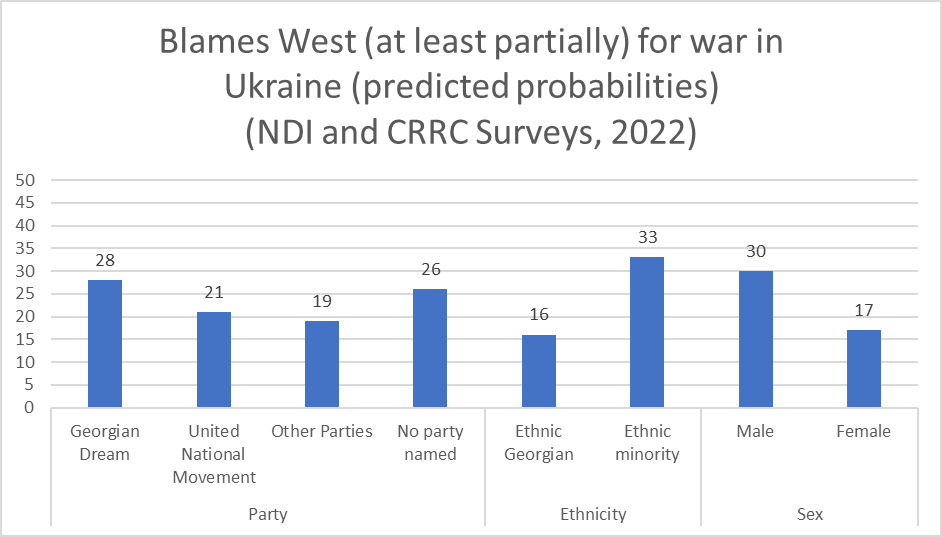
Ethnic Georgians, opposition supporters, those that claim they support no particular party, and people living in urban areas are more likely to blame Russia and/or Putin, compared to ethnic minorities, Georgian Dream supporters, and people in rural areas.

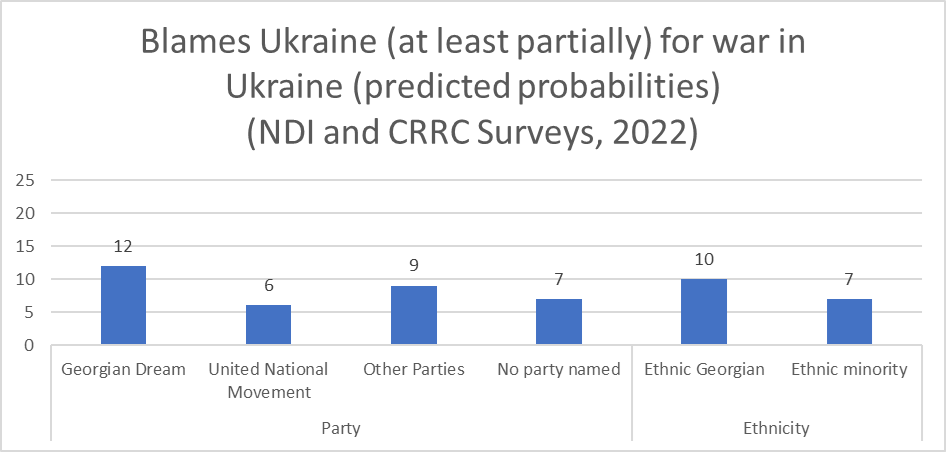
Men and Georgian Dream supporters are more likely to believe that Ukraine is at fault for the war than women and opposition supporters. 
 

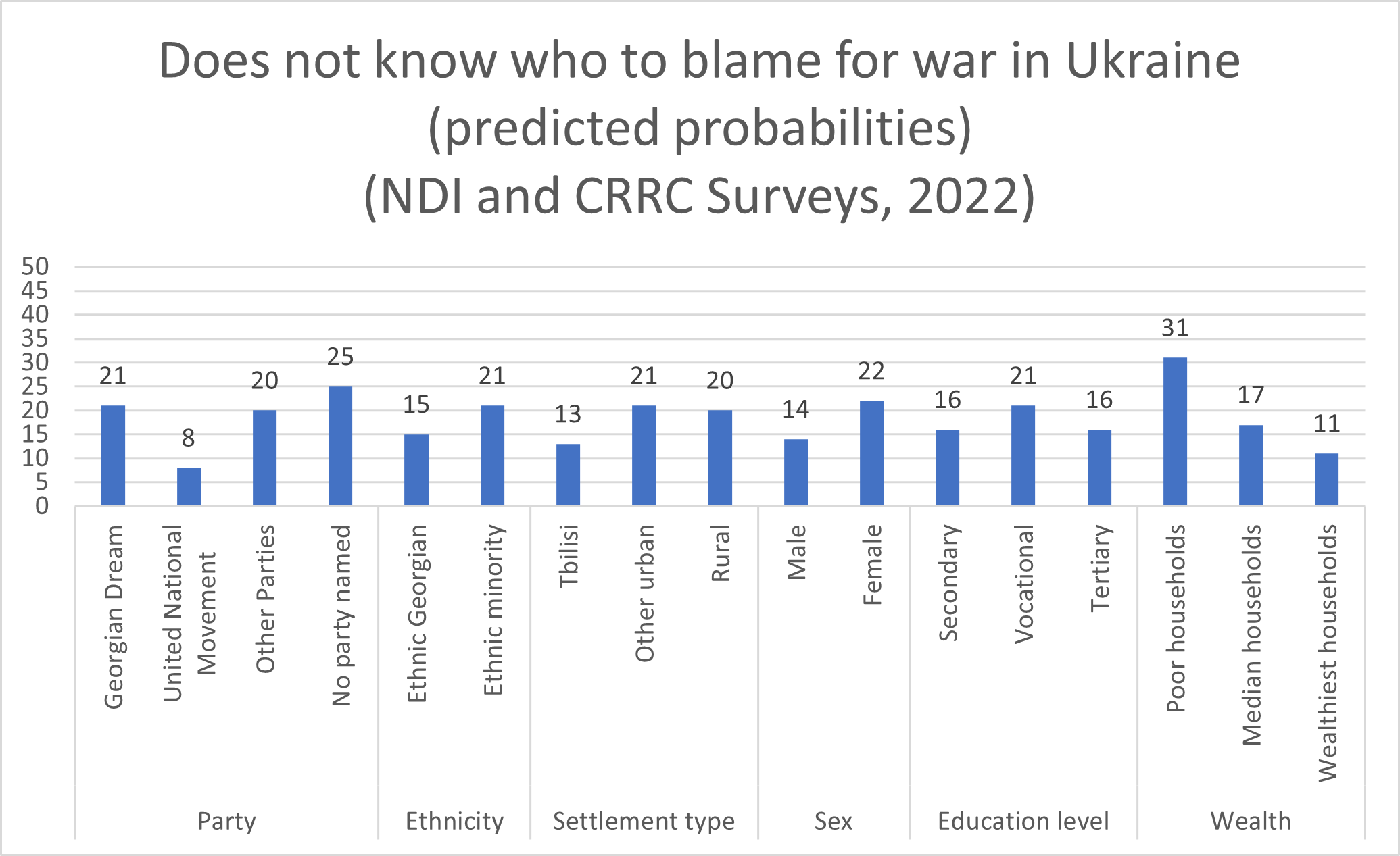
Women, people with vocational education, those outside Tbilisi, poorer people, and people who support Georgian Dream are more likely than men, people with secondary education, those in Tbilisi, wealthier people, and those who support the opposition to be uncertain about the causes of the war.


The data do not suggest that any particular group is more or less likely to name at least one Russian actor and one Western actor for the war.

While Russia’s fault in the war is questioned by relatively few in Georgia, the data do show that some groups are more likely than others to believe that Western actors or Ukraine itself is partially or fully at fault. A substantial share also remains uncertain.


Note: The social and demographic breakdowns shown in the article above were generated from a regression analysis. The analysis had someone’s belief about who was at fault for the war as the dependent variable, including naming Russia/Putin or not, naming any Western institution or not, naming both a Western and a Russian actor or not, and naming Ukraine or not. The independent variables included age group (18-34, 35-54, 55+), sex (male or female), settlement type (Tbilisi, other urban, or rural), education level (secondary, vocational, tertiary), wealth (an index of durable goods owned by the respondents’ household), ethnicity (ethnic minority or ethnic Georgian), employment (working, unemployed, or outside the labor force), and party support (Georgian Dream, United National Movement, other opposition, refuse to answer/don’t know/no party). This article only reports on statistically significant differences between groups.

Monday, April 08, 2019

The election environment in minority areas of Georgia is getting worse

[Note: This article was published together with OC-Media. It was written by Dustin Gilbreath. The views presented in this article do not necessarily represent the views of CRRC-Georgia. The views presented in this article do not represent the views of the National Democratic Institute or any related entity.]

Post-election polling by CRRC-Georgia suggests that not only are elections most problematic in Georgia’s ethnic minority regions, they are also getting worse.

The 2018 presidential elections, and particularly, the events surrounding the second round, have come to be considered a setback for Georgia’s democratic trajectory. Between the first and second round, it was announced that 600,000 voters would have debt relief immediately following the elections, leading some to suggest this was a form of vote buying. A number of instances of electoral fraud were also alleged. The use of party coordinators around election precincts was also widely condemned.

Elections in minority regions have generally been worse in quality than in ethnic Georgian populated regions. Some statistical evidence suggests irregular voting behaviour if not fraud in these regions. Moreover, these regions of the country consistently vote for whoever is in power.

The situation appears to be getting worse, at least when compared with the parliamentary elections of 2016.

CRRC-Georgia and the National Democratic Institute’s 2016, 2017, and 2018 post-election polling asked voters, ‘Thinking back to the situation when you voted in the polling station/place (either in the 1st or 2nd round), please say whether you agree or disagree with the following?’

  • It was well ordered;
  • It was overcrowded;
  • It was intimidating;
  • The election officials were well prepared.
Respondents were also asked whether they noticed party coordinators around the polling station asking for personal information.

The results suggest that people in predominantly minority settlements were about three times more likely to report seeing party coordinators collecting personal information outside polling places. People in minority areas were 2.5 times as likely to report that the polling place was intimidating and four times more likely to report the polling station was overcrowded. They were 14 percentage points less likely to report that election officials were well prepared, and 13 percentage points less likely to report that the polling place was well ordered.


All respondents were also asked ‘Please tell us whether [each of the following] occurred or not during the election process’:
  • People voting more than once (including carousel voting);
  • Intimidation of voters or party representatives;
  • Use of administrative resources to benefit a campaign;
  • Bribing of voters;
  • Pressure to donate or not donate to certain candidate/party;
  • Mobilising state employees to participate in campaign/vote for a certain candidate;
A similar pattern as the above holds with these questions, with respondents consistently reporting most of the above problems more often in predominantly minority settlements than in ethnic Georgian settlements. The only activity which was not reported more often (statistically) in minority settlements than ethnic Georgian ones was putting pressure on people to donate.


The data suggest that problems with elections in minority regions are on the rise. The share of individuals in predominantly minority settlements reporting that the polls were intimidating more than tripled between 2016 and 2018. The share reporting it was overcrowded more than doubled between 2016 and 2018. The share of individuals in predominantly minority settlements reporting that the election precinct was well ordered also declined between 2016 and 2017.

In predominantly ethnic Georgian settlements, there was a decline between 2017 and 2018 in terms of how well prepared election officials were perceived to be. There was also a slight decline in terms of people reporting that the polling station was overcrowded. However, there was no change in the share reporting it was well ordered or intimidating.

The 2018 elections had problems. While the conduct of elections in predominantly minority areas in Georgia has been historically problematic, these problems appear to have gotten worse, at least by comparison to the elections in 2016 and 2017.

Monday, September 25, 2017

Why NATO? The main reasons for approving and disapproving of the Government of Georgia’s stated goal of joining NATO

On 1st August, 2017, US Vice President Mike Pence reiterated the United States’ support for the Georgian government’s aim to become a NATO member at a joint press conference in Tbilisi with Georgian Prime Minister Giorgi Kvirikashvili. Membership in NATO has been a stated aim of successive Georgian governments since 1999. According to CRRC/NDI survey findings from February 2012 to June 2017, this aim enjoys popular support in Georgia. However, less is known about the reasons why people either approve or disapprove of Georgia’s goal of joining NATO. These reasons are explored in this blog post using CRRC/NDI survey data.

Data from the past five years shows a 60%-80% approval rate of Georgia joining NATO. While the share of those who either answered “Don’t know” or refused to answer this question has declined, the share of those who answered “Disapprove” has increased over this period.


Information on the reasons for approval or disapproval of Georgia’s membership in NATO was collected during the April 2017 CRRC/NDI survey. As the chart below shows, a hope for greater security was the main reason for approval, with 71% of the population mentioning it. Expecting improvement in the economic situation in Georgia was the second most frequent reason for approval, which 30% of the population mentioned.


Note: An open question was asked. Up to three responses were accepted. 

About a fifth (21%) of the population reported disapproving of Georgia joining NATO in April 2017. When asked to name up to three reasons for their disapproval, about half of those who disapprove reported doing so, because they believed it will cause conflict with Russia. 


Note: An open question was asked. Up to three responses were accepted. The margin of error is larger for these answers since a very small subsample answered this question. 

The majority of the population of Georgia consistently support the country joining NATO. Quite logically, hopes for increased security are named most often as the reason for support. The strength of approval suggests that the Georgian government has a strong mandate to continue pursuing NATO membership.

To explore the CRRC/NDI data presented in this blog post, please visit our online data analysis tool.


Monday, January 02, 2017

Three months before the 2016 Parliamentary elections: Trust in the Central Election Commission and election observers in Georgia


The June 2016 CRRC/NDI Public attitudes in Georgia survey, conducted three months before the Parliamentary elections, provides interesting information about trust in the Central Election Commission (CEC) and election observers, both local and international.

The CEC’s role in conducting elections in Georgia has been subject to contentious political debates about the organization’s impartiality. The survey data demonstrates the public’s lack of trust in the institution. In June, only 29% of the population of Georgia believed that the CEC would conduct parliamentary elections “well” or “very well”. In contrast to this general opinion, a majority (60%) of likely voters for the incumbent Georgian Dream party believed the same, while less than a third of likely voters for the two other parties that won seats in parliament (the United National Movement and Alliance of Patriots of Georgia) believed that the CEC would conduct the elections “well” or “very well”.


Note: The shares of those reporting they would vote for either Movement State for People or Alliance of Patriots of Georgia was very small (respectively, 4% and 3%), and the results for the supporters of these two parties are only indicative. 

Unsurprisingly, trust towards Georgian and international observers also differs. Overall, the population of Georgia tends to trust international observers more than Georgian observers. Forty eight percent report either “fully trusting” or “trusting” international observers, compared to 34% who report trust in Georgian observers. There are even wider gaps in trust in these two groups of observers depending on party support: while 63% of United National Movement supporters report either “fully trusting” or “trusting” international observers, only 29% “fully trust” or “trust” Georgian observers.


Note: The shares of those reporting they would vote for either Movement State for People or Alliance of Patriots of Georgia was very small (respectively, 4% and 3%), and the results for the supporters of these two parties are only indicative.

To explore the CRRC/NDI June 2016 survey findings, visit CRRC’s Online Data Analysis portal. On the topic of anomalies in the voting process, CRRC-Georgia recently conducted the Detecting Election Fraud through Data Analysis (DEFDA) project regarding the 2016 parliamentary elections. Preliminary findings can be found here. CRRC-Georgia has also previously published blog posts on the electoral process in Georgia, including on government spending before elections and public opinion shifts before and after elections.


Saturday, January 25, 2014

Positive Public Attitudes in Georgia

In November 2013, CRRC conducted a survey on public attitudes in Georgia for the National Democratic Institute (NDI), with funding from the Swedish International Development Cooperation Agency (SIDA). The survey shows that Georgians are generally positive about the direction in which their country is going, the state of democracy in Georgia, and the current ruling coalition. Rural residents are even more positive than urban residents, and supporters of the Georgian Dream coalition (currently the majority force in parliament) have a more positive outlook than supporters of the previous ruling coalition, the United National Movement (UNM).

The November 2013 survey was the latest in a wave of surveys that CRRC conducted for NDI in November 2012 and March, June and September 2013, thus allowing for a comparison of attitudes over the last year. Overall, Georgians feel there has been improvement on a host of issues ranging from affordable healthcare and freedom of speech to the availability of kindergartens in the country. In fact, Georgians have a positive outlook for 28 out of the 32 issues examined. For instance, 66% of Georgians believe the situation regarding pensions has improved since October 2012. 44% think affordable healthcare has improved (3% believe that it has worsened), and 31% feel that media independence has improved (1% believe that it has worsened).

53% of Georgians also feel that Georgia is definitely or mainly going in the right direction, compared to 9% who say it is mainly or definitely going in the wrong direction. This positive response has increased from 39% in September 2013. There are also different perceptions of this question based on settlement type. Georgians living in rural areas have a slightly more positive outlook about the direction Georgia is going in (57%), than those living in urban areas (50%). Additionally, Georgian Dream supporters are more positive (67%) than UNM supporters (28%) on this question.


Overall, Georgians feel more positive about the state of democracy in Georgia than in the previous survey wave. When asked whether Georgia is now a democracy, 54% of Georgians respond affirmatively, up from 44% in September. Georgian Dream supporters are more positive about Georgia’s state as a democracy (64%) than UNM supporters (39%). However, when given a range of qualifications for democracy in their country, Georgians give more varied responses, as seen below:


Concerning the voting process, Georgians appear to have few concerns. The majority of Georgians said they did not encounter any problems with the voters’ lists on election day (97%), felt they had enough information about where to vote (95%), and thought they had enough information about voting procedures to vote without difficulty (94%). Also, a majority felt that the 2013 presidential election was well conducted (89%), compared to the 3% who thought it was falsified.

Finally, Georgians are also positive about the current government. 73% of Georgians completely or somewhat agree that the current government is making changes that matter to them, with 80% of rural Georgians and 85% of Georgian Dream supporters saying the same. In contrast, 24% of Georgians completely or somewhat agree that if the parliamentary opposition were in charge they would make the changes that matter to them, though 69% of UNM supporters completely or somewhat agree.


Thus, the November 2013 survey shows that, overall, Georgians feel positive about the direction in which Georgia is going, the state of democracy in the country, and the current ruling coalition. 
For more information, please visit NDI’s published survey results at on their website.