Showing posts with label Social Media. Show all posts

Tuesday, February 13, 2024

Young, in the city, and online: most Georgians use more than one social media platform

Note: This article first appeared on the Caucasus Data Blog, a joint effort of CRRC-Georgia and OC Media. It was written by Zachary Fabos, a Researcher at CRRC-Georgia. The views presented in the article are the author’s alone and do not necessarily represent the views of CRRC-Georgia, Caucasian House, or any related entity.

A CRRC Georgia survey found most Georgian respondents use more than one social media platform, with younger people and people living in cities using a greater variety of platforms. 

According to Georgia’s National Statistics Office, 96% of Georgia’s internet users use social media. While social media’s popularity in Georgia is clear, which platforms are most used and who uses the most platforms? 

According to the 2021 Caucasus Barometer survey, 68% of Georgians use the internet daily. The most frequently mentioned destinations for those online are Facebook, with 69% of survey participants using the site, followed by YouTube, with 61% of respondents using the platform. Use of other sites such as Instagram (26%), TikTok (19%), Odnoklassniki (6%), Twitter (5%), and Vkontakte (5%) trails in comparison. 

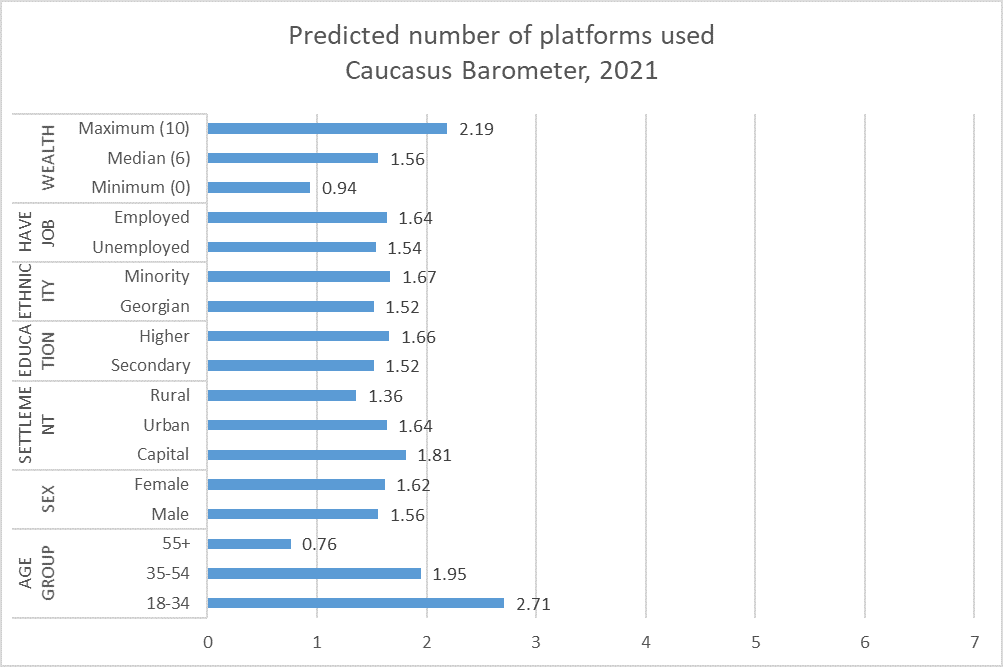
An analysis found the number of different platforms respondents reported using, with the data suggesting that the average number is two.

When this data is broken down, it shows that among demographic factors, the strongest predictor of using a diversity of platforms is age. On average, people aged 18-34 use three platforms while those 55+ use only one, controlling for other factors. Those aged 35-54 use two platforms, controlling for other factors. 

Aside from age, the number of platforms someone uses is also associated with settlement type. People living in rural settlements use one platform, while those in Tbilisi and other urban settlements use two on average, controlling for other factors.

Employment status, ethnicity, education level, and sex are not correlated with the number of platforms a person uses.
The above pattern holds across the different platforms asked about on the survey — young people (18-34) are more likely than people in older age groups to use each platform asked about on the survey, controlling for other factors.
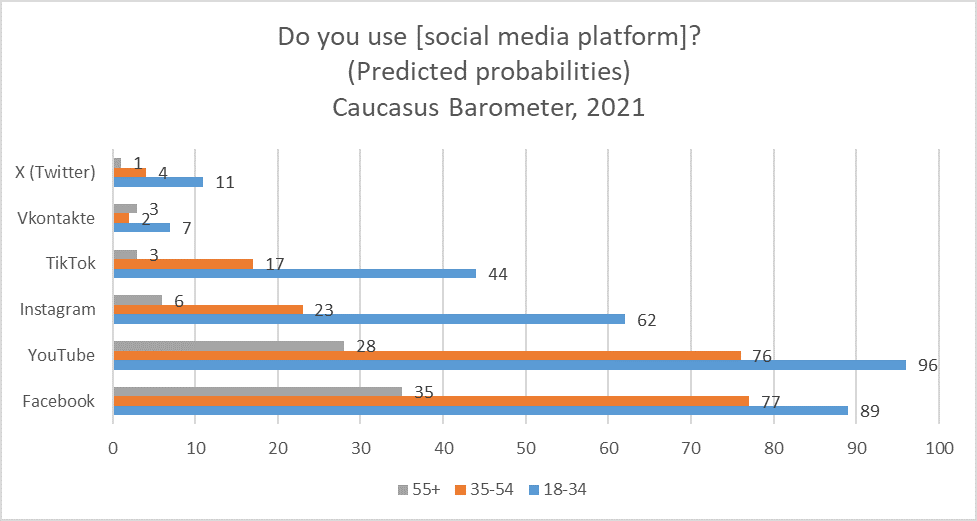
The above data shows that young people both use a more diverse set of social media platforms than older people, while also using each and every social media platform asked about more often than people 35 and older.

This article was written by Zachary Fabos, a Researcher at CRRC Georgia. The views presented in the article are the author’s alone and do not necessarily represent the views of CRRC Georgia or any related entity.

Note: The analysis in this article makes use of logistic regression analysis. The analysis included gender (male, female), age group (18-34, 35-54, and 55+), settlement type (capital, urban, rural), education (secondary/ secondary technical/ lower, and tertiary), ethnicity (ethnic Georgian, ethnic minority), employment (not employed, employed), and a wealth index (0-10), as predictor variables. 

The data used in this article is available here.

Tuesday, June 13, 2023

Do Georgians Feel Like They are Being Spied on by the Government?

 Note: This article first appeared on the Caucasus Data Blog, a joint effort of CRRC Georgia and OC Media. It was written by Dustin Gilbreath, a Senior Non-Resident Fellow at CRRC Georgia. The views presented in the article are of the author alone, and do not necessarily reflect the views of NDI, CRRC-Georgia, or any related entity.


Nearly half of the Georgian public think that they or their family members are under government surveillance at least some of the time.

Georgia has consistently had controversies around surveillance over the past two political administrations, as both the United National Movement and Georgian Dream governments have had extensive access to communications.

In September 2021, a massive cache of files allegedly belonging to the State Security Services (SSG) was leaked, causing a scandal in Georgia and stirring fears of mass surveillance among the public.

[Read more on OC Media: Datablog | Georgian public opinion on the SSG files]

Though Georgian Dream initially made some reforms in this area upon coming to power, recent legislative changes have largely rolled back on this progress. In light of the consistent scandals, it is perhaps unsurprising that nearly half the public thinks that they are being surveilled in one form or another, according to a recent survey CRRC-Georgia conducted for the Social Justice Center.

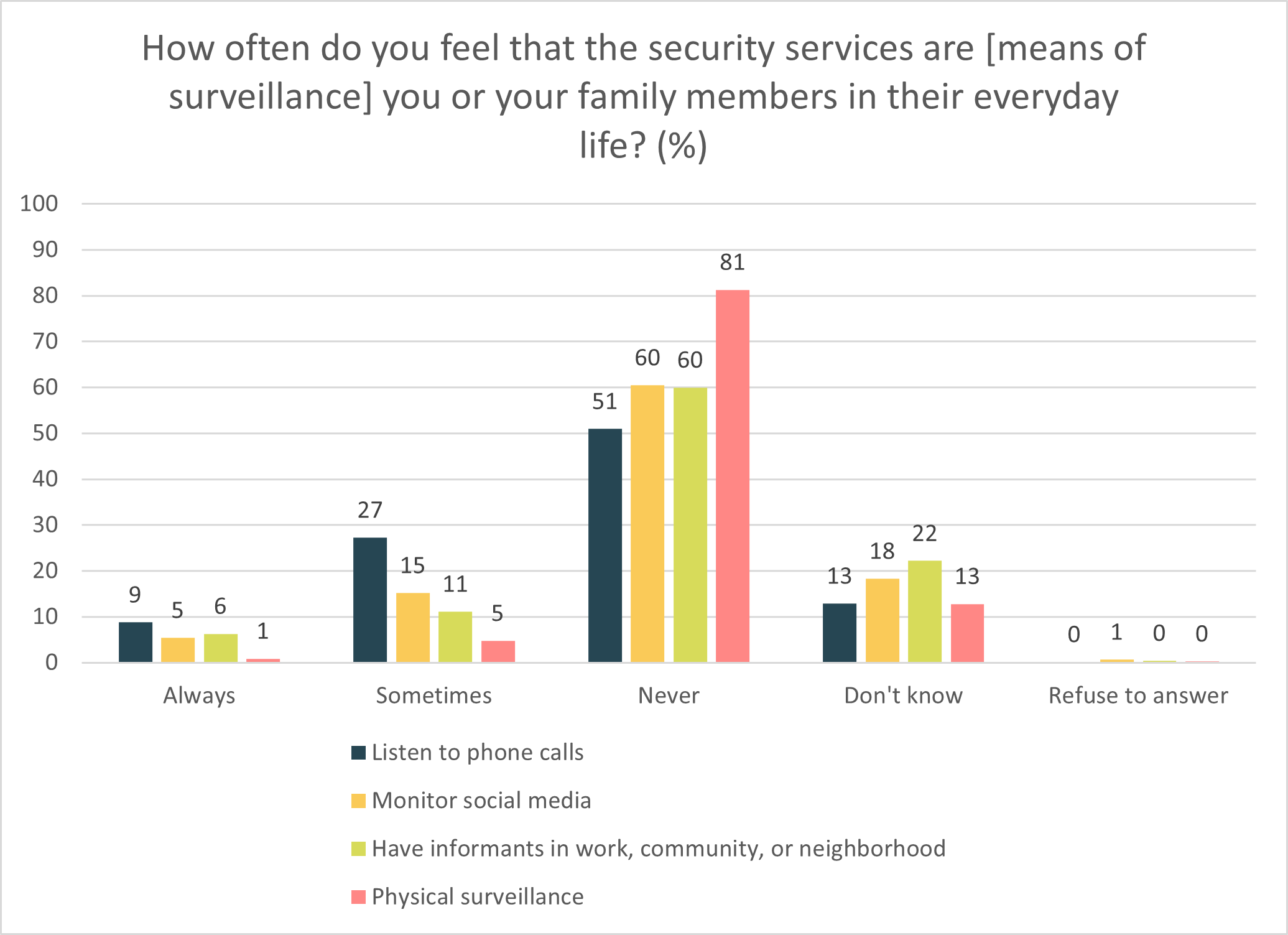
The survey asked respondents how much they felt that the SSG surveilled them or their family members in everyday life through the following means:

    Listening to their phone calls;
    Monitoring their social media activity;
    Informants in their neighbourhood, community, or workplace and;
    Physical surveillance.

The data suggest that the public is most likely to think that security services listen to their phone calls, with 36% reporting they believe this happens sometimes or always.

Social media monitoring was the second-most common form of surveillance people believed to be subject to, with one in five (20%) believing this happens sometimes or always. Approximately one in six (17%) believe that there are government informants at their workplace, in their community, or in their neighbourhood. Direct surveillance is believed to be least common among the public, with only 6% reporting they believe this happens to them sometimes or always.


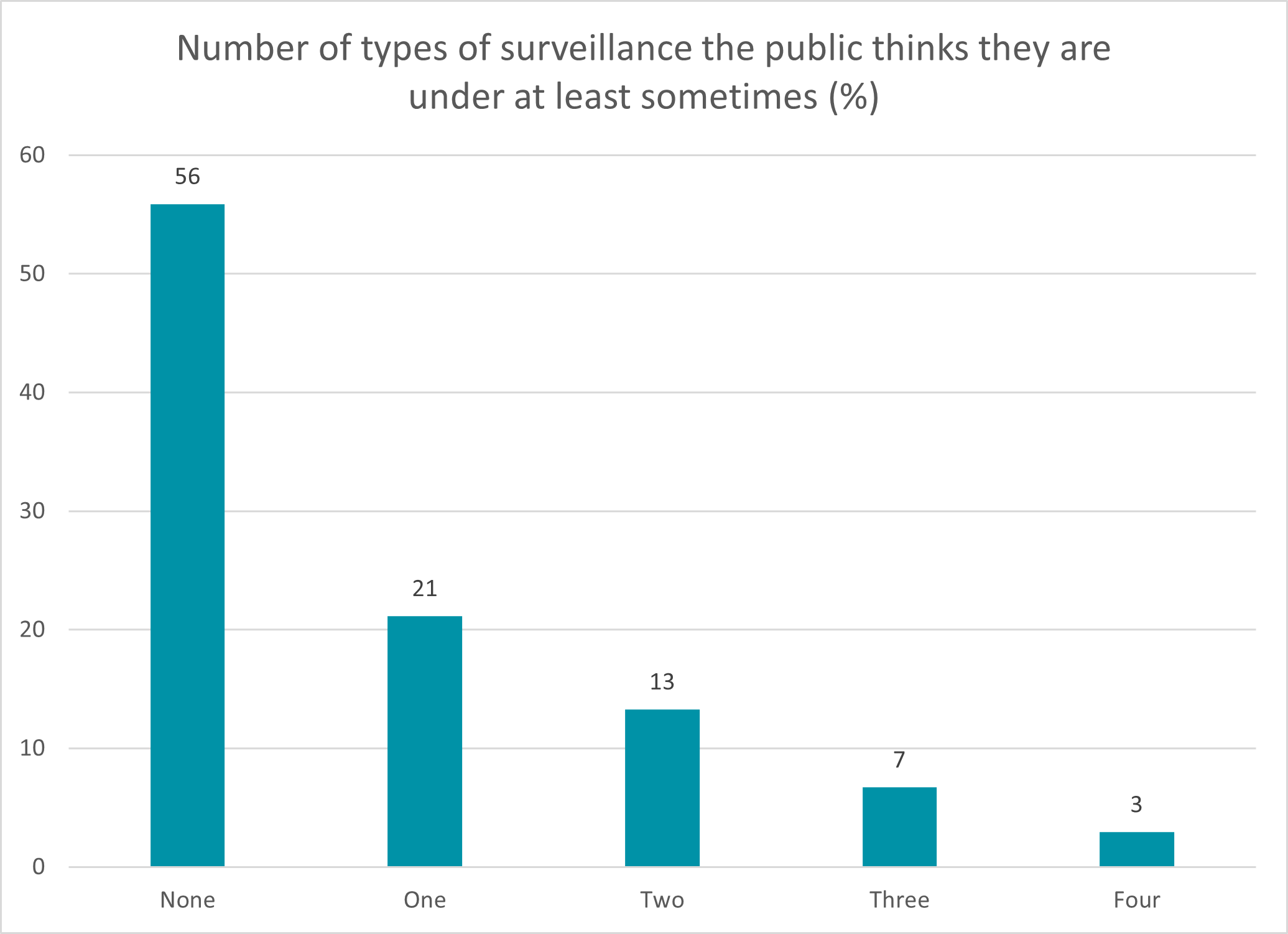
Overall, 44% of the public reported that they believe the government monitors them in one of the above manners. One in five (21%) named one means of surveillance on the survey, one in eight (13%) reported two means of surveillance while one in ten (10%) reported three or four means of surveillance.


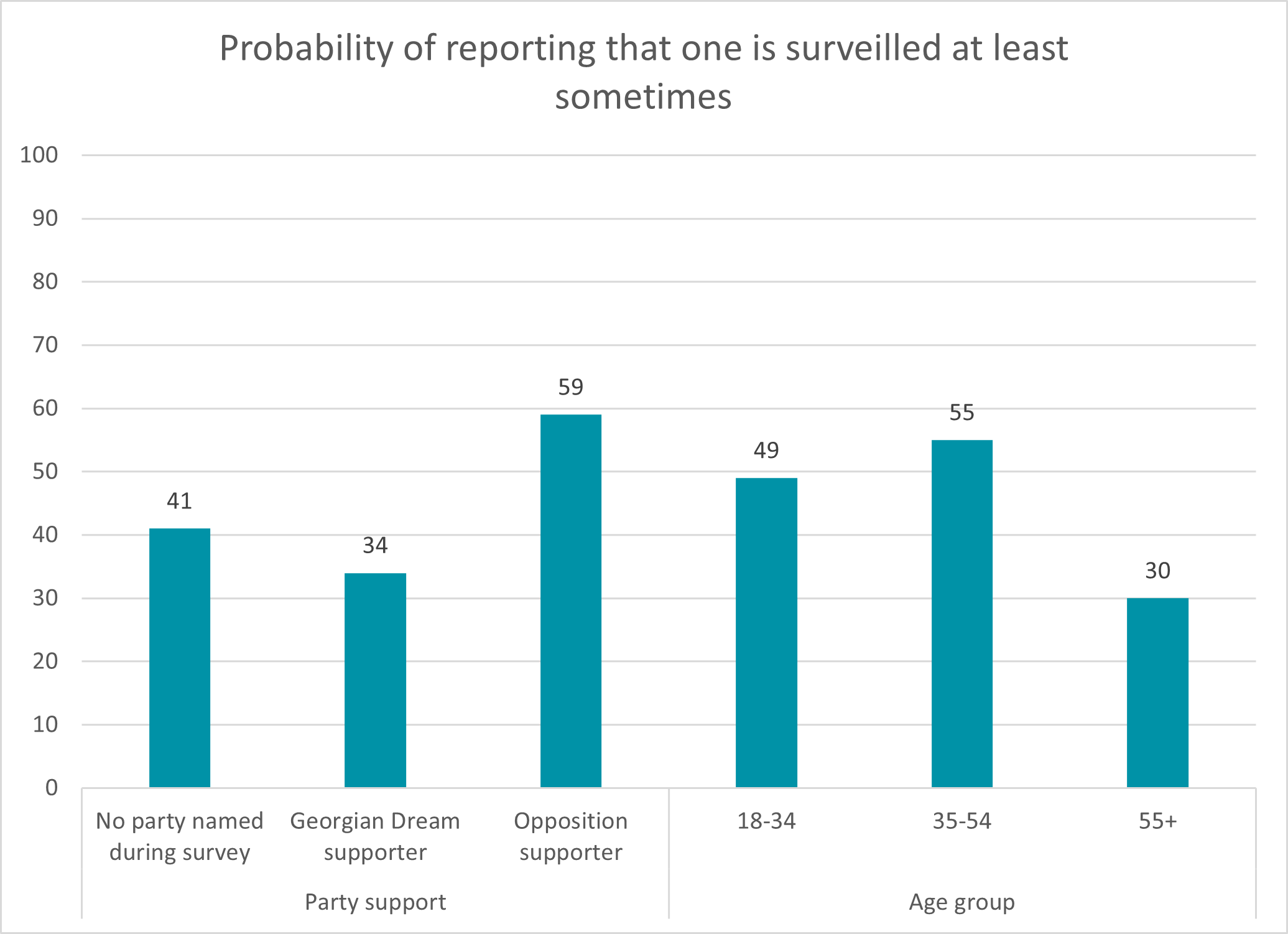
When the data is broken down by social and demographic variables, a number of patterns emerge: first, older people (55+) are significantly less likely to believe they are under surveillance than those between 18–34 or 35–54.

Second, people who support the opposition are 25 points more likely than Georgian Dream supporters to believe they are under surveillance at least sometimes. Similarly, nonpartisans are seven points more likely to believe that they are being surveilled than supporters of the ruling party.

A regression that included the above variables did not show any significant differences between men and women, ethnic minorities and ethnic Georgians, IDPs and non-IDPs, wealthier and poorer households, people in different types of settlement, those with differing levels of education, those working and not, and working the public and private sectors.


The above data suggests that nearly half the public thinks the government is surveilling them, with opposition supporters being particularly likely to believe the government is watching.

The data in this article is available here.

Tuesday, August 30, 2022

Do Georgians worry about fake news online?

Note: This article first appeared on the Caucasus Data Blog, a joint effort of CRRC Georgia and OC Media. It was written by Salome Dolidze, a Researcher at CRRC-Georgia. The views presented in the article are of the author alone, and do not necessarily reflect the views of CRRC Georgia, or any related entity.

Caucasus Barometer 2021, an annual household survey run by CRRC, investigated a range of attitudes and behaviours related to social media in Georgia. 27% of those surveyed felt that social media had a negative effect on the country, 18% a positive effect, and 42% a neutral or mixed effect.

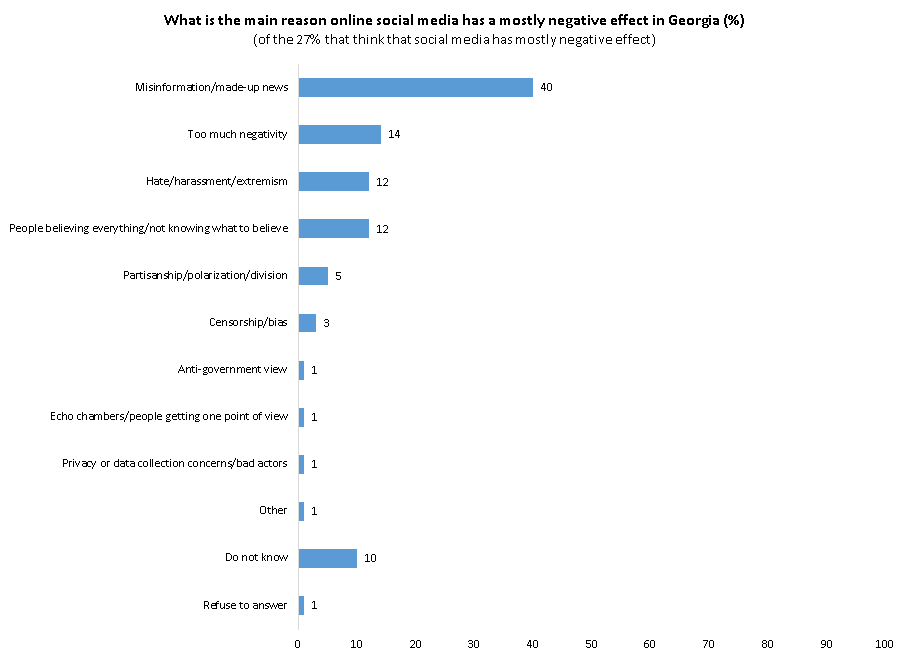
Of those that thought it had a negative effect, 40% reported that the main reason for the negative effect was misinformation. This answer was by far the most common response to the question.

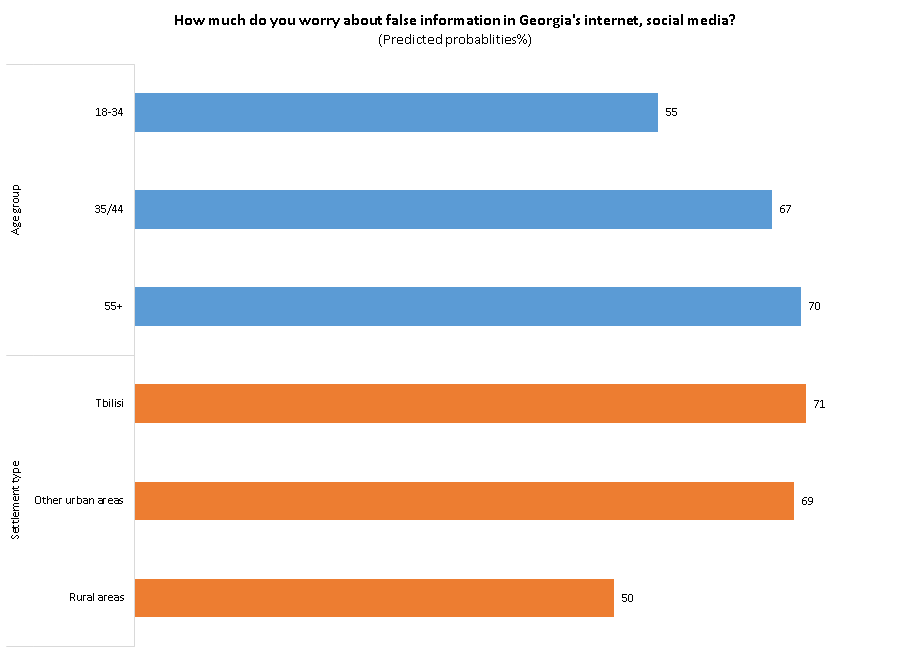
Similarly, more than half (59%) of those who use the internet worry about false information on the Georgian internet. Regression analysis suggests that some groups are particularly worried about false information. People over the age of 35 were more likely to report that they worry about false information online.  People living in rural areas were less likely to worry about this issue.

Other social and demographic variables such as sex, education, ethnicity, employment status, wealth, and having children in the household were not associated with attitudes towards false information on Georgia’s internet.

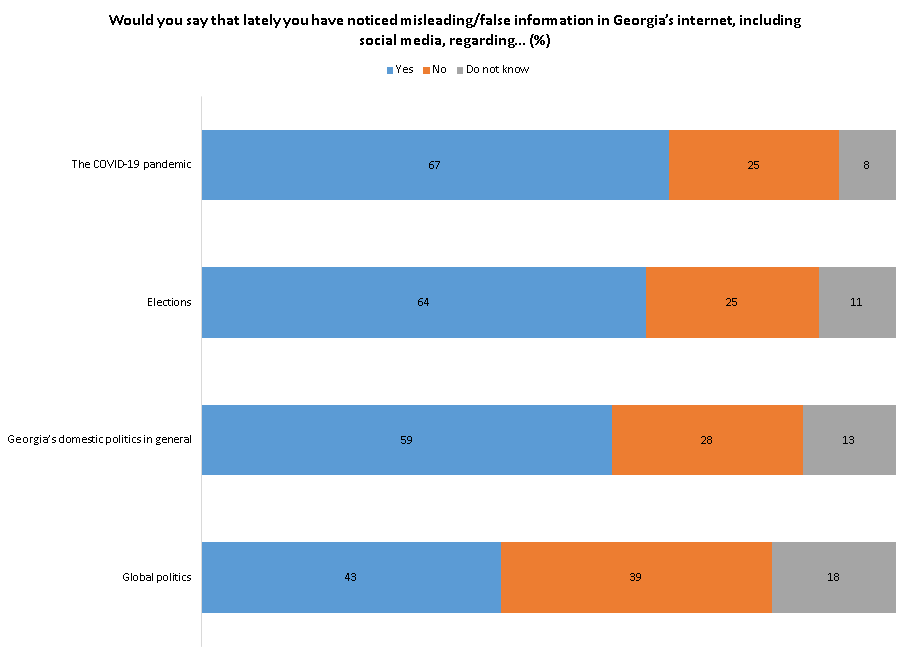
More than half of the internet-using population said that lately, they had noticed misleading or false information online about the COVID-19 pandemic (67%), elections (64%), and Georgia’s domestic politics in general (59%), while 43% say the same regarding global politics.

When it comes to reasons for disseminating misleading or fake news, 43% of Georgians think that the reason is to confuse people and distract them from real problems. The next most common reasons were advancing a political agenda or position (15%) or getting more engagement with their content (14%).

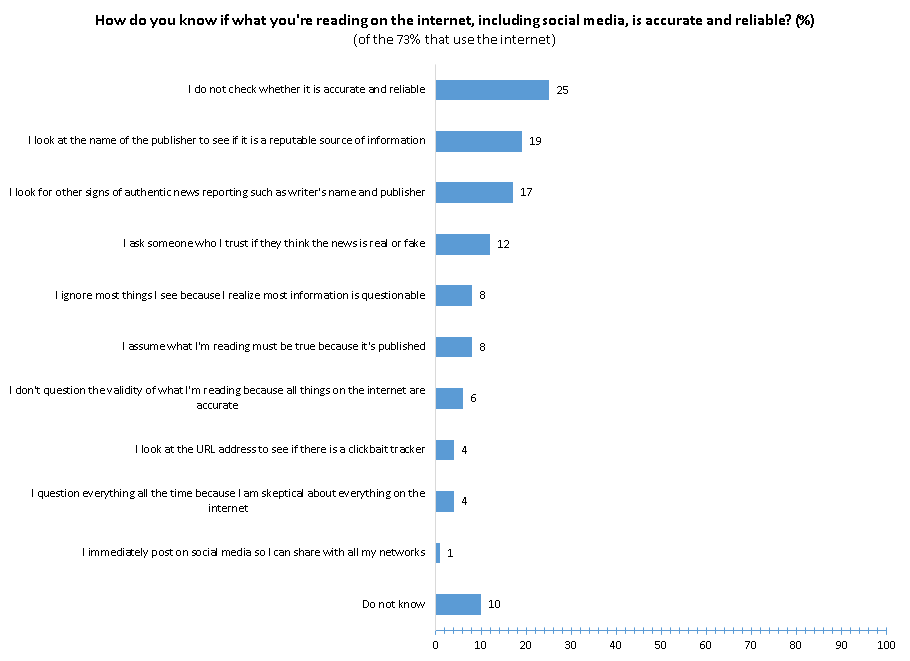
While Georgians recognise that misinformation is an issue, few do much to check the information that they receive online. One in five does not check if the information they are reading online is accurate and reliable. 

Around half (53%) of the internet-using population believe what they are reading on the internet but verify it in some manner. Some report using approaches like looking for the writer’s name and/or a publisher (36%), or looking at a URL address (4%).  A further 12% ask someone they trust, and 1% post on social media looking for clarification. 

Another 14% report they believe just about everything online, with 8% saying that they believe what they read on the internet because it is published, and 6% thinking that everything on the internet is accurate. 

Few are highly sceptical about everything they read on the internet. In total, 8% ignore most things they see, because they feel most information is questionable. A further 4% question all the information they access because they are sceptical about everything on the internet. 

The analysis shows that most people in Georgia who use the internet worry about the spread of fake news on the internet and social media. However, a large proportion of people do not check whether the information they receive on the internet is reliable or not. 

The data used in this article is available here. The regression analysis used in this article included the following variables:  Age (18-34, 35-54, 55+); Sex (male or female); Settlement type (Tbilisi, other urban, rural); Education level (tertiary or not); Ethnicity (Ethnic Georgian or ethnic minority); Employment status (employed or not working); Child dependency ratio (share of household 18 or under); Wealth index (A simple additive index of ownership of a number of durable goods within a household).
Tuesday, April 02, 2019

Georgia’s far-right are anti-Russian but share Russian narratives

[Note: This article was published in OC-Media. It is available in Georgian, here. David Sichinava is the Research Director at CRRC-Georgia. The views expressed in this article represent the views of the author alone. The article was written within the auspices of the Russian Propaganda Barometer Project funded through the East-West Management Institute’s ACCESS program.]


A USAID-funded study by CRRC-Georgia released on Monday shows that the far-right in Georgia is engaged in activities similar to their Russian supported counterparts in the European Union but speak more negatively about Russia than the West. Whether witting or unwitting, the implications are far-reaching for Georgia.

Since the mid-2000s, numerous media and academic sources have alleged that Russia is weaponising far-right and anti-liberal politics worldwide. This can be seen in Russian support for organised far-right groups within the EU, which in turn are used to attempt to influence domestic and regional politics.

Russian political elites have further used the anti-liberal far-right through the promotion of what has been called the ‘Russian model’ of authoritarian rule.

A crucial component of the model promotes Russia’s image as a protector of ‘traditional values’, including pro-religious and socially conservative views. Taken collectively, these far-right groups’ efforts can be understood as aimed at manipulating European public opinion through engendering anti-liberal sentiment within the EU.

To understand potential sources of Russian propaganda in Georgia and the far-right more broadly, CRRC-Georgia’s study analysed more than 26,000 posts from approximately 70 far-right Georgian-language Facebook pages.

The data suggest a growing appetite among Georgians for radical right-wing ideas. Between late 2015 to mid-2018, page likes for far-right pages increased eight-fold, from 89,000 to 760,000. Although there is clearly increased engagement on social media, this likely also reflects increased internet penetration in Georgia, with new internet users with previously far-right ideas finding far-right Facebook groups.


Besides purely nationalist sentiments, these groups are apt to criticise the liberal world order from a right-wing perspective, thus resonating with what Russia has endorsed. Some pages also reflect specific Russian talking points.

An illustrative example of right-wing, Georgian-language Facebook pages amplifying pro-Russian narratives can be seen in online opinions toward the US-funded Richard Lugar Centre for Public Health Research in Tbilisi. Since its opening in 2013, Russian politicians have been especially anxious about the establishment of the centre and frequently claim it is a test site for biological weapons. Following the loss of 15 lives to a flu outbreak in Georgia in early 2019, several right-wing pages shared posts accusing the laboratory of causing the outbreak.

While the number of social media posts talking about the lab in relation to the flu outbreak was small (18), their messages reached a wide audience: these 18 posts earned 754 likes from visitors and were commented on 538 times. Social media posts in which right-wing groups discussed the Lugar Laboratory were shared 1,639 times.

As previous analysis has highlighted, Georgia’s far-right is a heterogeneous crowd, and labelling them uniformly pro-Russian is misleading. In fact, the analysis of 26,000 social media posts shows that Georgia’s far-right speaks more negatively about Russia than the West on the whole. A sentiment analysis, a machine learning technique, scored conversations about Russia as net negative compared with almost neutral for the West.

Still, some pages which have pro-Russian slants also boast large followings. For instance, before being blocked by Facebook, Georgian Idea had about 40,000 subscribers. Another nationalist group, Georgian March, is followed by over 17,000 users and another 16,000 users subscribe to its content. On the whole, both groups speak more positively than negatively about Russia.

The analysis also suggests that pro-Russian pages actively engage with their audiences. Content created by the pro-Russian Georgian Idea garnered about 25,483 comments and 180,026 likes, while pro-Russian Georgian March attracted 32,761 comments from users. Importantly, other nationalist pages were less successful in engaging their audiences.

In contrast to the above pages, a large majority of far-right groups were not explicitly pro-Russian. Rather, the content of their messages was critical of both Russia and the West. The latter is usually criticised for pushing Georgia to accept a ‘liberal political agenda’. In contrast, Russia is portrayed as an enemy responsible for Georgia’s territorial conflicts.

While there is little besides circumstantial evidence that (parts of) Georgia’s far right is funded by Moscow, the data show that they do propagate messages that resonate with the Russian government’s vision of the world.

Despite sharing a similar vision, most far-right pages attack Russia with more vigour than the EU. While it is unclear whether some of these groups are backed by Russia, it is clear is that they at least amplify if not plant pro-Russian sentiments among the Georgian public.

Monday, August 24, 2015

Internet and social media usage in Georgia


In April-May 2015, CRRC-Georgia carried out a representative survey of the adult population of Georgia for Transparency International Georgia. The survey contained a number of questions on Internet and social media usage, and the results show us who is online, what people are doing online, who is using social networks, and which networks people use most.

The young, educated, Tbilisi residents, and employed report using the Internet more frequently than other Georgians. Most of Georgia’s elderly (56+) never use the Internet - only 19%, 7% and 5% of them in the capital, other urban and rural settlements (respectively) report using the Internet on a daily basis. The most vociferous Internet users are by far 18 to 35 year olds with a full 81% of them in the capital, 61% in other urban settlements and 39% in rural settlements reporting using the Internet every day. Only 1% of Georgians have never heard of the Internet, lower than in previous surveys which showed that as much as 6% of Georgians had not heard of the Internet. Notably, 46% of the population reported never using the Internet.


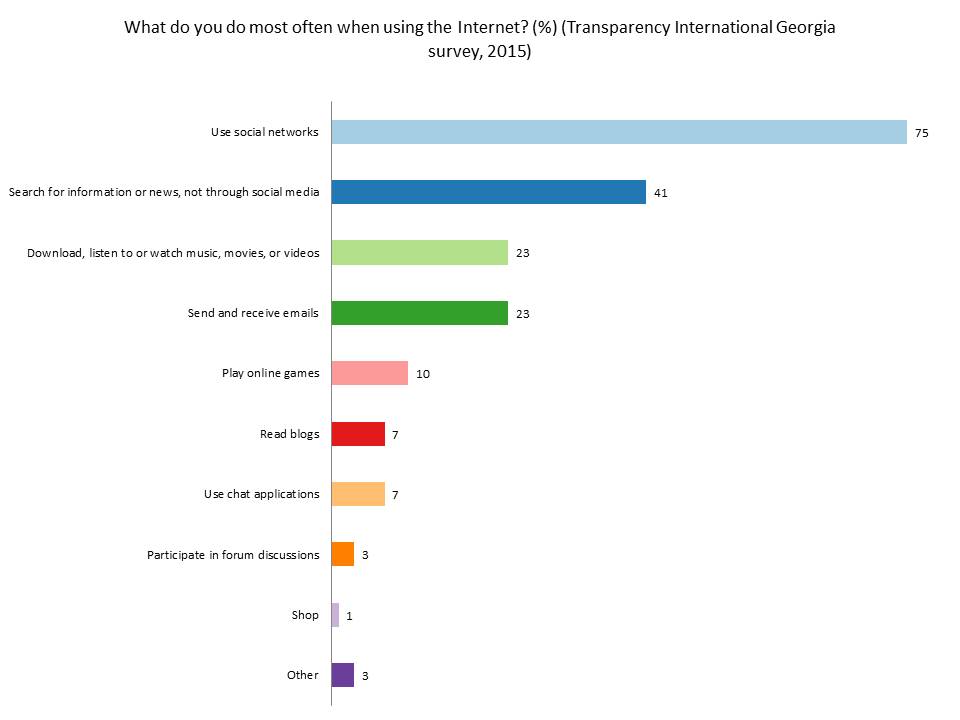
Those who report using the Internet at least once a month – we refer to them as regular Internet users (43% of the adult population) – were asked a number of questions about what they do online. As results show, when online, most are using social networks. In a distant second, regular Internet users report searching for information or news through means other than social media. Less, but roughly equal shares of them reported their most often online activity as either emailing or downloading /listening to/watching movies, music or videos.


Note: Only those who use the Internet at least once a month were asked this question. Each respondent could select up to three answer options.

Roughly nine out of ten regular Internet users in Georgia use either Facebook, Twitter, Odnoklassniki or VKontakte – or some combination of these social networks – at least once per week. This means that approximately four in ten Georgian adults regularly use a social network. As far as specific social networks go, Facebook is by far the most popular in Georgia –79% of regular Internet users are on Facebook at least once a week. The next most popular social networking site is the Russian Odnoklassniki; rather small shares of Georgians use VKontakte and/or Twitter on a regular basis.


The data shows three major patterns of social network choice by regular Internet users in Georgia – Russian networks only, American networks only, and a mix of both. The Russian only users are the smallest share of users (9% of regular Internet users) followed by American only network users (36%). A plurality (43%) of regular Internet users are on a Russian and American social network at least once per week.

The American only users are heavily concentrated in Tbilisi (68%) compared with the mixed and Russian network only users who are more evenly distributed throughout the country. The American only users are also more affluent being both more highly educated and having higher household incomes.

What trends have you noticed on social media use in Georgia? Join the conversation here on our Facebook page.