Showing posts with label Trust. Show all posts

Tuesday, June 24, 2025

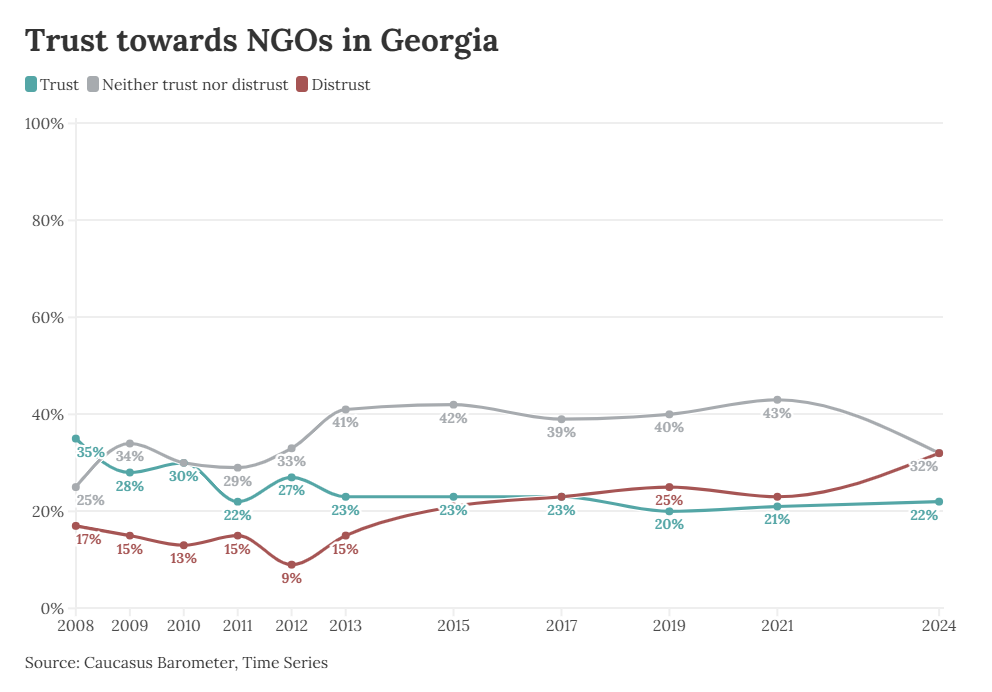
Trust in NGOs in Georgia has grown increasingly polarised

Note: This article first appeared on the Caucasus Data Blog, a joint effort of CRRC-Georgia and OC Media. This article was written by Zachary Fabos, a researcher at CRRC Georgia. The views presented in the article are the author’s alone and do not necessarily represent the views of CRRC–Georgia or any related entity.

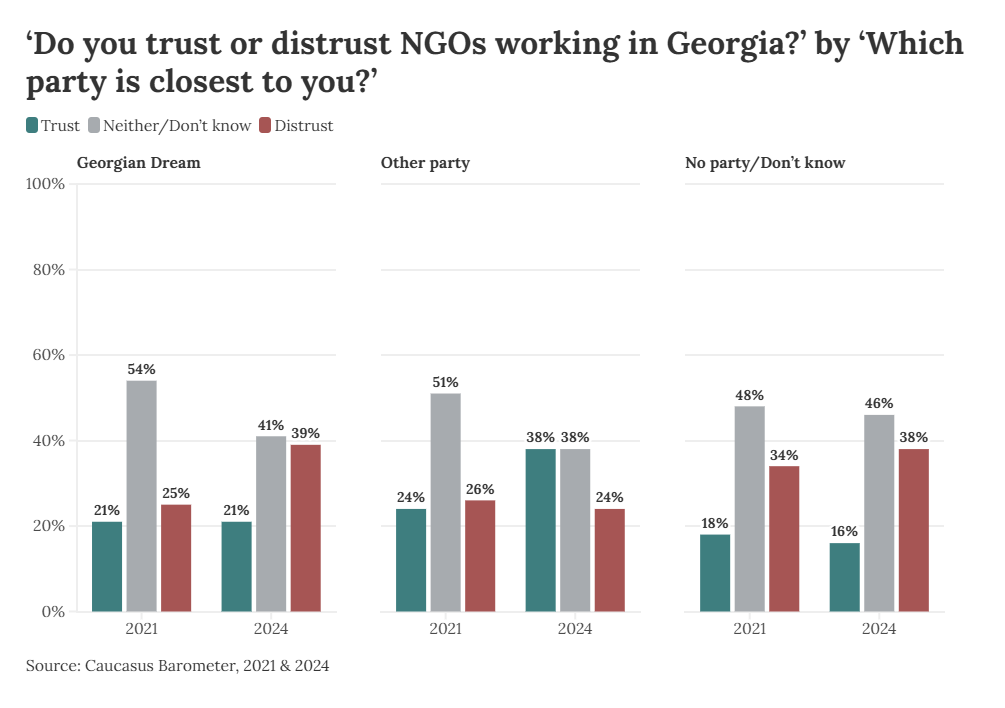
Comparing the frequency of distrust and trust among party supporters between 2021 and 2024 further demonstrates the recent development of political polarisation around NGOs operating in Georgia. While distrust and trust towards the sector was about the same among both Georgian Dream and other party supporters in 2021, by 2024 trust and distrust developed a partisan character.

Distrust grew from 25% of Georgian Dream supporters in 2021 to 39% of Georgian Dream supporters in 2024. Among opposition party supporters, trust grew from 24% to 38%. Those who did not support any party did not experience a similar attitude shift.
An analogous dynamic is at play when looking at media consumption.

Between 2021 and 2024, distrust of NGOs among viewers of the pro-government TV channels Imedi, PosTV, and Rustavi 2 more than doubled from 20% to 41%. On the other hand, trust in NGOs nearly doubled among viewers of opposition-leaning TV channels Formula, Mtavari, and TV Pirveli, from 21% to 39%. The sharp divide in distrust and trust of NGOs points to the politically polarised narratives directed at the sector.
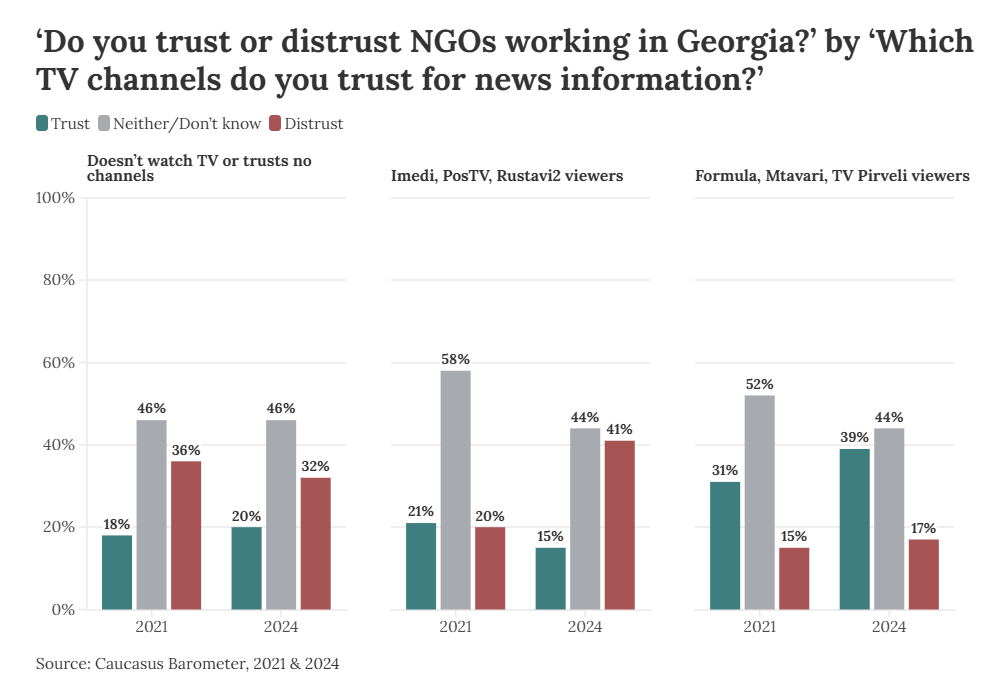
Although distrust towards Georgia’s NGOs hit an all-time high in 2024, time series data demonstrate that skepticism of the sector has grown most prominently among Georgian Dream supporters and viewers of Imedi, PosTV, and Rustavi 2, aligning with Georgian Dream’s promotion of anti-civil society legislation and conspiracy theories. The politicisation of attitudes surrounding NGOs is further shown in the opposite trend among those who support other parties and watch news from opposition-leaning channels.

Tuesday, January 30, 2024

Trust and political independence in Georgia’s interior ministry

Note: This article first appeared on the Caucasus Data Blog, a joint effort of CRRC-Georgia and OC Media. It was written by Tinatin Bandzeladze, a senior Researcher at CRRC-Georgia and Mariam Kobaladze, a senior Researcher at CRRC-Georgia. The views presented in the article are the author’s alone and do not necessarily represent the views of CRRC-Georgia, Caucasian House, or any related entity.

A CRRC survey found that trust in Georgia’s Interior Ministry and the police is closely tied to perception of the ministry’s political independence, or lack thereof. 

In summer 2022, CRRC Georgia and the Social Justice Center partnered on a nationwide public opinion survey on state and personal security. It found that while the Interior Ministry was one of the most trusted institutions in the country, many respondents were concerned that the ministry lacks transparency and political impartiality.

Georgia’s Interior Ministry is largely made up of and closely associated with the country’s police, with police officers often seen as representatives of the ministry. Previous research has demonstrated that police need public trust to effectively carry out their mandate to fight crime and maintain public safety. 

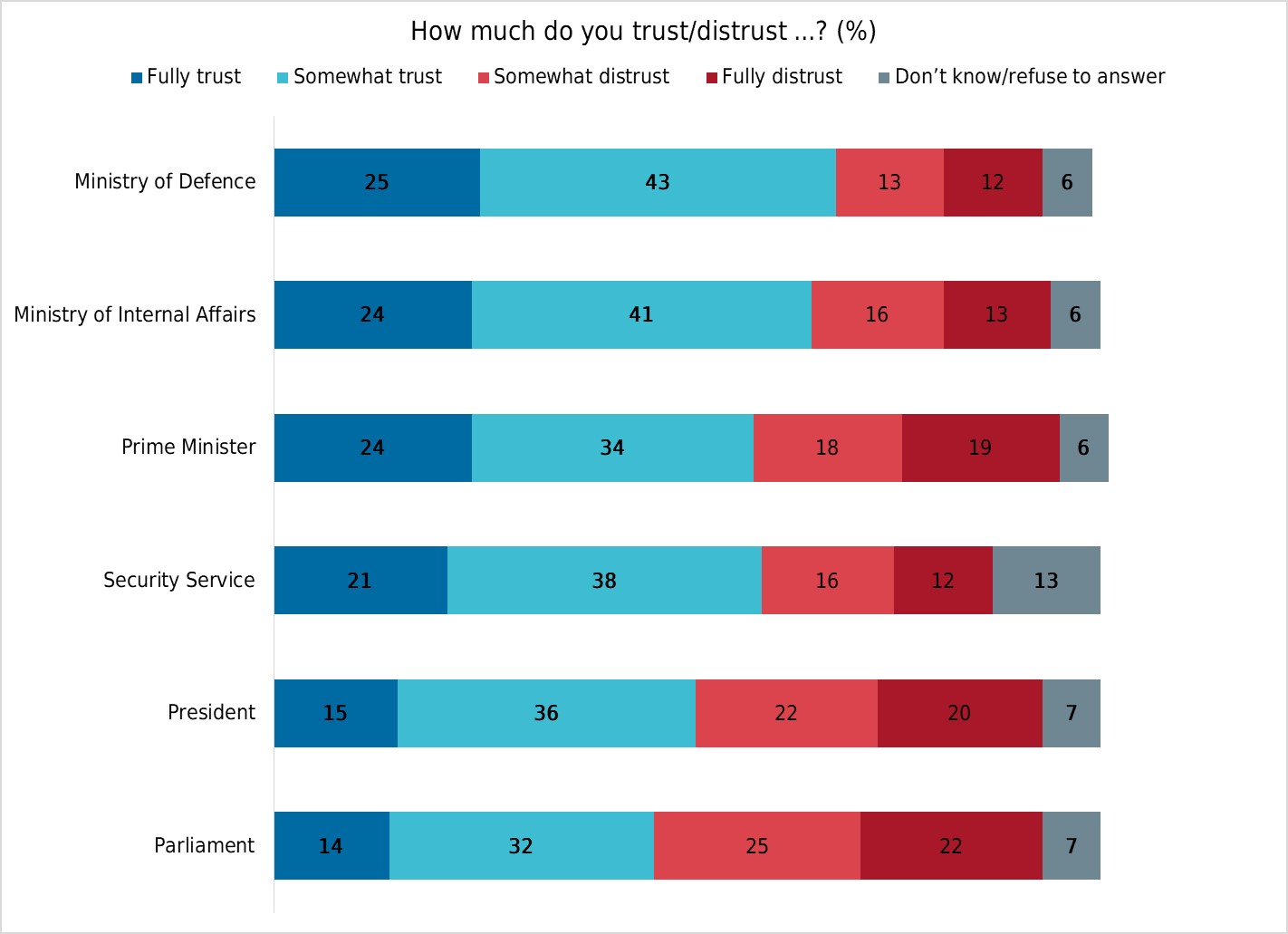
According to the 2022 survey, a majority of the Georgian public trust the Interior Ministry. About two thirds (65%) of the public has full or partial trust in the ministry. This is lower than that of the Defence Ministry (68%), but outperforms the Prime Minister (58%), the State Security Service (59%), the President (51%), and the Parliament (46%). 

Trust in the Interior Ministry varies with a number of social and demographic characteristics.

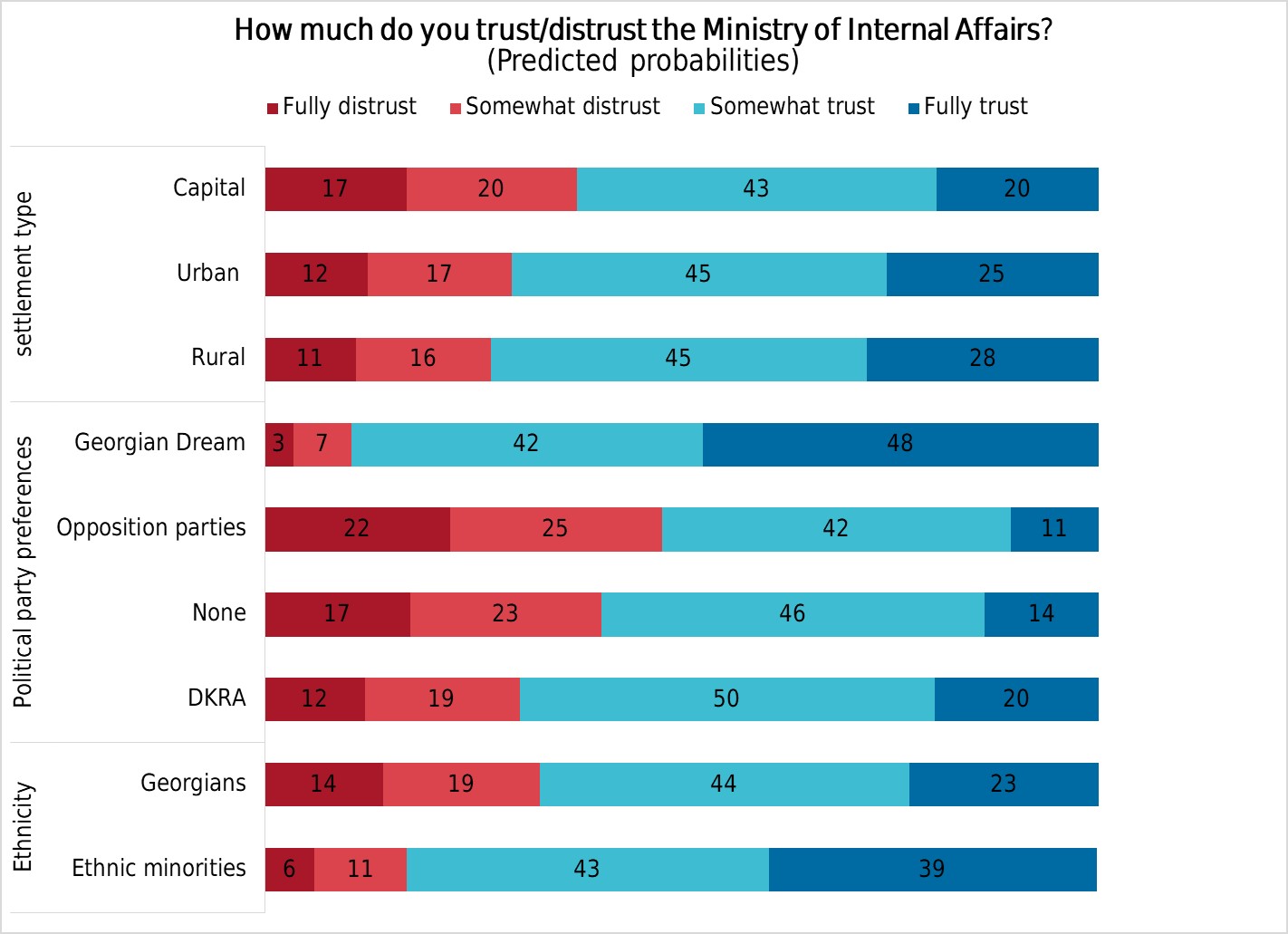
Residents of Tbilisi are less likely to fully trust the Interior Ministry than residents of other cities and people in rural areas. 

Trust in the ministry is also associated with party preferences. People who support the ruling Georgian Dream party are more inclined to fully trust the ministry than supporters of opposition parties and those who support no party. Almost half of ruling party supporters fully trust the Interior Ministry. 

Ethnic minorities fully trust the Interior Ministry at nearly twice the rate of ethnic Georgians. 

Other demographic characteristics do not predict trust in the ministry.

Research by others suggests that trust in the police is connected more to perceptions of police fairness than with perceptions of police effectiveness in dealing with crime. 

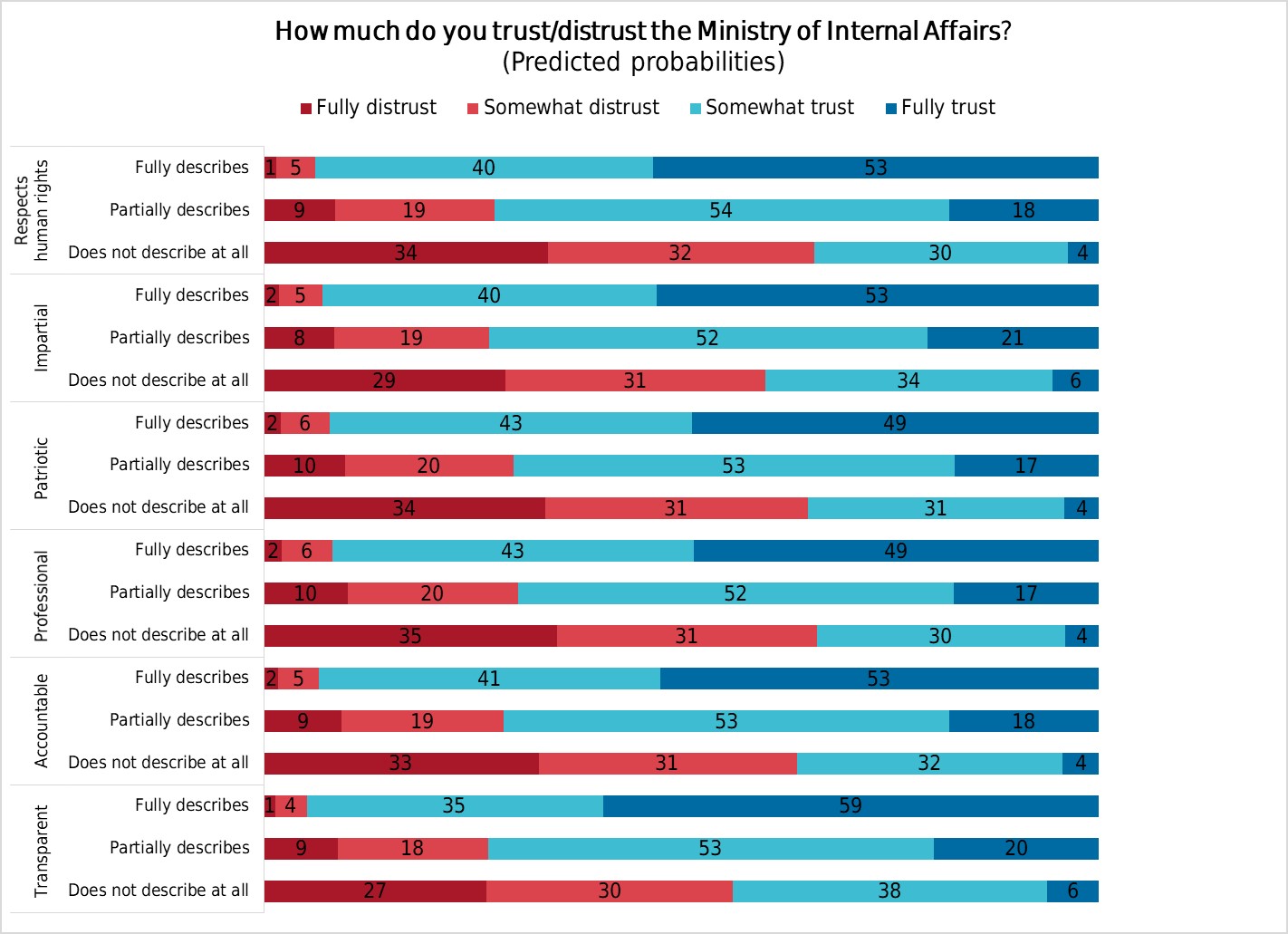
In relation to that, the study also asked about whether the public perceived the Interior Ministry as patriotic, professional, impartial, and transparent. The surveyed respondents viewed the ministry as patriotic (23%) and professional (23%) more frequently than they perceived it to be impartial (15%) and transparent (14%). 

The above opinions are associated with trust in the Interior Ministry. Those that think these characteristics fully describe the ministry, also nearly unanimously trust it. In contrast, majorities of those that do not think each characteristic describes the ministry also mistrust it. 

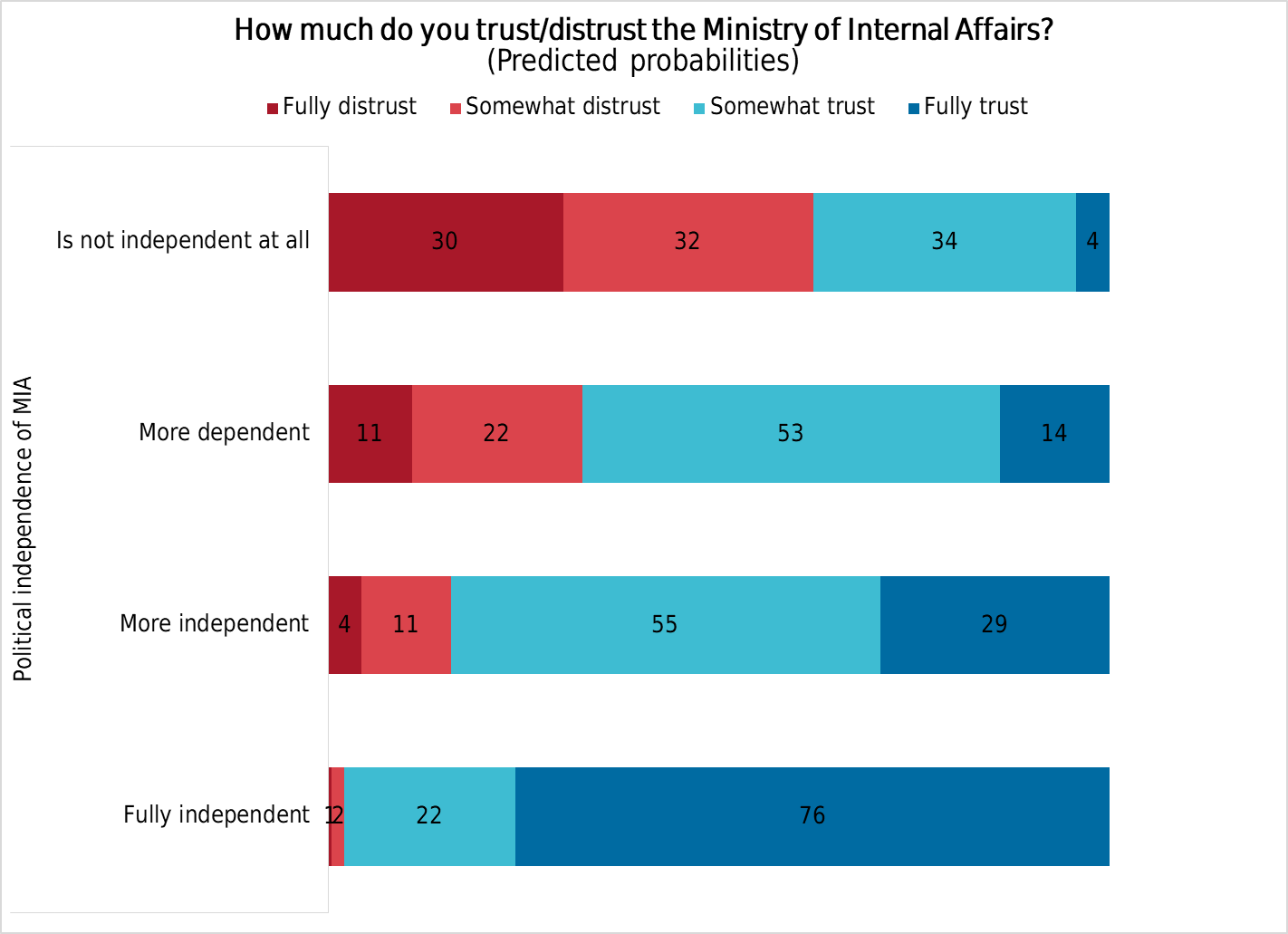
Respondents were also asked if they believed the Interior Ministry was independent from politics. Only 9% of those surveyed felt that the Interior Ministry was fully independent from political influence, while 23% believed it was more independent than dependent. On the other hand, 47% reported believing that the ministry had no political independence or it was more politically ‘dependent’ than independent. The remaining 21% did not know or refused to answer the question. 

The data indicate that opinions regarding political independence strongly predicted trust in the ministry. While there was a 62% chance an individual would fully or partially distrust the Interior Ministry if they believed it was not independent at all, the likelihood dropped to 2% among those who believed it was fully independent. 

While a majority of Georgians reported trusting the Interior Ministry, and thereby the police, in 2022, relatively few reported they were transparent and impartial, with only a third of respondents viewing them as politically independent. A belief that the ministry lacks independence as well as a lack of belief that it is transparent, accountable, professional, patriotic, impartial, and respects human rights are strong predictors of whether people trust the institution.

Note: This blog makes use of ordinal logistic regression analysis. The dependent variable was trust in the MIA, with don’t know and refuse to answer responses removed. The independent variables included:  sex, age, employment status, level of education, a wealth index, settlement type, political sympathy and ethnic identity. 

Tuesday, September 13, 2022

Do Georgians trust TV?

Note: This article first appeared on the Caucasus Data Blog, a joint effort of CRRC Georgia and OC Media. It was written by Kristina Vacharadze, Programs Manager, and Mariam Kobaladze, Senior Researcher at CRRC-Georgia,  The views presented in the article are of the authors alone, and do not necessarily reflect the views of CRRC Georgia, or any related entity.

In an increasingly polarised media environment, Georgians have mixed feelings about how much TV and TV journalists can be trusted. 

Over the past decade, TV as a source of news has been on the decline in Georgia. With just 53% of those surveyed in 2021 using TV as their primary news source, as compared to 88% in 2009, it is clear that TV has lost its dominance. Nonetheless, it remains the main news source for  half of the adult population.

This fall in TV consumption has taken place against a background of an increasingly divided media environment. Media monitoring studies show that, in recent years, there have been clear trends of polarisation amongst television channels, with many strongly supporting either the ruling party or the opposition. 

This has been reflected in qualitative studies by CRRC-Georgia, in which many people have said that they have to watch news on several television channels to be able to draw reasonable conclusions on events that have happened and how they might interpret them. 

In such an environment, what does the Georgian public think of television and TV journalists? 

Can TV be trusted?

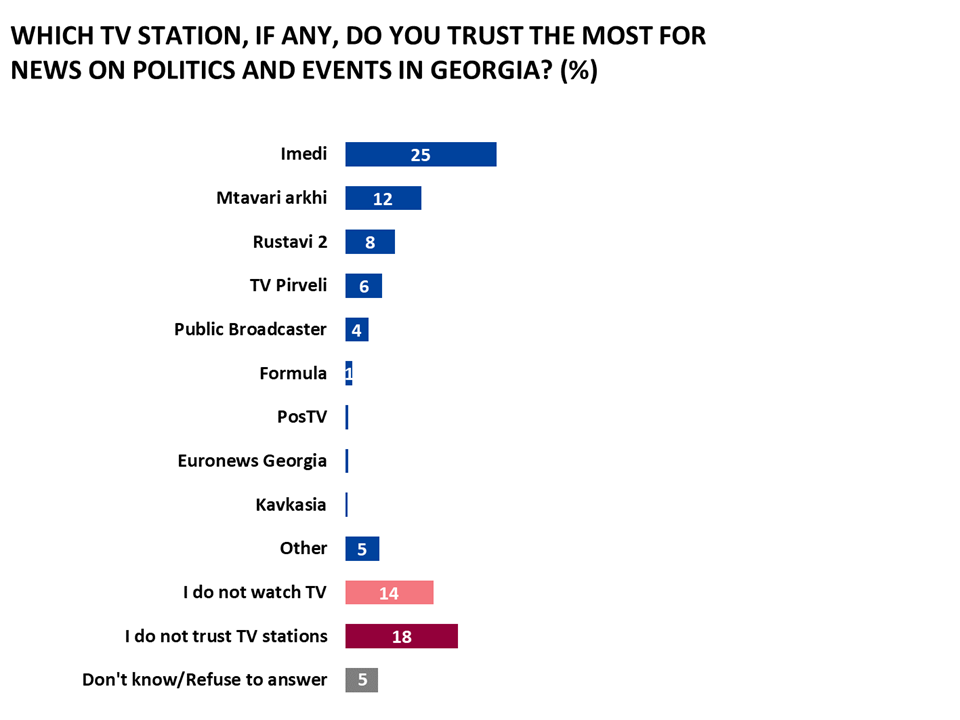
According to the Caucasus Barometer 2021, an annual household survey run by CRRC, 18% of the population does not trust any television channel for news about politics and current events and 14% does not watch television news at all. 

The most trusted television channels for news on politics and current events were found at opposite ends of the political sprectrum - the pro-government Imedi, trusted by a quarter (25%) of the population, and the pro-opposition Mtavari, trusted by 12%. Less than a tenth of the population trusted Rustavi 2 (8%), TV Pirveli (6%), and the Public Broadcaster (4%) more than any other station.

A regression analysis found that trust in TV and TV stations and viewing habits were associated with various demographic characteristics. 

Older people were more likely to watch and trust TV compared to other age groups. 

Ethnic minorities were more likely to distrust TV or not watch it compared to ethnic Georgians. This could be in part related to a lack of Armenian- and Azerbaijani-language programming on Georgian television. 

Working people were more likely to distrust and/or not watch TV news compared to people who did not work. 

People who supported a political party were more likely to watch and trust TV than people who did not support any party, or refused to report a party preference.

There were no patterns associated with settlement type, gender, or education level.

Note: The analysis uses a multinomial regression, where the dependent variable is whether people distrust TV, do not watch any TV channel for news about politics and current events, or trust a specific TV station. The independent variables are gender, age group, ethnicity, settlement type, level of education, and employment status.

What do the public think of TV journalists?

With a third of the population distrusting and/or not watching news on any television channel, what does the Georgian public think of the performance of TV journalists? 

About half of those surveyed (48%) believed that Georgian TV journalists inform the population about ongoing events in Georgia neither poorly nor well, while approximately a fifth of the population either positively or negatively assesses their work.

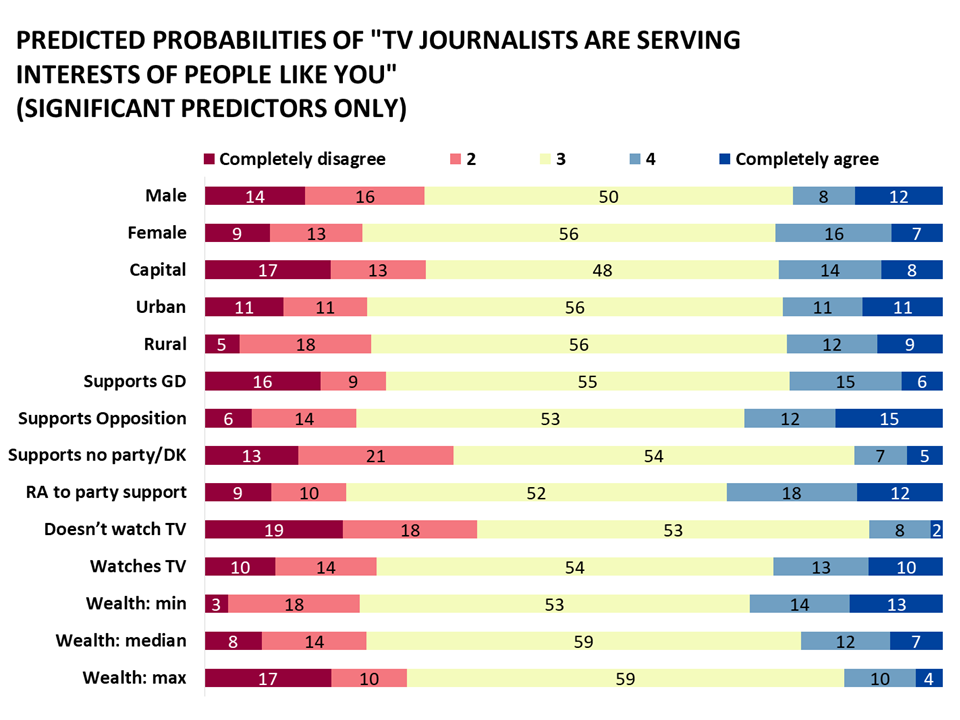
A multinomial regression showed that women were more likely to agree with the idea that TV journalists were serving their interests than men were. On the other hand, people living in urban areas assessed the performance of TV journalists more negatively than those living in rural settlements.

Party allegiance was also a significant predictor of people’s views: respondents who supported an opposition party were more positive towards the performance of journalists than supporters of the ruling party, Georgian Dream. 

Wealth (measured as the number of items a household owns from a list of 14) was also a significant predictor: poor people assessed the performance of journalists more positively than wealthier people.

Unsurprisingly, people who watched TV tended to feel more positively about TV journalists than people who do not watch TV.

A regression analysis did not show significant differences in attitudes between different age groups, ethnicities, people with different education levels, or with and without a job.

Note: The analysis uses a multinomial regression, where the dependent variable is whether people agree or disagree with the statement that TV journalists in Georgia are serving the interests of people like them. The independent variables are gender, age group, ethnicity, settlement type, level of education, wealth, watching TV and employment status.

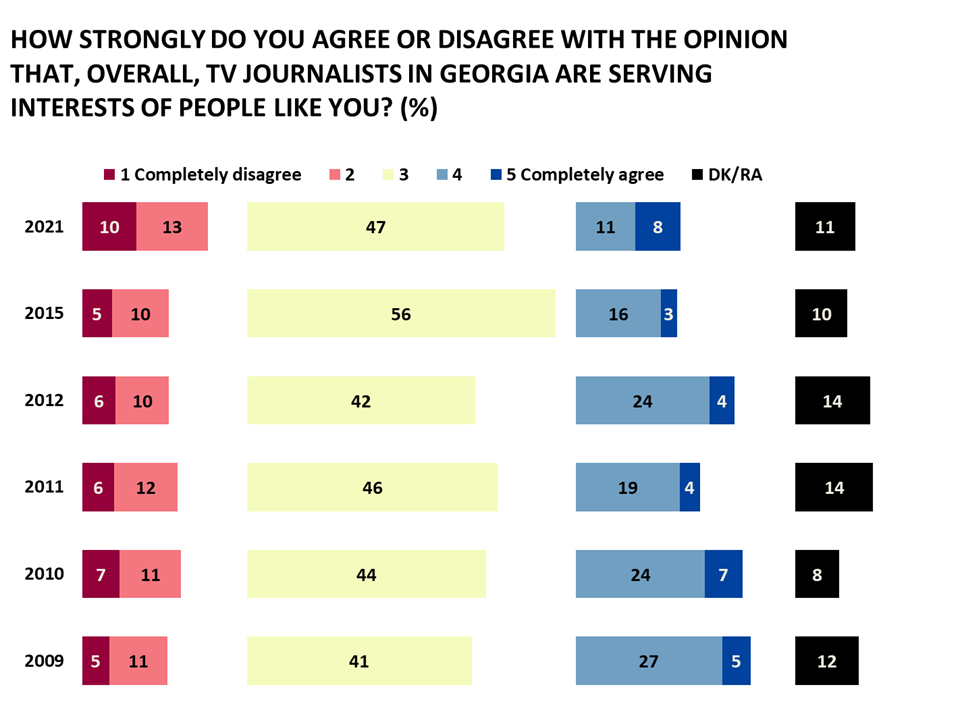
The data shows a similar pattern with regard to views on whether TV journalists in Georgia serve the interests of the people. Slightly less than half of the population in Georgia (47%) neither agree nor disagree, while around a quarter (23%) believed that TV journalists do not serve the interests of the people, and a fifth (19%) believed that they did. Notably, people have become more pessimistic with regards to this question over the last decade, with a seven percentage point increase in disagreement with this sentiment between 2009 and 2021, and a 13 point decline in agreement with the statement during the same period. 

In the context of a very divided media landscape, it is notable that there is low public trust in television news and outlets. This trust appears to have fallen over the past decade, with fewer now believing that TV journalists in Georgia serve their interests. 

The data used in this post is available here.

Tuesday, February 02, 2021

Despite gains in 2020, Georgia’s institutions remain poorly trusted

Note: This article was published on the Caucasus Data Blog, a joint publication of CRRC Georgia and OC Media. It was written by Dustin Gilbreath, Deputy Research Director at CRRC Georgia. The views expressed in this article do not represent the views of CRRC Georgia or any related entity.

The newly released 2020 Georgia Caucasus Barometer shows that trust in most institutions rose significantly since the start of the pandemic, but some institutions gained more than others.

This shows that the rallying around the flag effect, previously demonstrated for people’s assessments of the performance of institutions in the spring of 2020, has also led to large increases in trust towards them.

In December 2020, when the survey was conducted, religious institutions and the army were the most trusted institutions in the country. By contrast, political parties had the least amount of trust, followed by a large number of institutions that 25%–30% of people reported trusting.


While these levels of trust are not particularly high for most institutions, on average they were still 10 percentage points higher than the previous year. No institution saw a decline in trust. 

For seven of the fourteen institutions asked about, there was a double-digit increase in the share of the population trusting them. The executive government experienced the strongest gain of 19 percentage points compared to 2019. 

The media, the healthcare system, religious institutions, local government, political parties, and parliament also all experienced large gains in trust. By comparison, NGOs and banks did not gain a significant amount of trust during the pandemic.


Even though there has been an almost universal rise in trust in Georgia’s institutions, the country is still behind where it was in terms of institutional trust compared to 2008, the first year for which comparable data is available.

Trust is up in political parties, the executive government, and the army compared to the 2008 baseline. It has not changed significantly for local government, the police, the courts, or religious institutions. It has declined for the president, banks, the media, NGOs, parliament, the education system, and even the healthcare system. 

While the pandemic, and the largely effective institutional responses to it, likely explains the rise in trust in institutions between 2019 and 2020, trust in most of them remains low. 

Indeed, despite the gains in trust in 2020, most institutions are still less trusted than they were in 2008.

The data used in this article is available here.


Monday, March 16, 2020

Trust in institutions continues its steady decline in Georgia

[Note: This article was co-published with OC Media. The article was written by Dustin Gilbreath, Deputy Research Director at CRRC Georgia. The views presented in the article do not necessarily reflect the views of CRRC-Georgia or any related entity.]

Trust in institutions has been on the decline in Georgia for a decade now. For instance, the level of trust in religious institutions declined from 86% of the public reporting trust in 2008 to 71% in 2019, with the decline being particularly prominent among Orthodox Christians, the main religious group in the country.

Although there has been a decline in trust in most institutions, the decline has been starkest when it comes to political institutions. Newly released data from the Caucasus Barometer 2019 suggests this decline has continued, with the largest decline surrounding trust in the President, Salome Zourabishvili.

Between 2017 and 2019, there were no major increases in trust in institutions. Concomitantly, there were five declines in trust beyond the margin of error. The largest decline in trust was in the president — a 21 percentage point drop.

This likely reflects the change over from Giorgi Margvelashvili to Salome Zourabishvili as president in 2018. Zourabishvili gained office in a heated presidential election, the quality of which was problematic according to some observers. Moreover, few approve of her performance: only 12% reported they viewed her performance positively in a July 2019 NDI and CRRC survey. Hence, the decline is in some senses unsurprising.


Note: Trust in institutions was measured using the question, ‘I will read out a list of social institutions and political unions. Please assess your level of trust toward each of them on a 5-point scale, where code “1” means “Fully distrust”, and “5” means “Fully trust”. First, please tell me how much do you trust or distrust Georgia’s [Institution]?’ Responses of ‘fully trust’ and ‘trust’ are combined into trust for the purposes of this writing.

Aside from the president, there were also declines in trust in parliament and the courts of seven percentage points. There were also declines in trust in the healthcare system and executive government of six and five points, respectively.

While this shows that in the short term, there has been a decline in trust in institutions, there are also notable mid-term trends when it comes to trust in political institutions.

There was a high point in trust in the parliament and executive government in 2012, when the Caucasus Barometer survey took place shortly after the parliamentary elections which unseated the United National Movement.

Similarly, there was an increase in trust in the presidency after the first wave of the Caucasus Barometer survey after Giorgi Margvelashvili was elected (The 2013 wave took place during the presidential election). However, these trends have since reversed, reflecting the growing dissatisfaction with the state of affairs in the country.


While there have been several mid-term trends in the data, taking the long view suggests that the drop in trust is a longer-term phenomenon that is larger than the administration of one political party or another.

Trust in all the domestic institutions asked about on the Caucasus Barometer survey have declined since the question was first asked, with the exception of the Army.

Not only has trust declined for all institutions aside from the Army, it has generally done so by large amounts. Compared with 2008, trust in the President has declined by 35 percentage points, in the media by 30 points, and in the Public Defender’s Office and banks by 29 and 28 points respectively. Even the highly trusted police force has experienced a five-point decline in the share of the population reporting they trust them since 2008. The average decline in trust was 17 percentage points between 2008 and 2019.


Note: Trust in political parties was first measured in 2012. Trust in local government was first measured in 2009. All other institutions were first measured in 2008.

The drops in trust in institutions in Georgia are not the only sign that all is not well. Data from other sources suggest that people increasingly think Georgia is heading in the wrong direction.  Fewer people are optimistic about the state of Georgia. Fewer people are satisfied with life. There have been large drops in the belief that most people can be trusted in Georgia. Taken together, the above points to stagnation in Georgia.

The data used in this blog post is available here.


Monday, January 14, 2019

Institutions need to replace personality

[This article was first published on OC-Media.]

A fair amount of scholarship indicates that (dis)trust in political institutions provides an indication of how well the institutions work. Hence, trust in political institutions is an important indicator for the functioning of a democratic government.

Following this line of logic, one would expect that trust in institutions reflects the public’s trust in who runs them. Caucasus Barometer (CB) data from 2011 to 2017 support this argument.

Overall, the data indicates that trust in political institutions has declined since 2011. None of the political institutions asked about on CB (the president, local government, executive government, parliament, and political parties) received as high a level of trust on the 2017 Caucasus Barometer as on the 2011 or 2012 waves of the survey.

While trust has declined overall, the relative levels of trust have largely been in sync with the changes of power in the country.

After Georgian Dream came to power in 2012, there was an increase in trust towards the executive government (from 39% to 48%) and parliament (from 37 to 44%), the two institutions that changed political leadership.

Trust in the president continued to decline from 58% in 2011 to 28% in 2012 and 23% in 2013. All of these surveys were done while Mikheil Saakashvili was still president.

Trust in the president grew in 2015, the first wave of CB after the 2013 presidential elections, which ended Mikheil Saakashvili’s presidency and brought Giorgi Margvelashvili to office.

Public trust in local government did not follow the same logic as executive government, parliament, and the presidency. Even though Georgian Dream won the 2014 local elections, trust in local government did not change between 2013 and 2015.

This could be due to the relatively weak public expectations of local government. Indeed, in 2013, only 4% of the public reported they had attended a local government meeting in the last year on a CRRC/TI survey. Besides low expectations, many local government officials had defected from the UNM to GD in the years since the change of power. Hence, it is not clear that the elections truly marked a change of power.

At the same time that trust in local government did not increase, trust towards executive authorities and the parliament declined as the popular glow surrounding Georgian Dream wore away. Trust towards the executive fell from 48 percent in 2012 to 26 percent in 2017. While 44 percent trusted parliament in 2012, trust fell to 22 percent in 2017. Meanwhile, trust in President Margvelashvili continued grow, which might be attributable to his de facto opposition to the ruling party, without defection to the UNM.

Trust in political parties has remained low and showed little change from year to year. It declined between 2011 and 2015, yet, trust in political parties does not appear to follow the electoral cycle as trust in institutions controlled by specific parties appears to.

Growing public mistrust toward political institutions in Georgia is a sign of weak state institutions in the country. Renewed optimism and trust in institutions appear to follow changes in political leadership, but without strong institution-building processes, optimism turns into disappointment.

While Georgian democracy has made consistent progress for the last three decades, transitioning from personality to policy driven politics remains a challenge for Georgia’s democratic consolidation.

This article was written by Kristina Vacharadze, Programs Director at CRRC-Georgia. The opinions expressed in the article do not represent the views of CRRC-Georgia or any related entity.

To explore the data further, visit our Online Data Analysis tool.


Monday, August 13, 2018

Is Georgia’s Orthodox Christian population losing (trust in) their religion?

Surveys conducted in Georgia have repeatedly shown that the Georgian Orthodox Church’s leader Patriarch Ilia II is the most trusted public figure in the country. Yet, CRRC’s Caucasus Barometer survey data from 2008 to 2017 suggests that both the share of Orthodox Christians in Georgia that trust the Church and the degree to which they trust the Church is on the decline. Although the survey does not provide direct evidence, the scandals surrounding the church in recent years could have contributed to this. For instance, in 2017, a priest was convicted of attempting to poison the Secretary of Ilia II. The government has sold land to the Church at symbolic prices on numerous occasions, often leading to negative media coverage. In 2013, priests were involved in an anti-LGBT rights riot.

CB data on Georgia’s Orthodox Christians’ trust towards the Church shows that 75% reported fully trusting it in 2008. Only 33% did in 2017. During the same period, the share of those who reported trusting the Church more moderately (‘rather trust’ responses) increased from 15% to 38%. Combining the options ‘rather trust’ and ‘fully trust’ is also telling. In 2015, a total of 82% of Orthodox Christians reported trusting the Church; 71% did in 2017, an 11 percentage point decline.

Note: Only answers of those who identified themselves as Orthodox Christians are presented in the charts in this blog post. Answer options “Don’t know” and “Refuse to answer,” which made up less than 5% of responses in any given wave of the survey, are not shown in the charts throughout this blog post.

The decline in trust in the Church between 2015 and 2017 was starkest in Tbilisi, where reported trust declined by 18 percentage points. In Tbilisi, the share of people reporting distrust increased, while outside Tbilisi it did not change beyond the margin of error.

The decline in reported trust in the Orthodox Church is not reflected in changes in some forms of religious practice. Orthodox Christians have reported fasting at similar levels since 2008. There are small fluctuations in reported attendance of religious services, but no clear trend.
 

Note: The original answer options “Always fast” and “Often fast” were combined into the category “Often or always fast” on the chart above. The answer options “Rarely fast” and “Never fast” were combined into the category “Never or rarely fast”. 

Note: The original answer options “Everyday”, “More than once a week”, “Once a week”, and “At least once a month” were combined into the category “At least once a month”. Answer options “Less often” and “Never” were combined into the category “Less often or never”. 

While Orthodox Christians in Georgia may not be losing their religion, fewer trust in its key institution - the Church.

The data used in this blog post is available here.


Tuesday, April 10, 2018

Changes in public opinion between 2011 and 2017

A lot changed in Georgia between 2011 and 2017, including the government. New promises and new regulations have been made and new priorities set by politicians. A visa free regime with the Schengen zone countries came into force. An ultranationalist ‘Georgian March’ was organized. A Georgian priest was charged with conspiracy to murder the Secretary of the Patriarch of the Georgian Orthodox Church, the most trusted institution in Georgia. This list is by no means exhaustive, but it does raise questions about whether and how public opinion has changed against the backdrop of these and other events.

Using data from five waves of CRRC’s Caucasus Barometer survey (2011, 2012, 2013, 2015 and 2017) and four waves of EF/CRRC’s Knowledge of and Attitudes towards the EU in Georgia survey (2011, 2013, 2015 and 2017), this blog post highlights five of the many important changes in public opinion between 2011 and 2017. We do not, however, attempt to explain or link these changes to specific events, leaving the interpretation to the reader.

CRRC’s time-series data show that:

1. Between 2011 and 2017, Georgia’s population became more aware of their rights and powers as citizens. There is an 11 percentage point increase in the share of those who think that people like themselves have the right to openly say what they think, while the share of people who think that it is important for a good citizen to be critical towards the government increased by 14 percentage points. Moreover, the share of those who agree with the statement that “People should participate in protest actions against the government, as this shows the government that the people are in charge” doubled since 2011, reaching 62% in 2017. 

2. People in Georgia acknowledged the importance of volunteering and started practicing it. The share of people who think that it is important for a good citizen to do volunteer work meeting the needs of the community without expecting any compensation increased by 38 percentage points since 2011. The share of those who report having volunteering experience themselves increased as well, although less impressively.

3. People became less trustful of other people, and of major social and political institutions. The share of people who report trusting parliament and executive and local government decreased by more than 10 percentage points in each of these cases. Distrust is on the rise not only towards government institutions, but also towards businesses and religious institutions. The share of people who report trusting banks decreased by 20 percentage points and the share of people who report trusting the religious institutions to which they belong decreased by 18 percentage points. People report less trust towards each other as well: the share of those who think that one can't be too careful in dealing with people increased by 19 percentage points.

4. Georgia’s population became less optimistic about domestic politics and more doubtful about Georgia’s prospects for EU integration. Compared to 2011, there is a 25 percentage point drop in the share of people reporting that Georgia’s domestic politics is going in the right direction, and less people now report trusting the EU. Moreover, the share of people who think that the EU threatens Georgian traditions increased from 29% to 41%. Considering the high importance people attach to respect of traditions, which has remained unchanged in Georgia during these years, this trend once again indicates decreased support for the EU in Georgia.

5. People’ assessments of their economic situation and health became worse, but they report being slightly happier overall. The share of people who report having personal debts increased by 12 percentage points, while the share of those who rate their overall health as good decreased by 10 percentage points. At the same time, the share of people who report that, overall, they are happy increased by 10 percentage points during the last seven years.

We’ve highlighted only some of the many changes in the public opinion between 2011 and 2017. To explore the data more, try CRRC’s online data analysis tool and the datasets available from caucasusbarometer.org, and share what you find with us.

Monday, January 02, 2017

Three months before the 2016 Parliamentary elections: Trust in the Central Election Commission and election observers in Georgia


The June 2016 CRRC/NDI Public attitudes in Georgia survey, conducted three months before the Parliamentary elections, provides interesting information about trust in the Central Election Commission (CEC) and election observers, both local and international.

The CEC’s role in conducting elections in Georgia has been subject to contentious political debates about the organization’s impartiality. The survey data demonstrates the public’s lack of trust in the institution. In June, only 29% of the population of Georgia believed that the CEC would conduct parliamentary elections “well” or “very well”. In contrast to this general opinion, a majority (60%) of likely voters for the incumbent Georgian Dream party believed the same, while less than a third of likely voters for the two other parties that won seats in parliament (the United National Movement and Alliance of Patriots of Georgia) believed that the CEC would conduct the elections “well” or “very well”.


Note: The shares of those reporting they would vote for either Movement State for People or Alliance of Patriots of Georgia was very small (respectively, 4% and 3%), and the results for the supporters of these two parties are only indicative. 
 
Unsurprisingly, trust towards Georgian and international observers also differs. Overall, the population of Georgia tends to trust international observers more than Georgian observers. Forty eight percent report either “fully trusting” or “trusting” international observers, compared to 34% who report trust in Georgian observers. There are even wider gaps in trust in these two groups of observers depending on party support: while 63% of United National Movement supporters report either “fully trusting” or “trusting” international observers, only 29% “fully trust” or “trust” Georgian observers.


Note: The shares of those reporting they would vote for either Movement State for People or Alliance of Patriots of Georgia was very small (respectively, 4% and 3%), and the results for the supporters of these two parties are only indicative.

To explore the CRRC/NDI June 2016 survey findings, visit CRRC’s Online Data Analysis portal. On the topic of anomalies in the voting process, CRRC-Georgia recently conducted the Detecting Election Fraud through Data Analysis (DEFDA) project regarding the 2016 parliamentary elections. Preliminary findings can be found here. CRRC-Georgia has also previously published blog posts on the electoral process in Georgia, including on government spending before elections and public opinion shifts before and after elections.


Monday, September 26, 2016

Trends in the Data: Declining Trust and Rising Ambivalence towards the Media in Georgia

CRRC has written before about the ambivalent attitude of the population of Georgia towards journalists. Based on CRRC’s Caucasus Barometer (CB) survey data, this post explores the population’s trust in the media over time, showing that it has been declining steadily since 2008, while ambivalence, demonstrated by the finding that people have difficulty stating their opinion and opt instead for either/or options, has been increasing. 

Between 2008 and 2015, reported trust in the media declined by 28 percentage points in Georgia. The biggest drops are between 2008 and 2009 and between 2011 and 2012. Interestingly, over the same period, the reported level of distrust in the media has remained rather steady. Ambivalence, however, is rising. The share of the population responding that they “neither trust nor distrust” the media climbed from 28% in 2008 to 54% in 2015.


Note: A 5-point scale was used during the survey. For this chart, answer options “Fully trust” and “Trust” have been combined into ’Trust’ and answer options “Fully distrust” and “Distrust” have been combined into ’Distrust’. Caucasus Barometer was not carried out in 2014.

The decline in trust and rise in ambivalence towards the media is consistent with responses to other CB questions on the media. Over time, the population’s positive assessment of how well TV journalists inform the population about what is going on in the country has also declined, while their ambivalence has risen. Since both trends are steady, this change seems to be less of a question of a reaction to specific events and more of a general shift. Between 2009 and 2015, positive assessments of how well TV journalists inform people dropped by 14 percentage points while ambivalence increased by 12 percentage points. As in the answers about general trust in the media, reported negative assessments remain stable.


Note: A 5-point scale was used during the survey. For this chart, answer options “Very well” and “Quite well” have been combined into option ‘Well’ and answer options “Very poorly” and “Quite poorly” have been combined into ‘Poorly’. 

Similar patterns can be discerned with regards to whether the Georgian population thinks that TV journalists serve their interests. Since 2009, the share of the population who reported believing that TV journalists, overall, serve the interests of people like them decreased by 13 percentage points, while ambivalence increased by 15 percentage points. 


Note: A 5-point scale was used during the survey. For this chart, answer options “Completely agree” and “Somewhat agree” have been combined into option ’Agree’ and answer options “Completely disagree” and “Somewhat disagree” have been combined into ’Disagree’. This question was not asked in 2013. 

The population of Georgia’s trust in the media has been steadily declining since 2008. Interestingly, this decline coincides with an increase in ambivalent attitudes rather than distrust. The same is reflected in assessments of how well TV journalists keep the public informed and how well they represent the interests of “regular” people. In all cases, positive assessments have decreased, while ambivalence has increased. If the trends marked here are indeed general shifts in attitudes towards the media, as the data for available years suggests, this has the potential to point to long-term changes that are less attached to specific political events or media scandals and may indicate avenues for further research on public opinion in Georgia about the media. 

The datasets used in this blog post and related documentation are available at our online data analysis platform. 

Monday, September 12, 2016

Trends in the Data: Changes in the level of trust in social and political institutions in Armenia

According to an earlier CRRC blog post, which looked at the changes in the level of trust in social and political institutions in Georgia from 2011 to 2015, trust in a fair number of institutions in Georgia declined. This post provides a comparable review of the situation in Armenia, using CRRC’s Caucasus Barometer (CB) survey data.

The level of trust in most political institutions CB asked about has declined in Armenia since 2011. The largest decline can be observed in respect to the President. Trust dropped from 36% in 2011 to 16% in 2015. Trust in executive government and parliament also declined between 2011 and 2013, and has stabilized since at a rather low level.

Note: The charts in this blog post only show the share of those who report trusting the respective institution. Answer options “Fully trust” and “Rather trust” were combined.

The survey results also show a slight decline in trust in courts between 2011 and 2015. Trust in the police, educational system and healthcare system remained largely unchanged, while trust in the army increased.


In sum, of the institutions CB asked about, the largest drop in the level of trust is observed was in the President, while trust in the army increased in Armenia. The levels of trust in executive government, parliament, and courts in Armenia have slightly declined since 2011, while the levels of trust in the healthcare system, police and educational system have not changed.

To learn more about trust in institutions in the South Caucasus, take a look at the data using our Online Data Analysis tool.

Friday, September 02, 2016

Trends in the Data: Declining trust in the banks in Georgia

The last few years have been turbulent for Georgia’s national currency, the Lari (GEL), the value of which started to decline in November 2014. While in October 2014 one US dollar traded for GEL 1.75, since February 2015 to date, the exchange rate has fluctuated between GEL 2 and 2.5 per dollar. Needless to say, the depreciation of the Lari has been widely covered by the media, and although it had numerous causes, a number of organizations and people were blamed for the devaluation. With this background in mind, this blog post looks at how reported trust in banks has changed in recent years in Georgia, using CRRC’s Caucasus Barometer (CB) survey data.

In 2015, for the first time since CB started asking the population about their trust in banks, more people in Georgia reported distrusting than trusting them. The decline in trust, however, started well before the GEL began to depreciate. While 27% reported trusting banks in October 2015, 53% did in October 2008.


Note: The original five-point scale was recoded into a three-point scale for this chart. Answer options “Fully trust” and “Trust” were combined into the category ‘Trust,’, while “Fully distrust” and “Distrust” were combined into ‘Distrust.’ “Neither trust nor distrust” was not recoded. The Caucasus Barometer survey was not conducted in 2014.

As is generally the case with trust in social and political institutions in Georgia, the population of rural settlements report less distrust in banks than residents of urban settlements. Nonetheless, since 2008, distrust in the banks in rural settlements has nearly tripled, from 11% in 2008 to 30% in 2015. In the capital, distrust has almost doubled during the same period.
 

Although there has been a decline in trust in the banks in recent years, this decline started before the devaluation of the Lari began in 2014. While the devaluation likely contributed to the decline in trust, the fact that trust began declining earlier shows that there is more to the story than the devaluation.
Given that the banking system, and trust in it, is crucial to the effective functioning of a country’s economy, the government of Georgia and banks themselves should consider efforts aimed at building trust in the banking sector.

What factors are at play in declining trust in the banks in Georgia? Join the conversation on the CRRC-Georgia Facebook page here, and to explore more data on Georgia and the South Caucasus, visit our online data analysis tool (ODA).

Monday, June 13, 2016

Changes in the level of trust in social and political institutions in Georgia


The population’s level of trust in government and other institutions can be affected by many factors, and of course, may change over time. This blog post looks at how reported levels of trust in the president, local government, executive government, parliament, the army, healthcare system, police, educational system and courts have changed over the years in Georgia, using CRRC’s Caucasus Barometer (CB) survey data from 2011 to 2015 and NDI-CRRC polls.

The level of trust in most political institutions has declined in Georgia since 2012. One of the largest declines was in the level of trust in executive government, which dropped from 49% in 2012 to 21% in 2015. Reported trust in local government has also declined since 2011. There was a large drop in trust in the president since 2011, however, after 2013, it has increased by 10 percentage points. Since 2014, NDI-CRRC polls have shown decreasing support for the Georgian Dream (GD) coalition, which has a majority of seats in the parliament and forms the government. President Giorgi Margvelashvili, on the other hand, is quite distanced from the ruling party, is often criticized by the GD coalition and has made a number of critical remarks towards GD and its leaders. This may explain the discrepancy between rising trust in the president and declining trust in the executive government and the parliament between 2013 and 2015, although more research is needed.


Note: Answer options “Fully trust” and “Rather trust” were combined for the charts in this blog post. The charts only show the share of those who report trusting each institution. 

While there has been a consistent drop in trust in most political institutions since 2011, there is a similar albeit less dramatic decline in trust in the police and educational system. The healthcare system is an exception – trust in this system has increased by 16 percentage points since 2012. This may be in response to the introduction of the State Universal Healthcare Program in 2013. Notably, the performance of the Ministry of Labor, Healthcare, and Social Affairs is ranked among the highest of all ministries according to NDI polls. The level of trust in the army is consistently high. Trust in courts has slightly increased since 2012, although it has not returned to its 2011 levels.


Since 2012, the levels of trust in local and executive government, parliament, the educational system and the police in Georgia have declined. Trust in the president and the healthcare system, on the other hand, have increased. Trust in the army remains high.

To explore data on trust in institutions in the South Caucasus further, take a look at our Online Data Analysis tool.

Monday, June 06, 2016

Attitudes towards public opinion polls in Georgia (Part 2)

CRRC/NDI’s public opinion polls become the subject of intense discussions after the results of every wave of the survey are released, with politicians from various political parties criticizing the polls. Such a situation, though, is not unique to Georgia. As Professor Arthur Lupia recently put it, pollsters are a “popular whipping boy in politics”, yet they also “can give people a stronger voice”. In a previous blog post, we showed that attitudes toward public opinion poll results are mixed in Georgia, with nearly equal shares of the population trusting, distrusting, and neither trusting nor distrusting the results. This blog post shows that even though public opinion polls are regularly criticized in Georgia, there is still a public demand for them. 

CRRC’s 2015 Caucasus Barometer survey asked respondents to rate the level of their agreement or disagreement with the following statements:

• “Public opinion polls help all of us get better knowledge about the society we live in”;
• “Ordinary people trust public opinion poll results only when they like the results”; 
• “Public opinion polls can only work well in developed democratic countries, but not in countries like Georgia”;
• “The government should consider the results of public opinion polls while making political decisions”;
• “Politicians trust public opinion poll results only when these are favorable for them or for their party”;
• “I think I understand quite well how public opinion polls are conducted”.

Those who, while answering the previous question about trust in polling results, reported they did not know anything about public opinion polls, were not asked these questions.
Two-thirds of the population agrees with the statement that the government should consider the results of public opinion polls while making decisions, and nearly half agrees that polls help everyone to better understand the society they live in.   

Note: A 10-point scale was used to record answers to these questions. On the original scale, code ‘1’ corresponded to the option “Completely disagree” and code ‘10’ corresponded to the option “Completely agree”. For the charts in this blog post, the answers were grouped as follows: codes ‘1’ through ‘4’ were labeled “Disagree”; codes ‘5’ and ‘6’ were labeled “Neutral”; codes ‘7’ through ‘10’ were labeled “Agree”. Options “Don’t know” and “Refuse to answer” aren’t shown on the charts.

The share of the population who disagree with the statement that “polls can only work in developed democratic countries, but not in countries like Georgia,” is almost twice as large as the share of those who agree with this statement.


At the same time, people don’t feel they have a good knowledge of how public opinion polls are conducted. Only 36% report believing they have a good understanding of it. 45% also report that ordinary people trust the results of public opinion polls only when they like them, and 62% report the same in the case of politicians. Increasing knowledge of and trust in polls are clear challenges for pollsters in Georgia.

Whether people trust them or not, polls are important for society, and the results presented in this blog post show that people do acknowledge this importance. Polls help everyone grasp what society thinks, and the majority of the population thinks the government should consider poll results when making decisions.

To learn more about public opinion polls, take a look at earlier blog posts including Attitudes toward public opinion polls in Georgia,  Ask CRRC | Survey vs Census and Pre-Election Polls | what would be needed. To learn more about how CRRC collects data, take a look at this video or read CRRC-Georgia’s Research Guidelines.