Sunday, June 28, 2015

Finding divorce hard to justify

By Maya Komakhidze

[Note:  Social Science in the Caucasus is publishing the work of six young researchers who entered CRRC-Georgia’s Junior Fellowship Program (JFP) in February 2015. This is the third blog post in the series. Click here to see the first and second blog posts in the series.]

A study carried out by the UNDP in 2013 shows that traditional views of gender roles persist in Georgia – women primarily view themselves as housewives, spouses and mothers. Unsurprisingly, in the focus group discussions conducted within the framework of the National Research on Domestic Violence project, respondents associated divorce with “disaster,” “the end of the world” and the shame of a woman returning to her parents’ home after divorce. Female focus group participants stated that a woman should not think of divorce unless violence against her becomes intolerable. In contrast to these attitudes, the official number of divorces has increased in Georgia between 2006 and 2014. This blog post explores Georgians’ views on divorce using data from the CRRC Caucasus Barometer (CB) survey. As previous studies highlighted the changing values of young respondents who “no longer blindly follow traditions” and “do not tolerate from their husbands what their grandmothers and mothers put up with,” the blog post briefly discusses the attitudes of younger Georgians as well.

Slightly over half of the Georgian population reports that divorce is not justified, and this attitude did not markedly change between 2011 and 2013. Nationwide, differences by age groups are within the confidence interval. Differences by gender are also within the confidence interval. Differences by settlement type, on the other hand – namely, differences in the opinions of the population of the capital and the rest of the country – are obvious. The population of the capital demonstrates markedly higher acceptance of divorce compared with those living in other urban and rural settlements.


Note: Answer options to the question, “To what extent can getting a divorce be justified or not?” were re-coded for this and the following chart from a 10-point scale into a 3-point scale, with original options 1 through 4 corresponding to the option “cannot be justified,” 5 and 6 “sometimes justified,” and 7 through 10 “can be justified.”

The chart below shows the answers of the residents of different settlement types broken down by age group. Residents of the capital in all age groups differ in their views from the residents of other urban and rural settlements. In addition, the difference of opinion between younger and older generations is more pronounced in the capital, but less so in other settlements. This suggests that acceptance of divorce in Georgia is more closely related to where a person lives, rather than what generation a person belongs to, although age does appear to be an important factor.


Overall, disapproval of divorce remains strong in Georgia, and more than half the population thinks it cannot be justified. The views of people residing in the capital diverge markedly from the views of rural and urban residents, the most tolerant group being young residents of the capital. Still, despite the younger respondents of  the previous studies, who “no longer blindly follow traditions,” this seems to be the case predominantly in the capital, since young people outside Tbilisi generally do not approve of divorce.

For more information on the Caucasus Barometer data, take a look at the CRRC’s Online Data Analysis tool.

Wednesday, June 24, 2015

Georgia’s e-government – who is it for?

By Davit Mzikyan

[Note:  Social Science in the Caucasus is publishing the work of six young researchers who entered CRRC-Georgia’s Junior Fellowship Program (JFP) in February 2015. This is the second blog post in the series. Click here to see the first blog post.]

In the late 1990’s together with the boom in digital and information technologies, the concept of e-government first began to take shape. Since then, e-government has spread throughout the world. In 2007, e-government was launched in Georgia with the creation of the government commission supporting e-governance development, and in 2010, the Data Exchange Agency (DEA) was created under the Ministry of Justice of Georgia. One core function of the DEA is to assist in the development of e-governance. Since, the state has implemented a significant number of e-government projects including my.gov.ge, hr.gov.ge, eauction.ge, rs.ge. Looking to international rankings, progress is visible. According to the UN’s E-government development index, Georgia rose from 72nd place in 2012 to 56th in 2014.

E-government in Georgia will, of course, continue to develop, but, at the same time, it should be useful and efficient – to a certain extent, herein lays a problem. While the government develops and improves its digital services and communications through information and communications technology, a large share of the population – potential e-citizens – lacks knowledge of how to use computers, as well as knowledge of how to use the internet. Survey data from the 2013 Caucasus Barometer (CB) shows that roughly half of the county’s population (52%) has no basic knowledge of how to use a computer. This means that in all likelihood, these people are unable to use e-government services, or other means of communication with governmental bodies via the internet. In many ways, e-government without more or less advanced computer users is like a government without a population – its existence is pointless unless there are people who will benefit from its services. This blog post looks at the potential and perspectives of e-governance in Georgia considering self-assessed level of knowledge of computers by age and settlement type.

Stemming from the common belief that young people are good with technology, while the older generation has trouble using it, one might think that older people are the only group in society which has no basic knowledge of computers. While CB data confirms this impression to a certain extent, as 86% of those 56 and older report little to no knowledge of computers, it also shows that 24% of 18-35 year olds report having no basic knowledge of how to use a computer. Although the majority of 18-35 year olds (76%) reports knowledge of the computer, 14% of them report only a beginner’s level of knowledge. Still, young people are likely most capable of using e-government services, compared with older populations.

Note: The question about computer knowledge asked about the level of knowledge of computer programs, excluding games. Options “Do not know” and “Refuse to answer” are excluded from the analysis throughout this blog post.

In addition to age, knowledge of computers differs by settlement type as well. CB 2013 shows that almost half (46%) of the population of urban settlements outside the capital and 67% of the rural population do not know how to use a computer, compared to 31% of capital residents. Distribution of internet access also falls along these lines. According to the Institute for Development of Freedom of Information’s Statistics of Internet Users in Georgia – 2013 of 434,969 wired internet subscriptions in 2013, 273,396 were in Tbilisi. Imereti region comes in second with only 42,198 subscriptions. According to GeoStat, the population of Tbilisi in 2013 was 1,171,200 while the population of Imereti was 703,900. Therefore, Tbilisi had approximately 233 wired internet subscriptions per 1000 inhabitants, compared with only 60 in Imereti. Hence, in order to improve access to e-governance, the greatest amount of work will be spreading knowledge and access to technology in the populations of villages and urban settlements outside the capital. This is particularly important as residents of the capital can much more easily communicate with governmental bodies or receive services by visiting ministries or agencies, but for citizens living outside the capital there are fewer alternatives.


Nevertheless, in every settlement type, 18-35 year olds report more advanced knowledge of computers than those over 36 years old. In the capital, only 11% of young people report no knowledge of computers compared with 13% of youth residing in urban settlements outside the capital and 43% in rural settlements. Still, in all settlement types, knowledge of computers decreases with age.


This blog post has looked at e-government in Georgia in light of reported knowledge of computers. Despite the fact that the older generation generally knows less about computers and therefore has less access to the services that e-government provides, the young generation often has enough knowledge of computers to use its services. Considering that this young generation will replace the older one, it appears that in the future, with increasing knowledge of computers, e-government will be more widely used in Georgia. Nevertheless, compared to the capital, knowledge is lacking in other urban settlements and, especially, in rural settlements.

For more information, take a look at our earlier blog post on e-transparency in Georgia, or look through our data using the Online Data Analysis tool.

Monday, June 22, 2015

Connections or education? On the most important factors for getting a good job in Georgia

By Nino Zubashvili

[Note: Over the next two weeks, Social Science in the Caucasus will publish the work of six young researchers who entered CRRC-Georgia’s Junior Fellowship Program (JFP) in February 2015. This is the first blog post in the series.]

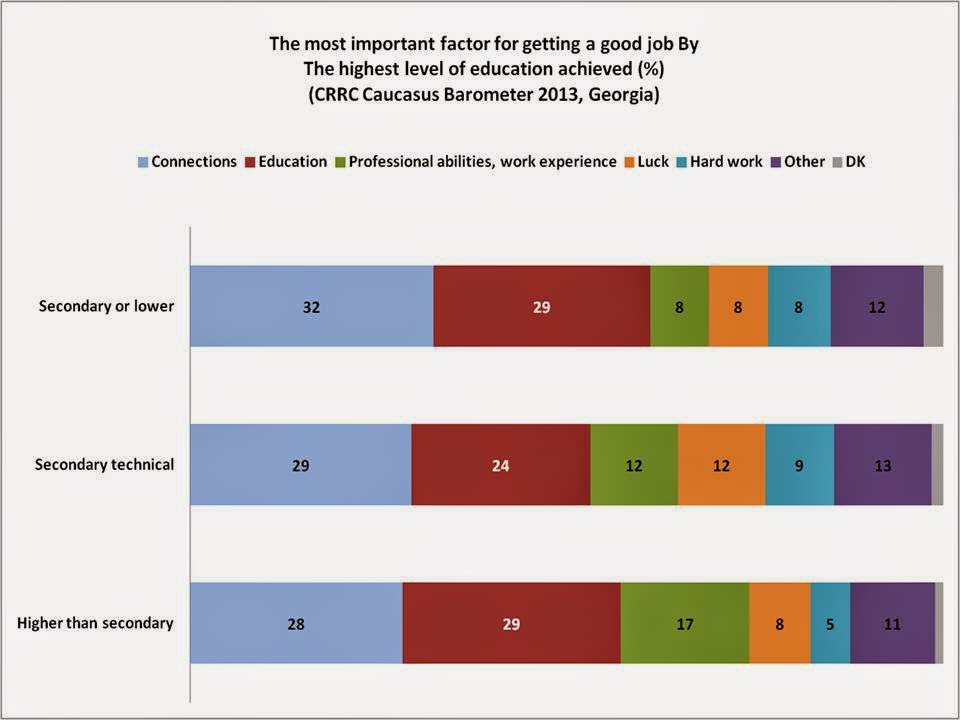
What is believed to be the most important factor for getting a good job in a country where unemployment is widely considered to be one of the biggest issues? CRRC’s 2013 Caucasus Barometer (CB) survey results show that connections (30%) and education (28%) are the most frequent answers to this question in Georgia. This finding is in line with studies on social capital in various countries, arguing that social ties provide people with better labor market opportunities (Lin, 1999; Mouw, 2003;  McDonald and Elder, 2006), as well as with studies on the role of education in the job market, finding that education is an important resource worth investing in as it provides individuals with access to employment and better chances at  obtaining well-paid jobs (Kilcullen, 1972;Smith and McCoy, 2009). Analyzing both the social ties and perceptions about what is reported as the most important factor for getting a good job, an earlier CRRC blog post, Finding a good job in Georgia, argued that Georgians without connections might be more likely to think that connections are the most important factor for getting a good job. This blog post, on the other hand, looks at how the answers about the most important factors for getting a good job differ by level of education and by employment status, with the aim of finding out who is more likely to think that education matters the most for getting a good job in Georgia.

CB 2013 data shows there is almost no difference in answers to this question between people having different levels of education. The only notable difference can be observed in relation to the perceived importance of professional abilities/work experience. While 17% of those with post-secondary education think this is the most important factor for getting a good job, 8% of those with secondary or lower education report the same.


Note: The answer options for the question, “What is the highest level of education you have achieved to date?”  were grouped as follows: options “No primary education”, “Primary education (either complete or incomplete)”, “Incomplete secondary education”, and “Completed secondary education” were grouped into “Secondary or lower”. Options “Incomplete higher education”, “Completed higher education (BA, MA, or specialist degree)”, and “Post-graduate degree” were grouped into “Higher than Secondary”. For the question, “What is the most important factor for getting a good job in Georgia?” infrequently named answer options – “Age”, “Appearance”, “Talent”, “Doing favors for the ‘right’ people”, and “Other” – were grouped into “Other”.

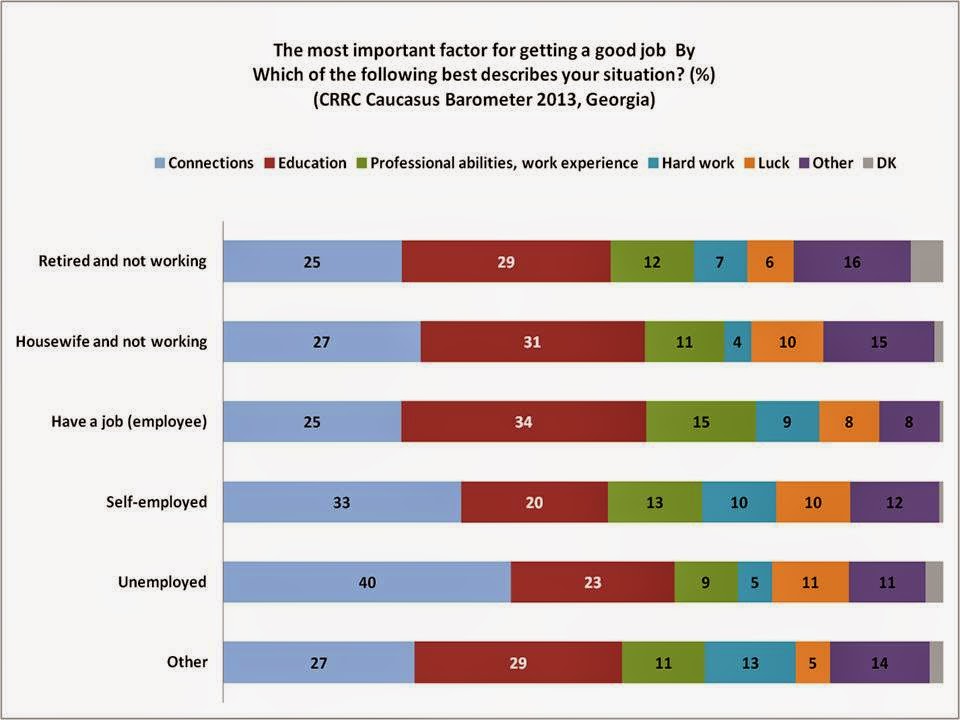
While there are few differences in perceptions about important factor(s) for getting a good job by education, such differences can be seen by employment status, and specifically between those who describe themselves as self-employed, employed and unemployed. Namely, 34% of the employed think education is the most important factor for getting a good job compared to 25% of the group who report connections. In contrast, the self-employed report that education (20%) is the most important factor for getting a good job less frequently than they report connections (33%). Those who consider themselves to be unemployed also name connections (40%) most frequently.


Note: To the question, “Which of the following best describes your situation?”, the following answer options – “Student and not working”, “Disabled”, “Other”, “Refuse to answer”, and “Don’t know” – were combined into “Other”.

This blog post has shown that while opinions about the most important factors for getting a good job in Georgia do not differ by education level, opinions do vary by employment situation. Those who describe themselves as employed more commonly think that education is the most important factor for getting a good job, while the self-employed and the unemployed most often name connections.

To learn more about CRRC surveys, visit our Online Data Analysis tool.

Junior Fellows at CRRC-Georgia: Facing new challenges


[Note: Over the next two weeks, Social Science in the Caucasus will publish the work of six young researchers who entered CRRC-Georgia’s Junior Fellowship Program (JFP) in February 2015.]

CRRC’s Junior Fellowship Program (JFP) was launched in 2009 as a Carnegie Corporation initiative within the CRRC, with the goal of providing on-the-job training opportunities in applied research for young social scientists. As the Program’s motto claims, the JFP would be “the best and hardest” experience the Junior Fellows would ever have, opening doors for educational and employment opportunities worldwide. Every year since, a new group of bright young people interested in social science research and selected through a highly competitive and challenging selection process would join CRRC-Georgia for a period of five to nine months.

Once becoming members of the CRRC-Georgia team, Junior Fellows are engaged in ongoing research projects at various stages of implementation both through direct participation and observation. Fellows learn about questionnaire development, pretest, sampling, survey fieldwork and back-checks, data management and analysis, slide production and presentation of results, report writing, the development of discussion guides, and preparation of interview and focus-group write-ups. We believe, Georgian higher educational institutions currently fail to help students acquire most of these skills, and hence the opportunity offered by CRRC-Georgia is quite unique for the Junior Fellows.

Potential junior fellows are expected to have already completed at least a BA degree, although it is not required that this degree is in the social sciences. They have to commit to the program full-time, and hence cannot combine JFP and another job or full-time studies during the fellowship period. In addition to valuable research experience, the Junior Fellows are provided with a number of training sessions on quantitative data analysis using SPSS and Stata statistical software, qualitative data analysis using NVivo software, and report writing.

Thirty two young people have been CRRC-Georgia Junior Fellows to date. After their fellowship period, seven stayed on to work at CRRC-Georgia, five continued their education abroad, and others started jobs at a number of different international and governmental organizations.

We asked some of the former fellows to share their opinions about what the JFP experience gave them, and how it relates to their current educational and employment situations. Here are some answers:

[At CRRC-Georgia] I got a valuable knowledge of how high-quality research should be conducted. While working with qualified people, I obtained knowledge and experience that helped me to advance in my future career. A great team, interesting projects and a great deal of perspectives – this is how I would describe my experience working at CRRC.
Nino Kerkadze, JFP-2012

CRRC is a small family, where one acquires new skills that will be useful [for the rest of your life].
Merab Bochoidze, JFP-2011

CRRC is a place with a wonderful working environment, qualified colleagues and great friends that will give a valuable boost to your career.
Salome Minesashvili, JFP-2011

CRRC-Georgia is currently hosting six junior fellows, and we believe, one of the most exciting, although challenging tasks for the current Junior Fellows is writing blog posts for the CRRC regional blog, Social Science in the Caucasus. In their blog posts, the Junior Fellows can focus on social science issues they are most interested in, apply their data analysis skills, and communicate their findings to an audience of international and local scholars, researchers, and journalists.

For the first time, we have decided to publish the 2015 Junior Fellows’ first blog posts in a single series. The JFP series will start today with Nino Zubashvili’s post and continue for two weeks.

Monday, June 15, 2015

Trust in institutions in the South Caucasus – generating a combined score


Trust in institutions is a widely studied subject in the social sciences – typing 'trust in institutions' into Google Scholar yields roughly 2.5 million results. It is generally believed to have multi-directional relationships with different aspects of social life, with high levels of trust associated with positive phenomena – acceptance of innovation and a good business environment just to name two. While the Social Science in the Caucasus blog has often looked at trust in social and political institutions in each country with a focus on the peculiarities of each country or a particular institution, to date there has not been a description of the overall level of trust in these institutions in each South Caucasus country by major demographic characteristics, such as gender, age or settlement type. This blog post fills the gap by looking at the average level of trust in institutions using 2013 Caucasus Barometer data.

To measure the average level of trust in social and political institutions, a trust in institutions scale was generated for this blog post. The scale was created by adding together responses for the 15 trust in institutions questions asked on the Caucasus Barometer (CB) survey: the health care system, banks, the educational system, the army, the court system, NGOs, parliament, executive government, the president, the police, political parties, media, local government, the religious institution the respondent belongs to, the ombudsman. Respondents in all three South Caucasus countries were asked “Please assess your level of trust toward each [institution] on a 5-point scale, where ‘1’ means “Fully distrust”, and ‘5’ means “Fully trust’.” The original scale was re-coded for this blog post in the following way: codes 1 and 2 (fully distrust and distrust) re-coded as -1; code 3, corresponding to answer “neither trust nor distrust,” re-coded as 0; and codes 4 and 5 (trust and fully trust) re-coded as 1. Scores for each of the 15 institutions were added together in order to generate a trust in institutions scale with -15 on this scale corresponding to distrust to every institution asked about, and 15 corresponding to trust in each of the 15 institutions. By taking the average score in each country, we are provided with a picture of how much South Caucasians trust their countries's major social and political institutions in general, rather than the individual institutions which were asked about.

Without further ado, the results demonstrate that, overall, Armenia is the least institution trusting country in the South Caucasus – by a wide margin. Armenia’s average score is -1.4, while Azerbaijan and Georgia score 3.2 and 3.3, respectively.


Notably, women are slightly more trusting than men in each country. Trust also varies by settlement type and a clear pattern emerges when looking at Armenia and Georgia – trust in institutions is highest in rural settlements followed by urban settlements and the capital. Even in institution distrusting Armenia, the rural population comes in with an almost positive trust score of -0.1. In Azerbaijan, rural settlements still exhibit the highest levels of trust in institutions, but in Baku there is a slightly higher level of trust than in other urban settlements.


No clear cross-country pattern can be observed as regards trust in institutions by age, but each country does have its own distinctive pattern in this respect. In Armenia, the youngest age group is most trusting of institutions – a possible sign of optimism among the youth. Trust decreases with age in Armenia. In Azerbaijan, trust in institutions is slightly lower in the younger age groups and highest in the oldest one.  In Georgia, the youngest and oldest age groups report more or less similar levels of trust (3.2 and 3.0 average scores respectively), with the middle age group (36-55 year olds) reporting trusting institutions most.


In the three South Caucasus countries, the overall trust in social and political institutions is lowest in Armenia. In each country, women express slightly more trust than men, and rural residents report the highest trust. In Azerbaijan, the elderly have the most trust in institutions and in Armenia the least.

To explore the data on trust in institutions more, visit CRRC’s Online Data Analysis tool here.


Tuesday, June 02, 2015

How does press freedom in Georgia compare to Eastern Europe?

Georgia’s media was once again ranked the most free in Eurasia in Freedom House’s 2015 Freedom of the Press report, released on April 28, 2015. On Freedom House’s scale, in which countries receive a score from 0 (the most free) to 100 (the least free), Georgia’s rating of 48 places it firmly in the ‘partly free’ category. Amid an overall worsening picture for press freedom in Eurasia – and worldwide – Georgia showed one of the biggest improvements in the world, with press freedom advancing by 7 points over the previous five years. Reasons for the recent improvements include the 2013 passage of the so-called “must carry” legislation, reduced political influence over broadcast media and increased media competition.

Georgia is currently ranked 93rd in the world in the Freedom House report, on par with Lesotho, Senegal and Tunisia, and above EU member state Greece, which received a score of 51. Since the country’s independence, Georgians have aspired to closer ties with the European Union, so it is important to ask how press freedom in Georgia compares with recent EU member states such as Romania, Hungary and Poland. This blog post tries to answer this question based on the Freedom House data.

Despite the noted improvements, Georgia has always – and continues to – fare worse than most countries in Europe. For instance, Freedom House has classed Poland’s press as free (score 30 or below) every year since 1991, despite a gradual decline since 2003. In contrast, Romania’s media has been considered ‘partly free’ every year since 1994, with greater variation over the 20-year period compared to Poland. Hungary, which was roughly level with Poland between 2004 and 2010, has seen press freedom sharply decline over the past five years, with Freedom House noting it has “suffered from increased state regulation and other interference since 2010.” Still, Freedom House rates all three countries as having a freer press than Georgia.

Hungary provides a good example that even stable democracies can regress, so vigilance is even more necessary in hybrid regimes such as Georgia, which are neither wholly democratic nor wholly authoritarian. Georgia has consistently been considered as such by major democracy indexes, including Freedom House. Indeed, Georgia’s press freedom scores in 2014 and 2015 only bring it back to the level it first reached in 2000, after sharp improvements during the 1990s were followed by a decade of a more restrictive media environment.


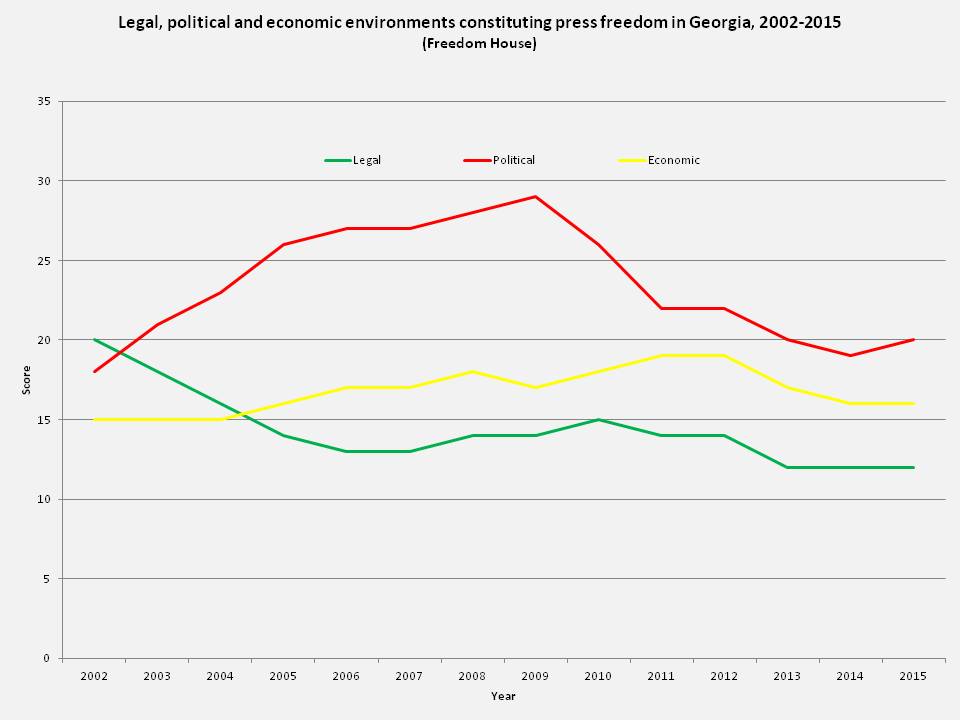
Since 2002, Freedom House has looked at three categories when rating press freedom – the legal, political, and economic environments. The scores from each category are summed to produce the final rating. Looking at data from Georgia since this system was first used shows that the biggest factor contributing to the improvement of Georgia’s score has been the political environment in the country. This factor monitors the extent of political control over the content of news media, taking into consideration editorial independence, media diversity and vibrancy, access to information and sources, censorship, and harassment and intimidation of journalists.

The legal environment contributing to press freedom – such as constitutional guarantees on freedom of expression and the independence of the judiciary – has slowly worsened since 2002, with slight improvements between 2008 and 2012.


To what extent do indexes such as Freedom House’s reflect how Georgians themselves perceive their media? Data from CRRC’s Caucasus Barometer survey between 2008 and 2013, which asked respondents to assess their level of trust toward the media, show that distrust in the media has remained relatively stable since 2008, ranging between 16% in 2008 and 12% in 2013, all changes being within the margin of error. However, there has been a dramatic decrease in the share of Georgians who state that they fully trust the media – down from 50% in 2008 to 24% in 2013. At the same time, the share of those answering “neither trust nor distrust” the media has almost doubled during the same period. This suggests that public trust in the media is driven in Georgia by other factors than those considered by Freedom House’s index.


Public opinion data suggests that substantial problems remain in the media environment in Georgia. While Georgia’s Freedom House rating is edging closer to other transition countries that are EU member states, such as Hungary and Romania, it is not solely because the situation in Georgia is improving, but because the situation in much of Europe is deteriorating. Notably, Freedom House’s changing press freedom scores do not match up with population’s reported trust in the media in Georgia, which suggests that it may be a good idea for organizations like Freedom House to adjust its scoring methodology.

What do you think could be at the root of this divergence? Join in the conversation on our Facebook page and take a look at this Caucasus Analytical Digest article on political country rankings in the South Caucasus.

Monday, June 01, 2015

What do children and young people in Georgia need to be well and happy?

Georgia ranks 134th out of 156 countries in the United Nations World Happiness Report 2013. The list is topped by some of the Northern and Central European countries – Denmark, Norway and Switzerland – whereas central African states such as Togo, Benin and Central African Republic appear in the bottom positions. Interestingly, all of Georgia’s neighbors score higher than Georgia, with Russia in 68th, Turkey in 77th, Azerbaijan in 116th, and Armenia in 128th place. This ranking takes into account GDP per capita, life expectancy, perceptions of corruption, freedom to make life choices, etc., but what do people and particularly children and young people, think they need for happiness and well-being? This blog post provides some insight into the subject based on a preliminary qualitative study on perceptions of children and young people on well-being conducted in Tbilisi by CRRC-Georgia for the MYWEB project. Twenty in-depth interviews and four focus groups were conducted in November of 2014. 

Taking into consideration their age (11-19 years old), the groups of children and young people who took part in the research largely fit into the ego identity and role confusion category of adolescence identified by prominent psychoanalyst Erik Erikson (1950, 1963). This period is important as children start becoming more independent and thinking about their future careers, relationships, families, and society. At this stage of development, children have to learn the roles they will occupy as adults, and it is interesting to see what the views of youth at this crucial stage of development are on well-being and happiness.

Happiness, well-being and life satisfaction are often discussed together in studies trying to measure human happiness. Unsurprisingly, respondents in the MYWEB study often used well-being and happiness as concepts which complemented each other. Young people identified parents/family, health, financial stability, success and freedom as major components needed for happiness and well-being.

Parents were noted as an important part of well-being and happiness for children of all ages in the study. However, while at 11 one needs to have parents around to feel well and happy, at 18, happiness is related to one’s independence from parents. 

My parents are the most important people for me. They are the ones who bring me up and take care of me [Interview_Girl_12]. 
[Happiness is] doing what you want without your mother and father [Interview_Girl_17].

Even though teenagers crave independence, their parents’ opinions remain highly valued to them. 

While at the onset of the ego identity and role confusion category, children indicate that closeness to and the health of their parents and family are central parts of happiness and well-being, as the years go by, more abstract and value-based concepts appear. 15-16 year old respondents were especially inclined to mention freedom as a major component of well-being and happiness. For example, a 15 year old girl stated, “I think everyone [young people] wants the same – to be free, to be themselves.” A few of them stressed the importance of freedom in general, while others thought of freedom as the ability to do what you want, to say what you want and to choose what you want starting from minor everyday things to choosing a career. In the later years of the ego identity and role confusion category, a set of rights and responsibilities emerges and becomes important for well-being and happiness including the right to vote, drive, have a bank account, and buy cigarettes and alcohol. 

I turned 18, and I gained some rights. I am getting a driver’s license, for example. I opened a bank account, not to mention alcohol and cigarettes [Focus-group_Boy_18].

Importantly, young people in their late teens are also thinking about responsibilities, which vary from study workload to taking more of a lead in their own lives and thinking more about how to live in practical terms.

Even though children and young people sometimes differ in their perceptions of what the most important components of happiness and well-being are when asked about the present, their views are largely similar when asked what will matter for their happiness and well-being as they grow to their parents’ age. All study participants saw themselves having families and children of their own, having jobs/careers and being healthy.

For more on the MYWEB project, see the project website here.

Monday, May 25, 2015

Perceived (in)equality in the courts in Georgia - the poor in trouble


The judiciary is essential to the functioning of a state. Hence, not only is its good performance important, but so are perceptions of the courts’ impartiality. In 2011 and 2014, CRRC-Georgia conducted two nationally representative public opinion polls funded by East-West Management Institute and the United States Agency for International Development. The surveys explored Georgians’ knowledge, trust and perceptions of the judiciary. Survey findings suggest that the situation has not changed much during this period, although there was a slight increase in the share of the population who reports completely agreeing that, in Georgia, everyone is equal before the law – from 34% in 2011 to 43% in 2014. Nevertheless, there are still representatives of certain social groups that people do not expect the courts will treat impartially.


During the survey interviews, a number of scenarios were offered to the respondents about representatives of various groups who were hypothetically charged with the same crime they did not commit. The respondents were asked who, in their opinion, would be more likely to be found guilty – rich or poor; Georgian or non-Georgian; Orthodox or non-Orthodox; heterosexual or a representative of a sexual minority.

While over 60% of the population claims in 2014 that Georgians and non-Georgians, Orthodox and non-Orthodox, heterosexuals and a representative of a sexual minority have the same chance of being found guilty or innocent when charged with an identical crime they did not commit, the population thinks that being rich or poor does make a difference – 43% answer that a poor person is more likely to be found guilty. Importantly, though, the most frequent answer reported by 49% in 2014 is that both a rich person and a poor person have the same chance of being found guilty or not guilty. Interestingly, 52% of the residents of the capital report a poor person is more likely to be found guilty, while only 40% think a rich person and a poor person will have the same chance in court. This suggests that the population in Tbilisi is less likely to perceive courts as impartial compared with the population in the rest of the country.

Note:  Don’t know and refuse to answer responses are not displayed on the chart.

Thus, although from 2011 to 2014 there was a slight increase in the perception that in Georgia everyone is equal before the law, almost half of the population still does not expect the courts will treat the rich and the poor equally.

For more information about the surveys on the judiciary, please take a look at the data here. A report comparing the results of the two waves can be found here.

Monday, May 18, 2015

Attitudes reported by Georgian parents and the qualities they find important for children to learn


The vast majority of Georgians (90%) agree with the statement that one of their main goals in life has been to make their parents proud, according to the 2008 World Values Survey (WVS). It would be hard to overestimate the importance of family for Georgians, and the same is true for the attention paid, on the one hand, to raising children and, on the other hand, caring for elderly family members. But to what extent do parents themselves share the values they claim are important for children to learn? WVS data provides us with the opportunity to find answers to this question by comparing the qualities that Georgian parents report as important for children to learn with their own attitudes and values that they report while answering a number of survey questions.

According to WVS data, 76% of adult Georgians had at least one child in 2008, and throughout this blog post, we focus on parents’ responses. The absolute majority – 90% – of parents report it is especially important for children to learn to work hard, be responsible (81%), be tolerant and respect other people (72%), have religious faith (67%), and be independent (52%).


Do the parents themselves possess these qualities? In order to answer this question, let’s take a closer look at parents’ attitudes towards hard work, tolerance, religiosity and independence.

Hardworking? According to WVS data, about 20% of parents who name hard work as an especially important quality for children to learn, ‘neither agree nor disagree’ or ‘disagree’/’strongly disagree’ with the statements that ‘people who don’t work become lazy’ and ‘work should always come first, even if it means less free time’ (22% and 21%, respectively). Furthermore, 29% of these parents ‘neither agree nor disagree’ or ‘disagree’/’strongly disagree’ with the statements that ‘work is a duty toward society.’ We can, therefore, claim that it appears that some parents want their children’s generation to be harder working than they are themselves.

Tolerant? 93% of those parents who said that ‘tolerance and respect for other people was an especially important quality for children to learn, named homosexuals among the groups they would not like to have as neighbors. Furthermore, 37% of them would not like to be neighbors with people of a different religion, and 23% report the same about people of a different race and immigrants/foreign workers, thus hardly passing a hypothetical test on tolerance.

Religious? 97% of parents who name this value as important for children to learn claim to be religious people themselves, and 90% say that God is very important in their lives. However, when it comes to religious practice, the share of parents who pray or attend religious services is relatively low – 28% say they do not take moments of prayer, meditation or contemplation, and 61% report attending religious services only on special holidays or less often.

Independent? The absolute majority (94%) of parents who name independence as an especially important quality for children to learn, ‘strongly agree’/‘agree’ with the statement that they decide their goals in life by themselves. However, 21% of these parents still live with their parents instead of leading an independent life, and 40% of these adults still living with their parents are between 36 and 45 years old, an age group at which one is not too young to be expected to take care of oneself. Even though those living together with their parents often due to economic problems which many Georgian families face, or in order to take care of their parents, one could argue that it is also a sign of mutual dependence between adult children and their parents. In a number of cases, even if adult children can afford to live separately, they often prefer to stay with their parents. The latter can be regarded as a sign of dependence.

To conclude, Georgian parents want children to be hardworking, responsible, tolerant, and independent, and to have religious faith. As the findings presented in this blog post show, some of the parents naming these very qualities, however, fail to share these values themselves. The best demonstration of this is, probably, the large share of parents who mention ‘tolerance and respect for other people,’ but do not want to have homosexuals or people of a different religion or race as their neighbors.

What do you think? Share your thoughts on the CRRC Facebook page, here, or in the comments section below.

Monday, May 11, 2015

Under surveillance: Public perceptions of safety while talking on the phone in Georgia


Illegal government surveillance is an issue which has been intensely debated in recent years in Georgia. Surveillance related legislation was adopted in 2010 and allowed law enforcement agencies to have unlimited access to telecommunication servers and hence to monitor everyone’s phone conversations at any time. Before 2012 Parliamentary elections, this legislation was criticized by the Georgian Dream Coalition (GDC) and was expected to be significantly altered after GDC came to power in 2012. This, however, did not happen, and the new surveillance law passed in 2014 did not change the situation much, allowing the Ministry of Internal Affairs to maintain direct and unlimited access to surveillance equipment.

A survey commissioned by Transparency International – Georgia (TIG) and conducted by CRRC-Georgia in 2013 included a number of questions about Georgians’ perceptions of privacy while talking on the phone. This blog post presents the results of this survey and shows that the majority of Georgians report restraining from sharing critical opinions about the government while talking on the phone, while a quarter of Georgia’s population believes that the government listens to everyone.

When asked, “In Georgia today, do you think or not that people like yourself have the right to openly say what they think?” 76% of Georgians answered “yes,” according to CRRC’s Caucasus Barometer survey in 2013. However, when the TIG survey asked, “Would you share a critical opinion about current political events in Georgia with a friend over the phone?” 69% of Georgians answered negatively. Importantly, similar attitudes were recorded when the question was asked about sharing a personal secret with a friend, which demonstrates that Georgians do not feel comfortable or safe talking on the phone, and, generally, do not consider phones a secure means of communication, irrespective of the topic they are discussing.


The results presented in the chart above are hardly surprising, taking into consideration that a quarter of the population reports that they believe the government listens to everyone’s phone conversations, and a further 39% answer “Don’t know” or “Refuse to answer” – an extremely large share, suggesting that people didn’t feel comfortable answering this question.

In addition, 18% of Georgians think that the government monitors his/her internet activities including email, social networks and forums. People agree with the latter statement irrespective of which sector they are employed in – public or private. However, people working in the public sector are almost twice as likely to express uncertainty about whether or not the government listens to everyone.


The data also shows that, in Tbilisi, 28% think that the Georgian government listens to everybody and monitors people’s internet activities, while this share is smaller in other urban settlements.

The data discussed in this blog post tells us more than just about Georgians’ perceptions of illegal surveillance. These perceptions are important as they can effect civic engagement significantly. People who think that the government is following their internet activities and listening to their phone conversations are likely to limit discussing politics through the internet and phone, as well as publicly which, in turn, limits public discussion and critical evaluation of current events. Even though this data was collected in 2013, when the new surveillance legislation had not yet passed, how much do we expect public perceptions to have changed since?

The upcoming data from TI Georgia’s 2015 survey, to be available shortly, will show whether these perceptions have changed since 2013. Meanwhile, you can learn more about the 2013 results here.

Friday, May 01, 2015

Ethnic minorities, Georgians, and foreign policy orientation


Georgia’s prominent West-ward political orientation has been demonstrated numerous times, especially in the period following the 2004 Rose Revolution. The signing of the Association Agreement with the European Union in 2014 emphasized once more the country’s willingness for closer cooperation with the EU. Georgia’s choice of strategic partners is stark when looking at the country’s neighborhood, with Azerbaijan moving one step forward and one backward in regard to partnership with the EU, Armenia flirting with both the European Union and the Eurasian Economic Union, and Turkey a “forever-candidate” of the EU. Importantly, Russia considers Georgia’s EU and, especially, NATO aspirations a threat to its national security.

While Georgia’s closer ties with the EU represent the views and beliefs of a large majority of Georgian citizens, support for the Euro-Atlantic path is notably weaker among the country’s ethnic minority citizens than among the ethnic Georgian population. Hence, it is important to look at the micro dynamics of attitudes and perceptions within the population of Georgia and explore whether ethnic minorities in the country share the same attitudes as the ethnic majority population. CRRC-Georgia’s 2013 survey Knowledge and attitudes toward the EU in Georgia, funded by the Eurasia Partnership Foundation, offers the opportunity to engage in such an endeavor. Ten percent of all survey respondents were sampled from ethnic Azerbaijanis living in the Kvemo Kartli region and ethnic Armenians in the Samtskhe-Javakheti region, and the data is representative of the opinions and attitudes of ethnic minorities. Notably, minorities in ‘ethnic enclaves’ are often different from ethnic Armenians and Azerbaijanis that live in other parts of Georgia and, in some ways, are better integrated into Georgian society. Throughout this blog post, we refer to the subsample of Armenians and Azerbaijanis in the noted ‘ethnic enclaves’ as “minorities,” and to the rest of the sample as “Georgians”.

While 83% of Georgians would vote for Georgia’s EU membership and 74% would vote for Georgia’s NATO membership if a referendum was to be held the day after the survey interview in 2013, only 38% and 31%, respectively of minorities would do the same. Notably, minorities’ non-response rate for these two questions was also much higher compared to Georgians. Thus, minorities are visibly less inclined to support Georgia’s membership in either the EU or NATO.


Opinions on potential allies that can best support Georgia are also different, with most Georgians (38%) choosing the EU, while most minorities (57%) choose Russia. Smaller, but almost equal shares of Georgians think that the USA and Russia (18% and 17%, respectively) can best support the country, and smaller shares of minorities (17% and 14%, respectively) think that the United States and the EU would be best. If choices of the EU and USA are jointly considered as an orientation towards the West, then 56% of Georgians see the West as the best supporter of Georgia, while the same share of minorities (57%) would see Russia in this role.


Minorities differ from Georgians in other respects as well. Asked about the three most important issues currently facing Georgia, the most visible differences in the opinions of Georgians and minorities regard relations with Russia and Georgia’s territorial integrity. While most citizens of Georgia, no matter their ethnicity, name employment (“jobs”) as the most pressing issue (indicated by 63% of the population), their opinions about the importance of other issues differ – the second most frequently mentioned issue for minorities is relations with Russia (indicated by 56% of minorities), while for Georgians it is territorial integrity (indicated by 39% of Georgians).


This blog post compared the views of ethnic minority populations living in the Kvemo Kartli and Samtskhe-Javakheti regions of Georgia with the rest of the population in the country. Georgians and minorities have different views especially when it comes to Georgia’s membership in the EU and NATO, international actors that can currently best support Georgia, and partially in relation to the most pressing issues the country currently faces.

How do you think these differences in points of views are manifested or reflected in Georgia’s foreign or domestic policy choices? Join the conversation on the CRRC Georgia Facebook page or in the comments section below.

Monday, April 27, 2015

NGOs and the Georgian public's expectations


The so-called third sector which consists largely of non-governmental organizations is diverse in Georgia, with organizations focusing on issues ranging from LGBT rights to political party development. To what extent these issues match up with the “demand” of the population though is still an open question. This blog post provides a snapshot of which issues Georgians think NGOs actually address and compares it with what Georgians think NGOs should be doing more of. Ultimately this provides an approximation of the “perceived supply” and “perceived demand” for NGO services in Georgia from the population’s perspective.

In the 2014 Volunteering and civic participation survey funded by USAID and conducted by CRRC-Georgia, Georgians were asked, “In your opinion, what issues do the NGOs in Georgia address most frequently?” and “What issues would you like to see NGOs addressing more often?”  Georgians reported that NGOs most frequently address elections, healthcare and/or social assistance, minority rights, and media and freedom of speech. Significantly, the second most common response to the first question was “don’t know” (22%). This supports the findings in a previous blog post, according to which a large share of the Georgian public fails to correctly identify organizations as NGOs or non-NGOs.

In contrast, Georgians most often mention “increasing prices, poverty or unemployment” as  issues which, in their opinion, NGOs should address more often. They also think that NGOs should focus much more on healthcare/social assistance and education, even though they believe that NGOs already work on these issues to a certain extent.


Note: The results do not add up to 100% as respondents were allowed to select up to three answers to each question from a show card. 

The gap between what Georgians think NGOs should be doing more often and what they think NGOs actually do is apparent in a number of important areas. While the population most commonly believes that NGOs work on election issues, only 5% want them to work more in this field. The greatest gap between what Georgians think NGOs are doing and what they think they should be doing more of is on issues related to increasing prices, poverty or unemployment. While NGOs may not be the right agents to affect change on the economy, policy issues aside, this expectation coincides generally with what Georgians consistently report to be the greatest problems in the country – unemployment and poverty. Answers “Healthcare and social assistance” and “Education” come in next with the greatest gaps between what the population perceives NGOs are doing and what they think NGOs should be doing.


Note: Only gaps that are larger than 10% are shown. 

What accounts for these gaps? The fact that NGOs and their activities are frequently funded by donors rather than the general public in Georgia may explain some of the discrepancies. While donor priorities often coincide with what the population demands, this is not always the case and hence, NGOs may address particular issue(s) that donors believe to be important, but which the population may be unaware of or uninterested in.

A second factor which could contribute to these gaps is the communication strategies of NGOs. As noted in a prior blog post, a large share of the population is not well informed about NGOs. This likely implies that information on what NGOs are working on does not reach the general public. Hence, there may be a number of NGOs working on poverty, healthcare, or education, but compared to those working on elections and minority rights, their communications are less effective.

A third potential factor, which is closely related to the second, is the role of the mass media. The two issues which Georgians are most likely to think are covered by NGOs, elections and minority rights, consistently receive concentrated media attention, clustered around specific events. The 2012, 2013, and 2014 elections and the May 17, 2013 IDAHOT demonstration come to mind in this regard.

What other issues do you think are at play when thinking about what NGOs are working on and where their efforts should be directed? Join in the conversation on Facebook or in the comments section below.

Monday, April 20, 2015

In the know about NGOs in Georgia


The civil society sector in Georgia is populated by a wide diversity of actors from national chapters of well-known international NGOs like Transparency International – Georgia to local NGOs such as the Civil Society Institute. With this great diversity of voices in the sector, and in light of Bidzina Ivanishvili’s recent announcement that he intends to investigate the heads of a number of NGOs, it is interesting to look at the knowledge that the population of Georgia has about NGOs. This blog post looks at how well people can identify whether an organization is an NGO or not, based on CRRC-Georgia’s 2014 Survey on Volunteerism and Civic Participation, funded by USAID. In this survey, respondents were asked, “I will now name several organizations you may know. Please tell me which of these, in your opinion, is an NGO, and which is not,” and a list of 15 organizations, some NGOs, some state agencies, and some commercial enterprises, was read to them. Answer options for each organization included NGO, not an NGO, never heard [of the organization], don’t know, and refuse to answer.

One of the most prominent findings is that a large share of the Georgian population reports not knowing whether the majority of organizations asked about are NGOs or not. Of 2140 respondents, 151 responded “Don’t know” in respect to every organization, which, when weighted, corresponds to almost 6% of the population. For individual organizations, “Don’t know” responses varied from 11% (Parliament of Georgia) to 40% (Open Society Georgia Foundation).


Note: In the chart above, NGOs are marked with an asterisk (*).

The following chart shows the share of those who have correctly identified whether an organization was or was not an NGO. Unsurprisingly, 85% of the population is aware that the Parliament of Georgia is not an NGO, but still, 15% failed to provide a correct answer. The Georgian Young Lawyers Association (GYLA) was the second most correctly identified organization (also meaning that it is probably the most widely recognized NGO in Georgia). GYLA aside, other NGOs were correctly identified by between 30% (Identoba) and 47% (Liberty Institute) of the population. Georgians were least likely to know that USAID and British Petroleum are not NGOs.


This section of the survey had one trick question. The organization “Association of Unemployed People” does not actually exist in Georgia and was included in the list of 15 organizations to check how thoughtfully the respondents were answering the questions. The correct response in respect to this organization was “Never heard of,” and only 31% of Georgians responded so. About a third reported that it was either an NGO or not an NGO, and 36% responded “Don’t know,” a somewhat more correct answer.

Still, Georgians quite often know – and admit – that they do not know whether an organization is an NGO or not. In order to gain a better understanding of Georgians’ knowledge of NGOs, a scale was generated for this blog post based on the 15 questions discussed above. The scale ranges from -15 to 15, with -15 being an incorrect response to each of the 15 questions (equivalent to total absence of knowledge or totally inaccurate knowledge) and 15 being a correct response to every question (equivalent to very good knowledge). “Don’t know,” “Refuse to answer” and “Never heard of” responses were coded as 0, since respondents presumably were reporting accurately that they did not know or had never heard of an organization. In the case of the (non-existent) Association of Unemployed People mentioned above, the answer “never heard of” was coded as a correct response, while both “NGO” and “not an NGO” were coded as incorrect responses.


The results are positive in that, generally, while Georgians do not necessarily know a great deal about whether an organization is or is not an NGO, they do know that they don’t know this, and report accordingly. Overall, Georgians reported more correct answers than incorrect ones. The highest score on the scale was 15 (4 respondents in total) and the lowest was -8 (1 respondent), with an average score of 4.6. Approximately 4% of the population scored below 0 (meaning that their knowledge is extremely poor, even though they may think otherwise), 12% scored 0 (meaning that they report not knowing about NGOs, but are not necessarily misinformed), and 84% scored 1 or above.

Considering the above, the question who knows more and who knows less about NGOs comes to the fore. One difference that appears when looking at average scores is that those with some higher education know more about NGOs than those with either secondary technical education or secondary or lower education.

Note: The confidence intervals for the above averages are very small (with the upper and lower bounds varying from the average by <0.01), and hence are not displayed.

Age is another interesting characteristic which shows some difference between groups, although the differences by age are smaller than those by education. The most knowledgeable age group is those between the ages of 36 and 55 (average score 5.03), while the least knowledgeable age group includes those 56 years old and older (average score 4.05). The youngest age group (18-35 year olds) scores between the two, with an average score of 4.61.

This blog post has looked at knowledge of NGOs in the Georgian population. While many Georgians do not know if a large number of organizations are or are not NGOs, many also recognize this fact by saying that they have either never heard of or do not know if an institution is or is not an NGO. Moreover, more Georgians identified organizations correctly, rather than incorrectly. Those with at least some tertiary education score higher on average than those with secondary technical education, and those with secondary education or lower score the lowest.

To explore the data in greater depth, take a look at the 2014 Volunteerism and Civic Education survey on the Online Data Analysis tool.

Monday, April 13, 2015

The political climate in Georgia, 2012-2014: Increased nihilism or room for new political actors?


In October 2012, the Georgian Dream Coalition (GDC) obtained 54.97% of the party list vote, winning the majority of seats in Parliamentary elections. The United National Movement (UNM), then the ruling party, moved into the opposition with 40.34% of the vote. This was the first occurrence since Georgia’s independence when there was a peaceful, electoral handover of power. Two and a half years have passed, and the next parliamentary elections are on the way, planned to be held in 2016. While the two major parties continue to compete on the political arena to sustain and obtain voters’ support, survey data on political attitudes shows that there may be room for new political actors. This blog post describes the dynamics of attitudes towards GDC and UNM from November 2012 through August 2014 using survey data from the National Democratic Institute (NDI). The data is nationally representative of the adult (18+) Georgian-speaking population in Georgia.

Support for the United National Movement, measured indirectly by the answers to the question, “Which party is closest to you?” has been stable since November of 2012 when 10% of the population named the UNM as their first choice while answering this question. This share has not changed much since. About 30% reported in November 2012 liking two of the UNM leaders, Mikheil Saakashvili and Gigi Ugulava, and these numbers have also not changed much since. Vano Merabishvili’s rating declined from 28% in November 2012 to 17% in June 2013 and has remained at this level since. Giga Bokeria has been one of the least liked UNM politicians for the last two years, while Davit Bakradze has been the most liked.


Note: Only “Like” responses are shown on the chart. 

Unlike the UNM, GDC’s support fluctuated during this period. In November 2012, 63% named GDC as their first choice when asked about the party closest to them. This rating started decreasing in the following months, but went up again in November 2013. In April 2014, there was a larger drop in support for the GDC, when 42% named GDC as their first choice.
Similar to party support, most GDC leaders’ ratings were over 60% in November 2012. In the beginning of 2013, these numbers started to decline, and dropped even more in August 2014. In 2012 and 2013, Bidzina Ivanishvili was the most liked GDC leader, though in 2014 the share of people who reported they liked Ivanishvili decreased. In August 2014, Irakli Alasania was the most liked GDC leader, followed by Irakli Gharibashvili and Davit Usupashvili.


Note: Only ’Like’ responses are shown on the chart. This question was not asked about Irakli Alasania, Irakli Gharibashili and Kakha Kaladze until November 2013.

Unsurprisingly, the data also shows that support for the United National Movement and Georgian Dream Coalition closely resembles the public’s assessment of their respective performances. The share of people reporting that the UNM was performing well was 14% in November 2012 and has not changed much since. As for the Georgian Dream Coalition, the respective share was 65% in November 2012, and after consistent downward movement (with the sole exception of November 2013) it reached 23% in August 2014.

Another visible trend concerns the share of those who answered “no party”, “don’t know” or “refuse to answer” when asked about the party closest to them. An increasing share of people have reported that no existing political party is closest to them, rising from 5% in November 2012 to 30% in August 2014. About one fifth of the population answered either “don’t know” or “refuse to answer” to this question in November 2012, and by August 2014, this share dropped to 8%.


Thus, though support for the UNM has remained stable, albeit at a low level, support for GDC has shown a downward trend. Since November 2012, fewer people have evaded answering the question about the party closest to them, and more reported there is no such party. Could these findings mean that there is a space for new parties in the Georgian political arena, or do they indicate increased political nihilism? Share your thoughts in the comments section or on our Facebook page here.

More data from NDI public opinion surveys and detailed information about the methodology are available here.

Friday, April 03, 2015

Gender roles in Azerbaijan: A cross-generational continuum


While the choice of pink versus blue has come to symbolize how parents and other adults establish a gendered order throughout youngsters’ childhood, the construction of gender roles dynamically accompanies people throughout their life. It starts from early childhood with how children are supposed to play, dress, talk and, most importantly, how they are supposed to act, what competences they are supposed to develop, and what they are encouraged to do as adults. Thus, children’s potentials are largely defined by societies according to their gender – which is a priori defined by their sex. This comes to define not only what men and women “should do”, but also what they can and cannot do. CRRC-Azerbaijan’s 2012 Social Capital, Media and Gender Survey in Azerbaijan, funded by the Swedish International Development Cooperation Agency (SIDA), provides the opportunity to explore this normative dimension of gender roles and its promotion from childhood through adulthood in Azerbaijan.

Tracing gender role construction during childhood is an ambitious aim for a blog post, but nevertheless some basic insights can be discussed while looking at the answers to the questions “When you were a child or teenager, were you taught how to cook // clean the house // clean the bathroom/toilet // fix home appliances // do laundry // drive a car // do shopping for groceries // care for younger siblings?” From the chart below it is clear that as children, people were taught how to perform different tasks in accordance to their gender. Thus, females were taught how to cook, clean the house and the bathroom/toilet as well as do laundry much more frequently than males. Males were predominantly taught how to drive a car and how to fix home appliances. In almost all of these cases, the difference between males’ and females’ answers is greater than 50%.


Note: Options “Do not know” and “Refuse to answer” are excluded from the analysis throughout this blog post.

One might wonder if there are any generational differences in what children in Azerbaijan were taught to do in different decades and, thus, what duties and activities different generations were expected to perform. In other words, did people of different ages report learning different tasks during their childhood? As is clear from the next chart, different age groups did not report differences in the nature of tasks they were taught to perform as children or teenagers. Although one might expect the gendered character of taught activities to be less visible in younger generations, the data does not support this supposition.

In order to have a clear picture of what children of different generations were taught in Azerbaijan, the predominantly female-taught activities such as cooking, cleaning the house, cleaning the bathroom/toilet and doing laundry were combined into ‘taught to do housework,’ while predominantly male-taught activities such as drive a car and fix home appliances were combined into ‘taught how to drive a car and/or fix home appliances’. Interestingly, no variation can be seen by age groups, thus showing that children have been taught what to perform in a gendered manner over the decades – females were consistently taught how to cook, clean the house, clean the bathroom/toilet and/or do laundry, while males were taught how to drive a car and/or fix home appliances.


Note: A positive answer to at least one of the predominantly “female-taught” activities (“taught how to cook”, “taught how to clean the house”, “taught how to clean the bathroom/toilet”, and “taught how to do laundry”) was coded as “Yes” in “taught to do housework”. Similarly, a positive answer to at least one of the predominantly “male-taught” activities (“taught how to drive a car” and “taught how to fix home appliances”) was coded as “Yes” for ‘taught how to drive a car and/or fix home appliances’.

While it is a jump to explain adults’ perceptions of gender roles and occupations by what they were taught to do as children or teenagers, it is nevertheless interesting to see if these roles are internalized and thus there is a gendered consensus on what men and women are supposed to do as adults. Indeed, the chart below shows that stereotypes on gender roles are commonly accepted in Azerbaijan, despite the fact that women tend to hold these views slightly less than men. Thus, there is no difference between genders when it comes to agreeing with the statements that “A women’s most important role is to take care of her home and cook for her family” and “Changing diapers, giving kids a bath and feeding kids are the mother’s responsibility.” Furthermore, although women tend to agree less with the following statements “Men should have the final word about decisions in the home,” “On the whole, men make better political leaders than women do” and “On the whole, men make better business executives than women do,” more than 60% of women still agree with each of these statements.


Note: Answer options to all the above statement were re-coded as follows: “Strongly agree”/“Completely agree” and “Agree”/“Somewhat agree” into “Agree”; and “Strongly disagree”/“Completely disagree” and “Disagree”/“Somewhat disagree” into “Disagree”. 

This blog post explored the attitudes of Azerbaijanis towards gender roles, and whether these have changed over time. It showed that there is a cross-generational continuum in the defined gendered character of the activities children and teenagers have been taught to perform. Furthermore, the blog post described the continuity of the embedded gender roles, noting the fact that as adults, people continued to see men and women as having very distinct roles and responsibilities and that there is a general consensus in Azerbaijan that the outer-home public space is still the domain of men.

To what extent are gender roles embedded in the Azerbaijani, Armenian and Georgian societies? Join the conversation on the CRRC Facebook page or in the comments section below.