Showing posts with label NGOs. Show all posts

Tuesday, June 24, 2025

Trust in NGOs in Georgia has grown increasingly polarised

Note: This article first appeared on the Caucasus Data Blog, a joint effort of CRRC-Georgia and OC Media. This article was written by Zachary Fabos, a researcher at CRRC Georgia. The views presented in the article are the author’s alone and do not necessarily represent the views of CRRC–Georgia or any related entity.

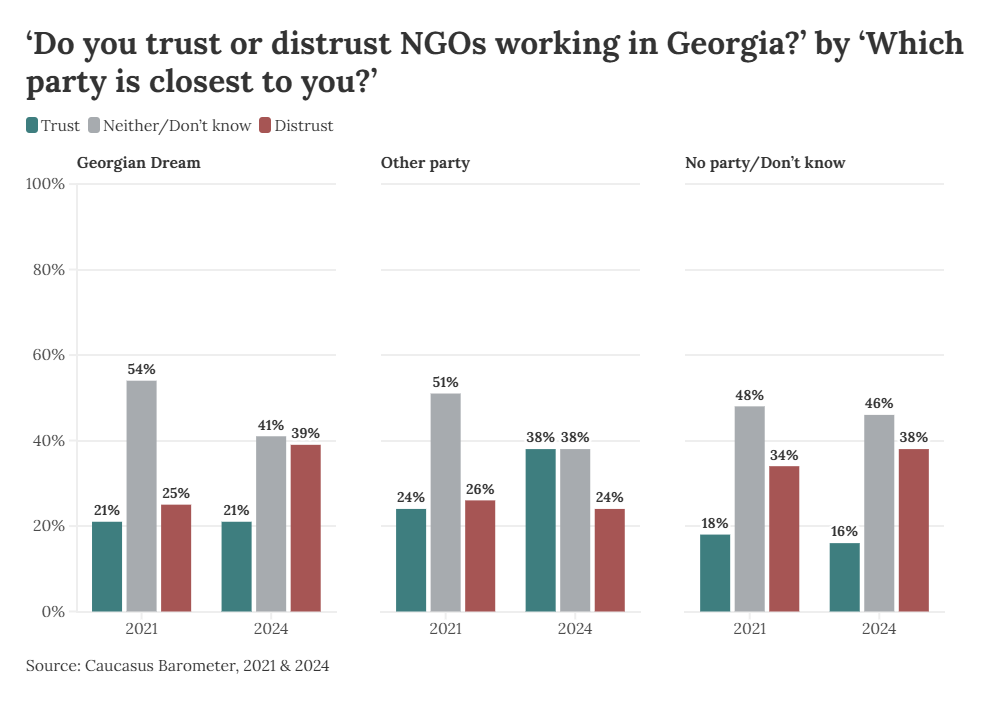
Comparing the frequency of distrust and trust among party supporters between 2021 and 2024 further demonstrates the recent development of political polarisation around NGOs operating in Georgia. While distrust and trust towards the sector was about the same among both Georgian Dream and other party supporters in 2021, by 2024 trust and distrust developed a partisan character.

Distrust grew from 25% of Georgian Dream supporters in 2021 to 39% of Georgian Dream supporters in 2024. Among opposition party supporters, trust grew from 24% to 38%. Those who did not support any party did not experience a similar attitude shift.

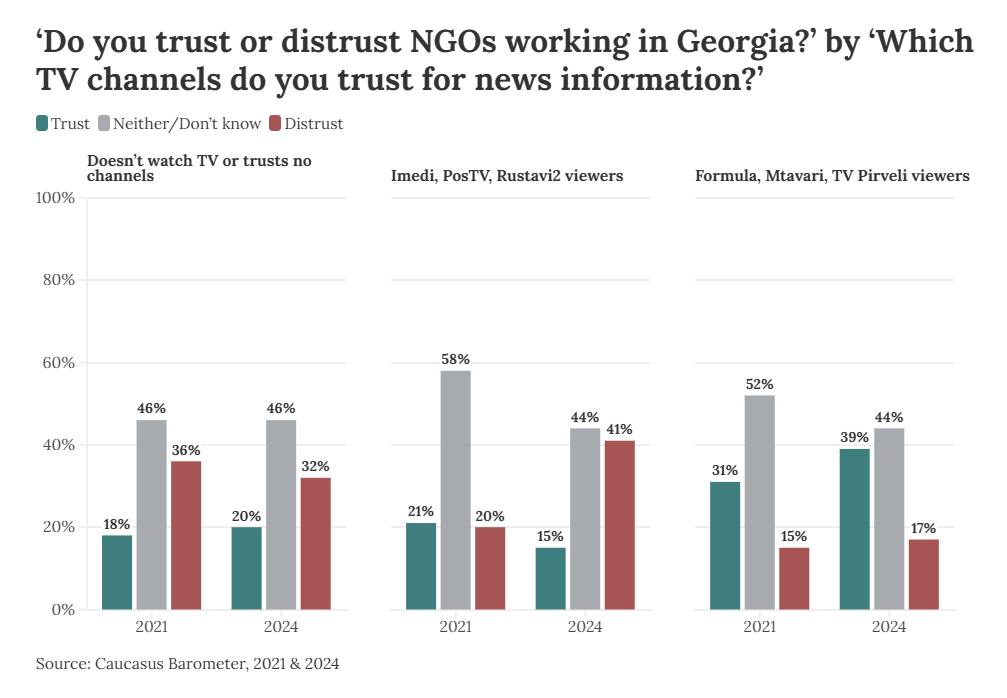
An analogous dynamic is at play when looking at media consumption.

Between 2021 and 2024, distrust of NGOs among viewers of the pro-government TV channels Imedi, PosTV, and Rustavi 2 more than doubled from 20% to 41%. On the other hand, trust in NGOs nearly doubled among viewers of opposition-leaning TV channels Formula, Mtavari, and TV Pirveli, from 21% to 39%. The sharp divide in distrust and trust of NGOs points to the politically polarised narratives directed at the sector.

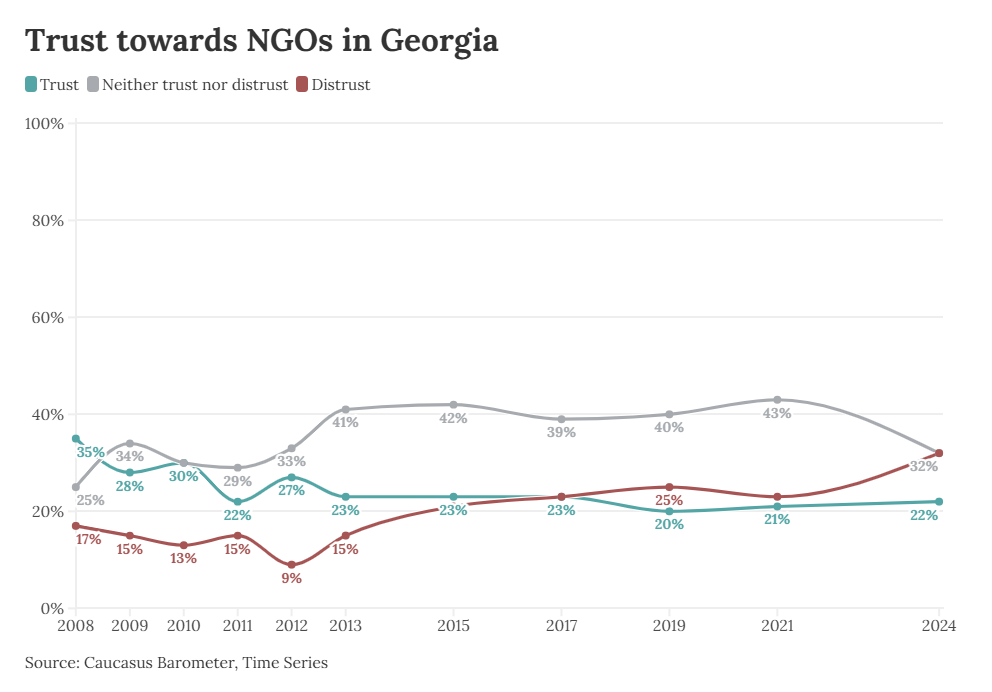
Although distrust towards Georgia’s NGOs hit an all-time high in 2024, time series data demonstrate that skepticism of the sector has grown most prominently among Georgian Dream supporters and viewers of Imedi, PosTV, and Rustavi 2, aligning with Georgian Dream’s promotion of anti-civil society legislation and conspiracy theories. The politicisation of attitudes surrounding NGOs is further shown in the opposite trend among those who support other parties and watch news from opposition-leaning channels.

Monday, February 18, 2019

NGOs in Georgia: Low trust, high expectations? (Part 2)

As discussed in the first part of this blog post, the results of CRRC-Georgia’s survey conducted for the Georgian Civil Society Sustainability Initiative (CSSIGE) project in fall 2017 confirmed that both knowledge about NGOs and trust toward them is quite low in Georgia. This blog post looks at the inconsistency between low trust toward NGOs, on the one hand, and quite positive assessments of their activities, on the other hand.

The most frequent answer about the goal that, in people’s opinion, NGO members are pursuing in Georgia, is to help the population of the country in solving their problems (27%). The second most frequent answer, to receive funding/grants, was chosen from a show card by 16% of the population, and the third most frequent answer, to protect human rights in Georgia, by 13%. Thus, 40% believe the goal of NGOs is to help people in solving their problems or protecting their rights, which is an impressive share, especially given the low level of reported trust in NGOs.

When asked to assess the influence of NGOs in the development of Georgia, the findings are, again, counter-intuitive given the low level of trust. A majority (56%) assess this role as either “definitely positive” (17%) or “mainly positive” (39%), as opposed to the 14% who have chosen negative assessments (“mainly negative” according to 9% and “definitely negative” according to 5%). While 76% of those who report trusting NGOs quite logically say that NGOs’ role in the development of Georgia is positive, 5% assess this role as negative, and 13% answer they don’t know. A third of those who report distrusting NGOs assess NGOs’ role in the development of Georgia as positive and only a slightly larger share (39%) as negative.


Note: For the chart above, answer options “Fully trust” and “Rather trust” were combined into the category “Trust”, and answer options “Fully distrust” and “Rather distrust” were combined into the category “Distrust”.

It would be impossible to find out the causes of such inconsistencies without additional research. At this point, though, it is clear that both knowledge of and attitudes toward NGOs in Georgia are neither systematic nor coherent. Focus groups conducted for the same project suggest one possible explanation for this inconsistency – while not trusting NGOs, the participants’ dominant attitude was that NGOs would not do harm either. Moreover, a belief was reported that life in Georgia is better with NGOs than without them.

To have a closer look at the data, visit CRRC’s online data analysis platform.


Monday, February 11, 2019

NGOs in Georgia: Low trust, high expectations? (Part 1)

Over the last decade, people in Georgia have reported rather low levels of trust toward NGOs. At the same time, when asked during surveys to assess specific aspects of NGO activities, the answers have usually been positive. This blog post is based on the findings of a survey on attitudes toward NGOs collected by CRRC-Georgia in fall, 2017 for the Georgian Civil Society Sustainability Initiative (CSSIGE). The first part of this blog post looks at the most up-to-date data on knowledge of NGOs in Georgia and reported levels of trust toward them. The second part explores the inconsistency between low trust toward NGOs in Georgia, on the one hand, and quite positive assessments of their activities, on the other hand.

Less than a third of the population of Georgia (28%) report trusting NGOs. Most people, though, are either indifferent (37% “neither trusting, nor distrusting” NGOs) or cannot answer the question (17%). The reported level of trust toward NGOs is comparable with the level of trust toward the courts and political parties, with one notable difference: the share of those who cannot answer the question is highest when trust toward NGOs is assessed. This may suggest that people do not always have a clear understanding of what NGOs are for or what they do in Georgia.

To gain an understanding of how solid people’s knowledge of NGOs is, the following question was asked, “I will now name several organizations. Please tell me whether it is an NGO or not. If you have not heard of any of these organizations, tell me you have not heard of it.” Two out of the 10 organizations asked about did not exist in Georgia at the time of the fieldwork.


Note: NGOs are marked with one asterisk (*). Organizations that are not NGOs are marked with two asterisks (**). Organizations that did not exist in Georgia at the time of the fieldwork are marked with three asterisks (***). Correct answers are highlighted in green.

Of the organizations asked about, only the status of the Parliament of Georgia was correctly identified by a large majority (87%). It also had the lowest share of “Don’t know” responses. Over half of the population was correctly informed about the Labor Party, Georgian Young Lawyers’ Association (GYLA), and the Rustavi 2 TV network. It is quite rare, however, that people consistently provide correct answers about all the organizations asked about. Leaving aside the answers about the two organizations that did not exist at the time of the fieldwork (“Association of the Unemployed” and “Society for Spreading Literacy”), less than 2% of the population answered about all other organizations correctly. This suggests that knowledge of NGOs is highly fragmented in Georgia.

As seen in the table above, the population has better knowledge about the status of six organizations: the Parliament of Georgia, the Labor Party; GYLA; Rustavi 2; Aldagi (an insurance company); and Transparency International – Georgia. Yet, the share of the population who named the correct status of all these organizations is only 16%. Below, this group is referred to as the “better informed population.”

Surprisingly, the better informed population does not report trusting NGOs in Georgia at a different level than people who are less informed about NGOs. These two groups differ only when it comes to the share of those answering “Don’t know”: while 5% of the better informed population responded so, 19% of the rest of the population did.

NGOs have not yet secured the population’s trust in Georgia. Still, the population reports rather positive assessments of specific aspects of NGO activities as will be discussed in the second part of this blog post next Monday.

To have a closer look at the data, visit CRRC’s Online data analysis platform.

Monday, May 30, 2016

People who trust NGOs are more active


NGOs play an important role in Georgian society, weighing in on issues as diverse as energy policy and the budget. An important question however is, how much do people trust NGOs and are those who trust NGOs different from those who don’t? This blog post looks at how people who report trusting NGOs in Georgia differ from those who report distrusting them in terms of their social and political engagement.

CRRC’s Caucasus Barometer surveys (CB) regularly ask about trust in NGOs. In 2015, 23% of the population reported fully or rather trusting NGOs, while about the same share reported fully or rather distrusting them. In addition, a large share of the population (42%) reported neither trusting nor distrusting NGOs. The share who answered that they “don’t know” if they trust or distrust NGOs has declined from 31% in 2012 to 14% in 2015, which may indicate that awareness of NGOs has increased in recent years. The share of the Georgian public which trusts NGOs (sum of “fully trust” and “rather trust”) has more or less stayed the same since 2011, while the share which distrusts them (sum of “fully distrust” and “rather distrust”) has increased from 9% in 2012 to 20% in 2015.


People who trust NGOs are slightly more socially and politically active (i.e. attend public meetings, vote, etc.), than those who distrust NGOs. In 2015, 25% of those who trust NGOs reported attending a public meeting during the six months prior to the survey, while only 15% of those who distrust NGOs reported doing the same. This finding has been consistent over the past few years.


Note: Answer options “fully trust” and “rather trust” are combined in the columns “Trust”, and answer options “fully distrust” and “rather distrust” are combined in the columns “Distrust”. 


Those who report trusting NGOs also say they would participate in presidential elections if they were held next Sunday more often than those who distrust NGOs. In 2015, 78% of those who trust NGOs said they certainly or most probably would participate in elections if held next Sunday, while a slightly lower share (69%) of those who distrust NGOs said the same.


People who report trusting NGOs are more socially and politically active than those who distrust them, as demonstrated by CB data on public meeting attendance and intention to participate in elections.

For more on trust in NGOs in Georgia, see this Caucasus Analytical Digest article and for more data from CB 2015 take a look at our Online Data Analysis tool here.

Monday, October 19, 2015

Do Think Tanks in Georgia Lobby for Foreign Powers?

[Editor's note: This is the fifth in a series of blog posts co-published with On Think Tanks. The views expressed within this blog series are the authors alone and do not represent the views of CRRC-Georgia.]

By Till Bruckner

If you work on policy issues in a transition or developing country, you probably know the standard line on think tanks by heart. Local think tanks build domestic research capacity, improve policy formulation processes and outcomes, and enrich and enhance democratic debates, thereby contributing to the emergence of more democratic, wealthy, and equitable societies. (Yes, you may copy and paste this into your next fundraising proposal if you wish).

Below, just for the heck of it, I’ll make the counterargument. Here’s the rival hypothesis:

Most local think tanks in transition or developing countries do not conduct real research. They just act as front groups for foreign lobbying campaigns. Western powers fund them to capture domestic policy formulation processes and distort democracy. Acting in concert with equally remote-controlled, faux-local NGOs and media, think tanks use foreign funds to push foreign agendas, creating a heavily tilted playing field on which the politics and policies favoured by the West always come out top, and on which real democracy can never emerge.

In September 2014, when the New York Times alleged that foreign donors were attempting to “buy influence” by bankrolling major think tanks in D.C., it caused an outcry across America. Congress rapidly reacted and soon after adopted a new rule requiring Congressional witnesses employed by think tanks to reveal any foreign funding that they and their parent organization had received. One lawmaker pushed foreign funding for non-profits onto the agenda of an upcoming review of foreign lobbying safeguards. A whole year after the event, some think tanks still seem to feel a bit shaken by the whole hullabaloo.

These revelations were enough to spark a protracted and sometimes paranoia-tinged debate on how foreign funding of think tanks might actually be foreign lobbying in disguise, and how such sinister practices threaten to distort American democracy and exert undue influence on foreign policy formulation in D.C. 

Ironically, America was at the same time conducting sustained, highly orchestrated and lavishly funded foreign lobbying campaigns via think tanks to pry the countries of Eurasia away from Russia and to build elite and popular support for a rival pro-Western path consisting of NATO membership, EU accession, and free market reforms. 

The thing is, nobody in Eastern Europe, the Caucasus or Central Asia called them lobbying campaigns. Instead, we called them “democracy promotion”. Or “civil society strengthening”. And American funding for local think tanks and local NGOs – the borders are blurred as both tend to tank far more than they think – was a key element of these lobbying attempts.

The following description of USAID’s More Transparent and Accountable Governance program in Georgia neatly illustrates how America’s foreign lobbying efforts work: pour money into think tanks, NGOs and the media – not to promote independent policy research and critical thinking, but to push pre-defined Western policy agendas:

“[T]he project will focus on strategic policy issues identified jointly by USAID and GoG partners… The project will provide support in advancing these issues through Georgia’s policy development and law-making systems and processes. In complementary fashion, support to CSOs and journalists under this project will align with the same set of strategic priorities where possible… Georgian CSOs, particularly think tanks, will receive training on similar skills under the civil society component of this project.”

While some pundits in America get paranoid about think tanks with a bit of foreign funding in their portfolios, USAID posts a comprehensive foreign lobbying strategy on its Georgian website – and nobody considers this unusual. 

Considering foreign actors’ role in Georgia’s Rose Revolution and Ukraine’s Orange Revolution, and USAID’s apparent willingness to use foreign aid as an inducement in explicitly quid pro quo foreign lobbying deals, this is surprising; even in bigger and more resilient Germany, some people are beginning to raise the alarm about possible democratic distortions as a result of American-funded non-profits’ maneuverings. 

Efforts by governments abroad to boost non-profit oversight and regulation tend to be dismissed almost reflexively as ‘crackdowns’ by many Western donors and their chorus line of NGO grantees, even in the case of mature democracies such as India. These opponents of meaningful government oversight frequently forget – or choose to ignore – that even the world’s oldest democracy, the United Kingdom, places restrictions on the political activities of non-profits, including those that are entirely domestically funded. 

If a foreign government designed and funded a similar programme in the U.S., the participating NGOs and think tanks would almost certainly need to register under the Foreign Agents Registration Act, forcing them to document and subsequently disclose their financial dealings and interactions with officials in great detail. 

Non-profit regulation is a minefield in every country, balancing the imperative to preserve freedom of speech (including donor-funded speech) on the one hand, and the desire to protect democratic debating space from excessive distortions by powerful and wealthy vested interests (specifically donor interests) on the other. 

(See here for an especially good attempt to strike such a balance through dialogue.)

In Georgia, two decades of largely unregulated, nearly 100% Western-funded think tanking have had positive outcomes in terms of policy, but arguably negative outcomes in terms of politics. 

On the positive side, think tanks have largely delivered on their promise in terms of policy development: they have helped to build domestic research capacity and to improve policy formulation processes and public debates around specific policies, and they deserve a lot of credit for this.

On the negative side, I have witnessed how, over time, think tanks in Georgia have narrowed the field for democratic debate. There’s something impoverished about a political landscape in which every single think tank paper seems to be pro-Western, pro-NATO, pro-E.U., pro-market, and even pro-gay rights, with the scope of inquiry reduced on to how best and fastest to join NATO, join the EU, open markets and privatize, and safeguard minority rights. 

Meanwhile, alternative voices, choices and options have been pushed to the margins of media coverage, public debate, and eventually electoral politics, in the process politically marginalizing Georgian voters with different ideological leanings by robbing them of voice, choice and representation. NATO-or-Putin, privatization-or-communism, gays-or-gulags – only idiots and traitors would dissent.

Some observers lament America’s polarized think tank landscape with its endless dialectic clashes between Heritage, Cato, the Center for American Progress & Co., but they miss that each side in every debate should get a chance to articulate, refine and communicate its views through rival think tanks. In Georgia, there is no such democratic competition, as only one ideological side has all the think tanks, all of which financially depend on a cabal of Western donors with overlapping agendas. 

What can Georgians do to reclaim and diversify their domestic political space? One option is the German model of funding for think tanks tied to political parties with public money. Another is for think tanks to mobilize more money from domestic donors. Either way, if Georgians want to have a healthy democracy, sooner or later they will have to start paying the bills. 

Till Bruckner spent several years living in Georgia, where he witnessed the Rose Revolution while shilling for sinister foreign interests in a variety of roles, including think tank ventriloquist, NGO stooge, and journalistic parrot. He later wrote his PhD thesis on accountability in international aid in Georgia, focusing on the political economy of aid and non-profit accountability. His collection of hats currently includes freelance journalism, think tanking, and running advocacy efforts for Transparify, an initiative promoting greater think tank transparency worldwide. This article was researched and written in a private capacity. None of the views expressed here should in any way be taken to represent the views of Transparify or of any other organization.

The views expressed in this blog post are those of the authors' alone and do not necessarily represent the views of CRRC.


Monday, October 12, 2015

The development of Azerbaijani think tanks and their role in public policy discourse

[Editor's note: This is the fourth in a series of blog posts co-published with On Think Tanks. The views expressed within this blog series are the authors alone, and do not represent the views of CRRC-Georgia.]

By Zaur Shiriyev


The development of local think tanks in Azerbaijan has taken a different route to that followed by most other post-Soviet states and Eastern European countries. In the Eastern Bloc countries, research institutes modeled on Western think tanks became increasingly popular following the collapse of the Soviet Union. However, in Azerbaijan this did not happen, largely due to domestic political developments in the early 1990s.

Barriers to development

During the latter years of the Soviet Union, Azerbaijani social science research institutions educated the public and raised awareness about the Nagorno-Karabakh conflict with neighboring Armenia as well as national history. They did so by publishing books and making media appearances, which had previously been subject to censorship and/or propaganda under the Soviet regime.

Members of academies and universities played a role in popular uprisings against the Soviet Union at the end of the 1980s, and held government positions immediately after independence. However, after a change in government in 1993, most of these people entered opposition politics rather than returning to academia or setting up research institutions that could promote new ideas or policy recommendations for the government.

Without a doubt, research capacity was also weak. Academics were unable to integrate Western social science methodologies into their discourses, and instead, old Marxist dogmas mixed with nationalist rhetoric prevailed. Therefore, despite their early role in public enlightenment, the research institutions did not develop.

Thus, the National Academy of Science – which encompassed over thirty scientific institutions and organizations – remained locked in Soviet tradition, whereby they served the state without any aim of playing a constructive role in stimulating or shaping public discourse.  This was the main difference between Azerbaijan and its neighbors, and from the outset weakened the role of research institutions in shaping the political agenda and public opinion.

These two factors – the lack of post-independence capacity building for old research institutions and a political environment that resisted the establishment of Western-style research organizations – were the main barriers to the development of the think tank sector during the first decade of independence. But a number of other factors also contributed.

In the early 1990s, Western funds were used to increase civil society capacity through the creation of NGOs, aimed at supporting democratic development. In pursuit of funding, NGOs called themselves “research institutions” or “think tanks” to increase their chances of securing funds. This led to the creation of increasing numbers of so-called think tanks in Azerbaijan. All that was required by foreign donors from these self-declared think tanks though was official NGO registration status. But, with a tiny number of employees and limited, grant-based funding, these NGOs struggled to fulfill their promises. The pursuit of funding also led to the “one man think tank” phenomenon, and in 2014, there were more than 3000 NGOs in Azerbaijan, and roughly 70-120 of them used ‘think tank’ or ‘research institution’ in their name.

This quasi-think tank community lacked Western-trained academics and experienced scholars, and the standard of work tended to be relatively low. Adding impetus to the problem, rapidly changing donor preferences in regard to subject matter meant that no one had a chance to develop real expertise in any one area (This also took place in Georgia, as observed by Ghia Nodia).

The factors outlined above posed significant institutional challenges, but perhaps even more important was the extent to which think tanks were prevented from participating in public discourse.
Until the end of the 1990s, media censorship limited the public appearances of researchers. Compounding matters, researchers were often working on topics that did not attract public interest. Moreover, funding often came with the stipulation that reports be produced in English, which seriously limited organizations’ audiences to a more educated and informed public.

When experts did appear in the media to discuss political issues, they tended to display partisanship, rather than presenting objective analysis. Weak analytical research skills and the absence of any real policy dialogue with the government undermined this community in the eyes of the public. Clearly, think tanks needed to cooperate and engage with political elites, but the poor relationship between the two sectors prevented this from happening. Moreover, the government did not seek the advice of research institutions, as they lacked the capacity to provide input on, for instance, the development of the economy and energy sectors. Instead, it turned to international expertise. Thus it was international experience that supported the creation of key national institutions like the State Oil Fund of Azerbaijan. The government also needed to increase its influence in Western capitals, especially in the US. While policy research institutes could have played a valuable role here, the government, seeking what it saw as an easier and cheaper alternative, invested in lobbyists.

Progress

The development of the expert community’s capacity began in the mid-2000s and stemmed from government initiative and greater human capital. On the governmental side, this process was initiated due to its greater financial resources, its need for institutions to advise it, and the desire to build and integrate a pro-government research community into its overseas lobbying strategy.
In 2007, the establishment of a government funded think tank (the Center for Strategic Studies, or SAM) marked the start of this process. In the same year, Parliament approved the concept of state support to NGOs, establishing the Council on State Support to Non-Governmental Organizations under the President of the Republic of Azerbaijan. The first NGO Support Fund, which gave small research grants to NGOs, required that grant recipients disseminate their research via media appearances. The establishment of the Science Development Foundation in 2009 increased funding opportunities for academic research. In prioritizing research activities, the government sought to improve its national and international image.

The government’s motivation’s aside, there emerged a group of people who had gained experience working at think tanks abroad, primarily in Turkey. Many of them had been educated in prestigious US and European universities. This new human capital dramatically changed things, and the new generation opened up a way to avoid working for government-funded think tanks and research institutions by establishing independent organizations.  But the early – unrealized – expectation was that this investment in human capital could lead to the establishment of a think-tank that could offer a model for others in future, as seen in Turkey. For instance, in Turkey, the 2000s saw the establishment of non-state think tanks- a key model in this regard was the Center for Eurasian Strategic Studies, or ASAM (Avrasya Stratejik Araştırmalar Merkezi); after that other think tanks proliferated based on that example.

In turn, this prompted foreign donors to take a more selective approach to grant allocation. They began to select institutions with the resources and capabilities needed to produce quality research. In 2008, Open Society Institute launched the “Program for Assistance to Analytical Centers”, aimed at improving the quality of political research and ensuring the sustainable development of independent political research institutions. Additionally, increased research funds from the EU within the European Neighborhood Policy framework and requirements for sector-specific research – e.g. on conflict resolution – created a more competitive environment for research institutions, leading to higher quality outputs.

All of the above enabled Azerbaijani think tanks to begin playing a larger role, which is demonstrated by the University of Pennsylvania’s Go-Think tank Report – in 2014, there were fourteen Azerbaijani think tanks listed, up from twelve in 2010.

Challenges

Notwithstanding the positive developments, there is still work to be done.
First, state funded think tanks and research centers have a strong tendency to orient their work towards international audiences, limiting local impact and capacity building, for instance, by improving access to policy research and debate by establishing high-quality policy publications in the Azerbaijani language.

Second, the parameters of enriching public discourse have shifted over the past decade. If in the 1990s, local media appearances were a priority for members of the expert community in stimulating public discourse, today, the combination of a proliferation of poor quality online media outlets together with increased informal state censorship of media has meant that most experts now prefer to publish in international media.

Television remains the main source of news for the majority of the population outside the capital, but expert participation is low. Particularly troublesome is the fact that there are no high-quality analytical programs that could serve as a bridge between the think tank community and the public which would broaden the scope of discourse and debate.

Third, legislative amendments to the Law on NGOs have placed serious limits on foreign funding, and most foreign funded NGOs operating as think tanks – regardless of the quality of their work – are struggling to survive. In general, the successful development of think tanks in international practice has relied heavily on philanthropy, which is absent in Azerbaijan. Thus in the absence of a competitive environment, which is further compounded by the lack of the financial resources, there has been a monopolization of the research market by a few experienced groups.

Conclusion 

The development of think tanks in Azerbaijan has faced serious challenges since the 1990s, when Western funding for the development of research centers lacked clear criteria and led the creation of quasi research institutions and one-man think tanks. The distinction between an NGO and think tank remains blurred. In general, think tanks played a minimal role in the shaping of public discussion during the 1990s.

The 2000s saw the creation of some higher capacity think tanks, but as before, the scope of the research was geared towards international audiences rather than the local public. As a consequence, high-quality policy journals and media outlets operating in Azerbaijani never developed. The shift to digital media led to the deterioration of research quality, pushing many professionals to publish in international journals rather than local ones, with the ultimate consequence of limiting the role of think tanks in public discourse.

Overall, the experience of Azerbaijan differs from other post-Soviet countries, especially in the former Eastern Bloc countries, not only because the latter benefited from greater Western investment in institution building, but also because in most of these countries the integration of scientific research into decision-making supported a smooth political process.

Currently, after more than two decades of experience in this field, there are a few main concerns and challenges for the development of the think-tank community that can be identified. The first is financial; without independent financial support, how can non-state think-tanks be developed? Second, given the proliferation of quasi think-tanks, what model for development can be followed, and specifically, can the establishment of research institutions in universities offer a better model for future development? Last but not least, taking into account that the integration of the non-state think-tank community into the policy making process remains impossible, what kind of steps should be taken to improve long term public outreach? One thought is establishing a common online platform for high-quality Azerbaijani language analysis. Have others? Tweet at me here.

Monday, October 05, 2015

Think Tanks in Armenia: Who Needs their Thinking?

[Editor's note: This is the third in a series of blog posts co-published with On Think Tanks. The views expressed within this blog series are the authors alone, and do not represent the views of CRRC-Georgia.]

By Yevgenya Jenny Paturyan

Think tanks are considered to be an important part of civil society: providers and keepers of expertise on important social, economic, environmental, political and other issues. Organizations like Chatham House and Carnegie Endowment for International Peace come to mind. In addition to ‘pure’ think tanks, there is a plethora of organizations that combine research with advocacy and action, Transparency International being a prominent example.

What does the think tank landscape look like in Armenia?

First of all, the term itself remains an alien catchword that has not taken root (and, frankly, perhaps it should not). Translated into Armenian (ուղեղաին կենտրոն) it sounds utterly ridiculous. Of the 11 Armenian think tanks mentioned by name in the Global Go Think Tanks Index Report 2014, in fact, only one describes itself as a think tank (in English, but not in Armenian). Some organizations prefer to call themselves research centers: a name that is easily translatable into Armenian. Others have broader descriptions corresponding to their general mandate (“an academic bridge between  diaspora [sic] and native Armenian scholars” or a “non-governmental organization … which aims to assist and promote the establishment of a free and democratic society in Armenia”).

Taking a closer look at those 11 organizations (supposedly the top Armenian think tanks as ranked by external reviewers) is an interesting reality check. As the 21st century saying goes: if you are not online, you don’t exist. How do these 11 names fare in a Google search? The table below summarizes the results.

Table 1. Online presence of Armenian entities mentioned by name in the Global Go Think Tanks Index Report 2014


*I did not search for a separate Armenian language web page. Instead, I simply noted if the main English web page has a link to an Armenian version

As a result of my little Googling exercise, one organization (Education and Training Unit) could not be found at all and another two are only mentioned on other organizations’ web sites but have no web sites of their own. Either they were active once upon a time, resulting in their names being listed in some databases, or they are very internet-unfriendly think tanks that prefer not to maintain their own web sites. (Let me clarify that at this point it is not my intention to engage in a discussion on how accurate the Global Go Think Tanks Rankings are, although this small experiment could be a starting point for such a debate. This was simply an empirical approach at trying to gauge the internet visibility of “top” Armenian think tanks).  Of the remaining eight organizations, two have not updated their websites since 2013. We are left with only six “finalists” that seem to be up and running. For those studying Armenian civil society this is no surprise. Many organizations in this sector are short lived or exist only on paper.

Who are the main consumers of those research centers’ outputs? Note that two of the six “finalists” (including the research center I work for) have no Armenian websites. This does not mean we do not produce Armenian language reports or policy briefs (we do), but it does tell you something about the main focus. Another interesting little experiment: of these four organizations that maintain both English and Armenian websites, if you just type in the ‘main’ website (like www.acgrc.am for our first example) it will take you to the English version in three cases; only in one case (http://ichd.org/) the first page you land on is the Armenian page. English language seems to be more important. This is no big surprise if you think where the main sources of funding are, but it does raise a question of how relevant think tanks are (and want to be) to the population of their own country.

One might argue that this is not a problem. Think tanks’ main “clients” are decision-makers. In the case of Armenia it should be the Armenian government and the international development organizations. Both turn to think tanks from time to time, but the outputs are produced for internal consumption, making it hard for the think tanks to establish themselves in the public eye, and to improve the quality of their products, as there is no equivalent of peer-review. As a result, Armenian think tanks remain virtually unknown to the public, including such important segments of the public as journalists, students, scholars, and others who would clearly benefit from think tank generated, systematized and stored information.

But is there a public interest in research and analysis produced by think tanks? Here is another little experiment: Civilnet (currently one of the leading sources of online news in Armenia) has about 30 articles in Armenian discussing research conducted by Armenian organizations or individuals: a simple search for the Armenian word հետազոտություն (research) returned 156 hits, out of which approximately every 5th was about research conducted locally. So, yes, there is some interest, and there are news outlets willing to publish think tanks’ stories. Of course researchers have to make an effort to translate their outputs into media- and public-friendly language (and of course, it wouldn’t hurt if it was also translated into Armenian).

While some Armenian think tanks are well established, there are many organizations (claiming to be think tanks) that are short-lived or active only from time to time. Their activity is mostly driven by external funding. They tailor their outputs more towards English readers. As a result, their public outreach and impact remains very low.

This short overview of the Armenian think tank landscape and their visibility online, leads to a number of questions:
1. Does Armenian public need to know more about the think tanks? Should think tanks prioritize public outreach more, or should they use their scarce resources to target donors and top decision-makers?
2. Do donors have a responsibility to share think tank outputs with the public in a language accessible to the public?
3. How can we ensure the quality of  Armenian language outputs, given that the circle of potential peer-reviewers is so small?
While these questions are beyond the scope of this post and are not likely to have simple answers, they are worth deliberating. What’s your take on these issues? Share your insights by tweeting at us here.

Monday, April 27, 2015

NGOs and the Georgian public's expectations


The so-called third sector which consists largely of non-governmental organizations is diverse in Georgia, with organizations focusing on issues ranging from LGBT rights to political party development. To what extent these issues match up with the “demand” of the population though is still an open question. This blog post provides a snapshot of which issues Georgians think NGOs actually address and compares it with what Georgians think NGOs should be doing more of. Ultimately this provides an approximation of the “perceived supply” and “perceived demand” for NGO services in Georgia from the population’s perspective.

In the 2014 Volunteering and civic participation survey funded by USAID and conducted by CRRC-Georgia, Georgians were asked, “In your opinion, what issues do the NGOs in Georgia address most frequently?” and “What issues would you like to see NGOs addressing more often?”  Georgians reported that NGOs most frequently address elections, healthcare and/or social assistance, minority rights, and media and freedom of speech. Significantly, the second most common response to the first question was “don’t know” (22%). This supports the findings in a previous blog post, according to which a large share of the Georgian public fails to correctly identify organizations as NGOs or non-NGOs.

In contrast, Georgians most often mention “increasing prices, poverty or unemployment” as  issues which, in their opinion, NGOs should address more often. They also think that NGOs should focus much more on healthcare/social assistance and education, even though they believe that NGOs already work on these issues to a certain extent.


Note: The results do not add up to 100% as respondents were allowed to select up to three answers to each question from a show card. 

The gap between what Georgians think NGOs should be doing more often and what they think NGOs actually do is apparent in a number of important areas. While the population most commonly believes that NGOs work on election issues, only 5% want them to work more in this field. The greatest gap between what Georgians think NGOs are doing and what they think they should be doing more of is on issues related to increasing prices, poverty or unemployment. While NGOs may not be the right agents to affect change on the economy, policy issues aside, this expectation coincides generally with what Georgians consistently report to be the greatest problems in the country – unemployment and poverty. Answers “Healthcare and social assistance” and “Education” come in next with the greatest gaps between what the population perceives NGOs are doing and what they think NGOs should be doing.


Note: Only gaps that are larger than 10% are shown. 

What accounts for these gaps? The fact that NGOs and their activities are frequently funded by donors rather than the general public in Georgia may explain some of the discrepancies. While donor priorities often coincide with what the population demands, this is not always the case and hence, NGOs may address particular issue(s) that donors believe to be important, but which the population may be unaware of or uninterested in.

A second factor which could contribute to these gaps is the communication strategies of NGOs. As noted in a prior blog post, a large share of the population is not well informed about NGOs. This likely implies that information on what NGOs are working on does not reach the general public. Hence, there may be a number of NGOs working on poverty, healthcare, or education, but compared to those working on elections and minority rights, their communications are less effective.

A third potential factor, which is closely related to the second, is the role of the mass media. The two issues which Georgians are most likely to think are covered by NGOs, elections and minority rights, consistently receive concentrated media attention, clustered around specific events. The 2012, 2013, and 2014 elections and the May 17, 2013 IDAHOT demonstration come to mind in this regard.

What other issues do you think are at play when thinking about what NGOs are working on and where their efforts should be directed? Join in the conversation on Facebook or in the comments section below.

Monday, April 20, 2015

In the know about NGOs in Georgia


The civil society sector in Georgia is populated by a wide diversity of actors from national chapters of well-known international NGOs like Transparency International – Georgia to local NGOs such as the Civil Society Institute. With this great diversity of voices in the sector, and in light of Bidzina Ivanishvili’s recent announcement that he intends to investigate the heads of a number of NGOs, it is interesting to look at the knowledge that the population of Georgia has about NGOs. This blog post looks at how well people can identify whether an organization is an NGO or not, based on CRRC-Georgia’s 2014 Survey on Volunteerism and Civic Participation, funded by USAID. In this survey, respondents were asked, “I will now name several organizations you may know. Please tell me which of these, in your opinion, is an NGO, and which is not,” and a list of 15 organizations, some NGOs, some state agencies, and some commercial enterprises, was read to them. Answer options for each organization included NGO, not an NGO, never heard [of the organization], don’t know, and refuse to answer.

One of the most prominent findings is that a large share of the Georgian population reports not knowing whether the majority of organizations asked about are NGOs or not. Of 2140 respondents, 151 responded “Don’t know” in respect to every organization, which, when weighted, corresponds to almost 6% of the population. For individual organizations, “Don’t know” responses varied from 11% (Parliament of Georgia) to 40% (Open Society Georgia Foundation).


Note: In the chart above, NGOs are marked with an asterisk (*).

The following chart shows the share of those who have correctly identified whether an organization was or was not an NGO. Unsurprisingly, 85% of the population is aware that the Parliament of Georgia is not an NGO, but still, 15% failed to provide a correct answer. The Georgian Young Lawyers Association (GYLA) was the second most correctly identified organization (also meaning that it is probably the most widely recognized NGO in Georgia). GYLA aside, other NGOs were correctly identified by between 30% (Identoba) and 47% (Liberty Institute) of the population. Georgians were least likely to know that USAID and British Petroleum are not NGOs.


This section of the survey had one trick question. The organization “Association of Unemployed People” does not actually exist in Georgia and was included in the list of 15 organizations to check how thoughtfully the respondents were answering the questions. The correct response in respect to this organization was “Never heard of,” and only 31% of Georgians responded so. About a third reported that it was either an NGO or not an NGO, and 36% responded “Don’t know,” a somewhat more correct answer.

Still, Georgians quite often know – and admit – that they do not know whether an organization is an NGO or not. In order to gain a better understanding of Georgians’ knowledge of NGOs, a scale was generated for this blog post based on the 15 questions discussed above. The scale ranges from -15 to 15, with -15 being an incorrect response to each of the 15 questions (equivalent to total absence of knowledge or totally inaccurate knowledge) and 15 being a correct response to every question (equivalent to very good knowledge). “Don’t know,” “Refuse to answer” and “Never heard of” responses were coded as 0, since respondents presumably were reporting accurately that they did not know or had never heard of an organization. In the case of the (non-existent) Association of Unemployed People mentioned above, the answer “never heard of” was coded as a correct response, while both “NGO” and “not an NGO” were coded as incorrect responses.


The results are positive in that, generally, while Georgians do not necessarily know a great deal about whether an organization is or is not an NGO, they do know that they don’t know this, and report accordingly. Overall, Georgians reported more correct answers than incorrect ones. The highest score on the scale was 15 (4 respondents in total) and the lowest was -8 (1 respondent), with an average score of 4.6. Approximately 4% of the population scored below 0 (meaning that their knowledge is extremely poor, even though they may think otherwise), 12% scored 0 (meaning that they report not knowing about NGOs, but are not necessarily misinformed), and 84% scored 1 or above.

Considering the above, the question who knows more and who knows less about NGOs comes to the fore. One difference that appears when looking at average scores is that those with some higher education know more about NGOs than those with either secondary technical education or secondary or lower education.

Note: The confidence intervals for the above averages are very small (with the upper and lower bounds varying from the average by <0.01), and hence are not displayed.

Age is another interesting characteristic which shows some difference between groups, although the differences by age are smaller than those by education. The most knowledgeable age group is those between the ages of 36 and 55 (average score 5.03), while the least knowledgeable age group includes those 56 years old and older (average score 4.05). The youngest age group (18-35 year olds) scores between the two, with an average score of 4.61.

This blog post has looked at knowledge of NGOs in the Georgian population. While many Georgians do not know if a large number of organizations are or are not NGOs, many also recognize this fact by saying that they have either never heard of or do not know if an institution is or is not an NGO. Moreover, more Georgians identified organizations correctly, rather than incorrectly. Those with at least some tertiary education score higher on average than those with secondary technical education, and those with secondary education or lower score the lowest.

To explore the data in greater depth, take a look at the 2014 Volunteerism and Civic Education survey on the Online Data Analysis tool.

Wednesday, July 01, 2009

Joel Lazarus on Political Parties and Western Democracy Promotion in Georgia

Why, after almost two decades of independence, do Georgia’s political parties and party system remain so weakly institutionalised? Joel Lazarus, a PhD student in the Department of Politics and International Relations at the University of Oxford, attempted to answer this question in a public lecture on June 18th at the CRRC-Georgia entitled "Georgian Political Parties and Western Democracy Promotion".

While acknowledging Georgia’s democratic potential from a theoretical perspective, in his doctoral research Lazarus seeks to identify the domestic and international explanations for why political parties in Georgia and the party system within which they operate remain so weakly institutionalised.

Joel explored the following major domestic explanations:

  • No early experience of democratic politics;
  • Lack of a tradition of rational bureaucratic governance;
  • Remaining patron-client structures, fiefdoms;
  • Privatisation of social sphere;
  • Weak citizen-party linkages;
  • Low levels of organisation; Very low levels of trust in parties and other political institutions;
  • Absence of pro-democratic values, such as: tolerance, self-reliance, restraint.
Joel proffered these international explanations:
  • Political democracy promotion usually expressed in backing “reformers” and excluding all others;
  • The international community ignoring and sometimes even praising unfree and unfair elections and constitutional/electoral code manipulations;
  • A shift in donor funding from civil society/media to direct government support after Rose Revolution.
To summarize, Joel argues in his thesis that Western “democracy promotion” has actually served to exacerbate polarization and conflict in Georgian party politics, thereby serving to undermine any potential process of party and party system institutionalisation.

You can see the PowerPoint presentation below!

Joel Lazarus is a PhD student in the Department of Politics and International Relations at the University of Oxford. His doctoral research focuses on: “Promoting Democracy? Georgian Political Parties and Western Democracy Promotion.”

Monday, January 12, 2009

Georgian Perspectives on Aid | Survey Data

How do Georgians look at the influx of foreign aid? And how do they interpret what is coming in? How should it be spent? These are questions that Transparency International wanted to find out about last November. We added the questions to an ongoing survey. The results, in the meantime, have also been published in the Caucasus Analytical Digest, a new online publication that summarizes key findings, and combines them with short analysis pieces.


If the image is too small, click on it to increase it in size.


Interested in more? Check out the Caucasus Analytical Digest, and, for the thoughtful and engaging Transparency International report go directly to their website.

Tuesday, July 31, 2007

Attitudes in the South Caucasus Towards NGOs and International Organizations

CRRC Researcher and Fellow Irakli Sakandelidze recently conducted a study analyzing the attitudes of the local populations toward social institutions and the role of international organizations in the capital cities of the South Caucasus. The researcher used various research methods to analyze the determinants of trust towards non-governmental organizations (NGOs). In Armenia, confidence in NGOs is predominantly determined by age; respondents under 40 display higher levels of trust than older generations. Sex is also a determinant of trust in NGOs as women had higher confidence levels in NGOs than men. Similar to the results of the Armenia study, trust in NGOs in Georgia is mostly determined by age. In contrast, in Azerbaijan, the study results indicated that education is the only determining factor.


On a curious sidenote, it turns out that people working for international organizations are more likely to think that "things in our country are moving in the right direction". Arguably, working for an international outfit really sets people apart from their society. Below a slide from our 2006 Data Initiative, showing Armenian data.

(CRRC Data Initiative, 2006, open for extra resolution)

These discrepancies would merit a little more digging through the dataset, which we may do soon.

Tuesday, June 12, 2007

Gender, Georgia and the “F” Word

Georgian women have a significant history of being politically active and engaged. In fact, more women than men died in the April 1989 massacre by Soviet forces in Tbilisi. During Georgia’s nationalist movement, and indeed through many of its transitions, issues of gender equality were viewed as peripheral, if not irrelevant. Tamar Sabedashvili, commissioned by the Heinrich Böll Foundation, took a retroactive look at Georgia’s democratic developments from 1991-2003 with an emphasis on the post-Rose Revolution period. She sought to explore how these transitions have affected women, if women have an increased presence in politics, or if a robust women’s movement has been spurred.

Much of Sabedashvili’s commentary is predictable. It is not shocking that Georgian women have not made large strides in representation in politics or increased wages and job opportunities. Georgia has de jure gender equality, which is convenient while on the books, but largely immaterial in practice. She articulates two major reasons for this stagnation, one being that women’s groups do not articulate their needs well, and a general lack of political will.

What was particularly interesting was Sabedashvili’s review of the actual wording in the Georgian Constitution, which is replete with institutionalized paternalism. Women are mentioned only twice in the Constitution, in the same class as minors, and contextualized by their roles as mothers and spouses. The Constitution confers responsibility on the state as guarantor of gender equality but the quality of legislation is sorely lacking, and legislation itself is not sufficient to uproot such deeply entrenched attitudes as on the competency of women in politics (a poll found that in general men were believed to be “better politicians” than women) and the traditionalist influence of the Church. The Constitution uses gender-neutral terminology such as “citizen,” “person,” and “individual,” as though it is unnecessary to differentiate citizens on the basis of sex; Sabedashvili reminds us that the “history of legal thought” regarded men as the subjects of law, so terminology should be changed to read “men and women” instead of just “persons.”

Georgian Constitutional Article 6, Paragraph 2 declares that international law – both treaty-based and customary- takes precedence over domestic normative acts. International law however needs first to be implemented in the form of domestic legislation. Georgia cannot complete its treaty obligations on gender equality without first implementing operational corresponding legislation- and then applying that legislation.

In exploring the problems associated with guaranteeing human rights, Sabedashvili referenced the “possession paradox,” the problem that arises when a person has the right to something without the corresponding right (and actual practice) to enforcement of said right.

Sabedashvili’s article brings up many interesting and varied questions on the relevance of Western feminist thought, cultural relativism, and gender equality in Georgia, which can be expanded to include many developing countries and the general international discourse. The influence of the Church in Georgia is immeasurable, and is a great contributing factor in conservative and paternalistic attitudes towards women in Georgia. The passage of October 2000’s UN Security Council Resolution 1325 on women, peace and security put a female representative in the Georgia’s Office of the State Minister for Conflict Resolution but women as of yet not been invited to the formal conflict resolution process.

One of the key propositions Sabedashvili gives is for Georgian women’s groups to identify roadblocks and create strategies to cooperate with each other and better influence policymakers. International development organizations can consult and disseminate aid until there is none left to give, but without an authentic grassroots movement and a targeted Georgian approach to these problems, their actions and roles in Georgian society will be limited.

Sabedashvili's paper can be found here.