Showing posts with label Climate Change. Show all posts

Thursday, April 25, 2024

Georgians are feeling the effects of climate change

Note: This article first appeared on the Caucasus Data Blog, a joint effort of CRRC-Georgia and OC Media. It was written by Dustin Gilbreath, a Non-Resident Senior Fellow at CRRC-Georgia. The views presented in the article are the author’s alone and do not necessarily represent the views of CRRC-Georgia, Caucasian House, or any related entity.

The effects of climate change are increasingly being felt acutely in Georgia. A CRRC poll investigated Georgian people’s perception of climate change, and found that 90% of respondents considered it to be an important issue, and 75% had experienced changes in local weather patterns. 

Climate change is increasingly having catastrophic impacts around the world, from an increase in insect-borne infectious disease to a rise in deadly heatwaves, flooding, and storms. 

These impacts are also being felt in Georgia, with unpredictable weather severely impacting agriculture and winemaking, glacial melting causing an increase in natural disasters, and deadly weather events like the Black Sea storm Bettina increasing in frequency. 

However, climate change had only infrequently appeared in mainstream Georgian discourse prior to the tragic Shovi landslides. 

In this context, what does the Georgian public think about climate change? 

Data from a newly released CRRC Georgia poll suggest that an overwhelming majority of Georgians consider climate change important, and most believe that they have personal experience of climate changing in their area.

While few considered climate change one of the primary issues that Georgia faced, almost all believed that climate change was happening. 

To assess the relative importance of climate change, the surveyed public was asked to identify the top issues the country faced, and allowed to name two. As in most surveys, economic concerns prevailed, with 21% naming the economy and 18% naming poverty as Georgia’s top issues. In contrast, 2% named climate change and 5% named environmental protection. In total, 6% named one or the other, as some respondents named both climate change and environmental protection. 

While the data suggests that climate change is not seen as a high priority issue, it also shows that the public does nonetheless consider it to be significant. 

When asked how important or unimportant the issue was, 90% considered it to be important (31%) or very important (59%). The data paints a similar picture for how concerned the public is about climate change — 80% of the public is worried (42%) or very worried (38%) about climate change. 

While there is a high degree of sympathy towards the issue, the public is relatively unclear about the root causes of climate change. Only a third of Georgians (32%) believe that climate change is primarily driven by human action, while 42% believe it is partially natural and partially human driven. One in five (21%) believe that climate change is primarily driven by natural causes. 

While the primary cause of climate change is less than clear to the public, there is consensus on climate change being real: only 1% of respondents reported the belief that climate change is not happening at all.

The strong belief in climate change may be connected to a high prevalence of people reporting seeing the effects of climate change in their communities, and that they have experienced weather events that they take as proof of climate change. 

Three quarters (75%) of the surveyed public reported that there have been changes in their local weather patterns, and 74% agreed with the statement that ‘I have personally experienced unusual weather that I feel is clear proof of climate change’.

Regarding the specific weather events that people had noticed, unusually warm weather for the time of year, heavy rains and flooding, and sudden changes in weather topped the list. In contrast, less than 10% of respondents named heavy snowfall, large storms, and unusually cold weather.
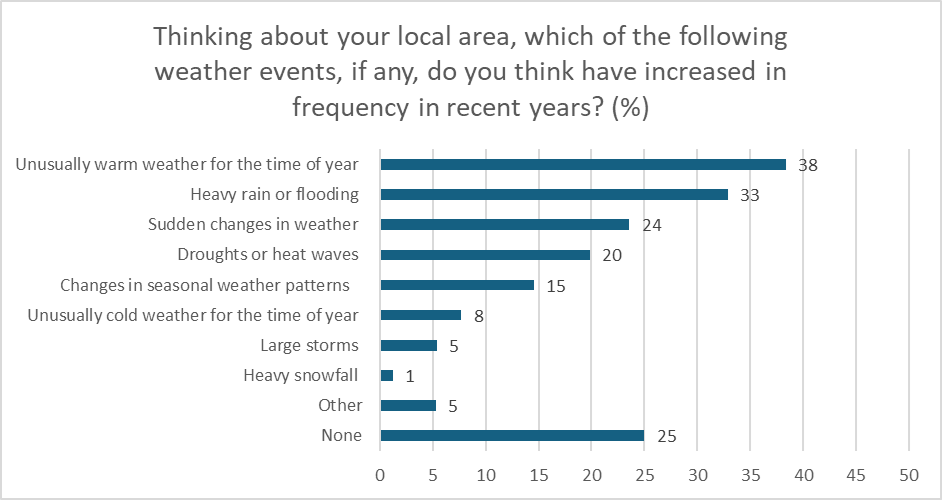
The above data shows that while climate is not a primary concern to the Georgian public it does matter to them, with people aware of the changing climate in their communities. 

This article was written by Dustin Gilbreath, a non-resident senior fellow at CRRC Georgia. It is based on a new report, available here.

Dustin works as a polling consultant for climate change-related organisations, as disclosed on his LinkedIn profile. The views within this article reflect the views of the author alone, and do not necessarily reflect the views of CRRC Georgia, any related entity, or any entity which Dustin works for.

Monday, September 09, 2013

Does Climate Change Matter in the South Caucasus?


The Environment and Security Initiative confirmed that climate change has already negatively impacted the South Caucasus in its 2011 study, “Regional Climate Change Impact Study for the Caucasus Region ”. The issue of climate change was recently given media coverage when a group of approximately 40 people gathered at Turtle Lake in Tbilisi on August 5th to protest the destruction of trees and shrubs in order to construct a new restaurant complex. Their aim was to protect the plants in order to help reduce pollution. This post assesses knowledge of and attitudes about climate change in the South Caucasus. Data from the 2011 Life in Transition survey shows that the general concern for issues related to climate change is higher in Azerbaijan with Georgia being very close and Armenia somewhat behind. However, there is little understanding about what climate change is in all three countries. 

The Life in Transition survey shows that the majority of people in the South Caucasus have a certain degree of concern about climate change. Measured on a scale from 1 (not concerned) to 5 (extremely concerned), the data shows a high degree of indifference in Armenia (33%). Six out of 10 Azerbaijanis express concern (61%), followed by 59% of Georgians, and fewer Armenians (42%). 


However, when asked to assign a relative value to climate change by choosing from a list of serious problems currently facing the world, respondent’s opinions differ from what was expressed in the figure above. 73% of Azerbaijanis view climate change as a very serious problem, followed by Armenians (61%) and Georgians (45%). The answers to the next question, “Which is the most important?”, are consistent; 17% of Azerbaijanis, 13% of Armenians and 7% of Georgians view climate change as the most important issue.

 In your opinion, which of the following do you consider to be a very serious problem currently facing the world? 

And which is the most important?

(Life in transition survey II, 2011)


In order to measure general awareness of climate change, it is important to assess how people feel they understand the causes of this phenomenon. Throughout the region, the majority of people feel they are “not very well informed” or “not at all informed” about the issue. Again, Azerbaijanis show the highest propensity with 48% of them feeling well informed about the topic, Armenians being second (35%) and Georgian third (23%). Thus, the lack of concern may be due to a lack of knowledge.


Finally, respondents were asked if they had personally taken actions aimed at helping to fight climate change. Very few people said they had done so—2% in Armenia, 2.5% in Azerbaijan and 1.6% in Georgia. 

For more information on climate change and the South Caucasus in general, visit the Life in Transition data on the European Bank for Reconstruction and Development’s website.


Thursday, April 19, 2007

Public Opinion in Armenia on America, Darfur, Genocide and Climate Change

The Chicago Council on Global Affairs and WorldPublicOpinion.org have released their data from several of their most recent World Public Opinion -- Global Issues surveys. The surveys cover 18 countries and the Palestinian territories and includes Armenia! (Why Armenia was chosen is an interesting issue -- anybody who knows or has thoughts about this, we would welcome your commentary.)

In Armenia, the fieldwork was carried out by the Armenian Center for National and International Studies. In the survey documentation, it states that the Armenian survey was done in 1300 nationally representative households using face-to-face interviews. However, how a nationally representative sample was obtained is not mentioned. Also, the sampling frame is not discussed. This leaves many questions of quality in terms of representativeness.

Nevertheless, the data is quite fascinating and it would be great to be able to compare among the South Caucasus countries. Four surveys were recently released: "Views of the United States," "Genocide and Darfur," "Climate Change and the Global Environment," "Labor and Environmental Standards in Trade Agreements." The former three will be covered briefly in this blog entry.

Views of the United States

Armenia's views of the United States appear to fall in the middle of the surveyed countries. 63% of Armenians responded that they thought that the "U.S. is playing the role of world policemen more than it should be." However, even more Americans (76%) agreed with this statement. Indeed, only in one country -- Philippines -- did more than half of the population disagree with the statement.

Asked, if they trust the U.S. to act responsibly in the world, 27% of Armenians said "not at all" and 31% "not very much." This puts Armenia squarely in the middle of responding countries. Argentina is the most distrustful (69% "not at all" and 15% "not very much" and Israel (56% "a great deal" and 25% "somwhat") the most trustful.


Genocide and Darfur

Questions related to Genocide would seem particularly interesting to ask in Armenia, given the hotly debated use of the term in the Armenian context. So how do Armenians respond? When asked if the UN has the responsibility to intervene against the will of a government where the genocide is taking place, 66% of Armenians thought that the UN had that responsibility--though a large percentage (19%) said they were not sure or declined to answer.

However, the survey indicates that Armenian interest in the politics of genocide may not transfer to other contexts-- or perhaps there is no media coverage. When asked if the UN had the right to intervene in Darfur, 46% of Armenians said they were not sure or declined to answer (similarly high rates occurred in Ukraine, Poland, Thailand and Argentina). Of those who answered, the largest percentage (29%) did think that the UN had the responsibility to authorize intervention.

Climate Change and the Global Environment

According to the survey, Armenians respond similarly to Russians. When given a series of statements ranking the importance of global warming, 19% of Armenian and 22% of Russians chose the statement that took global warming the least seriously, saying that "Until we are sure that global warming is really a problem, we should not take any steps that would have economic costs." Only India had a higher percentage that chose this response -- 24% -- though the U.S. did not do much better at 17%. The margin of error is different in each country, so maybe the U.S. is worse than Armenia but not nearly as conscious as Thailand, where only 7% chose the response.