Showing posts with label Age. Show all posts

Monday, September 09, 2019

The Easterlin Paradox and Happiness U-curve in Georgia

Two of the more prominent findings from the study of happiness are that money does not buy it (up to a point) and that young and old people are happier than those in between. That money does not buy happiness is often referred to as the Easterlin Paradox. It highlights that between and within countries happiness increases with wealth, but only up to a certain point, at which increases in wealth are associated with marginal gains in happiness. That the elderly and young are happier is referred to as the happiness U-curve. This finding has been found to hold in the West, but not in the former Soviet space, where the elderly are the least happy. This blog looks at these phenomenon in Georgia.

On the 2018 UN Women and CRRC Georgia survey, respondents were asked to rate their self-reported happiness, from “Extremely unhappy” to “Extremely happy” on an eleven point scale. A plurality of respondents reported being extremely happy (40%). By comparison, only 1% reported being extremely unhappy.


In agreement with previous studies on happiness within the post-Soviet space, increased household economic status was associated with higher levels of happiness. Individuals who were wealthier were more likely report a happier response on the scale. In contrast, those who have relatively few assets reported lower levels of happiness. However, once respondents have three out of the eleven assets asked about or more, reported happiness increases at a marginal rate, as the Easterlin Paradox would predict.


The U-shaped happiness curve does not hold in Georgia, as happiness generally decreases with age. The presence of children, sex, settlement type, household size, whether or not the respondent was displaced by conflict, and education level were not associated with happiness.


The above data suggests that the Easterlin paradox appears to hold in Georgia, with individuals becoming happier with greater wealth, up to a point. As in other post-Soviet countries, older people are generally less happy, again re-affirming the lack of a u-curve in happiness in the region.

Note: The above analysis is based on an ordinary least squares regression, where the dependent variable is the respondent's self-reported happiness level. The independent variables are respondents’ household economic status (measured with an asset index, composed of ownership of 11 assets), age, sex (male, female), education, settlement type, displacement status, household size, and age’s interaction with the presence of children in the home. Replication code for the above analysis can be found here. The data for the above analysis can be found here.


The views presented in the above blog post do not represent the views of UN Women, SDC, or any related entity.

Monday, January 22, 2018

What are young people’s values and how are these different from older generations’ values in Georgia?

[Note: This blog post summarizes the findings of an article written by CRRC-Georgia researcher Tamar Khoshtaria and published in The Journal of Beliefs and Values in August, 2017.]

As Georgian society is going through social and cultural changes, it is important to understand people’s beliefs and values. Comparing the values of young people to those of the older generations is also important. This blog post summarizes the findings of a study that examined the values of young people aged 18 to 25, and analysed how these values are different from the values of older people in Georgia, based on both quantitative (World Values Survey, 2014) and qualitative data (40 in-depth interviews conducted in 2016). The study looked at values, perceptions, attitudes and tolerance towards different minority groups in Georgia. It concludes that in many cases, the younger generation shares more modern views and values, while the older generations are more inclined to support traditional values and hold conservative points of view.

The study used Shalom H. Schwartz’s theory of basic values, which identifies ten basic values:

  1. Self-direction: Independent thought and action-choosing, creating, exploring; 
  2. Stimulation: Excitement, novelty, and challenge in life; 
  3. Hedonism: Pleasure and sensuous gratification for oneself; 
  4. Achievement: Personal success through demonstrating competence according to social standards;
  5. Power: Social status and prestige, control or dominance over people and resources;  
  6. Security: Safety, harmony and stability of society, of relationships, and of self; 
  7. Conformity: Restraint of actions, inclinations, and impulses likely to upset or harm others and violate social expectations or norms;  
  8. Tradition: Respect, commitment and acceptance of the customs and ideas that traditional culture or religion provide the self; 
  9. Benevolence: Preservation and enhancement of the welfare of people with whom one is in frequent personal contact; 
  10. Universalism: Understanding, appreciation, tolerance and protection for the welfare of all people and for nature. 

In his empirical work, Schwartz used short verbal portraits which describe a person as having a certain goal, aspiration or wish and point implicitly to one of the ten value types. After hearing a verbal portrait, respondents had to evaluate to what extent the person described was like or not like him or her. These verbal portraits were used during the 2014 World Values Survey (WVS) conducted in Georgia. During qualitative interviews (conducted independently from the WVS), respondents could provide detailed accounts of their attitudes. 

The quantitative and qualitative data show similar results. Quantitative data analysis suggests that Schwartz’s higher-ordered values ‘conservation’ (which includes the basic values of ‘security’, ‘conformity’, and ‘tradition’) and ‘self-transcendence’ (which includes the basic values of ‘benevolence’ and ‘universalism’) are very important for people of all age groups in Georgia. Over 70% in all age groups evaluated the persons described in the verbal portraits representing these five basic values as being ‘very much like them’ or ‘like them.’ When it comes to these basic values, the young generation, in general, does not differ much from the older generations.


On the other hand, there are some values which were assessed quite differently by people in different age groups. When looking at the basic values ‘self-direction’, ‘stimulation’, and ‘hedonism’ (representing the higher-ordered value of ‘openness to change’), there are differences by age group. Compared to older generations, a larger share of young people identified themselves with a person to whom it is important to think up new ideas, take risks, and have a good time.


Similarly, the basic values of ‘achievement’ and ‘power’ (representing the higher-order value of ‘self-enhancement’) have been assessed differently by young people and people of older generations. While being successful is important for 66% of young people, the share is lower among older people. In addition, while ‘being rich, and having a lot of money and expensive things’ was not reported as an important value in Georgia, the share of those valuing this kind of ‘power’ is slightly larger among young respondents than it is among the older ones.

The second part of the study focused on tolerance towards different minority groups, measured by a question about which groups of people respondents would not want as their neighbours. The least tolerated group in Georgia is homosexuals. People of all generations would not like to have them as their neighbours. Still, the answers of young people suggest more tolerance and openness to different minority groups.


Note: A show card was used for this question. Respondents could name as many answer options as they wanted. 

While some values (e.g. ‘security’, ‘conformity’, ‘tradition’, ‘benevolence’, and ‘universalism’) are almost equally important to young and old people in Georgia, the young generation identifies more with values like ‘self-direction’, ‘stimulation’, ‘hedonism’, and ‘achievement’. In addition, the young generation is slightly more tolerant towards different minority groups.

For detailed results, see the full article in the Journal of Beliefs and Values.

Monday, September 04, 2017

A generation gap in retirement planning in Georgia

The pension system in Georgia faces challenges. According to the World Bank, in a country with a declining working age population (see slides 6 and 7), a retirement system in which the state is solely responsible for providing pensions – as in Georgia – is unadvisable. The Government of Georgia, with the help of international organizations, has been working to reform the country’s pension system, with the latest pension reform plan approved in spring 2016. The government is set to launch the new system in October 2017. With the new plan, in addition to the basic “universal” pension, still provided by the government, the employee, his/her employer, and the government will each make contributions to the employee’s retirement savings account. Each of the contributors will pay at least 2% of the employee’s monthly salary, totaling a minimum of 6% of his/her salary in a given month. Hence, an individual’s retirement savings will consist of these contributions and the interest accumulated on the retirement account.

According to the March 2016 CRRC/NDI survey, the plurality of the population of Georgia plans to or is supporting themselves in their old age with state pensions (49%) and/or assistance from their children (31%). Roughly a quarter (27%) reported that they have done nothing, have never thought about it, or don’t know what they do or plan to do to support themselves in old age. Younger people, however, plan to rely on sources of income other than state pensions more often than older people.


Note: A show card was used for this question. Up to three answer options were accepted per interview. Answer options “Saved or plan to save money in the bank” and “Rely or plan to rely on support from my relatives (besides my children)” were named very rarely and are thus combined with the answer option “Other.”

The above chart shows the distribution of answers nationwide, but there are important differences by age. The majority (72%) of the population 56 years old and older name government pensions as a means to support themselves in old age. In contrast, only 29% of young people between 18 and 35 years old report planning to rely on government pensions when they get old.


Note: Answer options “Made or plan to make investments”, “Saved or plan to save money, but not in the bank”, “Saved or plan to save money in the bank”, and “Bought or plan to buy a house/apartment for rent or sale” were combined with the answer option “Other”. 

Government should encourage the diversity of options for retirement planning that young people already report they plan on using as it may reduce dependence on state pensions in the long term. Awareness raising campaigns about such options are also important for supporting citizens in making informed decisions, and could be integrated into the campaigns already planned before the launch of the new pension system in 2017.

The data presented in this blog post is available at CRRC’s Online Data Analysis (ODA) tool.


Tuesday, October 07, 2014

The Wave of the Future: Optimism, Pessimism and Fatalism in Georgia


A recent CRRC regional blog post analyzed the presence of fatalism in Georgia. The post cited CRRC Caucasus Barometer (CB) data which shows that in 2013, 28% of Georgians agreed that “everything in life is determined by fate.” While the CB findings demonstrate that a sizeable portion of the adult population is fatalistic about the future, Georgians are increasingly likely to see that future in a positive light, whether it be determined by fate or not. This blog post analyzes survey data and finds a recent trend of Georgians describing both their present economic situation and expected future situation in more positive terms than in previous years. However, survey results also illuminate dissonance in Georgian society, as urban residents and the younger population are more likely to look to the future with optimism than are rural dwellers and older Georgians. Notably, members of the latter groups are more likely to hold fatalistic attitudes.

CB longitudinal data demonstrates that over time Georgians have become more likely to describe their current household standing in positive terms. The survey asks: “Let’s imagine there is a 10-step ladder reflecting the economic standing of all households in Georgia today…On which rung of this ladder do you think your household currently stands?” For the purpose of this blog post values were re-coded from a ten-point scale to a three-point scale, with rungs 1-4 designated as the “low” position, 5-6 designated as the “intermediate” position, and 7-10 designated as the “high” position. In 2009 CB results showed that 64% of Georgians described their household being in the “low” economic position in society. That proportion remains high but has steadily declined since, and by 2013 only 45% of citizens described their household position in the same terms. It should be noted that the largest decline in negative responses occurred from 2009 to 2010. One plausible explanation is that GDP recovered rapidly over the same period, with the World Bank reporting that Georgia’s GDP contracted by 3.8% in 2009 before growing by 6.3% in 2010. As for the “high” position, 11% of Georgians placed themselves there in 2013, compared with only 4% in 2009. It appears that most of the difference on the time series is accounted for by people changing their perception from “low” to “intermediate.”

Not only do Georgians feel better about their current standing, they are looking forward to a brighter future. In recent years the vast majority of adults in the country have seen the future of their households in uncertain terms at best, indicating “Don’t Know” or “Refuse to Answer” on the survey, and pessimistic terms at worst. Those attitudes haven’t disappeared, but public sentiment is becoming more sanguine. After describing their current position, respondents are asked “On which rung of this ladder do you think your household will be standing 5 years from now?” The percentage of Georgians expecting their household to be in the “high” position increased over a span of four years, showing an overall rise from 16% in 2009 to 29% in 2013. By contrast, the percentage of those indicating the “low” position was stagnant.


What is most telling about these numbers is that the proportion of pessimists did not rise, given that the proportion of “Don’t Know” and “Refuse to Answer” responses declined from 2009 to 2013, from 60% to 49% (after peaking at 65% in 2011).  This figure remains relatively high, however. At the same time the share of people indicating “high” and “intermediate” positions increased. Taken in aggregate, these numbers suggest that Georgians are more certain about their futures than they were four years ago, and increased certainty has apparently translated into higher expectations.

The data indicates, however, that residents of urban areas are much more likely to view the future with optimism than rural residents. Of those expecting their household to be in the “high” position in five years, 67% percent lived in urban areas (including Tbilisi). Of those expecting to be on the “low” position, 62% lived in rural areas. Thus we observe an association between urbanization and optimistic economic expectations. There is also a discord between age groups. Those aged 18-35 are the most likely to expect to be in the “high” position, while those aged 36-55 and 56+ are less likely to have that expectation and are increasingly likely to give DK/RA responses. According to the CB 35% of Georgia’s young adults indicated “high” compared to 27% of the middle-aged population and 23% of the elderly. It should also be noted that the under-36 age group constituted a larger proportion of the population in Tbilisi than in other urban (non-Tbilisi) or rural areas (42% of Tbilisi’s adult population is under 36, compared to 36% of the population in other urban areas and 31% of the rural population), so it is unclear whether age group or settlement type is a better indicator of optimism.


The presence of fatalistic attitudes offers a possible explanation for these cleavages. Those residing in Tbilisi are more likely to be optimistic about the future and much less likely to agree that “everything in life is determined by fate,” with the CB 2013 finding that 18% of Tbilisi residents agreed with the statement compared to 29% of urban Georgians (excluding Tbilisi) and 32% of rural inhabitants. However, it must be noted that non-Tbilisi urbanites were more likely than residents of Tbilisi to indicate both expectation of the high economic position and having fatalistic attitudes. As for the age divide, only 23% of those aged 18-35 indicated fatalistic attitudes, compared to 26% of the 36-55 age group and 34% of those 56 and over. Comparing age groups, we observe a negative association between optimism for the future and fatalism.

This statistical analysis indicates that Georgians have demonstrated increasingly optimistic attitudes over the past four years. While that is good news, exuberance should be tempered by the fact that high expectations are largely concentrated in the urban population and those under the age of 35. The lack of optimism amongst the rural and 36+ populations also appears to be associated with the presence of fatalistic attitudes in Georgia. Georgian society is becoming more optimistic on the whole, but growing optimism is not spread evenly amongst the population.

For additional information concerning public opinion in Georgia take a look at our data using the CRRC’s Online Data Analysis tool.


Monday, August 25, 2014

Emigration, Language, and Remittances in Georgia

As discussed in a recent blog post, household incomes in Georgia have risen steadily since 2008. The percentage of Georgians who have family or close relatives living abroad has also significantly increased from 37% in 2009 to 53% in 2013. 14% of Georgian households currently receive money from family members, relatives, or friends living in another country as an income source. This blog examines changes in interest in emigrating from Georgia over the last five years, while controlling for certain variables.

Since 2008, though the percentage of Georgians who have family living abroad has increased, interest in emigrating from Georgia, both temporarily and permanently, has barely changed. In 2008, 48% of Georgians expressed interest in emigrating temporarily, while 44% felt the same in 2013. Interest in permanently emigrating from Georgia has remained extremely low, at 8% in 2008 and at 7% in 2013.


In CB 2013, respondents were asked to describe their ability in English and Russian. Today in Georgia, 63% of Georgians say they have no basic knowledge of English, 15% say they have intermediate knowledge, and 6% feel that they have advanced knowledge. As might be expected, knowledge of English among younger Georgians is higher than among older Georgians. 41% of Georgians aged 18-35 years old say they have intermediate or advanced knowledge of English, while only 14% of Georgian aged 36-55 feel the same. Knowledge of Russian is more widespread among Georgians, with 70% of Georgians saying they have intermediate or advanced knowledge of Russian. Among 18-35 year old Georgians, 65% say they have intermediate or advanced knowledge of Russian, while 80% of 36-55 year old Georgians say the same. As a general trend, Georgians with more advanced language skills in English or Russian tend to express a higher level of interest in temporarily emigrating from Georgia. This trend is more pronounced among English speakers.

Similarly, more frequent users of the Internet are also more interested in temporarily emigrating. However, there is no discernible pattern between the desire to permanently emigrate and knowledge of English or Russian, or frequency of internet usage. Both Georgian men and women are equally disinterested in permanently emigrating (only 7% are interested), while slightly more Georgian men are interested in temporary emigration (49% of men and 39% of women).


In conclusion, though there has been no visible increase in interest among Georgians in emigrating over time, it is possible that this interest will eventually grow as more Georgians learn foreign languages and use the internet more frequently.

Monday, July 07, 2014

Facebook usage in Azerbaijan

On February 3rd, 2014, Facebook celebrated its 10th anniversary. According to the World Map of Social Networks December, 2013 statistics, Facebook is the world’s most popular social network with more than one billion users. It is followed by QZone with 552 million users, Vkontakte (190 million users), Odnoklassniki (45 million users), and Cloob (1 million users). However, it is important to note that social network usage is not distributed evenly geographically. In some countries different social networks have more usage than Facebook: for example, QZone in China, Vkontakte and Odnoklassniki in Russia, and Cloob in Iran. This blog post examines the usage of Facebook and its popularity among different age and gender groups in Azerbaijan.

In Azerbaijan, according to the annual Caucasus Barometer (CB) survey, 57% of the respondents reported using the Internet in 2013. Use of social networking sites was reported as the most popular activity on the Internet. Other activities, such as searching for information (49%), downloading/listening/watching music/videos (36%), and using Skype (33%) were also mentioned.


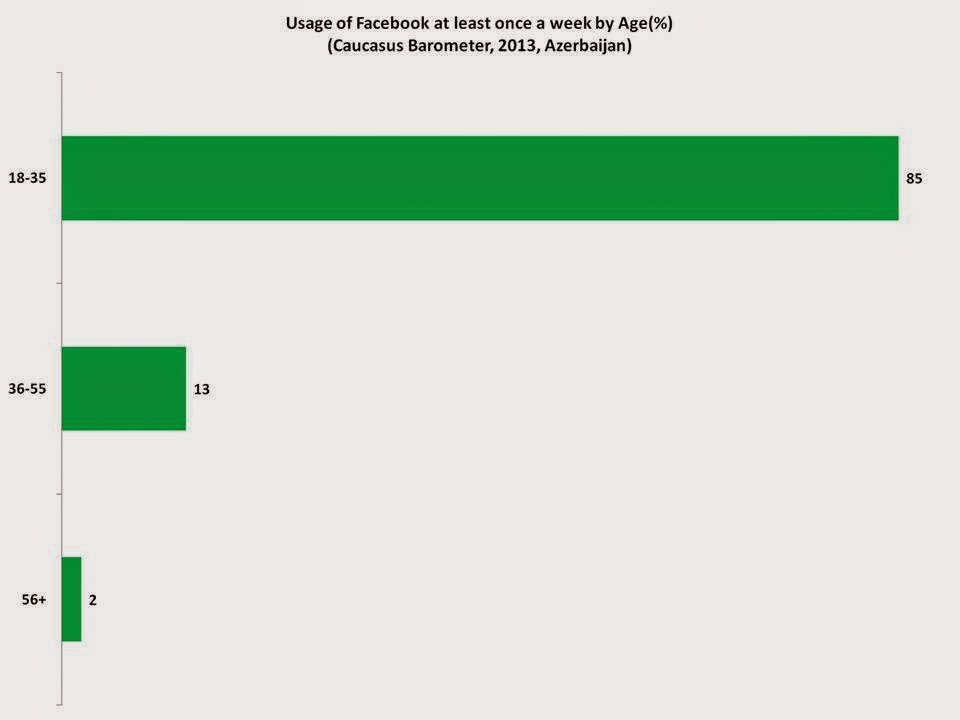
Facebook is the most popular social network in Azerbaijan, and it is used quite frequently.According to the CB, 16% of all respondents in Azerbaijan actively use Facebook. Moreover, 49% of Internet using respondents in Azerbaijan use Facebook at least once a week. Most Facebook users are males (65% according to Socialbakers statistics from 2014, 68% according to the CB), and the majority are young people aged 18-35 years old (72.8% according to the Socialbakers from 2014, and 85% according to the CB).


Among the respondents of the CB, almost 1/3rd of active Facebook users are posting news, personal observations or photos (30%). Other frequent Facebook activities mentioned by CB respondents in Azerbaijan included: commenting on other people’s posts and photos (26%), chatting (20%), and reading or viewing news-feeds (18%).

Besides connecting people as a tool for communicating with friends and family, Facebook has also made it easier to share opinions about information. Most CB respondents in Azerbaijan (88%) did not find it hard to express their opinion on Facebook. However, 5% of respondents expressed difficulty. Notably, posting opinions on FB is harder for women than men (10% of female respondents consider it hard to express their opinions on Facebook, while only 3% of male respondents express similar difficulty).

According to Statistics Brain Facebook data from 2014, the average number of friends per person on Facebook is 130. In Azerbaijan, 39% of CB respondents said they had 51-100 friends, whereas 37% of respondents had less than 50 friends on Facebook. Only 18% of respondents had more than 100 friends. The evidence suggests that for most Facebook users in Azerbaijan, the social network is a platform for connecting with their relatives and close friends; preferring a more selective form of communication, rather than communicating their thoughts, ideas and personal information to a larger audience.

To get more information about the Caucasus Barometer data and others activities by CRRC, we recommend following us on our Facebook page here. To learn more about Facebook usage in Azerbaijan and other South Caucasus republics, we recommend accessing Caucasus Barometer data here with our Online Data Analysis (ODA) tool.

By Aynur Ramazanova

Tuesday, May 13, 2014

Common Challenges Facing the Elderly in Georgia

According to the World Health Organization (WHO), “Multiple social, psychological, and biological factors determine the level of mental health of a person at any point in time. In addition to the typical life stressors common to all people, older people are more likely to experience events such as bereavement, a drop in socioeconomic status with retirement, or a disability.” According to the WHO, these factors, among others, can result in isolation, loss of independence, loneliness and psychological distress in older people. D. Srinivasan, psychiatrist, at Kovai Medical Center and Hospital in Tamil Nadu, India has highlighted some common social and psychological problems faced by the elderly including, loss of confidence and sensitivity to minor symptoms of illness, a chronic state of depression when losing financial independence or mobility, emptiness syndrome when children no longer live with parents, and a sense of worthlessness and hopelessness. This blog looks at whether these factors affect the elderly population’s health in Georgia. For this reason, the blog examines the extent to which elderly (56+) people in Georgia are influenced by a sense of emptiness and loneliness, as well as the types of economic conditions in which they live.

According to survey results from the Caucasus Barometer (CB) 2011, 20% of Georgians 56 and older experienced a general sense of emptiness. By comparison, the proportion of younger age groups (18-35 and 36-55) who reported experiencing emptiness was half of that (9% and 11%, respectively).


The following chart shows that 40% of Georgians, 56 and older felt that there were enough people to whom they felt close, and 49% who more or less thought that there were enough people close to them. Only 12% rejected the idea of having a sufficient amount of close people around. However, it is also worth mentioning that exactly the same percentage (12% for each) of individuals was present in the other two younger age groups (18-35 and 36-55) who also turned down the idea (‘there are enough people to whom I feel close’).


According to survey results, a sense of emptiness (20%) and loneliness (12%) among Georgia’s elderly population is not high. One of the explanations of this tendency could be that in Georgia it is common for elderly people to continue living with their children and grandchildren. This likely gives them the opportunity to stay actively engaged in family life through taking care of grandchildren, helping other family members with running the household, as well as being taken care of whenever necessary.

This way of living gives a smaller place to thoughts of being unwanted or useless, lonely or depressed and can be considered as an alternative to some common recommendations doctors give in scope of organizing manner of living for aged people according to Amutha Kannan.

If problems are not very visible for the aged population in Georgia (from a social perspective), their economic state gives a significantly different picture. According to the CB 2011 survey results, 40% of elderly people (56+) in Georgia reported living in poor economic conditions not having enough money for food in the household. Younger Georgians, by comparison, attested to living in similar poor economic conditions and not having enough money for food in the household (24% of the 36- 55 age group and 15% of the 18 – 35 age group).


This blog post reviewed factors that negatively affect the elderly’s mental health in Georgia. Hence, in comparison to social settings for older people in Georgia, their economic conditions can be considered a serious challenge to remain physically and mentally healthy. To further explore this subject and other issues influencing aging people’s health in Georgia, we recommend exploring our data using the ODA tool here.

Monday, December 02, 2013

Happiness in Azerbaijan

Happiness is one of many indicators of well-being. On July 9, 2011 the General Assembly of the UN adopted a resolution which declared, “happiness as a universal goal and aspiration [that] embodies the spirit of the Millennium Development Goals”. In response, the UN organized a high level meeting on happiness in April 2012, and in 2013 the UN declared March 20th as the International Day of Happiness. To enhance the connection between happiness and sustainable development, the UN supported the publication of the World Happiness Report in September 2013. The report measured happiness in 156 countries by examining six variables: GDP per capita, life expectancy, social support, perceptions of corruption, prevalence of generosity, and the freedom to make life choices. The report ranks Azerbaijan 116th out of 156 countries, and notes that Azerbaijan has had a negative shift between 2005-2007 and 2010-2012. 

                                        Comparing Happiness: 2005–07 and 2010–12. World Happiness Report 2013.

The annual Caucasus Barometer(CB) asks, “How happy would you say you are?” on a 1 to 5 scale where 1 means extremely unhappy and 5 means extremely happy. The data shows that the level of reported happiness in Azerbaijan has gradually increased from 2010 to 2012, yet it remains lower than in Armenia and Georgia.


CRRC-Azerbaijan's 2012 survey on Social Capital, Media, and Gender asked the same question and showed that 19% of Azerbaijanis between 18 and 35 years old say they are extremely happy relative to those over 56 years old who say the same (9%).


Settlement type also matters. More people in the capital and urban areas say they feel happy -points 4 and 5 combined  (62% and 65%, respectively) compared to those who live in rural areas who say the same (46%).


The correlation between education and happiness can be contentious. British economist and co-editor of the World Happiness Report, Richard Layards, excluded education from the list of factors that might have an effect on happiness. However, data from the Social Capital, Media, and Gender survey shows that there is a strong connection between education and happiness. 93% of people with a Master's degree and above are more likely to describe themselves as happy in Azerbaijan, and this percentage declines as the level of education declines.


For more data on happiness in Azerbaijan please visit the CRRC dataset.

Tuesday, September 27, 2011

Georgia's desire for NATO membership

On September 15th 2011, the former American Ambassador to NATO, Kurt Volker, delivered a speech at the Georgian Foundation for Strategic and International Studies about NATO’s past development, present capabilities and future challenges. The second part of the speech addressed relations between NATO and Georgia. According to Ambassador Volker, the enlargement of the alliance will not be on the agenda during the next summit in Chicago.

Even though there is no indication of Georgia’s possible membership in the near future, the majority of Georgians continue to support their country’s membership in NATO.

So what does the data tell us about Georgian support for NATO membership? Data from the 2009 and 2010 Caucasus Barometer (CB) again allows a closer analysis of three aspects that influence Georgian attitudes: age, education and trust towards the executive government.

According to the 2010 CB, 70% of Georgians support NATO membership and this number has increased by more than 10% since 2009 (from 59%).

Additionally, full support for NATO membership has increased among young people. The 2009 CB shows that one third (33%) of Georgians between the ages of 18 to 35 fully supported Georgia’s NATO membership, followed by 31% between the ages of 36 to 55 and 20% for those aged 56 or more. However, according to the CB 2010, full support among the younger generation has increased to 44%, while this figure is 29% for the other two age groups, respectively.

Apart from age, education level influences support for Georgia’s accession to NATO. People with higher education are more supportive of Georgia’s NATO integration. Specifically, 44% of Georgians with higher education fully support Georgia’s membership in NATO (37% in 2009). There is a small difference between people with secondary education (29%) and those with secondary or lower (32% and 22%, respectively in 2009) education.

Trust towards the Georgian executive government is a third pattern that affects support for membership. 61% of Georgians who fully trust the executive government fully support Georgia’s membership in NATO. This figure is 34% among those who fully distrust the executive government.

Thus, the majority of Georgians support joining NATO even though Georgia does not have official candidate status for membership and will not obtain candidacy status during the next NATO summit in Chicago.

The dataset is available online, if you want to pursue further analysis on factors influencing. [LINK]