Showing posts with label Media. Show all posts

Tuesday, September 13, 2022

Do Georgians trust TV?

Note: This article first appeared on the Caucasus Data Blog, a joint effort of CRRC Georgia and OC Media. It was written by Kristina Vacharadze, Programs Manager, and Mariam Kobaladze, Senior Researcher at CRRC-Georgia,  The views presented in the article are of the authors alone, and do not necessarily reflect the views of CRRC Georgia, or any related entity.

In an increasingly polarised media environment, Georgians have mixed feelings about how much TV and TV journalists can be trusted. 

Over the past decade, TV as a source of news has been on the decline in Georgia. With just 53% of those surveyed in 2021 using TV as their primary news source, as compared to 88% in 2009, it is clear that TV has lost its dominance. Nonetheless, it remains the main news source for  half of the adult population.

This fall in TV consumption has taken place against a background of an increasingly divided media environment. Media monitoring studies show that, in recent years, there have been clear trends of polarisation amongst television channels, with many strongly supporting either the ruling party or the opposition. 

This has been reflected in qualitative studies by CRRC-Georgia, in which many people have said that they have to watch news on several television channels to be able to draw reasonable conclusions on events that have happened and how they might interpret them. 

In such an environment, what does the Georgian public think of television and TV journalists? 

Can TV be trusted?

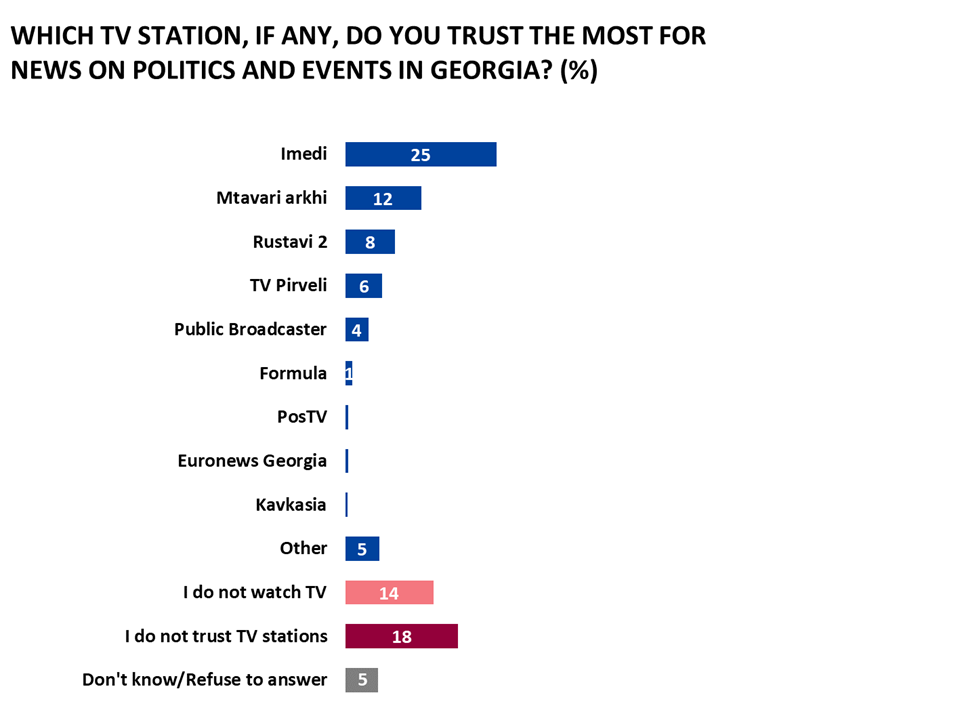
According to the Caucasus Barometer 2021, an annual household survey run by CRRC, 18% of the population does not trust any television channel for news about politics and current events and 14% does not watch television news at all. 

The most trusted television channels for news on politics and current events were found at opposite ends of the political sprectrum - the pro-government Imedi, trusted by a quarter (25%) of the population, and the pro-opposition Mtavari, trusted by 12%. Less than a tenth of the population trusted Rustavi 2 (8%), TV Pirveli (6%), and the Public Broadcaster (4%) more than any other station.
A regression analysis found that trust in TV and TV stations and viewing habits were associated with various demographic characteristics. 

Older people were more likely to watch and trust TV compared to other age groups. 

Ethnic minorities were more likely to distrust TV or not watch it compared to ethnic Georgians. This could be in part related to a lack of Armenian- and Azerbaijani-language programming on Georgian television. 

Working people were more likely to distrust and/or not watch TV news compared to people who did not work. 

People who supported a political party were more likely to watch and trust TV than people who did not support any party, or refused to report a party preference.

There were no patterns associated with settlement type, gender, or education level.

Note: The analysis uses a multinomial regression, where the dependent variable is whether people distrust TV, do not watch any TV channel for news about politics and current events, or trust a specific TV station. The independent variables are gender, age group, ethnicity, settlement type, level of education, and employment status.

What do the public think of TV journalists?

With a third of the population distrusting and/or not watching news on any television channel, what does the Georgian public think of the performance of TV journalists? 

About half of those surveyed (48%) believed that Georgian TV journalists inform the population about ongoing events in Georgia neither poorly nor well, while approximately a fifth of the population either positively or negatively assesses their work.

A multinomial regression showed that women were more likely to agree with the idea that TV journalists were serving their interests than men were. On the other hand, people living in urban areas assessed the performance of TV journalists more negatively than those living in rural settlements.

Party allegiance was also a significant predictor of people’s views: respondents who supported an opposition party were more positive towards the performance of journalists than supporters of the ruling party, Georgian Dream. 

Wealth (measured as the number of items a household owns from a list of 14) was also a significant predictor: poor people assessed the performance of journalists more positively than wealthier people.

Unsurprisingly, people who watched TV tended to feel more positively about TV journalists than people who do not watch TV.

A regression analysis did not show significant differences in attitudes between different age groups, ethnicities, people with different education levels, or with and without a job.
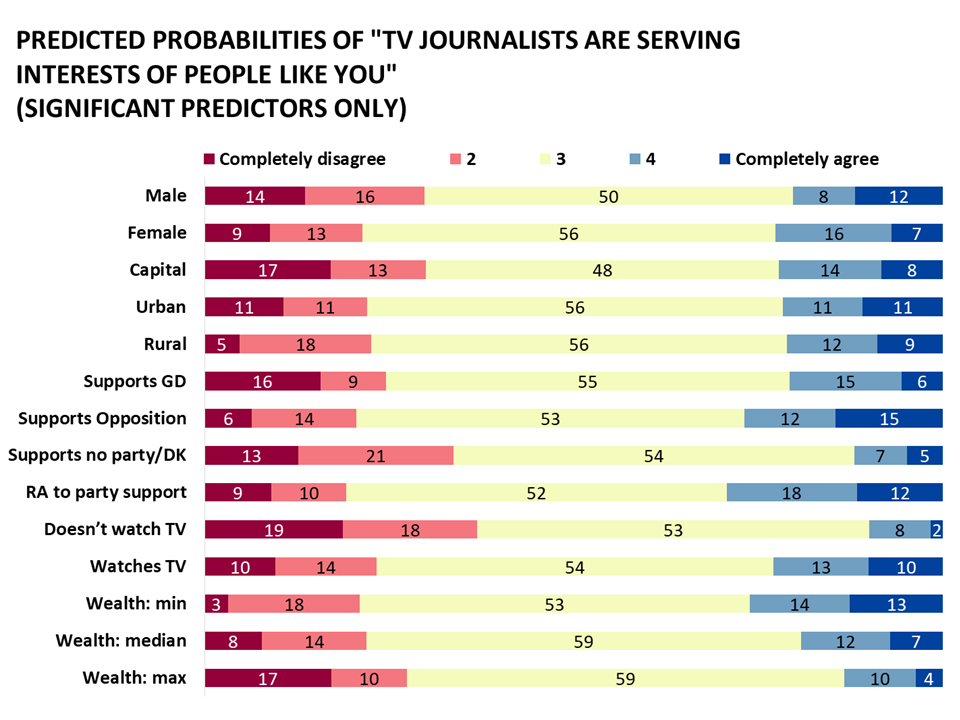
Note: The analysis uses a multinomial regression, where the dependent variable is whether people agree or disagree with the statement that TV journalists in Georgia are serving the interests of people like them. The independent variables are gender, age group, ethnicity, settlement type, level of education, wealth, watching TV and employment status.

The data shows a similar pattern with regard to views on whether TV journalists in Georgia serve the interests of the people. Slightly less than half of the population in Georgia (47%) neither agree nor disagree, while around a quarter (23%) believed that TV journalists do not serve the interests of the people, and a fifth (19%) believed that they did. Notably, people have become more pessimistic with regards to this question over the last decade, with a seven percentage point increase in disagreement with this sentiment between 2009 and 2021, and a 13 point decline in agreement with the statement during the same period. 
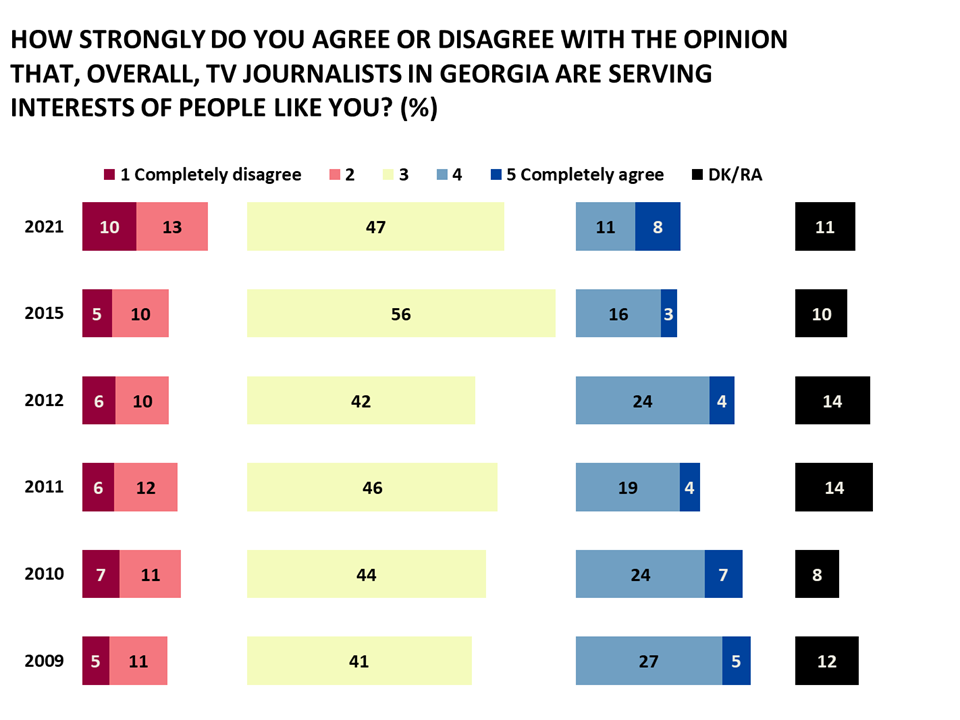
In the context of a very divided media landscape, it is notable that there is low public trust in television news and outlets. This trust appears to have fallen over the past decade, with fewer now believing that TV journalists in Georgia serve their interests. 

The data used in this post is available here.

Tuesday, June 08, 2021

Who doesn’t watch TV in Georgia?

Note: This article first appeared on the Caucasus Data Blog, a joint effort of CRRC Georgia and OC Media. It was written by Dustin Gilbreath, Deputy Research Director at CRRC Georgia. The views presented in the article do not represent the views of CRRC Georgia or any related entity.

Television is the primary source of information for most in Georgia, and it has been for at least the last decade. Yet, as internet penetration expands in Georgia, so too has the share of people using the internet as their primary source of information, and data from CRRC Georgia’s 2020 Caucasus Barometer survey suggests that many people have simply stopped watching TV.

The 2020 Caucasus Barometer survey asked respondents which TV station they trusted most. In response to the question, nearly one in five (19%) reported that they do not watch TV.

To understand who does not watch TV in Georgia, a regression controlling for people’s age, sex, ethnicity, the settlement type they live in, education level, employment status, number of adults in the household, whether or not the household had children, whether the respondent was internally displaced, and the household’s economic status was run.

Of the above variables, ethnicity, age, and whether or not there are children in a household predict whether or not someone watches TV. Ethnic minorities were 24 percentage points more likely to report they do not watch TV, controlling for other factors. People without children in their household were nine percentage points more likely to report they do not watch TV. 

The largest difference in demographics is by age, however. A person in the 18-34 age group has a 40 percent chance of not watching TV compared with someone in the 55+ age range who has a 9 percent chance of not watching TV, controlling for other factors. 

The data indicates that most people not watching TV use the internet. People who report not watching TV report using the internet every day at a rate higher than people who report watching TV (83% versus 59%). This difference holds up when controlling for other factors, though the difference declines to six percentage points, suggesting that demographics (including,  age, sex, ethnicity, settlement type, education level, employment status, number of adults in the household, children in a household, internal displacement status, and economic condition) explain much of this.

In short, almost one in five Georgians report that they do not watch TV, with young people and ethnic minorities being significantly less likely to watch TV and the data appears to indicate that Georgians are replacing TV with the internet for information.

Note: The data used in this article are available here.

Tuesday, May 04, 2021

How different are people who trust different TV channels in Georgia?

[Note: This post first appeared on the Caucasus Data Blog, a joint effort of OC Media and CRRC Georgia. The post was written by Givi Silagadze, a Researcher at CRRC Georgia.  The views expressed in this article are the author’s alone and do not represent the views of CRRC Georgia or any related entity.]

The Georgian media landscape is often described as pluralistic but ‘extremely polarised’. But does the media merely reflect the prevailing political polarisation or cause it? 

The majority of sizeable TV channels in Georgia are politically biased. At the same time, for seven in ten Georgians, TV remains the main source of information.

While this is a classic chicken and egg problem, arguably, causation flows both ways. Nonetheless, it has been documented that partisan media can polarise consumers and radicalise partisan voters. 

While it is not possible to untangle cause and effect through the available data, it is possible to describe the differences between viewers who trust different stations. Data from Caucasus Barometer 2020 suggests that party preferences go hand in hand with media preferences. 

Moreover, after controlling for social and demographic factors, TV trust seems to be strongly associated with views on some current domestic political issues, but less so when it comes to foreign policy positions.

Overall, 66% of the adult population of Georgia named a TV channel that they trusted for news and politics in Georgia on the 2020 Caucasus Barometer survey. One in four Georgians reported that they trust pro-government station Imedi TV. In contrast, 14% named Mtavari as the TV station they trust. Mtavari is regarded as the station most critical of the government and pro-opposition.


Partisanship and media

Public trust in different channels reflects party lines to a great extent. A majority (57%) of Georgian Dream supporters said they trusted Imedi, while only 8% of the opposition-minded electorate and 15% of nonpartisans said they trusted the channel. 

Similarly, 47% of opposition supporters said they trusted either Mtavari or TV Pirveli, while only 5% of Georgian Dream supporters and 20% of nonpartisans trust either of those stations.

A regression analysis suggests that, after controlling for other factors, people who trust Imedi were 10 times more likely to support the Georgian Dream party compared to people that trust Mtavari or TV Pirveli. 

People who trust Rustavi 2 were 20 percentage points more likely to support Georgian Dream than people who trust Mtavari or TV Pirveli, but 35 percentage points less likely to sympathise with the ruling party compared to voters who trust Imedi. 

Current issues

Views on the direction the country is headed, views of whether people should protest, and views of the country’s handling of the pandemic were also associated with which TV station they watch. 

A regression analysis suggested that people who trust Imedi were sharply different from other groups in their assessments of the country’s direction. People who reported trust towards Imedi were 59 percentage points more likely to say that Georgia is moving in the right direction compared to people that trust Mtavari. 

TV trust was also associated with views on protesting. People who said they trusted Mtavari and TV Pirveli were significantly more likely to report that people should participate in protests against the government than people who said they trusted Imedi, Rustavi 2, and other channels, as well as those who do not watch TV or trust no station. 

People who said they trusted the opposition-leaning Mtavari and TV Pirveli were less prone to praise Georgia’s handling of the pandemic than people who trusted other TV channels, people who did not trust any channel, or those who did not watch TV at all. 

While there are some differences between the audiences of different channels, media consumption was not correlated with many factors. 

For instance, there was no difference between TV audiences in terms of whether or not they believed that areas of neighbouring countries where artefacts of the Georgian culture are located should be included in the borders of Georgia. The public largely reports that such territories should be part of Georgia. 

The question has implications for the Davit Gareja case, which attracted significant public attention during the pre-election and post-election period. The issue has been politically instrumentalised with pro-government channel Imedi adopting the slogan ‘Davit Gareja is Georgia’. 

Still, the formulation of the question in the Caucasus Barometer 2020 dataset is in general terms and therefore proxies attitudes rather than providing direct evidence of what the public thinks regarding the Davit Gareja case. 

As with the question on territory, there are limited differences between groups on foreign policy priorities. Even though a regression analysis suggests there are some statistically significant associations, these differences do not carry huge substantive importance as all the groups, ultimately, tend to support Georgia’s membership in the EU as well as NATO.

Another regression model was constructed to test associations between TV trust and support for Georgia’s membership in the Russian-led Eurasian Union. Some groups tended to sympathise more with Georgia becoming a member of the Eurasian Union than others, however, overall, the public disapproves of Georgia joining the Russian-led project. 

All else equal, the TV media environment seems to be at the core of the country’s polarised political discourse. 

TV is strongly associated with party preferences and assessments of many current domestic issues and developments, but less so with a foreign policy orientation. 

To what extent TV channels in Georgia persuade voters or make them more extreme, remains an open question.  However, what the above analyses suggest is that the socio-political landscape in Georgia is being increasingly divided into two camps. This divide revolves around contrasting perceptions of reality, and TV seems to be exacerbating rather than bridging the chasm.

Note: The above data analysis is based on logistic and multinomial regression models which included the following variables: age group (18-35, 35-55, 55+), sex (male or female), education (completed secondary/lower or incomplete higher education/higher), settlement type (capital, urban, rural), wealth (an additive index of ownership of 12 different items, a proxy variable), employment situation (working or not), IDP status (forced to move due to conflicts since 1989 or not), frequency of internet usage (every day or less often), and frequency of attendance at religious services (regularly/on special religious holidays/less often). 

The data used in this analysis is available here.

Tuesday, December 15, 2020

Georgian TV and the political framing of foreign actors

Note: This article first appeared on the Caucasus Data Blog, a joint production of CRRC Georgia and OC Media. It was written by Mariam Kobaladze, Communications Manager at CRRC Georgia. The views expressed in this article are the author’s alone and do not represent the views of the European Union, the United Nations Development Program, or CRRC Georgia. 

No matter their political stripes, TV channels in Georgia frame association with Russia as politically condemnatory and association with Western countries as praiseworthy. 

The preliminary statement of the OSCE/ODIHR international election observation mission, published on 31 October, assessed the Georgian media environment as ‘highly polarised’. The Georgian Charter of Journalistic Ethics came to a similar conclusion, highlighting that polarization in television news increased as the election campaign wore on.  

CRRC Georgia’s media monitoring during the pre-electoral period shows that polarization carried through to the use and portrayal of foreign actors in Georgian media. While any affiliation with Russia was intended as damaging to the reputation of a political actor, the EU and the United States were mostly portrayed as respectful actors, whose support added credit and whose criticism cast doubt on politicians.

‘Russia’ as a dirty word

Politicians who commented on ongoing events in news stories would call their opponents ‘pro-Russian’ or acting in line with Russian interests, with the clear goal of diminishing their credibility. 

Both the opposition and the ruling party used this tactic. For example, in a news story on Rustavi 2, a pro-government leaning news outlet, a member of the ruling Georgian Dream Party said that after the Bolsheviks and Communists, the opposition United National Movement ranked next in fulfilling Russia’s tasks.

Meanwhile, TV Pirvelli, an outlet critical of the Georgian Dream government, informed their audience that Bidzina Ivanishvili’s cousin visited Moscow 177 times, while pro-UNM news channel Mtavari Arkhi aired a story on how Russia funds the ultra conservative Georgian March group and the conservative Patriots’ Alliance party, arguing that the lack of reaction from the Georgian government to these organisations demonstrates their sympathies with russia. 

An interesting example of using Russia to discredit a political actor was the coverage of the Davit Gareji cartographers’ court case. Opposition media covered it as a ‘Russian project’, suggesting the scandal was Russian commissioned in the wake of the tensions prior to the outburst of active conflict between Armenia and Azerbaijan. In contrast, pro-government channels used the story to discredit the previous authorities, claiming they had pursued Russian interests. 

The West is best

Unlike Russia, EU and US-affiliated actors were presented as having authority and respect. Yet, while covering the same statements, comments, and issues issued from Western actors, different television channels underlined western support or criticism of the government based on their editorial stance, instead of both support and criticism. 

While government-leaning TV Channel Imedi covered stories on US and EU representatives calling on Georgia to hold free, fair, and transparent elections and presented OSCE/ODIHR recommendations, they did so in a way that highlighted western support for Georgia, its government, and positive assessments from international observation missions (e.g. of Election Code reform). In another similar instance, Pos TV covered the EU parliament’s resolution on Georgia’s fulfillment of the Association Agreement as the EU’s unprecedented support for Georgia and a success to be ascribed to the ruling party. 

Channels with critical views of the ruling party and the government also covered the statements and recommendations of western actors. However, the emphasis was on criticism of the ruling authorities. TV Pirveli for example aired a story about an EU Parliament report on Georgia which they presented as a tough pre-election warning for Georgia. ‘Five-hundred and fifty-two EU parliamentarians write that there is a politicized court in Georgia, court cases against opposition leaders were political, and the country under Ivanishvili’s rule has political prisoners’, a TV Pirveli journalist stated on air. ‘All this was written in the annual report of the EU parliament.’

CRRC Georgia’s monitoring of television news suggests that when covering foreign actors, television channels tend to express their political sympathies. Russia is used to cast doubt on parties and politicians while Western actors are presented as figures of authority whose support is advantageous and criticism disadvantageous. The meanings ascribed to Russia and the West hold whether or not the channel is for or against the government. But, the coverage of Western statements does change, either focusing on praise or criticism of the government and little of the coverage is balanced.


Monday, March 05, 2018

Partisanship and Trust in TV in Georgia

[Note: This post was first published on OC-Media. The post was written by David Sichinava, a Senior Policy Analyst at CRRC-Georgia. The views presented in this blog do not represent the views of CRRC-Georgia, the National Democratic Institute, or any affiliated entity.]


One of the outcomes of the stark polarization of news media sources globally is that people tend to align to the media outlets which resonate most with their ideological beliefs. In most cases, consumption of a particular ideological media source can only reinforce one’s beliefs, which might lead to an even further polarization of the audience. These patterns can be characteristic of mass media in contexts as different as, for instance, the United States and Lebanon. As the data from the December 2017 wave of CRRC/NDI survey shows, people in Georgia also appear to be selective in trusting media that aligns with their political beliefs as well.

The two largest TV networks in Georgia, Imedi TV and Rustavi 2, tend to support different political parties in their coverage of current events. A long-term media monitoring project which was funded by the European Union (EU) and the United Nations Development Program (UNDP) unveiled that throughout the 2016 parliamentary and the 2017 municipal election campaigns, Imedi TV allocated more airtime to and provided positive and neutral coverage of the governing Georgian Dream (GD) party. The network dedicated less airtime to and had more negative coverage of the opposition United National Movement (UNM). In contrast, Rustavi 2 covered the ruling party negatively, while covering the UNM with neutral or positive tones. The UNM also received more airtime on Rustavi 2.

Unsurprisingly, those who name the Georgian Dream as a party closest to their views were more likely to trust Imedi TV for accurate information on politics and current affairs in Georgia than were those who named the United National Movement on the December 2017 CRRC/NDI survey. At the same time, those who named the UNM as a party closest to their views were more likely to trust Rustavi 2. No specific preference could be seen in the case of those who answered “No party”, “Don’t know”, or refused to answer the question (i.e., non-partisans).

This tendency persists across the population of different settlement types and endures even when controlling for major demographic characteristics, such as gender, age, and ethnicity. Tbilisi residents who reported either of the two political parties as being closest to their views were the most polarized: those identifying themselves with the UNM in the capital had a relatively small probability (27%) of trusting Imedi TV, while those who identify themselves with GD had a comparably low probability of trusting Rustavi 2 (32%).


Note: Points on the chart display predicted probabilities of trusting Imedi or Rustavi 2 by settlement type and party preference, while bars correspond to 95% confidence intervals. For example, the probability for a person who identifies with Georgian Dream and resides in Tbilisi to trust Imedi is about 63%, while the probability for a UNM supporter in Tbilisi to trust this TV channel is as low as 27%. These probabilities are calculated using logistic regression models. Replication data and corresponding R code can be found here.

Unsurprisingly, those who report any of the two major Georgian political parties to be closest to their views tend to trust the TV network that favorably covers their party. In contrast, the non-partisan population does not systematically differ in trusting either TV network.

To have a closer look at CRRC/NDI survey results, visit our Online Data Analysis portal.

Monday, December 25, 2017

Gender (in)equality on TV

Stereotypes are an inseparable part of every society, and present in many parts of everyday life. Georgian society is no exception in this regard. For example, some professions like teaching are stereotypically thought of as “women’s professions” while others like being a soldier are considered “men’s professions”.  The media is considered one of the strongest means through which stereotypes are strengthened or broken. In Georgia, TV is the most important media, given that according to CRRC/NDI data, 73% of the population of the country name television as their primary source of the information. In order to understand the dynamics around gender-based stereotypes on TV, CRRC-Georgia monitored the main evening news releases and political talk shows broadcast during prime time (from 18:00 to 00:00) on five national and three regional channels from September 11 to November 12, 2017 (Channel One of the Public Broadcaster, Adjara, Rustavi 2, Imedi, Maestro, Trialeti, Gurjaani, Odishi) with the support of the UN Joint Program for Gender Equality with support from UNDP Georgia and the Swedish government.

The monitoring suggests that gender related stereotypes and gender equality issues in the media matter. While there were cases when journalists tried to break gender stereotypes through covering stories of successful women in spheres that are not generally associated with women, the results show that journalists often lack gender sensitivity.

The main findings of the monitoring include:

  • Some topics are almost always associated with either women or men. Stories about education (schools, kindergartens), culture, healthcare and the environment mostly include female interlocutors. Schools and kindergartens are almost exclusively reported as women’s topics, which strengthens the stereotype that childcare is women’s more than men’s business. On the other hand, topics related to the military, foreign policy, transport, and sports are mostly covered with male respondents; 
  • As for the political talk shows the number of male guests was far greater than the number of female guests;
  • One of the main goals of the monitoring was to identify stories which strengthened or weakened gender stereotypes. Stories that fostered gender stereotypes far exceed coverage that challenged them; 
  • Language on television is not always gender neutral. Phrases such as ‘representatives of the weaker sex’ and ‘the beautiful sex’ where used on a variety of TV channels, while men were referred to as ‘the stronger sex’. Professions were also sometimes differentiated as either “men’s” or “women’s” jobs. These expressions feed inequality between men and women. However, these terms were used infrequently, and more commonly used by guests than journalists. 
  • There are objective reasons why journalists cannot maintain gender balance in their news items or talk shows. For example, there are fewer women in leading positions in politics. This reality makes it more difficult for media to weaken stereotypes. Therefore, the audience mainly watches how men make decisions and are involved in political debates, which strengthens stereotypes about women’s roles in the society.

The media monitoring shows that gender inequality and stereotypes require more attention. To try to break stereotypes, the media and journalists should become more sensitive to the issue. At the same time, the underlying inequalities in society should also be addressed in order to enable the media to challenge stereotypes.

The full report on the gender-based media monitoring in the pre-election period is available here.

Monday, November 07, 2016

Who watches foreign television news in Georgia?

Foreign influence in Georgia's media is a popular topic of discussion for the press, academic researchers, politicians, and press freedom watchdog groups alike. However, they focus mainly on media sources’ countries of origin, content of news reporting, and the effect(s) on public opinion in Georgia. Missing from the conversation is an understanding of who actually consumes foreign media in Georgia. This is an important piece of the puzzle. A link between foreign media consumption and voting behavior in Georgia is a popular supposition, but is impossible to test without an understanding of who foreign media’s audience is. The June 2016 CRRC-NDI survey Public Attitudes in Georgia provides interesting information about some characteristics of foreign language TV viewers in Georgia. Notably, the survey results show that while more viewers of news programs on foreign language TV channels reported that they would vote if elections were held tomorrow, there are not large differences in support for the four major political parties in Georgia between those who watch news on foreign TV and those who only watch Georgian-language news programs.

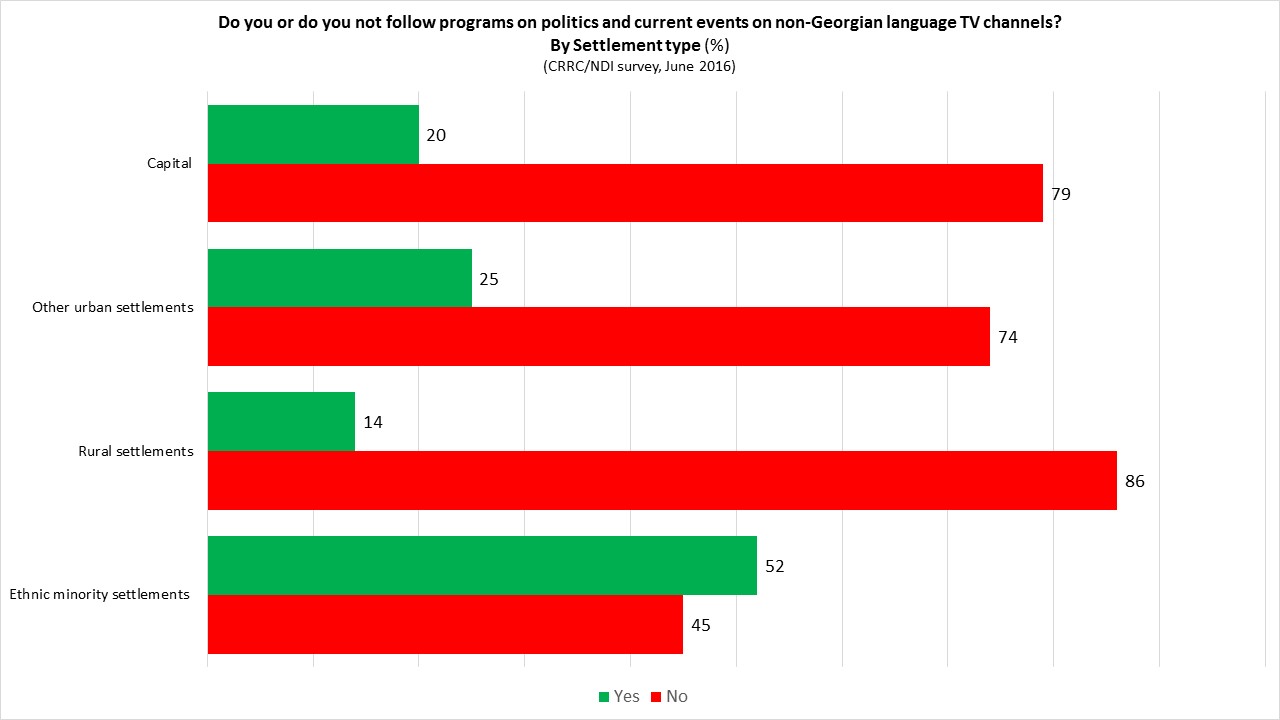
TV is the main source of information about politics and current events for a majority of Georgia's population—77% pick TV as their primary source, and an additional 12% choose it as their secondary source. However, only 23% of the population of Georgia, irrespective of whether they name TV as their primary or secondary source of information, reports watching programs on politics and current events on foreign TV channels. Four out of the five most frequently mentioned foreign language TV channels watched by these 23% broadcast in the Russian language (Russia Channel One, RTR, Russia 1 and Russia 24), while the fifth (Euronews) broadcasts in both English and Russian.

How does the 23% of Georgia’s population that watches programs on politics and current events on foreign TV channels compare demographically and politically to the rest, who report only watching news on Georgian-language channels? Some characteristics of the former group are intuitive. For example, about half of the population of ethnic minority settlements (52%) report watching the news on foreign language TV channels. In contrast, only a quarter of the population in urban settlements outside of Tbilisi report watching the news on foreign language TV channels, while those living in Georgia’s rural non-ethnic minority settlements report the lowest viewership (14%).


A larger share of viewers 36 and older tend to watch foreign (especially Russian-language) TV channels for information on politics and current events than younger viewers. This likely reflects the patterns of knowledge of the Russian language in Georgia. According to the CRRC’s 2015 Caucasus Barometer survey, 40% of Georgia’s population 35 and younger report either not having any knowledge, or a beginner’s level of knowledge of the Russian language, compared to only 19% of the population between 36 and 55, and 27% of the population who are 56 and older.

On the other hand, some characteristics of foreign news program audiences in Georgia are not as obvious. For example, a slightly higher share (25%) of those who reported that they would vote in parliamentary elections if they were held tomorrow watch foreign language news programs than likely abstainers (19%). Twenty-eight percent of decided voters also reported that they follow programs on politics and current events on foreign channels, compared to 20% of undecided voters.


Note: A 10-point scale was used to record the answers to the question, “If parliamentary elections were held tomorrow, would you vote or not?”, where option 1 corresponded to the answer “Certainly will not vote”, and option 10 corresponded to the answer “Will certainly vote”. For this blog post, the original scale was recoded, so that those choosing option 10 were coded as “Likely voters” (67%), while all those choosing options were grouped into “Likely abstainers” (33%).

If viewers of foreign TV news report slightly more often that they are likely to vote, and that they have made a decision regarding who to vote for, the question emerges – are their political affiliations any different from their counterparts who only watch domestic TV news? Interestingly, the party preferences of the two audiences show no statistically significant differences between them. Even when the data are separated further to distinguish between viewers of Russian-language TV and other foreign language TV, there is no difference in reported party preferences between the groups.

Hence, watching programs on politics and current events on foreign TV channels does not appear to tilt voters towards particular parties. Deciding which political party to vote for in Georgia is a complex process. Understandably, voters take into account a large number of individual, social, and political factors when making decisions at the voting booth. While viewers of foreign TV news may be slightly more willing to vote, and surer of their voting choices, the choices they make are similar to those who watch domestic TV channels.

To explore the data in more depth, try CRRC's Online Data Analysis tool. If you are interested in the landscape of popular media in Georgia, check out CRRC's earlier blog posts on the role of the Georgian Public Broadcaster, Georgia's press freedom ranking, and Russia's influence on Georgia's media.

Monday, September 26, 2016

Trends in the Data: Declining Trust and Rising Ambivalence towards the Media in Georgia

CRRC has written before about the ambivalent attitude of the population of Georgia towards journalists. Based on CRRC’s Caucasus Barometer (CB) survey data, this post explores the population’s trust in the media over time, showing that it has been declining steadily since 2008, while ambivalence, demonstrated by the finding that people have difficulty stating their opinion and opt instead for either/or options, has been increasing. 

Between 2008 and 2015, reported trust in the media declined by 28 percentage points in Georgia. The biggest drops are between 2008 and 2009 and between 2011 and 2012. Interestingly, over the same period, the reported level of distrust in the media has remained rather steady. Ambivalence, however, is rising. The share of the population responding that they “neither trust nor distrust” the media climbed from 28% in 2008 to 54% in 2015.


Note: A 5-point scale was used during the survey. For this chart, answer options “Fully trust” and “Trust” have been combined into ’Trust’ and answer options “Fully distrust” and “Distrust” have been combined into ’Distrust’. Caucasus Barometer was not carried out in 2014.

The decline in trust and rise in ambivalence towards the media is consistent with responses to other CB questions on the media. Over time, the population’s positive assessment of how well TV journalists inform the population about what is going on in the country has also declined, while their ambivalence has risen. Since both trends are steady, this change seems to be less of a question of a reaction to specific events and more of a general shift. Between 2009 and 2015, positive assessments of how well TV journalists inform people dropped by 14 percentage points while ambivalence increased by 12 percentage points. As in the answers about general trust in the media, reported negative assessments remain stable.


Note: A 5-point scale was used during the survey. For this chart, answer options “Very well” and “Quite well” have been combined into option ‘Well’ and answer options “Very poorly” and “Quite poorly” have been combined into ‘Poorly’. 

Similar patterns can be discerned with regards to whether the Georgian population thinks that TV journalists serve their interests. Since 2009, the share of the population who reported believing that TV journalists, overall, serve the interests of people like them decreased by 13 percentage points, while ambivalence increased by 15 percentage points. 


Note: A 5-point scale was used during the survey. For this chart, answer options “Completely agree” and “Somewhat agree” have been combined into option ’Agree’ and answer options “Completely disagree” and “Somewhat disagree” have been combined into ’Disagree’. This question was not asked in 2013. 

The population of Georgia’s trust in the media has been steadily declining since 2008. Interestingly, this decline coincides with an increase in ambivalent attitudes rather than distrust. The same is reflected in assessments of how well TV journalists keep the public informed and how well they represent the interests of “regular” people. In all cases, positive assessments have decreased, while ambivalence has increased. If the trends marked here are indeed general shifts in attitudes towards the media, as the data for available years suggests, this has the potential to point to long-term changes that are less attached to specific political events or media scandals and may indicate avenues for further research on public opinion in Georgia about the media. 

The datasets used in this blog post and related documentation are available at our online data analysis platform. 

Monday, June 06, 2016

Attitudes towards public opinion polls in Georgia (Part 2)

CRRC/NDI’s public opinion polls become the subject of intense discussions after the results of every wave of the survey are released, with politicians from various political parties criticizing the polls. Such a situation, though, is not unique to Georgia. As Professor Arthur Lupia recently put it, pollsters are a “popular whipping boy in politics”, yet they also “can give people a stronger voice”. In a previous blog post, we showed that attitudes toward public opinion poll results are mixed in Georgia, with nearly equal shares of the population trusting, distrusting, and neither trusting nor distrusting the results. This blog post shows that even though public opinion polls are regularly criticized in Georgia, there is still a public demand for them. 

CRRC’s 2015 Caucasus Barometer survey asked respondents to rate the level of their agreement or disagreement with the following statements:

• “Public opinion polls help all of us get better knowledge about the society we live in”;
• “Ordinary people trust public opinion poll results only when they like the results”; 
• “Public opinion polls can only work well in developed democratic countries, but not in countries like Georgia”;
• “The government should consider the results of public opinion polls while making political decisions”;
• “Politicians trust public opinion poll results only when these are favorable for them or for their party”;
• “I think I understand quite well how public opinion polls are conducted”.

Those who, while answering the previous question about trust in polling results, reported they did not know anything about public opinion polls, were not asked these questions.
Two-thirds of the population agrees with the statement that the government should consider the results of public opinion polls while making decisions, and nearly half agrees that polls help everyone to better understand the society they live in.   

Note: A 10-point scale was used to record answers to these questions. On the original scale, code ‘1’ corresponded to the option “Completely disagree” and code ‘10’ corresponded to the option “Completely agree”. For the charts in this blog post, the answers were grouped as follows: codes ‘1’ through ‘4’ were labeled “Disagree”; codes ‘5’ and ‘6’ were labeled “Neutral”; codes ‘7’ through ‘10’ were labeled “Agree”. Options “Don’t know” and “Refuse to answer” aren’t shown on the charts.

The share of the population who disagree with the statement that “polls can only work in developed democratic countries, but not in countries like Georgia,” is almost twice as large as the share of those who agree with this statement.


At the same time, people don’t feel they have a good knowledge of how public opinion polls are conducted. Only 36% report believing they have a good understanding of it. 45% also report that ordinary people trust the results of public opinion polls only when they like them, and 62% report the same in the case of politicians. Increasing knowledge of and trust in polls are clear challenges for pollsters in Georgia.

Whether people trust them or not, polls are important for society, and the results presented in this blog post show that people do acknowledge this importance. Polls help everyone grasp what society thinks, and the majority of the population thinks the government should consider poll results when making decisions.

To learn more about public opinion polls, take a look at earlier blog posts including Attitudes toward public opinion polls in Georgia,  Ask CRRC | Survey vs Census and Pre-Election Polls | what would be needed. To learn more about how CRRC collects data, take a look at this video or read CRRC-Georgia’s Research Guidelines. 


Monday, April 11, 2016

Attitudes toward public opinion polls in Georgia

In his book Polling and the Public Herbert Asher notes that findings of public opinion polls have significant effects on citizens’ attitudes and behavior. This is clearly true in Georgia where public opinion polls (especially those focused on political attitudes) are widely discussed by politicians, experts, and the media. Using CRRC’s 2015 Caucasus Barometer (CB) data, this blog post examines attitudes towards public opinion polls in Georgia.

Generally, the public’s trust in the results of public opinion polls is mixed in Georgia. One-third of the population reports trusting poll results, another third reports a neutral attitude, and 21% reports distrusting them. A small share of the population either does not know anything about the polls, answers “Don’t know” or refuses to answer this question.


Note: A 10-point scale was used to record answers to the question: “Generally speaking, to what extent would you say you trust or distrust the results of public opinion polls conducted in our country?” On the original scale, code ‘1’ corresponded to the option “Do not trust at all” and code ‘10’ corresponded to the option “Completely trust”. For this blog post, the answers were grouped as follows: codes ‘1’ through ‘4’ were labeled as “Distrust”; codes ‘5’ and ‘6’ were labeled as “[In the middle]”; codes ‘7’ through ‘10’ were labeled as “Trust”. Options “Don’t know” and “Refuse to answer” were combined. 

Reported trust in the results of public opinion polls varies in different demographic groups. Tbilisi residents tend to report slightly higher trust compared to those living in other urban and rural settlements. Those who are younger (18 to 35 years old) also report higher trust than those who are 56 years old or older. A slightly greater share of those with higher than secondary education reports trusting poll results compared to those with secondary or lower education.


Note: Only shares of those who reported trusting public opinion poll results are shown in the chart. The answer options for the question on education level were grouped as follows: options “No primary education”, “Primary education (either complete or incomplete)”, “Incomplete secondary education” and “Completed secondary education” were grouped into “Secondary or lower”. Options “Incomplete higher education”, “Completed higher education (BA, MA, or specialist degree)” and “Post-graduate degree” were grouped into “Higher than secondary”.

Interestingly, nearly half (46%) of those who report trusting the media also report trusting poll results, and statistical correlation of the answers to these two questions is significant. By comparison, only a quarter (26%) of those who distrust the media report trusting poll results.


Note: A 5-point scale was used to record answers to the question, “Please tell me how much do you trust or distrust Georgia’s media?” For this blog post, answer options "Fully trust" and "Rather trust" were combined into "Trust media"; ”Rather distrust" and "Fully distrust" were combined into "Distrust media". Options "Don't know" and "Refuse to answer" are not shown on the chart.

Attitudes toward public opinion poll results in Georgia are mixed, and nearly equal shares of the population trust, distrust or neither trust nor distrust the results. There are, however, some differences between those living in different settlement types, as well as between representatives of different age groups, and those having different levels of education. Generally, those who report trusting the media tend to trust the results of public opinion polls.

To learn more about public opinion polls, take a look at earlier blog posts including Ask CRRC | Survey vs Census and Pre-Election Polls | what would be needed. To learn more about how CRRC collects data, take a look at this video or read CRRC-Georgia’s Research Guidelines. 

Monday, February 29, 2016

What the population of Georgia wants to know about the EU and how people want to be informed


The Government of Georgia (GoG) recently announced a plan to better inform the public about European Union (EU) programs in Georgia and their benefits. This effort is important, because the population often does not have accurate information about the EU and Georgia’s relations with it, as described in a recent blog post, as well as in a more comprehensive report. Nonetheless, roughly half of the Georgian population reports they would like to get more information on the EU, and this share has remained steady since 2013. This blog post aims at understanding how the EU and GoG could best design their information campaign about Georgia-EU relations by covering topics Georgians are most interested in. To do so, we take a look at the 2013 and 2015 waves of Europe Foundation’s Knowledge and attitudes towards the EU survey which was conducted by CRRC-Georgia.

To start, existing knowledge about the EU is rather limited. Only 27% of the population of Georgia knew in 2015 that the EU had between 21 and 30 member states, while 23% chose an incorrect answer. Most importantly, half of the population responded that they did not know the answer or refused to answer the question. These findings are roughly the same as in 2013. 

The population’s level of education seems like an understandable place to turn for possible explanations for the lack of knowledge. However, 46% of those providing an incorrect answer to the respective question report having at least some higher education – in fact, the shares of people with various levels of education are the same irrespective of whether they answered this question correctly or incorrectly.


Note: During the interviews, a show card was used for the question, “How many member states are currently in the EU?” The options from the show card have been recoded for this chart. The option “Incorrect” combines options “Up to 10 [member states]”, “From 11 to 20”, “From 31 to 40”, and “More than 40.” The option “Correct” corresponds to the option “From 21 to 30 [member states]”. Reported level of education has also been recoded for this chart. The options “Complete or incomplete primary”, “Incomplete secondary”, and “Complete secondary” have been combined into category “Secondary or lower education”. The options “Incomplete higher [education]”, “BA”, “MA”, and “Postgraduate” have been combined into the category “At least some higher education”.

When assessing how interested people are in various areas of knowledge about the EU, there is obviously a great deal of interest in the EU’s potential practical benefits for Georgia. Forty-one percent of those who report they would like to get more information about the EU want to have more information on Georgia-EU trade relations, consistent with the finding that economic reasons are named most frequently when Georgians are asked why they support the country’s membership in the EU. Unemployment and poverty being at the top of people’s concerns, it again isn’t surprising that the Georgian population is interested in the socio-economic situation in the EU.

Note: A show card was used for this question. Only the most frequently named answers are presented in the chart. 

Although 35% of those who would like to get more information on the EU mentioned that they would like to have more information on the EU’s role in conflict resolution, when asked what the EU Monitoring Mission does in Georgia, only 20% answered that it helps regulate the situation in the areas affected by the 2008 August War. Forty one percent reported they did not know the answer.

Television was identified by the Georgian Government in 2013 as the main source of information for Georgians about the EU and European integration. However, 40% of the population reported in 2015 that, in their opinion, there was little or no information on the EU on TV – almost twice as much as in 2013.


Note: A 5-point scale was used to record answers to the question, “How much information about the EU do you get from TV?” On the original scale, code ‘1’ corresponded to the answer “No information at all” and code ‘5’ corresponded to the answer “A lot of information”. For the analysis presented in this blog post, answer options ‘1’ and ‘2’ of the original scale have been combined and labeled as “Little / No information”. Option ‘3’ was not recoded and is labeled ”A fair amount of information”. Answer options ‘4’ and ‘5’ were combined and labeled as “A lot of information”. Options “Don’t know” and “Refuse to answer” (less than 5% if combined) were excluded from the analysis. 

Thus, on the one hand, about half of the Georgian population reports wanting to have more information about the EU, and its main source of information is TV. On the other hand, in 2015 more people reported that they receive little or no information on the EU from TV than did so in 2013. But efforts like the harmonization of Georgian legislation with EU legislation in areas such as the common market, sectoral policy, law, freedom, and security require wide ranging and costly reforms before leading to practical benefits. This means the reforms require public support if they are to be sustained. Therefore, it is increasingly important that TV broadcasters and other media find a way to keep Georgians informed about the EU and the country’s European integration. 

If the EU and GoG concentrate their communication efforts on the practical benefits for regular people, they are likely to succeed in sustaining the high level of approval towards European integration in the country.  

Tuesday, December 22, 2015

No, Putin is not winning Georgia away from Europe. Here are the facts.

[Editor's Note: This post was originally published on the Washington Post's Monkey Cage on Monday, December 21, 2015. The original post is available here. The views and opinions expressed in this article are those of the author alone and do not necessarily reflect the views of CRRC-Georgia or any of the sponsors of the survey which this article is based on. The data on which this article is based is available here.]

By Dustin Gilbreath

Last Friday, after years of diplomatic wrangling over the course of two administrations, the Republic of Georgia received a report from the EU green lighting visa free travel within the European Union in the near future. Yet, media accounts from earlier this year suggested that Georgia was undergoing a “Russian turn”.

That appeared to be true last May, when an NDI-CRRC public opinion poll declared that 31 percent of Georgians favored ECU membership. Have voters in the Republic of Georgia suddenly begun to prefer an affiliation with the Russian-led Eurasian Customs Union over their existing affiliation with the European Union?

If true, it would be shocking. Since its independence in 1991, Georgia has favored Europe overwhelmingly. Polling has found levels of support for the EU that Brussels could only dream of elsewhere in Europe, and serious ongoing problems between Georgia and Russia would naturally strengthen those pro-Europe leanings.

Certainly, many observers have taken that poll number to heart. Nearly a dozen publications and organizations—such as the Financial Times, the Washington Post, Al Jazeera, the Wall Street Journal, Foreign Policy, the BBC, Foreign Affairs, Carnegie Endowment, and Brookings Institution—have cited the number. It even seems to have influenced a Roll Call op-ed, the first sentence of which cited “recent news accounts” on Georgia and Ukraine. Almost every news account on Georgia at the time cited the number.

But that number hasn’t changed since 2013, when the Caucasus Barometer examined support for Georgian Customs Union membership. Moreover, the number by itself is misleading. The data show far fewer Georgians are consistently pro-Russian. ”The Russian turn” has been overstated.

Two Unions, Four preferences

In August, Georgians were asked whether they approve of the Georgian government’s goal of joining the EU and whether Georgia should join the Eurasian Customs Union. Twice as many Georgians prefer the EU to the Eurasian Union, 61% to 31%. This has been largely consistent over time, although support for the EU has had its ups and downs with a slight decline in recent years. Nonetheless, support for the Eurasian Customs Union has never been more than half the level of support for the EU.

Georgians fall into four consistent groups about union membership. Here’s the largest one: 39% say they would vote for the EU and against the Customs Union (marked in the graph below as pro-EU). Only 15 percent would vote for the Customs Union and against the EU. The joiners, 12 percent, support membership in both unions. And the isolationists, 5 percent, would vote against both unions. Another 11 percent don’t know how they feel about either union, and 17 percent had responses that didn’t really have a clear interpretation.


Why would any Georgians support economic union with the nation’s former oppressor, Russia?


To read on, please visit the Washington Post's Monkey Cage: