Showing posts with label Journalism. Show all posts

Tuesday, September 13, 2022

Do Georgians trust TV?

Note: This article first appeared on the Caucasus Data Blog, a joint effort of CRRC Georgia and OC Media. It was written by Kristina Vacharadze, Programs Manager, and Mariam Kobaladze, Senior Researcher at CRRC-Georgia,  The views presented in the article are of the authors alone, and do not necessarily reflect the views of CRRC Georgia, or any related entity.

In an increasingly polarised media environment, Georgians have mixed feelings about how much TV and TV journalists can be trusted. 

Over the past decade, TV as a source of news has been on the decline in Georgia. With just 53% of those surveyed in 2021 using TV as their primary news source, as compared to 88% in 2009, it is clear that TV has lost its dominance. Nonetheless, it remains the main news source for  half of the adult population.

This fall in TV consumption has taken place against a background of an increasingly divided media environment. Media monitoring studies show that, in recent years, there have been clear trends of polarisation amongst television channels, with many strongly supporting either the ruling party or the opposition. 

This has been reflected in qualitative studies by CRRC-Georgia, in which many people have said that they have to watch news on several television channels to be able to draw reasonable conclusions on events that have happened and how they might interpret them. 

In such an environment, what does the Georgian public think of television and TV journalists? 

Can TV be trusted?

According to the Caucasus Barometer 2021, an annual household survey run by CRRC, 18% of the population does not trust any television channel for news about politics and current events and 14% does not watch television news at all. 

The most trusted television channels for news on politics and current events were found at opposite ends of the political sprectrum - the pro-government Imedi, trusted by a quarter (25%) of the population, and the pro-opposition Mtavari, trusted by 12%. Less than a tenth of the population trusted Rustavi 2 (8%), TV Pirveli (6%), and the Public Broadcaster (4%) more than any other station.
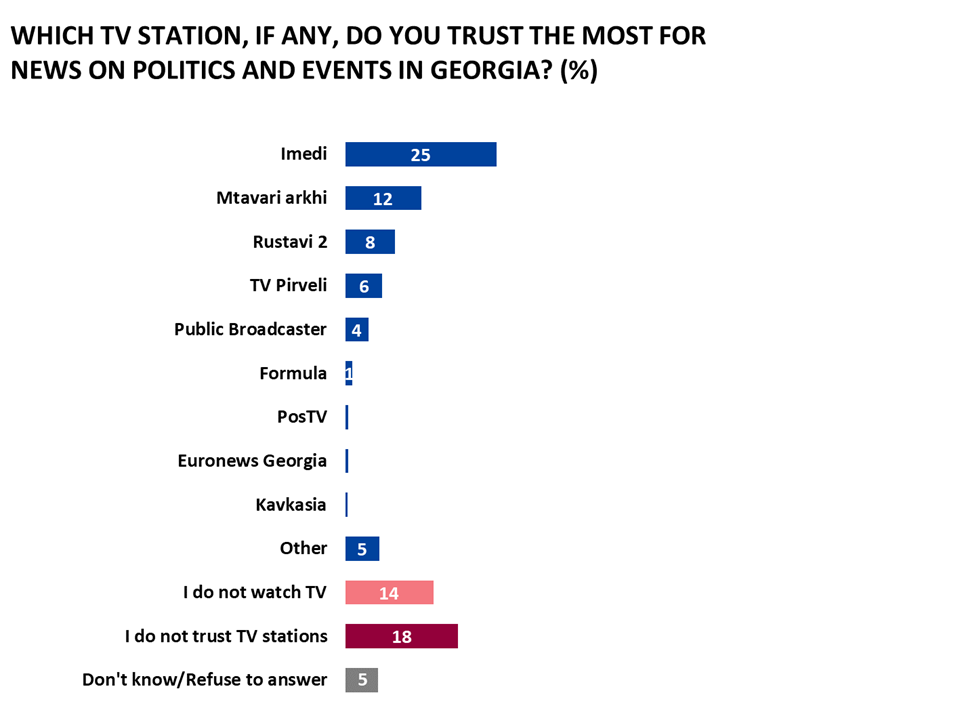
A regression analysis found that trust in TV and TV stations and viewing habits were associated with various demographic characteristics. 

Older people were more likely to watch and trust TV compared to other age groups. 

Ethnic minorities were more likely to distrust TV or not watch it compared to ethnic Georgians. This could be in part related to a lack of Armenian- and Azerbaijani-language programming on Georgian television. 

Working people were more likely to distrust and/or not watch TV news compared to people who did not work. 

People who supported a political party were more likely to watch and trust TV than people who did not support any party, or refused to report a party preference.

There were no patterns associated with settlement type, gender, or education level.

Note: The analysis uses a multinomial regression, where the dependent variable is whether people distrust TV, do not watch any TV channel for news about politics and current events, or trust a specific TV station. The independent variables are gender, age group, ethnicity, settlement type, level of education, and employment status.

What do the public think of TV journalists?

With a third of the population distrusting and/or not watching news on any television channel, what does the Georgian public think of the performance of TV journalists? 

About half of those surveyed (48%) believed that Georgian TV journalists inform the population about ongoing events in Georgia neither poorly nor well, while approximately a fifth of the population either positively or negatively assesses their work.

A multinomial regression showed that women were more likely to agree with the idea that TV journalists were serving their interests than men were. On the other hand, people living in urban areas assessed the performance of TV journalists more negatively than those living in rural settlements.

Party allegiance was also a significant predictor of people’s views: respondents who supported an opposition party were more positive towards the performance of journalists than supporters of the ruling party, Georgian Dream. 

Wealth (measured as the number of items a household owns from a list of 14) was also a significant predictor: poor people assessed the performance of journalists more positively than wealthier people.

Unsurprisingly, people who watched TV tended to feel more positively about TV journalists than people who do not watch TV.

A regression analysis did not show significant differences in attitudes between different age groups, ethnicities, people with different education levels, or with and without a job.
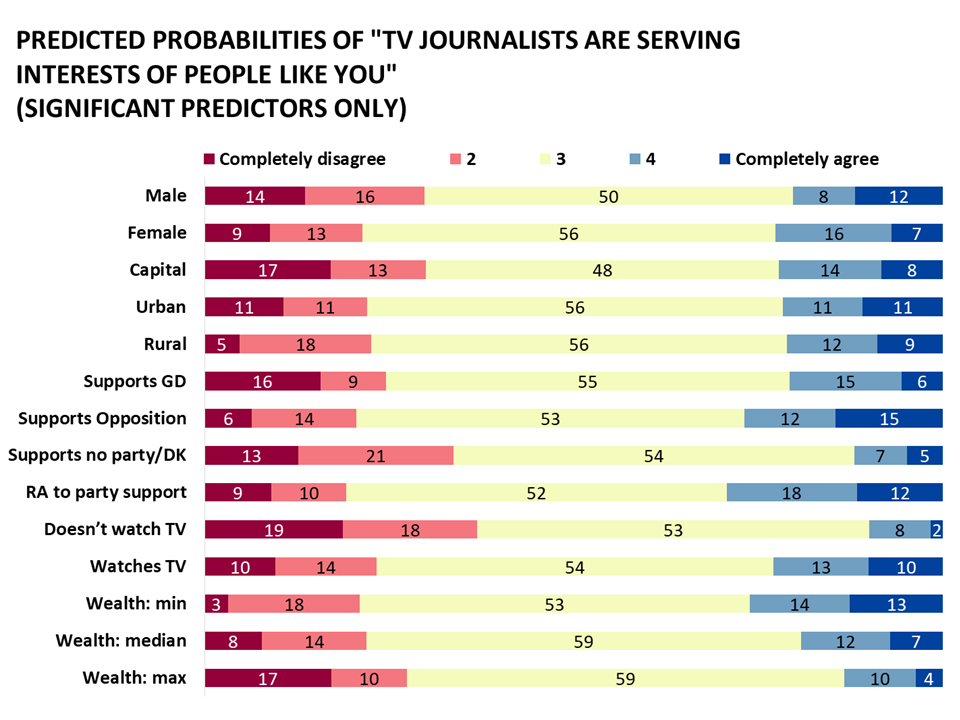
Note: The analysis uses a multinomial regression, where the dependent variable is whether people agree or disagree with the statement that TV journalists in Georgia are serving the interests of people like them. The independent variables are gender, age group, ethnicity, settlement type, level of education, wealth, watching TV and employment status.

The data shows a similar pattern with regard to views on whether TV journalists in Georgia serve the interests of the people. Slightly less than half of the population in Georgia (47%) neither agree nor disagree, while around a quarter (23%) believed that TV journalists do not serve the interests of the people, and a fifth (19%) believed that they did. Notably, people have become more pessimistic with regards to this question over the last decade, with a seven percentage point increase in disagreement with this sentiment between 2009 and 2021, and a 13 point decline in agreement with the statement during the same period. 
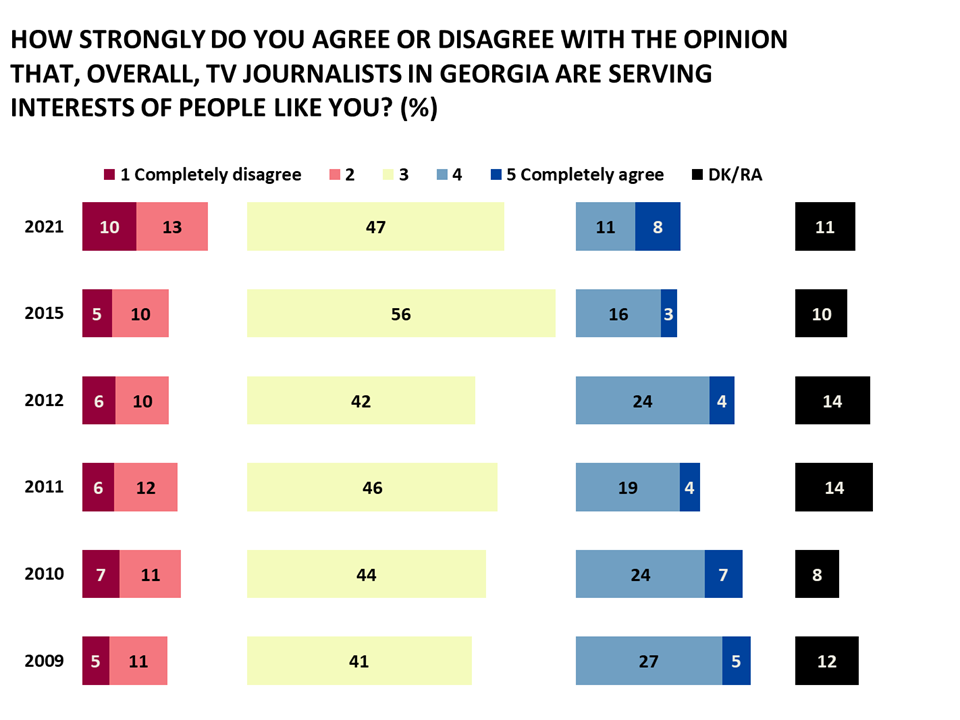
In the context of a very divided media landscape, it is notable that there is low public trust in television news and outlets. This trust appears to have fallen over the past decade, with fewer now believing that TV journalists in Georgia serve their interests. 

The data used in this post is available here.

Monday, September 26, 2016

Trends in the Data: Declining Trust and Rising Ambivalence towards the Media in Georgia

CRRC has written before about the ambivalent attitude of the population of Georgia towards journalists. Based on CRRC’s Caucasus Barometer (CB) survey data, this post explores the population’s trust in the media over time, showing that it has been declining steadily since 2008, while ambivalence, demonstrated by the finding that people have difficulty stating their opinion and opt instead for either/or options, has been increasing. 

Between 2008 and 2015, reported trust in the media declined by 28 percentage points in Georgia. The biggest drops are between 2008 and 2009 and between 2011 and 2012. Interestingly, over the same period, the reported level of distrust in the media has remained rather steady. Ambivalence, however, is rising. The share of the population responding that they “neither trust nor distrust” the media climbed from 28% in 2008 to 54% in 2015.


Note: A 5-point scale was used during the survey. For this chart, answer options “Fully trust” and “Trust” have been combined into ’Trust’ and answer options “Fully distrust” and “Distrust” have been combined into ’Distrust’. Caucasus Barometer was not carried out in 2014.

The decline in trust and rise in ambivalence towards the media is consistent with responses to other CB questions on the media. Over time, the population’s positive assessment of how well TV journalists inform the population about what is going on in the country has also declined, while their ambivalence has risen. Since both trends are steady, this change seems to be less of a question of a reaction to specific events and more of a general shift. Between 2009 and 2015, positive assessments of how well TV journalists inform people dropped by 14 percentage points while ambivalence increased by 12 percentage points. As in the answers about general trust in the media, reported negative assessments remain stable.


Note: A 5-point scale was used during the survey. For this chart, answer options “Very well” and “Quite well” have been combined into option ‘Well’ and answer options “Very poorly” and “Quite poorly” have been combined into ‘Poorly’. 

Similar patterns can be discerned with regards to whether the Georgian population thinks that TV journalists serve their interests. Since 2009, the share of the population who reported believing that TV journalists, overall, serve the interests of people like them decreased by 13 percentage points, while ambivalence increased by 15 percentage points. 


Note: A 5-point scale was used during the survey. For this chart, answer options “Completely agree” and “Somewhat agree” have been combined into option ’Agree’ and answer options “Completely disagree” and “Somewhat disagree” have been combined into ’Disagree’. This question was not asked in 2013. 

The population of Georgia’s trust in the media has been steadily declining since 2008. Interestingly, this decline coincides with an increase in ambivalent attitudes rather than distrust. The same is reflected in assessments of how well TV journalists keep the public informed and how well they represent the interests of “regular” people. In all cases, positive assessments have decreased, while ambivalence has increased. If the trends marked here are indeed general shifts in attitudes towards the media, as the data for available years suggests, this has the potential to point to long-term changes that are less attached to specific political events or media scandals and may indicate avenues for further research on public opinion in Georgia about the media. 

The datasets used in this blog post and related documentation are available at our online data analysis platform. 

Monday, September 14, 2015

The Georgian public on journalists


Over the last month, a number of scandals have emerged on the Georgian media landscape. On August 7th, Rustavi 2, a national television station often associated with the previously governing United National Movement (UNM), had its assets frozen in response to Kibar Khalvashi’s claim that he was wrongfully denied his ownership rights of the station during the UNM’s governance. More recently, cancellation of two political talk shows was announced on Imedi TV, another national station, owned by Badri Patarkatsishvili’s family. Imedi later stated that it was not cancelling the talk shows. Two weeks ago, it was announced that two more political talk shows face cancellation (see here and here). Suspicions have been voiced that these cases are related to the upcoming 2016 Parliamentary elections. Considering the recent scandals, an understanding of how Georgians view journalists is important as the public’s view of them proxies the public’s trust in the media they consume. This blog post takes a look at attitudes towards journalists reported during the May 2015 Transparency International – Georgia public opinion poll, conducted by CRRC-Georgia.

On the whole, Georgians are quite ambivalent about journalists. To start, more than half of the Georgian population reports that they neither trust nor distrust journalists. This response is more or less equally characteristic for various segments of Georgian society, with roughly half of the representatives of every education level, age group, settlement type, and gender reporting so. Slight differences are present – those with at least some tertiary education, the young, and Tbilisi residents are all slightly less trusting of journalists than those who are less educated, older, and live outside the capital. Georgians report neither trusting nor distrusting journalists more often than representatives of any of the other professions or institutions asked about on the survey, including judges, police, doctors, teachers, NGOs, the President, Parliament, Prime Minister, and local government. Slightly more Georgians, though, report trusting journalists than distrusting them (25% versus 18%).


Note: The original five-point scale was recoded into a three-point scale. “Fully trust” and “Trust” were combined into the category ‘Trust’ on the chart above, while “Fully distrust” and “Distrust” were combined into ‘Distrust.’ “Neither trust nor distrust” was not recoded. Education levels were also recoded. ‘Secondary or lower’ includes individuals with only primary education, some secondary education, and completed secondary education. ‘Tertiary education’ includes those with some higher education, Bachelor’s degrees, Master’s degrees and PhDs. ‘Secondary technical’ education was not recoded.

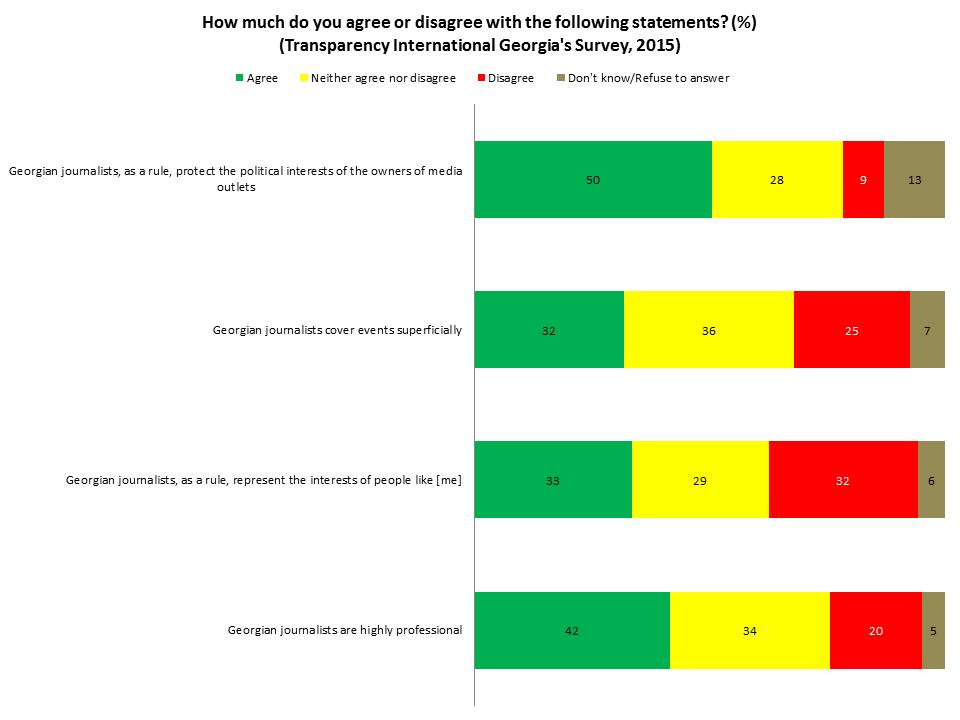
The wide spread “neither trust nor distrust” attitude must in part stem from the perception that journalists in Georgia lack independence and are not working with the average person’s interests in mind. Half of the Georgian population believes that “Georgian journalists, as a rule, protect the political interests of the owners of media outlets,” though different people may have different attitudes to this issue. In addition, only a third of the public agrees with the statement that “Georgian journalists, as a rule, represent the interests of people like [me]”, and 32% agree with the statement that “Georgian journalists cover events superficially”. On a bright note, however, twice as many Georgians agree with the statement “Georgian journalists are highly professional” compared with those who disagree.


Note: Originally, the responses were recorded on a five-point scale where code 1 meant “Fully disagree” and code 5 meant “Fully agree“. For the chart above, codes 1 and 2 were combined into ‘Disagree’ and codes 4 and 5 were combined into ‘Agree.’ ”Neither agree nor disagree” was not recoded.

The findings suggest the journalists in Georgia need to work with the interests of ordinary people, not the owners of media outlets, in mind. If they do so, the population’s trust towards them will likely increase. To learn more about Georgians’ attitudes towards the media, have a look at the findings of the Media survey in Georgia here.

Tuesday, July 10, 2012

New and Old Media: Trends in Azerbaijan

Despite some international criticism on media freedom, nationwide survey data shows that Azerbaijanis seem to be generally satisfied with certain forms of national mass media—although with a few exceptions. The overall picture that emerges from the 2011 Caucasus Barometer in Azerbaijan is that 44% of the population thinks TV journalists inform the population well, 32% are neutral, and 16% say TV journalists do not inform the population well (7% don’t know). A 2012 survey conducted by CRRC on Social Capital, Media and Gender (download at http://www.crrccenters.org/activities/research/?id=70) highlights some interesting facts about how Azerbaijanis use mass media and how they stay informed.

Taken together, channels of information such as television and personal networks remain favored by a majority of the population, whereas new media such as the internet still plays a minor role. Television is the preferred main source of information by 90% of the population. This is followed by informal personal networks such as family members and neighbors/friends that are preferred by 30% and 27% of the population, respectively, as their second main source of information. These ways of obtaining information far outstrip the internet or printed media (e.g., newspapers).

Source: Social Capital, Media and Gender in Azerbaijan, 2012

Television plays a pivotal role in Azerbaijan since the majority of the population uses it as their main source of information. Moreover, when asked to assess the level of importance for media to freely publish news and ideas without government control, 75% of Azerbaijanis think this is very important for TV. This is followed by fewer people who say that this freedom is very important for the radio (23%), internet (34%) and newspapers (27%).

In general, newspapers are less preferred in the country. 79% of Azerbaijanis do not read newspapers at all, 10% read them but not daily, and the other 11% say they read newspapers at some point on an average day. This indication of discontent with printed media seems to be stronger in rural regions where the percentage of those who do not read newspapers at all increases to 87%. The most common reasons people give for not reading newspapers are little interest (37%), not enough time to read them (21%), insufficient distribution (14%) and a lack of money (11%).

Source: Social Capital, Media and Gender in Azerbaijan, 2012
 Another interesting result that has emerged from the data is that general internet use is low in Azerbaijan. 64% of Azerbaijanis never use the internet and 11% say they don’t know what the internet is. Out of those who say they never use the internet, slightly more are women (55%) than men (45%). 17% use the internet at least once a week (up from 10% in 2010) and 7% access the web at most once a month.

The so-called digital divide which refers to inequalities within a society in terms of access to or knowledge of information and communication technologies is one of the reasons for the low level of internet usage in the country. 34% of Azerbaijanis have limited or no access to a computer or mobile phone (these two items were asked about within the same question), and 10% do not use the internet due to old age. Moreover, 27% of the population says that it has no interest using the internet. However, interestingly the level of education is positively associated with internet usage as 62% of adults with a degree above a Bachelors use the internet at least once a week.

Source: Social Capital, Media and Gender in Azerbaijan, 2012

More trends emerge with regard to radio usage. 56% of the population listens to news on national radio channels at least once a week and about 10% listen to regional channels for news. However, much of the population listens to the radio for entertainment such as popular (83%) or classical (61%) music. 

In summary, Azerbaijanis still prefer to rely on television and personal networks to obtain the news. It will be interesting to observe if Azerbaijan will follow the same path as many western countries in which there is an increasing importance of new media or if it will continue to place primary importance on TV and personal networks.

Monday, October 27, 2008

World Press Freedom | Caucasus does badly!

Yet another index, and one with little happy news. How does world press freedom look? Reporters Without Borders, an advocacy group founded in 1985 ("investigate, expose, support"), has just released an international ranking. A total of 173 countries are ranked, and the Caucasus is in the bottom third.

Armenia does best, ranked at 102, but is also down sharply from last year, following the state of emergency. Armenia is behind Ukraine (87) and Moldova (98). Armenia shares its place with Turkey, which with restrictions on various topics has a curtailed public space.

Georgia, also down sharply, is ranked at 120, behind Sierra Leone, Indonesia and other troubled countries, but still ahead of Kazakhstan (125) and Russia (141). The press release notes the state of emergency imposed in late 2007, and that several journalists became victims of the recent conflict.

Azerbaijan is ranked at 150, following Swaziland, the Democratic Republic of Congo, and extraterritorial Israel, presumably the occupied territories. However, Azerbaijan is ahead of Zimbabwe (151), Belarus (154), Uzbekistan (172) and North Korea (173). Arguably, Azerbaijan should hope to move out of this company (where, as the report says, being a journalist "is a high risk exercise involving endless frustration and constant police and judicial harassment") and try to place itself closer to, say, Kuwait (61) or the United Arab Emirates (69), countries that build easy legitimacy through oil wealth.

But what exactly does the index measure? The website provides an overview over the methodology. The index is based on a survey with 49 questions, reflecting distinct criteria, and is available online. Attention is given to "every kind of violation directly affecting journalists (such as murders, imprisonment, physical attacks and threats) and news media (censorship, confiscation of newspaper issues, searches and harassment)." It also looks at whether those that violate press freedoms enjoy impunity. Moreover, it looks at legislation and the degree of self-censorship. Certainly, that's an important component: one friend, moderating a TV talk show found the producers interrupting through his earpiece, instructing him not to touch on certain topics.

While one has little reason to doubt that journalism is not in a happy state, and that unfortunately the rankings are broadly accurate, a little more detail on the methodology would have been useful. How are the different components weighted? To what extent, for example, was the sharp drop for Georgia explained by the recent conflict? Or did the index finally catch on more to problems of self-censorship? Or did it reflect, in particular, the violent closure of Imedi? Providing such detail would be helpful, since it could stimulate public debate, focusing on particular shortcomings.

To take a closer look, go to the website of Reporters Without Borders.