Showing posts with label Azerbaijan. Show all posts

Wednesday, April 26, 2023

Life Satisfaction And What People Teach Their Children

Note: This article first appeared on the Caucasus Data Blog, a joint effort of CRRC-Georgia and OC Media. It was written by Dr. Tamar Khoshtaria, a Senior Researcher at CRRC-Georgia. The views presented in the article are of the author alone, and do not necessarily reflect the views of NDI, CRRC-Georgia, or any related entity.


Data from the European Values Study (EVS) of 2017 suggests that values commonly taught to children in different countries appear to be linked to how satisfied communities are with their lives. CRRC Georgia has compared the results between Russia, Georgia, Armenia, Azerbaijan, and a handful of European countries.

Most people in the world seek satisfaction with their lives; however, whether one experiences it is a matter of numerous potential factors.

One plausible contributor to life satisfaction could be the values parents or society instil in young people.

Data from the European Values Survey suggest that countries where larger shares of the public are satisfied with their life are more likely to teach their children about tolerance, respect, and independence.

Hard work tends to be associated with lower levels of life satisfaction, a trait commonly reported in the South Caucasus and Russia.

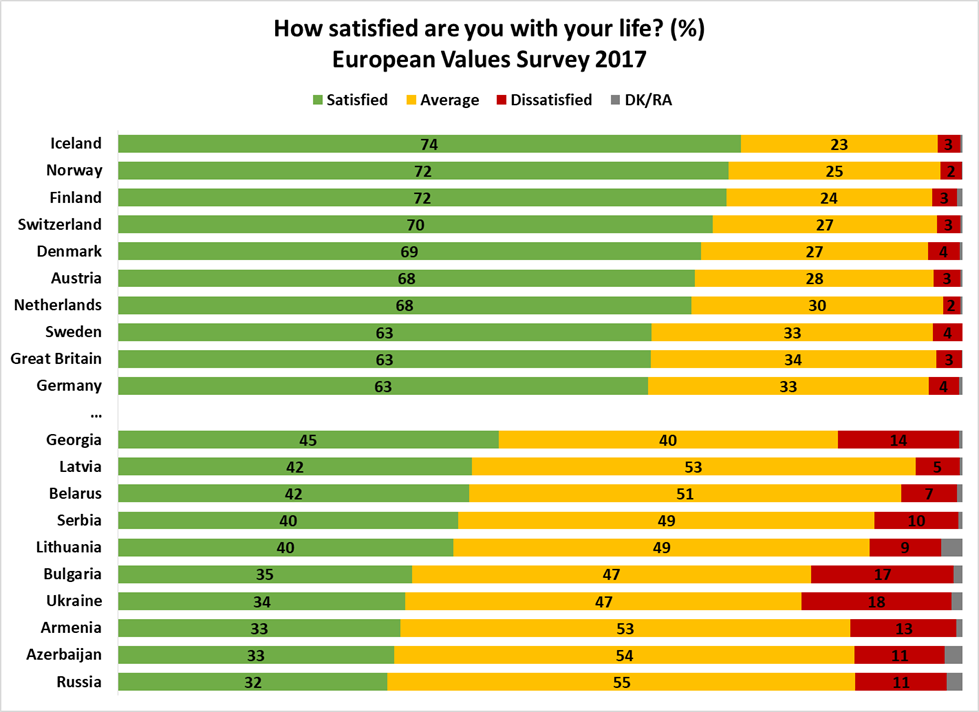
The European Values Survey suggests that Northern European countries reported the highest level of happiness and life satisfaction: data from 2017 suggested that over 90% of respondents living in Iceland (95%), Norway (94%), and Sweden (94%) say they are ‘very’ or ‘quite happy’. In addition, of the 36 countries covered in the survey, Iceland (74%), Norway (72%), and Finland (72%) reported the highest levels of satisfaction with life.

In contrast, only about one-third of people in Armenia (33%), Azerbaijan (33%), and Russia (32%) reported they were satisfied with life. Georgia stands somewhere in between, with 45% of its respondents claiming to be satisfied.

After Ukraine (18%) and Bulgaria (17%), Georgia has the highest share of people who say they are dissatisfied with their lives (14%).

Note: Respondents assessed life satisfaction on a 10-point scale, where 1 meant dissatisfied and 10 meant satisfied. Responses 1, 2 and 3 are labelled as dissatisfied on the chart above. Responses 4, 5, 6, and 7 are labelled as average, and 8, 9 and 10 are labelled as satisfied. The above chart does not include all countries in the survey due to space limitations. The graph above presents the 10 most and least satisfied countries in the study.


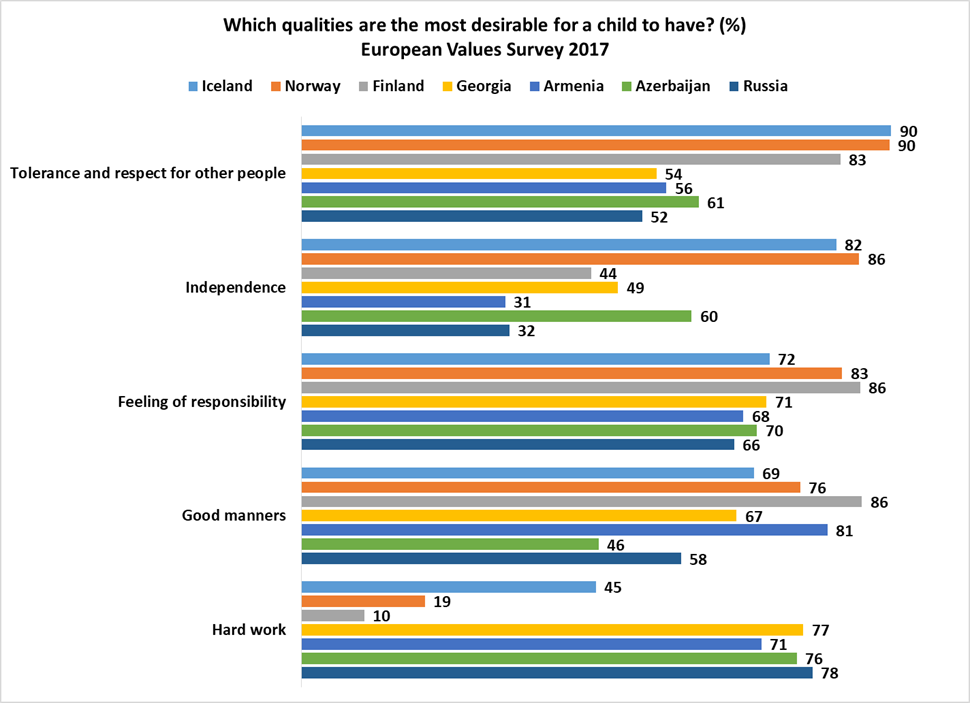
When looking at countries that are most and least satisfied with their lives and comparing them to Georgia, we see that these countries tend to have different ideas on what qualities are the most desirable for their children to learn.

In the countries most satisfied with their lives — Iceland, Norway, and Finland — tolerance and respect for other people were named by over 80% of respondents. This share is significantly lower in Georgia (54%) as well as in the countries where people are least satisfied with their lives — Armenia (56%), Azerbaijan (61%), and Russia (52%).

In Iceland and Norway, though not in Finland, independence is named by over 80% of the public as a highly desirable quality for a child. The share of people naming this quality as most desirable is significantly lower in Azerbaijan (60%) and Georgia (49%) and even lower in Armenia (31%) and Russia (32%).

While over 70% of respondents name hard work as the most desirable quality which a child should have in the South Caucasus and Russia, the percentage is significantly lower in Iceland (45%), Norway (19%), and Finland (10%).

Some qualities were deemed desirable in all seven countries, such as having a sense of responsibility and being well-mannered.


Several patterns also stand out for specific countries. For example, 62% of people in Finland think determination and/or perseverance are desirable qualities, while religious belief is more desirable in Georgia (50%) than in all other countries.

Being able to save money and thrift was valued the most in Russia at 49%.  A number of other characteristics show relatively little in terms of distinctive patterns. 


The above data show that the most satisfied people in Europe live in Iceland, Norway, and Finland, while the least satisfied live in Armenia, Azerbaijan, and Russia. Georgia stands somewhere in between.

People who are most satisfied with their lives are more likely to teach their children qualities such as tolerance and independence, while the least satisfied communities are more likely to emphasise the importance of hard work.

Responsibility and good manners are generally valued in all of these countries, while religious faith is more important in Georgia than in the other seven countries explored in this article.

The data used in this article is available here.

Tuesday, June 29, 2021

CRRC’s 7th Annual Conference: The South Caucasus after a Turbulent Year

On June 25 and 26, the Caucasus Research Resource Centers in Armenia, Azerbaijan, and Georgia hosted the 7th annual methods conference. This year the conference focused on the changing landscape of the South Caucasus and the turbulent year witnessed in the region. From the conflict between Armenia and Azerbaijan, to the political crisis in Georgia, speakers focused on what and how they are studying the changing landscapes in the region.

The first day of the conference featured two panels, one focused on COVID 19 and related innovations in social science and policy research. The second focused on politics and democratization in the South Caucasus.

The first day also featured two keynote addresses. In the first, Dr. Gevorg Yeghikyan described how big data from taxis and public transport could be used to improve urban planning. In the second, Dr. Jennifer McCoy presented research on the democratic hypocrisy hypothesis and experimental work on how presenting out groups as threats erodes democratic support.


The second day of the conference also featured two panels, with the first looking at how societies are changing in the South Caucasus. The second explored the prospects for conflict transformation in the South Caucasus.


The conference concluded with a keynote speech from Dr. Laurence Broers. Dr. Broers' address focused on how we can study the recent developments in the conflict between Armenia and Azerbaijan.


The full conference video is available for viewing here: Day 1 and Day 2.

The conference agenda and abstract book is available here. 


Wednesday, March 24, 2021

How do Georgians assess the parties involved in the Nagorno-Karabakh war?

This article first appeared at the Caucasus Data Blog, a joint effort of OC Media and CRRC Georgia. This article was written by Nino Zubashvili, a Researcher at CRRC Georgia. The views expressed in the article are the author’s alone and do not reflect the views of CRRC Georgia, or any related entity.  

While polling suggests that 26% of Georgia’s population had not heard of the war in Nagorno-Karabakh last autumn, for those who had, opinions were difficult to gage. So how did Georgians view the roles of the belligerents, outside actors, and indeed their own country?

In December 2020, shortly after the end of military operations in Nagorno-Karabakh, 74% of Georgians reported they had heard of the conflict that had raged there only a month prior. Among those that were aware of the conflict, the data indicate that assessing the parties directly or indirectly involved in the conflict was quite difficult. 

While Georgia’s role is assessed most positively, the roles Russia and Armenia played in the conflict seem to be viewed most negatively. In this regard, the data might reflect Georgian society’s views of its own unresolved conflicts.

Besides the belligerents to the conflict, a number of states and multilateral organisations were involved in the conflict and its resolution, including Turkey, Russia, France, the US, and the EU, among others. 

During the war, both Azerbaijani and Armenian forces were reported to have violated international humanitarian laws and the laws of war, resulting in civilian casualties and abuses of prisoners of war. 

Turkey was an open and strong supporter of Azerbaijan, while Russia, France, and the United States were involved in the ceasefire negotiations. Russia has since deployed peacekeepers in the post-conflict area to oversee the ceasefire. A joint Russian-Turkish ceasefire monitoring centre based in Azerbaijan, outside of the zone of conflict, has also been opened.  

Although Georgia remained officially neutral throughout the war and offered to facilitate dialogue, there was a great deal of disinformation regarding Georgia’s position in both Armenian and Azerbaijani media. Meanwhile, the EU expressed concern over the fighting and allocated millions in emergency aid for civilians affected by conflict, but did not play a significant diplomatic role.

While this is the backdrop in which Georgians were asked their views of the different parties involved in the conflict, it does not mean that respondents were aware of it when surveyed. Indeed, a large share of those that were aware of the conflict found it difficult to positively or negatively assess the roles of each group asked about, with between 41% and 69% unable to assess each of the actors they were asked about either positively or negatively. 

People were particularly uncertain about how to evaluate France, the US, and the EU.

Those aware of the conflict were most positive about Georgia (44%). A regression model suggests that the assessment of Georgia’s role in the conflict does not vary significantly across different groups in society. 

The next most positively assessed party was the Azerbaijani authorities (33%). While there were no significant differences across different demographic groups here either, those who distrust the media were least likely to positively assess Azerbaijan’s role. Those neutral in their trust of the media were 15 points more likely (57%), and those who trust the media were 24 points more likely (66%) to report a positive view of Azerbaijan’s role.

A quarter of those aware of the conflict assessed the role of the EU positively, and around a fifth assessed the role of Turkey, the US, and France positively.


The roles of Russia and the Armenian authorities were assessed most negatively, followed by Turkey and the Nagorno-Karabakh authorities. 

While no differences were found in the assessment of the Armenian authorities across different groups in society, the assessment of Russia was associated with respondents’ ethnicity. Ethnic Georgians were 25 percentage points less likely to assess Russia’s role positively compared to ethnic minorities, including both ethnic Armenians and Azerbaijanis.

Although the reasons behind people’s views of the parties to the conflict require further research, more positive assessments of Azerbaijan might be linked to the territorial integrity issues that Georgia itself faces. 

Back in 2013, when asked about a possible solution to the conflict in Nagorno-Karabakh, slightly less than half of Georgians who reported they had heard about the conflict either could not answer the questions about the future status of the territory or refused to answer the questions. Of those who did answer, more were in favor of having it as a formal part of Azerbaijan rather than of Armenia.

The data shows that although the assessment of parties involved in the recent conflict in Nagorno-Karabakh varies, an important share of the public is unable to make any assessment. 

For those who could make assessments, Georgia’s role was seen most positively, while Russia’s role was seen negatively. Azerbaijani authorities were assessed around three times more positively than the authorities of Armenia. 

The data used in the article can be found on CRRC’s online data analysis tool. 

The analysis of whether the roles of Armenia, Azerbaijan, Russia and Georgia were assessed positively or negatively was carried out using logistic regression. The regression included the following variables: sex (male or female), age group (18–35, 35–55, 55+), ethnic group (ethnic Georgian or other ethnicity: Armenian, Azerbaijani, or other), settlement type (capital, other urban, rural), educational attainment (secondary or lower education, or higher than secondary education), employment situation (working or not), IDP status (forced to move due to conflicts since 1989 or not), frequency of internet use (every day, less often, never), trust in media (distrust, neither trust nor distrust, trust).

Wednesday, March 17, 2021

War in Nagorno-Karabakh went unnoticed for a quarter of Georgians

Note: This article first appeared on the Caucasus Data Blog, a joint effort of CRRC Georgia and OC Media. It was written by Nino Zubashvili, a researcher at CRRC Georgia. The views expressed in the article are the author’s alone and do not reflect the views of CRRC Georgia or any related entity.

The recent war in Nagorno-Karabakh resulted in thousands of deaths and the displacement of tens of thousands. Yet despite there being a brutal war near its borders, many in Georgia were unaware of the conflict.

Data from the Caucasus Barometer survey indicate that awareness of the conflict’s existence increased shortly after the war in 2020 compared to 2013, but only slightly. In 2013, when the Nagorno-Karabakh conflict was ‘frozen’, 66% of Georgians reported they had heard of it. Around a third of the population was not aware of it. In December of 2020, shortly after the 44-day long war, 74% of Georgians reported they had heard of it.  A whole quarter (26%) of the population, meanwhile, was not aware of military operations between the country’s two direct neighbours. 

A regression model suggests that some groups in Georgian society were more likely to be aware of the conflict than others. Considering Georgia has a large population of ethnic Armenians and Azerbaijanis, among others, it does not come as a surprise that ethnic minorities are 18 percentage points more likely than ethnic Georgians to be aware of the conflict between Armenia and Azerbaijan, all else being equal.

Controlling for other factors, men were 13 percentage points more likely to have heard about the war compared to women. 

Older people were more likely to be aware of the conflict than younger people. People aged 18-35 were 10 percentage points less likely to have heard of the conflict compared to those aged 35-54, and 13 percentage points less likely compared to older people (55+). 

Access to information is presumably also associated with awareness. Those living in Tbilisi, where access to information is better, were significantly more likely to be aware of the conflict compared to people in other cities and settlements, while no notable differences are found between those living in other cities and rural areas. Similarly, people with higher education were more likely to be aware of the conflict than those with secondary or lower education. Regular internet users were six percentage points more likely to have heard of the conflict, all else equal, compared to irregular users. 

Employment status, being displaced due to previous conflicts in the region, and general trust in the media were also analysed, but do not show statistically significant differences. 

Despite a war raging near its borders, a quarter of the Georgian public was unaware of it. An indirect link of awareness with access to information appears to be present in the data and a number of other variables were also significant predictors of awareness, but the reasons behind their significance require further research.

The data used in the article can be found on CRRC’s online data analysis tool. The analysis of which groups were aware or not aware of the war was carried out using logistic regression. The regression included the following variables: sex (male or female), age group (18–35, 35–55, 55+), ethnic group (ethnic Georgian or other ethnicity), settlement type (capital, other urban, rural), educational attainment (secondary or lower education, or higher than secondary education), employment situation (working or not), IDP status (forced to move due to conflicts since 1989 or not), frequency of internet use (every day, less often, never), trust in media (distrust, neither trust nor distrust, trust).


Monday, December 04, 2017

Are Georgians as tolerant as they claim to be?

[Note: This article was co-published with OC-Media and written by Dustin Gilbreath, a Policy Analyst at CRRC-Georgia. The views presented in this article are the author’s alone and do not represent the views of CRRC-Georgia or any related entity.]


On 15 November, the Ministry of Culture announced it would give ‘Georgian tolerance’ the status of intangible cultural heritage. Historically, Georgia may have exhibited relatively high levels of tolerance, with many pointing to the reign of King David the Builder in the 12th century. David is celebrated for presiding over the start of the country’s golden age, and many point to his encouragement of other ethnicities settling in Georgia as a good example of Georgian tolerance.

Yet, recent events in Georgia like the far-right March of Georgians, numerous incidents targeting Georgia’s Muslim community, and the 2013 riots during International Day Against Homophobia suggest Georgia has a ways to go when it comes to tolerance.

Survey data also consistently suggest modern day Georgia lacks tolerance towards minorities of all stripes, though is more tolerant than neighbouring Armenia and Azerbaijan. According to Caucasus Barometer data, Georgians generally disapprove of Georgian women marrying other ethnicities, a common proxy for tolerance in international surveys.

The graph below shows the net approval rating of women marrying other ethnicities between 2009 and 2015. Net approval ratings show whether attitudes are more positive or negative towards an individual or subject overall. The only positive net approval rating is for Russians and only in 2015. Every other net approval rating is less than zero suggesting more Georgians disapprove of women of their ethnicity marrying other ethnicities than approve.  This includes many ethnicities which the Ministry of Culture is presumably celebrating the country’s tolerance towards such as Armenians, Azeris, Abkhaz, Jewish people, and Ossetians.


The data also shows a clear religious bias. The chart below shows the average net approval of women in Georgia marrying ethnicities associated with Christianity and other religions. The graph shows that ethnicities traditionally associated with religions besides Christianity are less approved of by about 20 percentage points.


Note: Ethnicities associated with Christianity in the above graph include Russians, Armenians, Armenians living in Georgia, Ossetians, and Abkhaz. Ethnicities not associated with Christianity include Azeris, Azeris living in Georgia, Jewish people, Kurds, and Turks.

While Georgia lacks in tolerance, when compared with its neighbors in Armenia and Azerbaijan, Georgia is welcoming. The graph below shows the net approvals for each ethnicity on the Caucasus Barometer between 2009 and 2013. The general pattern holds whether or not Armenians and Azerbaijanis attitudes towards each other are taken into account.


Note: Average net approvals were calculated using all ethnicities that were asked about in all three countries as well as the two South Caucasian neighbors of each country. Titular ethnicities were excluded from the calculation. Caucasus Barometer was not carried out in Azerbaijan in 2015.

While Georgia is more tolerant than its neighbors, it still has a long way to go, especially if it wants to match the famed tolerance of King David the Builder.

The data used in this article is available from CRRC-Georgia’s Online Data Analysis Tool.

Monday, October 12, 2015

The development of Azerbaijani think tanks and their role in public policy discourse

[Editor's note: This is the fourth in a series of blog posts co-published with On Think Tanks. The views expressed within this blog series are the authors alone, and do not represent the views of CRRC-Georgia.]

By Zaur Shiriyev


The development of local think tanks in Azerbaijan has taken a different route to that followed by most other post-Soviet states and Eastern European countries. In the Eastern Bloc countries, research institutes modeled on Western think tanks became increasingly popular following the collapse of the Soviet Union. However, in Azerbaijan this did not happen, largely due to domestic political developments in the early 1990s.

Barriers to development

During the latter years of the Soviet Union, Azerbaijani social science research institutions educated the public and raised awareness about the Nagorno-Karabakh conflict with neighboring Armenia as well as national history. They did so by publishing books and making media appearances, which had previously been subject to censorship and/or propaganda under the Soviet regime.

Members of academies and universities played a role in popular uprisings against the Soviet Union at the end of the 1980s, and held government positions immediately after independence. However, after a change in government in 1993, most of these people entered opposition politics rather than returning to academia or setting up research institutions that could promote new ideas or policy recommendations for the government.

Without a doubt, research capacity was also weak. Academics were unable to integrate Western social science methodologies into their discourses, and instead, old Marxist dogmas mixed with nationalist rhetoric prevailed. Therefore, despite their early role in public enlightenment, the research institutions did not develop.

Thus, the National Academy of Science – which encompassed over thirty scientific institutions and organizations – remained locked in Soviet tradition, whereby they served the state without any aim of playing a constructive role in stimulating or shaping public discourse.  This was the main difference between Azerbaijan and its neighbors, and from the outset weakened the role of research institutions in shaping the political agenda and public opinion.

These two factors – the lack of post-independence capacity building for old research institutions and a political environment that resisted the establishment of Western-style research organizations – were the main barriers to the development of the think tank sector during the first decade of independence. But a number of other factors also contributed.

In the early 1990s, Western funds were used to increase civil society capacity through the creation of NGOs, aimed at supporting democratic development. In pursuit of funding, NGOs called themselves “research institutions” or “think tanks” to increase their chances of securing funds. This led to the creation of increasing numbers of so-called think tanks in Azerbaijan. All that was required by foreign donors from these self-declared think tanks though was official NGO registration status. But, with a tiny number of employees and limited, grant-based funding, these NGOs struggled to fulfill their promises. The pursuit of funding also led to the “one man think tank” phenomenon, and in 2014, there were more than 3000 NGOs in Azerbaijan, and roughly 70-120 of them used ‘think tank’ or ‘research institution’ in their name.

This quasi-think tank community lacked Western-trained academics and experienced scholars, and the standard of work tended to be relatively low. Adding impetus to the problem, rapidly changing donor preferences in regard to subject matter meant that no one had a chance to develop real expertise in any one area (This also took place in Georgia, as observed by Ghia Nodia).

The factors outlined above posed significant institutional challenges, but perhaps even more important was the extent to which think tanks were prevented from participating in public discourse.
Until the end of the 1990s, media censorship limited the public appearances of researchers. Compounding matters, researchers were often working on topics that did not attract public interest. Moreover, funding often came with the stipulation that reports be produced in English, which seriously limited organizations’ audiences to a more educated and informed public.

When experts did appear in the media to discuss political issues, they tended to display partisanship, rather than presenting objective analysis. Weak analytical research skills and the absence of any real policy dialogue with the government undermined this community in the eyes of the public. Clearly, think tanks needed to cooperate and engage with political elites, but the poor relationship between the two sectors prevented this from happening. Moreover, the government did not seek the advice of research institutions, as they lacked the capacity to provide input on, for instance, the development of the economy and energy sectors. Instead, it turned to international expertise. Thus it was international experience that supported the creation of key national institutions like the State Oil Fund of Azerbaijan. The government also needed to increase its influence in Western capitals, especially in the US. While policy research institutes could have played a valuable role here, the government, seeking what it saw as an easier and cheaper alternative, invested in lobbyists.

Progress

The development of the expert community’s capacity began in the mid-2000s and stemmed from government initiative and greater human capital. On the governmental side, this process was initiated due to its greater financial resources, its need for institutions to advise it, and the desire to build and integrate a pro-government research community into its overseas lobbying strategy.
In 2007, the establishment of a government funded think tank (the Center for Strategic Studies, or SAM) marked the start of this process. In the same year, Parliament approved the concept of state support to NGOs, establishing the Council on State Support to Non-Governmental Organizations under the President of the Republic of Azerbaijan. The first NGO Support Fund, which gave small research grants to NGOs, required that grant recipients disseminate their research via media appearances. The establishment of the Science Development Foundation in 2009 increased funding opportunities for academic research. In prioritizing research activities, the government sought to improve its national and international image.

The government’s motivation’s aside, there emerged a group of people who had gained experience working at think tanks abroad, primarily in Turkey. Many of them had been educated in prestigious US and European universities. This new human capital dramatically changed things, and the new generation opened up a way to avoid working for government-funded think tanks and research institutions by establishing independent organizations.  But the early – unrealized – expectation was that this investment in human capital could lead to the establishment of a think-tank that could offer a model for others in future, as seen in Turkey. For instance, in Turkey, the 2000s saw the establishment of non-state think tanks- a key model in this regard was the Center for Eurasian Strategic Studies, or ASAM (Avrasya Stratejik Araştırmalar Merkezi); after that other think tanks proliferated based on that example.

In turn, this prompted foreign donors to take a more selective approach to grant allocation. They began to select institutions with the resources and capabilities needed to produce quality research. In 2008, Open Society Institute launched the “Program for Assistance to Analytical Centers”, aimed at improving the quality of political research and ensuring the sustainable development of independent political research institutions. Additionally, increased research funds from the EU within the European Neighborhood Policy framework and requirements for sector-specific research – e.g. on conflict resolution – created a more competitive environment for research institutions, leading to higher quality outputs.

All of the above enabled Azerbaijani think tanks to begin playing a larger role, which is demonstrated by the University of Pennsylvania’s Go-Think tank Report – in 2014, there were fourteen Azerbaijani think tanks listed, up from twelve in 2010.

Challenges

Notwithstanding the positive developments, there is still work to be done.
First, state funded think tanks and research centers have a strong tendency to orient their work towards international audiences, limiting local impact and capacity building, for instance, by improving access to policy research and debate by establishing high-quality policy publications in the Azerbaijani language.

Second, the parameters of enriching public discourse have shifted over the past decade. If in the 1990s, local media appearances were a priority for members of the expert community in stimulating public discourse, today, the combination of a proliferation of poor quality online media outlets together with increased informal state censorship of media has meant that most experts now prefer to publish in international media.

Television remains the main source of news for the majority of the population outside the capital, but expert participation is low. Particularly troublesome is the fact that there are no high-quality analytical programs that could serve as a bridge between the think tank community and the public which would broaden the scope of discourse and debate.

Third, legislative amendments to the Law on NGOs have placed serious limits on foreign funding, and most foreign funded NGOs operating as think tanks – regardless of the quality of their work – are struggling to survive. In general, the successful development of think tanks in international practice has relied heavily on philanthropy, which is absent in Azerbaijan. Thus in the absence of a competitive environment, which is further compounded by the lack of the financial resources, there has been a monopolization of the research market by a few experienced groups.

Conclusion 

The development of think tanks in Azerbaijan has faced serious challenges since the 1990s, when Western funding for the development of research centers lacked clear criteria and led the creation of quasi research institutions and one-man think tanks. The distinction between an NGO and think tank remains blurred. In general, think tanks played a minimal role in the shaping of public discussion during the 1990s.

The 2000s saw the creation of some higher capacity think tanks, but as before, the scope of the research was geared towards international audiences rather than the local public. As a consequence, high-quality policy journals and media outlets operating in Azerbaijani never developed. The shift to digital media led to the deterioration of research quality, pushing many professionals to publish in international journals rather than local ones, with the ultimate consequence of limiting the role of think tanks in public discourse.

Overall, the experience of Azerbaijan differs from other post-Soviet countries, especially in the former Eastern Bloc countries, not only because the latter benefited from greater Western investment in institution building, but also because in most of these countries the integration of scientific research into decision-making supported a smooth political process.

Currently, after more than two decades of experience in this field, there are a few main concerns and challenges for the development of the think-tank community that can be identified. The first is financial; without independent financial support, how can non-state think-tanks be developed? Second, given the proliferation of quasi think-tanks, what model for development can be followed, and specifically, can the establishment of research institutions in universities offer a better model for future development? Last but not least, taking into account that the integration of the non-state think-tank community into the policy making process remains impossible, what kind of steps should be taken to improve long term public outreach? One thought is establishing a common online platform for high-quality Azerbaijani language analysis. Have others? Tweet at me here.

Tuesday, September 29, 2015

The lay of the land: An interview with Hans Gutbrod on think tanks in the South Caucasus


[Editor's note: This is the second in a series of blog posts co-published with On Think Tanks. The views expressed within this blog series are the authors alone, and do not represent the views of CRRC-Georgia.]

Interview by Dustin Gilbreath

Dustin Gilbreath: You recently recently pointed out that think tanks in the South Caucasus have come a long way in recent years, but that they still face challenges on some of the fundamentals – quality of research, policy relevance, funding, and operational acumen.  At the national rather than regional level, what are the relative strengths of and challenges before the think tank sector of each country?

Hans Gutbrod: The think tank sector is most relevant in Georgia, since Georgia is a context in which ideas are being worked out, and where there is an interest in policy solutions. Citizens have come to expect that the government delivers. So that, in principle, is a great opportunity for institutions in Georgia.

In Armenia, by contrast, policymaking is fairly closed. There are a few elite pockets of discussion, often involving the Central Bank and some other institutions, but in my view, the space for discussion is narrower. There are some bright spots, such as the Civilitas Foundation and CRRC Armenia. Both of those (and I have worked with both, to be clear) can contribute ideas, but the political system offers fewer access points.

Civilitas Foundation, interestingly, has developed into providing even more content and media, and that is a sensible approach, as it can be hard to transmit messages through traditional media that often has an insufficient institutional and financial basis for quality journalism. CRRC Armenia has been active on issues involving social protection for a long time, and has a good network and contacts in that field. Yet, overall, Armenia is punching way below its weight as a country, with only a limited effort to make it an attractive country to live, work and stay in. This limits the role of any research organization. Perhaps indicative of that situation is that even a Prime Minister whose appointment was greeted with at least some optimism, such as that of ex-Central Bank Director Tigran Sargsyan on balance delivered fairly little. When Prime Ministers can't deliver, there's not that much that think tanks can do.

In Azerbaijan, there isn't any think tank scene to speak of. The government typically has tried to solve any problem by throwing money at it, and by throwing any independent voice into jail. The results are mixed, at best. Yet, ironically, an investment in think tanks might be even more important, just for that reason. Ultimately it's possible, but unlikely, that the regime of Ilham Aliyev will last long. The most remarkable aspect about Ilham Aliyev really is how utterly incompetent his government is. They were handed huge amounts of money, and mostly blew it on themselves and a few prestige objects, instead of actually modernizing the country, its universities, and establishing alternatives to oil and gas. While the regime looks solid now, it has so little management capacity that it could unravel quite quickly in a crisis.

The key question is what alternatives will then be available. Given that there is no opposition to speak of, who can be ready to run things? You need to train people who understand the policy issues so that they can deliver results within the first six months of taking over. If you do that, a post-Aliyev government has a good chance. Conversely, if there is no viable alternative things could turn grim quickly, as Libya illustrates. I know this sounds far out right now, but it's important to hedge against downside risks, and thus policy research would be a good investment.

Coming back to Georgia, policy research organizations haven't really caught up with the new realities. The previous Saakashvili government was brimming with ideas. Some of these ideas were harebrained, but others also proved remarkably successful and even visionary. With the government hatching so many ideas, research organizations often struggled to keep up and had limited opportunities to contribute new suggestions.

This has now changed. Most people agree that the current government is much more receptive to outside input and ideas, partially because they produce fewer of their own. Yet we don't see that much input from research outfits. Many policy research organizations, have settled into a comfortable routine of criticizing the government, along with the society. That's understandable, but there is a missed opportunity of bringing in new ideas. Take one example: when the mayor of Tbilisi promised to plant 1 million trees, this would have offered an extraordinary opportunity. Research organizations could have jumped at this issue, coming up with ideas on how to plant these trees, talking about urban planning, reviving parks, greening the city, bringing in excellent ideas that worked elsewhere. Here and there this may have happened, but I haven't really seen a sophisticated paper by anyone that advanced the discussion.

So what's the biggest missing ingredient, for policy research organizations to succeed? In my view, it's curiosity. I myself have been to many events which are interesting, engaging, and where new ideas are being discussed. It's regrettable that often not a single policy researcher is there, even if the event happens close to their office. Improving ideas doesn't happen in isolation. It's a result of intense discussion. It also often requires sifting through lots of less relevant material. Of course, I understand that all these organizations have many other things to do: other projects, administration, other obligations.

Yet research outfits aspiring to be think tanks do need to ask themselves whether at the end of the day they really are passionate about policy. If you have not read Nudge, what are you doing at the table of a policy discussion? I know this is an extreme view, but I do think it needs to be brought into the discussion.

To be a good lawyer, to be a good practitioner, to be a good policy professional – for all of that you need to keep up with what's happening in the field, you need to connect with the community you work in. I wouldn't want my heart to be operated on by someone who is fumbling along, without having checked in with what's happened in the field in the last 20 years. Why should we demand less from think tanks? In the most extreme case, they're involved in open-heart surgery of entire societies.

Donors, too, should be discriminating in that regard, and hold local research organizations to a much higher bar. Asking for more transparency is just one of those aspects -not sufficient, but certainly necessary. We all need to ask more, to get better results, better policy proposals, and ultimately, better policies.

Ultimately I'm fairly optimistic that this can succeed, though think tanks may be dragged into the future rather than leading into it, and existing institutions may be sidelined. The playing field is now better for those that are agile. Ray Struyk has put forward a great book on how to manage think tanks, and this can help ambitious institutions get it right, if they take the materials seriously.

Another reason, to end on a plug for something that I put together, is that now journalists and ordinary citizens no longer need to take anything on faith. They have access to some of the best think tank research through tools such as www.findpolicy.org. So new ideas may come in, though not necessarily from formalized organizations.

The key challenge for all of us is how to accelerate a better understanding of policy. The best think tanks should be ahead of this process, not behind.

DG: In Azerbaijan, given the recent crackdown and shuttering of organizations which could provide just the training you mentioned, where are there (if there are) opportunities to invest in think tanks either from the side of donors or domestically?

HG: I think in Azerbaijan, the key is to invest in organizations that may work on the outside, that help to clarify what really is going on, that use innovative tools, that collect data that highlights how official data just isn't right. In a way this would be a research outfit that could feed into discussions via social media, a kind of research version of the original version of Radio Free Europe. I know that this is difficult, but you really need to invest into thinking precisely when times are particularly difficult. The case for such external research organizations has also been made by Emin Milli, a dissident who spent significant time in jail for daring to speak up.

DG: You noted here as you have noted elsewhere that donors need to push for higher quality research outputs from local organizations. Do you have any concrete recommendations of how to do so?

Well, there are many measures, and not so many have been tried. I would hope that donors engage substantially with this question. Here are some key measures that come to mind.

  1. Finance: there should be more core financing to start with. Many research organizations are totally projectized, and this makes it harder for them to invest into quality.
  2. Nudging: at the point of application, ask about quality assurance mechanisms. Some key questions could include what are you actually doing, with whom, how? Can you put this on to your website, to indicate your commitment to such quality assurance? That would be a good start.
  3. Checklists: use and encourage the use of checklists. For example, does a policy proposal include a budget? Or is it just a wishlist? 
  4. Comparison: encourage and finance small public reviews and comparisons. For example, does an organization make its old reports accessible, or does it lose all materials when updating a website? Unfortunately the latter still happens way too often, and is a great loss. Many organizations barely think of that, and knowing that you will be reviewed could encourage more attention on that issue.
  5. Network: create access to constructive external peer review. You could potentially encourage the formation of a network of quality review. This would be an experiment, but if it works it could have a transformative impact. 
  6. Transparency: there are many reasons for transparency, but an additional one is that having full financial information on a grantee website helps donor coordination. Donors should not just be transparent themselves, their quality can also be measured by the transparency of their grantees.  

I think there might be many more ideas, and that is why we need a debate on these issues.

DG: Any final thoughts?

HG: Yes. Ultimately, the really interesting things often are outside the disciplinary mainstream. I cannot recommend Ed Catmull’s book Creativity, Inc. highly enough. He describes how Pixar works, and how they consistently managed to turn out successful films. This book holds many lessons for creative organizations, and think tanks should be at least somewhat creative, and in the end also tell a compelling story.

Monday, September 28, 2015

Thinking about think tanks in the South Caucasus

[Editor's note: This is the first in a series of blog posts co-published with On Think Tanks. The views expressed within this blog series are the authors alone, and do not represent the views of CRRC-Georgia]

By: Dustin Gilbreath

Starting from similarly troubled slates at the turn of independence, the South Caucasus countries – Armenia, Azerbaijan, and Georgia – have diverged over the last 25 years, and the region is an interesting case of divergence despite similarity. While in Azerbaijan the government is squeezing the last bit of free expression from the country, Georgia is having its problems but is by far the freest place in the region. Armenia still has space for engagement, but it is not as open as Georgia.

Perhaps unsurprising, the think tank landscape in the region mirrors the environment in each country. While Georgia enjoys a vibrant think tank sector (despite its shortcomings), Azerbaijan has shuttered many of the independent organizations in recent years which produced policy research just as it shuttered independent media outlets. In Armenia, think tankers have limited channels to reach decision makers or see policy proposals enacted, but there is room to maneuver.

Georgia clearly has the strongest sector of the three countries, and it will likely remain so for the foreseeable future. When it comes to impact, it’s clearly here and policy researchers are taken seriously. Just to provide one recent, rather specific example, the Ministry of Finance felt the need to respond to a series of roughly 300 word blog posts from a Transparency International – Georgia analyst on the miscalculation of the budget deficit (see here, here, and here for the blog posts and see here and here for the responses). While no doubt an important issue, 300 words on a blog caused a course change – the government started calculating the budget deficit the way they were supposed to again. Policy research more generally is taken seriously, and it isn’t uncommon for multiple high level officials to be at presentations and conferences. This stems in part from the relatively open institutional environment, but also from the strength of international organizations here, which amply back local organizations. In the medium term though, this backing is going to be a larger question as the county develops, particularly as it will soon be declared an upper-middle income country.

In stark contrast to Georgia, there is hardly any room for policy entrepreneurship in Azerbaijan. In addition to the widely covered imprisoning of journalists, think tanks and many of the organizations which have supported them have been shuttered in recent years. A Russian style NGO law has kept organizations which had funding from spending it. It’s gotten to the point where at least one organization considered carrying a suitcase of money across the border to keep projects going.

Armenia is something of the middle path in the region. Policy researchers are capable of impact, but the pathways to influence are fewer than in Georgia. Organizations can say what they want, but whether anyone is listening is a question. Informal ties, as in Georgia and elsewhere in the world, play an important role.

Contributors

This series will be composed of the following posts:

The lay of the land: An interview with Hans Gutbrod on think tanks in the South Caucasus Interview by Dustin Gilbreath

This interview will introduce the three South Caucasus countries and the think tank landscape from an insider perspective to the On Think Tanks readership. The interview will look specifically at: 1) how think tanks have developed over time in the region; 2) the different institutional landscapes in each country and opportunities for think tanks given the institutional environment; 3) what are the challenges to be overcome and where will the think tank sector be headed in the region in the coming years.

Think tanks in Armenia: Who needs their thinking? by Yevgenya Jenny Paturyan

Think tanks are considered to be an important part of civil society: providers and keepers of expertise on important social, economic, environmental, political and other issues. Similarly to other Armenian civil society organizations, think tanks are fairly institutionalized, but detached from the public. One might argue that it is not a problem. Their main clients are decision-makers: in the case of Armenia it should be the Armenian government and international development organizations. Both turn to think tanks from time to time, but the outputs produced are for internal consumption, making it very hard for think tanks to a) establish themselves in the public eye and b) to improve their quality, as there is no equivalent of peer-review. As a result, Armenian think tanks remain virtually unknown to the public, including to important segments of the public such as journalists, students, scholars, and others who would clearly benefit from think tank generated, systematized and stored information. They also suffer from the general public’s attitude which is projected onto the entire civil society sector: “the grant eaters - harmless at best, sellouts pursuing someone’s hidden agenda at the worst.”

The role of Azerbaijani think-tanks in public policy discourse by Zaur Shiriyev

The establishment of local think-tanks in Azerbaijan was a phenomenon that began in the mid-2000s. In the decade after independence in 1991, Western-oriented or international NGOs had been effectively the only source of policy analysis in Azerbaijan. However, unlike Western-funded NGOs or national chapters of Western NGOs, local Azerbaijani think-tanks had different goals and modes of operation. In particular, the functions of government-funded or supported think-tanks were essentially limited to promoting the party line and strengthening the government’s international image. This piece will analyze the current role of think-tanks in public discussion in Azerbaijan, including an assessment of their strengths and weaknesses.


Do Think Tanks in Georgia Lobby for Foreign Powers? by Till Bruckner

There is a growing literature on some donors' use of think tanks as lobbying tools, and the arguably blurred line between think tanks and lobbyists. However, this discussion is largely confined to think tanks in wealthy countries. Using examples from Georgia, Armenia and Azerbaijan, this blog will argue that think tanks frequently function as lobbying tools in less developed countries as well.


Being a specialized think tank in Georgia by World Experience for Georgia 

In the final post of the series, World Experience for Georgia will share the experience of being a specialized think tank, focused on energy, in Georgia.

Tuesday, June 30, 2015

CRRC’s third annual Methodological Conference: Transformations in the South Caucasus and its Neighbourhood


The third annual CRRC methodological conference took place on June 26 and 27 at Rooms Hotel, Tbilisi. With over 50 participants and a packed program of presentations, workshops, and speeches the conference drew together policy practitioners and researchers from the South Caucasus and beyond.

Rory Fitzgerald, Director of the European Social Survey and Senior Research Fellow at City University London, delivered an engaging workshop on the challenges of cross-national surveys using the example of the European Social Survey (ESS).


Mihaylo Milovanovitch, Network Fellow at the Edmond J. Safra Center for Ethics, gave a memorable presentation on a method for measuring ethics in the Armenian education system. The research linked corruption with educational outcomes in Armenia.


Alexi Gugushvili, an Academic Swiss Caucasus Net (ASCN) Research Fellow in South Caucasus Studies at the Russian and Eurasian Studies Centre of the St Antony’s College, University of Oxford, delivered the final keynote speech, Money Can’t Buy Me Love: Foreign Land Ownership Regime and Attitudes in Georgia.  In the speech, Alexi argued that the land ownership debates of recent years in Georgia arise from “the confluence of factors such as the communist legacy, historical memory, rural nationalism, agricultural underdevelopment and inequality”.

For more information, the full program and some of the papers presented at the conference can be accessed here.

Friday, April 03, 2015

Gender roles in Azerbaijan: A cross-generational continuum


While the choice of pink versus blue has come to symbolize how parents and other adults establish a gendered order throughout youngsters’ childhood, the construction of gender roles dynamically accompanies people throughout their life. It starts from early childhood with how children are supposed to play, dress, talk and, most importantly, how they are supposed to act, what competences they are supposed to develop, and what they are encouraged to do as adults. Thus, children’s potentials are largely defined by societies according to their gender – which is a priori defined by their sex. This comes to define not only what men and women “should do”, but also what they can and cannot do. CRRC-Azerbaijan’s 2012 Social Capital, Media and Gender Survey in Azerbaijan, funded by the Swedish International Development Cooperation Agency (SIDA), provides the opportunity to explore this normative dimension of gender roles and its promotion from childhood through adulthood in Azerbaijan.

Tracing gender role construction during childhood is an ambitious aim for a blog post, but nevertheless some basic insights can be discussed while looking at the answers to the questions “When you were a child or teenager, were you taught how to cook // clean the house // clean the bathroom/toilet // fix home appliances // do laundry // drive a car // do shopping for groceries // care for younger siblings?” From the chart below it is clear that as children, people were taught how to perform different tasks in accordance to their gender. Thus, females were taught how to cook, clean the house and the bathroom/toilet as well as do laundry much more frequently than males. Males were predominantly taught how to drive a car and how to fix home appliances. In almost all of these cases, the difference between males’ and females’ answers is greater than 50%.


Note: Options “Do not know” and “Refuse to answer” are excluded from the analysis throughout this blog post.

One might wonder if there are any generational differences in what children in Azerbaijan were taught to do in different decades and, thus, what duties and activities different generations were expected to perform. In other words, did people of different ages report learning different tasks during their childhood? As is clear from the next chart, different age groups did not report differences in the nature of tasks they were taught to perform as children or teenagers. Although one might expect the gendered character of taught activities to be less visible in younger generations, the data does not support this supposition.

In order to have a clear picture of what children of different generations were taught in Azerbaijan, the predominantly female-taught activities such as cooking, cleaning the house, cleaning the bathroom/toilet and doing laundry were combined into ‘taught to do housework,’ while predominantly male-taught activities such as drive a car and fix home appliances were combined into ‘taught how to drive a car and/or fix home appliances’. Interestingly, no variation can be seen by age groups, thus showing that children have been taught what to perform in a gendered manner over the decades – females were consistently taught how to cook, clean the house, clean the bathroom/toilet and/or do laundry, while males were taught how to drive a car and/or fix home appliances.


Note: A positive answer to at least one of the predominantly “female-taught” activities (“taught how to cook”, “taught how to clean the house”, “taught how to clean the bathroom/toilet”, and “taught how to do laundry”) was coded as “Yes” in “taught to do housework”. Similarly, a positive answer to at least one of the predominantly “male-taught” activities (“taught how to drive a car” and “taught how to fix home appliances”) was coded as “Yes” for ‘taught how to drive a car and/or fix home appliances’.

While it is a jump to explain adults’ perceptions of gender roles and occupations by what they were taught to do as children or teenagers, it is nevertheless interesting to see if these roles are internalized and thus there is a gendered consensus on what men and women are supposed to do as adults. Indeed, the chart below shows that stereotypes on gender roles are commonly accepted in Azerbaijan, despite the fact that women tend to hold these views slightly less than men. Thus, there is no difference between genders when it comes to agreeing with the statements that “A women’s most important role is to take care of her home and cook for her family” and “Changing diapers, giving kids a bath and feeding kids are the mother’s responsibility.” Furthermore, although women tend to agree less with the following statements “Men should have the final word about decisions in the home,” “On the whole, men make better political leaders than women do” and “On the whole, men make better business executives than women do,” more than 60% of women still agree with each of these statements.


Note: Answer options to all the above statement were re-coded as follows: “Strongly agree”/“Completely agree” and “Agree”/“Somewhat agree” into “Agree”; and “Strongly disagree”/“Completely disagree” and “Disagree”/“Somewhat disagree” into “Disagree”. 

This blog post explored the attitudes of Azerbaijanis towards gender roles, and whether these have changed over time. It showed that there is a cross-generational continuum in the defined gendered character of the activities children and teenagers have been taught to perform. Furthermore, the blog post described the continuity of the embedded gender roles, noting the fact that as adults, people continued to see men and women as having very distinct roles and responsibilities and that there is a general consensus in Azerbaijan that the outer-home public space is still the domain of men.

To what extent are gender roles embedded in the Azerbaijani, Armenian and Georgian societies? Join the conversation on the CRRC Facebook page or in the comments section below. 


Monday, March 02, 2015

Deserving to be beaten and tolerating violence: Attitudes towards violence against women in Azerbaijan


Domestic violence counts for a considerable part of violence against women worldwide, with as many as 38% of all murders of women in 2013 being committed by intimate partners, compared with only 6% of murders of men according to the World Health Organization. The gendered character of domestic violence is a pressing issue in the South Caucasus. In Georgia, 1 in 11 married women has been a victim of physical domestic violence. Compounding the issue, 78% of women in Georgia consider domestic violence a private matter that should remain in the family, according to the United Nations Population Fund in 2010. Although, in Georgia 25 women were reported to have been killed by their husbands or partners in 2014 alone, the number is widely believed to be higher due to non-systematic practices of recording violence against women. In contrast to both Azerbaijan and Georgia, in Armenia there is still no legislation against domestic violence, with Amnesty International reporting that the numbers of women having experienced violence from their husbands or family members in 2008 was as high as 1 in 4 women. Azerbaijan presents a similarly alarming case, with 83 women that have been killed and 98 that committed suicide as a result of domestic violence in 2013, according to the Council of Europe. Against this background, it is important to have a closer look at people’s attitude towards violence against women and more specifically, towards domestic violence in Azerbaijan.

CRRC-Azerbaijan’s 2012 Social Capital, Media and Gender Survey in Azerbaijan, funded by the Swedish International Development Cooperation Agency (SIDA), provides an opportunity to explore the attitudes of different socio-demographic groups of the Azerbaijani population towards violence against women. Respondents were asked, to what extent they agree or disagree with the statements, “There are times when women deserve to be beaten” and “Women should tolerate violence in order to keep their families together.” This blog post looks into how the attitudes of the representatives of various socio-demographic groups differ towards these two statements, which are jointly referred to as “violence against women”.

In general, Azerbaijanis are more inclined to agree that women should tolerate domestic violence in order to keep their family together (40%) than to agree that there are times when a woman deserves to be beaten (22%). Thus, part of the Azerbaijani population thinks that even though women do not deserve to be beaten, they should still tolerate violence in order to keep their families together.

In Azerbaijan, men are more inclined than women to think that there are times when women deserve to be beaten and/or that women should tolerate violence in order to keep their families together. Thus, 13% more men than women think that there are times when women deserve to be beaten, and 9% more men think that women should tolerate violence in order to keep their families together. Nevertheless, it is important to notice that women themselves (16% in the former case, and an alarming 36% in the latter one) also agree with the statements. 


Note: Answers to both statements, “There are times when women deserve to be beaten” and “Women should tolerate violence in order to keep their families together,” were re-coded here and in the rest of the analysis as follows: “completely agree” and “somewhat agree” into “agree,” and “completely disagree” and “somewhat disagree” into “disagree.” Options “Do not know” and “Refuse to answer” are excluded from the analysis throughout the blog.

Attitudes towards violence against women also vary by settlement type. When moving from rural settlements to the capital, less people believe that women deserve to be beaten or that women should tolerate violence. The difference is visible when considering that 1 in 3 people in rural settlements think that there are times when women deserve to be beaten, against only 1 in 10 people agreeing with the statement in Baku. Moreover, almost every other person in rural settlements believes that women should tolerate violence in order to keep their families together, against less than 1 in 4 people that think so in Baku.


Attitudes towards violence against women also vary by economic situation. About a third (30%) of those that describe their economic situation as poor believe that there are times when women deserve to be beaten and half of them believe that women should tolerate violence, compared with 16% and 17% of those reporting their economic situation as good. Thus, it seems that the better their economic situation, the less Azerbaijanis tend to think that violence against women is justifiable.


Note: Answer options on economic situation were re-coded as follows: “very good” and “good” into “good” and “very poor” and “poor” into “poor”.

When it comes to the level of education, the most visible cleavage in relation to attitudes towards violence against women is between the people with higher education and everyone else. Not unexpectedly, people with higher education are less inclined to believe that women deserve to be beaten or that they should tolerate violence, compared to the rest of the population of Azerbaijan.


Note: Level of education was re-coded as follows: options “Vocational/technical degree”, “High school diploma (10 or 11 years)”, “Nine year diploma,” and “Did not obtain a nine year diploma” were combined into “High school/technical degree or lower,” and options “Bachelors degree/5 years diploma” and “Any degree above bachelors” were combined into “Bachelors degree/5 years diploma or higher”.


This blog post explored the attitudes of different socio-demographic groups in Azerbaijan towards violence against women, with a specific focus on domestic violence. The analysis showed that the more educated and the better off economically people are, the less they tend to believe that women should be beaten or that they should tolerate violence in order to keep their families together. The same is also true for women and people living in the urban settlements  ̶  especially in the capital  ̶  as opposed to men and people living in rural settlements of Azerbaijan.

What do you think are the attitudes of people in Georgia and Armenia towards violence against women? Join in the conversation on the CRRC Facebook page or in the comments section below. 

Wednesday, February 11, 2015

Trust and Distrust in Political institutions in Azerbaijan

[This is a guest blog post by Anar Valiyev, Azer Babayev, Hajar Huseynova and Khalida Jafarova, prepared in the framework of the Research Beyond the Ivory Tower project of the Norwegian Institute of International Affairs (NUPI). The views expressed in this blog are those of the authors alone, and may not reflect the views of CRRC-Armenia, CRRC-Azerbaijan, or CRRC-Georgia.]

This blog post is based on research on (dis)trust in political institutions in Azerbaijan. Internationally, levels of trust in political institutions often reflect how well these institutions perform in relation to citizens’ expectations. This is not necessarily the case in Azerbaijan. Although survey results consistently show that trust in the President is high, crucial political institutions such as Parliament and local government are less trusted and, overall, the level of trust is not very high. This is important because of two implications: on the one hand, high levels of political trust can aid economic development and political stability. Distrust in political institutions, on the other hand, can lead to low voter turnout and the weakening of democratic reforms. Allegedly, it may also lead to corruption.

As in other post-Communist states, in Azerbaijan, political distrust is historically rooted. Even during the Communist regime, trust toward state institutions was not high due to high levels of corruption, nepotism and mismanagement of institutions. Since the collapse of the Soviet Union, declining trust levels and poor public management have led to political apathy and low membership in political organizations.

In Azerbaijan, which is a presidential republic, trust in the President and trust in other institutions of the executive government differ from each other. While, according to CRRC’s Caucasus Barometer survey, 56% of the population reports trust and 22% distrust in executive government, e.g. the Ministers, 84% of the population reports trusting the President of Azerbaijan. However, only 39% of the population reports trusting local government. Attitudes towards local government are also reflected in very low turnout during municipal elections – 32% in 2009, 23% in 2011, 39% in 2014. It is possible that people do not see much value in participating in these elections due to the ineffectiveness of municipalities.

In order to address the issue of distrust in political institutions, the government should take immediate action by making the work of state institutions transparent and public, educating the public on the importance of state institutions, and involving the public in the decision-making processes.