Monday, June 24, 2019

How is memory about Stalin kept in contemporary Georgia?

[This blog post was written by Rati Shubladze and Tamar Khoshtaria within the auspices of the CHIEF project. It was originally published here. The opinions expressed in this blog are the authors alone, and do not represent the views of CRRC-Georgia, the CHIEF Project, or the European Union]

On May 12, 2019, the Joseph Stalin museum hosted a public lecture in his hometown, Gori, dedicated to the “Day of Georgia’s Allotment to the Virgin Mary”, a holiday that the parliament of Georgia minted into the calendar a week prior in special session. Rather than a scene from a postmodern farce or satire, this is Georgian reality. In that reality, memory is bifurcated. As Nutsa Batiashvili  has argued, this bifurcation in collective memory presents Georgia as glorious or heroic and wrong or inadequate at the same time. Memory of the legacy of Joseph Stalin in Georgia is no exception to this broader pattern, and the Stalin Museum in Gori is a clear manifestation of this.

The fact that a Georgian became one of the most powerful people in the world awoke national pride in Soviet Georgia. In the peak of his power, in 1937, the house where Stalin was born was turned into a memorial museum. Later, but still during Stalin’s lifetime, next to the memorial house, construction started on a new building, which would become the museum. The building was finished in 1957, four years after Stalin’s death.


Today, the two-floor building is considered a monument of cultural heritage. The museum has kept its Soviet aesthetic. The first thing a visitor sees in the gigantic hall of the building, built in the best practises of Stalinist architecture, is a white statue of Stalin. The size of the hall gives the impression that you are visiting a Soviet bureaucracy with red carpets and old wallpaper. Inside are artefacts related to Stalin’s life, including childhood and family photos, materials from his school days and the revolution, his works and his poems.

As one of the most influential political figures of the 20th century and a leader of the Soviet Union, Stalin is considered a national hero and saviour of the country from Nazism. At the same time, he is perceived as a bloody dictator. A survey that CRRC Georgia conducted in 2012 showed that nearly 45% of Georgians had positive attitudes (respect, sympathy, or admiration) towards Stalin, while 20% reported having negative feelings (antipathy, irritation, fear, disgust, or hatred).  The same study showed that while half of Georgians (53%) agree that Stalin was a cruel tyrant, responsible for the deaths of millions, a significantly higher percentage (68%)  perceive Stalin as a wise leader who brought power and prosperity to the Soviet Union.

The Stalin Museum, as a storehouse of memory of Stalin, is a vivid manifestation of the bifurcation of memory in Georgia. In it, the official soviet iconography of Stalin and contemporary attempts to show the horrors of Stalin’s rule co-exist in one space. When entering the museum, a wise and powerful portrayal of Stalin in Soviet style greets the entrant. Though, not many things have changed in the permanent exhibitions to reflect recent Georgian history, the museum added two small exhibits dedicated to victims of the Great Purge of the 1930s and the 2008 Russian-Georgian military conflict, during which Gori was largely affected. These small exhibits are meant to emphasize the Soviet Union’s and Russia’s destructive side. However, the image of Stalin overshadows these minor updates.

The subject matter of the museum is sometimes challenging. During field visits within the CHIEF project, one of the museum’s staff noted that visitors are divided in their assessment of Stalin’s legacy and arguments and debates occur regularly among visitors. Guides try to remain neutral to avoid arguments with visitors. However, they find it difficult to talk objectively about Stalin’s deeds in a quasi-temple of the “Father of Nations”.

Today, as a local hero in his hometown, many schools organise field trips to the Stalin Museum. Interviews conducted with school children near the Stalin Museum indicate that young people frequently visit the Museum with their school. These young people noted that they respect Stalin, as he was a strong man and a local, who remains a source of pride in the community.


The notion of Stalin as a sort of local hero is clearly illustrated in a study Alexi Gugushvili and a number of collaborators published in 2016. It shows that there are clear links between people’s attitudes and where they live in Georgia. In settlements around his birthplace and locations in Georgia where he usually spent his holidays attitudes are more positive.

Another 2016 study Peter Kabachnik and colleagues published argues that positive attitudes toward Stalin among young people relates to the process of socialization in schools and families. They argue that “while parents in families cannot be prevented from transmitting positive attitudes toward Stalin to their offspring, schools and universities are public spaces in which positive indoctrination about Stalin can be prevented by way of governmental policy and the crafting of national curricula.

What efforts there have been to erase Stalin from Georgian public life have achieved limited success. A study Carnegie Endowment published in 2013 suggests that the de-Stalinization process in Georgia was superficial and that attitudes toward the leader remained positive. More recently, in 2008, Georgian authorities tried to revise Stalin’s place in the public discourse through removing a bronze statue of Stalin from the central square in Gori. The move angered the Gori public as, the government removed the statue without consulting them. Since 2012, following the loss of power of the government that removed the Gori statue, new Stalin monuments were raised in other villages, towns, and cities.

Politicians and civil society groups have proposed different policies on the Stalin museum since independence. In the book The Stalin Puzzle, Lasha Bakradze, the director of the Georgian State Museum of Literature, together with Maria Lipman and Lev Gudkov, discuss two proposals. In 1995, then Georgian president (and former Communist Party leader), Eduard Shevardnadze proposed transforming the museum into a “centre to study the ‘phenomenon’ of Stalin.” Civil society groups in the mid-2010s advocated for it to be renamed the “Museum of Stalinism”. However, neither of these proposals gained traction.

Efforts to erase Stalin are unlikely to work. Therefore, rather than making Stalin “disappear”, it would likely be more effective to start addressing the issue by providing more information about the consequences of Stalin’s legacy in schools and educational centres. The Stalin museum as an education oriented institution could play a role in this process, given its status as a storehouse of memory about Stalin and his legacy.

Monday, June 17, 2019

Do Georgians understand what gender equality means?

[This article was co-published with OC-Media. The views expressed in this article are the author's alone and do not reflect the views of CRRC-Georgia, the National Democratic Institute, or any affiliated entity.]

The terms ‘gender equality’ and ‘feminism’ are increasingly used in public discourse in Georgia. In 2010, Georgia passed a law on gender equality. Popular TV shows often discuss the topic, and Georgia’s Public Defender reports on the issue. Yet, survey data shows that Georgians often appear not to understand what gender equality means.

In October 2014, the CRRC/NDI survey asked the population whether they thought that there was gender equality in Georgia or not. Only a fifth of respondents said there was, though twice as many people reported that women and men in Georgia have equal opportunities to succeed in any field.
Even though they touch on the same subject, the difference between the answers to these questions is significant, suggesting a misunderstanding in what the population understands by the term ‘gender equality’.

The CRRC/NDI December 2017 survey asked whether people had positive or negative associations towards gender equality, equality between men and women, and feminism, two terms that basically mean the same thing and another that means advocating for the other two.

The data shows that the majority of Georgia’s population has positive associations towards ‘equality between men and women’ and ‘gender equality’. However, they have more negative than positive associations with the term ‘feminism’. An even larger share is uncertain about what types of associations they have with the term feminism.


People of different genders, age, and levels of education report similar associations towards equality between men and women, with a majority indicating positive associations towards the expression. A slightly smaller share of the population of the capital reports positive associations compared to those living in other urban and rural settlements. In ethnic minority settlements, even smaller shares hold positive attitudes and more say they don’t know whether their associations are negative or positive.


A similar situation is observed with the term ‘gender equality’. While there are no differences by gender, age, and education level, a smaller share of the population of the capital report positive attitudes, compared to those living in other urban and rural settlements. Moreover, an even smaller proportion of people from ethnic minority settlements say they have positive attitudes and more than 40% say they don’t know if their associations are positive or negative.


As for the term feminism, there is more variance in people’s attitudes across various demographic groups. People over 55 indicate more frequently that they don’t know if their associations are positive or negative compared to younger people. People from rural areas and minority settlements are much more likely to say they don’t know if they have positive or negative associations.

The difference is especially visible when comparing people with different levels of education. Forty-seven per cent of people with secondary or lower education indicate they don’t know if their associations are negative or positive, while 40% of people with secondary technical education and only 25% of people with tertiary education state the same. People with tertiary education are more capable of providing a response compared to those with lower levels of education.


People have more positive associations with the expression ‘equality between men and women’ and less positive associations with ‘feminism’. In all demographic groups, people have the least clear attitudes towards feminism, frequently responding they don’t know what associations they have with the term.

Why this might be a case?

One albeit speculative explanation hints to the relative novelty of the idea of feminism in Georgia’s public discourse. Even though feminism implies equal rights for men and women, the explicit accent on one gender might trigger negative attitudes.

At the same time, heated verbal exchanges which often accompany televised discussions on gender equality are unlikely to help create positive associations with feminism. Nevertheless, this is only speculation and further research could clarify why people are less likely to have an opinion about feminism or be positive about it.

Tsisana Khundadze is a Senior Researcher at CRRC-Georgia. The views expressed in this article are the author’s alone and do not reflect the views of the National Democratic Institute, CRRC-Georgia, or any related entity.

The data used in this article is available here.


Monday, June 03, 2019

It’s the economy stupid: An experiment on Georgian support for the European Union

Georgians are enthusiastic in supporting the country’s accession to the European Union. Since 2012, when the National Democratic Institute (NDI) and CRRC-Georgia started tracking attitudes, three quarters of Georgians approved of the government’s goal of joining the EU, on average. What motivates Georgians to support the Union, or alternatively, to abandon support? A survey experiment included in the latest CRRC/NDI poll suggests potential economic burdens have a modest yet significant effect on support for membership. Results do not support the common belief that a potential military threat from Russia dampens Georgians’ support for the EU.


Over the years, a utilitarian hypothesis for public support of the European Union has gained traction: the potential economic gains associated with EU membership explain popular attitudes in Western Europe as well as in countries formerly behind the Iron Curtain. At first glance, economic factors are key for Georgian support for the EU. When prompted on reasons for approving the country’s EU membership, Georgians most frequently pick the opportunity to improve Georgia’s economy. In contrast to support, security appears to be the main reason why people oppose EU membership. 

Although these findings are suggestive, people’s stated reasons often hide other potential causes. Moreover, less is known about whether potential economic and security trade-offs have a compounding effect on decision making to approve EU membership. In the April 2019 CRRC/NDI poll, CRRC carried out a survey experiment to learn more about these issues. Respondents were randomly presented four vignettes describing potential economic benefits and losses of EU membership. To assess whether a potential security threat might cancel out or exacerbate the effects of more utilitarian statements, two out of the four vignettes included an additional sentence on a potential security threat from Russia.


After hearing vignettes, respondents were asked their voting intentions on a hypothetical EU membership referendum (see figure above). The results suggest that a potential economic loss (“increasing prices”) increases the probability of voting against EU membership. The effect is rather small – presenting the statement on the potential economic burden of EU membership increases the probability of voting against EU membership by five percentage points. These findings might be explained through the concept loss aversion. According to this idea, humans are more likely to act to avoid losses rather than working for a gain or pleasure. Thus, not surprisingly, Georgians are more concerned with potential losses associated with EU membership than its benefits. Although a plausible cause, a further experiment testing whether people react to the idea that joining the European Union could decrease prices would better pinpoint whether loss aversion is at work or not in this case.


Importantly, none of the other treatments including the combination of the Russian threat and increasing prices changed attitudes. It is hard to crack the mechanism why a doubly negative statement does not affect respondents’ feelings, when one of the statements alone does. One speculative explanation suggests that potential benefits associated with the European Union overpowers or cancels out the effects of ominous Russian threat as the latter is almost ever-present in the country’s life. Nontheless, more research is needed in order to test whether this is a plausible explanation.
  
What do these findings tell us? Null results suggest that many Georgians have attitudes towards the country’s foreign policy goals that are not easily swayed. Positive attitudes are relatively prone to change even when communicating potential economic and security threats. Importantly, among other utilitarian factors economic costs have the highest potential to move Georgians against integration in the European Union among the lines of argumentation tested. 

To explore the data in the blog above, visit caucasusbarometer.org. Replication code for the analysis used in this blog is available here. A full presentation of the results of the recent CRRC/NDI poll is available here.

Monday, May 27, 2019

Does our algorithm still work?

Within the Russian Propaganda Barometer Project, funded by USAID through EWMI’s ACCESS program, CRRC-Georgia created a model, using a k-nearest neighbors algorithm, which attempts to predict whether a person falls into one of three groups: consistently pro-Western; anti-Western; or neither and potentially at-risk of being influenced towards an anti-Western foreign policy position. The model used data from NDI and CRRC’s polling between 2008 and July 2018.  It included variables for age, education level, settlement type, and when the survey was conducted.

In essence, this was done to see whether it is possible to guess a person’s foreign policy preferences using the aforementioned variables. The model successfully predicted people’s status 64% of the time, as described in this policy brief. This was a nine percentage point improvement over always guessing the most common status.

But, as is well known, social scientists can play around with data to make themselves look good. In this regard, one way of understanding how well a model works is whether it can predict observations that are inaccessible to the researcher at the time of the development of the model i.e. does the model make accurate predictions about people it does not yet have information about?

To test the model, CRRC-Georgia used the same algorithm to predict people’s status on the December 2018 and April 2019 NDI survey. Neither dataset was available to the researcher at the time the model was developed.

The results suggest the model works in near identical form, predicting 65% of responses accurately. As in the policy brief, the new data suggest that people in predominantly ethnic minority settlements, people with lower levels of education, and older people are significantly more likely to be at risk of being influenced by anti-Western propaganda in Georgia.


These results lead to a number of conclusions. First, the model does appear to work. In essence, it can guess someone’s foreign policy position correctly two thirds of the time if you know the type of settlement they live in, age, and education level.  Second, it re-affirms the recommendation in the policy brief that people working towards countering anti-Western propaganda in Georgia should prioritize working with ethnic minority communities; people who are not so young; and those with lower levels of education. At some level, these groups are relatively difficult for NGOs to reach. NGOs often focus on working with young people and the highly educated. Moreover, NGOs rarely have the capacity to work in Armenian and Azeri communities, aside from the organizations from those communities.

Despite the challenge in reaching these populations, the need is clear, and if Georgia is to prevent anti-Western propaganda from dividing society actors should work to counter Russian propaganda efforts among these groups.

The views expressed in this blog post do not represent the views of EWMI, USAID, or any related entity.

Replication code for the above data analysis is available here.


Monday, May 20, 2019

Grit among young people in Georgia

Angela Duckworth’s concept grit has gained a great deal of attention in recent years. Grit, described as some combination of perseverance and passion, has gained this attention, because the data suggest it is associated with a number of positive outcomes like employment and completion of education. In 2018, CRRC-Georgia measured the grit of over 2500 young people (15-35) within a baseline evaluation for World Vision’s SAY YES Skills for Jobs project (funded by the European Union within EU4YOUTH program) which is taking place in Mtskheta, Akhaltsikhe, Adigeni, Kutaisi, Zestaponi, Bagdati, Senaki, and Zugdidi. The data suggest that grit is good predictor of positive outcomes in Georgia as is it is in other contexts.

The grit scale is made up of 12 questions, measured on a five point scale, which were asked to a representative sample of young people in World Vision’s project area. The chart below shows the average score for each of the 12 statements.

The grit scale (average score on the above statements) is quite a good predictor of labor force participation. A person is considered outside the labor force if they do not have a job and are not interested in one, looking for one, or able to start one. A person is considered in the labor force if they are employed or are looking for a job, can start one, and are interested in one. The chances of whether someone will be in the labor force increase significantly as an individual’s grit increases. This pattern holds when adjusting for other factors including age, sex, parental education level, whether the person was displaced by a conflict, family size, and municipality. The chart below shows the probability of participation in the labor force adjusted for each these factors. It suggests that all else equal, if a person moved from the lowest score observed (1.4) to the highest (5), their chances of participating in the labor force would increase from 47% to 82%, a 35 percentage point increase in the probability of labor force participation.

The pattern is also quite consistent when looking across different demographic groups, with the pattern holding for women and men, people of different ages, from different socio-economic backgrounds, affected and not by the conflicts in the country, from large and small families and in the different municipalities the survey was carried out in.

The above data may suggest that grit may help in getting a job in Georgia, a positive story given that people often think connections are more important than hard work for finding a job. Given this, it also suggests that the grit scale works in Georgia as in other contexts, giving some amount of validity to it outside the United States where it has been used extensively.

The views presented in the above blog post are the author’s alone and do not represent the views of World Vision or the European Union.


Monday, May 13, 2019

Pessimism about Georgia’s direction hides room for optimism

[Note: This article was co-published with OC-Media. The article was written by Koba Turmanidze, the Director of CRRC-Georgia. The views expressed in this article represent the author’s alone and do not necessarily represent the views of the National Democratic Institute or any other entity.]


While a large number of Georgians think the country is going in the wrong direction, the fact that they are judging the country’s performance based on issues rather than political partisanship alone is a good sign.

A quick and simple look at where people think the country is headed is not very hopeful in Georgia: NDI/CRRC survey data show that at least one in three adults believe that the country has been going in the wrong direction for the past five years, and for most of that time, more people have reported the country was going in the wrong direction than the right one.

While a first look suggests a less than rosy picture, the data do hide some positive news. People, at least in part, appear to judge direction based on policy performance rather than only whether their preferred party is in power, something that has inhibited the development of a stable political and party system in Georgia.

Looking at demographic factors that might influence assessments of the country’s direction, including age, gender, education, employment, household economic status, and household size suggests demographics explain relatively little in terms of attitudes towards the direction of the country. Only tertiary education is associated with having a more negative attitude towards the direction of the country among these variables.

Yet, a statistical analysis that includes people’s assessments of specific policies and party preferences shows a strong link with how people perceive the direction of the country. People who negatively assess a specific issue are two to three times more likely to assess the country’s general direction negatively. Of 16 issues asked about on the survey, the only exception was inflation, where a negative assessment influences perceptions of the country’s general direction relatively little, all else equal.


Surely, some issues are more important for people than others, jobs being at the top of the list in Georgia. In contrast, freedom of speech was close to the bottom at the time of the survey, with only 2% naming it as an issue of national importance in the same survey wave.

Yet, no matter the relative importance of the issue, the relationship described above still holds. The chart below illustrates the point. A person with a negative assessment of the country’s direction is 25 percentage points more likely to say that the situation regarding jobs is going in the wrong direction. Likewise, people who say that the situation regarding freedom of speech is going in the wrong direction are 32 percentage points more likely to assess the country’s direction negatively.


Attitudes towards political parties are also associated with assessments of the country’s general direction. On the survey, people were asked whether there was a party they would never vote for, a question used to measure negative partisanship.

As one would expect, a negative attitude towards Georgian Dream, the ruling party, is positively associated with a negative assessment of Georgia’s general direction, while a negative attitude towards the United National Movement is associated with more positive assessments. This holds for both the direction of the country as well as individual policies in most cases.


While people’s partisanship matters, so do their assessments of particular issues. Both predict whether or not someone thinks the country is headed in the right or wrong direction, controlling for the other factors.

The chart showing assessments regarding each of the 16 issues by negative attitudes towards the two largest parties illustrates the point. Whether people dislike Georgian Dream or the United National Movement, a negative assessment of a specific issue is associated with a negative assessment of the country’s direction. The same observation holds for people who do not hold a negative predisposition towards any political party.

This matters. Citizens are not looking at specific and general issues through narrow partisan lenses alone. Instead, the data suggest assessments are at least partly independent from party labels, which provides parties with the opportunity to campaign on issues instead of merely blaming each other for their failures and attempting to cultivate followings around charismatic leaders.   

Note: The above analysis is based on a series of logistic regressions, where the dependent variable is a negative assessment of Georgia’s general direction, key independent variables are a negative assessment on each of 16 specific policy issues as well as attitudes towards political parties. In addition, all models have demographic control variables including, gender, age, settlement type, education, employment status, household size, and household’s economic status. Replication code of the full analysis is available here. 

Tuesday, May 07, 2019

Men report doing more at home than they likely do in Armenia and Georgia

[Note: This article first appeared in OC-Media.]

In Armenia and Georgia, traditional gender roles continue to define the division of labour within families. Although a few tasks are within men’s domain and a few others are more or less equally shared, for the most part, women hold the primary responsibility for household duties.

However, men and women also have different perceptions of how much work each are doing: data from a UN Women survey on women’s economic activity and engagement in the informal labour market suggests that men tend to overestimate their own household contributions relative to women’s.

Most Armenians and Georgians see household tasks as divided according to standard gender roles. As shown below, when asked who in their household was mainly responsible for certain tasks, people said that cleaning, cooking, and laundry are often done by women. More Georgians than Armenians said that men share the responsibility of childcare with women: 28% of Georgians said that both male and female household member are responsible for childcare, compared to 12% of Armenians.


Men tend to have fewer household duties. Among the long list of household tasks asked about, ‘Repairing things around the household’ is the only activity for which men are primarily responsible. Grocery shopping is the only household activity with a distribution perceived to be near-equal. The only other task where there is a relatively higher number of shared responsibilities is related to ‘Taking care of other family members’, although the task is still mostly performed by women. These percentages are similar across Armenia and Georgia.


However, men and women also have different perceptions of how household labour is split— and the data suggests that men tend to overestimate the relative share of their contributions. Across a wide range of household tasks, men are more likely than women to report that duties are shared equally. Women, on the other hand, are more likely to report that tasks are their responsibility. This gap is larger in Georgia, where men report more involvement in household labour than in Armenia.

The perception gap is more striking for the activities in which men reported higher levels of equal involvement. For example, as we see below, 20% of Armenian men and 40% of Georgian men said that childcare duties were shared equally, while only 7% of Armenian women and 18% of Georgian women agreed. Regarding grocery shopping, 57% of Armenian men and 57% of Georgian men said that men and women were equally responsible, while only 39% of Armenian women and 42% of Georgian women agreed.


This is not unique to Armenia and Georgia: it’s consistent with trends from other contexts showing that even when both parents work outside the home and aspire towards an equal division of household labour, in practice, women usually still end up doing more. Surveys from the US show that although men are doing more in the house than ever before, they still do not do as much housework or childcare as their partners. Despite this, men are more likely to say that duties are shared equally.

Indeed, in Armenia and Georgia, when asked about the actual time people spent on tasks, women were likely to report higher average hours for most tasks. While men and women reported roughly equal time spent grocery shopping, and men spent more time fixing things, the amount of time required for these tasks was much less than women reported spending on childcare, cooking, or cleaning.


So how do men and women feel about this? Despite these differences, most people in Armenia and Georgia said they expressed satisfaction with their household labour division.  Only 6% of Armenian men, 10% of Armenian women, 5% of Georgian men, and 9% of Georgian women said that they were either ‘dissatisfied’ or ‘very dissatisfied’ with the breakdown of labour in their household.
Gender stereotypes appear deeply rooted in labour distributions in families in both countries. Women bear primary responsibilities for most household activities, while ‘repairing things around the house’ is the only predominantly male activity. Even when men think they are sharing household duties, in practice, women are still likely to be doing more.

This article was written by Meagan Neal, an International Fellow at CRRC-Georgia, and Kristina Vacharadze, CRRC-Georgia’s Programmes Director.

The data used in this article are available at CRRC-Georgia’s Online Data Analysis tool. 

The views presented in this article are the views of the authors alone and do not represent the views of UN Women. 

Tuesday, April 30, 2019

Who doesn’t want democracy for Georgia?

After the collapse of the Soviet Union, Georgia adopted western-style democratic institutions. They have never functioned in a fully democratic manner, fluctuating between more liberal and authoritarian tendencies. That is, Georgia is and has been a hybrid regime.

But what do people want?

CRRC-Georgia and NDI’s December 2018 survey suggests that about half of the public thinks a western style liberal democracy (53%) is most suitable for the country. The other half of the country is split between not knowing what would be best for Georgia (14%), and thinking a system like the Soviet one, but more democratic and market-based (11%) would be suitable. One in ten (10%) report the Soviet system itself (10%) would be best, and another 10% report a strong authoritarian system that places order above freedom would be most suitable. Relatively few want a monarchy or hereditary autocracy (2%).

This leads to the question, who doesn’t think democracy is suitable for Georgia?

As the chart below shows, ethnic minorities, older people, and people with children in their home are less likely to think that democracy is the most suitable system for Georgia. People with higher levels of education are more likely to report a democracy is the most suitable form of government for the country. Having a job may also be associated with a higher level of support for democracy. There is no statistically significant difference between those who use the internet once a week or more often and those who use it less often; between different settlement types; or sexes (male, female).


There is also a substantively large differences between poorer people and the relatively well off. The survey asked about ownership of ten different assets, and individuals who own 10 assets have a 63% chance of reporting that democracy is the most suitable system for Georgia compared with 41% for those with 0 of the assets asked about on the survey.


Preferences for democracy are also associated with different party preferences, as measured by intended vote choice. GD and UNM supporters (as measured by who they reported they would vote for if an election were held tomorrow) are a bit more likely to support democracy than supporters of other parties, those who refused to identify what party they support, and individuals who do not support any party.  In some sense, this might not be surprising. After all, both groups have substantial representation in parliament, likely meaning that they have at least some sense that democracy is serving their interests.


Who is less likely to think democracy is suitable for Georgia? Older people, poorer people, ethnic minorities, people with lower levels of education, those with children in their home, and those who do not support a party.

The data which the above analysis was made using is available here.

Monday, April 22, 2019

Perceptions of prosecutors’ and judges’ wheelings and dealings

On January 19th, 2019 the Rustavi 2 TV channel broadcast an investigative documentary Studio Monitor and Radio Liberty produced. The documentary “Judges in the Government’s Service” followed up on the government’s attempted confiscation of Constanta Bank from its founders in 2011. It further hinted at alleged misconduct by the prosecutors and judges.

Between January 28 and February 4, 2019 CRRC-Georgia conducted a follow-up phone survey to find out whether and how the public viewed the documentary. The survey asked about a number of issues presented in the documentary including:

  • If people knew that the Department to Investigate Offenses Committed in the Course of Legal Proceedings existed in the Prosecutor’s Office of Georgia; 
  • Generally, in their opinion, how likely it was that the Prosecutor’s Office effectively prosecuted representatives of the justice system (judges, prosecutors) if it found they had committed offences in the course of legal proceedings;
  • How frequent or rare cases of judges in Georgia making deals with the government to have decisions favorable for them are;
  • If they could recall a specific, recent case of government representatives seizing property from private individuals. 
The phone survey resulted in 804 completed interviews. Its results are representative of the adult Georgian-speaking population of the country. The average margin of error of the survey is 2.6%. Results discussed in this blog are based on all completed interviews (804) and are weighted to the demographic characteristics of the population.

The documentary was broadcast on Rustavi 2 and shared on the websites and social media pages of Radio Liberty and Studio Monitor. Only 3% of the adult Georgian-speaking population of the country reported watching the film. Most of them (66%) saw it on Rustavi 2. Most respondents that saw the film (54%) found it convincing.

A small share of the public had heard of the Department to Investigate Offenses Committed in the Course of Legal proceedings. Only 12% of the adult Georgian-speaking population had heard that a special department was established at the Prosecutor’s Office of Georgia to investigate offences committed in the course of legal proceedings. A large majority (87%) did not know about it.

People are often uncertain about the Prosecutor’s Office serving as a neutral actor in relation to the judiciary. About a quarter (26%) said it was fully likely or more likely than unlikely that the Prosecutor’s Office prosecuted judges and prosecutors if it found that they had committed offences in the course of legal proceedings. About the same share (27%) reported that it was more unlikely than not or entirely unlikely that the Prosecutor’s Office effectively prosecuted representatives of the justice system. For the most part, people found it hard to respond to this question and the most frequent response was ‘Don’t know’ (46%). One percent of respondents refused to answer the question.


As for judges making deals with the government, about a third (30%) of the population reported that in their opinion it was frequent, 27% said it was rare, and only 6% responded that it was never the case. A plurality (37%) could not answer the question.


Few people can recall a case of the government seizing private property. Respondents were asked to recall a specific, recent case of a government representative seizing property from private individuals. Only 1% could. Respondents generally said they did not know (49%), they could not recall a specific case (46%), or refused to answer the question (4%). Only a few people named specific cases. Those that did pointed to the Omega case, TBC Bank case, and Anzor Kokoladze case.


Overall, the data suggests a small share of the public is aware of the Prosecutor’s Office’s department for investigating crimes committed during legal proceedings. They are also generally uncertain about how the Prosecutor’s Office would deal with issues in the judiciary.

The phone survey conducted in January 28-February 4, 2019 resulted in 804 completed interviews. Its results are representative of the adult Georgian-speaking population of the country. The average margin of error of the survey is 2.6%. They survey is part of the “Promoting Prosecutorial Independence through Monitoring and Engagement (PrIME)” project funded by the European Union.  This blog post has been produced with the assistance of the European Union. Its contents are the sole responsibility of CRRC-Georgia and IDFI and do not necessarily reflect the views of the European Union.

Monday, April 15, 2019

Georgians are split over the Prosecutor’s Office in Georgia

On November 3, 2018 Rustavi 2 broadcasted an investigative film created by the Studio Monitor and Radio Liberty about a suspended investigation of the Prosecutor’s Office of Georgia. The film How to subjugate a judge? focused on accusations against prosecutors and judges related to the abuse of power, seizure of real estate, and giving of land to private individuals.

On November 16-28, 2018 CRRC-Georgia conducted a phone survey to find out if people watched the film and what was their attitude towards the issues raised in it. The survey specifically asked about:

  • How often people think prosecutors abuse power and make deals with judges; 
  • If the Prosecutor’s Office prosecutes current and former high-ranking officials impartially;
  • What the goal of the restoration of justice investigations was.
The phone survey resulted in 599 completed interviews. Its results are representative of the adult Georgian-speaking population of the country. The average margin of error of the survey is 2.4%. Results discussed in this blog are based on all completed interviews.  The data are weighted to reflect the demographics of the population.

Even though the film How to subordinate a judge? was broadcasted on Rustavi 2 and shared on the websites and social media pages of Radio Liberty and Studio Monitor, only 2% of the adult Georgian-speaking population reported watching it. The majority of those who watched saw it on Rustavi 2 and found the film convincing or partially convincing.

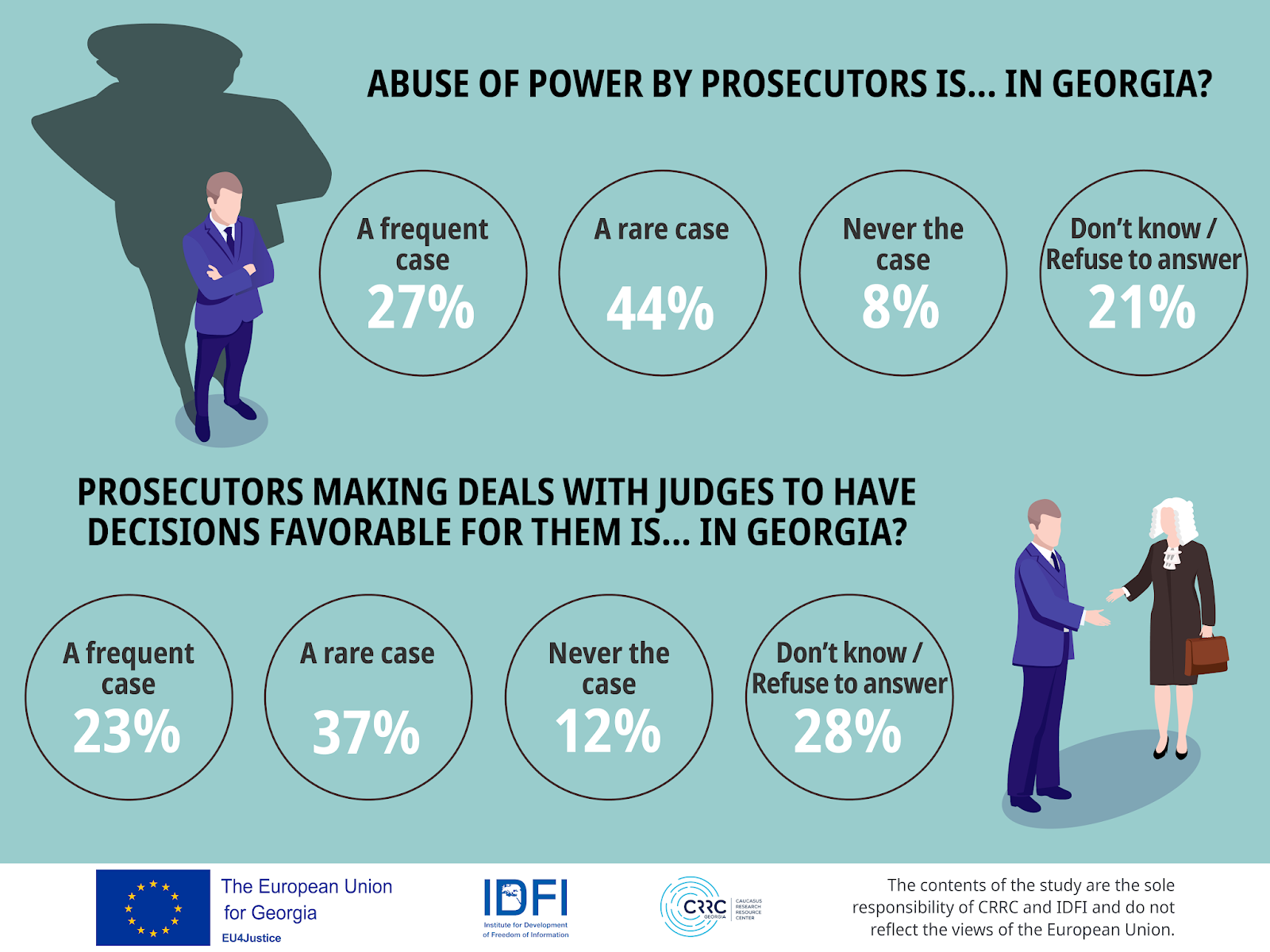
Respondents were asked if abuse of power by prosecutors in Georgia was, in their opinion, frequent, rare, or never occurred. Even though few watched the investigative video, a quarter of the public (27%) said abuse of power was frequent, 44% said it was rare, and only 8% reported it never happened in Georgia. About a fifth (21%) did not know what to answer to the question.
The same scale was used to ask about whether prosecutors made deals with judges to have favorable decisions. About a quarter of the population (28%) said they did not know. Another quarter (23%) said it happened frequently, 37% said it happened rarely, and 12% said it never took place.


Opinion on the Prosecutor’s Office in Georgia is relatively split. On the survey, about half the public (52%) reported trusting the Prosecutor’s Office (22% fully trust and 30% trust more than distrust). With current officials, 41% say the Prosecutor’s Office will prosecute them impartially and 41% partiality. The public is also split about former officials, with 41% reporting they would be prosecuted impartially and 38% partially. Interestingly, in terms of both current and former high-ranking officials, only 4% and 3% of the population, respectively, said the Prosecutor’s Office will not prosecute them at all, whether it is reasonable to do so or not.


Of those who responded that the Prosecutor’s Office will prosecute high-ranking officials very un-objectively (17%), more than a quarter (28%) recalled Saralidze’s case, 6% named the cases of Saralidze and Machalikashvili, and 3% the Partskhaladze case as recent examples of unfair prosecutions. However, almost half (49%) could not recall a specific case of unfair prosecution.
Of those who said the Prosecutor’s Office will prosecute former officials very un-objectively (11%), half (50%) could not recall a specific case, 6% named the Saralidze’s case, 4% the Mirtskhulava case, and 2% the cases of Robakidze and Merabishvili.

Studio Monitor and Radio Liberty discussed the “restoration of justice” that the Georgian Dream government initiated after coming to power in 2012. Respondents were asked their opinion about the “Restoration of Justice”. Officially, the process was meant to prosecute former high-ranking officials who allegedly abused power during the previous government. Although some groups argued that it was used for justifying persecution of political rivals. When asked what the goal of those investigations was, the most frequent response was “restoration of justice” (31%). A fifth (21%) reported it was a way to present the government positively to the public. About a third (30%) named political retribution as a goal of the “restoration of justice” investigations. Less than one fifth of the population (17%) said it was to punish criminals, and 12% related it to the protection of human rights. Another 16% of the population did not know what to answer to this question.


Note: Respondents were allowed to give multiple answers. Therefore, percentages do not add up to 100%.

Overall, the public is relatively split in terms of attitudes towards the Prosecutor’s Office. About half the public trusts them, and relatively equal shares think they will do their job impartially and partially when it comes to prosecuting current and former officials. This suggests the need to work towards increasing trust in the Prosecutor’s Office among the public that distrusts them.

[Note: The survey is part of the Promoting Prosecutorial Independence through Monitoring and Engagement (PrIME) project implemented by the Institute for Development of freedom of Information (IDFI) in partnership with CRRC-Georgia and Studio Monitor with the financial support of the European Union (EU).  The contents of this blogpost are the sole responsibility of CRRC-Georgia and do not necessarily reflect the views of the European Union, IDFI, and Studio Monitor.]

Monday, April 08, 2019

The election environment in minority areas of Georgia is getting worse

[Note: This article was published together with OC-Media. It was written by Dustin Gilbreath. The views presented in this article do not necessarily represent the views of CRRC-Georgia. The views presented in this article do not represent the views of the National Democratic Institute or any related entity.]

Post-election polling by CRRC-Georgia suggests that not only are elections most problematic in Georgia’s ethnic minority regions, they are also getting worse.

The 2018 presidential elections, and particularly, the events surrounding the second round, have come to be considered a setback for Georgia’s democratic trajectory. Between the first and second round, it was announced that 600,000 voters would have debt relief immediately following the elections, leading some to suggest this was a form of vote buying. A number of instances of electoral fraud were also alleged. The use of party coordinators around election precincts was also widely condemned.

Elections in minority regions have generally been worse in quality than in ethnic Georgian populated regions. Some statistical evidence suggests irregular voting behaviour if not fraud in these regions. Moreover, these regions of the country consistently vote for whoever is in power.

The situation appears to be getting worse, at least when compared with the parliamentary elections of 2016.

CRRC-Georgia and the National Democratic Institute’s 2016, 2017, and 2018 post-election polling asked voters, ‘Thinking back to the situation when you voted in the polling station/place (either in the 1st or 2nd round), please say whether you agree or disagree with the following?’

  • It was well ordered;
  • It was overcrowded;
  • It was intimidating;
  • The election officials were well prepared.
Respondents were also asked whether they noticed party coordinators around the polling station asking for personal information.

The results suggest that people in predominantly minority settlements were about three times more likely to report seeing party coordinators collecting personal information outside polling places. People in minority areas were 2.5 times as likely to report that the polling place was intimidating and four times more likely to report the polling station was overcrowded. They were 14 percentage points less likely to report that election officials were well prepared, and 13 percentage points less likely to report that the polling place was well ordered.


All respondents were also asked ‘Please tell us whether [each of the following] occurred or not during the election process’:
  • People voting more than once (including carousel voting);
  • Intimidation of voters or party representatives;
  • Use of administrative resources to benefit a campaign;
  • Bribing of voters;
  • Pressure to donate or not donate to certain candidate/party;
  • Mobilising state employees to participate in campaign/vote for a certain candidate;
A similar pattern as the above holds with these questions, with respondents consistently reporting most of the above problems more often in predominantly minority settlements than in ethnic Georgian settlements. The only activity which was not reported more often (statistically) in minority settlements than ethnic Georgian ones was putting pressure on people to donate.


The data suggest that problems with elections in minority regions are on the rise. The share of individuals in predominantly minority settlements reporting that the polls were intimidating more than tripled between 2016 and 2018. The share reporting it was overcrowded more than doubled between 2016 and 2018. The share of individuals in predominantly minority settlements reporting that the election precinct was well ordered also declined between 2016 and 2017.

In predominantly ethnic Georgian settlements, there was a decline between 2017 and 2018 in terms of how well prepared election officials were perceived to be. There was also a slight decline in terms of people reporting that the polling station was overcrowded. However, there was no change in the share reporting it was well ordered or intimidating.

The 2018 elections had problems. While the conduct of elections in predominantly minority areas in Georgia has been historically problematic, these problems appear to have gotten worse, at least by comparison to the elections in 2016 and 2017.

Tuesday, April 02, 2019

Georgia’s far-right are anti-Russian but share Russian narratives

[Note: This article was published in OC-Media. It is available in Georgian, here. David Sichinava is the Research Director at CRRC-Georgia. The views expressed in this article represent the views of the author alone. The article was written within the auspices of the Russian Propaganda Barometer Project funded through the East-West Management Institute’s ACCESS program.]


A USAID-funded study by CRRC-Georgia released on Monday shows that the far-right in Georgia is engaged in activities similar to their Russian supported counterparts in the European Union but speak more negatively about Russia than the West. Whether witting or unwitting, the implications are far-reaching for Georgia.

Since the mid-2000s, numerous media and academic sources have alleged that Russia is weaponising far-right and anti-liberal politics worldwide. This can be seen in Russian support for organised far-right groups within the EU, which in turn are used to attempt to influence domestic and regional politics.

Russian political elites have further used the anti-liberal far-right through the promotion of what has been called the ‘Russian model’ of authoritarian rule.

A crucial component of the model promotes Russia’s image as a protector of ‘traditional values’, including pro-religious and socially conservative views. Taken collectively, these far-right groups’ efforts can be understood as aimed at manipulating European public opinion through engendering anti-liberal sentiment within the EU.

To understand potential sources of Russian propaganda in Georgia and the far-right more broadly, CRRC-Georgia’s study analysed more than 26,000 posts from approximately 70 far-right Georgian-language Facebook pages.

The data suggest a growing appetite among Georgians for radical right-wing ideas. Between late 2015 to mid-2018, page likes for far-right pages increased eight-fold, from 89,000 to 760,000. Although there is clearly increased engagement on social media, this likely also reflects increased internet penetration in Georgia, with new internet users with previously far-right ideas finding far-right Facebook groups.


Besides purely nationalist sentiments, these groups are apt to criticise the liberal world order from a right-wing perspective, thus resonating with what Russia has endorsed. Some pages also reflect specific Russian talking points.

An illustrative example of right-wing, Georgian-language Facebook pages amplifying pro-Russian narratives can be seen in online opinions toward the US-funded Richard Lugar Centre for Public Health Research in Tbilisi. Since its opening in 2013, Russian politicians have been especially anxious about the establishment of the centre and frequently claim it is a test site for biological weapons. Following the loss of 15 lives to a flu outbreak in Georgia in early 2019, several right-wing pages shared posts accusing the laboratory of causing the outbreak.

While the number of social media posts talking about the lab in relation to the flu outbreak was small (18), their messages reached a wide audience: these 18 posts earned 754 likes from visitors and were commented on 538 times. Social media posts in which right-wing groups discussed the Lugar Laboratory were shared 1,639 times.

As previous analysis has highlighted, Georgia’s far-right is a heterogeneous crowd, and labelling them uniformly pro-Russian is misleading. In fact, the analysis of 26,000 social media posts shows that Georgia’s far-right speaks more negatively about Russia than the West on the whole. A sentiment analysis, a machine learning technique, scored conversations about Russia as net negative compared with almost neutral for the West.

Still, some pages which have pro-Russian slants also boast large followings. For instance, before being blocked by Facebook, Georgian Idea had about 40,000 subscribers. Another nationalist group, Georgian March, is followed by over 17,000 users and another 16,000 users subscribe to its content. On the whole, both groups speak more positively than negatively about Russia.

The analysis also suggests that pro-Russian pages actively engage with their audiences. Content created by the pro-Russian Georgian Idea garnered about 25,483 comments and 180,026 likes, while pro-Russian Georgian March attracted 32,761 comments from users. Importantly, other nationalist pages were less successful in engaging their audiences.

In contrast to the above pages, a large majority of far-right groups were not explicitly pro-Russian. Rather, the content of their messages was critical of both Russia and the West. The latter is usually criticised for pushing Georgia to accept a ‘liberal political agenda’. In contrast, Russia is portrayed as an enemy responsible for Georgia’s territorial conflicts.

While there is little besides circumstantial evidence that (parts of) Georgia’s far right is funded by Moscow, the data show that they do propagate messages that resonate with the Russian government’s vision of the world.

Despite sharing a similar vision, most far-right pages attack Russia with more vigour than the EU. While it is unclear whether some of these groups are backed by Russia, it is clear is that they at least amplify if not plant pro-Russian sentiments among the Georgian public.

Monday, March 25, 2019

Anti-western discourse dashboard: Tracking what the far-right is talking about on Georgian language Facebook

Within the framework of the Russian Propaganda Barometer project, funded by EWMI’s ACCESS program, CRRC-Georgia developed an anti-Western discourse dashboard. The dashboard visualizes what known sources of anti-western propaganda in the Georgian language have been talking about on Facebook since 2015.

The dashboard has a number of functions. It uses thematic modeling to identify what subjects people have been talking about over the years. The topics which different groups have been talking about are also provided by different sources of anti-Western propaganda. In addition, how the different groups (positively or negatively) talk about the West and Russia is provided on the dashboard’s landing page.


Besides the above, the dashboard has a wide variety of other tools. The posts page provides the number of posts on any given day as well as the number of likes, comments, frequency of sharing different sites the construction of networks between different sites, and activity levels during different parts of the week and time of day.


On the tool, the texts tab provides an analysis of the frequency of use of different words and bi-grams for different words used in connection to Russia and the West.


The tool is only available in Georgian, but over the course of the coming months, this blog will have posts describing findings from the data collected on anti-western discourse on Georgian language Facebook in English. To see a previous report from the same project click here, and an article based on that report, click here.

Monday, March 18, 2019

Parents think Georgia’s schools are fine. But are students actually learning?

[Note: This article was originally published here with OC-Media. It is available in Georgian here. This article was written by Meagan Neal, an International Fellow at CRRC-Georgia. The views expressed in this article do not necessarily reflect the views of CRRC-Georgia, the National Democratic Institute, or any affiliated entity.]

Around the world, an increase in the systematic collection of education data has revealed a previously invisible problem: even though more children have access to education than ever before, it does not necessarily mean they are learning. In fact, many students are progressing through school systems without mastering the basic skills necessary to fully participate in society. The gap is so stark it has become known as a ‘learning crisis’.

Given the global trends, a new wave of controversial reforms to Georgia’s school exam system, and a planned increase in the national education budget, what do Georgians think about the quality of their own education system? And should Georgia be concerned about its own students’ learning?

At first glance, public opinion suggests that education quality is not a large problem. Surveys CRRC and NDI conducted in December 2018 suggest that most people think the government is doing a good job providing education to the country’s children.

A plurality of Georgians (50%) thought that the government did a ‘somewhat good’ or ‘very good’ job providing education to all its citizens, while 34% rated the government’s performance as ‘somewhat bad’ or ‘very bad’. Among people with a child in their household currently in school, only 4% rated their family member’s school as ‘bad’ or ‘very bad’.  Most said that it was ‘good’ or ‘very good’.


At the same time, most people also think that private tutoring is necessary to study well, to graduate from secondary school, or to get into university, suggesting Georgia’s schools are falling short of their basic duties.
As the chart below shows, a slight majority (55%) said that it was necessary to have a private tutor to pass secondary school graduation exams. A large majority (73%) said that tutoring was necessary to pass the Unified National Exams to gain entrance to university. Even respondents who rated their family member’s school as ‘good’ tended to agree.


These attitudes towards tutoring could change soon. In February, the government announced that they would abolish secondary school graduation exams and change the requirements for university entrance exams. According to the government, the new measures will allow secondary schools to focus less on test preparation, give universities more autonomy to choose which exams to use for their own admissions processes, and lower expenses for parents by reducing the need for private tutoring.

In March, the Prime Minister also announced that the government would increase education spending annually until 2022 — reaching a maximum of 6% of GDP, a quarter of the country’s budget.

The perceived necessity for tutors says something about the current quality of schooling, and these reforms may be missing the point. After all, abolishing tests will not fix the system if schools are not well-equipped to teach students the essentials of secondary school in the first place. Nor will pumping in more funding lead to better outcomes if those funds are not strategically allocated towards evidence-based strategies to improve learning, rather than an increase in ‘business as usual’ inputs like school infrastructure.

So how much are Georgian students actually learning? National assessment data can give some clues. Georgia has participated in the past few rounds of PISA, an international exam of 15-year-olds’ reading and maths abilities in OECD and partner countries.

The most recent results were not great. Half of the students scored below Level 2 in reading and maths, the PISA threshold for being able to fully participate in school and society. Even having made substantial improvements since 2009, Georgia was still one of the lowest performers among PISA-participating countries in 2015.

What’s more, trends from the 2009 round of PISA as well as the 2015 round of TIMSS (Trends in Mathematics and Science Study) suggest that most of the gains in performance are driven by urban students, while rural students continue to lag behind.

Can the new reforms help address these inequities? More funding and a reduced focus on national tests could be a good thing for low-performing students — if schools and teachers have the resources and capacity to redirect the energy and funds they would spend on test prep towards better adapting their curriculum and methods to the individual needs of their students, and if they are held accountable for the learning outcomes they deliver.

But right now, like in many countries, it is not clear Georgian schools have the capacity or accountability mechanisms to do so. As Transparency International recently highlighted, government spending on education has already continued to increase over the past eight years without any goals set around actual student learning. Abolishing exams, which, for all their imperfections, can be used as an accountability mechanism, is unlikely to help this.

Despite general perceptions that Georgia’s schools are fine, the data on student achievement and the perceived need for tutors suggest a much deeper problem of learning.

In theory, increased funding could be a great opportunity to address this. But unless the government pivots this spending towards strategies that have been shown to help students learn, such as more effective pedagogy and better teacher performance and accountability, it is unlikely to have much effect.

If they draw lessons from the global conversation around learning, on the other hand, the government can work to ensure that Georgia’s students develop the basic skills necessary to succeed in life — whether they need an exam to graduate or not.

Curious about perceptions of Georgia’s education system? The data used in the above article is available here.


Monday, March 11, 2019

Georgians support technical inspections of motor vehicles, even given the financial burden

[Note: This article was originally published on OC-Media. The text is also available in Georgian here. The article was written by David Sichinava, CRRC-Georgia’s Research Director, and Nino Mzhavanadze, a Junior Researcher at CRRC-Georgia. The views presented in the article do not necessarily represent the views of CRRC-Georgia, the National Democratic Institute, or any related entity.]


In 2018, the Government of Georgia decided to resume mandatory periodic technical inspection of vehicles, which was partially suspended in 2004. From January 2019, all cars are required to pass technical inspection. In 2018, heavier vehicles were required to do so. The change was spurred on by the Association Agreement with the European Union, under which Georgia took responsibility to resume inspections. More practically, the government also began inspections as Georgia’s private vehicle fleet has been recognized as the main source of air pollution in the country. A June 2018, CRRC/NDI survey finds people in Georgia overwhelmingly support the decision.

To learn whether potential costs associated with the reform such as repairing a vehicle to meet standards the technical inspections require would influence support for the reform, a survey experiment was carried out. Half of the sample (the control group) was asked, “In your opinion, is it necessary or not to have technical inspection of vehicles?” The other half (the treatment group) was asked, “In your opinion, is it necessary or not to have technical inspection of vehicles, as a result of which the car owners may be required to repair their vehicles or buy new ones?”

While these questions were randomly assigned, the share of the supporters of the reform does not differ between the two groups, which suggests that, overall, people’s support for the reform does not vary significantly when reminded of the additional costs that will be associated with the reform.
Clearly, car owners will be directly affected by the reform. However, people living in households that reported owning car(s) (41% of the population) feel enthusiastic about obligatory inspections of vehicles. Similar shares in both car-owning and non- car-owning households answered that technical inspections should be necessary.

People living in Tbilisi (96%) and urban settlements (92%) almost unanimously supported resumption of technical inspection, while residents of ethnic minority settlements were much more (62%) reluctant about the changes. There is no difference between respondents who have different perceptions of air quality. Interestingly, those who perceive the quality of air as completely satisfactory, are more likely to support the introduction of technical inspections if they are exposed to the treatment statement.

Opinions do differ along party lines, however. Those who reported the United National Movement (UNM) as the party closest to them were significantly less likely to report technical inspections were necessary (regardless of being in the treatment or control group).

There is a strong consensus among people in Georgia regarding the need for the newly introduced technical inspections for vehicles. People support the idea even when reminded of the costs associated with the reform. The survey also indicates that attitudes towards the reform significantly differ along party lines, hinting at the politicization of the issue.

The data used in this blog post is available here. Replication code is available here.

Monday, March 04, 2019

Choosing a profession: who should decide young people’s career paths?

Choosing a career path is one of the most important decisions that people make in their life. For some, it might be a complicated and anxiety-riddled experience. One reason is that the process of choosing a career begins at a young age when a person may not have thought about what they want to do with their lives. For this, among many other reasons, parents often play a role in deciding what their children study at university, which is often though not always associated with their profession.  However, there are a number of arguments about why it is better to allow a child to choose their own career paths.  Based on the CRRC/NDI June 2018 survey, this blog post describes the adult population of Georgia’s views about whether parents or their children should choose their career, and describes how opinions differ by a number of demographic characteristics.

The survey asked respondents, ”Which of the following statements do you agree with: ‘When choosing a profession [profession has a similar meaning to university major in the Georgian language], the parents [should decide] because a parent knows better what will be useful for his/her child’ or ‘When choosing a profession, the child [should decide] even if the parent thinks that the child is making a mistake.‘”

A majority (75%) of the population agreed that when choosing a profession the child should decide, while 23% answered that the parent(s) should. People living in the capital are more likely to  agree (85%) that the child should decide than people who live in rural settlements (68%). People between the ages of 18-35 are more likely to agree with the statement that children should decide than people of other age groups.  Level of education also is associated with whether people think that children or their parents should decide a child’s future profession. People who have higher than secondary education are more likely to agree with the statement that the child should decide than people with a lower level of education.  Interestingly, there is no visible difference between the answers of people who live in households with children (under 18) and people who do not. Nor is there a difference between men’s and women’s views regarding this issue. Similarly, ethnic minorities and majorities express similar opinions. These results are supported by a logistic regression analysis.

Note: Answer options “Agree with neither”, “Don’t know”, and “Refuse to answer” are not shown on the chart above. The combined share of these responses options was under 4%. 

Overall, most people in Georgia report that when choosing a profession, the child should decide even if the parent thinks that the child is making a mistake.  This opinion is supported more often by people who live in the capital, have higher than secondary education, and young people (18-35).

To explore the data used in this blog post further, visit our Online Data Analysis platform. The results of the regression noted above are available here.

Monday, February 25, 2019

Are there predictors of not knowing and refusing to answer on surveys in Georgia?

Are there variables that predict who is likely to report “Don’t know” or to refuse to answer survey questions more often in Georgia? This blog post looks at this question, using un-weighted Caucasus Barometer 2017 (CB) data for Georgia.

Only questions that were asked to all respondents were considered during the analysis presented in this blog post (a total of 177 questions), and variables were generated for:

  1. The number of times a respondent answered “Don’t know” and;
  2. The number of times a respondent refused to answer a question.

On average, respondents refused to answer one question on CB 2017. The median number of refuse to answer responses was zero. Respondents answered “Don’t know” to nine questions on average, and the median number was five. As a previous blog post highlighted, people most often report they do not know when asked about political questions and areas of reasonable uncertainty (e.g. their economic futures). When it comes to refusing to answer, people are most likely to refuse to answer questions about their income and politics.

To analyze whether or not demographic variables predicted “Don’t know” and “Refuse to answer” responses, Poisson regression was used. The following demographic variables were included in both regressions: age group (18-35, 36-55, 56+), gender, ethnicity (ethnic minority or ethnic Georgian), settlement type (capital, other urban, rural), and level of education (secondary or lower, vocational, tertiary). Besides demographics, the analysis also included a variable for whether people besides the interviewer and respondent were present during the interview. After the regression analysis, the number of times a respondent would be expected to respond either don’t know or refuse to answer was calculated, controlling for other factors included in the models.

A number of demographic characteristics are associated with higher expected rates of “Don’t know” response. Ethnic minorities, people in rural areas and urban areas outside Tbilisi, people without tertiary education, women, and people over the age of 55 provide more don’t know responses than people in Tbilisi, those with tertiary education, and people under the age of 55. Besides demographics, whether someone is present at an interview that is not participating in it is also associated with how often people report they don’t know. If additional people are present at an interview, then respondents report one fewer don’t know response on average. This may reflect a large number of factors (e.g., maybe people with large families are more certain of their views), however, one plausible explanation is that people do not want to admit they do not know in front of other people.

Some demographic variables also predict “refuse to answer” response options. People in the 36-55 age group refuse to answer questions slightly more often than in other age groups as do people outside Tbilisi, those with tertiary education, and ethnic Georgians.  Besides demographics, the presence of people besides the interviewer at the interview has a significant impact on the frequency of refusing to answer. This again may reflect social pressure of some sort. Rather than respondents being worried about appearing uninformed, one plausible explanation is they are more likely to be worried about appearing socially uncooperative.

While don’t know answers and refusing to answer are both often treated as non-response, these arguably are different types of responses. If they indeed are different, one would expect them not to be strongly correlated. The results of a correlation analysis suggest a very weak (ρ=0.009) and non-significant association, supporting the contention that don’t know and refuse to answer options are indeed different types of responses rather than replacements for the other.

This blog post has looked at whether and which demographic groups respond “Don’t know” and “Refuse to answer” to survey questions more. The results suggest that a variety of demographic variables are significant predictors. In addition, the presence of other people at the interview appears to have an impact on how often people report they don’t know or refuse to answer survey questions, with both declining when people are present.

To download the data used in this blog post, click here.

Monday, February 18, 2019

NGOs in Georgia: Low trust, high expectations? (Part 2)

As discussed in the first part of this blog post, the results of CRRC-Georgia’s survey conducted for the Georgian Civil Society Sustainability Initiative (CSSIGE) project in fall 2017 confirmed that both knowledge about NGOs and trust toward them is quite low in Georgia. This blog post looks at the inconsistency between low trust toward NGOs, on the one hand, and quite positive assessments of their activities, on the other hand.

The most frequent answer about the goal that, in people’s opinion, NGO members are pursuing in Georgia, is to help the population of the country in solving their problems (27%). The second most frequent answer, to receive funding/grants, was chosen from a show card by 16% of the population, and the third most frequent answer, to protect human rights in Georgia, by 13%. Thus, 40% believe the goal of NGOs is to help people in solving their problems or protecting their rights, which is an impressive share, especially given the low level of reported trust in NGOs.

When asked to assess the influence of NGOs in the development of Georgia, the findings are, again, counter-intuitive given the low level of trust. A majority (56%) assess this role as either “definitely positive” (17%) or “mainly positive” (39%), as opposed to the 14% who have chosen negative assessments (“mainly negative” according to 9% and “definitely negative” according to 5%). While 76% of those who report trusting NGOs quite logically say that NGOs’ role in the development of Georgia is positive, 5% assess this role as negative, and 13% answer they don’t know. A third of those who report distrusting NGOs assess NGOs’ role in the development of Georgia as positive and only a slightly larger share (39%) as negative.


Note: For the chart above, answer options “Fully trust” and “Rather trust” were combined into the category “Trust”, and answer options “Fully distrust” and “Rather distrust” were combined into the category “Distrust”.

It would be impossible to find out the causes of such inconsistencies without additional research. At this point, though, it is clear that both knowledge of and attitudes toward NGOs in Georgia are neither systematic nor coherent. Focus groups conducted for the same project suggest one possible explanation for this inconsistency – while not trusting NGOs, the participants’ dominant attitude was that NGOs would not do harm either. Moreover, a belief was reported that life in Georgia is better with NGOs than without them.

To have a closer look at the data, visit CRRC’s online data analysis platform.


Monday, February 11, 2019

NGOs in Georgia: Low trust, high expectations? (Part 1)

Over the last decade, people in Georgia have reported rather low levels of trust toward NGOs. At the same time, when asked during surveys to assess specific aspects of NGO activities, the answers have usually been positive. This blog post is based on the findings of a survey on attitudes toward NGOs collected by CRRC-Georgia in fall, 2017 for the Georgian Civil Society Sustainability Initiative (CSSIGE). The first part of this blog post looks at the most up-to-date data on knowledge of NGOs in Georgia and reported levels of trust toward them. The second part explores the inconsistency between low trust toward NGOs in Georgia, on the one hand, and quite positive assessments of their activities, on the other hand.

Less than a third of the population of Georgia (28%) report trusting NGOs. Most people, though, are either indifferent (37% “neither trusting, nor distrusting” NGOs) or cannot answer the question (17%). The reported level of trust toward NGOs is comparable with the level of trust toward the courts and political parties, with one notable difference: the share of those who cannot answer the question is highest when trust toward NGOs is assessed. This may suggest that people do not always have a clear understanding of what NGOs are for or what they do in Georgia.

To gain an understanding of how solid people’s knowledge of NGOs is, the following question was asked, “I will now name several organizations. Please tell me whether it is an NGO or not. If you have not heard of any of these organizations, tell me you have not heard of it.” Two out of the 10 organizations asked about did not exist in Georgia at the time of the fieldwork.


Note: NGOs are marked with one asterisk (*). Organizations that are not NGOs are marked with two asterisks (**). Organizations that did not exist in Georgia at the time of the fieldwork are marked with three asterisks (***). Correct answers are highlighted in green.

Of the organizations asked about, only the status of the Parliament of Georgia was correctly identified by a large majority (87%). It also had the lowest share of “Don’t know” responses. Over half of the population was correctly informed about the Labor Party, Georgian Young Lawyers’ Association (GYLA), and the Rustavi 2 TV network. It is quite rare, however, that people consistently provide correct answers about all the organizations asked about. Leaving aside the answers about the two organizations that did not exist at the time of the fieldwork (“Association of the Unemployed” and “Society for Spreading Literacy”), less than 2% of the population answered about all other organizations correctly. This suggests that knowledge of NGOs is highly fragmented in Georgia.

As seen in the table above, the population has better knowledge about the status of six organizations: the Parliament of Georgia, the Labor Party; GYLA; Rustavi 2; Aldagi (an insurance company); and Transparency International – Georgia. Yet, the share of the population who named the correct status of all these organizations is only 16%. Below, this group is referred to as the “better informed population.”

Surprisingly, the better informed population does not report trusting NGOs in Georgia at a different level than people who are less informed about NGOs. These two groups differ only when it comes to the share of those answering “Don’t know”: while 5% of the better informed population responded so, 19% of the rest of the population did.

NGOs have not yet secured the population’s trust in Georgia. Still, the population reports rather positive assessments of specific aspects of NGO activities as will be discussed in the second part of this blog post next Monday.

To have a closer look at the data, visit CRRC’s Online data analysis platform.